We are at the emergency vet. Buddy got sick early this morning and threw up, then threw up some more, and some more, most of it yellow bile.
He was vocalizing in obvious pain and distress and while I was able to soothe his stomach a bit with some catnip — enough that he eventually climbed on top of me and slept for a while — I got really worried when we woke up a few hours later, I got out of bed and he didn’t budge. He stayed there for almost two hours.
He never does that. He follows me to the bathroom first thing, always, and then starts meowing for food.
When he finally left the bed he was extremely lethargic, not at all like himself. He wouldn’t eat. His eyes were half closed, he didn’t respond when I rubbed his head, and I couldn’t feel him purring. The local vet couldn’t see him, so I took him to an emergency vet.
The good news is that it doesn’t look like he has anything obstructing his digestive track, a UTI or any of the usual culprits.
He doesn’t have a fever, which is also good, but he’s significantly dehydrated and there were some concerning signs in his blood work.
I knew he really wasn’t doing well when the nurses took blood and gave him the anti-nausea injection and he didn’t even bother to object. Normally he’d try to tear their faces off but this time he didn’t raise a paw. I’m not even sure it registered with him that there were large dogs and other cats in the open floor plan space, where staff hurried between stations with equipment and animals cradled in blankets.
This is not how it ends, not here and now. For that I am grateful. I’m taking him home after the vet gives Bud some sort of subdermal hydration treatment and meds to hopefully get him eating and drinking again.
The bad news is that the visit cost an eye-watering amount, more than three times what I expected in the worst case scenario, and that was without x-rays. Absolute madness.
On the other hand I realize I have a lot to be grateful for. I just watched a young girl crying and holding onto her mother as a veterinarian worked on her cat, who was severely injured and looked like she’d been hit by a car. In one of the private rooms, a family was saying goodbye to their dog.
All this is a reminder to be grateful for the time we have. I will update soon, hopefully with good news.
A new story claims a Japanese immunologist has “created a miracle” with his treatment for cats.
The cat world is abuzz with a new report that hails the efforts of a Japanese scientist, claiming he’s “created a miracle” that can extend cat lifespans to 30 years.
The story on Bored Panda claims the drug has “astounding potential,” boasting “a level of efficacy that has exceeded all expectations and has the potential to revolutionize feline healthcare.” According to Bored Panda, we’re headed toward a gleaming future and “soon we will be able to grow old with our beloved pets and be grey together.”
“Cat Lovers Rejoice As New Medicine Will Extend Cat Lifespan To 30 Years,” the headline declares.
Okay, let’s dial it back a bit and break down what’s true and what’s not.
First and most obvious, the story oversells the treatment and if you’re counting on your cat living to 30, you’ll need to readjust your expectations.
That’s unfortunate because there’s a good story at the heart of this, and there may be real benefits to cats eventually.
Toru Miyazaki is an immunologist who discovered a protein that helps the kidneys flush out toxins. Eight years ago, he realized the protein — apoptosis inhibitor of macrophage, or AIM — doesn’t always work properly in felines, which is why so many cats are susceptible to kidney failure, especially when they reach age 10 or so.
The AIM protein, Miyazaki explained, launches from immunoglobin antibodies “like a jet fighter from an aircraft carrier,” removing waste and debris from the kidneys.
But in cats, sometimes the AIM protein — the fighter jet — is “too tightly bound” to the antibodies, meaning it doesn’t “launch” in the first place and can’t do its job of flushing out toxins.
Miyazaki was continuing his research into feline kidney failure while he was a professor at the University of Tokyo, but funding dried up in 2020 as the lion’s share of research money in immunology was directed toward addressing SARS-CoV-2 and the disease it causes, COVID-19.
When a Japanese newspaper published a story about Miyazaki having to abandon his research, donations came pouring in. Cat lovers across Japan donated an astounding $2.3 million, prompting Miyazaki to leave his post at the University of Tokyo and found a non-profit dedicated to tackling kidney disease in cats.
As of September 2023, Miyazaki’s organization is running clinical trials on his AIM therapy, and it has partnered with a Japanese pet food company on new food that is supposed to reduce the possibility of kidney disease.
There’s not enough data yet to make any definitive statement, and even if the data existed, the AIM therapy is not a cure: Miyazaki says if all goes well, kittens who are given AIM therapy injections from an early age, and eat a diet with the AIM-enhancing formula, could have their risk of developing kidney problems reduced and potentially live longer lives.
That’s a far cry from Bored Panda’s image of cat lovers dancing in the streets, joyous with news of a miracle pill that will allow Socks and Oreo to run around like kittens for three decades.
While it’s natural to be excited about the potential of AIM therapy, calling it a “miracle” that will “revolutionize feline healthcare” and allow us to grow old with our cats can give people false hope.
Even if the trials go perfectly and AIM therapy breezes through the approval process, the soonest the injection therapy could be available in Japan is 2025. The US, UK and Europe have their own regulatory agencies and clinical data requirements. That means it might help kittens born years from now, but it won’t double the lifespans of the cats we love now.
It’s also worth mentioning that not everyone is thrilled to hear Miyazaki has partnered with a pet food company that sells ultra-processed kibble. Over at bark&whiskers, Karen Shaw Becker — a veterinarian who specializes in preventative care — points out that ultra-processed dry food is thought to be a major contributor to the feline kidney problems, with the ingredients, rendering methods and lack of moisture (water) all posing health hazards to cats. Cats have low thirst drives and get most of their hydration from meat.
While Becker writes she’s watching the trials closely, like other veterinarians, she recommends cat lovers continue to feed their furry friends wet and/or fresh food with high quality ingredients, no fillers and lots of protein.
A new paper claims cats are healthier when fed human diets, but the “study” is activism masquerading as science.
We have a science problem in this country.
Tens of millions of adults are scientifically illiterate and cannot articulate a simple definition of the scientific method.
That includes the usual suspects, the people who don’t understand the difference between anecdotes and hard data and say things like “Evolution’s just a theory” or “I don’t believe in science” as if it’s an ideology or religion. It also includes people who like to declare they’re “into science” as if it’s a band or a genre of cinema, and often post articles from sites like “I F—-ing Love Science,” which routinely mistakes natural phenomena like stars, interstellar space and the animal life for “science.”
To quote Sam Kriss’ wonderful essay on the subject: “‘Science’ comes to metonymically refer to the natural world, the object of science; it’s like describing a crime as ‘the police,’ or the ocean as ‘drinking.'”
Science is a formalized method for studying the natural world. That’s it. No more, no less. It isn’t natural phenomena itself, it isn’t something that requires faith. It’s meant to be challenged, with each piece of knowledge hard-won as the scientific community collectively chips away at the vast edifice of things we don’t understand.
The lack of scientific literacy is an indictment of the American education system, but the science and journalism communities are also big contributors. A flawed academic publishing system encourages researchers to make grandiose claims in abstracts and press releases to increase the chances their work will get positive coverage in the press. Few journalists are more scientifically literate than the general population, so they report dubious claims credulously and present individual studies as the final word on subjects instead of tentative first steps in contributing to the corpus of human knowledge.
We see this all the time with reporting on the environmental impact of felines, but it’s certainly not limited to that subject. How many times have you seen your local news anchors or newspapers tout studies saying coffee is healthy, only to report the next week that a new study says coffee isn’t healthy after all?
“Those scientists can’t make up their minds,” they’ll say with a forced chuckle before handing the broadcast over to the weatherman, oblivious to their own failure to provide context.
The effort to rebrand cats as vegans
A new “study,” given prominent play today by major news outlets like Newsweek and aggregators like Drudge, is a classic example of misleading claims given the veneer of scientific authority. The paper claims vegan cats are “healthier” than their meat-eating counterparts. The study — which is actually a survey — says no such thing, and its authors are surely aware that the way it’s been packaged for media consumption will cause confusion, but they’ve gone ahead with it anyway.
The research involved asking 1,369 cat owners to fill out surveys about their cats, the cats’ diets, and their veterinary health histories.
Of those surveyed, there were 123 reported “vegan cats” in their households (about nine percent of the total), and while the abstract and media pitches claim the surveys show vegan cats are healthier, the differences are statistically insignificant. The sample size is too small to draw any conclusions from, and the fact that the details are self-reported means the “data” is worthless: People who put their cats on vegan diets despite knowing felines are obligate carnivores have a vested interest in defending their decision. They’re not impartial, and their survey answers aren’t either. (The paper acknowledges that 91 percent of the respondents are female, and 65 percent are vegans, vegetarians or pescatarians themselves. Those are admirable choices for a human diet, but not for a cat.)
Relying on self-reported “data” also means the research team doesn’t actually know the true veterinary histories of the cats in question, nor does it know anything about the nutrient content of the vegan “cat food” given to the 123 cats who have been deprived of meat. It also cannot account for possibilities like the so-called vegan cats slipping out at night to hunt rodents.
Credit: Engin Akyurt/Pexels
That’s especially important because of “vegan cat food’s” dubious history. Evolution, the brand that popularized the concept, is owned and operated by a man named Eric Weisman, who has been prosecuted and repeatedly sanctioned for misrepresenting himself as a physician, veterinarian and scientist — and continues to misrepresent himself.
Weisman, a chiropractor by trade, racked up a long list of violations in his chosen field before his chiropractor license was pulled, then was charged and convicted criminally for, among other things, practicing veterinary medicine and regular medicine without a license. Weisman’s list of offenses include “treating” cancer patients, “treating” and misdiagnosing animals, and posing as a physician for years, including in advertisements and literature related to his pet food and fake veterinary practices.
Weisman is still calling himself a physician in violation of his plea agreement, and he’s still selling “vegan cat food.” Would anyone in their right mind weigh the claims of that man against the tens of thousands of veterinarians and pet nutritionists who are horrified at the idea of restricting cats to vegan diets?
(In case you’re tempted to think chiropractors are legitimate to begin with, you should know that chiropractor was founded by a lifelong quack who claimed its methods were taught to him by the ghost of a physician, which allegedly appeared to him during a seance. Chiropractor’s founder dodged accountability for years by claiming his practice was a “religion.” The fact that it’s now a $15 billion industry despite its origins, and decades of research that has found no benefit to the practice, illustrates how eager people are to believe just about anything.)
The consequences of bad science
Not only will the “study” and press coverage of it mislead people into believing its claims, it’s another black mark on the scientific community. Trust is hard-won, easily lost, and for better or worse the misdeeds of a few scientists reflects on the entire field.
Others will simply believe it, especially when major news outlets like Newsweek report the results without question, without acknowledging that it’s a lazy effort masquerading as science by a research team that already knew what result it wanted before handing out the surveys. (The “study” was funded by ProVeg, an NGO that promotes plant-based consumption and is involved in the development of plant-based foods.)
Lastly and most tragically, cats will suffer for it. Cats who are denied meat suffer slow and agonizing deaths, with health problems accumulating due to the lack of certain proteins until they go blind, become chronically malnourished and eventually suffer organ failure.
And for what?
Because some people believe human morals apply to cats?
Because, despite all common sense, they think they can change a species that has been dependent on meat for so long in their evolutionary history that their bodies literally cannot synthesize certain proteins and cannot extract nutrients from most plant material?
How would we like it if we were dependent on giants to feed us, and those giants decided we could and should live on a diet of marshmallows? We’d suffer horribly and we’d die, but at least we’d know why.
Cats don’t have that luxury. They depend on us to do right by them, and when we adopt them it’s our basic responsibility to keep them healthy and well-fed. Let’s not fail our little friends by pretending human ethics is applicable to a species that can’t understand it, or consent to participating in it.
Meet Barney the cat, who waited NINE years for his forever home. PLUS: Buddy’s no longer chubby.
Barney goes home
Meet Barney, who finally has a forever home after nine years living in a shelter:
I’ve got a bias toward silver tabbies obviously, but look at this little guy! He’s handsome, he’s got bright green eyes and I’ve no doubt he’s got a ton of love to give to his new people.
The question is: Why did it take nine years for him to get adopted? It’s deeply unfair and depressing, although the people at Iowa’s Emmett County Animal Shelter deserve credit for never giving up on him.
Barney was born at the shelter and was passed over every time potential adopters came in to look at cats, shelter staff told the Des Moines Register. When someone posted a photo of Barney to Reddit along with a short note about his predicament, Amanda Scherer drove six hours to adopt him, telling the Register “I really wanted to give him a home.”
Social media has become an invaluable tool for shelters looking to place cats and dogs in homes, and there are two common denominators to the success stories: a great photo that capture’s the pet’s personality and a backstory. The more the story tugs at the heartstrings, the better.
No judgments here, but I wish people who are inclined to buy cats and dogs would think of all the Barneys out there who need homes. Some 1.5 million of them are killed every year because the demand for homes is greater than the demand for shelter pets. That’s a significant improvement over decades past thanks to relentless efforts to get animals spayed and neutered, but we can do better.
Bud’s looking ripped
Buddy’s been on a diet since early this summer, necessitated by my poor job of learning to say no when he screeches for snacks, which is approximately all the time.
It hasn’t been easy for either of us: He wants his treats and I desperately want him to stop meowing for them, but after three months I’ve really noticed a difference. He’s much trimmer these days and he’s mostly learned to be satisfied with smaller treat portions at longer intervals, so it’s been worth it.
Now all I have to do is avoid lapsing into being his human snack dispenser again and avoid using treats as a lazy way to get him to do things he doesn’t want to do. Like, for example, giving me a few minutes of meow-free peace when I’m trying to focus on writing. (The only time he stops trilling, chirping and meowing is when he’s eating or napping.)
I’ll get a good full shot of my feline overlord so you can see how ripped he’s looking, but in the meantime here’s a photo I took this week on the balcony, where Bud likes to lounge in the summer. There are no color filters or any other edits except a simple crop and a shadow/highlight adjustment, and you can see his “terracotta nose” and just how bright and green his eyes are in natural outdoor light:
Although there are no filters, I should note here that I took this photo with my new Samsung, and Galaxy phones are known for their saturated colors. My previous phone was a Google Pixel which often resulted in the opposite effect, with photos looking sapped of color in some lighting conditions. Still, the Galaxy’s photos are much closer to what I see with my own eyes when little man is playing outside.
P.S. Thank you to the reader who dubbed Bud “terracotta nose” a while back. I’m sorry, I can’t remember who bestowed him with that nickname, but I love it.
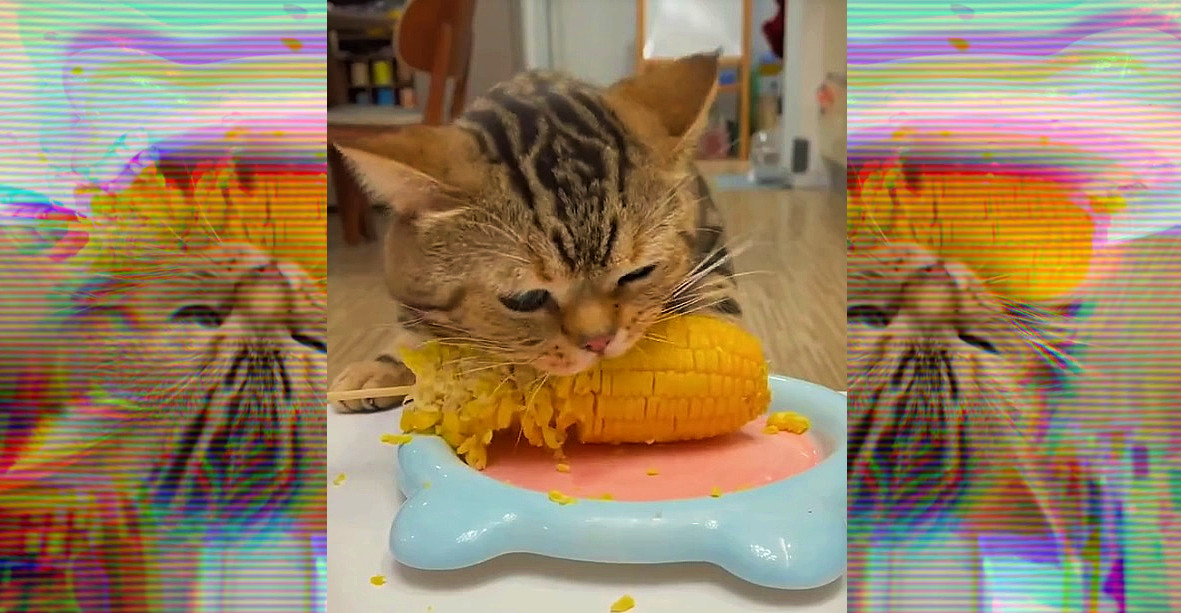
The English language does not provide the means to properly state how much this cat loves corn. To quote Dave Chappelle: “Look at him, he loves it!”
This isn’t just a video of a cute cat eating corn.
It’s a video of a cute cat who gives a cry of joy when he sees his human plop corn a cob of corn onto his plate, then tears into it with such gusto that he half-purrs, half-growls as he devours his yums. Seriously, make sure you turn the volume on, it has to be heard to be believed:
The Corn Kid, famous for declaring “When I tried it with butter, everything changed…I can’t imagine a more beautiful thing!” might be given a run for his money by this cat.
And if you haven’t heard about the Corn Kid, well, make your day brighter by checking out this songified version by the same guys who created a ridiculously catchy pop song out of the Bed Invader news segment back in 2010:
In case you’re wondering, corn won’t kill your cat. In fact, as veterinarians point out, your cat probably eats corn regularly because pet food companies use the stuff as filler in cat food despite the fact that, as obligate carnivores, cats don’t really get any nutritional value by eating it. However, it’s not meat, so if your cat likes corn, you should give it to kitty only in moderation as too much can cause an upset stomach and digestive problems.