Survey: 7 In 10 Americans Say They Sleep Better With Pets In Bed, Obviously Haven’t Met Buddy

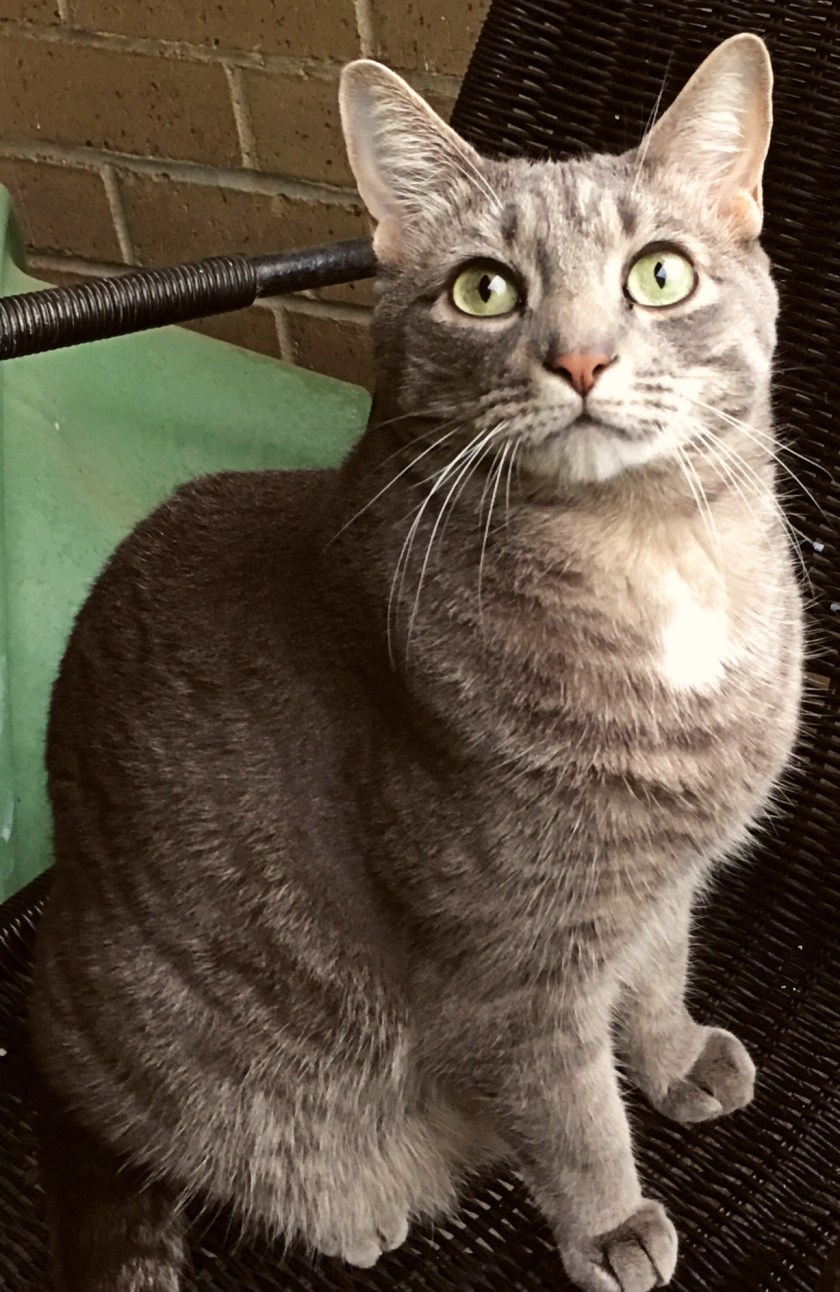
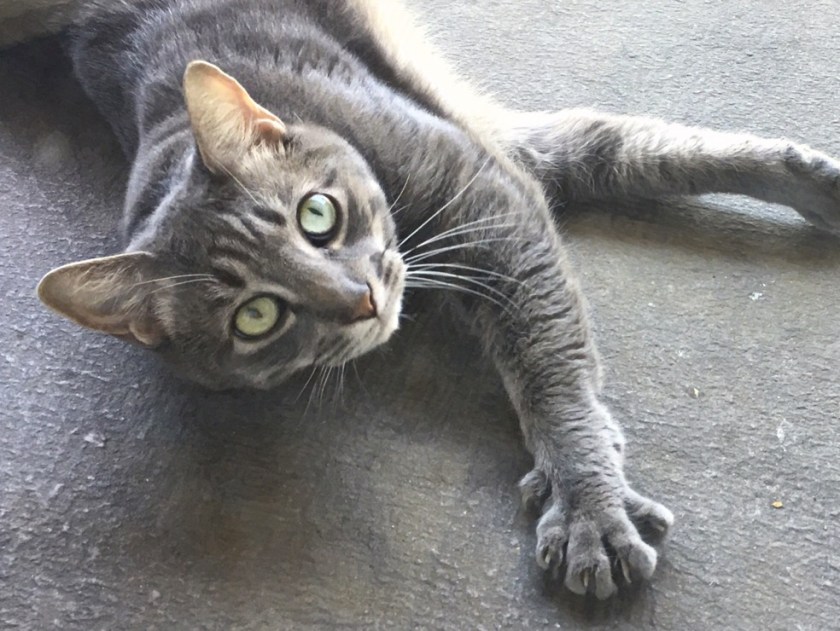
We’ll assume people who like to snooze with their furry buddies have normal cats. Buddy is not a normal cat.

Do you sleep better with your cat or dog in bed?

A significant majority of respondents in a recent survey said yes. British polling and survey firm OnePoll asked 2,000 Americans that question, with about 70 percent saying they get better rest with their furry friend next to them.

Most said having their cat or dog snoozing with them made them feel safer and more comfortable, while 58 percent admitted they sleep better with their pet in the bed than their significant other. While most people like having their animals sleep in their beds, some said pets could disrupt their sleep.

Of course if you’re like me, you never really had a choice. There was no adjustment period when I brought Buddy home for the first time. He didn’t hide under the bed and refuse to come out, or dash for the nearest small space.

That’s pedestrian behavior for a cat of his stature. Instead, the little guy came striding out of his carrier like a feline Genghis Khan and immediately started conquering territory.

PXL_20211212_072907627.NIGHT~4

“So this is my new bedroom, huh?” Buddy the Kitten seemed to say as he mewed excitedly. “Oh, look at this bed. Mine! Hey, that’s a sweet chair. Mine! I’m just gonna climb up onto your desk and survey my new territory if you don’t mind. The desk, by the way? Mine!”

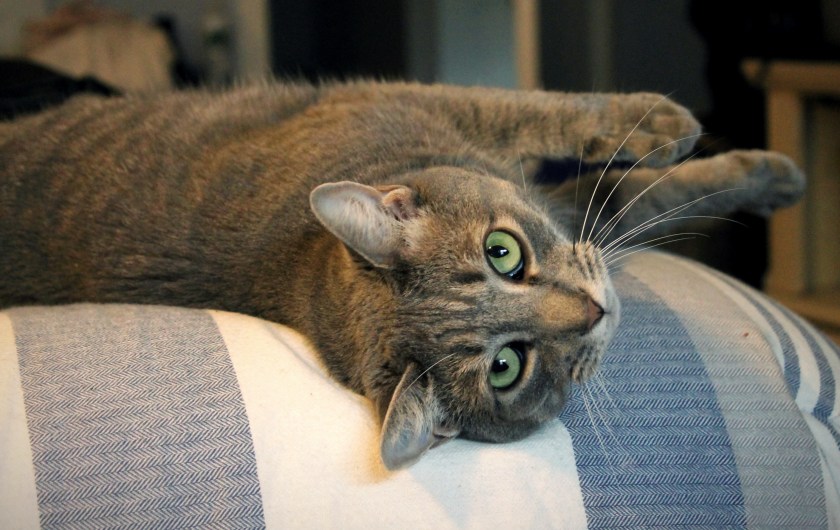
He decided from the very beginning that my bed was his bed, and while I was to be his butler, waiter, masseur and personal groomer, I would also make a fine human mattress.

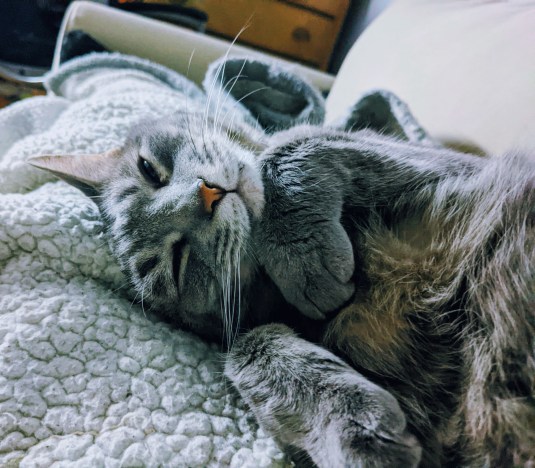
Thus our nightly routine: Buddy watches me impatiently as I get settled in bed, then makes himself comfortable either by draping himself over me, or wedging himself between my legs.

Readjusting and changing sleeping positions are severely frowned upon. I swear I can hear the annoyance in Bud’s voice, and his impatience as he waits for me to turn over so he can attend to what’s really important — his comfort.

buddy_bed
“You should be deeply honored that I have deemed you acceptable to sleep upon. Now stop moving and don’t toss and turn during the night. I need my beauty sleep!”

Do I sleep better with him there? Mentally, yes. Physically, no.

Recently I wrote about his new habit of getting “sleep scritches,” which came about after he realized he could get me to raise my hand while I sleep. It took me a while to realize it was happening: At most I was dimly aware until I had a dream I was petting him, woke up and realized I was holding my hand up while Buddy was rubbing his face against my palm and purring happily.

He doesn’t wake me up for food, since I set aside a bowl of dry kibble and a bowl of fresh water for him before bed every night. If he gets hungry, he slides lazily off the bed, pads over to his little dining nook and quietly munches a snack before going back to sleep.

The little stinker’s proximity, and his tendency to meow in his sleep, also means he gate crashes my subconscious while I’m sleeping and appears in my dreams.

I can’t get away from him, but that’s okay with me.

The OnePoll survey was commissioned by Sealy, the mattress company.

Do your cats sleep in your bed? Does their presence make your quality of sleep better or worse?

Buddy Thinks This Treat Is A Toy

Buddy: “Must dip my head into the food! Yes!”

Cats love ’em, they said. It’ll be a great bonding experience, they said. You’ll have to stop your cat from eating too much, they said.

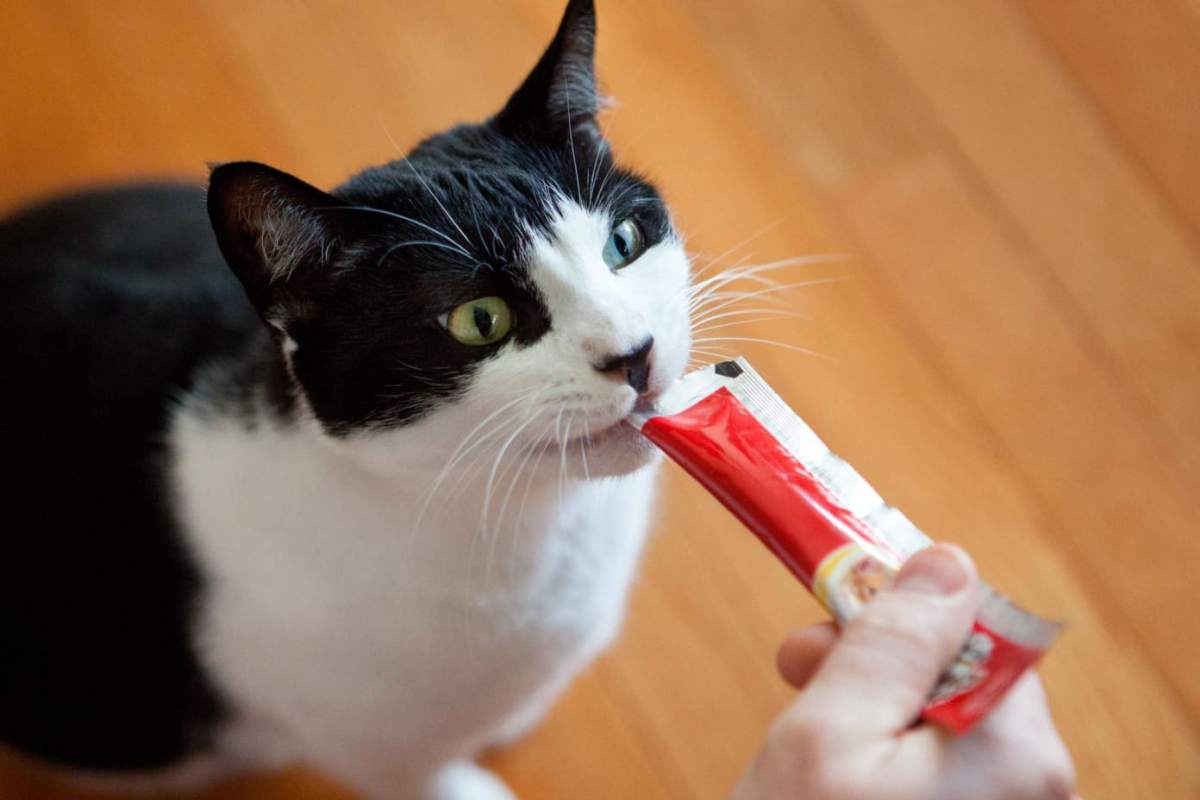
I had high hopes for the “squeeze” treats and was looking forward to getting home and giving Buddy a snack he hadn’t had before.

The problem? The Budster cannot get it through his stubborn little head that the squeeze treats are food.

He thinks they’re some sort of toy and every time I try to give him some, he head bunts the lickable chicken paste like it’s something he’s claiming with his scent, along with his plushies and wands.

After wiping the stuff off the top of his head for the umpteenth time, I squeezed a little bit of it on a paper towel and set it down for him, reasoning that he must finally understand it’s food.

Nope. Bud approached it, sniffed it, then dipped his face in it!

Bud praying
“Please grant me turkey, so that I might eat more delicious yums!”

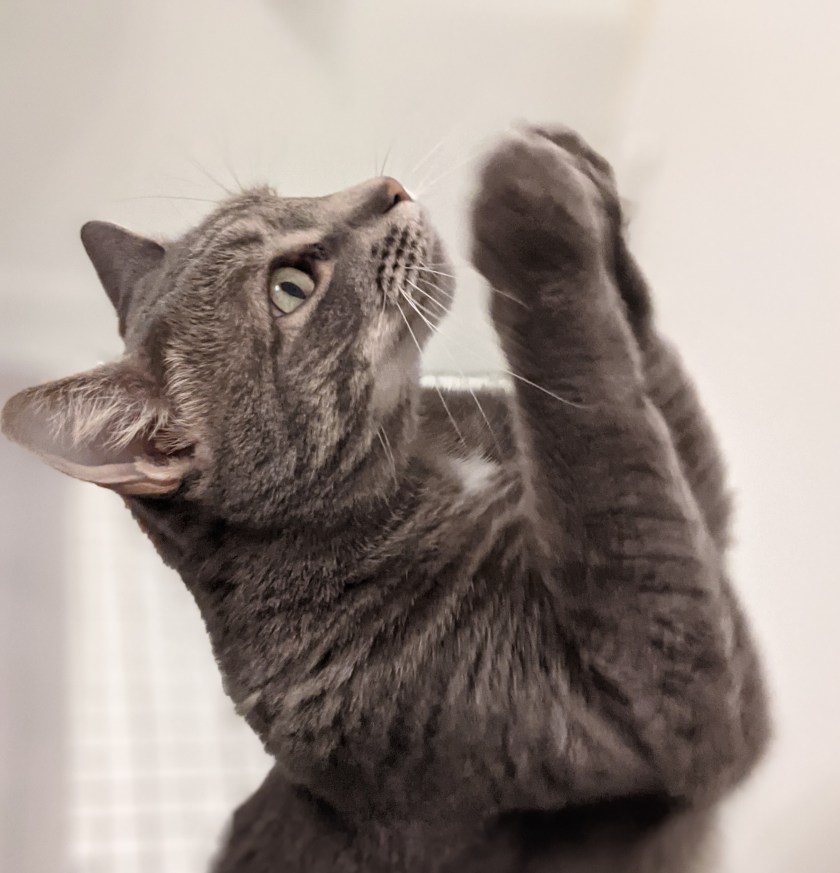
I’m not sure if this result means the stuff is so processed it doesn’t register as food, or if Bud’s just dense. After all, other cats love it, and we’re talking about a cat who whose idiosyncratic behaviors range from folding both front paws together and raising them as if in prayer, to spending months in late kittenhood engaging in boxing matches with the Bizarro Buddy in the mirror.

(I always knew when Bud was participating in a boxing match because I’d hear “Mmmmrrrrppp!” followed by THWAP THWAP THWAP! as his little paws hammered the glass. Then I’d gently pick him up off the table and set him down on the floor, praising him for his pugilistic skills while redirecting him to a less potentially destructive activity.)

Maybe I’ll try mixing some of the paste in with Bud’s wet food. Will he understand if it’s served with his beloved turkey? Or will be smoosh his entire face into the bowl and leave me with another mess to clean up?

Stay tuned until the next installment, same Buddy time, same Buddy channel!

It’s Actually Really Easy To Teach Your Cat To High Five

Training is also fun for your cat since it’s interactive, challenging and a diversion from routine. Plus, kitty gets treats.

My cousin thought I was joking when I told him my cat would come when called, sit when told and give me some love with a high five.

“Get outta here,” he said as we watched an NBA playoff game.

“Okay then,” I said. “Hey Bud!”

Buddy popped up from wherever he’d been lounging with a “Mrrrrrrrrppp!” He regarded me quizzically with his parakeet green eyes, knowing there was probably a treat in it for him as he padded toward me.

“Sit,” I said, gesturing for him to park his behind about two feet away from me. He sat.

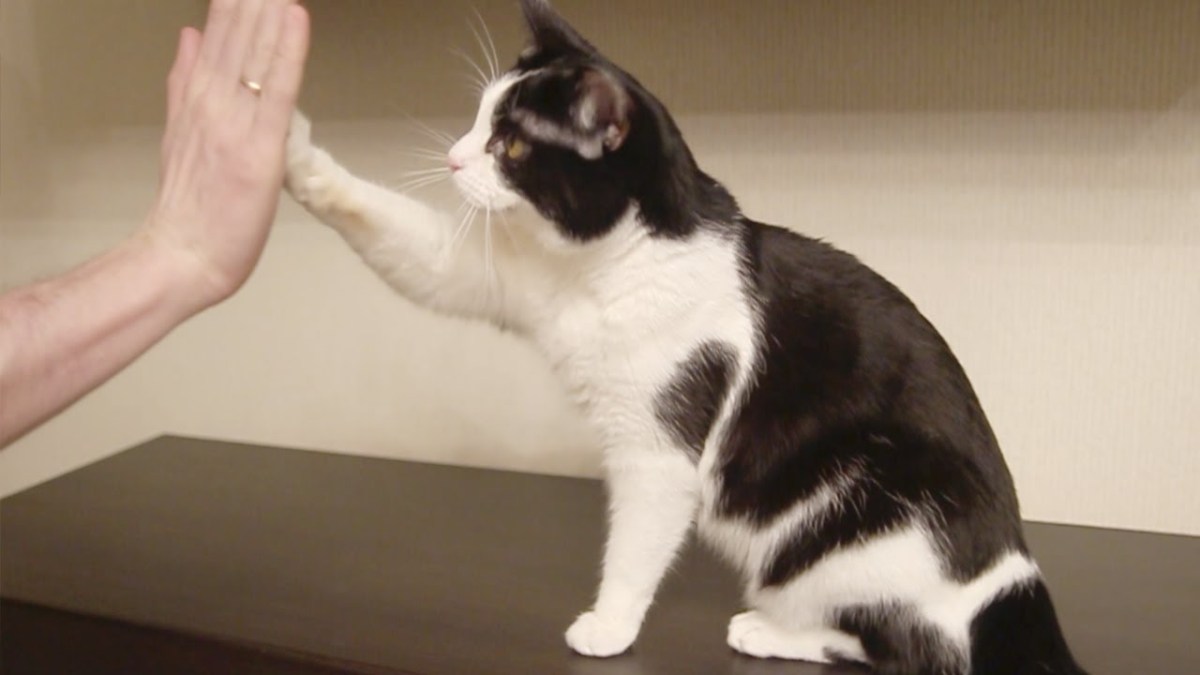
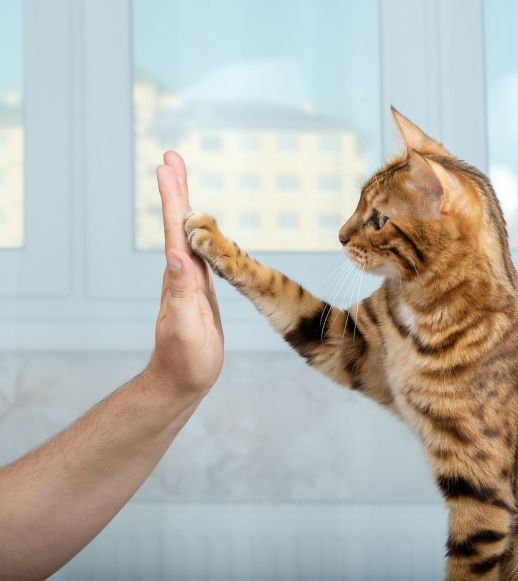
“High five!” I said as Buddy leaned forward and slapped his paw against my palm.

I tossed him a treat for a job well done. If it were up to Bud, we’d high-five another 10 times.

There are a lot of misconceptions about cats, and one of them is the idea that felines aren’t amenable to training. It’s why people use the phrase “trying to herd cats” to describe an impossible task.

People don’t expect to see a cat complying, and they definitely don’t expect to see our feline friends pulling off tricks, which makes it more fun to defy expectations.

It’s easy to train your cat to pull off simple tricks — so easy that I almost couldn’t believe it when Bud was reliably high fiving me within a week.

Cat High Five
It makes for a good party trick and a way to bond with your feline friend.

Teaching a cat to sit is a prerequisite for high fives. It’s a straightforward and easy process.

After that, it’s really just a matter of building trust with your cat so she’ll allow you first to touch her paw, then to gently take it in your hand and raise it. The first few sessions, all you need to do is touch or hold your cat’s paw. On the second day, start to raise it slightly.

Cats don’t do well with long training sessions anyway, so the time commitment is minimal. One or two sessions a day, 10 to 15 minutes each.

Every time you touch kitty’s paw, bring it a little bit higher than the last time, rewarding your cat with encouragement and a treat. After a few sessions, your cat will anticipate this new ritual you’ve got going and will raise her paw as soon as you start.

The last step is holding kitty’s paw against your outstretched palm for just a second or two, then rewarding her with a treat.

That’s it. You’re done.

Run through the trick a few times a day after your cat’s got it down, to reinforce good high fiving form and whichever affirmations you choose. (I chose to say “Good boy!” each time Bud pulled it off rather than use a clicker.) Either method works, since the important things are consistency and positive reinforcement immediately after your cat does well. You want to make sure you click or say “Good boy!” right away so your cat knows the praise is triggered by a successful high five. (Or an intermediary paw raise if you’re still working on the trick.)

For a more detailed breakdown of how to do it, check out this video from CatManToo, a professional dog trainer who adjusted his methods for cats. This is the method I used to train Bud. Again, you don’t actually need a clicker, just a consistent method of feedback to signal that your cat is doing well:

Does Your Cat Know Your Name? Study Says Maybe

If your cat doesn’t know your name, it’s nothing personal. You’re just a human, after all.

I’m pretty sure Buddy does not know my name, and why should he?

He doesn’t hear my name spoken often, and in his mind I’m probably “Big Dumb Benevolent Human And Butler,” or BDBHAB. That’s a mouthful, even in meow, thus the much easier-to-say “Big Buddy.”

But a new study from Japan claims cats “possibly” know the names of their humans.

First, the parameters of the study would have eliminated the Buddies from the start: the research team from Kyoto University enlisted only cats who lived with at least two other felines. This is because they also wanted to find out if cats knew the names of their furry roommates as well.

The 48 cats who participated in the study lived in regular homes or cat cafes. The team played a recording of their human calling the name of one of their buddies, while a monitor showed an image of a cat. Sometimes the names and the images matched, and sometimes they didn’t.

The cats took longer looks at the images when the feline image shown didn’t match the name they heard, which the researchers said was indicative of surprise.

Separately, 26 cats were run through a similar experiment. In that scenario, the researchers played an audio clip of the cat’s human’s name and showed an image of either the human caretaker, or a cat. Like they did with the first experiment, cats looked longer when the images didn’t match the names, expressing apparent puzzlement.

What's your name, dude?
“I’m a Buddy, you’re a Buddy. We’re all Buddies.”

In case you’re wondering, it does seem to matter if a cat grows up in a home rather than a cat cafe. When the name and face matched, researchers called that a “congruent condition.”

“Half of the trials were in a congruent condition where the name and face matched, and half were in an incongruent (mismatch) condition,” they wrote. “Results of Exp.1 showed that household cats paid attention to the monitor for longer in the incongruent condition, suggesting an expectancy violation effect; however, café cats did not.”

The reasons are fairly straightforward. In a home setting, cats almost always interact with their human family members, while felines in cafes interact with different employees on different shifts, and with customers, who might be regulars or strangers. Either way, the cats living in homes are much more likely to hear their own names and the names of their feline roommates.

“The latter probably have more opportunities to observe interactions between the owner and each of the other cohabitating cats, which might facilitate learning of the face–name relationship,” the team wrote.

The Kyoto team pointed out that many wild animals, particularly mammals and birds, make sounds that correspond to animals, objects or abstract ideas. Monkeys and birds, for example, use a range of different calls to communicate to each other when they’ve found food or spotted a predator heading their way.

The stakes are much lower in a home setting, but evolutionary traits can still serve cats and dogs well. One reason pets may be keen to recognize the names of their furry roommates, the research team speculated, is competition. After all, Socks would want to know if Oreo is getting more treats or head scritches.

Keeping Cats From Killing Local Wildlife May Be Easier Than We Think

Armed with real data, there’s a chance to stop horrific policies designed to kill millions of cats who are blamed for driving small wildlife species to extinction.

For the past two decades, a handful of birders and “conservationists” have claimed cats kill as many as 3.7 billion birds and 22.3 billion small animals every year in the US alone.

Their claims, repeatedly credulously in the press, have been catastrophic to cats: Hyperbolic headlines have labeled them “stone cold serial killers,” “God’s perfect little killing machines,” and posed questions like “Is your cat a mass murderer?” The headlines, often running in otherwise respectable publications, envision brutal “solutions,” like this one in Scientific American: “Cats Are Ruthless Killers. Should They Be Killed?

Politicians, wildlife conservationists and birders read headlines like the examples above and come up with ruthless policies, like bounties offering $10 for cat scalps and $5 for kitten scalps, government employees stalking public parks with shotguns and literally gunning down strays, and an Australian program designed to kill millions of cats by air-dropping sausages laced with poison.

“They’ve got to taste good,” an Australian scientist who helped develop the sausage formula said. “They are the cat’s last meal.”

Now who’s the serial killer?

Sadly, few people have thought to question the studies that claim jaw-dropping numbers of birds and small mammals are slaughtered by cats every year.

How did the studies arrive at those numbers? Their formula hasn’t varied much from “study” to “study,” and more or less looks like this:

  • Assemble your data from old studies that have nothing to do with cats preying on wildlife, or hand out questionnaires to a handful of cat owners and ask them how many animals they think their free-roaming cats might kill.
  • Since you don’t know how many stray, feral and free-roaming cats exist in the US, invent an arbitrary number. Most of these “studies” put the number of cats anywhere between 25 and 125 million, but higher numbers are better because they make for more apocalyptic predictions and generate more credulous headlines.
  • Completely ignore the primary factors driving avian extinction in the world, which are human-caused: Habitat destruction, habitat defragmentation, wind turbines, pesticides, cars, high tension wires and windows, which are by far the biggest bird-killers.
  • Attribute all of the above to feral, stray and free-roaming cats.
  • Take your original “data” and, without making any adjustments for climate, regional variation, migration patterns, other predatory impacts — or anything else, really — simply extrapolate the total number of bird deaths by multiplying your small dataset by the total number of free-roaming cats in the US, which you invented back in Step 2.
  • Package the entire thing as a rigorous study by Serious Conservationists, write some apocalyptic press releases and hype up your claims in your abstracts, because you know the vast majority of web aggregators and overworked reporters will not have the time to take a deep dive into the text of your study.
  • Encourage activist groups and lawmakers to push for the mass culling of cats, based on your studies.

Please, don’t take my word for it. Read the text of any of the widely-cited studies that have been reported as gospel in the last 20 years. You’ll be astonished at what passes for rigorous scientific work, and how policies that determine the fates of millions of cats are largely shaped by these studies.

The D.C. Cat Count and the importance of a baseline

But there’s hope: A coalition of groups in Washington, D.C., spent more than three years methodically taking a “census” of that city’s cat population using a variety of methods.

They surveyed thousands of households within the city limits to find out how many cat owners allow their pets to roam free. They set up 1,530 trail cameras in wooded areas, ditches, alleys, alongside streams. The cameras are motion-activated and they produced more than five million images — including more than 1.2 million images of cats and more than four million images of local wildlife. The cameras captured photos of squirrels, coyotes, raccoons, possums, deer and even wild turkeys.

They assembled teams of dozens of volunteers to personally survey areas where cats are known to congregate. Then, when all the data was collected, they spent months sorting the results, carefully keeping tally, sorting duplicate sightings of individual cats and confirming data when necessary.

low angle view of cat on tree
Credit: Pixabay/Pexels

When all was said and done, after three years, $1.5 million and countless man-hours, the study determined there are some 200,000 cats living in Washington, D.C., and only about 3,000 of them are truly feral, meaning they’re not pets and not part of managed cat colonies.

The team — which brought together conservationists, bird lovers, cat lovers, shelter volunteers and others who would normally oppose each other on cat-related policies — also documented every step to provide a toolkit for other cities and local governments to conduct their own methodical head counts. They don’t have to reinvent the wheel to take D.C.’s admirable lead.

The leaders of the D.C. Cat Count went to all that trouble because they understood that without knowing exactly how many cats they’re dealing with, where they congregate and how they behave, any policies attempting to deal with their potential impact would be flawed and could end up doing more harm than good.

Making informed decisions about managing outdoor cats

Anyone who continues to cite the old, sloppy studies should be reminded, loudly and often, that they have led to years of failed policies, heartbreaking outcomes, enmity between cat lovers and birders, and widespread misunderstanding of how cats behave and the impact they have on wildlife.

Now the next phase begins: Dispensing with the hysteria and finding real, useful ways to minimize the predatory impact of cats on local wildlife populations.

One of the first follow-up studies to bear fruit comes, not coincidentally, from a research team in nearby Fairfax County, Virginia, and yields some surprising revelations about free-roaming cat behavior and impact.

The biggest takeaway: Because free-roaming cats almost always stick to small areas (spanning only 550 feet, or 170 meters), “cats were unlikely to prey on native wildlife, such as songbirds or small mammals, when they were farther than roughly 1,500 feet (500 meters) from a forested area, such as a park or wooded backyard. We also found that when cats were approximately 800 feet (250 meters) or farther from forest edges, they were more likely to prey on rats than on native wildlife.”

That’s it. In other words, small buffer zones are “the difference between a diet that consists exclusively of native species and one without any native prey,” the study’s authors wrote.

“Our findings suggest that focusing efforts on managing cat populations near forested areas may be a more effective conservation strategy than attempting to manage an entire city’s outdoor cat population,” wrote Daniel Herrera and Travis Gallo of George Mason University.

a cute cat looking up
Credit: Phan Vu00f5 Minh Ku1ef3/Pexels

In other words, minimizing the predatory impact of cats is likely a hyper-local affair, and not something that can be effectively managed on a one-size-fits-all city-wide or county-wide basis.

This is just a first step in the right direction, and follow-up studies will yield further insights that will hopefully lead to fine-tuning strategies in managing free-roaming cats.

We still feel keeping cats indoors — for their own safety, as well as the safety of other animals — is the right thing to do, and all the evidence supports that view.

But what these efforts have shown us is that there is a way forward, and it’s not the contentious, divisive and irresponsible work that has guided cat management policy for two decades. It’s not just possible, but necessary, for all sides to work together to find solutions.

Let’s hope more people realize that, and the old “studies” are relegated to the dustbin where they belong.