What It’s Like To Care For World’s Oldest Cat, Plus: Utah Zoo’s New Kitten Is Cute But Deadly!

A London woman’s cat, Flossie, just celebrated her 29th birthday, making her the oldest cat in the world. And in Utah, a zoo just debuted an adorable little predator.

Happy Sunday, everyone, and if you’re on the east coast of the US like we are, we hope you’re safe and warm during this year’s first snow.

We’ll start off with a bit of significant news first reported in the The Buddesian Times: the famous artist and sculptor Meowchelangelo has unveiled a glorious marble statue of our favorite feline hero, “striding like a colossus toward evil-doers in the distance, his rippling muscles rendered in magnificent Calacatta Borghini,” which is marble from the same quarry in Carrara, Italy, that supplied the raw material for another masterpiece, the Renaissance sculpture commonly known as “David.”

The statue, which honors Buddy’s recent valorous defense of a helpless dog during a vicious attack by a pack of 72 coyotes, will likely be installed in Manhattan, although Washington’s city council is lobbying hard for it, promising the famous statue of Abraham Lincoln in his eponymous monument would be removed for the Buddesian likeness.

buddesiantimes
Today’s edition of the Buddesian Times with a front-page story on the statue.

The World’s Oldest Cat still moves like a kitten

The Guardian has an interesting column from Vicki Green, cat mom to Flossie, who at 28 years old is the Guinness World Records certified oldest domestic cat in the world.

Flossie, who was born in December of 1995, is as old as Green, who attributes the tortoiseshell’s longevity to “luck, and because she was loved by her previous owners.” Flossie was initially an outdoor kitten who lived in a managed colony until she was adopted by her first human, who died when Flossie was 14 years old.

The woman’s sister took Flossie in next but died after 10 years. Her son became the long-lived feline’s third servant, but after three years he brought her to Cat’s Protection in London, saying he could no longer provide the level of care Flossie deserved and needed.

Shortly after, Green was looking to adopt a cat and saw Flossie’s listing online.

“At the time, I thought it was an error and that she must be 17,” she wrote. “Cats Protection told me she was still available to adopt and that no, she was in fact 27, the same age as me.”

Green thought Flossie would likely only live a few more months, but “she’d at least spend them in a nice, warm flat, be fed well and get treats as well as a comfy bed.”

“To my surprise,” Green wrote, “I’ve had her for over a year now and she’s still going strong.”
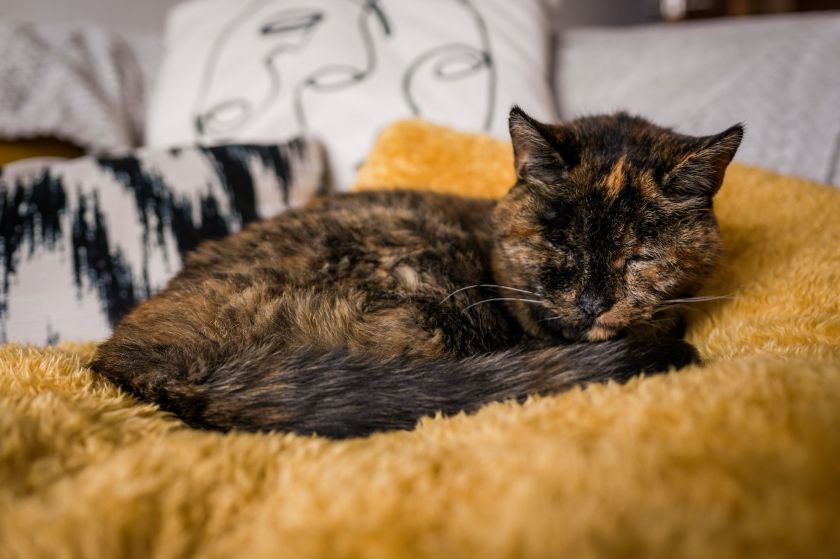
Flossie napping
Flossie takes lots of naps but is surprisingly active and playful for her age. Credit: Vicki Green

Despite her advanced age, Flossie is active, seeks attention and still plays with her favorite toys. Green got miniature stairs for the senior kitty to easily reach the couch, but Flossie doesn’t use them, preferring to jump up instead.

“The biggest difficulty is dealing with the fact that there may soon come a time when she passes. I’m in denial about that. I look at her and just think she doesn’t look old at all,” Green wrote. “Yet who knows? She could well be on the way to becoming the oldest cat in history. Though even if she doesn’t break the current record of 38 years and three days, at least I’ll know she had a great retirement home.”

Gaia the three-pound terror debuts in Salt Lake City

Black-footed cats are known primarily for three things: they’re outrageously cute, they’re diminutive and they’re remarkably deadly.

Of course with a maximum weight of three pounds, only tiny prey have to worry about the fury of these furry little guys. The rest of us get to point and go “Aww!”
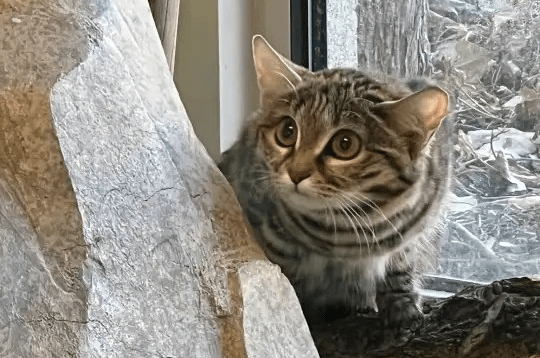
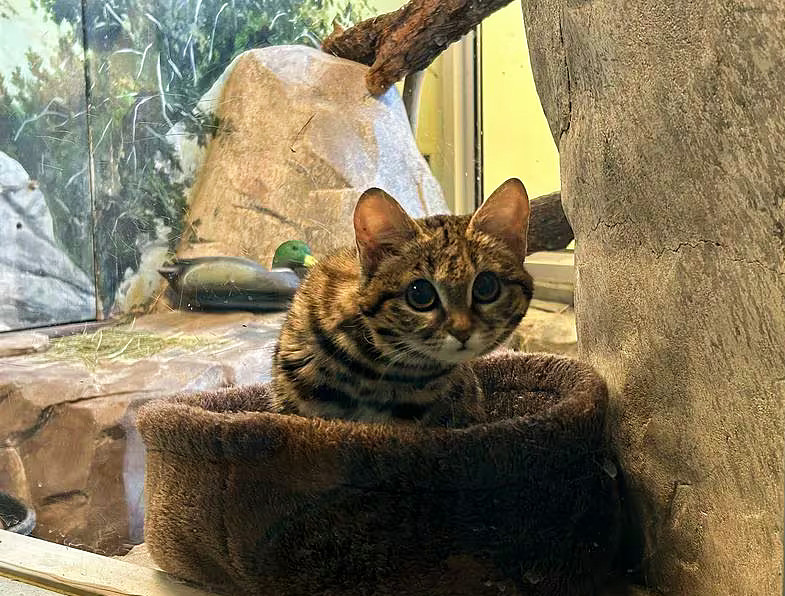
Gaia the black-footed kitten
Gaia’s personality is “large and feisty” according to zookeepers. Credit: Hogle Zoo

Native to the savannas of southern Africa, black-footed cats are excellent hunters, but like all felines they’re also prey, and they’re the subject of a worldwide zoological breeding and conservation program due to declining numbers in the wild.

The newest success story for those breeding efforts is Gaia, an eight-month-old black-footed kitten who just made her debut at Hogle Zoo in Utah.

Zookeepers describe baby Gaia’s personality as “large and feisty,” and they expect she’ll be popular with zoo visitors.

She’s now the second of her species at Hogle, joining Ryder, a male. They haven’t been introduced yet. A carefully supervised introduction is “in the cards, but we’ll let these two feline friends get acquainted when Gaia reaches maturity,” the zoo said.
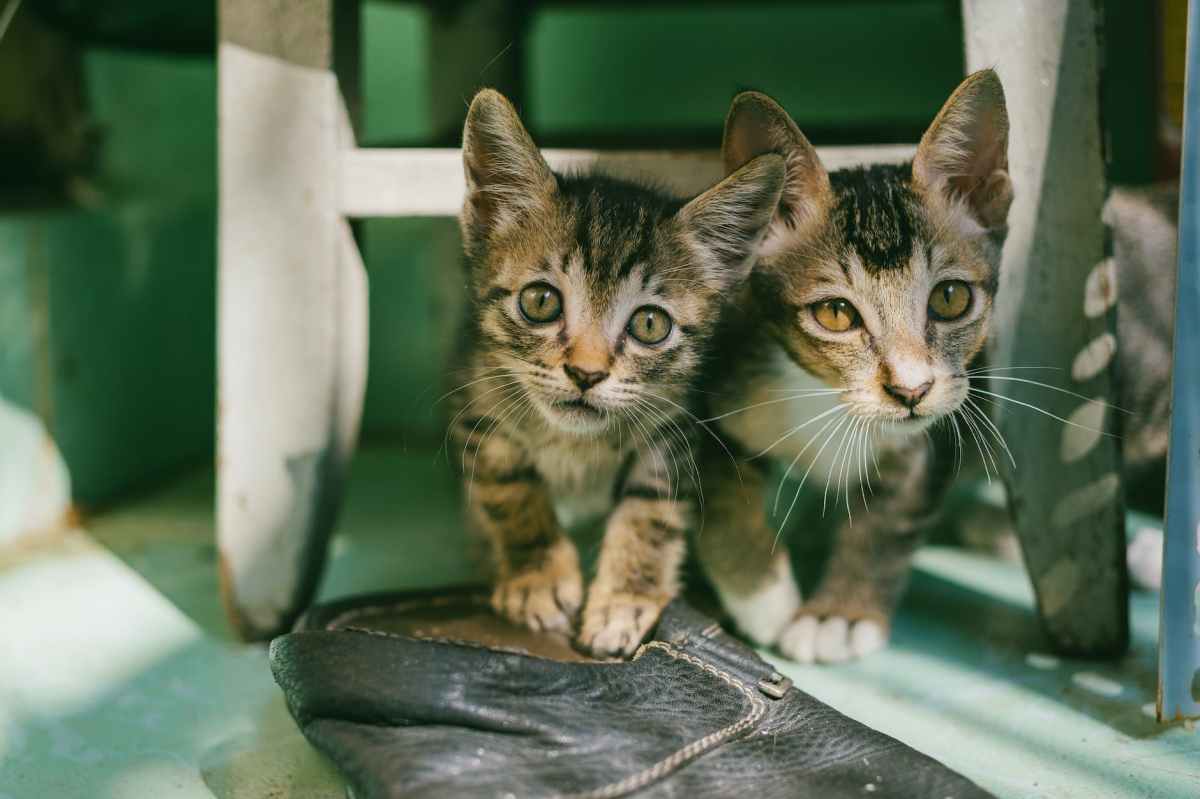
Athens Gets Its First Cat Cafe

The proprietors say they wanted to create a space that “calms and relaxes” guests and gives Athens’ street cats a chance to find forever homes.

Natalie and Dimitris went all in on their dreams for a cat cafe.

After experiencing similar places overseas and falling in love with the concept, they quit their jobs in tech and hospitality, found a nice spot in the Athenian neighborhood of Thissio — known for its prime views of the acropolis and Parthenon — and established the first cafe in Athens’ 3,000-year history.

0-6-1024x656
Guests film their favorite cats as the little ones play on a network of walkways and cat trees. Credit: Greek City Times

When I visited a cat cafe in Tokyo, slots were segmented into 30 minutes at 2,000 yen (about 13 bucks) per and coffee was from a vending machine. (To be fair, Japan’s vending machines are excellent and many of them brew fresh coffee internally.) Cat cafes in New York tend to operate in a similar manner, although without the vending machines and with strict separation between food prep areas and the sections where the cats roam, lounge and poop.

But Natalie and Dimitris wanted a cafe that reflected the pace of Greek life, so appointment is by reservation, there aren’t any limits on how long people can hang out, and half the cafe’s space is a fenced-in yard where people can enjoy the cats and the Mediterranean weather.

People can even serenade the kitties, who are all former strays by sitting down and playing a piano inside the cafe.

But ultimately, the couple told the Greek City Times, they opened the cafe — called simply Cat Cafe — because they love cats. Unlike their Turkish neighbors across the Aegean, Greeks aren’t known for caring for street cats despite many of them eking out a living in Athens and other cities.

In Greece, Natalie and Dimitris said, cats are “very misunderstood animals.”

“From the beginning, our goal was to bring people who don’t have cats into contact with cats,” they told Greek City Times. “To interact with them and get to know them. And decide to adopt one.”

Note: The original interview was in Greek and translated to English for the Greek City Times, so there’s some funky phrasing. Readers who are fluent in Greek can read the original here. Top image credit: Pexels

These People Surrendered Their Healthy Cats For Ridiculous Reasons

When we open our homes to furry overlords, we make a promise to give them good homes and care for them for life. Unfortunately not everyone sees it that way.

Stories about people abandoning perfectly healthy cats for inane reasons abound, but this week two particularly egregious cases from the same shelter caught my eye.

In the first case, Biscuit the cat was living comfortably in a home with “her cat best friend” when the latter feline died. Instead of realizing his surviving cat was distraught and taking special care of her, Biscuit’s former “owner” brought her to a shelter, saying he was surrendering her for euthanasia because his family “wanted a kitten” instead.

At 12 years old, Biscuit is “as sweet as a 12-week-old kitten,” staff at the Chesapeake Feline Association in Maryland wrote in a caption accompanying a video explaining her situation.

@chesapeakefeline

Biscuit lived her whole life with her best cat friend and what she thought was her forever family…until her companion cat passed away and her owner decided he wanted a kitten instead….so he brought Biscuit in to be put down. We quickly scooped her up and gave her so much love, but she is ready for a new family to call her own. Biscuit is about 12 years old but is just as sweet as a 12 week old kitten, please don’t let her age scare you ♥️ #catrescue #sheltercats #adoptdontshop #fyp #catsoftiktok #adoptablecats #adoptme #adoptablecatsoftiktok #maryland #delaware #pennsylvania #ownersurrender #seniorcat #sheltercat

♬ the winner takes it all – november ultra

Thankfully the shelter did not honor the man’s wishes for Biscuit to be put down, and the video is starting to accumulate views and comments. Let’s hope Biscuit’s future loving human is among them, and I’d like to think the CFA told her former human to beat it and sent him home without the kitten he wanted.

If they give in, that poor kitten’s going to come back to them a few years down the line as the guy keeps trading ’em in for younger ones like Leonardo DiCaprio.

Ignoramus Surrenders Cat For Scratching A Carpet

Cats have claws. Cats scratch. They don’t do it to piss us off and they don’t do it to ruin furniture. They do it because they’re genetically hardwired to, because it served multiple functions when their ancestors were in the wild — including marking territory — and because it still has practical purposes, like wearing down claws that have grown too long.

Anyone who knows the most basic facts about cats knows this. Anyone who has done at least minimal research before bringing a feline home knows you need to provide kitty with scratchers and redirect him to them when he goes for another object.

And if you have furniture you really want to protect, you make arrangements before bringing your new friend home, whether that means up-armoring a couch with scratch guards, putting soft nail caps on kitty’s claws, keeping her out of a certain room or one of many other potential solutions.

What you don’t do is adopt a cat, give him a home for six months, then take him back because he scratched your carpet.

Doing that makes you a jerk.

I’m not sure if general ignorance is the problem here, or if people see cute felines on Instagram et al, imagine unicorns and rainbows and bright-eyed kittens poking out of baskets, and never even think about the fact that felis catus is an animal, not a Pokemon or a stuffed toy.

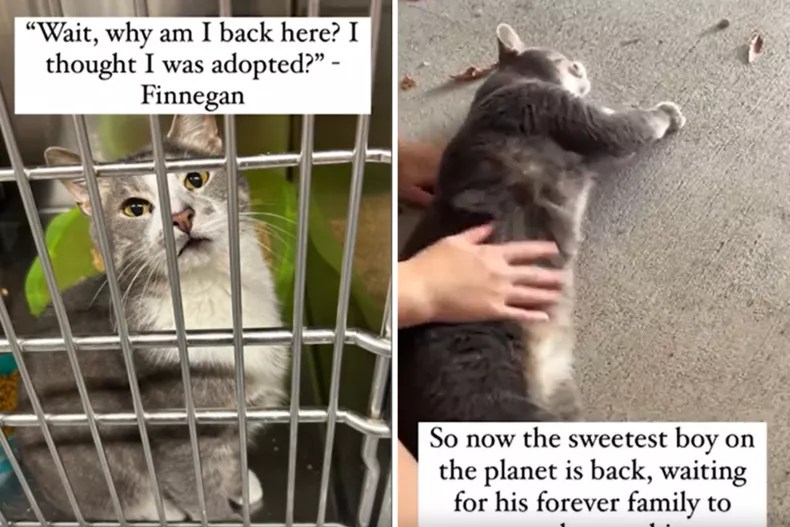
In any case, surrender for acting like a cat is exactly what happened to Finnegan, a gray and white tabby who “melt[s] in your arm and give[s] you all the love,” shelter staff wrote.

The little guy’s offense? Scratching a carpet. Shelter staff really tried to make it work: They offered to put nail caps on Finnegan every month at no charge and his humans still said no.

His ordeal has not soured him on people, thankfully. A video from the shelter shows him loving massages from volunteers at the shelter, and he looks like an incredibly chill little dude. He deserves a home where people love him.

You can find Biscuit, Finnegan and lots of other adoptable cats on the shelter’s Petfinder page and website.

Finnegan the cat
Finnegan, seen here in stills from a video, was surrendered by his people for the crime of behaving like a cat.

Do You ‘Pspsps’ To Your Furry Friend? Plus: An Obit For Miles The Cat

Do you use “pspsps” to get your cat’s attention?

Apparently a lot of people use the “pspsps” thing to get their cats’ attention, and Mental Floss has a new story proposing some theories about why people use it and why cats respond.

The first and most obvious is that felines hear higher frequencies than humans, and they’re especially tuned into those frequencies because their usual prey — including rodents and birds — not only make noises in the higher ranges, they make noise us humans can’t hear, but felid ears are primed to pick up.

Mental Floss’s Ellen Gutoskey also points out that it could be “a truncation of ‘Here, pussy, pussy, pussy’—popularized in part by ‘Pussy, Pussy, Pussy,’ a 1930s song by the Light Crust Doughboys. In fact, the tempo is fast enough that it almost sounds like they’re singing ‘Pspsps.”

I think she could be onto something there unless the “pspsps” sound is universal, but truthfully I have no clue whether people in other countries, or outside the English-speaking world, use it to call their cats. I don’t and never really needed to. Bud comes when called a good 85 percent of the time, and if he doesn’t I usually assume it’s for good reason, like he’s having a nice nap or he has no current use for his servant.

Miles the cat

The Guardian’s Hannah James Parkinson writes about adopting Miles, the shelter’s most skittish cat who had been passed over time and again until she came along.

Earning Miles’ trust wasn’t easy, but Parkinson did it with time, patience and love, and eventually Miles became her little buddy and even came out of his shell enough to make friends with another neighborhood cat.

milesthecat
Credit: Hannah Jane Parkinson

Unfortunately Miles got hurt, infected and died while he was outside overnight. Parkinson doesn’t say if the little guy got hit by a car, but the description of his initial injury is consistent with it.

The indoor vs outdoor thing is a thorny issue. I saw it as a more black-and-white problem until hearing from several readers who live in places like farmland or very quiet neighborhoods where the chance of a cat getting hit is small.

I don’t begrudge anyone making what they think is the best choice for their cat(s), except maybe for Australians and New Zealanders. Seriously, guys, bring those cats in before sadistic “hunters” get them in their crosshairs or they nibble on the poisoned meat that both governments like to use to “manage” the cat population. Neither country seems overly concerned with pet cats getting caught up in their zealous extirpation campaigns, and when birders are this riled up it’s best not to take chances anyway. If your cat isn’t spending time outdoors, it can’t be blamed for killing local wildlife.

I love dogs, but…

The Daily Mail has a horrific story about a pair of unleashed rottweilers that followed a woman into her home as she was carrying groceries and mauled her two pet cats to death in front of her traumatized children.

The attack happened around noon on Aug. 30 in a small town in the UK’s Western Midlands. The dogs came bounding in and snatched one of the cats off the kitchen counter, then mauled the other. The ginger tabby died immediately, either from shock or his severe injuries, while the other lived long enough to make it to the vet, who said the little tuxedo couldn’t be saved.

The woman told the newspaper her kids are having nightmares about the attack, while the police response was underwhelming to say the least, especially because the cats weren’t the only animals attacked by the roaming rottweilers.

“We were called to Raglan Way, Chelmsley Wood (on August 30) to reports of two dogs attacking another dog. The injured dog was taken to the vets to be treated,” a police spokesman told the paper. “The owners of the two dogs were spoken to and were taken back home to be secured by the owners. We have asked neighbourhood officers to speak to the dog’s owners regarding securing the animal, and will consider any further steps that need to be taken to ensure public safety.”

The owners of the dogs “were spoken to.” Wow. Let no one say the West Midlands Police don’t have a sense of scale. Perhaps if it happens again they’ll send a stern letter.

I hope the resulting media stories, and the beginning of the attack caught on a home security camera, lead to enough pressure that the police take the incident seriously and the owners of the dogs have to face consequences. There’s nothing prohibitive about talking to them. The only way irresponsible people are going to leash their dogs, especially dogs capable of this kind of thing, is if the consequences for not doing so are sufficiently prohibitive to make them think twice.

Finally, here’s a video of a cute baby kookaburra to balance out all that horribleness:

Two Families Battle Over A Cat, Prompting The Question: What Defines Pet ‘Ownership’?

Bob/Maui the cat was adopted by one family in 2013, went missing a few months later and was rescued by another family, who have had him for 10 years.

Bob the cat was adopted by Carol Holmes of Wichita, Kansas, in 2013.

Holmes says Bob disappeared a few months later and that was the last she saw of him.

Alex Streight, who also lived in Wichita at the time, found Bob in a bad way, malnourished and in “bad condition.”

“He was in horrible shape,” Streight told WRAL, a North Carolina TV news station. “I fed him, kept looking for [the] owner. I posted in the Wichita groups, but I never found anyone.”

Streight, who was 27 years old and pregnant at the time, said the veterinarian gave her no indication the cat belonged to anyone, and her efforts to find a potential owner were unsuccessful, so she paid for his veterinary fees, adopted him and named him Maui.

When Streight moved to North Carolina in 2015, she took Maui with her and he’s been living happily with her family ever since. In late August Maui slipped out of Streight’s North Carolina home. A neighbor picked him up and brought him to the vet, and the veterinarian realized there was a microchip. A scan showed Holmes as the cat’s owner.

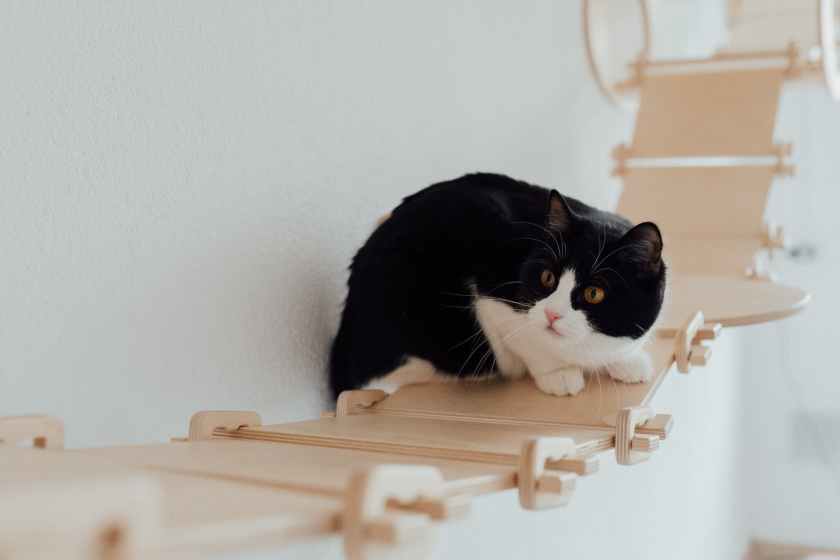
a tuxedo cat on a hanging wooden bridge
Credit: Arina Krasnikova/Pexels

Now Bob/Maui is in the custody of Wake County (NC) Animal Control, whose staff don’t sound keen on returning the cat to Streight. They’ve called Wilson, who said she’d like to be reunited with Bob/Maui, and when Streight went to animal control to get her cat — returning with the veterinary records when they wouldn’t release him to her the first time — the staff called police.

“The cat is in protective custody where an investigation will begin,” Jennifer Federico, a veterinarian with the county animal control, told the station. “The cat is safe and isolated.”

Federico seems intent on making the situation more complicated than it needs to be, telling WRAL that “Microchipping proves ownership, so we have to take that into consideration, and launch a full investigation.”

Streight doesn’t see it that way. She wasn’t registered as the owner on the chip, but she’s got 10 years’ worth of veterinary records, a photograph of Maui laying on her couch the day he slipped out of her house, and photos and videos showing the tuxedo cat with her kids and other pets over the past decade.

“It’s just absurd to me that anyone would think to take someone’s pet away from the family that he’s been with for ten years,” Streight said.

We have to agree with Streight here, and it’s disturbing that animal control has not only made itself the arbiter of the cat’s fate, but has apparently decided that nominal ownership based on a microchipping from 2013 trumps the fact that Maui has been happily a part of Streight’s family for at least 95 percent of his life.

We feel for Wilson, but Streight did everything right: She looked for the cat’s family, posted about him online, cleaned him up and got him veterinary care, then adopted him when all indications were he didn’t have a home. With a decade’s worth of vet bills, photos and videos backing her up, it’s clear Maui is happy in her home, has been well cared-for, and if he could speak there’s little doubt about where he’d prefer to go.

She’s clearly bonded to the cat, and he to her: Only someone who really loves their furry friend regularly takes photos of their cat, even after 10 years. I can attest to that fact: Probably 60 or 70 percent of the photos on my phone are of Buddy, and I’d be devastated if we were separated.

What do you think? Should Bob/Maui be returned to Wilson or Streight?

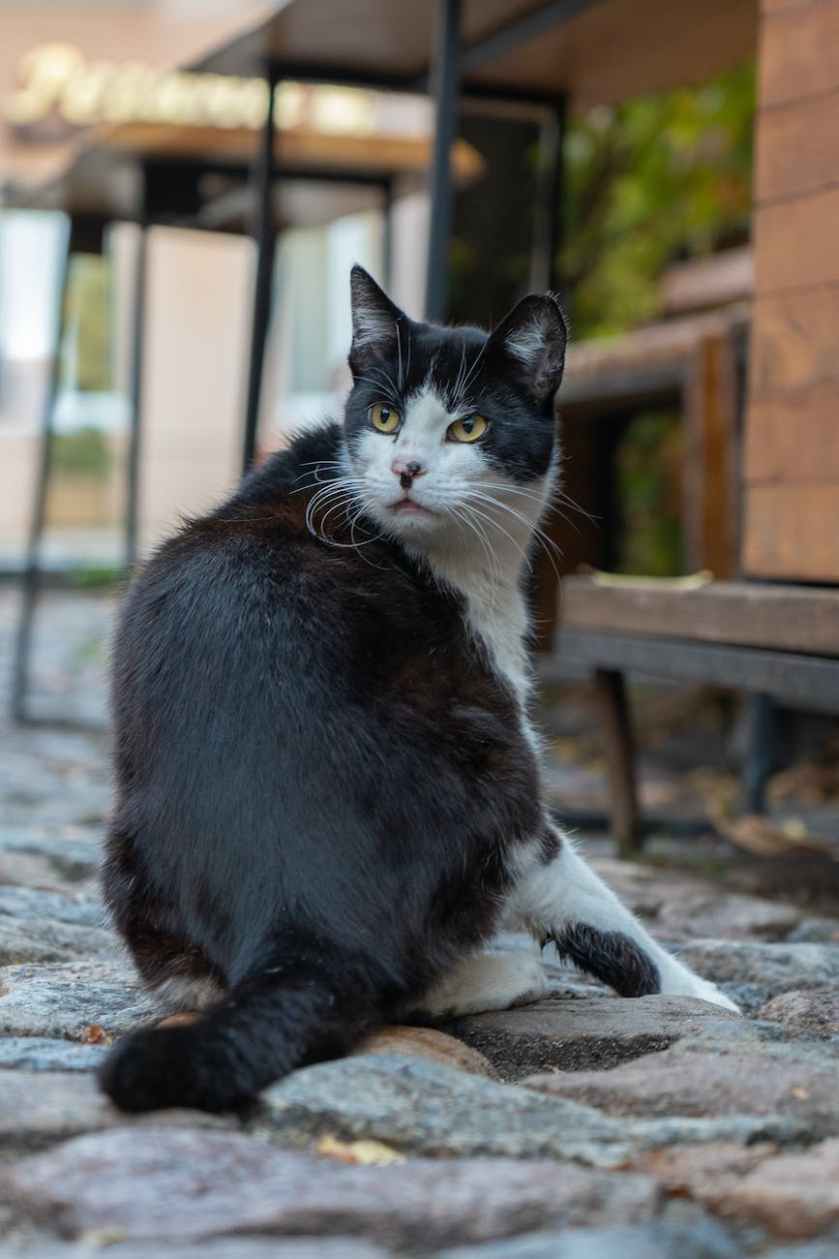
tuxedo cat sitting on ground
Credit: Dima Solomin/Pexels