The fast feline narrowly avoided becoming a meal for a pair of coyotes in Sacramento.
Allyson Seconds was driving through midtown Sacramento on Thursday morning when she saw flashes of fur weaving between cars in traffic.
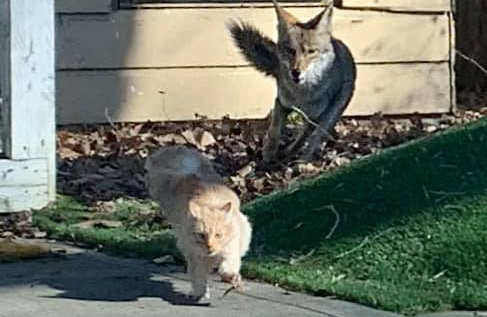
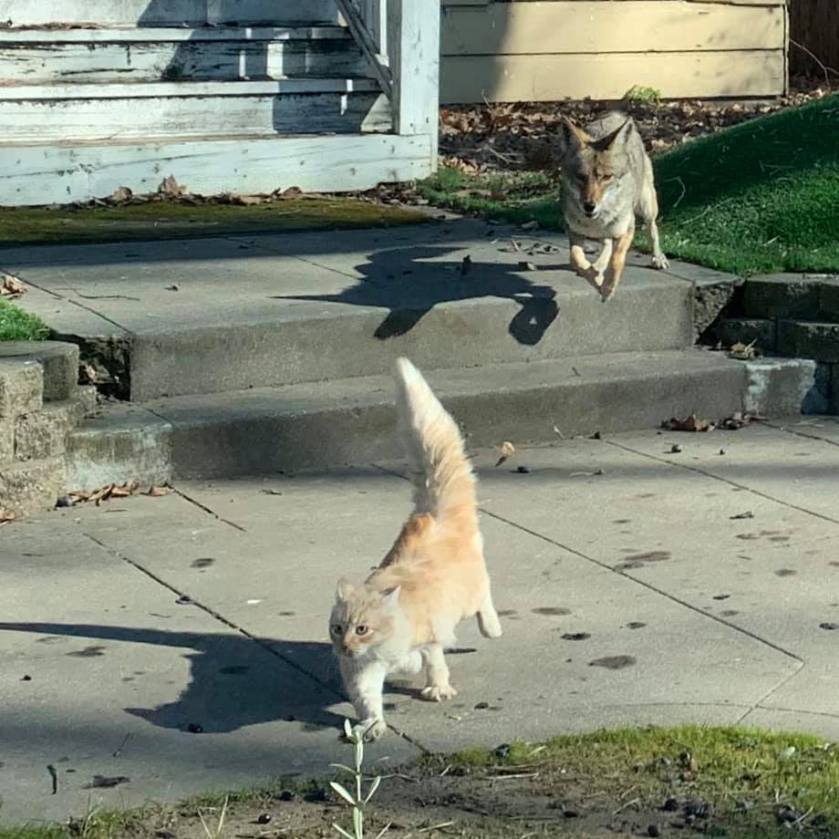
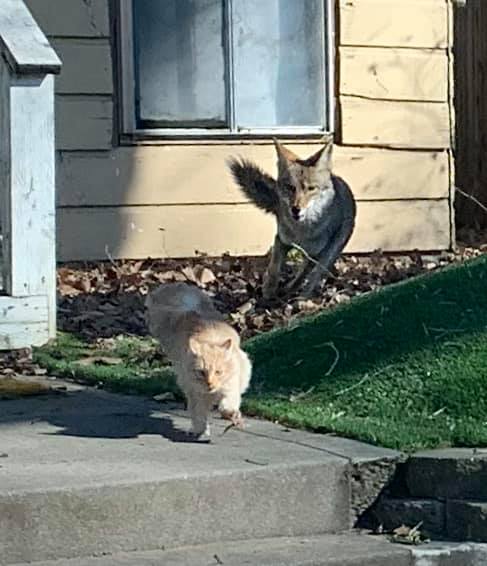
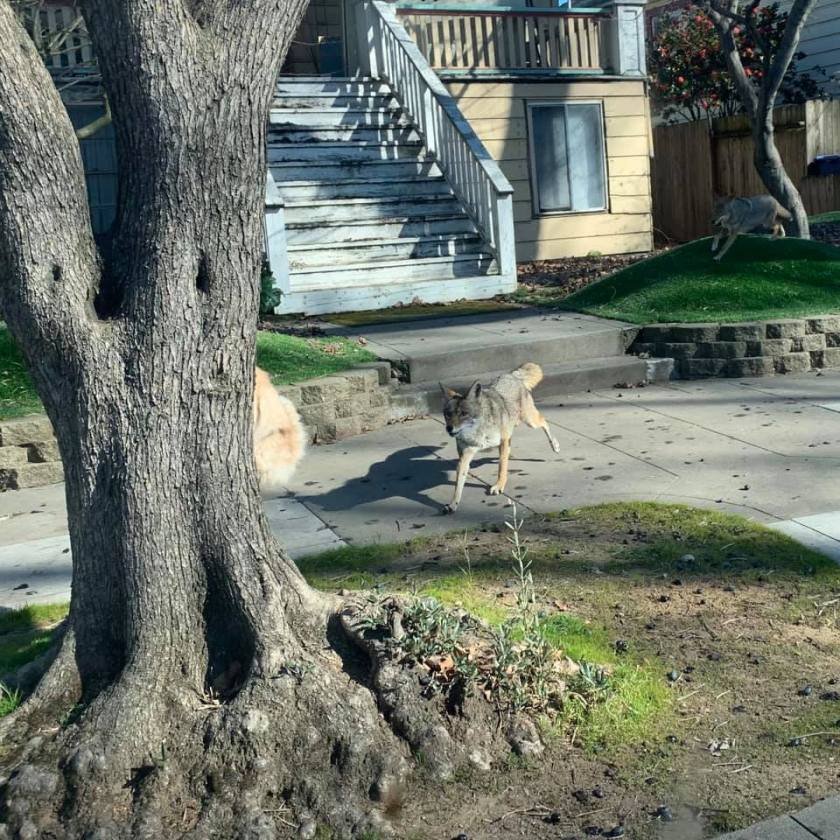
“I pulled over thinking I’d seen two loose dogs crossing the street and went into rescue mode,” the Sacramento woman recalled. “When I saw they were coyotes I grabbed my phone and took just these four shots of them running and jumping up at a tree.”
Seconds didn’t didn’t understand why the coyotes were so worked up until she reviewed the shots.
“I didn’t realize at first that it was a house cat they were after until I looked at the pictures,” she wrote. “That’s one lucky cat!”
The swift tabby managed to stay a stride ahead of his canid pursuers before going vertical and beating a quick retreat up a tree.
This photo shows the telltale signs of a terrified cat: Kitty’s tail is raised, rigid and three times its normal size while its ears are pinned back against its head.
A tabby cat narrowly escapes the jaws of two coyotes on Feb. 6 in Sacramento. Credit: Allyson SecondsThe coyotes were right on kitty’s heels. Credit: Allyson Seconds
The next two photos show the end of the chase: In the first we can see just a flash of fur as the cat scurries up the tree, and in the second shot the coyotes look miffed at being outplayed by a domestic cat.
Credit: Allyson Seconds
As for Seconds, she understands what so many people and local media reports get wrong. There aren’t “more” coyotes, as if they’ve suddenly decided to start becoming prolific breeders. The reason those of us in urban and suburban neighborhoods see them more often is because we encroach on their habitats with every development, cul-de-sac and ugly strip mall we build.
It’s a story that is sadly repeated across the globe as animals as varied — and endangered — as mountain lions, tigers and orangutans find fewer contiguous plains, jungles and forests to hunt and forage within.
“This is not even close to a coyote damning post,” Seconds wrote on Facebook. “Housing developments and more homeless living at the river are certainly driving them inland from their more suitable terrain but guess what? The coyotes are adapting to city life and we are seeing more and more of them in all corners of our town. They aren’t going anywhere.”
She signed off by making a suggestion we’ve advocated many times on this blog.
“And as for those worried about their cats for reasons illustrated in my photos? Time to start keeping kitty inside.”
A new video purports to show a cat speaking fully formed sentence in English. People are buying it.
A new, internet-breaking viral video appears to capture a cat speaking English, prompting a wave of speculation about whether cats are basically furry parrots when it comes to talent for mimicry.
The TikTok clip features a voice saying “Hello” and “Are you coming?” followed by an amused narrator turning the camera on his cat and incredulously asking “What did you just say?”
The video’s viral success has led to a net-wide conversation about animal cognition, and whether cats in particular understand far more than they let on.
“And this is a proof that animals can talk,” one TikTok user commented, summing up much of the online reaction to the clip.
It should be noted the handful of times cats have been recorded producing vaguely human-sounding speech, the sounds were stress vocalizations from terrified or anxious cats.
That’s what’s happening in the famous “Oh long Johnson, oh don piano!” video, in which a stressed out tuxedo vocalizes a few phrases before proceeding with more gibberish. To people who aren’t familiar with cats the video may seem funny, but those of us who care for the little tigers can recognize the signs of extreme agitation.
Here’s the “Oh long Johnson” video:
And here’s the new “Hello!”/“Are you coming?” video:
The viral TikTok video is a whole different ballgame: The words are well-formed, the sound is clear, and the phrase makes sense.
Unfortunately, it’s not real.
First I’ll point out the obvious: The cat is off-camera when it “speaks” because painstakingly editing video to make its mouth move in sync is a much more difficult task than dubbing in a vocal file.
Secondly, a careful listening with headphones makes it clear the “Hello” and “Are you coming?” are not from the same source as the meow, and the directional mix isn’t right. The sound should be distorted and should be directional if it’s coming from a cat in the next room, to the right of the person recording the scene on a smartphone.
This was an audio cut and paste job without much attention paid to detail. The video’s creator didn’t bother panning the clip.
But perhaps most damning of all, the sound looks wrong. I isolated clips of the cat “speaking” in a wave editor — an old copy of the ultra-reliable Cool Edit Pro — and compared them to various samples of cat meows pulled from the Internet and sampled from Buddy himself.
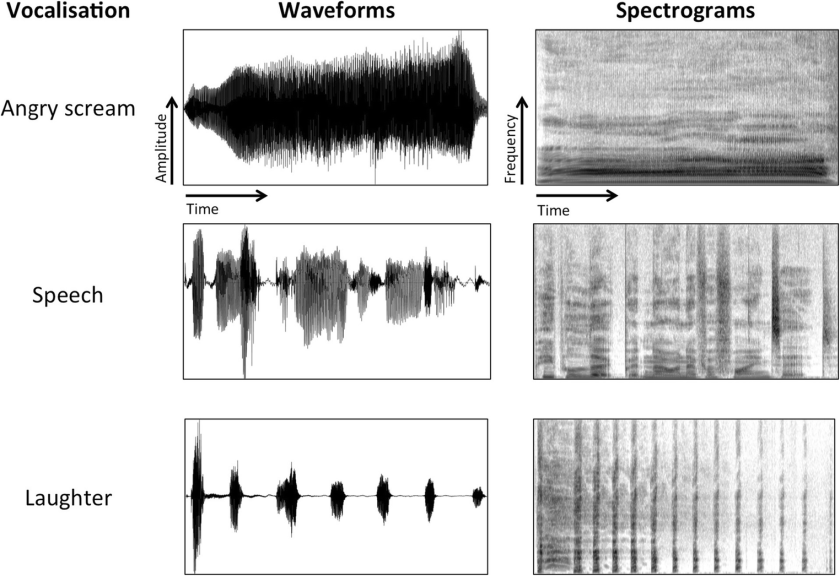
When visualized in an audio editor, “the waveform of speech is complex and variable, reflecting the variety of vowels and consonants that are used and the dynamic nature of speech articulation.”
In other words, you can see the stops and starts of human speech and the articulations of different sounds reflected in how the audio appears visually. This is because we have fine motor control over our vocal apparatus, something animals lack. (A 2016 Princeton study determined macaques, for example, have the necessary vocal anatomy to mimic human speech, but they don’t have the “brain circuitry” to form the precise articulations.)
Cat vocalizations, on the other hand, lack those markers. Additionally, at higher resolutions you can see patterns indicative of rhythmic sounds in samples of cat vocalizations, not unlike isolated drum tracks in a studio recording.
This is because feline meows often have embedded purrs, and trills are naturally quantized. They’re rhythmic sounds. If you’ve ever had a purring cat laying on your chest, this will be familiar to you: You can hear the percussive sound, which persists while the cat is exhaling and inhaling.
A domestic cat’s meow in waveform. Notice the lack of transients, pauses and variation, which would be indicative of human speech patterns.
Solicitation purrs and even basic meows have similar qualities. It’s a well-known fact that cats communicate with each other via body language — tail, eyes, ears, posture — and scent. Adult cats rarely vocalize to each other, so when they meow to us it’s because they recognize that we don’t “speak” tail or whisker, and they’re trying to communicate with us in a form we understand.
But cats are like macaques — they do not possess the brain circuitry to form the precise articulations necessary for human speech.
As primates, macaques have similarly-formed mouths, tongues, teeth and lips. Cats do not, which presents another set of problems when imagining them mimicking human speech. Think of “t” sounds, both the hard t and the soft “th” — they require us to rest our tongues against our upper front teeth or the roof of our mouths.
Cats don’t have substantial front teeth. They’re more like little shredders.
Likewise, to speak the phrase “Are you coming?” requires fine motor control to form the hard “c” sound. It involves precise control of air flow from the throat to the mouth and subtle placement of the tongue
Although the idea of talking pets may be appealing to generations that grew up on Disney movies and other media featuring anthropomorphized animals, the truth is they do talk to us in their own ways. The least we can do, as the supposedly more intelligent species, is to meet them halfway.
Wilford will have to slim down before moving to his forever home.
It seems like a new super chonk cat goes viral everyday, and it’s always the same story — the cat comes from a home where its owner is either negligent or unable to properly care for kitty, and a rescue is left with the dual responsibility of finding a new home and getting the cat to slim down.
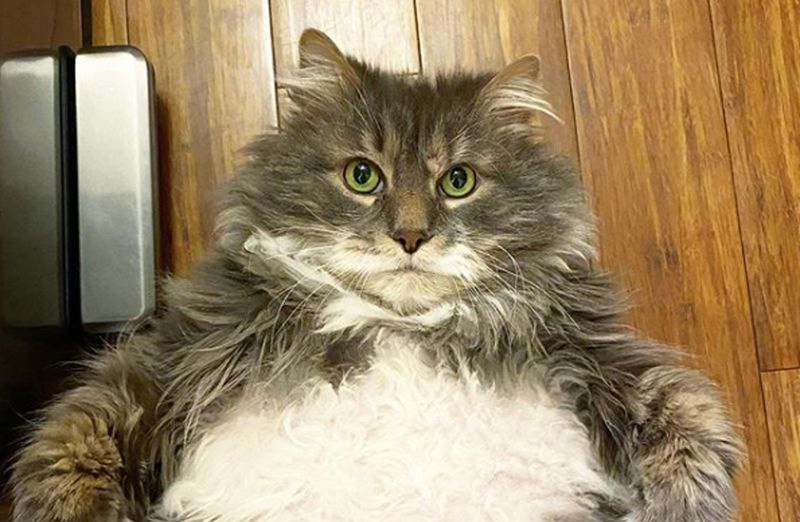
That’s the case with Wilford, a handsome eight-year-old tabby who weighs in at a hefty 28 pounds.
Wilford is living with a D.C.-area foster couple, who have the long-haired dude on a diet and are trying to get him to exercise. They say his ideal weight is about 14 pounds, half of what he weighs now.
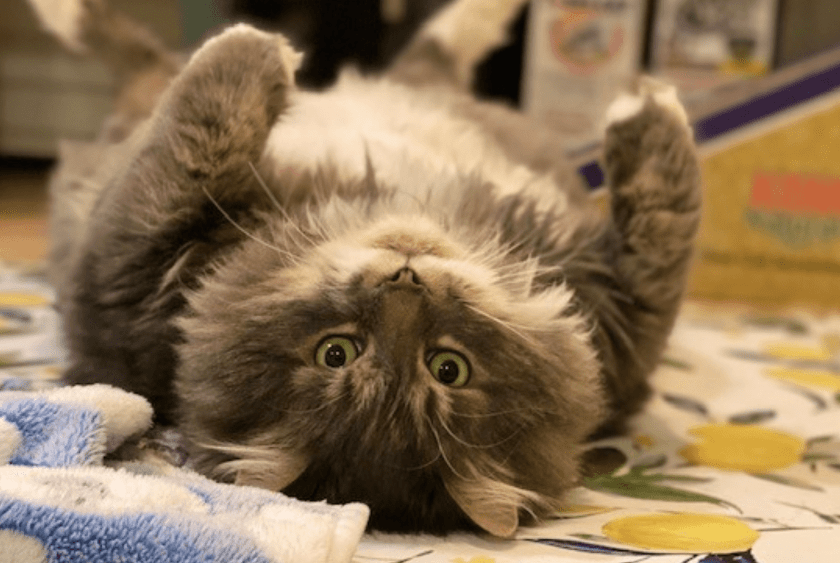
But as the video below illustrates, Wilford is so heavy, “playing” for him means laying on his back and doing “crunches” while batting at his wand toys instead of chasing them:
“Wilford absolutely loves to play- but he only feels comfortable doing so while safely ensconced beneath the dining room table,” his foster humans wrote on Instagram. “Kind of like preferring to work out at home instead of at the gym!”
In a bit of TMI, they say Wilford’s dropped some weight and is ready to start the process of screening for a forever home, but they’re still concerned over his sluggish ways and his “irregular vowel movements.”
Read: If you’re looking to adopt this regal little guy, you shouldn’t be the type who’s squeamish about blown-up litter boxes.
While handling Wilford feels like “picking up a greasy watermelon when you have to move him from place to place,” foster parent Jen tells DCist, “he is an absolute delight and we are so grateful to have the opportunity to spend time with him.”
Wilford’s favorite position is laying on his back, and unlike most cats, he actually likes it when humans scratch his belly.
“I mean, he’s just absolutely adorable,” Jen said. “He’s very dramatic, and when he wants something, he’ll roll over and just squeak. And you’re basically like, ‘Alright, Wilford, I’ll give you another tummy rub.’”
The authorities are closing in on Buddy and his catnip empire!
UNITED STATES DISTRICT COURT FOR THE SOUTHERN DISTRICT OF NEW YORK
Manhattan Division
UNITED STATES OF AMERICA v. Buddy the Cat, defendant
February 2020
INDICTMENT
THE GRAND JURY CHARGES THAT:
COUNT ONE
19 USC § 741D (Unauthorized Distribution of Schedule I Catnip)
The defendant and other relevant persons
1. Between or on about April 22, 2014 and January 1, 2020, defendant BUDDY THE CAT (“Buddy”) operated a vast interstate operation dedicated to the cultivation, packaging, distribution and sale of Nepeta Cataria, commonly known as CATNIP, and by the street names “The Nip,” “Feline Piff,” and “Meowijuana,” as well as Actinidia polygama, commonly known as SILVER VINE.
2. While overseeing his criminal organization, defendant Buddy the Cat headquartered his operation out of a New York apartment, entrusting his lieutenants Nipsy Rock, Socks the Evil Killah, Chairman Meow and Pawblo Escobar with the sale and wholesale distribution of catnip and silver vine, both Schedule I nipcotics according to the United States Drug Enforcement Agency (DEA).
3. During his tenure as the east coast’s primary “Niplord,” Buddy the Cat did engage in a ruthless campaign of violence and intimidation in order to claim territory (“corners,” “stoops” and “blocks”) for himself and his criminal organization.
COUNT TWO
23 USD § 892b (Criminal Endangerment of a Kitten)
4. Buddy the Cat, aided by his capitans, lieutenants and soldiers, did participate in the recruitment of kittens younger than six months of age for the purpose of serving as runners for “The Nip” and as lookouts to provide advance warning of the presence of law enforcement. The young kittens were recruited with promises of a glamorous lifestyle, compensation in the form of Temptations treats, and “street credibility.”
COUNT THREE
USD 113a § 046 (Feliny catslaughter in the first degree)
5. Buddy the Cat and his aforementioned lieutenants participated in the ruthless and diabolical elimination of rivals and potential “snitches,” among them Fat Tony Catsonova, consigliere of the Il Nipolino catnip cartel, Felix “Heisenpaw” White, chief chemist for the Los Angeles-based Los Gatos criminal gang, and “Meowvelous” Mikey Mike, a show cat who moonlighted as a dealer specializing in high-grade silver vine.
COUNT FOUR
USD 562a § 215 (Conspiracy to transport catnip across state lines)
6. On or about Oct 12, 2016, defendant Buddy the Cat and Nipsy Rock were observed by a federal agent discussing the shipment of 4,000 lbs of premium Meowijuana, with a street value of approximately $200,000 USD, from a grow warehouse in California to the operation’s Nip Distribution Center in Newark, NJ. In addition, defendants Chairman Meow and Pico de Gato were overheard planning the ambush and robbery of a silver vine shipment intended for a Los Gatos stash house in Houston, Texas.
The Substantive Violation
Defendant Buddy the Cat did willfully participate in the manufacture, distribution and sale of Schedule I nipcotics, the termination of rival Niplords, a protracted series of turf wars and a permanent campaign of disruption and terror aimed at his rivals in the illegal catnip trade.
Have you seen Buddy the Cat? Federal authorities have announced a $10,000 reward for information leading to the successful capture and conviction of the notorious niplord.
Do your cats graciously allow you to sleep on your own bed?
Here’s a question for cat servants: Do you “allow” your feline overlord to sleep in your bed?
I was surprised to learn there’s some controversy about this subject, because truthfully I didn’t think we have an option as dedicated cat servants.
The question becomes a little more difficult if your cat wanders outside all day. Outdoor cats can introduce fleas, ticks and dirt to your home and bed. (The Budster is an indoor-only cat, and on PITB we advocate indoor living for the simple reason that domesticated kitties live, on average, a whopping 13 years longer as indoor pets.)
When I adopted Buddy I had a sort of vague plan to restrict him to his own bed and the floor, but I was disabused of that notion in less than an hour after the little dude came striding out of his carrier and began laying claim to everything in his sight like a tiny, furry Genghis Khan.
Buddy didn’t want to use his fluffy new cat bed. He invited himself onto my bed and that was that.
“I set the rules here, servant!”
One of the first few nights after I brought him home, I awoke to find him contentedly snoozing with all four paws wrapped around my right arm, holding it tight like a stuffed bear or a security blanket. In the five years since, he’s established a consistent habit: Either he sleeps on top of me or burrowed in next to me.
“Let me in!”
Of course there have been times when I’ve crashed without checking to make sure he’s in the bedroom, or simply didn’t realize he was somewhere else. When that happens, I will be dragged out of bed again by his persistent, insistent, high-decibel meowing and door-scratching. Little dude is not subtle when it comes to letting me know he needs to be let in.
I’ve read about new cat servants who take a new kitten or cat home and lock the little one out of the bedroom at night. That’s not cool, especially with kittens. They’re babies! They need comfort. You’re their replacement for their mom and litter mates. (Just be careful about rolling over.)
If you shoo your kitty off the bed or lock her out of the room at night, you’re not only creating stress for your new family member, you’re missing out on a way to bond.
And if you don’t want your cat directly on your bed, say for allergy reasons, you can find a happy medium: Elevate the cat bed on a table or chair so your cat can snooze next or near to you without sleeping directly on your sheets.
If you’re having a difficult time motivating your feline friend, buy one of those nifty heating pads and watch as your furred one is drawn to it like a heat-seeking missile.
What’s the situation in your house? Do you allow your cats to sleep on your bed?
“Being the benevolent overlord that I am, I allow my human to sleep on the bed, and to enjoy the great honor of being my mattress.”




 Pain In The Bud