Nekorepa’s homes and apartments are designed with cats in mind.
Proving once again that their country is home to some of the most enthusiastic cat-servants, Japan now has a real estate agency that lists only cat-friendly homes and apartments.
Actually, cat-friendly might be an understatement. Nekorepa Real Estate (neko is Japanese for cat) aims to hook people and their furry buddies up with homes built with cats in mind.
What does that mean? Bathrooms that have built-in cat doors, for example, so renters and homeowners can keep litter boxes there, and presumably put a permanent end to the never-ending feline freak-outs when cats are left out while their humans occupy the throne.
Others have custom-built alcoves in less-trafficked areas where litter boxes can be tucked, with ventilation fans built into the spaces. Almost all of them have an array of perches and comfortable cat-size window spots.
A home earns Nekorepa’s official seal of approval if it meets three criteria, Japan Today reports: “[A]bundant natural sunlight (to facilitate cozy cat naps), floors and walls with scratch-resistant surfaces (so your pet can run and play to its heart’s content), and a design that ensures your furry friend can’t slip out of the apartment and get lost while you’re away from home.”
Click on the images below for larger versions. These are some sweet cat digs:
Pretty much every Nekorepa home has built-in feline-friendly features, like easy-to-reach window perches, plus platforms, bridges and walkways for when cats feel like viewing their kingdoms from above.
It’s worth noting that there’s a legitimate need for a service like this in Japan. Space is at a premium, rental prices are sky high, and it’s not easy to find landlords who allow pets. That’s one reason cat cafes were born in Japan and continue to enjoy success — they cater to people who love cats but can’t have them in their homes.
If you’re living in Tokyo you’ll have the most options, but the company says it’s expanding throughout the country. As for the rest of us, let’s hope a few cat-loving real estate agents read this…
A kitten and his best friend, a puppy, are warming hearts with a video of them showing their love for each other.
Who says cats and dogs have to be enemies?
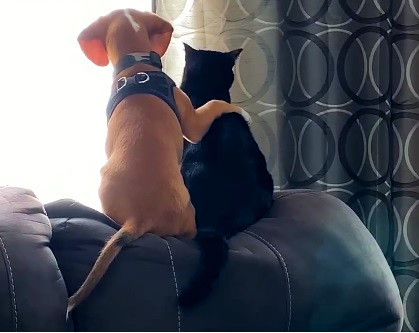
Bo, a 5-month-old Beagle puppy, drapes a paw around his best feline bud, 10-month-old Jasper, in this video showing that cats and dogs getting along is not a sign of the apocalypse, contrary to what Bill Murray said in Ghostbusters all those years ago.
Lisa Plummer of South Bend, Indiana is the pet mom to the adorable duo.
“Bo loves his cat siblings so much,” Plummer wrote, adding the little ones sometimes “drive me crazy with their constant chaos.”
“This sweet moment melted my heart,” she wrote, “and made me want to take back all the bad things I’ve said about them.”
Ingredients can change without any indication on pet food packaging or acknowledgment from the companies that manufacture pet food, the study revealed.
We’ve all heard the oft-quoted factoid claiming domestic cats kill billions of birds and small animals every year, and unsurprisingly that number is contested and controversial.
One reason skeptics doubt those numbers is because researchers didn’t observe cat behavior and extrapolate the ecological impact — they handed out questionnaires to owners and asked them how often their cats brought dead animals home. To get accurate results, researchers have to be confident people are answering honestly and have reliable memories. It’s really not the best way to do a study.
So a team at North Carolina State University came up with a better way to measure cat predation on wildlife: They’d take hair samples from more than 400 cats, which would reveal how much of their diets consist of cat food versus prey.
Hair analysis can reveal different isotopes, so the team would be able to directly note each cat’s diet by distinguishing between pet food isotopes and those from prey animals. As the team explained:
A common way to understand the composition of animal diets is to collect samples of fur, nails, or blood from an animal and analyze its carbon and nitrogen isotopes. All organic materials contain isotopes of elements that get locked into body tissues, following the basic principle that you are what you eat. For example, the ratios of nitrogen isotopes present in carnivores are dependably distinct from those of plant eaters. Similarly, researchers can distinguish the types of plants that an animal eats by measuring the ratio of carbon isotopes.
It was a good idea, but the study was derailed by an unexpected discovery: No one knows what the heck is in pet food.
Cat food manufacturers fill their products with mystery ingredients, the team found, which means one bag of kibble or one can of wet food doesn’t have the same ingredients as the next, even if they’re the same flavor from the same company.
Although they can meow in protest, our cats can’t tell us their food tastes different. (Source)
Additionally, pet food manufacturers can — and do — change what they put in their products without notifying customers or acknowledging the changes on the packaging.
As a result, the research team couldn’t identify which isotopes were from cat food and which ones were from hunted meals.
“We really thought this was going to be an ideal application of the isotope methodology,” said scientist Roland Kays, a co-author of the study. “Usually these studies are complicated by the variety of food a wild animal eats, but here we had the exact pet food people were giving their cats.”
That discovery essentially rendered the study useless for its original purpose, but like all good scientists, the North Carolina State team realized that failure reveals just as much as success, even if it’s not necessarily what you’re looking for.
“This isn’t what we aimed to study, but it is important in as much as there are hundreds of millions of cats (perhaps more) on Earth,” said Rob Dunn, a professor in NC State’s Department of Applied Ecology and co-author of the study. “The diets of cats, dogs and domestic animals have enormous consequences for global sustainability, cat health and much else. But they are very non-transparent. In short, at the end of this study we are still ignorant about why some cats kill more wildlife than others, and we have also found we are ignorant about something else, the shifting dynamics of ‘Big Pet Food.'”
As veterinarian Shawn Messonnier put it in an editorial for Pet Age, “the pet food industry remains shrouded in mystery about what’s really inside the pet food bag and how it’s created.”
Calling for more transparency in the manufacture and packaging of pet food, Messonnier pointed out ingredients can have a drastic effect on the health of our furry friends.
“For pet parents, a big leap of faith is required of them because unlike fresh human food, you can’t visually verify the ingredients used, their sources, freshness or the safeness of their handling,” he wrote. “Label language can be difficult to discern, too, so people rely mostly on the observations and opinions of friends and family they trust. Inevitably, people hope what goes in the bowl will translate into well-being and happiness for their dog or cat.”
Just to clear up any misunderstandings — and hopefully stave off more of those “Would a tiger and a house cat be good friends?” questions — cats aren’t down with each other just because they’re cats.
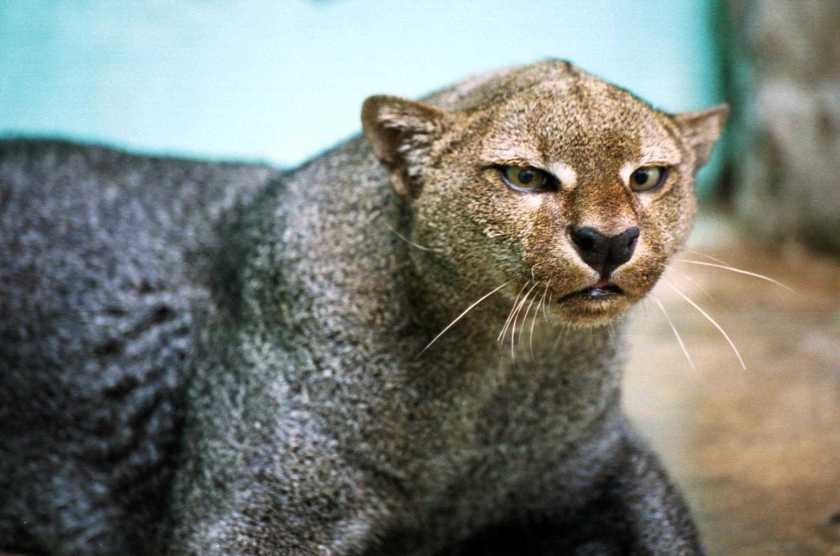
You won’t see a jaguar high-fiving a jaguarundi like “Sup bro? Hunt anything delicious lately?”
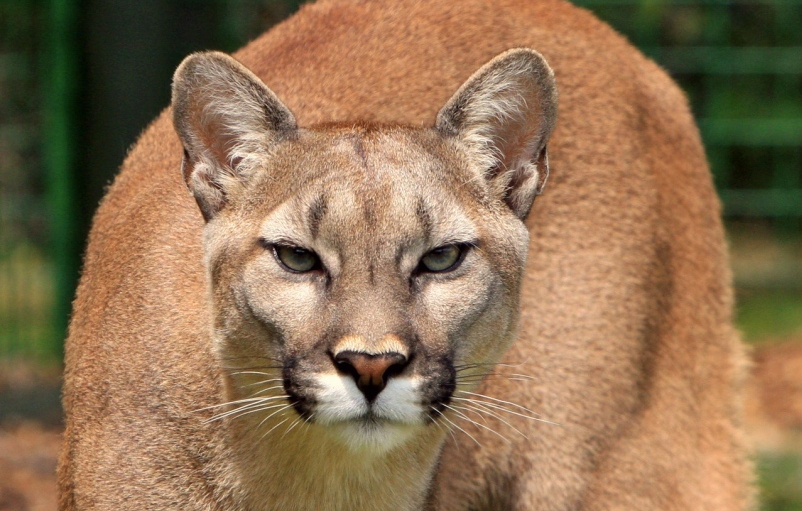
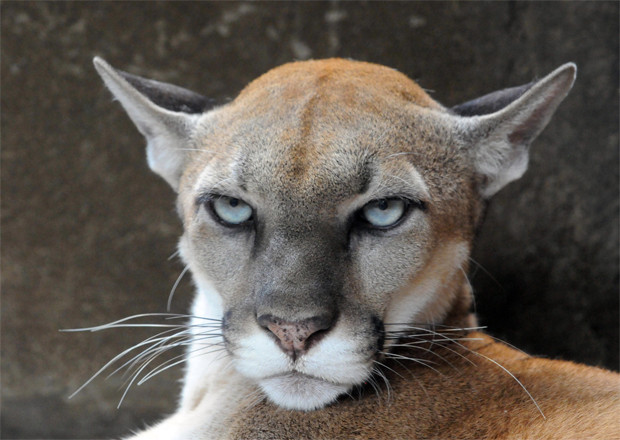
And you sure as hell won’t see your cat shooting the shit with a puma on your back porch, trading war stories about taking down prey.
Nope. To the puma, your cat is the prey.
That’s what happened early on Thursday morning in Boulder Creek, California, where footage from a Ring doorbell cam shows a puma — also known as a mountain lion or cougar — hovering over something partially obscured by a planter. There’s a flash of domestic kitty eyes for the briefest instant, then more noise followed by the puma walking away with the cat in its jaws.
Despite their large size, cougars are not considered “big cats” and are not aggressive toward humans. Source: CBS2NY
Sue Ann Sheely, whose camera caught the attack, said it’s the second time she’s seen a local cat fall victim to a cougar. She sent the footage to a local news station so her neighbors will finally wise up and bring their cats indoors.
Like coyotes, pumas aren’t breeding in greater numbers or suddenly intruding on human territory: We’re the intruders, chipping away at the wild cat’s habitat with each new housing development and strip mall we build. The majestic-looking cats die in unusually high numbers when roads cut through their ranges, and simply brushing up against a human neighborhood is often enough to get them shot.
With fractured habitats and fewer prey animals to hunt, pumas will sometimes turn to domestic animals as prey. Attacks on humans are exceedingly rare, and pumas normally do their best to steer clear of humans.
A recently-neutered cat gets an assist from his kitty friend.
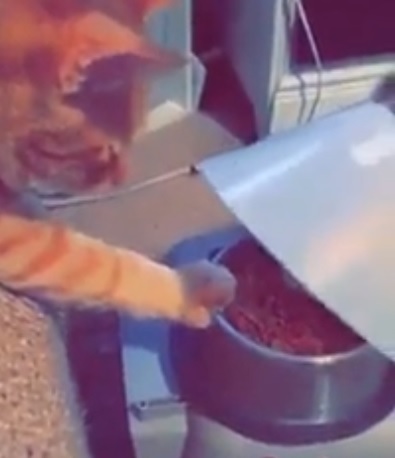
Moofie the cat, who was just neutered, couldn’t get to his food bowl because of the Elizabethan collar which was placed around his neck to stop him from aggravating the incision.
Cat parent Brianna K. Leroux placed Moofie’s bowl on top of his cat carrier, but that caused another problem: The bowl would fall off the carrier as Moofie ate.
Moofie’s best feline buddy, Simba, came to the rescue. In the video below, you can see Simba holding Moofie’s bowl so the on-the-mend little guy can eat in peace:



 Pain In The Bud