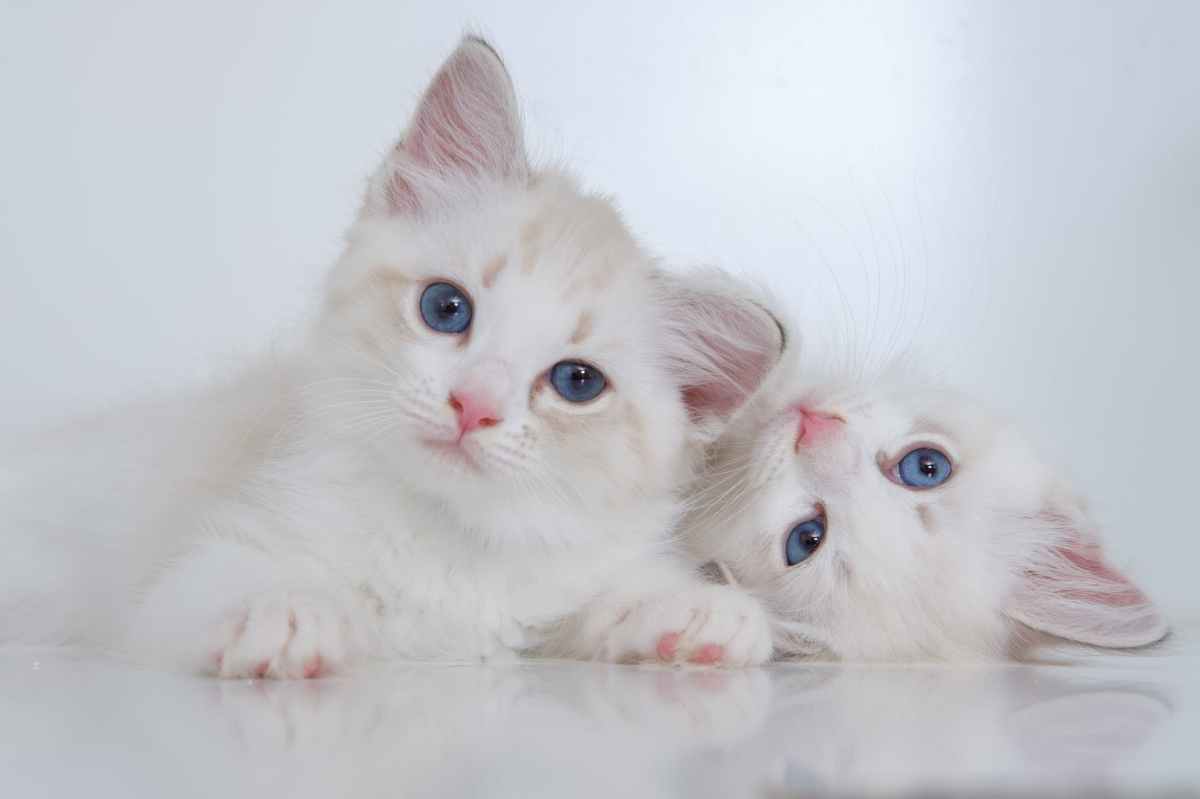
The Unflattering Cat Photo Challenge!

Sharing the derpiest photos of your cat(s) has become the new viral trend.

The hashtag #unflatteringcatphotochallenge has been trending on Twitter and Instagram the past few days, and Buddy’s not one to let an opportunity go by.

Here’s a derpy and surprised-looking Buddy:

IMG_0492

Here’s a loafing, chubby-looking Buddy:

bud_meatloafing

Here’s an out-of-focus, annoyed-looking, panting Buddy:

IMG_4831

Here’s baby Buddy looking like he’s a strangled muppet:

badbuddy

Study Confirms Cats Are Set At Ease By ‘Slow Blinks’

For the first time, a study shows slow-blinking has a positive effect on human-feline communication.

I’d been in Japan for almost two weeks last year when I dialed back to the States on a Facetime call and my mom — who had been taking care of Buddy in my absence — held Bud up to her iPad.

“Someone wants to say hi to you,” she said.

Buddy looked at me, then tentatively blinked with one eye. When I returned the blink, he meowed excitedly, reaching a paw out to the screen.

Aside from making me feel bad about leaving my cat for so long, the exchange between Bud and I seemed to confirm the importance of the slow eye-blink in feline-human communication. It also confirmed that he missed me.

Now there’s a formal study that, for the first time, shows cats are more relaxed and more likely to approach humans — even strangers — if they’re greeted with a slow blink. Cats also like to reciprocate with a slow blink of their own when greeted that way, the study found.

blinkingcat
Credit: u/sol-aurum/Reddit

“This study is the first to experimentally investigate the role of slow blinking in cat-human communication,” said Karen McComb, a psychologist from the University of Sussex and co-author of the study. “And it is something you can try yourself with your own cat at home, or with cats you meet in the street. It’s a great way of enhancing the bond you have with cats. Try narrowing your eyes at them as you would in a relaxed smile, followed by closing your eyes for a couple of seconds. You’ll find they respond in the same way themselves and you can start a sort of conversation.”

Why does a slow blink put cats at ease?

Tasmin Humphrey, a Ph.D. student and study co-author, said it’s “possible that slow blinking in cats began as a way to interrupt an unbroken stare, which is potentially threatening in social interaction.”

The researchers say their results could help people communicate more clearly with their cats, and could be useful in shelters, where staff and volunteers are often tasked with trying to calm scared cats.

Modern Box: The Magazine For Discerning Felines

Buddy the Cat, publisher and editor-in-chief of the all-new Modern Box Magazine, seeks cats of considerable taste for the ultimate feline lifestyle magazine.

modernboxmagazine

Buddy the Cat, publisher and editor-in-chief of the all-new Modern Box Magazine, seeks cats of considerable taste for the ultimate feline lifestyle publication. The editorial department seeks cats for the following positions: Investigative Eater, Box Reviewer, Keyboard Warmer, Leisure Editor. Must have at least three years’ experience sleeping, eating and lounging in a human home.

President Buddy Blasts ‘One Meal A Day’ Cat Study

The president of the Americats registered his displeasure with a new study claiming cats should be fed only once a day.

WASHINGTON — A new study suggesting cats should only be fed once daily is “an attack on our freedoms” and “quite possibly the biggest threat to felinekind since vacuums,” an angry President Buddy said Friday.

“One meal a day! That’s what these supposed ‘scientists’ say,” the president of the Americats said during a White House press briefing. “But could it be they have an agenda?”

The president waited a few moments as aide cats wheeled in a projector, then took reporters through a slide presentation positing a connection between the study’s authors and “nefarious interlopers from the Siamese communist government.”

“University of Guelph? What the hell is a Guelph? It sounds Siamese,” President Buddy said, clicking through the slides.

“The Siamese, led by Chairman Xinnie the Pooh, want to take away your freedoms,” the president said. “They want to tell you that you can’t have a tremendous turkey dinner at food o’clock because you ate eight hours earlier. If it were up to them, none of us would ever have snacks.”

catfood

The study involved only eight cats, all four years old or younger, who were fed a large meal once a day for three weeks, then smaller meals four times a day for three weeks. Feeding cats only once a day helped those cats burn more fat and make better use of the protein available to them, the authors said.

Cats fed once daily seemed “more satisfied” and didn’t ask for food as much as they did when they were fed four times a day, according to the study.

“That’s how you know it’s fake news,” President Buddy said. “Who are these supposed cats who are cool with eating once a day? I’ve never met them.”

The president said he would form a new commission, the Yums Studies Council, to “foster studies supporting the view that we need at least four meals a day, and that six or seven would be awesome.”

Screenshot_2020-09-25 6gxnxnia97c51 jpg (WEBP Image, 1241 × 1258 pixels) - Scaled (76%)

Big Buddy Goes Face To Face With A Tiger

A mere three feet away, the tiger looked me in the eye.

The big cats at the Bronx Zoo have had a rough 2020 too.

First the zoo was shut down — along with thousands of other gathering places — due to the novel Coronavirus.

Then a tiger at the zoo got sick and tested positive for COVID-19, marking the first positive test for an animal in North America and the first recorded instance of human-to-tiger transmission. Seven other big cats at the zoo caught the virus, including four tigers and three lions.

Thankfully they recovered and everything — or almost everything — looked normal when I visited this week.

One of the awesome things about the zoo’s Tiger Mountain is that it has a trio of viewing ports that provide a prime view of a small pond where the tigers drink, swim and nap.

This tiger lounged in the distance for a few minutes, then got up and gave us a show.

bronxtiger16

At one point the tiger came right up to the glass and looked at me:

bronxtiger17

Standing three feet from a tiger is an experience, glass or no:

bronxtiger6

Not as terrifying as Buddy’s visage, of course, but still something to behold.

bronxtiger11

bronxtiger

bronxtiger7

bronxtiger10

The lions were less welcoming. They were clumped up in the shade of an oak tree, snoozing without so much as a tail flick for motion.

Next was a snow leopard. This guy clearly didn’t deal well with a lot of humans gawking at him, and I could only snap a few shots before he retreated back up a hill in his enclosure, where the angle and brush gave him a measure of cover from human eyes.

I also saw him spinning in a circle repeatedly, a sign of zoochosis. I’m not an animal behaviorist and I’m not qualified to judge the work of the Bronx Zoo’s keepers, who obviously care a great deal for their animals. It’s just a reminder that even the best zoos in the world — with entire teams dedicated to things like enrichment and enclosure design — struggle to keep animals healthy and happy in captivity.

bronxsnowleopard3

bronxsnowleopard

Even though the name of their species sounds like an Italian dessert and they’re often mistaken for baboons, Gelada are old-world monkeys native to the grasslands of Ethiopia.

Geladas are the only primate species that are grazers: Up to 90 percent of their diet consists of grass and grass seeds. They’re easily recognizable by the hourglass-shaped furless patches on their chests, and they’re the only monkeys to form “herds” instead of troops, with an individual herd’s size swelling to more than 1,000 at a time.

When Geladas aren’t eating they’re grooming each other. Allogrooming, or social grooming, doesn’t just help monkeys keep their fur neat and free of parasitic bugs — it’s also a way of maintaining social bonds and reducing tension.

When I visited, I saw a male Gelada grooming a female. Female “heart patches” are usually more pale than their male counterparts, except when they’re in heat. So it’s probable that this scene is a bit of foreplay during mating season:

bronxgelada2

A female on the rocks nearby. The enclosure features a series of cliffs surrounding central grassland, closely mimicking the species’ native habitat:

gelada3

This bird got within feet of the path adjacent to its exhibit, and its kind seem to have free reign within the park, as I saw another one hanging out in a wooded area earlier.

I have no idea what kind of bird this is, but he was very vocal and insistent about something:

bronxbird

A group of zebras. I think they were sleeping. These four didn’t move a muscle, and zebras are one of a handful of species who can sleep while standing upright.

bronxzebra2


A brown bear enjoys the warm weather, which topped out at almost 80 degrees. Another bear was nearby, taking a dip in the pool.

bronxbearbronxbear3

And finally, a friendly reminder to the zoo’s visitors: Wear your masks! The zoo enforces an always-on policy for masks, which I think is a reasonable precaution. While masks may not be strictly necessary while strolling down the wide visitor paths of the zoo, viewing spots at popular exhibits can get crowded, and some of them are partially-enclosed.

bronxrhino