A man writes a stirring tribute to his beloved cat.
We take a break from our usual inanity, humor and Buddy’s mind-bogglingly terrible advice column to call your attention to this beautiful tribute to a special cat.
Tom Wrobleski, an opinion writer for the Staten Island Advance, said a tearful goodbye to his cat, Malkovich, on Jan. 11.
“I’ve cried more for that cat over the last three weeks than I have over some people that I’ve lost in my life,” he writes.
Tom says Malkovich was supposed to be his kids’ cat, but ended up bonding with him:
Mal would meet me at the door when I came home, flopping down and giving me his belly. He followed me into the bathroom. He curled up next to me in bed. He would flop in the hallway upstairs and rub his face on my foot.
Don’t let anyone tell you that cats don’t bond, that cats don’t love, that cats are stand-offish. Mal loved me. And I loved him. He was my buddy. My best boy. The top cat.
He became part of the fabric of our lives. He even grudgingly tolerated Lucy, the neighborhood stray we adopted in 2017.
Mal’s illness snuck up on Wrobleski, as so many cat health problems do because our furry friends are so stoic.
“We thought that Mal was getting a little chubby in recent months. It turns out that he was ill, with fluid gathering in his abdomen,” he wrote. “The news from the vet was dire: Mal had cancer throughout his body. There wasn’t a lot we could do.”
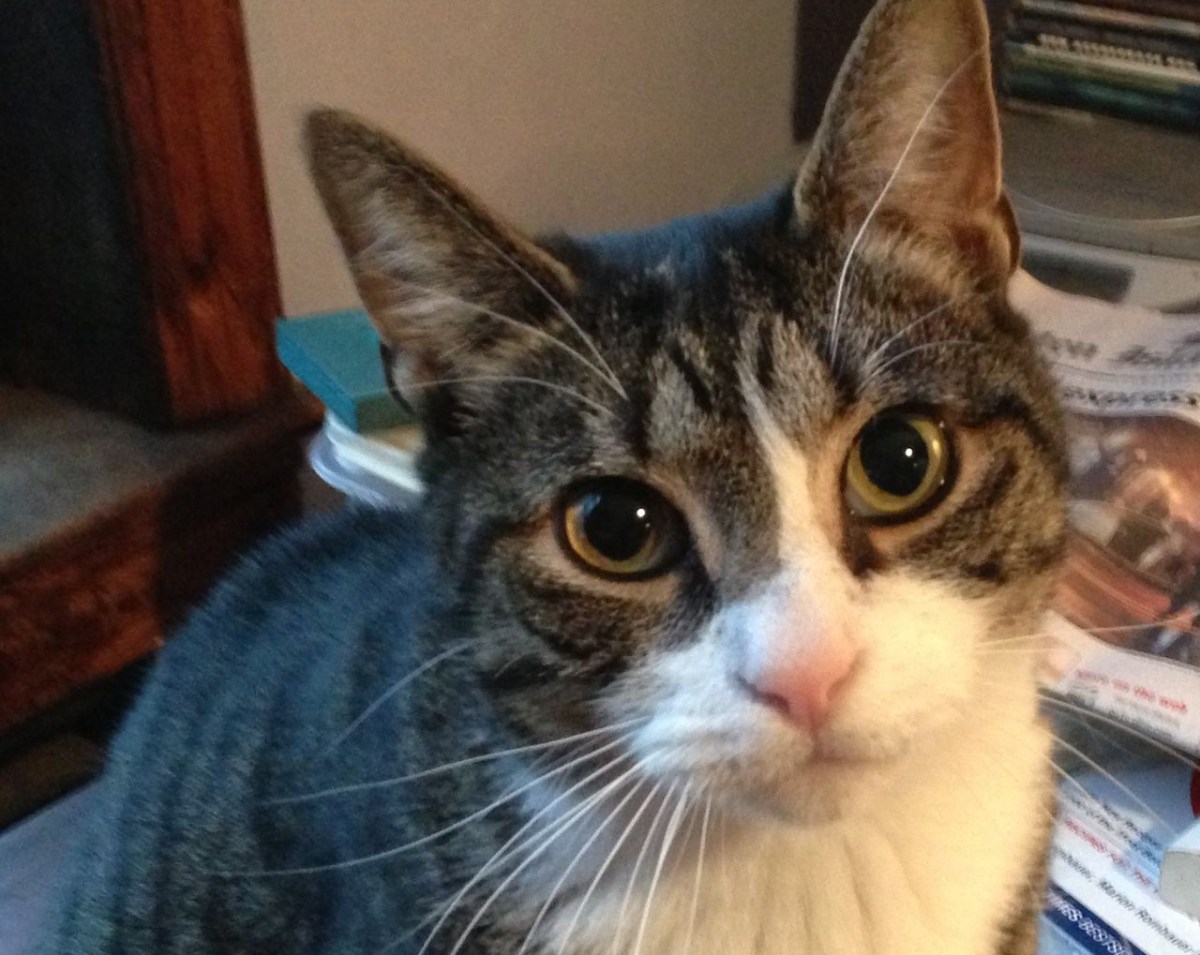
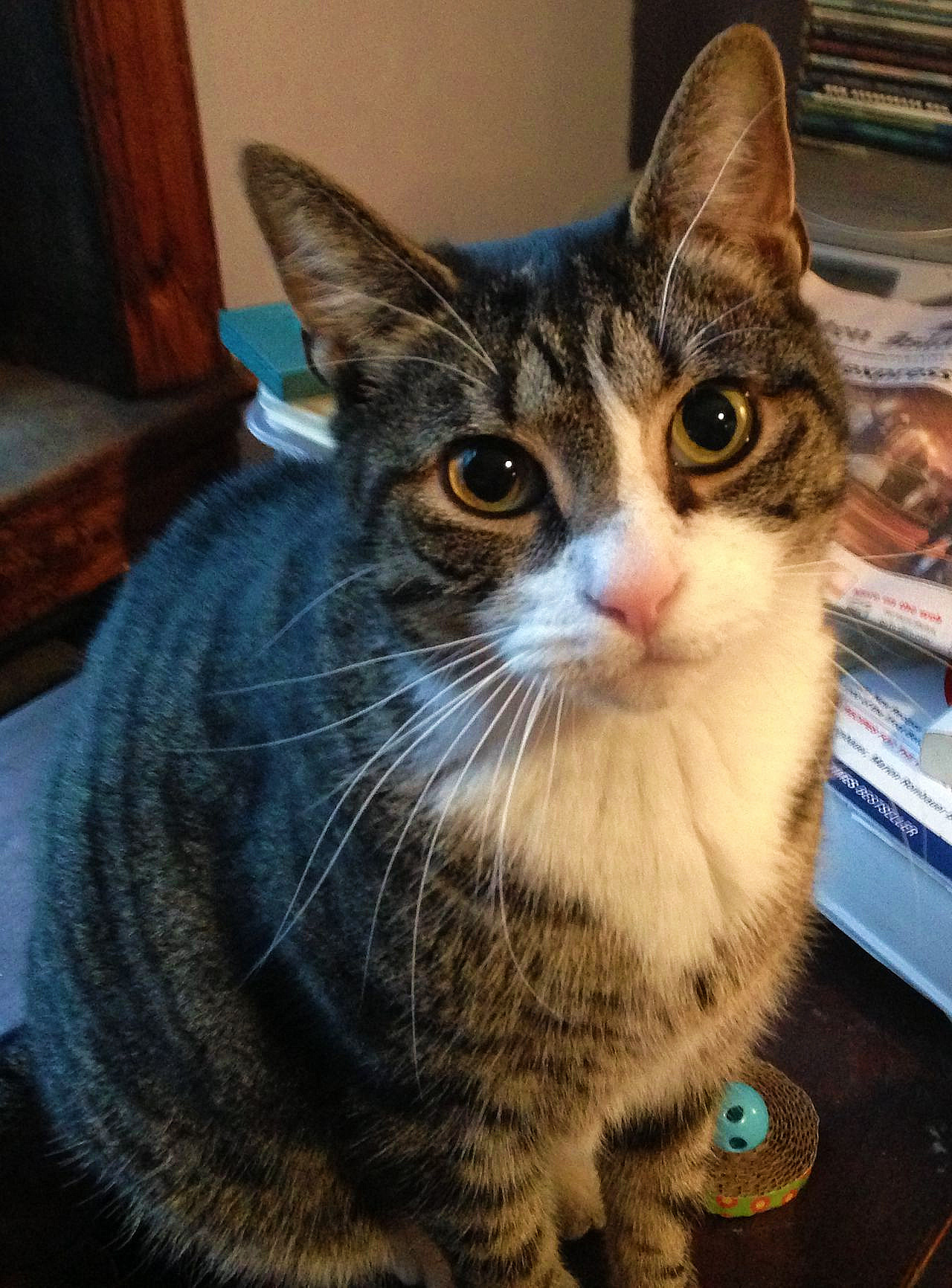
The author’s favorite photo of Malkovich the cat. Credit: Tom Wrobleski
The rest of it is really sad and would have made Buddy and I cry if we weren’t so manly and tough. Wrobleski writes about how much he misses Mal, and how much Mal changed his life during the 11 years he was a part of the family. (They adopted the little guy when he was four years old, and he lived until he was 15.)
His pain at losing the little guy is evident in every word and anecdote.
Be warned, though, that if you’re not as tough as Buddy and I, you probably will shed some tears, which Buddy and I definitely did not do. In fact, immediately after reading Wrobleski’s tribute to Malkovich, Bud and I watched a football game, drank Budweiser and shopped for a good old American pick-up truck while practicing our Sam Elliot voices.
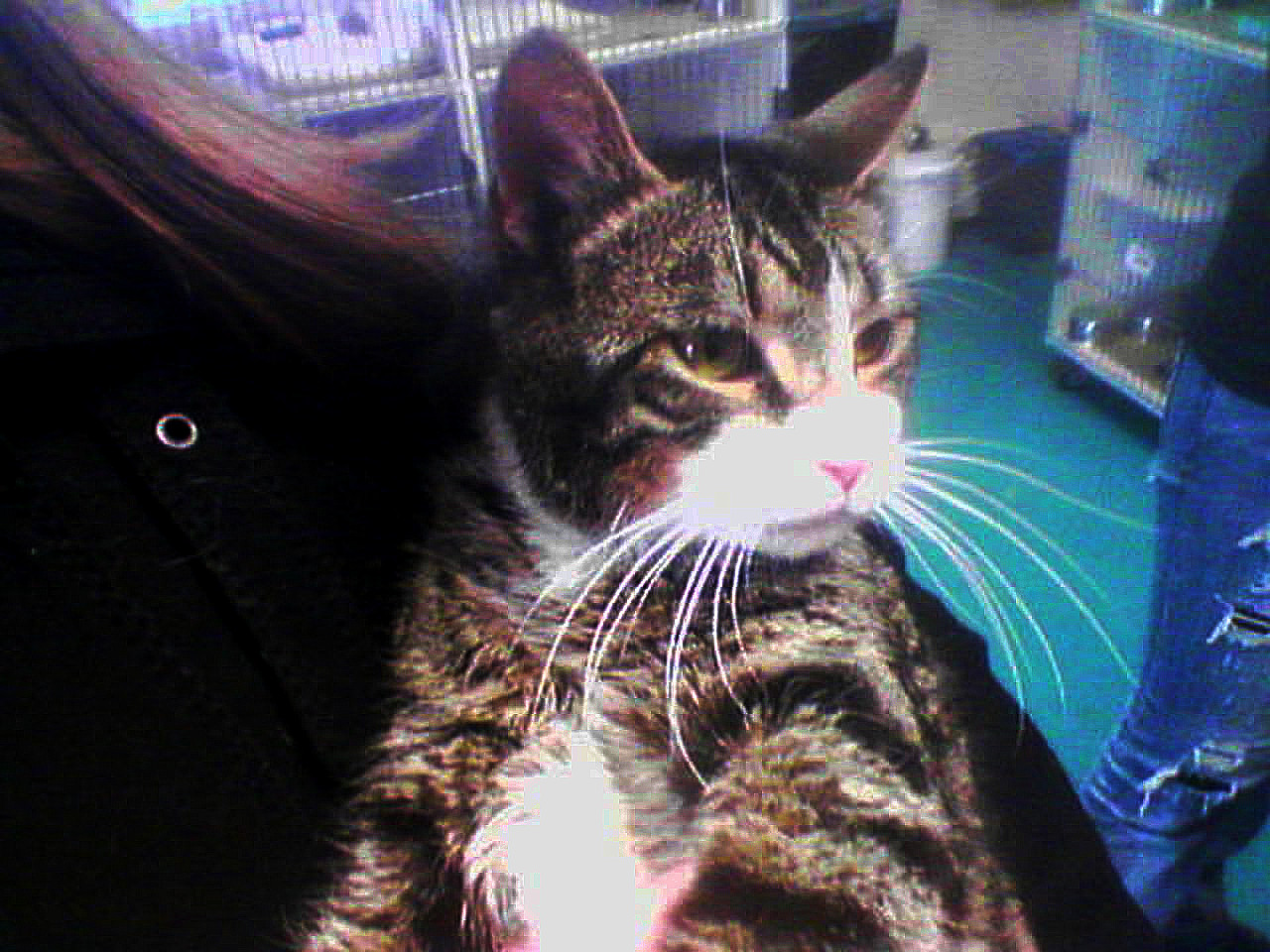
Malkovich on the day he was adopted. Credit: Tom Wrobleski
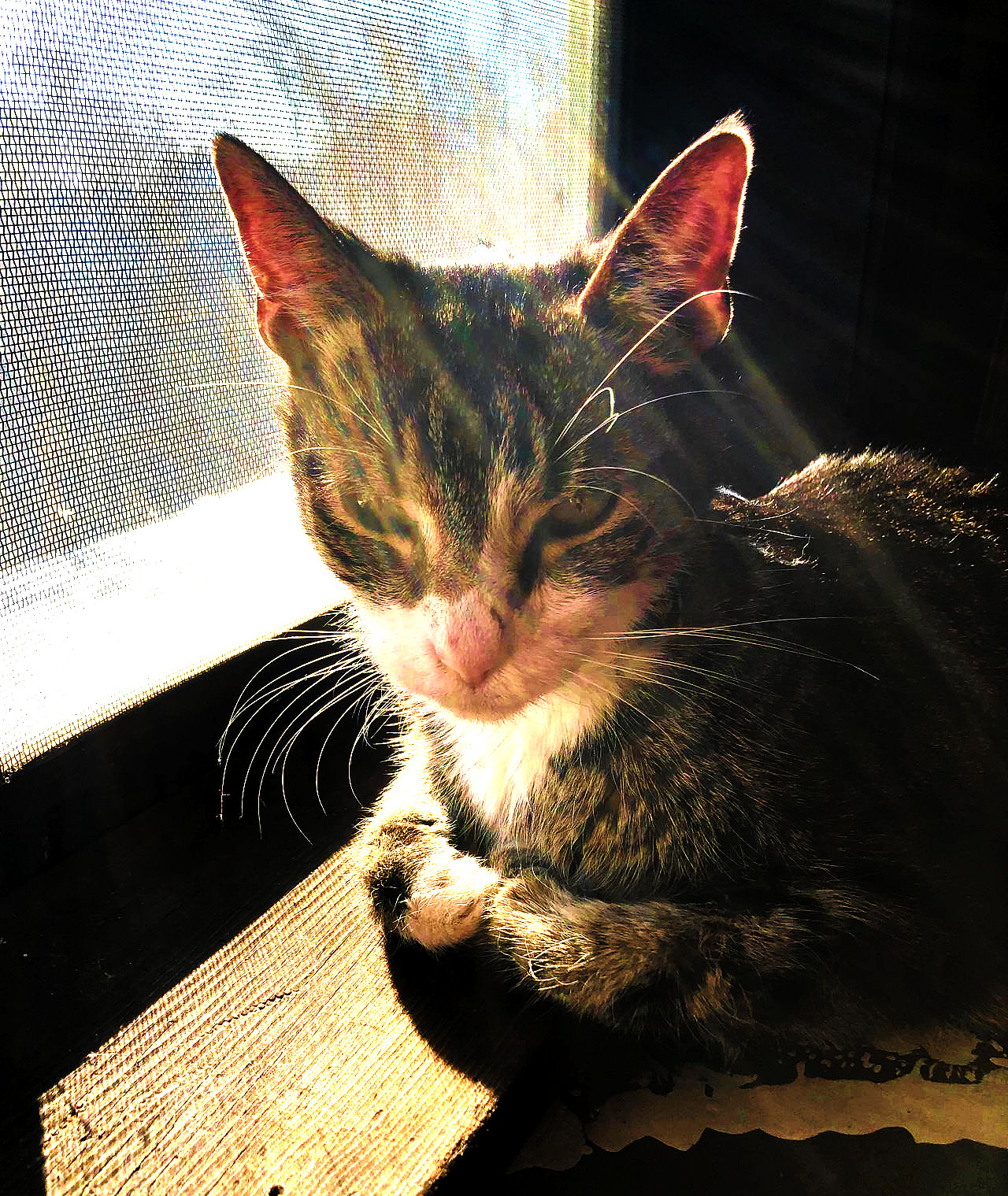
Malkovich on his last day, sitting in one of his favorite spots and soaking up the sun for the last time. Credit: Tom Wrobleski
“I don’t cry about anything…except vacuums, rustling paper bags, truck back-up beepers, dinner, and being locked out of the bathroom. But other than that, I’m fearless and keep a firm leash on my emotions!”
Thankfully for our furry friends, smaller brains don’t necessarily correlate to lower intelligence. It’s more about the complexity of neural connections.
Cats have gotten a good deal out of domestication: They’re safer, warmer and protected from almost all threats. They know where their next meal is coming from, and won’t hesitate to meow our ears off if dinner is late.
But one tradeoff doesn’t immediately appear beneficial: Domestic cats have smaller brains than the species they’ve evolved from, African and Eurasian wildcats.
“[D]omestic cats indeed, have smaller cranial volumes (implying smaller brains) relative to both European wildcats (Felis silvestris) and the wild ancestors of domestic cats, the African wildcats (Felis lybica),” the research team wrote.
Wild cats have the largest brains on average, followed by wild-domestic hybrids and domestic cats with the smallest brains of the three.
That’s another strong indicator that domestication is the determining factor in feline brain size, although the researchers point out that they are comparing domestic cats to current wildcats, and not the ancient population of wildcats from which domestic cats evolved beginning some 10,000 years ago with the dawn of agriculture and permanent human settlements.
Wildcats with friendlier and bolder dispositions were the first to approach human settlements, drawn by the rodents who were themselves feasting on human grain supplies. Humans realized that the cats were taking care of their rodent problems but weren’t interested in eating the grain, and a beautiful partnership was born.
“I have a yuge, yuge brain, the best brain. It’s tremendous.”
Smaller brains do not necessarily correlate to lower intelligence, however, and cats aren’t the only species whose brains became smaller after they were domesticated. Dog brains are about 30 percent smaller than the brains of gray wolves, but dogs have adapted spectacularly to living with humans and reading human behavioral cues.
“The dog is successful not because of the size of its whole brain per se, but because domestication has led to subtle brain changes with a stunning result: the ability to live in the world of people,” a Smithsonian Magazine article points out, noting dogs are also adept at getting people to do all sorts of things for them.
If brain size alone resulted in higher levels of intelligence, whales and elephants would rule the Earth.
Instead “the complexity of cellular and molecular organization of neural connections, or synapses, is what truly determines a brain’s computational capacity,” neuroscientist Kendra Lechtenberg wrote.
The researchers weren’t interested in drawing any major conclusions about feline cognition with the study. They’re more interested in the phenomena of “domestication syndrome,” which causes changes both physical (floppy ears, coat color variation, shorter muzzles) and behavioral. (Less aggression, playfulness.)
The jury’s still out on why exactly those traits emerge, but some studies have attributed it to differences in embryonic development. Unlike many other domestic animals, cats don’t look much different than their wild felis lybica and felis sylvestris counterparts.
The cat study was published on Jan. 26 to Royal Science Open Science, a peer-reviewed open-access journal. The research team was comprised of biologists from the University of Vienna and data curators from the National Museum of Scotland.
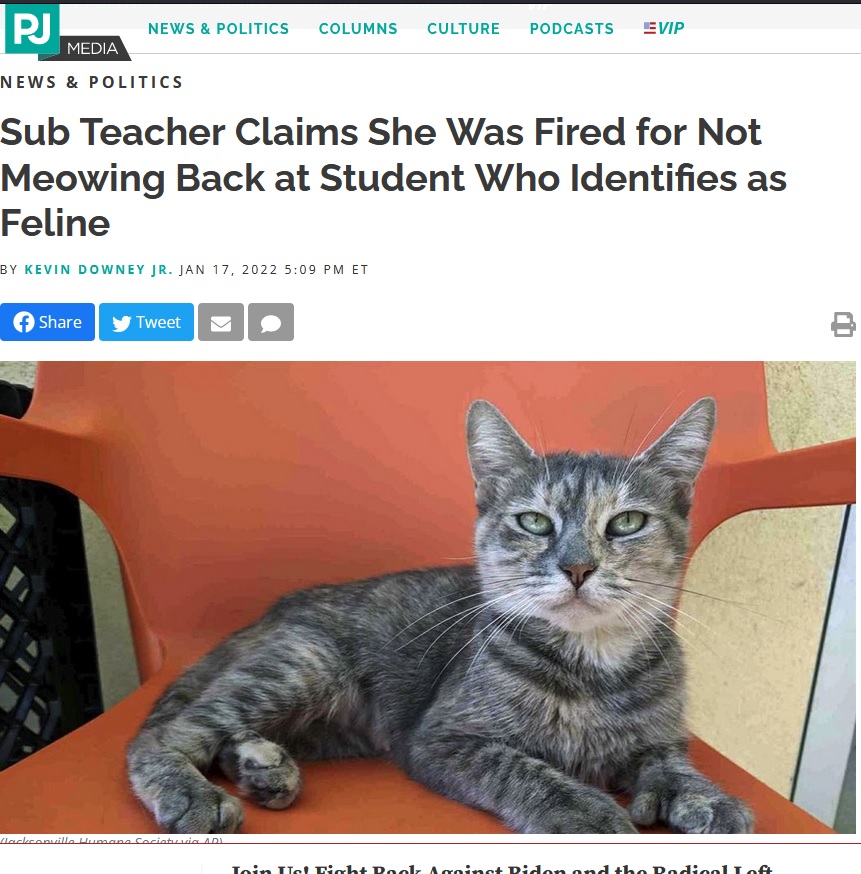
Two viral stories claim schools are allowing students to “identify” as felines, while one district is accused of providing litter boxes in school bathrooms.
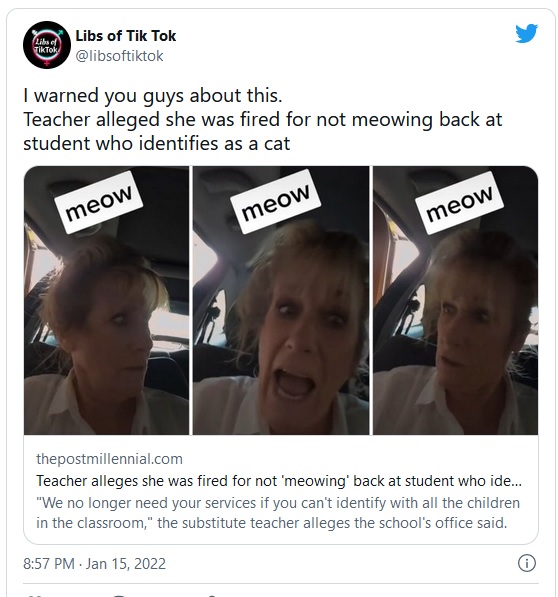
Two curious stories relating to cats have been circulating online this week: In the first story, a substitute teacher claims she was fired because she refused to meow back to a student who “identifies as a cat,” while parents in a Michigan school district were infuriated by a rumor that the district was providing litter boxes to cat-identified students in school bathrooms.
First, the obvious, or perhaps not-so-obvious considering the media attention and outrage surrounding bothstories: Neither one is true.
Why did people believe them? Because we’ve gone insane as a society, of course, and basic reality now means different things to different people depending on their political ideologies. If you’re on the left, you might think parents who aren’t sophisticated news consumers are so paranoid about school curricula, they’d believe just about anything. If you’re on the right, you’re might argue that some schools have gone so overboard with political correctness, it’s not a stretch to imagine privileges conferred on the allegedly cat-identified.
For those of us who subscribe to neither ideology, the whole thing is another sad example of the polarization that is destroying the US, the same divisive talk amplified by platforms like Twitter and Facebook.
But that’s beyond the scope of this blog, which is to celebrate cats, have a laugh and occasionally put the spotlight on animal welfare. I don’t want to lose readers by wading into a political landmine field, but most importantly I don’t want anyone to feel unwelcome on this site.
The Michigan incident started when a mom of kids at the Midland School District, about 130 miles northwest of Detroit, spoke at a school board meeting about a rumor — which she took as fact — alleging the school was accommodating “furries” by providing litter boxes in unisex bathrooms.
Lisa Hansen asked other parents to join her to “do some investigating” into the policy
“I’m all for creativity and imagination, but when someone lives in a fantasy world and expects other people to go along with it, I have a problem with that,” Hansen told the Midland school board. “This whole furry thing has just got me. I’m staying calm, but I’m not happy about it, and it’s happened on your watch, and I don’t understand it.”
Here’s the video: (It should start at the relevant section, but if it doesn’t, Hansen speaks at the 32:44 mark)
Hansen’s claims were picked up and reshared by a state GOP chairwoman, Meshawn Maddock, who warned “Parent heroes will TAKE BACK our schools” in a Facebook post.
The school’s superintendent, Michael Sharrow, was forced to do damage control with a public statement, telling parents it’s a “source of disappointment that I felt the necessity to communicate this message to you.”
“There is no truth whatsoever to this false statement/accusation,” Sharrow wrote. “There have never been litter boxes within MPS schools.”
The story about the fired substitute also had its roots in an online video, with a woman who says she’s a teacher relating the story via TikTok. The woman, who uses the handle @crazynamebridgetmichael, said she was taking attendance when a student responded to his name with feline vocalizations.
“I get to the third row and I hear this ‘meow!’ ‘Uhhh, excuse me? Excuse me?'” she said in the TikTok video. “I start looking on the ground, through the fourth row—everything’s good. Go to the fifth row—everybody’s there. Then I hear ‘meow!’ I’m like, ‘Okay, what’s up with that? Who’s doing it?’ And this little girl in the very front row says, ‘You have to meow back at him; he identifies as a cat.’ Are you kidding me?”
The student stormed out of the classroom when she laughed at him, she said, and the school’s administration fired her: “They said ‘We no longer need your services if you can’t identify with all the children in the classroom.'”
The story was picked up by several widely-read sites, included in Tucker Carlson’s daily newsletter, and reshared on prominent Twitter accounts in addition to going viral on Facebook.
The story was widely shared on social media and reported by a few dozen online media outlets.
The only problem is it isn’t true. In a follow-up video the teacher admitted she made up the story to “create awareness of what kids are going through at school.” She didn’t elaborate, so it’s not clear if she was criticizing school policies for allowing students to identify as different genders or arguing that kids’ needs aren’t accommodated. Occam’s Razor would indicate she was just chasing clicks.
The one thing that’s certain, however, is that cats don’t deserve to be in the middle of this mess.
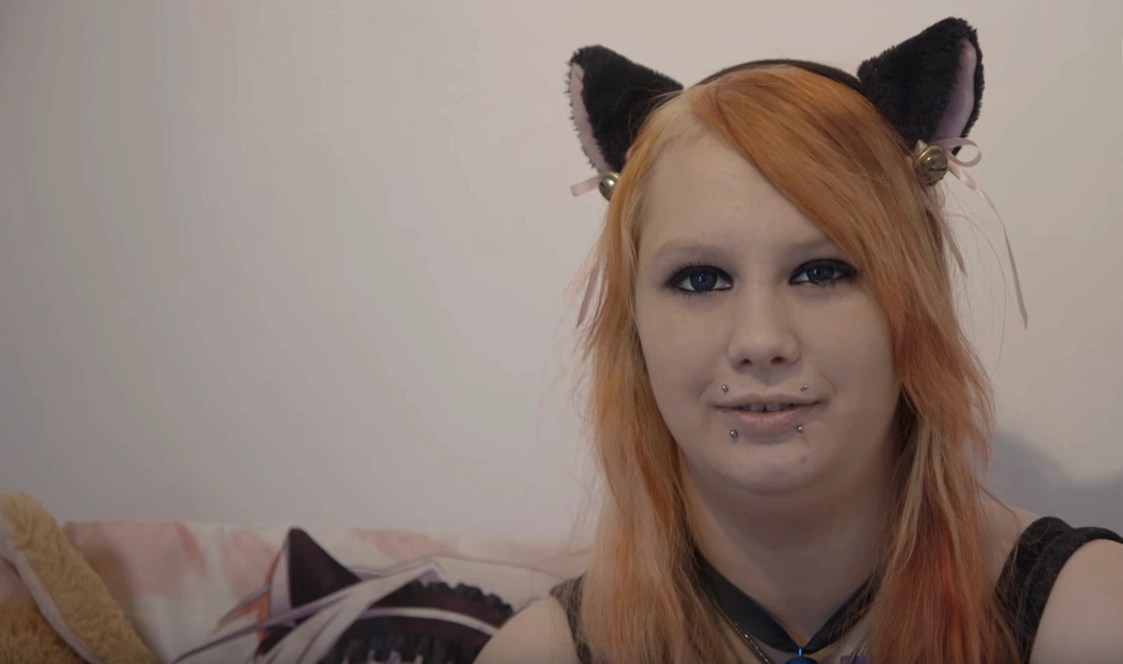
Top image: A 20-year-old Norwegian woman who identifies as a cat. The woman says she was “born the wrong species.” “My psychologist told me I can grow out of it, but I doubt it,” she told an interviewer. “I think I will be cat all my life.”
Archive 81 arrived just in time to help us through a content dead zone.
The Witcher’s excellent second season helped tide us over last month alongside Amazon’s not-so-great adaptation of The Wheel of Time, and critically-lauded The Expanse ended its six-year run on Jan. 14. Meanwhile, if network TV is your thing, the last few weeks of January through early February are filled with nothing but reruns as networks are loath to put any original content up against the NFL playoffs and Super Bowl.
Enter Archive 81: A story that promises mystery, Lovecraftian horror and a heavy dose of 90s nostalgia.
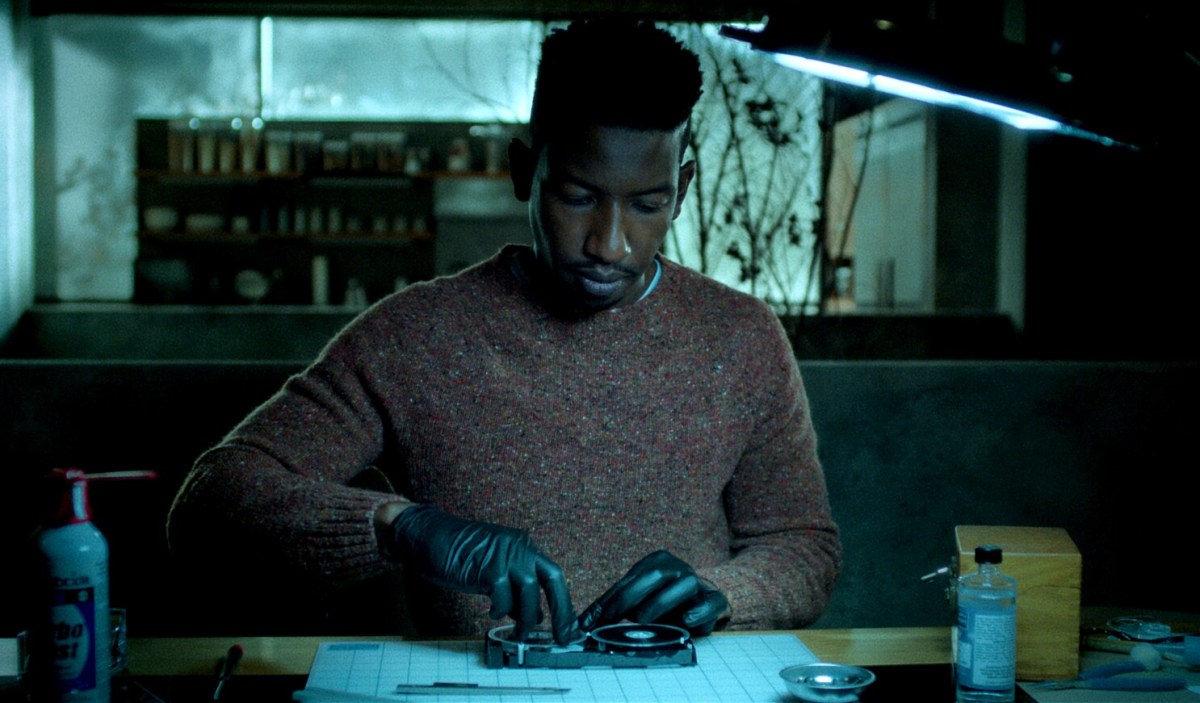
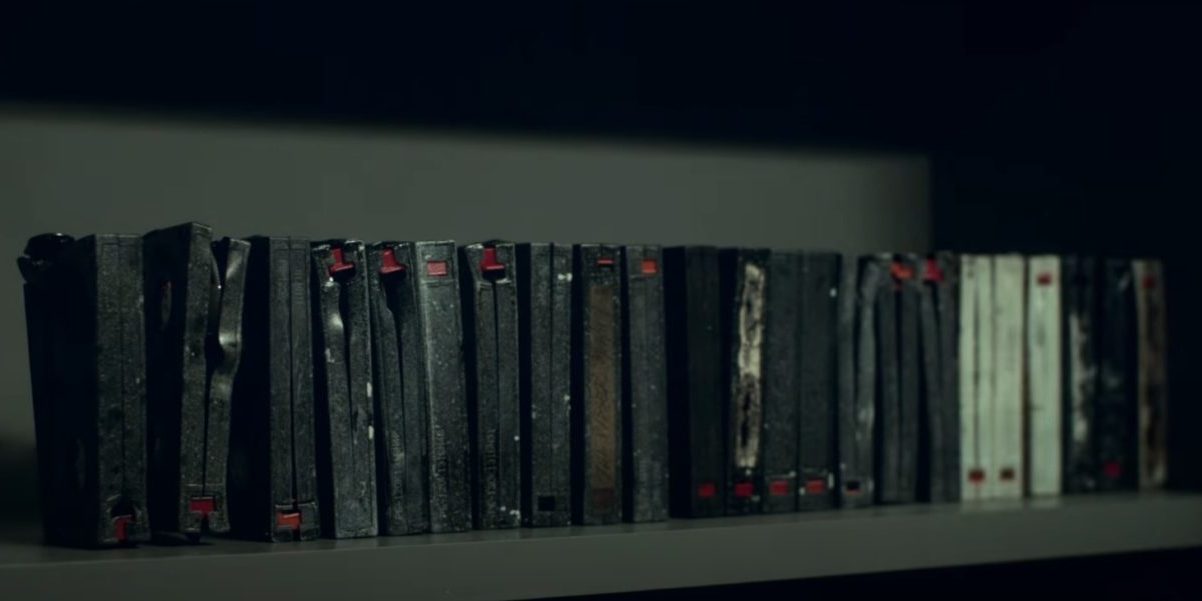
Our protagonist is Dan Turner (Mamoudou Athie), an analog enthusiast who makes a living restoring vintage media (VHS, cassette, Betamax and anything else pre-DVD), and spends his off hours crate-digging for rare recordings.
We meet Dan as he’s looking through recently-acquired VHS tapes at a street vendor’s stall in Manhattan.
“You know last month you sold me 16 hours’ worth of a T-ball tournament, yeah?” Dan asks.
“Yeah. But also, I sold you an uncut version of Phantasmagoria off channel 7,” his street vendor friend says. “That’s unreleased and very rare.”
When Dan balks at buying a box of random tapes, his vendor friend appeals to the hobbyist in him.”Look,” he says, “I know you love the hunt.”
“The hunt” he’s referring to is the obsessive drive that prompts collectors of all types to sift through yard sales, estate auctions and abandoned storage units. It’s the thrill of opening the unknown with the knowledge that most of it will be junk, but every once in a while a nondescript box will hold a rare gem.
It’s the thrill of the hunt that leads Dan to accept an archiving gig from a secretive company despite concerning red flags.
The job is to restore an archive of video cassettes scavenged from the charred ruins of a Manhattan apartment building called the Visser that burned to the ground in 1994. No one survived the building-consuming fire, and Dan’s employers believe the tapes could shed light on how the fire started as well as the people who lost their lives.
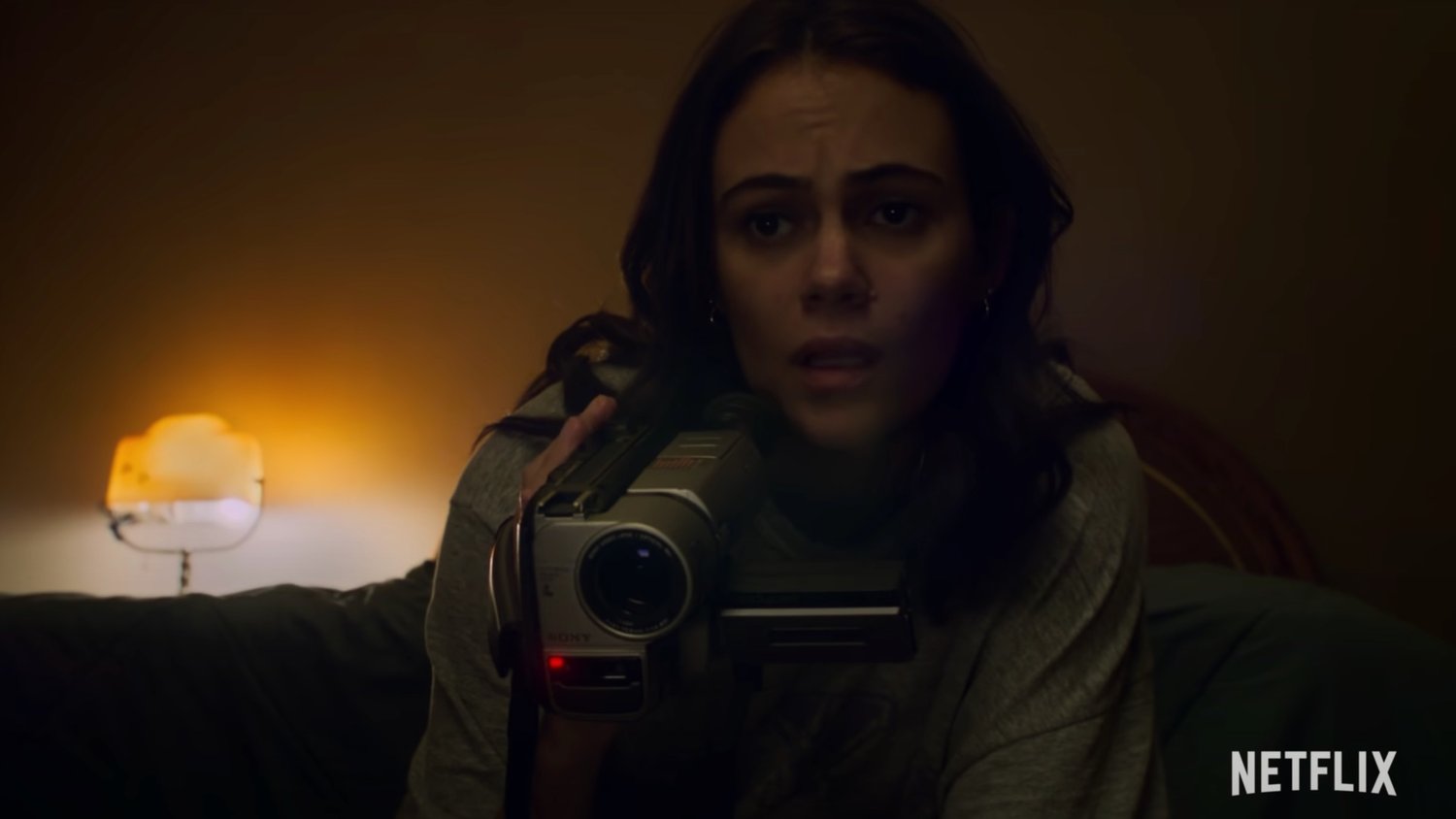
Dan finds himself increasingly invested in the story of Melody Pendras, who lived on the Visser’s fourth floor before the building was destroyed by fire. Credit: Netflix
Dan is hired by a company to restore fire-damaged cassettes that could contain important clues about a 1994 fire that destroyed an apartment building in Manhattan. Credit: Netflix
The company offers Dan a particularly generous fee for restoring and digitizing the footage, with the caveat that for the duration of the project he has to work out of a company-owned compound in the Catskills, a few hours’ drive north of New York City.
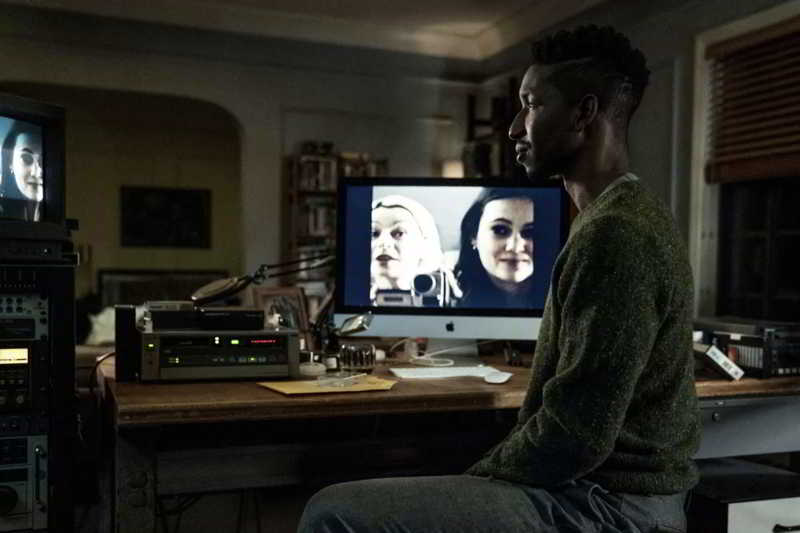
Dan accepts and it doesn’t take long for him to become engrossed in the content of the tapes he’s restoring. The collection of cassettes was shot by a young woman named Melody Pendras who moves into the historic and creepy Visser Building, ostensibly to interview its residents for a dissertation she’s doing on the strange history of the high rise.
With each cassette Dan restores and digitizes, a new chapter of Melody’s time at the Visser is revealed, and it becomes increasingly apparent that something is very wrong with the building and the people who inhabit it.
Think Ghostbusters and 55 Central Park West, also known as “Spook Central.” In the 1984 hit, 55 Central Park West’s bizarre design choices came courtesy of an architect who was heavily into the occult, and he built the high rise to serve as some sort of supernatural antenna for spirits from another dimension. The Visser has similar origins, although the details are best left unspoiled.
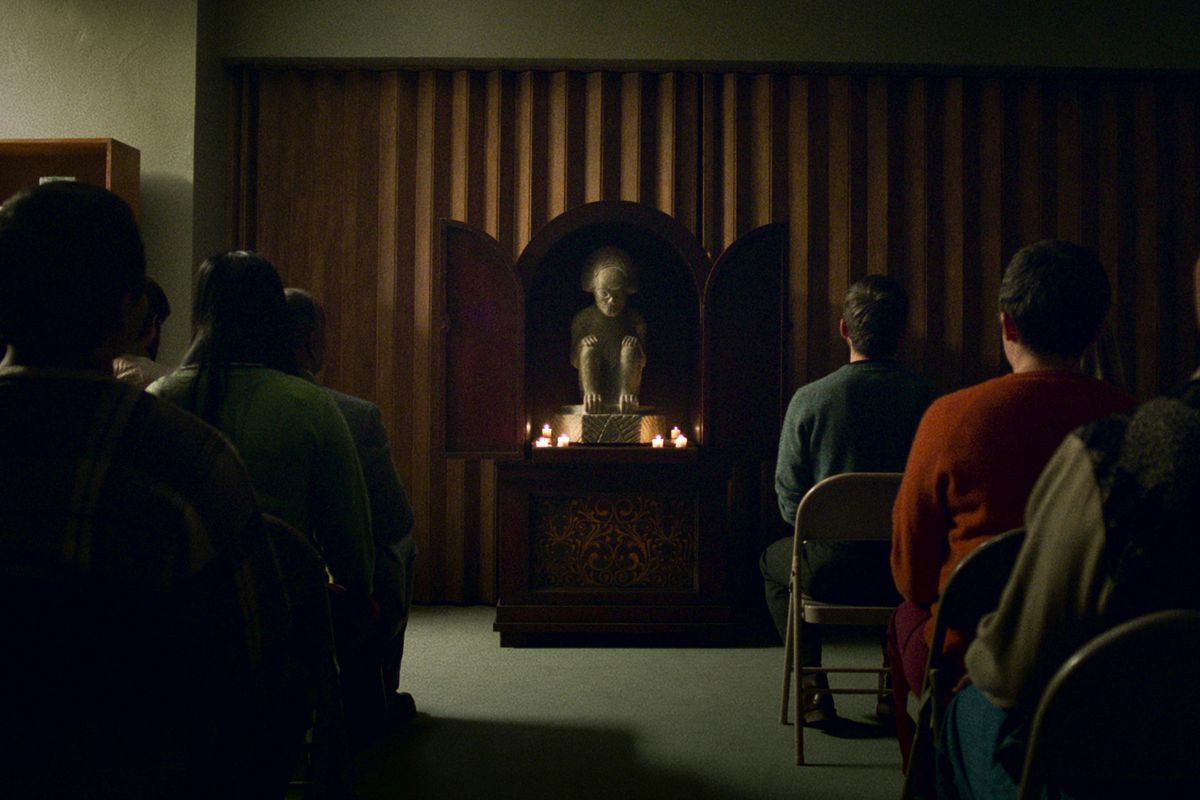
There’s something creepy going on in the Visser’s basement community room. Credit: Netflix
As Dan becomes increasingly invested in Melody’s story he begins to feel the effects of isolation, living in the brutalist compound that houses the repair studio and a cavernous living space. He’s not allowed visitors, as the content of the tapes are supposed to be confidential, he doesn’t get cell service and he begins to suspect the landline is tapped.
With a history of mental illness, Dan isn’t sure if he’s imagining things when he realizes someone else may be in the compound, and his paranoia is stoked by the discovery of journals that indicate he wasn’t the first archivist to work in the isolated building.
To make matters worse, he begins to experience vivid dreams in which he’s speaking directly to Melody — and she’s clearly in trouble, calling for help across almost three decades.
As Dan restores the damaged video tapes, he unravels more of the mystery surrounding the disappearance of Melody Pendras (Dina Shihabi). Credit: Netflix
Archive 81 is guilty of the so-called “mystery box” narrative format popularized by JJ Abrams and Damon Lindelof with Lost. The pair provided a template to string viewers along by unraveling just enough of the central mystery in each episode to keep viewers hooked, but as Lost proved, the mystery box form only succeeds in pissing the audience off if there’s not a solid pay-off at the end.
While Abrams and Lindelof dragged out Lost’s narrative and winged its conclusion to much derision, Archive 81’s Rebecca Sonnenshine clearly mapped out her story from start to finish. Momentum builds over eight roughly hour-long episodes until things escalate quickly toward the end. While I’m still not sure how I feel about the way things concluded, Sonnenshine’s story provides answers to most of the burning questions that pop up over the season’s run, and leaves just enough of a cliffhanger for a potential sequel. (And judging by the show’s several-week run atop Netflix’s charts, we probably will see at least another season.)
You could argue that mystery is baked into the genre: Archive 81 is a drama with elements of horror, but it doesn’t rely on jump scares. It avoids many of the latter genre’s most worn-out tropes while embracing others, layering the narrative with an ever-increasing sense of dread. It’s a clear attempt at high-concept horror.
There’s not much in the show to dissuade the squeamish and the writers are more concerned with exploring their characters than trying to freak viewers out. All the same, whether you enjoy the series or not probably depends heavily on how you feel about the genre. If you’re game for something a little dark, Archive 81 isn’t a bad way to spend a week’s worth of frigid January or February nights.
From easy to frustratingly difficult, these photos contain hidden felines. Can you find them?
Here, kitty kitty! Oh where could you be?
Not a challenge? Let’s try this one. Hint: Kitty’s shy:
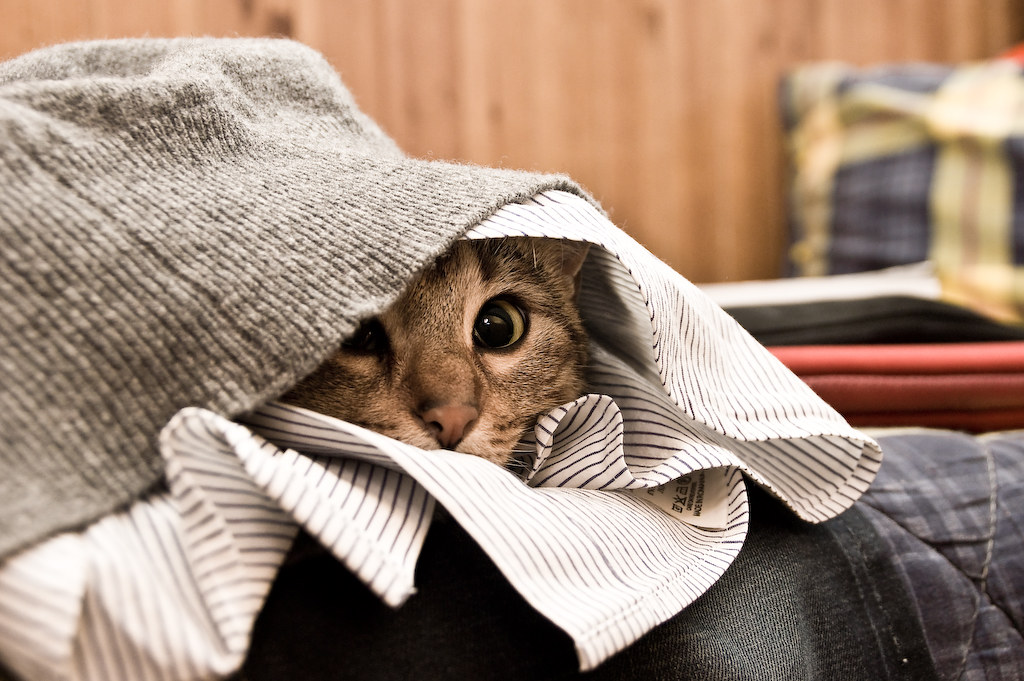
This cat is well hidden, but she’s like a deer in headlights:
This cute cat is getting ready for an ambush:
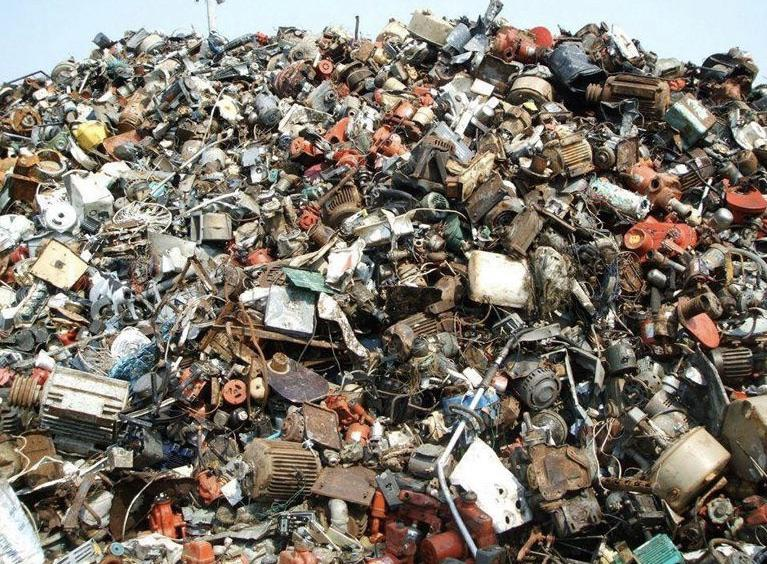
Last but definitely not least, if you enjoy a challenge (or just feel like driving yourself crazy), I assure you there is a cat in this photo. Hint: Kitty’s in plain sight, not half-buried in the junk. Good luck!



 Pain In The Bud