The spooked serval bolted through an open window and scurried up a tree during a traffic stop in Cincinnati.
We wish we could say this story is a viral marketing stunt for the recently-released movie Cocaine Bear, but authorities say they’re not joking.
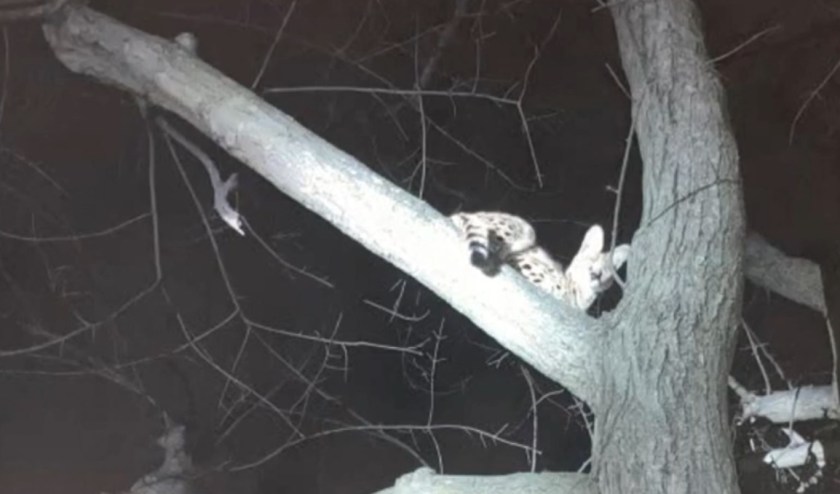
Cincinnati police pulled a car over in what they thought would be a routine traffic stop in late January. But when officers approached the vehicle a large cat inside got spooked, jumped through an open window and took refuge in a tree.
Cops called the city’s animal control staff, initially reporting a “leopard” on the loose.
“[They weren’t] sure what they were dealing with,” Cincinnati Animal Care’s Ray Anderson told WXIX. “Hindsight being 20/20, it probably would have involved a whole lot more people.”
Animal control officers who arrived on scene thought they were dealing with an F1 Savannah, a hybrid between a domestic cat and a serval, and were able to get the cat down from the tree, but not without some difficulty. The exotic wildcat suffered a broken leg in the process. (See video of the cat in the tree here.)
The serval took refuge in a tree. Credit: Cincinnati Animal Care
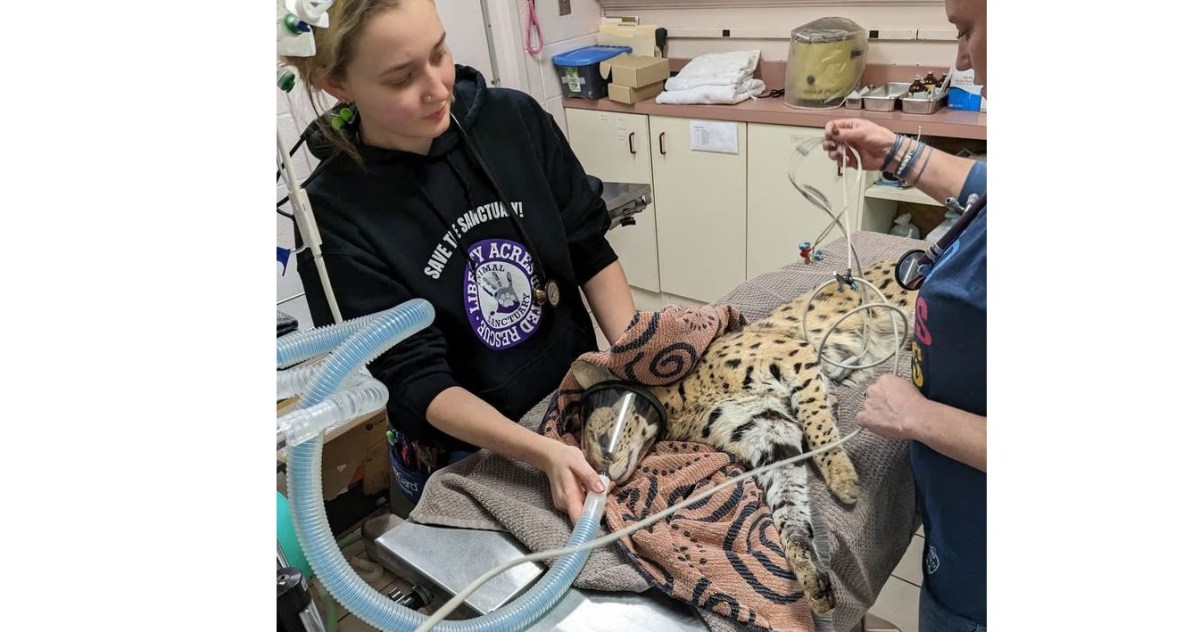
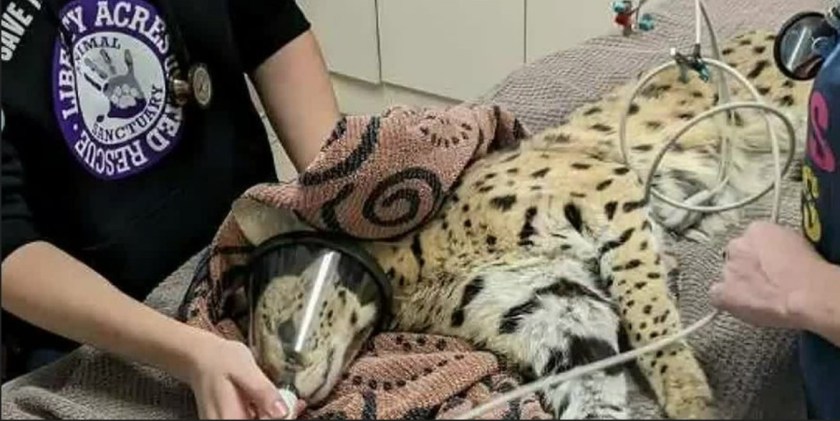
They brought the injured cat to the Cincinnati Zoo, where they were in store for several surprises: The felid was a serval, a medium-size African wildcat, and blood tests showed it had cocaine in its system. A subsequent DNA test confirmed the cat is a serval and not a Savannah hybrid.
The responding animal control officers were “pretty lucky because this cat could’ve shredded us” Chief Troy Taylor of the Hamilton County Dog Warden’s Office told Cincinnati’s WKRC.
The serval, whose name is Amorie, remains in the zoo’s care for now. Taylor said Amorie was given pain meds during treatment and is recovering. It’s not clear what will happen to him, and lots of questions about the incident remain unanswered. Local media reports say the driver was arrested during the traffic stop, but also said the driver is cooperating and has not been charged in relation to the cat or the narcotics.
It’s illegal to own wild cats in Ohio, and unless the serval found himself a bag of cocaine in the fleeting seconds between bolting from the car and scurrying up a tree, it seems the driver has some ‘splainin’ to do.
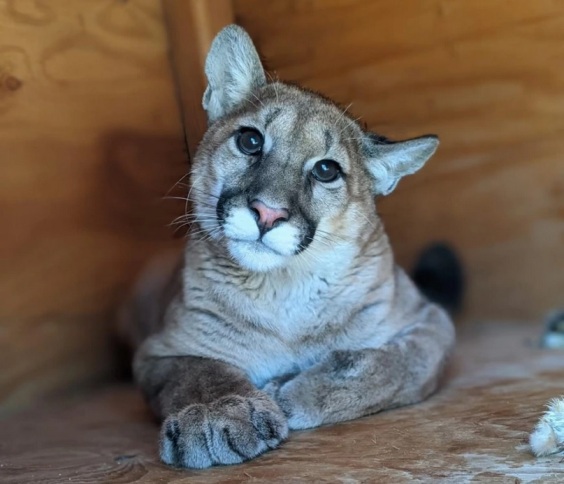
Nicholas requires regular veterinary care after his mother was killed and he almost lost his life when a driver struck them on a California highway.
Nicholas was just a cub and was following his mother across a busy toll road in Orange County, Calif., in 2020 when a driver hit them, killing his mother and leaving him with life-long disabilities.
Along with the trauma of watching his mother die, the little puma endured months of surgeries to repair his body. Since then, young Nicholas had been living in a sanctuary in northern California, but was about to find himself homeless when the sanctuary’s operators went bankrupt.
With just hours to go before that facility was closed, a sanctuary called Lions, Tigers & Bears of San Diego County swooped in and agreed to take the special-needs puma, who requires regular veterinary care.
“Nicholas has a head tilt and neurological issues, both conditions require ongoing veterinary care,” Lions Tigers & Bears founder Bobbi Brink told KTLA. “We’ve had a few animals with these issues, so our veterinary team is well-versed in providing the specialized care required for Nicholas, and we’re relieved to give him a permanent home with a den, a healthy diet, medical care and enrichment and toys.”
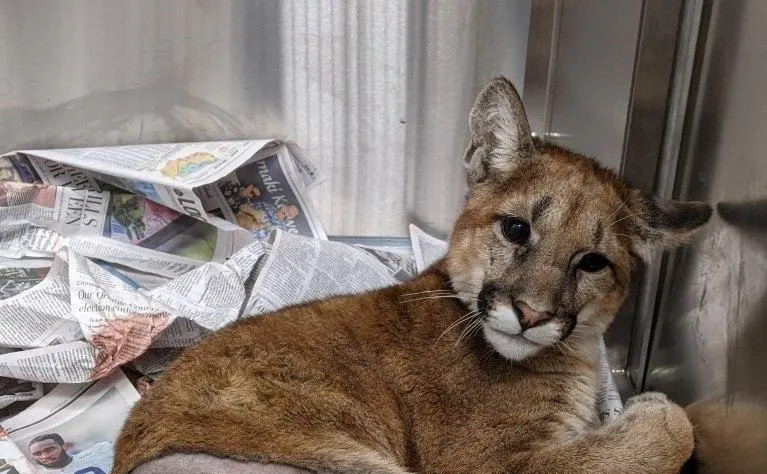
The handsome young puma is currently in quarantine, Brink said, and will be moved into his permanent habitat after 30 days.
Although California is part of their native range and home to a relatively stable population of mountain lions, the species is seriously threatened by habitat destruction, habitat fracturing and vehicle traffic. Some 70 pumas are killed each year on California’s highways, and experts say the survivors are stranded on isolated “islands” of habitat, separated from potential mates by deadly highways. Indeed, scientists who track native wildlife in California have noted signs of inbreeding among pumas, as the animals are cut off from other populations of their species.
Nicholas in quarantine. Credit: Lions Tigers & Bears sanctuary
The life of the much-celebrated, recently deceased mountain lion P-22 illustrates the problems faced by the unique cats.
P-22 became famous when he migrated from southern California to Los Angeles, crossing the state’s busiest and most dangerous highways to get there. He settled in LA’s Griffith Park, which straddles the hills with the famous Hollywood sign and the outdoor Greek Theatre.
Although he became a local icon, frequently making cameos on the doorbell camera systems of people living nearby and making his rounds through the park and surrounding neighborhoods, P-22’s range was only nine square miles — the smallest range ever recorded for an adult male mountain lion — and he did not have opportunities to mate and produce cubs, as his kingdom was cut off from areas where he might encounter female pumas.
One solution to the problem is to build land bridges connecting areas where mountain lions and other wildlife make their homes. In April of 2022, officials broke ground on the Wallis Annenberg Wildlife Crossing, which when complete will connect Agoura Hills to the nearby Santa Monica Mountains.
But such projects are wildly expensive and take years to complete. The Wallis Annenberg Wildlife Crossing has a $90 million price tag and won’t be finished until 2025. On the bright side, about two thirds of the cost has been covered by private donations, proving Californians and other wildlife lovers are invested in the survival of mountain lions, coyotes, deer and other fauna expected to make use of the bridge.
It’s also an encouraging sign indicating efforts to educate the public about local wildlife have been successful. Along with the other problems they face, pumas — also known as catamounts, cougars and dozens of other names — are often confused with African lions.
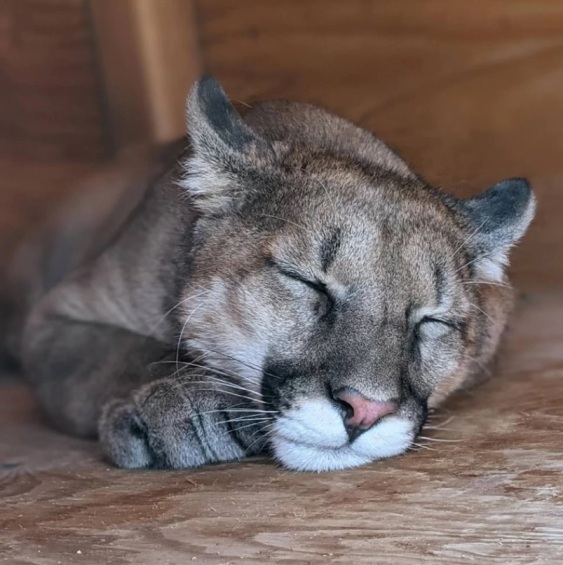
Nicholas enjoys a nap. Credit: Lions Tigers & Bears sanctuary
Because they’re large cats, they’re called lions and they resemble their African counterparts, many people assume mountain lions are dangerous. But not only are mountain lions (puma concolor) an entirely different species than African lions (panthera leo), they are not in the same category of felid.
Pumas are actually felines, meaning they’re more closely related to domestic cats, and like smaller cats they can purr but cannot roar. True big cats, like tigers, lions, jaguars and leopards, are members of the genus panthera and are capable of roaring, but not purring or meowing.
Perhaps most importantly, pumas are not aggressive toward humans. There are only 27 recorded deaths from encounters with mountain lions over the past century compared to more than 50,000 deaths from dogs, for example, and in almost every one of those cases the pumas were either cornered or their cubs were threatened.
Nicholas is not only a reminder that animal life is valuable, his circumstances also remind us that we’re going to have to find creative ways to ensure the survival of many species as humanity expands. The global population is expected to level off at about 11 billion and then slowly contract as third-world countries undergo the same lifestyle changes common to nations that have already made the transition to first world. But until then, it will take a massive and coordinated effort to ensure we don’t end up on a very lonely planet and likely endanger our own survival with the cascade failures that arise from extirpating entire species.
The congressional clown show continues, but it’s not funny anymore — it’s just sad.
The George Santos story just keeps getting worse.
My first reaction to the initial New York Times story outing newly-elected New York congressman George Santos as a serial fabulist was surprise, then sadness because I knew his election was in large part made possible by the death of local news. If there’d been competent local media still operating in the area, Santos’ campaign would have ended as suddenly as it started in a flurry of revelatory news coverage, and Santos himself would have been a footnote, a political oddity and embarrassment to the local GOP.
Then for one glorious moment I thought maybe Santos was a performance artist, that we’d find out George Santos is the alias of some comedian or media provocateur whose congressional run was designed from the start to show that politics has become so polarized, so divorced from issues and hitched to ideological loyalties that even a widely disliked grifter — with no roots in the community and a completely fabricated resume — could win simply because he said the right things, pushed the right buttons and kissed the right behinds.
Alas, no Dax Herrera or Ari Shaffir came forward to claim credit for inventing the George Santos persona.
And it just kept getting worse. There were the stories about pending criminal charges for using stolen checks in Santos’ native (?) Brazil, former roommates who saw Santos on TV wearing expensive clothes he’d allegedly stolen from them, and Santos working as the director of a company under investigation for running an alleged Ponzi scheme.
Sapphire, veteran Rich Osthoff’s service dog.
The latest story might be the most infuriating: Santos is accused of stealing $3,000 from a homeless, PTSD-suffering veteran whose beloved service dog needed life-saving surgery.
Rich Osthoff, who was living on the streets at the time, needed money to pay for veterinary surgery to remove a large and life-threatening tumor from his service dog, Sapphire. Osthoff says Sapphire was his lifeline during difficult times and he was desperate to get her the surgery she needed.
In 2016 a well-meaning vet tech and another veteran connected Osthoff with Santos, who claimed he ran a charity called Friends of Pets United and could help. At the time, Santos was going by the name Anthony Devolder.
Santos set up a GoFundMe drive for Osthoff and Sapphire, raised $3,000 with a tear-jerker of a plea, then basically ghosted Osthoff and his veteran friend Michael Boll, founder of New Jersey Veterans Network. After fobbing them off with a series of excuses, he stopped responding to their calls and vanished with the proceeds.
“It diminished my faith in humanity,” Osthoff said of the experience.
Santos denied the accusation.
“Fake,” Santos texted news startup Semafor on Wednesday. “No clue who this is.”
Osthoff with Sapphire.
But dozens of other people besides Osthoff, Boll and the vet tech were involved and confirmed Santos’ role in the fundraiser, there are publicly visible tweets from 2016 linking to it — and crediting “Anthony Devolder” for running it — and GoFundMe acknowledged the existence of the drive.
In addition, news reports have confirmed Friends of Pets United, Santos’ “charity,” was never registered as a non-profit. Santos also defrauded an animal rescue group in New Jersey when he pocketed the proceeds from a 2017 fundraiser he ran on behalf of the organization, according to dozens of media reports. Santos was terse in his response to the accusations from Osthoff and Boll, but he was eager to talk about his non-existent pet charity during his campaign, when he claimed Friends of Pets United “saved” more than 2,500 cats and dogs over a four-year span and trapped and neutered more than 3,000 cats.
Santos’ lies are so numerous and so outrageous it’s difficult to keep track of them, and it’s doubtful he remembers all of them.
He claimed his mother worked at a financial firm at the World Trade Center and died in the 9/11 attacks, but Fatima Devolder left the US for Brazil in 1999 and never returned. She also never worked in finance. He claimed four of his employees died in the 2016 Pulse Nightclub shooting that claimed 49 lives. Santos never had any employees, his company didn’t exist, and he didn’t know anyone who died at the nightclub. He claimed ownership over an impressive and burgeoning real estate empire, but never owned any properties and owes more than $40,000 in back rent on a Queens apartment he shared with his sister for years. (His sister was also the recipient of a $30,000 FEMA handout and contributed a hefty $5,000 to his campaign, but still owes tens of thousands in back rent on the apartment, reports say.)
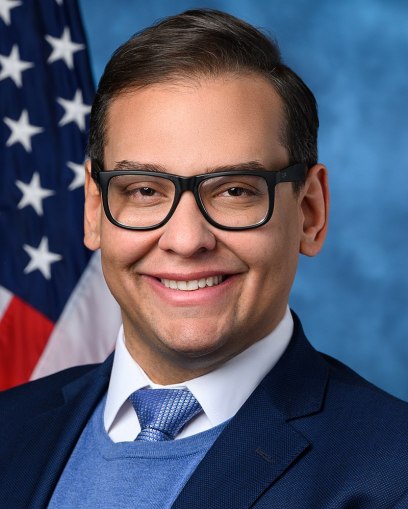
George Santos has refused to resign from congress despite calls from his own constituents, other lawmakers, figures in his own party and media commentators demanding his exit. Credit: Official congressional portrait
There are too many lies to list here, too much insanity to digest in one sitting, and it’s probably not good for the blood pressure to dwell on this weasel of a man allowing a homeless veteran’s service dog to die while pocketing the money raised for her surgery.
But we’re not done yet. We still don’t know how Santos bolstered his campaign with $750,000 of his own money, or where that cash came from. It’s not even clear if Santos is his real name, or if he’s actually a U.S. citizen, with some reports — like a New York Times story from last week — suggesting he may have married his former wife for citizenship.
While New York Republicans have been among the loudest voices to condemn Santos and demand he resign or be removed from congress, national party leaders haven’t made any moves to get rid of him — and have actually given him committee assignments — because they believe they need his vote in a slimmer-than-anticipated congressional majority.
As the lies keep piling up, the biggest question is: How long will this farce be allowed to drag on?
Each viral trend on the app is more grotesque than the last.
I’m all out of withering sarcasm, so I’ll just say it: The newest trend on TikTok involves close-up videos showing people popping their Sphynx cats’ pimples.
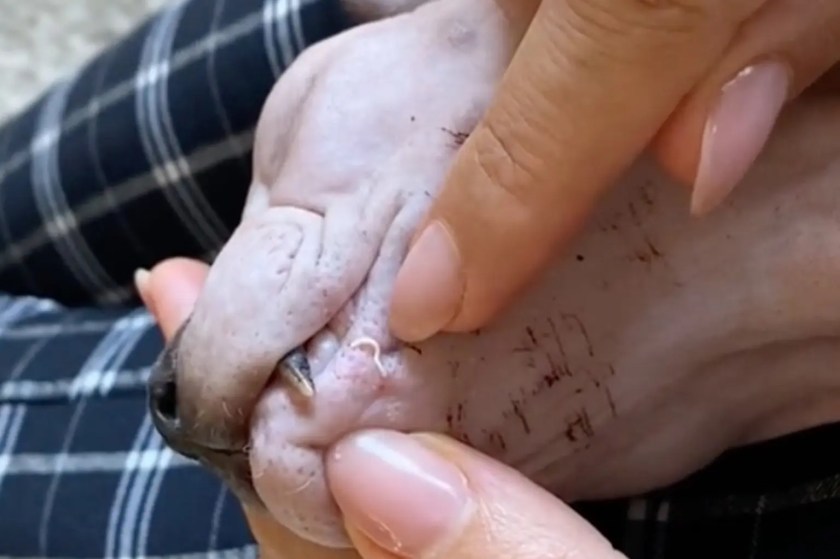
The PewDiePie of the craze, if you will, is one @Sphynx.cleaner, whose videos show a woman’s carefully manicured hands holding a defeated-looking Sphynx cat and popping its pimples between her formidable fingernails.
Tens of millions of people have watched her videos of puss pimple-popping, not including the millions of other views accumulated by lesser practitioners of the grotesque genre.
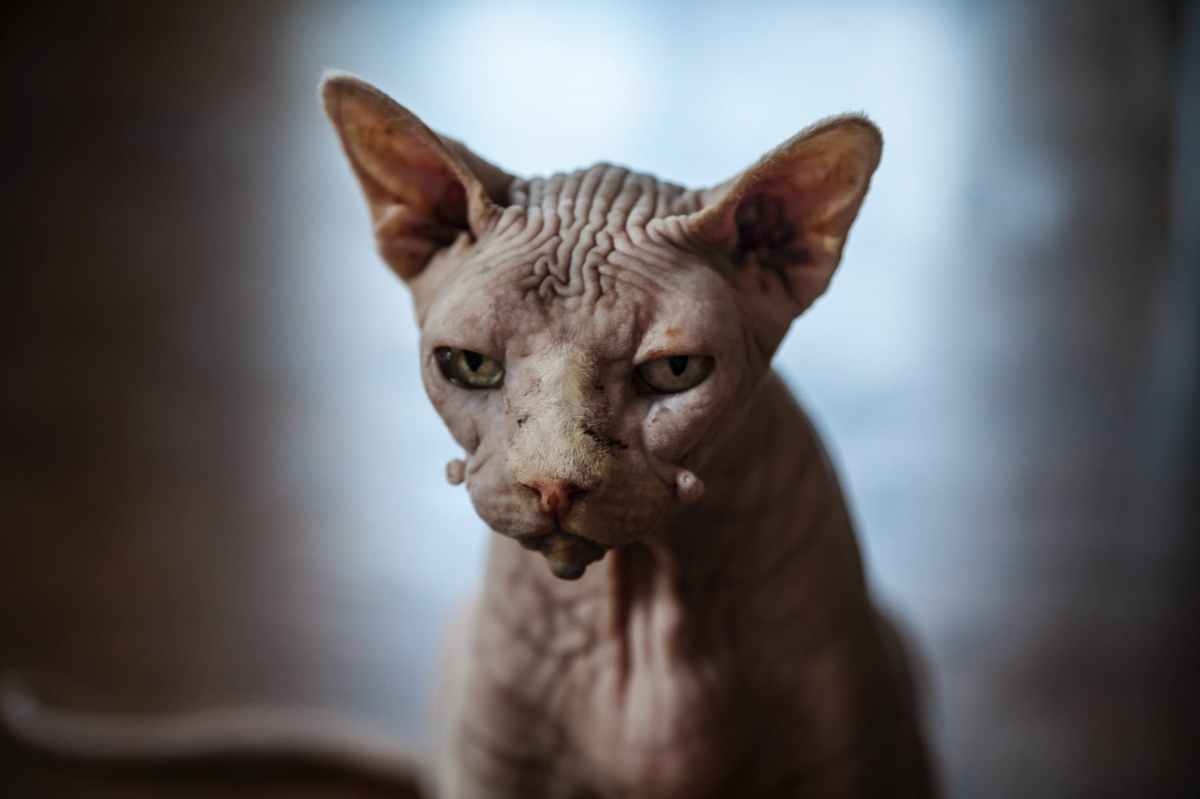
Sphynx cats lack fur and have skin often compared to chamois leather. Fur helps cats absorb and redistribute naturally-occurring oils secreted by the skin, so felines of the Sphynx breed are much more susceptible to acne problems than typical short- and long-haired cats. Without fur to help redistribute them, the skin oils can create a “film” that clogs pores, according to Jessica Taylor, a veterinarian in North Carolina.
Uh, no. Credit: Sphynx.cleaner/TikTok
Not surprisingly, popping a cat’s pimples makes things worse and is not pleasant for the kitty.
“These lesions indicate a disruption in the skin and skin barrier, and squeezing or poking them can introduce bacteria, potentially worsening the lesion, causing pain and infection,” Taylor told Newsweek. “If the lesion is already infected, handling it could spread bacteria to the pet parent.”
As for TikTok, this is not the first time one of the app’s trends has been detrimental to the health and safety of felines, although most of its inanity is focused on humans. I suppose you can view it as some sort of advanced Darwinian engine, accelerating the self-removal of human beings from the gene pool. Among the trends that have gone viral on the app:
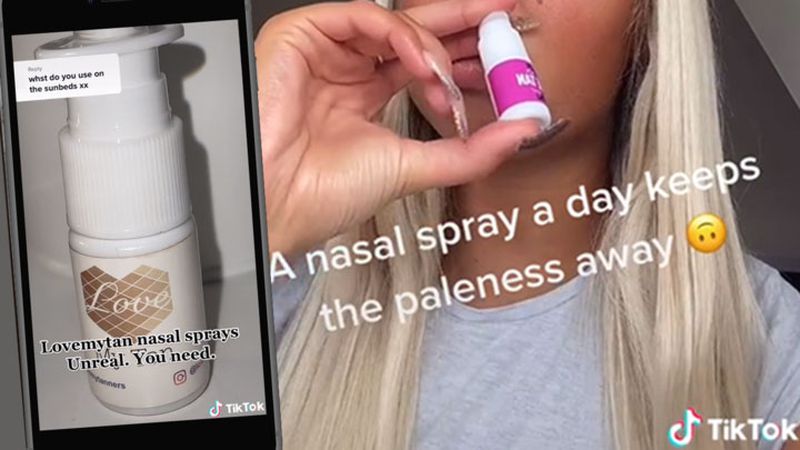
People who use self-tanning bottles as nasal spray out of some misguided belief that ingesting the stuff will not only achieve the desired effect, but somehow lead to a more even, natural-looking distribution of tanner. It reminds me of former President Donald Trump’s impromptu suggestion, during a national press conference, that ingesting hand sanitizer could be a “tremendous” way to stop COVID.
Videos instructing women to eat the tablets inside Clearblue pregnancy tests as a “contraceptive hack,” claiming the tablets — which are designed to absorb urine during the chemical test — are actually morning after pills.
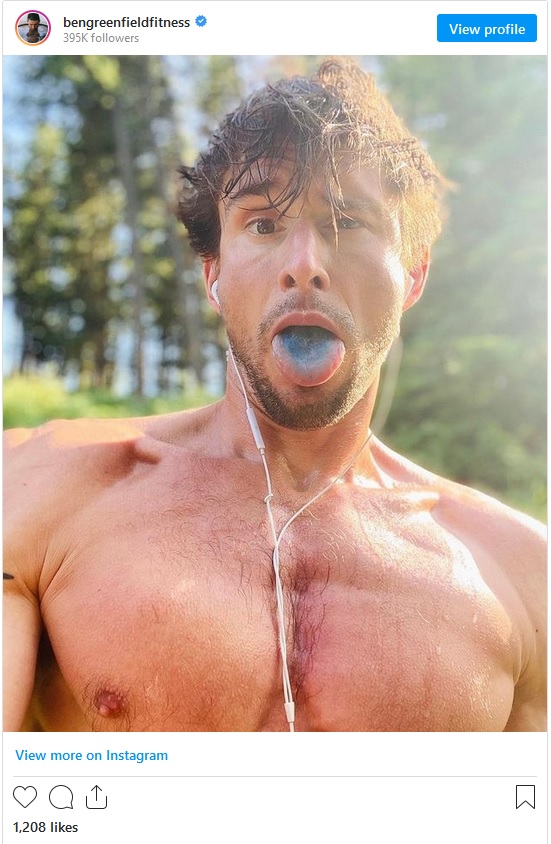
People ingesting methylene blue — an anti-fungal fish tank cleaner — because “fitness influencers” say it can “cure” COVID-19, boost metabolism and slow the aging process. Think of the triumph of critical thinking here: These are people who won’t get a vaccine that’s been through three-stages of trials before getting FDA approval, and whose efficacy and safety have been the subjects of rigorous peer review, but they’re willing to drink a chemical manufactured and sold as a cleaning solution for fish tanks.
Period blood face masks, which are self-explanatory. Another grotesque and potentially dangerous trend started by “influencers” who claim some sort of nebulous expertise and know that “hacks” will net them attention and clicks. The more outrageous, the better.
“Did you know that urinal cakes are made by Carvel? It’s true! They’re deliciously chocolatey, with just a hint of vanilla, cinnamon and industrial strength anti-bacterial. Mmmmmm!”
Of course, we’ve known for years that Chinese companies are beholden to the Chinese government according to Chinese law, which means the government — and the communist party — can help itself to TikTok user data whenever it wants.
After TikTok’s US-based executives insisted to congress that American users’ data is firewalled and cannot be accessed by the company’s employees in China — and, by extension, the Chinese government — a series of leaks confirmed that China’s government was in fact regularly accessing that data. Absolutely no one, except maybe the politicians who think the internet is a “series of tubes,” were surprised by this revelation.
China’s government can use the data to track journalists, exploit American and European users, program its algorithm to shuffle them toward harmful content, censor content the Chinese government doesn’t like, and even coerce individuals by threatening to release information on their viewing habits.
So can we evacuate TikTok’s US headquarters already, raze it to the ground, and ban the app from every mobile store?
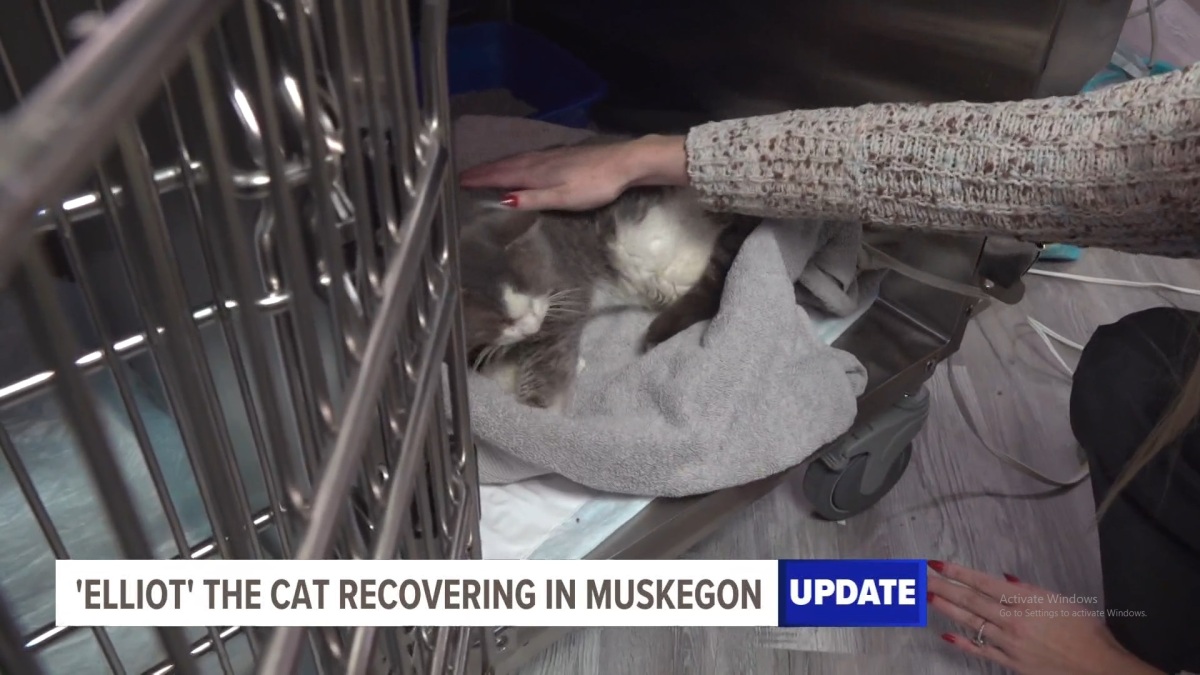
Little Elliot was recovering from his ordeal, but developed a deadly blood clot.
This feels like a real gut punch, especially after a South Carolina veterinarian’s heroic efforts to save Juliet, the cat who had 38 hair ties removed from her stomach and died after her health seemed to improve.
Elliot, you’ll recall, was the poor, sweet stray who was found literally frozen to the concrete on the day after Christmas, when the country was in a deep chill the likes of which we haven’t seen in decades, with temperatures plunging well into the negative. A Good Samaritan found the little guy in a bad way, with his eyes frozen shut and his organs shutting down, but she turned up her truck’s heat and rushed him to Big Lake Community Animal Clinic in Muskegon, Michigan, where the staff took good care of him and named him after the storm he was found in.
They wrapped little Elliot up in warm blankets, gave him fluids and began to slowly raise his body temperature, which was a dangerous 94 degrees. Things started to look up, too: Elliot had a habit of reaching his paw out to the vet techs who were monitoring him, began to regain his appetite, and eventually was able to stand and eat on his own.
But Elliot’s health took a turn for the worse again, and veterinarians determined he developed a saddle thrombosis, which is described as “a blood clot (called a “thrombus”) that lodges at the base of the aorta just as it branches into two distinct arteries, thereby obstructing blood flow to the hind limbs. It is so named because of the saddle-like shape it roughly resembles once it takes up residence in this location.”
For cats who develop a saddle thrombosis, the outlook is not good, and drugs designed to dissolve blood clots are often ineffective.
“Sadly, there was nothing we could have done to prepare for that but we knew it was time to let him be free from the pain and struggle he’s known most of his life,” Big Lake’s staff wrote to supporters.
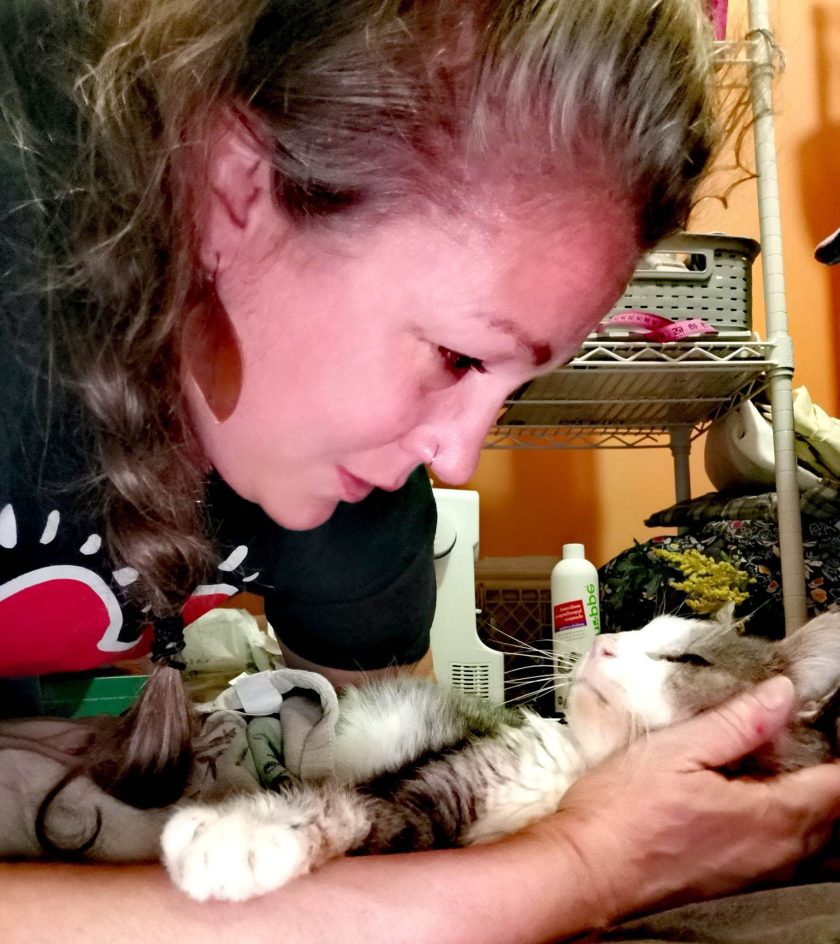
A staffer named Diane Neas, who took Elliot into her home after a few days when he’d stabilized, was particularly hard hit by the loss, and understandably so. Well-wishes and applications to adopt Elliot had come pouring in, and it seemed like the former stray’s suffering would lead to the best reward — a warm home of his own and people to love and care for him.
“We find peace in knowing the last two weeks of his life were spent with people who showed him kindness, care and love,” shelter staff wrote. “We can’t believe the following and support he has gained on this journey to healing; from the bottom of our hearts, thank you all for caring so deeply for him and sending such love and support his way.”
Images courtesy of Big Lake Community Animal Clinic