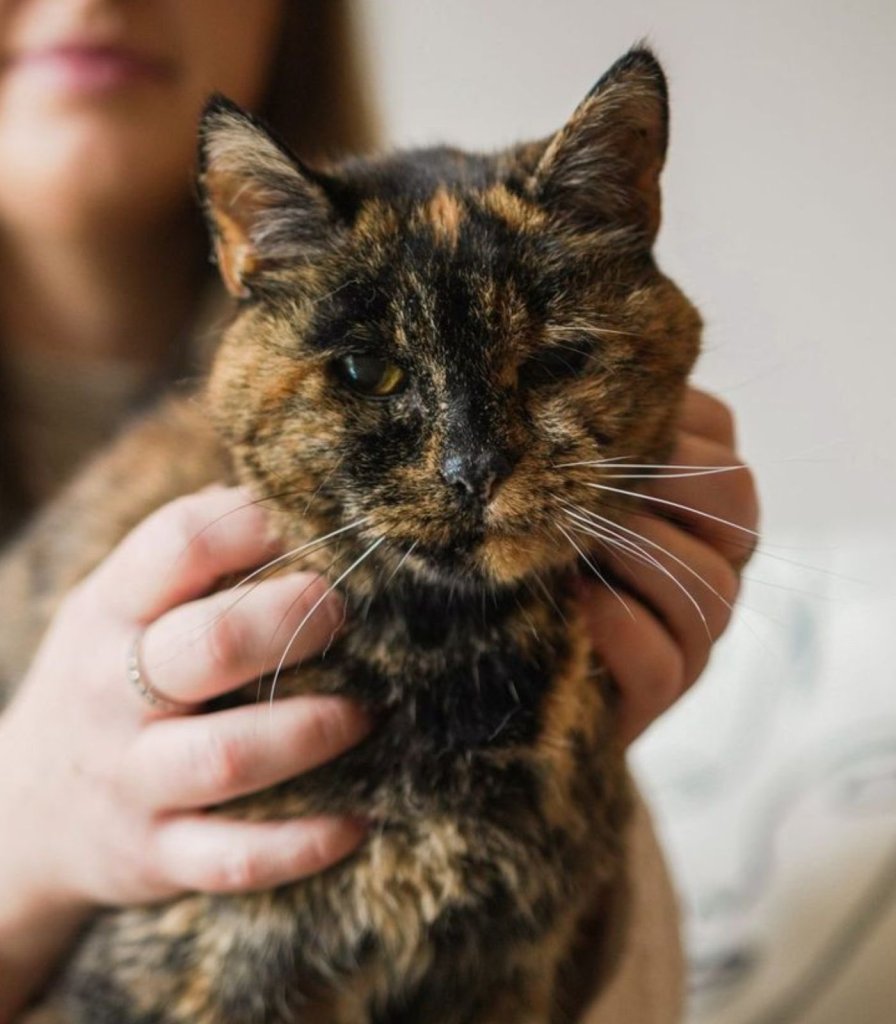
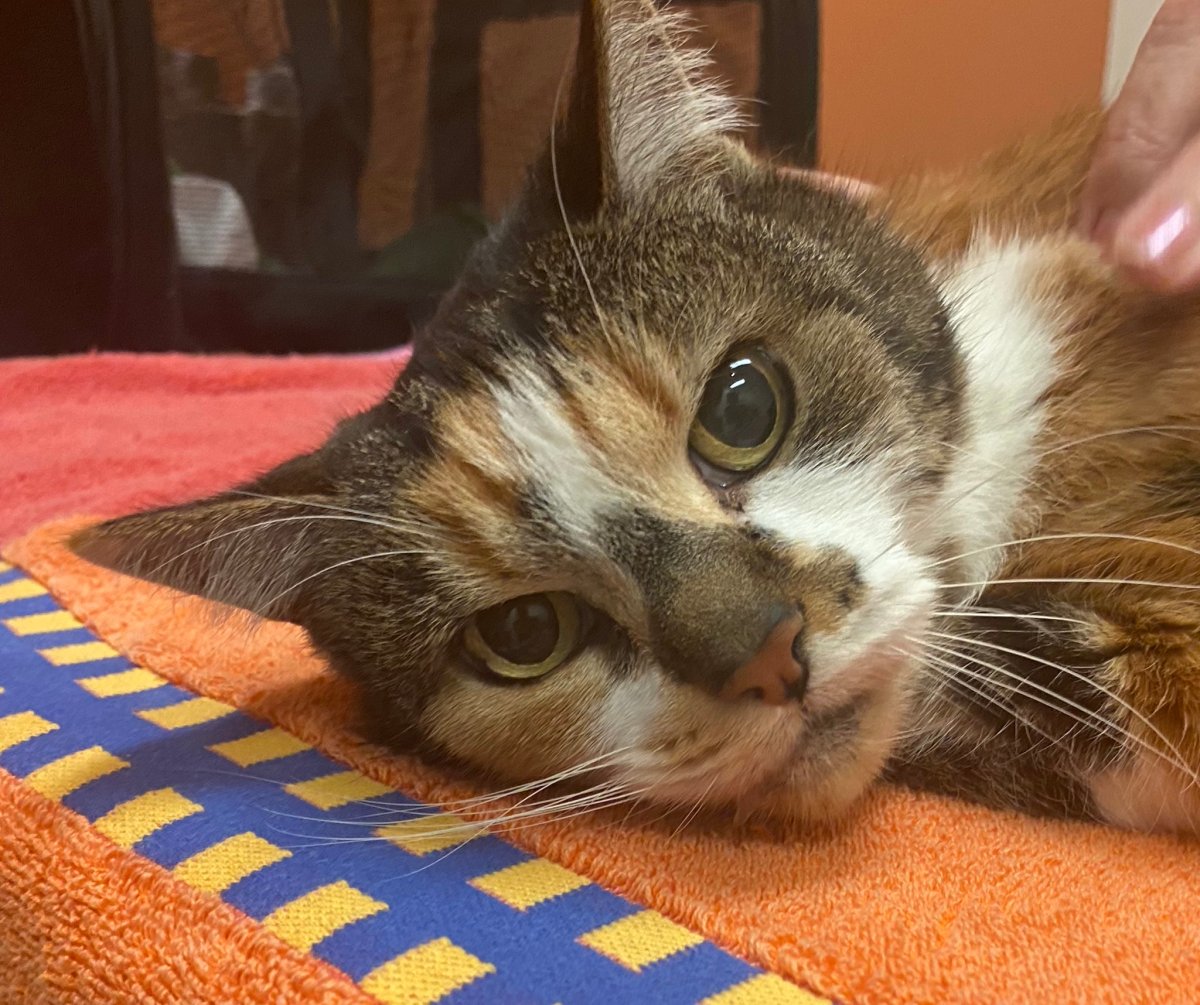
Despite her advanced age and loss of hearing, Flossie is still “affectionate and playful,” her human says.
When Flossie was born, Mariah Carey, Coolio and Pearl Jam ruled the airwaves alongside a band called Deep Blue Something with their hit, “Breakfast At Tiffany’s.”
Robert Deniro and Al Pacino were kings of the box office for their film, Heat, alongside Robin Williams’ Jumanji and Steve Martin’s Father of the Bride Part II. Bill Clinton was still serving his first term as president, and the internet was in its infancy as a network available to the wider public after years of use by the military and academics, with users connecting via cumbersome and painfully slow modems.
Your humble correspondent was just a kid, and Buddy wouldn’t be born for almost another 20 years.
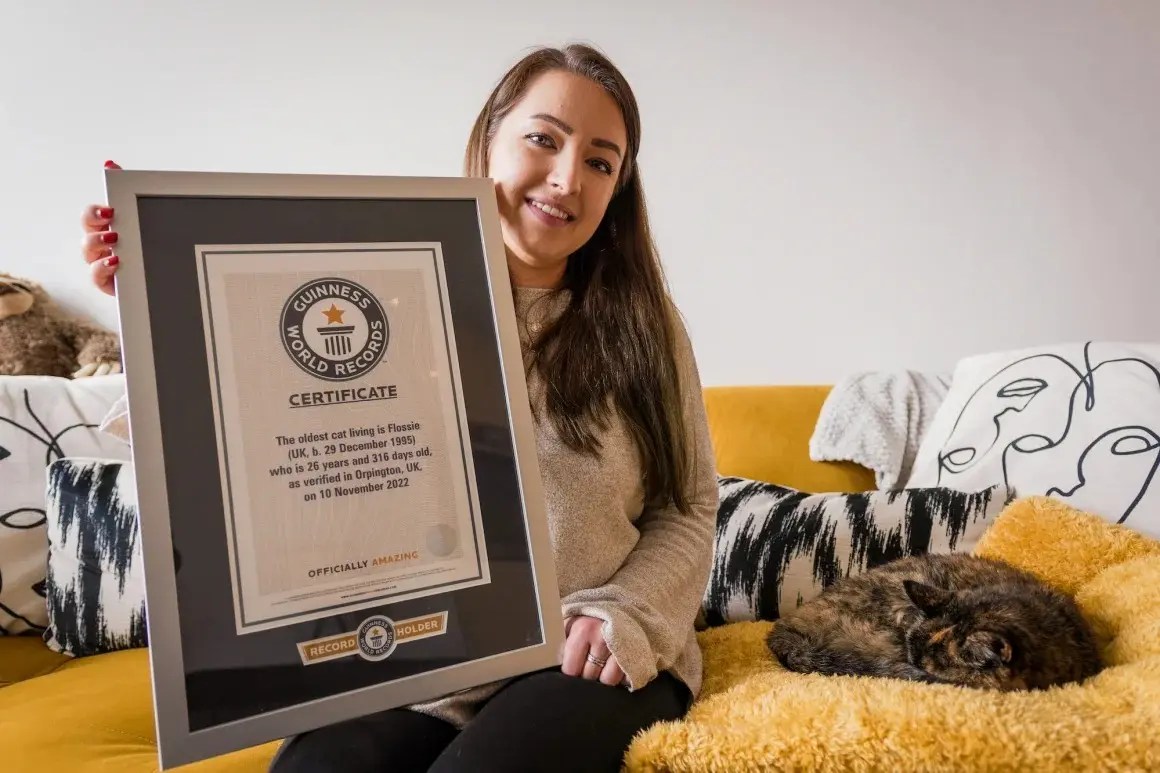
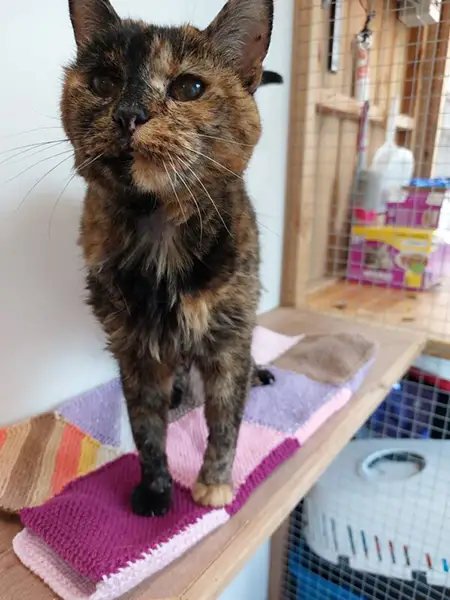
Yet Flossie’s still going and just celebrated her 30th birthday on Dec. 29. The tortoiseshell was officially named the world’s oldest cat in 2022 when she was 26 years old. Flossie, originally a stray living near a hospital, was adopted by her first human, a healthcare worker. When that woman passed away, her sister became Flossie’s caretaker. And in August of 2022, having outlived two of her humans, Flossie was taken in by the UK’s Cats Protection, who carefully screened applicants until settling on Victoria Green, who lived in Orpington, UK.
“I’ve always wanted to give older cats a comfortable life,” Green said when she was chosen as Flossie’s caretaker.
Flossie was deaf and had “limited eyesight,” veterinarians noted when they helped Guiness World Records verify the long-lived feline’s age. But despite that, Flossie remains “affectionate and playful,” Green said.
“I feel like I’m not sharing my home with the oldest cat. I feel like this is her home and I’m encroaching on her space,” Green told Guinness World Records at the time. “She’s a very nice roommate and we get on very well. I don’t feel like I’m living with a senior.”
The oldest cat on record was Creme Puff of Austin, Texas, who was born in August of 1967 and lived until 1995, when Flossie was born.
We wish the birthday girl a happy one and hope she’s got at least a few more birthdays in her.
Scientists have uncovered the elusive mechanisms behind coat color expression, opening the door to a new question: is fur pigment connected to personality?
When Professor Hiroyuki Sasaki retired, he wasn’t done with science. He just wanted to use it to better understand his cats.
The Japanese geneticist raised more than $73,000 from Japanese and international cat lovers and put together a team, including partners from the US. Then he began the hard work of scrutinizing feline DNA to find out why some cats are orange, and why most all-orange cats are male while virtually all calico and tortoiseshell cats, whose coats have splotches of orange, are female.
It turns out there’s no genetic instruction telling the fur to take on an orange pigment — it’s the absence of a segment of DNA, which governs pigment production, that does it.
In other words, ginger cats are mutants.
Most fully-orange cats are male because the mutation removes the DNA segment in the X chromosome. As males have X and Y chromosomes, they only need the mutation in the single X chromosome for their coats to express in that shade.
Lots of cat lovers swear that coat color and temperament are connected.
Females have an XX chromosomal arrangement, so they need the mutation in both chromosomes to turn tangerine. If the mutation only shows up in one chromosome, you get patches of the color instead of a consistent coat.
That explains why 80 percent of ginger cats are male, and why only one in 3,000 calicos and tortoiseshells are male. A male cat would need an extra X chromosome, XXY, to be born with a calico or tortoiseshell coat. One of the side effects, however, is sterility.
Scientists estimate only one in a thousand male calicos/tortoiseshells can reproduce and pass their unique mutations on.
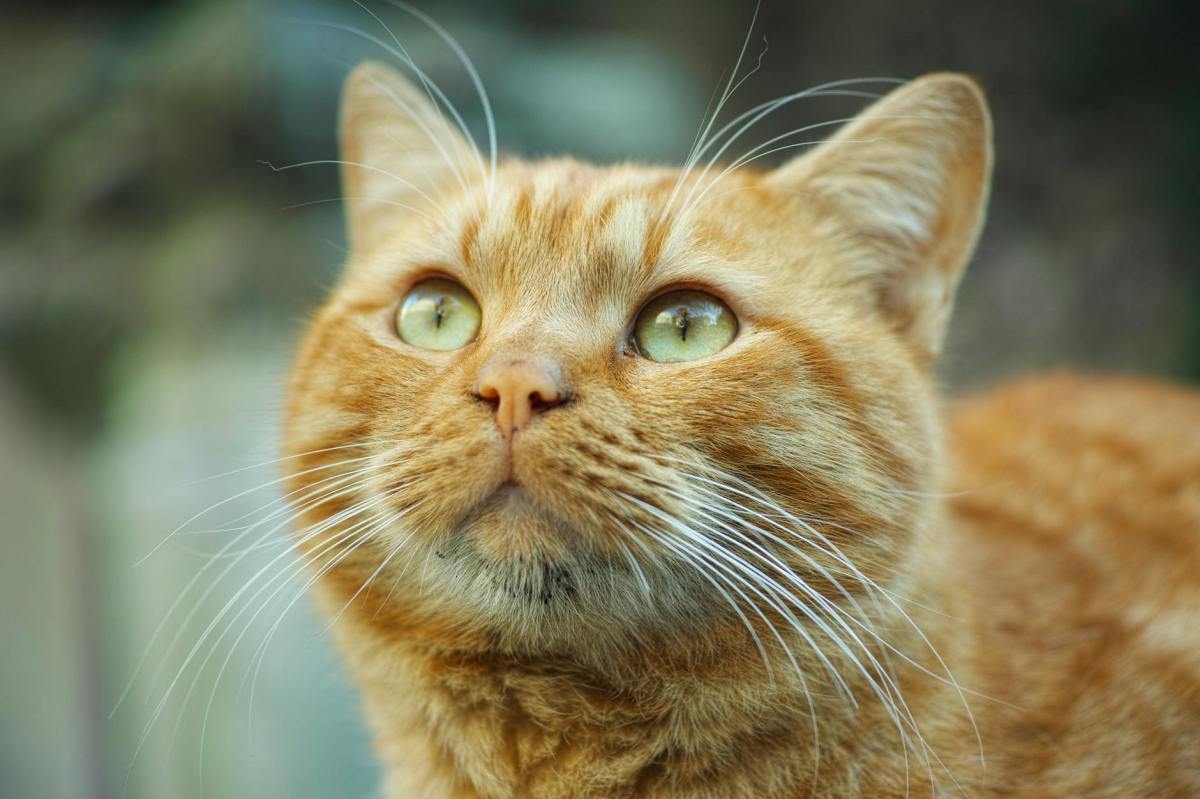
It’s not just coat color either. The mutation impacts skin and eye color, which is why a ginger cat might have a pink nose compared to the terracotta shade of a void cat or a silver tabby.
Are orange cats really more friendly and silly?
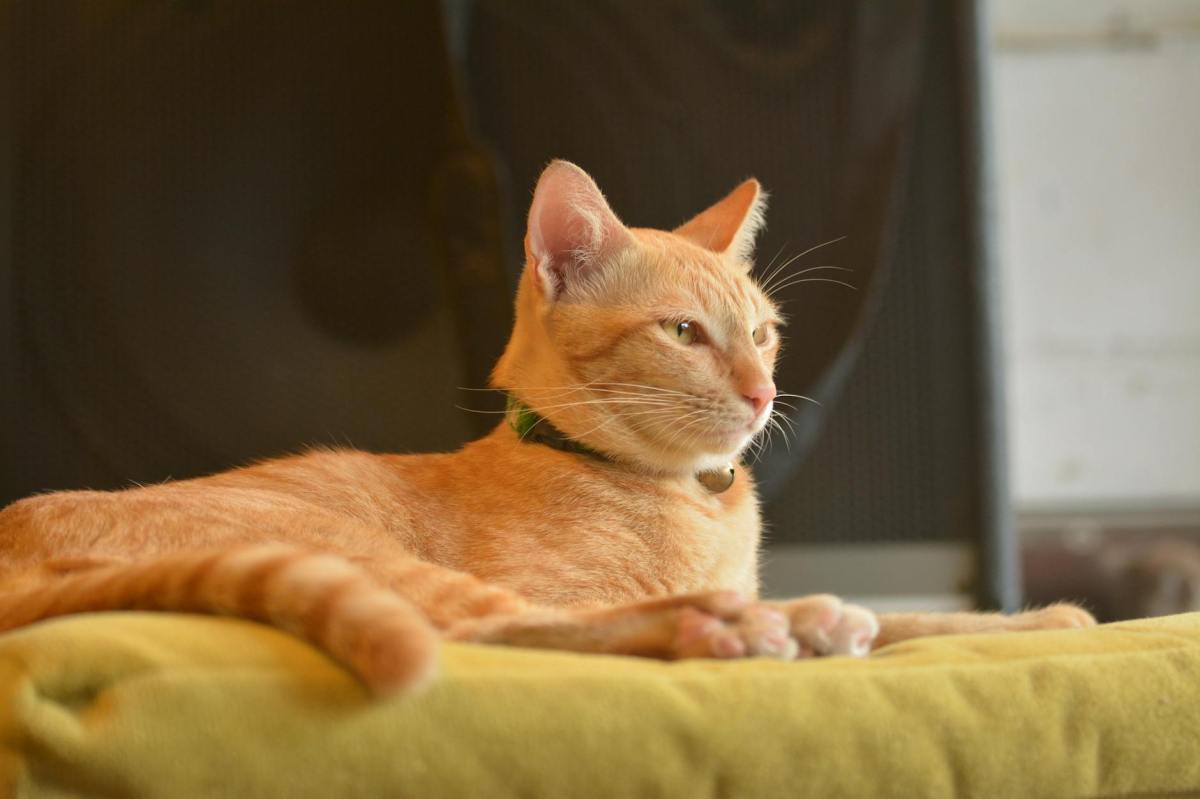
So how does this relate to temperament, and the many people who attest to a particular personality associated with orange cats? Some people say ginger tabbies are more loyal, affectionate and social than cats of other coat colors, but they’re also more prone to doing boneheaded things.
The stereotypes have picked up steam online, where people often share memes depicting orange felines as earnestly derpy, but they may be on to something — or at least, it can’t be ruled out until we know more.
Ginger cats are not the sharpest claw on the paw, according to popular memes.
Because of the missing piece of genetic code, a specific gene, ARHGAP36, isn’t “expressed.” Like so many genes, scientists don’t fully understand everything ARHGAP36 impacts, or how alterations can lead to unexpected changes elsewhere.
“Many cat owners swear by the idea that different coat colours and patterns are linked with different personalities,” Sasaki told the BBC. “There’s no scientific evidence for this yet, but it’s an intriguing idea and one I’d love to explore further.”
More Americans say they can’t afford to keep their cats because of inflation, leading to an increase in surrendered and dumped cats in some places.
More than 110 years ago, American geneticist Clarence Cook Little developed a theory explaining why some cats have orange coloring and some don’t.
Now Little has been proven correct thanks to the work of separate teams in Japan and the US, which discovered the mechanism that leads to orange coloring, including fully ginger felines as well as calicos and tortoiseshells.
The explanation may be a bit too heavy on genetics for some readers, but essentially the researchers found the specific gene that leads to the growth or orange fur. They’ve known about the gene for a long time, but didn’t realize the totality of its function. Its official name is ARHGAP36, but for the sake of simplicity, scientists are calling it “the orange gene.”
“The orange gene has a known role in hair follicle development, but scientists didn’t previously know it is also involved in pigment production,” a team of geneticists and biotechnologists wrote in The Conversation, a science publication. “This means that a new pathway for pigment production has been discovered, opening the way for exciting and important research into a basic biological process.”
In partially orange cats like calicos and tortoiseshells, the blotches of color are the result of imperfect gene copies and a secondary pigment-related gene switching “on and off.” Credit: Mehmet Guzel/Pexels
Ginger cats are usually male, but the pigmant can also appear in female cats due to an error in gene copying which deletes one segment of the orange pigment-producing genetic code.
That’s why calicos and tortoiseshells have orange blotches or mixed orange fur. “[T]he orange gene is persistently switched on in orange areas but is mostly switched off in non-orange areas of a cat’s coat,” the authors wrote.
Are there more strays in 2024?
Time magazine has a story examining the problem of stray cats in America’s urban and suburban population centers, why it’s happening, and what can be done about it.
First, might as well get this out of the way: We don’t know if there are “more” cats. The claim that there are more relies on anecdotes, and there’s no hard data to back that up. You have to be highly motivated to invest the time and money into a proper census like the D.C. Cat Count, and it’s an understatement to say most towns and cities are either not willing to do that, or don’t have the resources.
What we do know is there may be more cats in certain areas, with individual shelters in some places reporting record numbers of surrenders and cats scooped up by animal control.
Rescuers say people who can’t afford food, supplies and veterinary care are surrendering or dumping their cats in larger numbers than in years past. Credit: Dou011fu Tunce/Pexels
The story quotes rescuers who say they’ve seen more surrendered pets, as well as data from Shelter Animals Count, which tallies self-reported information from shelters and rescues. The latter says 32 percent of cats taken in were owner surrenders in 2024, compared to 30.5 percent in 2019.
“It’s a combination of people surrendering their pets and people not adopting because they’re not sure they can take on the financial commitment,” Animal Care Centers of NYC’s Katy Hansen told Time.
Rescuers say that’s reflected in their experiences trapping the felines, who are friendly and acclimated to humans.
The people surrendering their pets cite inflation, not only impacting the cost of essentials like food and litter, but also more expensive veterinary care.
The story additionally includes this eye-popping detail:
“At Veterinary Care Group, a private equity-owned practice in Brooklyn, the cost of spaying or neutering a cat has soared to $850 per animal. By contrast, at the nonprofit veterinary clinic Zweigart recently founded in Brooklyn, the cost of spaying or neutering a cat is $225 and a mid-sized dog is $300.”
The lesson here: Steer well clear of veterinary clinics that aren’t vet-owned or are obtuse about their ownership. Private equity groups don’t buy clinics out of love for animals.
The cost of spay/neuter procedures ranges dramatically at different veterinary practices. Credit: Tima Miroshnichenko/Pexels
As for solutions to local spikes in stray populations, the story doesn’t offer any. It mentions TNR (trap, neuter, return) but only in the context of a lawsuit against the San Diego Humane Society for its neuter/vaccination program.
That said, there probably isn’t a one-size-fits-all technique. What works for a small town won’t necessarily work in a city, and there are dozens of factors that could influence the prevalence of stray cats and colonies. Still, city councils and town boards don’t need to reinvent the wheel. Chances are if they look, they’ll find a municipality similar to their own where locals have successfully stabilized feline populations.
As for the Buddies, I’d live in my car before giving Bud up. He wouldn’t be thrilled about that situation, and we’d have to head south because the winters here are brutal, but as long as Bud has his servant, he’s good.
A previous version of this post incorrectly described cat chromosomes. The story has been updated to remove the error.
The Gladiator actor was training for a new role when he found a mewing kitten just off a path near his home in rural Australia.
Russell Crowe was training for the 2005 movie Cinderella Man, in which he plays boxer James J. Braddock, when he “took the bunch of blokes who had been beating me up for their pay check” — his trainers and fellow actors playing boxers in the movie — on a mountain bike ride in rural Australia.
After cresting a “particularly punishing hill” and stopping for a sip of water, Crowe wrote, he heard plaintive mews coming from the trees off the rural Australian trail.
“Underneath the swirl of sounds I heard something out of place. Was that a meow? I started to look around me. I heard it again. I took a few steps of the track into the rain forest. Thick with ferns and vines. One more step and then I saw it. A kitten…”
The baby cat was abandoned, and Crowe says he thinks the cat might have been dumped by a driver who passed the bicyclists a few minutes earlier.
“I looked back down the track and the boys were gaining on me,” he wrote. “I put the kitten in my backpack and rode on.”
Cinders as an adult. Credit: Russell Crowe
After returning to camp, Crowe took the kitten out of his pack, showed it to his friends and told them he was going to give it to his mother, who had been talking about adopting a cat.
“There’s something reassuring in a bunch of big sweaty boxers going crazy over a kitten,” Crowe wrote. “We flew down the hill in a tight group and arrived back at my farm together where I presented my mother with this tiny baby kitten. She was floored. So happy.”
That was in 2003. Cinders lived for 17 years and died on June 9. Crowe shared the story of finding and adopting the beloved cat in a Twitter thread.
Crowe, who was living with his mother while training for the movie, said he was originally opposed to getting a cat because felines are “the notorious enemy of bird life.”
When he found Cinders, he wrote, he felt “this was the universe telling me to respect my mother and give her what she wanted.”
“She had never grown to be fully trusting of humans, but, she loved my mum and my mum loved her.”
Russell Crowe is perhaps best known for his role as the Roman general Maximus in Ridley Scott’s 2000 epic “Gladiator.”







 Pain In The Bud