Facebook Is Flooded With Hoax Posts About A Supposed Black Mountain Lion

The purveyors of the deceptive posts want you to click, share and argue with other users about the veracity of the photos.

Not only is he the rarest puma in existence, he’s more well-traveled than most humans.

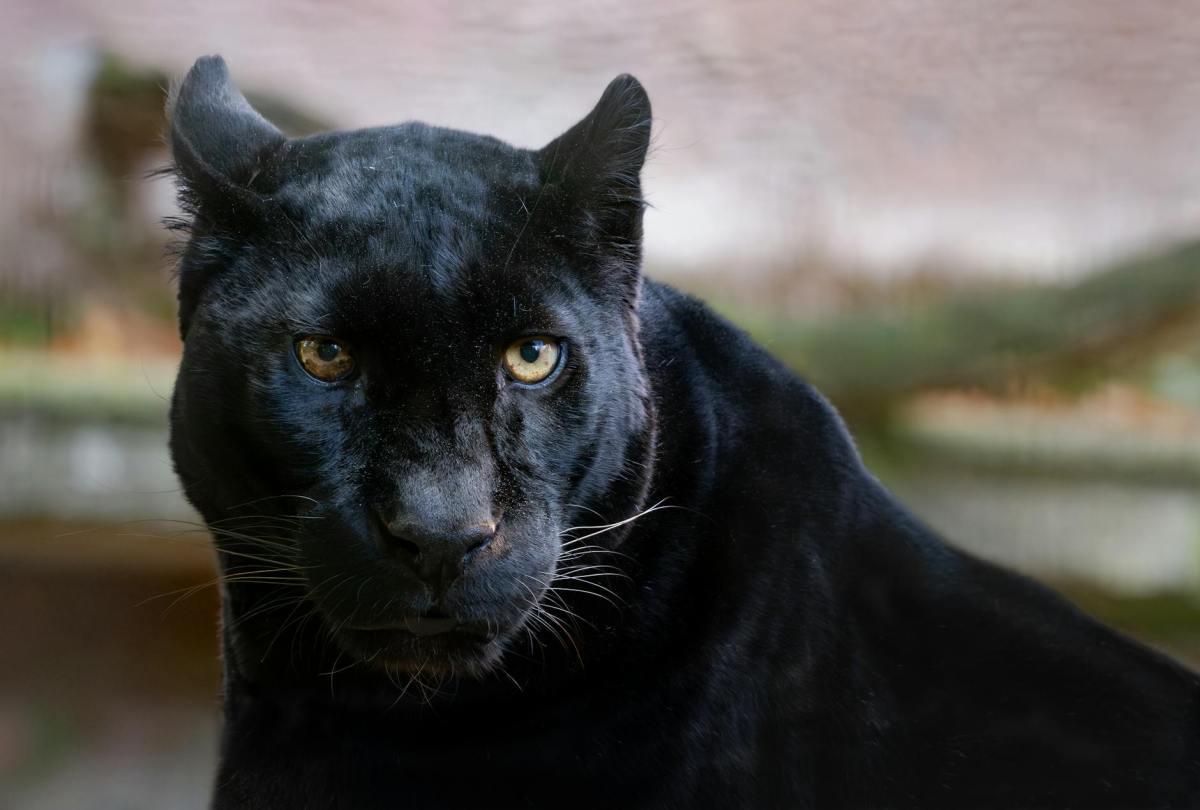
The mountain lion in question has a black coat, unprecedented for his species, and has been popping up all over Facebook. He’s photographed from the passenger seat of a truck cab, his tail in an unbothered curl, crouched amid the brush near a rural road.

Some posters claim they spotted the formidable feline in Mississippi. Others attribute the image to a sister-in-law who lives near Houston or a daughter in Charleston. A user in Louisiana claimed they took the photograph near the bayou, while another places the cat in Wyoming and claims he’s the first-ever documented “shadow cougar.” (Our friend Leah of Catwoods drew our attention to the images last week after seeing posts placing the cat in the south.)

In case it isn’t obvious, all the claims are full of it.

There is no such thing as a melanistic (black) mountain lion, and the big cat in the photo has the physical characteristics of a leopard, an animal that is not native to this hemisphere, let alone this continent.

The real story here is that Facebook remains a fountain of misinformation and Meta (its parent company) doesn’t care. Unscrupulous users will do anything to get attention and the clicks that come with it, and the average Facebook user is happy to indulge them, driving clicks by resharing the hoax content and juicing its algorithmic value by engaging in endless arguments with fellow users about the veracity and provenance of the photos.

Alleged big cat sightings are perfect for this sort of thing because they pique people’s natural curiosity, there’s a whiff of danger — especially when the poster claims the animal was spotted locally — and most people aren’t aware of telltale differences between cat species.

In many ways, the blurrier and more indeterminate the photo, the better: like Bigfoot and the Loch Ness monster, the idea of phantom cats is most fertile in the imagination.

These days you don’t even need a photo to get in on the click-baiting action. I asked Gemini to create an image of a jaguar-like big cat walking along a rural road at night, and this is what the LLM gave me:

In the image prompt, I asked it to make it look like an amateur photo taken with a midrange smartphone camera, but if we really wanted to get artistic, it’s simple enough to add noise, maybe some motion blur and digital artefacts to the image to make it look more like an authentically crappy, rushed shot of an unexpected animal.

Here’s the result of some simple efforts to en-crapify the “photo” further:

To give the image urgency and encourage people to engage with it, I can make it local and claim it was recent. Errors of grammar, spelling and punctuation add a nice seasoning of authenticity, along for feigned concern for others as the reason for sharing:

“Folks – just wanted to tell ya’ll to mind your pets an make sure of you’re surroundings bc theres a big cat on the lose!! my cousins GF took thus friday nite on Route 9 a few mile’s south of Dennies. a real honest to goodness black panther! BE SAFE!!!”

There’s a dangerous animal on the loose in your area! You know what you have to do: share it so others can bring their pets safely inside and stop their kids from playing outdoors, at least until it looks like the predator has moved on.

It’s your duty as a good American!

Since it doesn’t seem to matter if a quick reverse image search can settle the question of where an image came from, it’ll be interesting to see if anyone lifts the above image and text.

At the very least, maybe a few people who do think to run a search will find their way here, read about the hoax, and save themselves from getting drawn into online debates about the existence of cryptid cats.

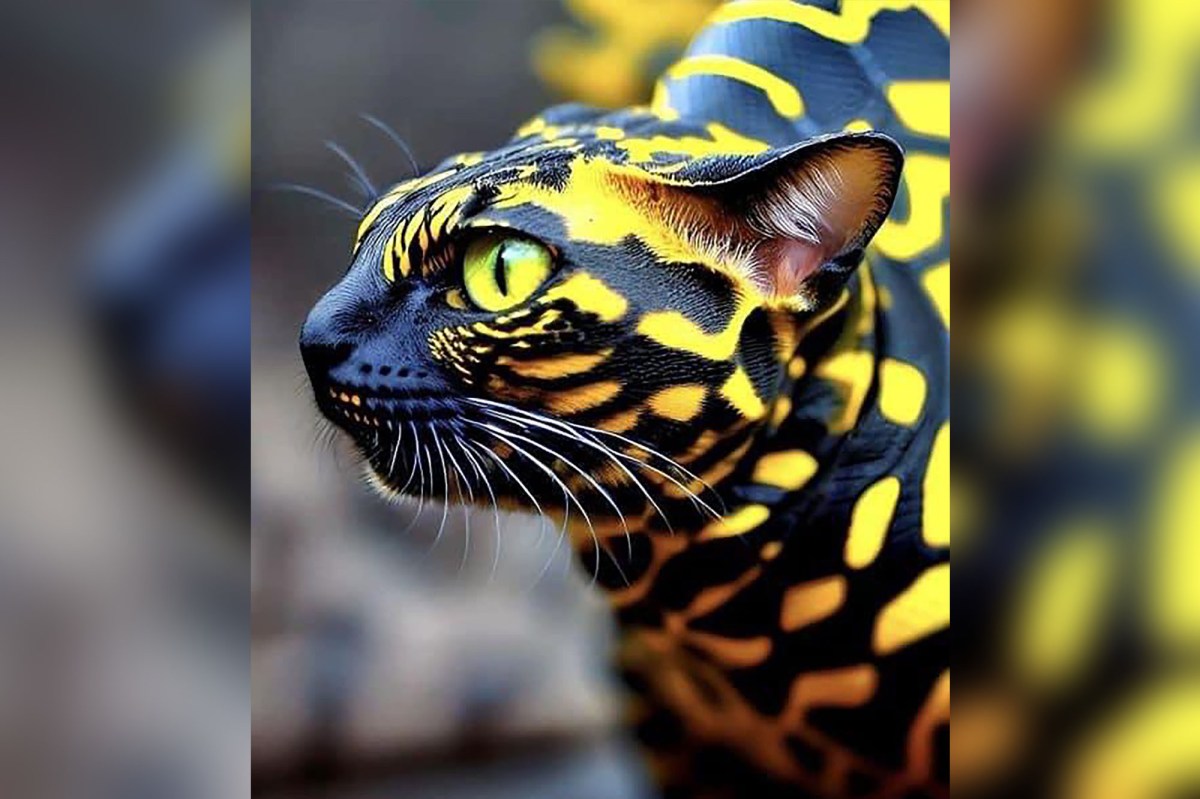
The ‘Snake Cat’ Is A Bad AI Fake

A viral image allegedly depicts a “snake cat,” described as an extremely rare species native to the Amazon rainforest.

Say hello to felis retrowavus, commonly known as the synthwave cat, one of the rarest species of felid on Earth.

Using the same technique GloFish employed to create bioluminescent neon fish for the pet market, scientists engineered felis retrowavus by extracting fluorescent proteins from jellyfish and inserting them into cat embryos, which incorporated the new proteins into their genome.

The result? A new species of cat that glows in fabulous colors like Tigerbrite Orange™, Electro Azure™, RadarGlo Green™, 1984 Pink™ and SithRed™!

Your brand new Neon Feline™ will run, jump and meow just like a regular cat, but unlike a plain old kitty, your Neon Feline™ will snuggle up with you at night and serve as your personal biological night light! Collect them all!

If that sounds like BS, that’s because it is.

Obviously.

Likewise, it should only take a second or two to realize the widely disseminated photo of a “snake cat” is a fake rendered by an AI.

The image has all the hallmarks of an AI generated image fail: Anatomical errors, fuzzy pixels where the AI struggled with the way light hits fur, a misshapen head and a nebulous, blurry background.

Although the media seems to be more obsessed with the snake cat hoax than people are (the snake cat image “mystified the internet,” the New York Post claims), after years of witnessing people take Onion stories seriously and confidently repeat misinformation online, I’m not really surprised when something like this makes the rounds.

The image was accompanied by a clever bit of writing claiming the cat isn’t well known because it’s native to the deep jungle of the Amazon, where scientists have difficulty tracking it. The text even offered a taxonomical name for the cryptid animal.

Enough people apparently fell for it that the staff at Snopes felt the need to debunk the image, even going as far as to check with a biologist who specializes in tropical fauna.

The original author of the snake cat post says he created the image and accompanying text to prove how easy it is for people to be fooled by AI-generated fakes. A noble goal if true, but I’m not sure everyone got the message.

In any case, the “snake cat” proves once again that AI, like all innovations, isn’t inherently good or bad. It’s what we do with the technology that counts.

Now can I interest anyone in a brand new Purple Velvet or Flaming Hot Cheetos SnuggleCat™?

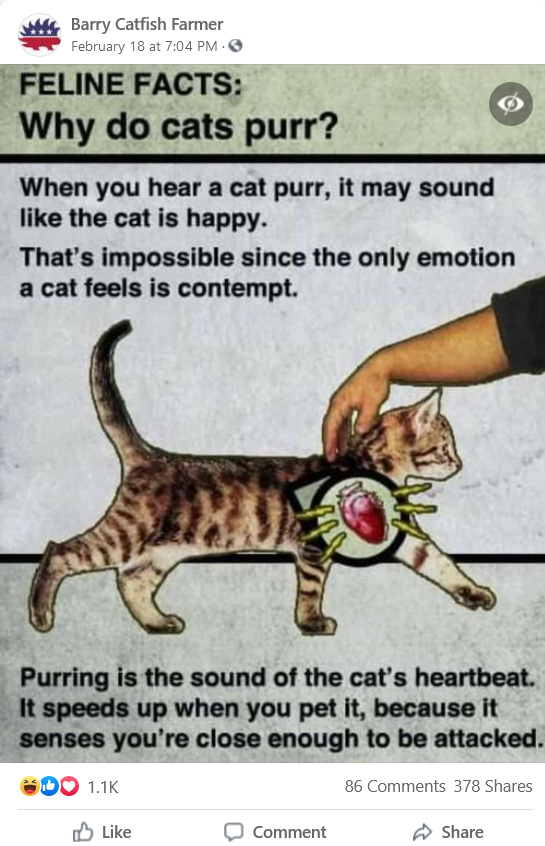
Viral FB Post Claims Cats Have One Emotion: Contempt

Factchecking a Facebook post claiming cats feel a single emotion: Contempt.

You have to feel sorry for the people still stuck in the Zuckerbergian cesspit that is Facebook, spending their days wading through tedious political arguments and “SHARE IF U AGREE” shitposts written for the paste-eating crowd.

Unfortunately, the platform’s rampant misinformation is not limited to politics. Here’s one of the latest viral posts:

Facebook Derp
Derp derp derp! A derp a derp derp derp!

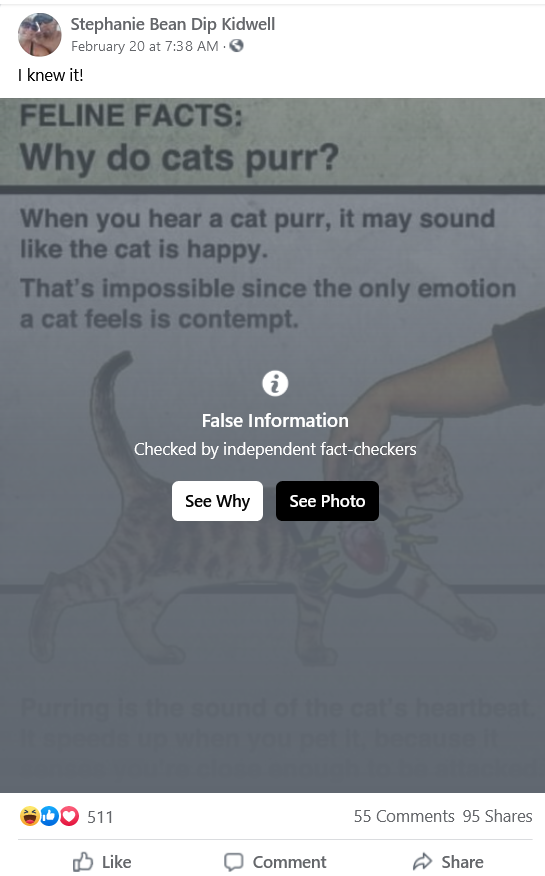
And this is what it looks like now, to protect people like your aunt who keeps sending you email forwards about Pizzagate:

Facebook: Derp!
Despite the flagged warning, people are still sharing the post. “Big Tech doesn’t want us to know the truth ’bout cats!”

Whenever I encounter stuff like this, my first instinct is to dismiss it as nonsense no one would actually believe. Then I remember our dubious track record when it comes to critical thinking: a third of millennials are flat-Earthers, one in four Americans thinks the sun orbits the Earth, and more than 16 million Americans believe chocolate milk comes from brown cows.

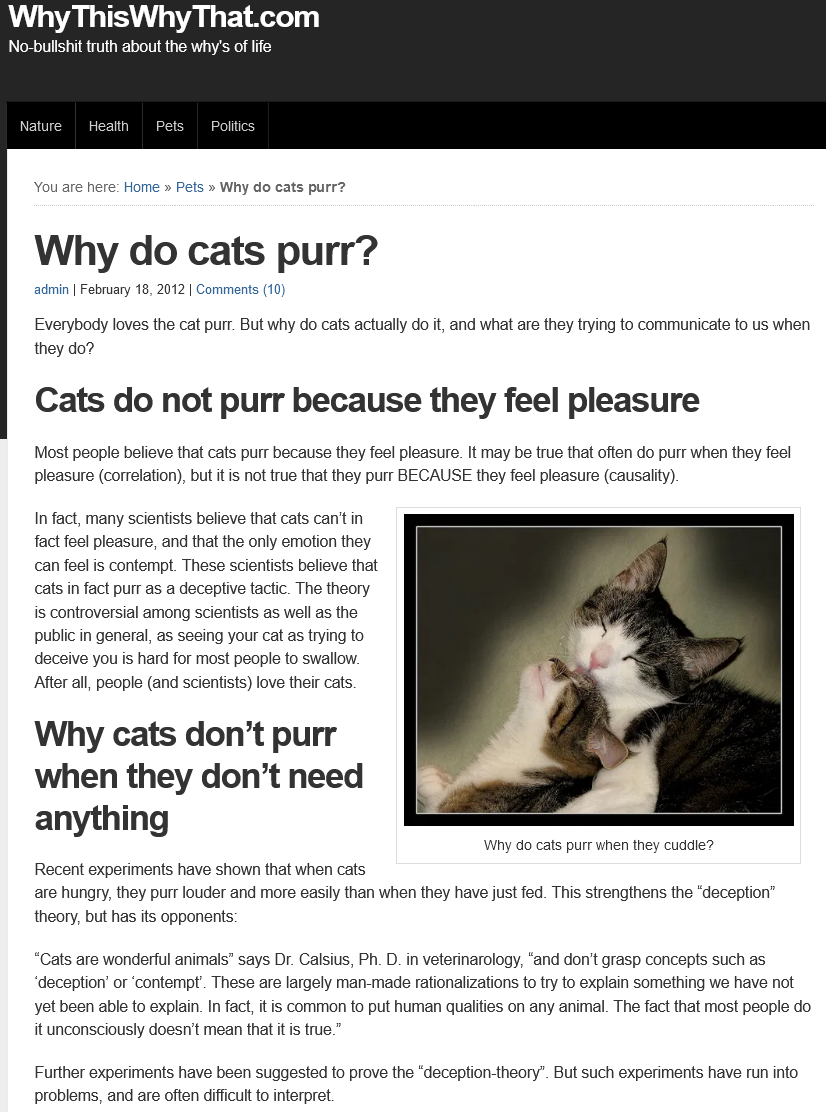
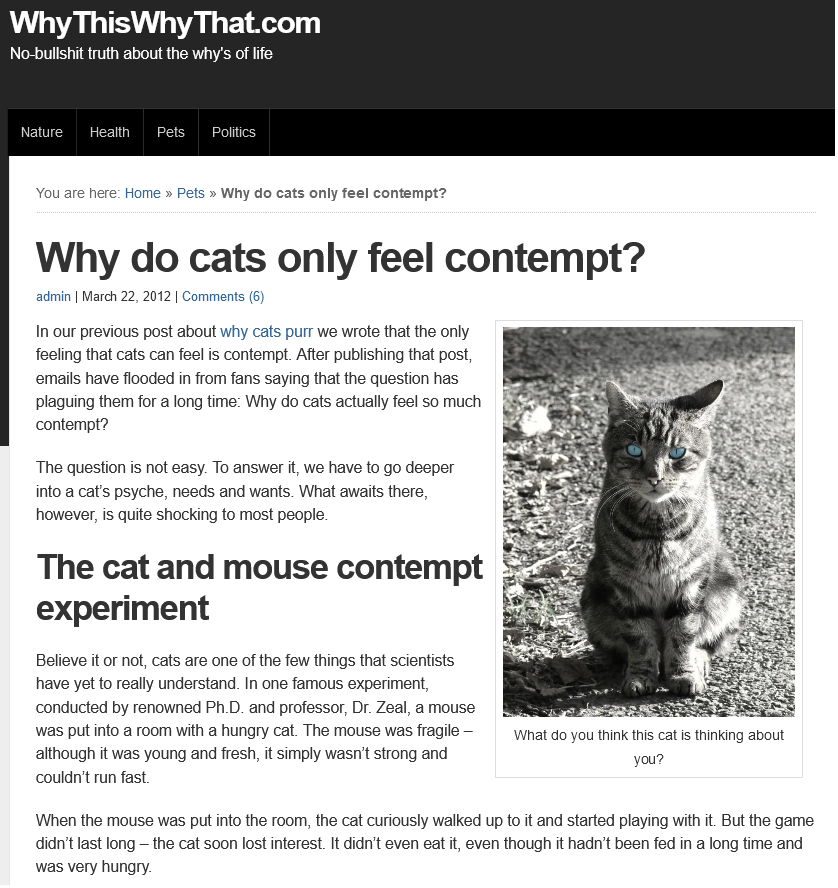
Some futurists and ethicists thought the world wide web would bring an end to conspiracy theories and outlandish beliefs, with the sum of human knowledge at our fingertips and the disinfectant power of the truth. But falsehoods have remarkable staying power, and the internet is happy to oblige any conspiracy theory no matter how far removed from reality, with sites like this one that says it offers “no-bullshit truth”:

Screenshot_2021-02-25 Why do cats purr

Screenshot_2021-02-25 Why do cats only feel contempt

So at the risk of stating the obvious, purring has nothing to do with a cat’s heartbeat, and cats experience all the same primary emotions we do (happiness, sadness, fear, excitement, nervousness) as well as quite a few secondary emotions, like jealousy, disappointment, contentment and confidence.

The idea that animals like cats and dogs are emotionless automatons went out of favor more than half a century ago, and modern technology has made it possible for scientists to peer into the minds of our domesticated friends and witness brain activity that mirrors our own when we process emotions. There is no debate: Cats have very real emotions, which is another compelling reason to treat them well.