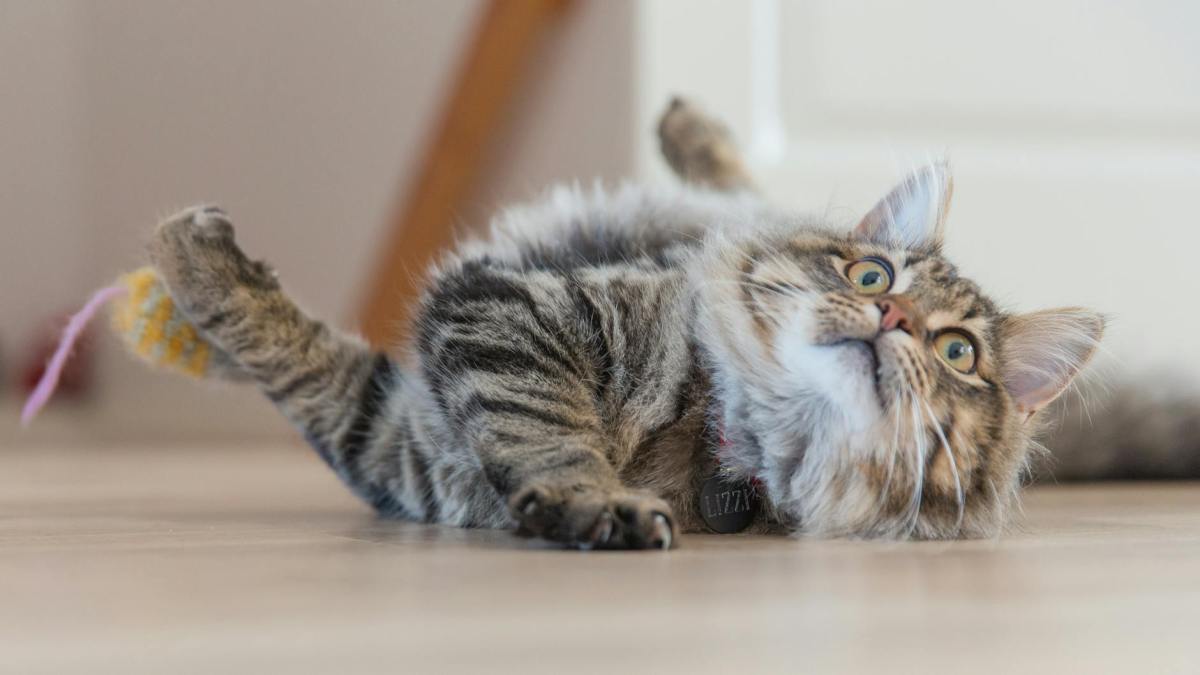
Shrill Editorial Calls Cats ‘Domestic Terrorists’ And ‘Skulking, Disobedient Destroyers’ Who Should Be ‘Locked Down’

The more bunk studies claim cats are driving wildlife to extinction, the more people in media and government call for extreme measures to contain them.

Seventy nine cats.

That’s how many felines stood in for the entirely of the UK in a 2022 study, which is the genesis for the claim that cats kill 270 million birds and small animals in that country.

Using GPS collars, owner questionnaires and samples of prey brought home by those 79 outdoor cats, a research team from the University of Reading applied data from a mix of studies dating as far back as 23 years ago, extrapolated and massaged numbers using things like “kernel density estimates” and “generalized mixed models,” and came up with that 270 million figure, which is cited routinely and credulously by UK media.

Actually, their estimate was between 140 and 270 million. An earlier study put the number at 92 million, and a 2016 study estimated UK cats kill 55 million birds and small animals. That’s a range of 215 million!

The Reading team even quotes the infamous US meta-analysis that claims domestic cats kill as many as 4 billion birds and 22.3 billion mammals a year here. That paper, as skeptics in the science community have noted, has virtually no relationship with reality, involves no original research, and relies on data from unrelated studies and surveys in which cat owners were asked to rate their pets’ hunting prowess on a point scale while imagining what the little ones get up to when they’re outside.

All of this is to say that aside from the thorough, labor-intensive and expensive D.C. Cat Count, which brought together cat lovers, birders and scientists to work cooperatively, the 2022 UK study and its counterparts in the US and Australia are exercises in pushing an agenda masquerading as honest academic research.

That’s how we get editorials like The Spectator’s “We need a cat lockdown now” by Zoe Strimpel. Though the tone isn’t tongue in cheek, I can’t imagine Strimpel dislikes cats nearly as much as she claims, and the post was probably written with wry anticipation for the click-generating fury of cat lovers indignantly sharing it on Facebook and X.

Still, it quotes the Reading study without skepticism and portrays cats as furry little wretches who abuse their human caretakers with their claws and their disdain while gleefully eating their way through endangered birds.

A cat stares down a mouse. Credit: Wikimedia Commons

Cats are predators, that much we can agree on, and outdoor cats are much more likely to negatively impact local wildlife, for obvious reasons.

Likewise, I can understand the concern with cat culture in the UK, where allowing pet cats to roam outside is the norm.

But every time the media cites the above-mentioned studies, more people are given an inaccurate impression of feline ecological impact, and more lawmakers at the local and national level consider “solutions” ranging from prohibiting people from keeping pet cats, as a government commission in Scotland recently proposed, or exterminating them outright, as some Australian states and municipalities in New Zealand have tried to do.

It’s worth pointing out that there is no data, not even a single study, showing that air-dropping poisoned sausages or arbitrarily shooting cats actually has any positive impact on birds and small mammals. All it does is terrorize sentient, intelligent domestic animals who have real emotions and experience real fear and pain.

The primary drivers of declining bird and small mammal populations — including habitat loss, environmental destruction, wind turbines and glass buildings — have nothing to do with cats. We have killed off 73 percent of the planet’s wildlife since 1970 and every species of iconic megafauna — from orangutans and gorillas to tigers and pangolins — is headed toward extinction. Are domestic cats responsible for that too, or can we be adults and fess up to our role as the main antagonist here?

An orange tabby and a mouse. Credit: Wikimedia Commons

Strimpel actually goes even further, claiming cats don’t have real affection for their caretakers and are more like psychopaths, faking love because it gets them what they want, primarily food and shelter.

Dogs have true affection for their humans but cats do not, she additionally claims, while adding that cat people are undateable because they share qualities with the “loutish and numerous creatures” they care for.

There was a time when I would have been ambivalent about Strimpel’s attitude toward cats, if not her cavalier treatment of basic facts. But then a drool-happy, friendly tuxedo cat showed me I could interact with his species without my allergies going haywire, and a tiny gray tabby kitten became my animal cognition teacher while blindsiding me with love.

Now every time I hear about some psychopath abusing cats, or terribly misguided politicians advocating a plan to kill millions of domestic felines, I think about my Bud. I think about how he cries for his Big Buddy when he’s hurt or stuck, how he meows and trills with excitement when he experiences something new, and how he began shaking, then threw up from overwhelming relief and happiness the first time I returned from a vacation after adopting him.

Buddy the Cat chillin’ on the balcony in the summer. Credit: PITB

He’s got a vibrant mind in his little head, with strong opinions and emotions. So does every cat on the street, in a shelter cage, and in the cross hairs of a birder or biologist playing God by “culling” or “harvesting” cats to protect another species.

Real science, not activism packaged as science, has proven that many times over in recent years. If people want to do harm to cats because they think birds and other animals will benefit, the burden of proof is on them to show not only that their methods work, but that the results could somehow justify the fear and misery they would inflict on innocent animals to achieve their goals.

Cats are obligate carnivores who don’t have a choice. We do.

Bogus Science And Unverifiable Claims Drive Cat Hatred In New Zealand

Cat hatred is driven in large part by bunk science authored by researchers who approach their work with predetermined conclusions.

After news of a now-canceled children’s cat hunting contest made international headlines this week, the usual suspects came out of the woodwork with wild, unsupported claims that cats — not humans, not human industrial processes, not human-driven habitat loss, wind farms or agricultural pesticides — are singlehandedly responsible for wiping out New Zealand’s native birds and the extinction of an arbitrary number of avian species.

One of the people leading the charge is Helen Blackie, a “biosecurity expert” who told the BBC that cats are responsible for the extinction of six native bird species in New Zealand.

Blackie doesn’t say where she got that information, but noted cat-hating Kiwi Gareth Morgan’s site claims that cats have killed nine native bird species, and attributes the information to a study, “A global review of the impacts of invasive cats on island endangered vertebrates.”

The “study” was published by academics in Spain and California without boots on the ground in New Zealand and is not actually a study at all. It’s a meta-analysis of prior studies, none of which count the number of feral, stray and pet cats in New Zealand, nor do they offer anything resembling a measure of how many birds are actually killed by cats.

Notably, the study does not say cats are responsible for the extinction of nine bird species.

close up shot of a stray cat
Credit: Mehmet Turgut Kirkgoz/Pexels

Much like their US bird-conservationist counterparts, the authors of the study cannot say how many cats actually live in New Zealand and have no observational data about feline predatory habits.

They rely on the same methods the US studies do, which is to say they collect data from unrelated research — including a paper measuring the impact of all predators on wildlife in the aftermath of wild fires in urban environments, a report on the way pet cat personalities impact how their owners view them, and a study on cat behavior in Culver City, California — stir the data into a pot of numbers, and massage the numbers until they get the desired results.

In this case, the “desired results” are any suitably impressive-sounding figure for the total number of native birds killed by cats in New Zealand. The authors aren’t conducting a scientific investigation to find out how those native birds died, they’ve already decided that cats are the reason and they’re misrepresenting data from unrelated studies to support that conclusion. That is not science.

Of course their conclusion has no basis in reality. How is it possible that a bunch of researchers on entirely different continents are able to come up with accurate figures on cat predation in New Zealand without any actual data about cats in New Zealand, without a population count of cats in New Zealand, and without a single observational study to draw information from?

How does a study of coyote and cat interactions in Culver City, California have any bearing on cats killing birds in New Zealand, an island country 6,700 miles away with habitats that bear little or no resemblance to California? Coyotes don’t even exist in New Zealand!

How does a self-reported questionnaire about the personalities of pet cats by American cat owners tell researchers anything about the behavior of feral cats in rural New Zealand?

How does a study about the Persian squirrel on Greek island ecosystems tell a research team anything about the impact of cats on flightless birds in a completely different environment, in a different part of the world, with different types of trees and cover, different native fauna and weather systems?

How does a study of alpine ecosystems inform estimates of cat predation in the temperate and subtropical ecosystems of Aotearoa?

view of a stray cat on a city street
Credit: Boys in Bristol Photography/Pexels

This is not science

This sort of buffet-style, cherry-picking nonsense wouldn’t pass muster in an undergraduate class in the hard sciences, yet somehow it’s not only published in peer-reviewed conservation journals, it’s reported breathlessly and credulously by reporters at outlets like NPR, the BBC and the Guardian, who don’t even bother to read beyond the abstract.

The claims are further undermined by their inexplicable assertion that feral cats and domestic cats are not the same thing, when in fact they are the same species: felis catus. Advocates of cat hunting in New Zealand fret that it’s impossible to tell if cats are feral or pets, not understanding that they are indistinguishable because they are the same. The only difference is that house cats have homes and ferals do not.

No one is claiming that cats don’t have an impact on the environment. It would be foolish to think they don’t.

But if anyone — especially journalists with influential platforms and researchers cloaked in authority thanks to the veneer of real science — wants to make the case that cats are the primary force leading to declining numbers of native bird populations, then the burden of proof is on them, and it’s a high one.

We’re talking about life here, the lives of fully sentient animals with their own rich internal thoughts and feelings. You don’t just casually call for their extirpation or send children off with rifles to arbitrarily shoot them like little serial killers in training.

If you want to make the case, do the work. Get the grants. Hire the personnel. Do it right. The Washington, D.C. Cat Count even has a free toolkit for other communities to conduct their own feline census, so they can make informed decisions. But if you’re unwilling or unable to do the work, then stop spreading misinformation, because it has tragic consequences for real-world animals, and their blood is on your hands.

Top image credit Aleksandr Nadyojin/Pexels

Cats Know Where We Are Even If It Seems Like They’re Not Paying Attention

New research offers more evidence that despite their poker faces, cats do care about where their humans are and what they’re doing.

A new study from Japan found cats keep track of their humans even when they’re not looking at them.

A research team from the University of Kyoto conducted the experiments in a cat cafe and in individual cats’ homes. Each cat was placed in a room without their humans. Then the researchers tested the way felines reacted to hearing their people calling their names from outside the room, followed by their reactions to hearing them inside via speakers.

When the cats heard their humans calling them from inside the room the furballs were surprised, expressing their confusion with ear twitches, whisker movement and uncertain body language.

On the other hand, when cats heard “non-social stimuli” — scientist-speak for sounds other than familiar people calling to them — they didn’t react to changes in the location and direction.

Some people might shrug and wonder what the fuss is about, but the experiment actually confirms a great deal about feline intelligence. It’s a test of what scientists call “socio-spatial cognition,” meaning cats form a mental map of things that are important to them, and nothing’s more important to a house cat than the person who provides food, security and affection.

That’s significant because it’s confirmation that cats understand object permanence, and that they are more than capable of abstract thought. Abstract thought — the ability to picture and think about something mentally, without having to see it — is hugely important in intelligence, allowing everything from creativity to understanding that other animals and people have their own points of view. For context, it takes about two years for human children to develop rudimentary abstract thinking skills.

Cats “may be thinking about many things,” Saho Takagi, the study’s lead author, told CNN.

“This study shows that cats can mentally map their location based on their owner’s voice,” Takagi said, per The Guardian. “[It suggests] that cats have the ability to picture the invisible in their minds. Cats have a more profound mind than is thought.”

Things like object permanence and spatial awareness were necessary for cats to thrive as hunters for the millions of years they’ve existed on Earth.

The results aren’t surprising from an evolutionary perspective, biologist Roger Tabor said.

“That awareness of movement – tracking things they cannot see – is critical to a cat’s survival,” Tabor told The Guardian.

“A lot of what a cat has to interpret in its territory is an awareness of where other cats are. It is also important for hunting: how could a cat catch a field vole moving around beneath the grass if it couldn’t use clues, such as the occasional rustle, to see in its mind’s eye, where they are? A cat’s owner is extremely significant in its life as a source of food and security, so where we are is very important.”

The study is also another piece of evidence showing cats are just as aware of — and concerned about — their people as dogs are, even though the conventional wisdom says they don’t care most of the time. That has implications for the way people bond with their cats, and the decisions we make about caring for them — like, for instance, how long we’re willing to leave them on their own while planning a trip.

“This is a great example of elevating our expectation of the cat a little bit,” cat behavior consultant Ingrid Johnson told CNN, “and realizing that they do have the capability of having that bond in that relationship where they actually will take comfort in their people.”

How Long Can You Leave Your Cat Alone?

“Cats take care of themselves,” the conventional wisdom insisted for decades. These days we know that’s not true.

Back in the Dark Ages of kitty cognitive knowledge, when scientists wouldn’t go near a cat with a 20-foot pole because they were considered impossible to work with, the conventional wisdom was that as long as a cat was fed and watered, its needs were met.

Going away for three days? Leave a few bowls of dry food and water and you’re good to go, or if you really want to splurge, get an automatic feeder, the prevailing wisdom went. Gonna be away for a week or two? Get someone to check in on the cat a few times a week just to make sure food and water is available.

“If you want a dog but you don’t have time to meet all of its needs, get a cat,” people would say. “They take care of themselves.”

It didn’t take me long to realize how wrong the “prevailing wisdom” on cats really was, and thankfully in recent years we’ve seen a boom in research into cat behavior, intelligence and emotional needs. Among the many things verified by those studies is the fact that cats absolutely are emotional animals and are not the cold, indifferent automatons many people insisted they were.

One reason for that enduring myth may be cats’ famous stoicism. Ignore a dog and she might cry, become destructive or pee in your house, but one thing’s for sure — she’s going to let you know she’s not handling the isolation well. Ignore a cat, and he’ll just withdraw.

I’ve seen plenty of examples of the latter in the homes of friends and acquaintances. The cats are just sort of there, existing like the furniture or plants, interacted with rarely and given affection only occasionally. Those poor cats are quiet, seemingly indifferent, expecting nothing and sadly accepting of their place. They are neglected.

But when you pay attention to your cats they come out of their shells, so to speak. They warm to you. They reveal their hidden emotional core.

Of course, when you raise a cat with attention and love, that’s there from the very beginning, and they WILL let you know when they’re not happy with your absence.

Who do we know who’s like that? His name sounds like Bum, or maybe Bunny, or…oh yeah! God forbid I should ignore Buddy. I’ll never hear the end of it. In fact, he’s on my desk right now, butt parked next to the mouse, and I’m sure any minute now he’s going to decide that I’ve been writing for too long and declare it’s Buddy Time.

Of course, the little jerk attacked his own cat sitter, a friend who has been caring for him when I’m away since he was a kitten! That complicates things.

“Oh servant! Servant, come here at once! I’d like a massage!”

If you’ve made it this far, you might be wondering how long you can really leave your cat alone. The answer is no more than 24 hours without someone dropping by to check on kitty, refill the water and food bowls, and give him some attention.

If you’re gone longer you’re going to want to make concrete plans for a cat sitter to be there every day.

“You should not leave your cat alone for a prolonged period,” veterinary postdoc Mikel Delgado told Inverse. “Cats also have emotional and social needs that can’t be met when they are left alone for extended periods.”

If your cat likes to play, that’s great, but even if the little one doesn’t, your cat sitter can make things easier by simply hanging out, Delgado said.

Now if you’ll excuse me, His Grace needs me…

Reason #488 To Keep Your Cats Indoors: They Hunt Whether They’re Hungry Or Not

Cats who have regular outdoor access and hunt wildlife still get 96 percent of their nutrition from pet food, a new study found, suggesting their predatory behavior is driven by instinct, not hunger.

A new study from the UK debunks the claim that cats need access to the outdoors to supplement their diets with wild kills.

Cats who spend a significant amount of time outdoors and regularly kill local wildlife still get 96 percent of their nutrition from meals provided by their humans, according to research by a team at the University of Exeter.

The scientists connected with cat owners through ads on social media, TV and in print publications, specifically seeking out “cat owners living throughout southwest England whose cats regularly captured wild animals and brought them back to the house,” the study’s authors said.

They gave the owners a questionnaire to collect some basic information on the kitties — age, sex, breed, whether they had unrestricted access to the outdoors, and how much time they spend outside — then split the 90 participating cats into six groups.

Cat hunting
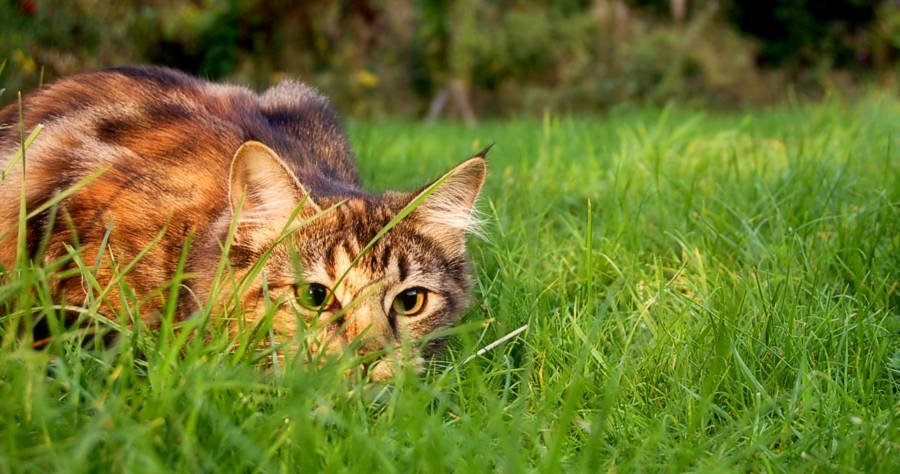
A domestic tabby cat stalking in the grass. Credit: Wikimedia Commons

To set a baseline, the scientists trimmed small sections of whisker from each of the cats, then trimmed a second sample at the end of the study.

By comparing stable isotope ratios in the whisker samples, they were able to determine what the cats were eating. Despite regular access to the outdoors and successful hunts, pet food accounted for the vast majority of their diets.

As a result, the researchers concluded, outdoor cats hunt because they’re driven by predatory instinct, not hunger.

“When food from owners is available, our study shows that cats rely almost entirely on this for nutrition,” said Martina Cecchetti, the study’s lead author.

“Some owners may worry about restricting hunting because cats need nutrition from wild prey, but in fact, it seems even prolific hunters don’t actually eat much of the prey they catch,” Cecchetti said. “As predators, some cats may hunt instinctively even if they are not hungry – so-called ‘surplus killing’ – to capture and store prey to eat later.”

A second component of the study was designed to find the best mitigation strategy to change the behavior of outdoor cats.

Each group was given a different strategy: In one group, cats were outfitted with bells on their collars, while another group wore reflective break-away collars and cats from a third group were fitted with BirdBeSafe collars. The other groups were told to make habit changes inside the home. For example, one set of cats was fed a higher-protein diet without grain filler, another group was fed with puzzle feeders, and the last group was given extra interactive play time.

While high-protein diets and play time helped cut down on hunting, the BirdBeSafe collars had the biggest impact on hunting success. The collars come in bright colors designed to stand out to avian eyes, taking away stealth and the element of surprise from cats.

The study was sponsored by Songbird Survival, a British non-profit that funds bird conservation research and looks for ways to mitigate the dwindling numbers of many avian species.

Susan Morgan, Songbird Survival’s executive director, said her group hopes cat owners will do their part to help: “Pet owners can help us reverse the shocking decline in songbirds via three simple, ‘win-win’ steps: fit collars with a Birdsbesafe cover; feed cats a premium meaty diet; play with cats for five to ten minutes a day to ‘scratch that itch’ to hunt.”

Of course there’s an obvious solution the study didn’t include: Keeping cats indoors. While keeping cats indoors is common in the US, cat ownership culture in the UK is different — another subject for another post.

Read the full text of the study here. Header image credit Pexels. Body images credit BeSafeCollar.

Previously:

1024px-Florida_panther_kittens
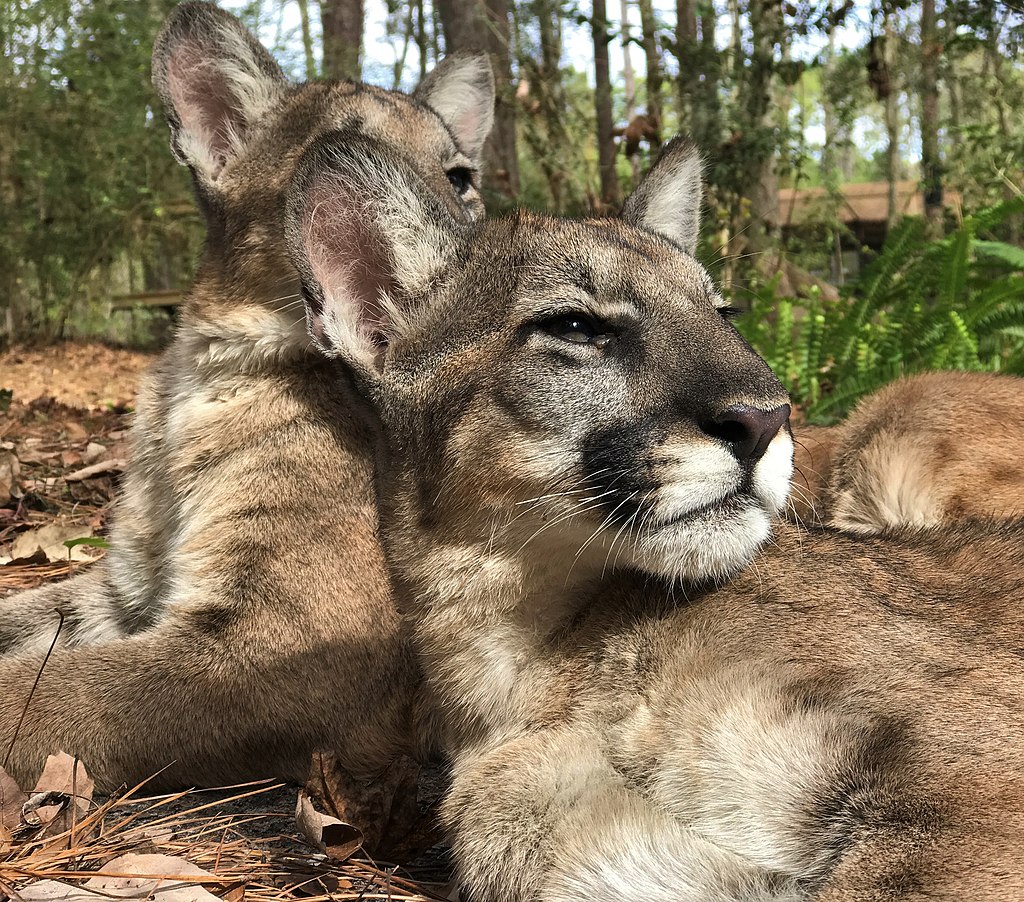
A pair of young mountain lions in Florida. Credit: Wikimedia Commons/WOConservation