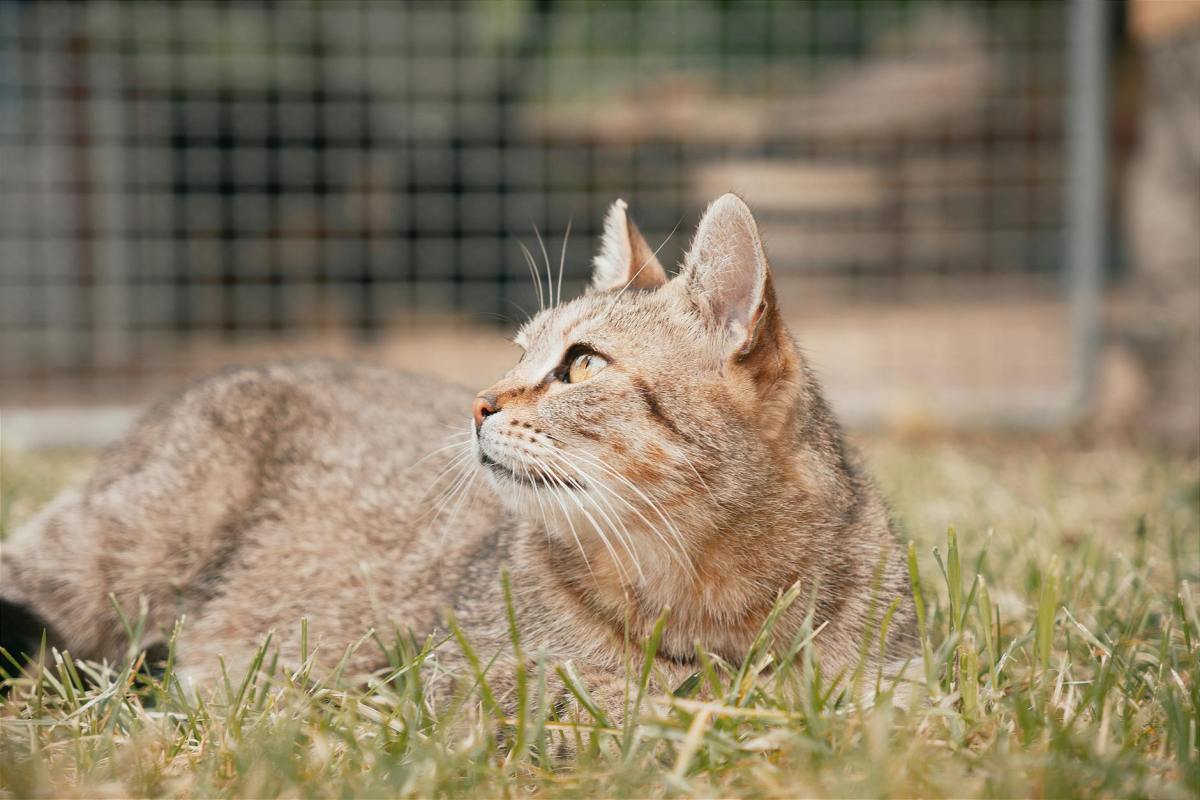
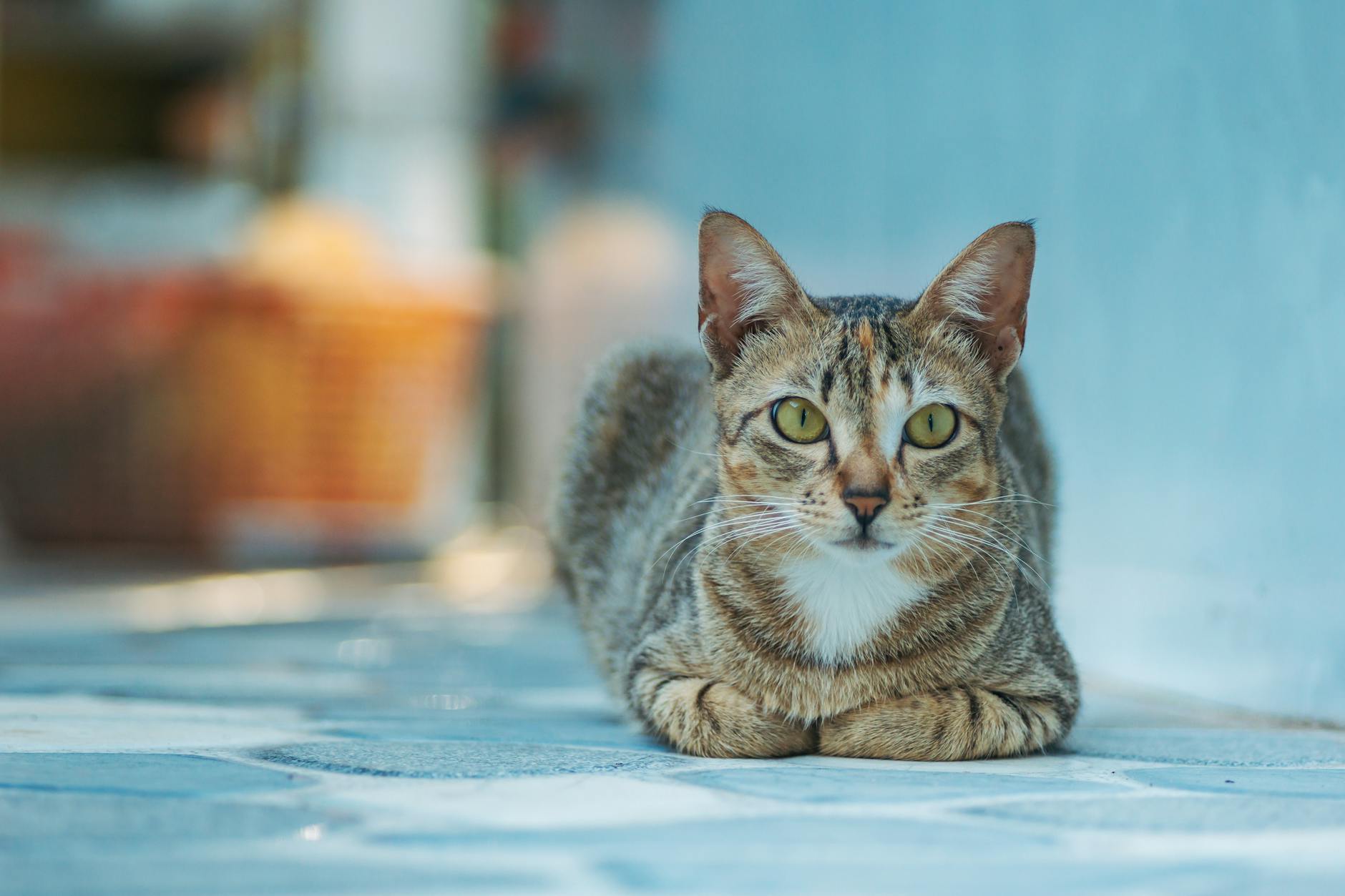
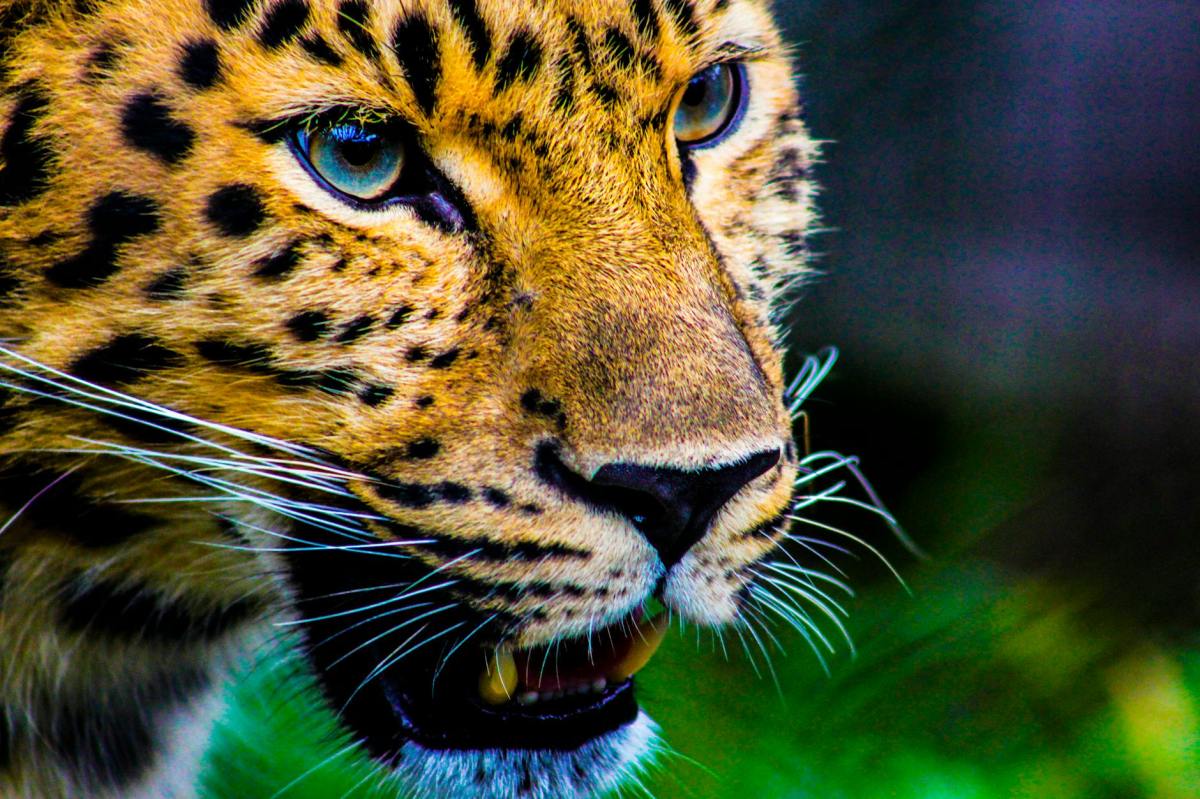
Happy Fourth of July from Little Buddy the Cat and Big Buddy the Human!
There’s a park less than a block from Casa de Buddy, and it’s the site of my town’s annual fireworks show, so Buddy handled the noise stoically as he always does. He’ll run screaming from a vacuum, but he’s a pro at ignoring fireworks thanks to experiencing them up close and loud every year since kittenhood.
I’ll be headed to a family barbecue, then the proper July 4 fireworks show in the neighboring town with my nieces. The Budster and I wish our readers well, and we hope your feline overlords are similarly unbothered if you happen to live in close proximity to a fireworks show. Happy 4th!
In the meantime we leave you with these important messages from the Americats:
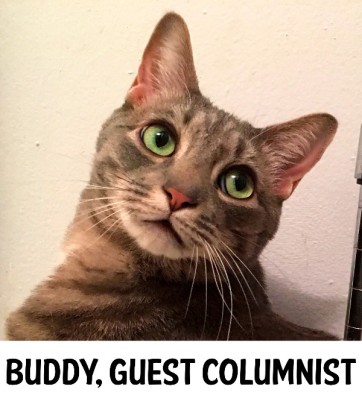
Buddy the Cat praises the many comfortable lounging spots at Casa de Buddy, while Buddy the Cat blasts his human for sitting in his favorite spot! Who’s right?
There Are So Many Wonderful Places to Lounge!
You know what I like about our my home, human? It affords me seemingly endless comfortable places to lounge and nap.
There’s the rug underneath the dinner table, which is soft and makes me feel well-protected with a roof over my head and chairs blocking access to anyone larger than me.
There’s your padded fake leather office chair, which not only retains your butt heat, but is also a fabulous item to scratch.
There’s my bed, which used to be your bed, which I graciously still allow you to use 22.3 percent of. Oh, and the wonderful raised platform above my scratcher, where I can watch birds safely and make weird noises when they fly. In the winter, the radiator provides a toasty alternative to draftier spots.
When I was but a kitten, I never dreamed of having such a vast realm to call my own, with so many comfortable places to be lazy.
Indeed, there’s no place like home, and no places like my spots.
Dude, You’re In My Spot!
Come on! Get up!
This is not funny. You know that’s my favorite spot! The left side of the couch is comfortable, warm, gives me a good view of everything, and smells like you.
Get up! Get up! If you don’t vacate the premises immediately I will be forced to disappear, wait until you’re distracted, then nearly give you a heart attack with a well-timed ambush.
Or perhaps I will take my spot anyway by sitting on your head. How foolish would you look then, eh human?
Yes, there are plenty of other places for me to rest but I like this one because you’re sitting in it.
Grrrr, fine! But I’m sleeping on top of you, so if you need to heed nature’s call, do it now, human. I don’t like to be disturbed by your bathroom trips. Also, could you try to breathe a little less? It’s just that when I’m laying on your chest, I can feel your exhales on my fur and it’s really annoying. If you could keep breathing to a minimum, that’d be great.
PLUS: Today’s the deadline for UK residents to get their cats microchipped under a new law that levies a hefty fine for people who don’t comply.
Another day, another story about a person who can’t tell if the cat they’ve brought inside is their own or a random lookalike.
In this case, a woman named Amber Porter says her indoor-only cat bolted outside, and after a few hours she was able to bring him back in — only to have doubts about whether he’s actually her cat. Meanwhile, an identical-looking black cat is hovering around Porter’s home, and she’s trying to lure it inside.
“I’m still a little worried about it,” Porter said. “I have fully convinced myself I have the wrong cat but I also think I do have the right one.”
This absolutely blows my mind. If someone asked me how long it would take to determine if a gray tabby is Buddy, I’d say approximately half a second. It’s not because of his “bib,” that unique white tuft of hair on his chest, or his pronounced muzzle, although both would offer confirmation.
It’s his behavior, his mannerisms and movement, the fact that if we were separated, he’d meow loudly the second we’re reunited and I’d hear that familiar half-trill, half-meow he does that seems to be Buddesian for “Hello, servant!”
In any case, I hope Amber Porter figures out which cat is hers, and the story looks like it’ll have a happy ending because she says she intends to keep both cats.
Today’s the deadline to get your cats microchipped in the UK
A reminder to our British readers: today, June 10, is the deadline to have your cat microchipped under a new law that makes chips mandatory.
If you’re caught with an unchipped cat, the fine is a hefty £500, or about $635 in ‘Merican greenbacks. That’s some serious chop, so get your little buddy chipped!
“Chip me, human!” Credit: FOX/Pexels
Alice Potter, a cat welfare specialist with the RSPCA, told Sky News that microchips with up-to-date information are the biggest factor in reuniting cats with their humans when the former go missing.
“On average, 11% of all cats coming into the RSPCA’s care are still not microchipped. We’ve also rescued cats who have been microchipped but the details haven’t been kept up to date, which is arguably even more frustrating as it means cats spend a long time in our care whilst we fruitlessly try to contact the owner with out-of-date information,” Potter said.
“However, we’ve also seen countless stories of cats that have been reunited with their owners thanks to a tiny microchip – showing what this change of legislation will achieve for animal welfare.”
With some muscle to back him up, Buddy the Cat becomes the scourge of the neighborhood.
NEW YORK — Taking refuge from the heat of an unusually humid early June day, cats and dogs alike were gathered around the neighborhood’s most popular watering hole when their quiet lapping was disturbed by a kittenish, falsetto-like meow.
“Coming through!” Buddy the Cat yelled. “Make way!”
The silver tabby ordered everyone to “vacate the premises,” declaring the water his “personal drinking spot.” One of the toughest cats on the block, a battle-scarred orange tom named Buster, continued drinking.
“Ahem!” Buddy said loudly. “Perhaps you didn’t hear me. Vacate the pond, Buster!”
“Or else my jaguar is not going to be happy,” Buddy replied.
Buster began laughing, then caught sight of the enormous apex predator and backed up warily.
“That’s right!” Buddy said. “Back up if you don’t want to become a light snack, Buster!”
Ek B’alam, Buddy’s jaguar friend, raised a paw sheepishly.
“Um, do we have to threaten violence? I’m not interested in hurting…”
“Shhhh! Yes, yes we do have to threaten them!” Buddy whispered. “Let’s see that intimidating pose you do…great, now roar!”
The jaguar let loose a primal rumble, sending every cat, dog, bird and squirrel within a mile running for cover.
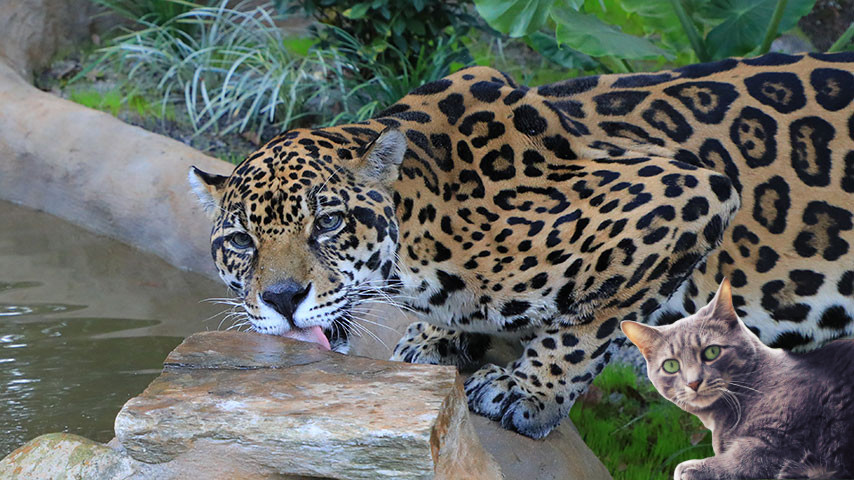
Buddy and Ek B’alam enjoying a prime drinking spot after bullying its previous occupants.
After enjoying a leisurely drink with the pond to themselves, Buddy and Ek B’alam took a lazy route to a nearby dog park where the pair terrorized a pitbull and a gang of Dobermans.
Witnesses said Buddy strolled into the Doberman circle, needled the dogs with insults and told them they’d have to hand over their treats promptly or face dire consequences.
“Oh yea?” the canine leader said, his tail twitching with anticipation. “Says who?”
“Says my jaguar!” Buddy said theatrically, holding both paws out like a magician.
The dogs paused, looked at each other and laughed uproariously.
“Get outta here, you pudgy little…oh! Oh! He’s really got a jag…I mean, I d-d-didn’t…”
Buddy feigned indifference as Ek B’alam padded out from behind a tree. The dogs emptied their bladders.
“You were saying something about me being pudgy, weren’t you? We don’t like insulting little mutts, do we, Ek B’alam?”
“No, we do not, Buddy,” the big cat replied.
“Sometimes we eat them for breakfast, don’t we, Ek B’alam?”
“Yes we do, Buddy. Better than bacon and eggs, with an agreeable aftertaste!”
The dogs whimpered, tails between their legs.
“Leave your toys and treats and scram!” Buddy said, making the canines flinch as he faked a leap toward them.
“You were right, this is kinda fun!” Ek B’alam said as he ate the dogs’ snacks. “Who do we terrorize next?”
Buddy rested his chin on his right paw thoughtfully.
“We could rob Los Gatos of every ounce of catnip they possess. We could put the fear of God into those ‘hunters’ who shoot at our puma buddies. I also have a revenge list of everyone who ever insulted me on the internet. That could be fun!”
As of late Tuesday night, local police scanner frequencies were buzzing with reports of two cats, one small and the other enormous, gleefully tearing apart industrial vacuum cleaners at a nearby Stanley Steemer shop.
The cat food cupboard is bare, and Buddy the Cat is not amused.
NEW YORK — The unthinkable happened on late Thursday night when Buddy the Cat’s human servant opened the very last package of chicken pate only to realize the meat inside had gone bad, probably from a hole in the damaged container.
It was a catastrophe. For the first time in 10 years, poor Buddy was bereft of wet food!
Making matters worse, and signaling a deep betrayal, Big Buddy elected not to potentially lose his parking space to make a late night run to a 24-7 store to buy emergency cat food for his feline overlord.
He is required to do so under the terms of the Cat Servant Agreement of 2014, which stipulates that running out of food is “unacceptable” and supplies “must be replenished when the Strategic Yums Reserve is reduced to five (5) cans or three (3) packages of Perfect Portions remaining in the Cupboard of Yums.”
Poor Buddy was left with nothing except Blue Buffalo dry food, Friskies dry treats, Rachael Ray Nutrish soft treats, chicken puree from a squeeze tube, diced gouda cheese, and a bowl of fresh water.
“Oh why Big Buddy have ye forsaken me?” Buddy asked, collapsing from the lack of meaty caloric energy his meowscular frame relies on to fuel his finely-tuned physique. “Et tu, Big Buddy? Et tu?”
Sources say Little Buddy vowed to exact bitter revenge on his irresponsible, traitorous, callous, selfish, non-empathetic, backstabbing, inconsiderate, terrible human…if he makes it through the night.
A visibly angry Buddy, pictured above, was in danger of starving on Thursday night due to lack of wet food.




 You know what I like about