This is just one reason why animal advocates are not fond of breeders.
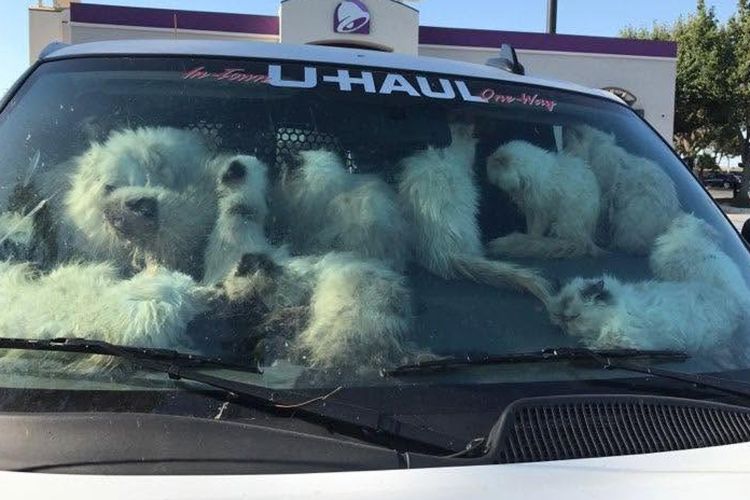
A California woman faces animal cruelty charges after police say she abandoned 134 cats in a U-Haul van without food or water in the sweltering summer heat.
The cats, ranging in age from a week to eight years old, have been removed from the van and the 106 survivors, described as “extremely emaciated,” are receiving veterinary treatment at the Merced County Animal Shelter, according to the Merced County Sheriff’s Office.
Jeannie Maxon/Facebook
A deputy found the van at 5:30 p.m. on Sunday in Santa Nella, a small town about 40 miles south of Modesto. The cats were stuffed in the U-Haul, which was left in a Taco Bell parking lot, and about 20 of them had taken up spots on the dashboard, center console and driver’s seat.
Jeannie Maxon, a 69-year-old woman from Long Beach, Calif., was charged with 93 counts of animal cruelty.
Maxon is the owner of a cat breeding business called Magicattery, which she’s touted on her personal Facebook page and an Instagram page specifically dedicated to the breeding operation. A separate site on its own domain remained up as of Tuesday evening and says the breeding operation specializes in Persian and Himalayan kittens.
A screenshot of Maxon’s Instagram page for her breeding business.
Many of the cats and kittens are dressed up, wrapped in pearls and ribbons, and posted with accessories in the photographs Maxon shared on social media. Maxon was active on Facebook and Instagram until late 2024, according to her visible public activity on both sites.
It’s not clear why she abandoned the cats. California does not have a state licensing system for breeders, but individual towns and cities may require breeders to obtain a license.
It wasn’t immediately clear if Maxon had retained an attorney.
Merced County Animal Shelter said in a Facebook post that the cats will be put up for adoption once they’re all stabilized and receive proper veterinary care.
The cats were found in extremely poor condition and were described as “severely emaciated” by police. They were abandoned without food or water. Credit: Merced County Sheriff’s Office
When serial cat killers serve sentences of less than a year due to plea deals and early release for good behavior, how much deterrent value do our laws have? Not much, it seems.
Note, 5/3/2025: We’ve heard from two readers who say the MyNorthWest report contains inaccuracies. We’ve reached out to the police and will follow up with police and courts on Monday to verify the facts and correct potential misinformation. Apologies for the confusion.
Every couple of months, at least in the last year or two, I’ve slowed down on posting, and almost always for the same reason: my cat-related news alerts are seemingly endless streams of depressing stories about people shooting, strangling or dismembering cats.
It never ends, and sometimes it’s so overwhelming that I’m put off from writing for days. At the same time, I am not a believer in the idea that all animal blogs should be saccharine feel-good fests about fluffy kittens and TikTok videos of cats doing silly things.
There’s always a place for celebrating cats, but if they’re in danger, and if the stories point to wider trends that cat lovers should know about, then I think it’s our responsibility to remain educated. Not only so we can guard against threats to our little friends, but also so we can add our voices to the chorus calling for tougher laws and greater accountability.
That’s ultimately what this is about: accountability.
Stories about two cat serial killers in about a week have made it clear that even the strengthened animal protection law — the Preventing Animal Cruelty, or PACT Act — passed in 2019, during the first Trump administration, raising animal cruelty and murder to the level of a felony, are still not enough. They’re not a deterrent, especially when the convicted abusers and killers end up serving a year or less because prisons are overcrowded and the wider law enforcement community still doesn’t take animal-related crime as seriously as other violence.
Antoine Leander Runner Jr. is a serial murderer of cats. The Seattle man was recently released from prison after serving just a year for a felony animal cruelty conviction.
The 43-year-old’s modus operandi was setting up crude, homemade snares and traps to capture and harm felines. He was also known in cat rescue circles, where he posed as a cat lover and took advantage of programs to get free supplies, including “cat food, kennels, collars, leashes, and treats to lure cats and kill them,” according to MyNorthWest, a Seattle news site.
When locals discovered new homemade traps in Runner Jr.’s old haunts and trail cameras picked up images of the man himself stalking wooded areas, neighbors called police and area shelters. The evidence showed Runner Jr. was allegedly visiting cat colonies at night and had picked up right where he left off. One colony cat’s body was discovered on March 31, “disemboweled and publicly displayed.”
“Animal Control confirmed the injuries to the cats were human-caused,” MyNorthWest reported, adding that it appears Runner Jr. was visiting colonies “every night” to hunt cats.
Above images by u/picardhasyourback, posted to the SeattleWA subreddit. Click on the images to see full-size versions.
Runner Jr. was picked up by Seattle police this weekend after a neighbor spotted him in a wooded area and phoned authorities. The convicted cat killer, who had a new bench warrant out for his arrest, was charged with a misdemeanor, but more charges are likely as police investigate his latest alleged attacks on Seattle-area cats.
The Seattle man was originally arrested for killing cats in 2023, but was released early. The Seattle area was also terrorized by a serial cat killer who stalked the area in 2018, mutilating cats so badly that I won’t repeat the details on this blog out of respect for readers.
It should be made clear that Runner Jr. was not connected to the 2018 killings, but police should reconsider those cases as well because if it turns out Runner Jr. is guilty of these latest cat murders, it will be abundantly clear that he is a high recidivist offender who cannot be trusted to leave the animals alone. He should serve a long, unabridged prison sentence and be subject to constant monitoring when he’s released.
Antoine Leander Runner Jr. was arrested this weekend by Seattle police. Credit: Sarah Seiler/Facebook Georgetown Community Discussion Group
What’s the solution here? Increasingly tough criminal penalties for animal abuse and murder? Expensive monitoring equipment to watch over every cat colony? Education and training for law enforcement so violence toward animals is taken as seriously as it should be?
I hate to keep pointing out that people who harm animals are likely to “graduate” to harming humans, as many studies have shown, because it implies that we should only be concerned about animal abuse for its tendency to turn into human abuse. It obscures the fact that animal life is intrinsically valuable, and that cats — and dogs, many bird species, mammals and marine life — are sentient, with their own thoughts and emotions. But if that’s what it takes for people to take this sort of thing seriously, then it’s worth repeating the point.
The suspect had been spotted by several people who live in the neighborhood, who said they saw him luring cats with food and injecting at least one feline with a needle.
For the past two years, people in Santa Ana, California, have sworn there was a serial cat killer in their midst.
The allegations picked up steam this week after a local TV station aired a segment from angry and confused neighbors whose pets disappeared, as well as others who saw the suspect injecting at least one cat and scooping up others. The neighbors shared information on a hyper local platform, zeroing in on one particular neighbor.
On Wednesday, the Santa Ana Police Department arrested 45-year-old Alejandro Oliveros Acosta and charged him with felony animal cruelty in connection with the case. Investigators were able to put together enough information to obtain a warrant, and a search of Acosta’s home turned up the corpses of “dozens” of cats, according to Officer Natalie Garcia, public information officer at the Santa Ana Police Department.
Heartbreakingly, Garcia said there were too many bodies in Acosta’s home for police to put an exact number on how many cats he’s allegedly killed. Police are still putting together the details, and more charges are likely.
A press release from Santa Ana police says the department is working with animal control and a neighboring police department. In addition to the evidence they collected in Acosta’s home, several neighbors positively identified Acosta as the man they saw luring neighborhood cats with food, scooping up a breed cat, and injecting another. One cat was left hanging from a tree, while others simply disappeared, preventing their people from finding closure.
“Isaw this same man grab [a] neighbor’s cat, inject it with a needle and some sort of substance,” one local told KTTV, a Fox affiliate in Los Angeles. “And [the neighbor] saw him and she yelled, ‘Hey!’ at him to get his attention. He got up and ran, jumped in his truck and left. And from what we know that cat died, and the owner went and put in a police report.”
Santa Ana is about 10 miles southeast of Anaheim, not far from Long Beach. Acosta was charged and sent to county jail. It wasn’t immediately clear if he’d retained an attorney.
The petition says “an exceptional teacher” has been “unjustly accused.” The petition’s creator blamed “snowflakes” for sharing the video of the incident with police, who arrested the teacher on Aug. 25.
A new petition claims Texas high school teacher Emily Marie Benner has been “unfairly accused” of abusing a cat and demands Benner’s school district reinstate her as a teacher immediately, “no questions asked.”
The petition’s creator blames “soft, slow-minded” “snowflakes” for allegedly manufacturing outrage, claims Benner could sue police for arresting her, and demands authorities drop charges against her.
Benner was arrested on Aug. 25 after police and school administrators were provided with a video showing the 25-year-old teacher allegedly abusing a cat two days earlier. In the video, which was shot in a classroom at Westwood High School of Palestine, Texas, Benner tells her students to hold the screaming feline down as she staples shut an incision on the cat’s abdomen, according to police, who also said the cat was not given anesthesia.
Benner was teaching an animal science class but is not a veterinarian and isn’t licensed to practice veterinary surgery. It’s not clear how she obtained the cat, nor have authorities said who made the initial incision on the cat’s abdomen. Police said the feline is recovering in the care of a veterinarian.
According to the petition, Benner is “a dedicated agricultural teacher in Westwood” who “has been unjustly accused of animal cruelty.”
“Her charge not only questions her professional integrity but also jeopardizes her role as an influential educator in our community. As people who appreciate her significant contributions to education in Palestine, TX, USA, we understand how detrimental this baseless accusation is to our local education system. Considering she has been an exceptional teacher, we call for the immediate dismissal of these charges and the reinstatement of Emily Marie Benner in her role, no questions asked.”
A still image from Benner’s high school classroom on Aug. 23 shows students holding down the thrashing, screaming feline while Benner staples its abdomen.
While Westwood School District Superintendent Wade Stanford said the “procedure amounted to animal cruelty” and promised to take “immediate and decisive action to address this issue” in a letter to parents of Westwood High School students, he did not say Benner was suspended or comment on her current status.
Benner’s arrest and alleged suspension as an educator is a “grave actionable breach to a respected member of our community,” the petition claims, asking signatories to help “right this wrong.” It also claims Benner has not been afforded due process.
“It’s the Christian thing to do and the right thing to do!” one person who signed the petition commented.
The petition’s creator, Jim Hughes of Palestine, made a post in Benner’s defense on Facebook, arguing that people were “spreading hate” by criticizing Benner. The post sparked arguments among locals who said home surgical procedures on animals are common in rural communities, and others who disputed that assertion, insisting it’s cruel not to provide the professional care of a veterinarian.
“Do you think everyone has the money to take their pet to the vet?” Hughes wrote, blaming the criticism on “snowflakes” who live in a “soft, slow-minded world.”
Arguing that animal owners “would be broke” if they sought veterinary help “for every incident,” Hughes said home surgery is just the way it’s done: “Every farmer I know castrates with just a pocket knife and no pain medicine.”
The late Pope Benedict was well known for his lifelong love of cats, but he was also a champion of animals and spoke out about the cruelties visited upon them by humankind.
Long before he was the pontiff, when he was just a young man named Joseph Ratzinger, the future Pope Benedict was known as a cat guy.
Growing up in the village of Hufschlag, about 55 miles southeast of Munich, Benedict’s family always had pet felines and he fed strays who spent time in their garden. During his years teaching theology to students at Bavaria’s University of Regensburg in the 1970s, then-professor Ratzinger was often seen followed by an entourage of cats — the little ones he fed and cared for — as he crossed campus.
“They knew him and loved him,” said Konrad Baumgartner, a fellow theologian at Regensburg.
His affinity for his four-legged friends never faded, even as he took on more responsibility and had more demands on his time. Cardinal Tarsicio Bertone, one of Benedict’s colleagues, said the German clergyman had a natural connection with animals.
“On his walk from Borgo Pío to the Vatican, he stopped to talk with the cats; don’t ask me in what language he spoke to them, but the cats were delighted,” Bertone recalled. “When the cardinal approached, the cats raised their heads and greeted him.”
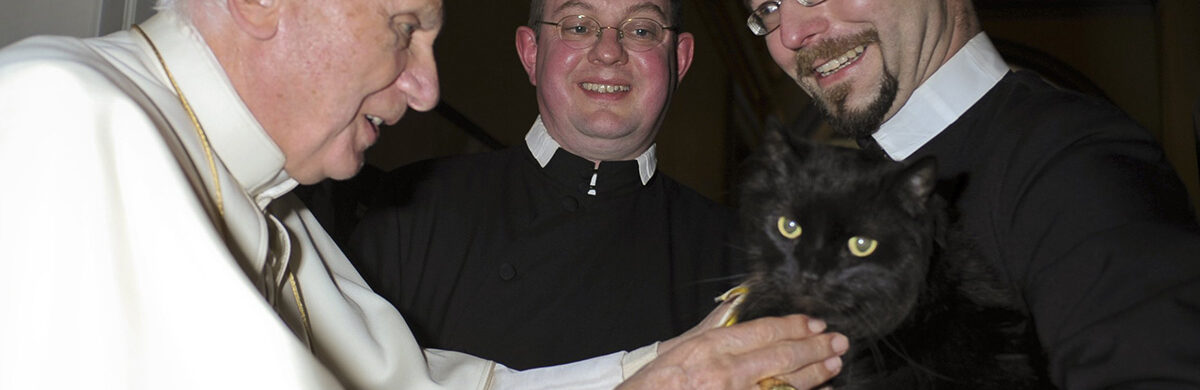
Pope Benedict with one of his cats.
As pope, Benedict continued to care for strays, and had two cats of his own — one who’d been with him since before he was made the leader of the global church, and another he rescued off the streets of Rome.
Photos of Pope Benedict with cats are different than the typical shots showing him meeting with world leaders or waving to crowds. His expression and posture are more relaxed in the presence of felines, and he’s often smiling in the images that show him holding a cat.
But it wasn’t just personal for Benedict.
“Dominion” over animals
For centuries, some people — mostly outside Catholicism, but some Catholics too — have argued that animals exist for the use of mankind, that their purpose on this Earth is to serve as resources. Proponents of the view point to a handful of Old Testament quotes, including a famous quote from Genesis that says God gave man “dominion over the fish of the sea, and over the birds of the air, and over the cattle, and over all the wild animals of the earth, and over every creeping thing that creeps upon the earth.”
Genesis 9:3 attributes this quote to God: “Every moving thing that lives shall be food for you.”
Pope Benedict was well known for his love of cats, from his childhood in Bavaria to his days as pope emeritus living in retirement.
Other verses detail precisely which animals they can eat and remain in His good graces, and many Christian sects see those lines as a clear indication that God intended for animals to serve the needs of men.
But the Old Testament also tells us we can take slaves (Leviticus 25:44-46), that parents can have their kids stoned to death for disobeying them (Deuteronomy 21:18-21), that when children make fun of others, it’s totally cool to call upon righteous bears to maul them to death (2 Kings 2:23-24), and that people with blindness, flat noses and other ugly “blemishes” should wait outside church with the rest of the rejects while the good-looking people pray. (Leviticus 21:17-24).
Don’t even get me started on Sampson and the Book of Numbers.
The point is, if you’re going to be a stickler for things supposedly okayed or forbidden in the Old Testament, animals are the very least of your problems, especially if you trim your beard, let your hair get too long, wear shirts made of two different materials, or have ever placed a bet on DraftKings.
“Animals are God’s creatures”
As we look back on the life of the late pope emeritus, it’s worth noting that Benedict and his successor, Pope Francis, have rejected the view that animals are God’s version of scripted NPC automatons who exist so we can eat steak and wear leather jackets.
“Clearly, the Bible has no place for a tyrannical anthropocentrism unconcerned for other creatures,” Pope Francis declared in 2015.
Benedict spoke out about the cruelty inflicted on animals, the incalculable suffering of animals in industrial farming circumstances, slaughtered by the billions for food after short, brutal lives in which no consideration is given to them as living, sentient creatures.
In a 2002 interview, Benedict called animals “companions in creation” and criticized the modern food industry for its “degrading of living creatures to a commodity.”
“Respecting the environment,” he said in a 2008 interview, “means not selfishly considering [animal and material] nature to be at the complete disposal of our own interests.”
Francis made the church’s position absolutely clear with an encyclical — an official letter to members of the church — called Laudato Si. In it, he condemned the “ruthless exploitation” of animals as commodities and asserts they are individuals who are recognized by God. He urged Catholics to treat them well, to respect and protect wildlife and the environment they depend on.
Animal life has “intrinsic value,” Francis said, adding that Christians must reject the idea that animals are “potential resources to be exploited.”
As if speaking directly to people who use the aforementioned Old Testament quotes to support practices like factory farming, harvesting animals en masse for pelts and hunting for the “fun” of it, Francis said:
“We must forcefully reject the notion that our being created in God’s image and given dominion over the earth justifies absolute domination over other creatures.”
Both popes also noted that, in addition to the suffering we cause, when we exploit animals as are also behaving in a way beneath the dignity of humankind. It’s a stain on our collective identity as a species, a betrayal of our roles as wardens of the planet.
Let’s put aside the moral considerations for a moment. The continued existence of the complex ecosystems on our planet — and indeed of humanity itself — depends on the many roles animals play, from carrying seeds to pollinating plants, limiting the growth of flora that would otherwise dominate and destroy other plants, rerouting water systems by creating dams, controlling the populations of creatures that would otherwise multiply unchecked, and the thousands of other roles they play in maintaining the balance of ecosystems.
Benedict left this Earth on Dec. 31, 2022, at a time when we have killed off almost 70 percent of all wildlife in the entire world. It’s not just a matter of living on a lonely planet, or tucking future children into bed while telling them that, no, they can’t see elephants or tigers because the last of them are dead. Removing keystone species, extirpating entire genera while rendering vast stretches of the planet uninhabitable, purging the oceans of life as they accumulate literal continents of plastic waste, means we’re marching toward a cascade failure most of us won’t even see coming as we argue about carbon credits, politicize common sense, tinker with viruses and edit genomes.
It’s long past time we recognize the fact that we share this planet with billions of other minds and start living in a way that respects them. If we can save them, perhaps we can save ourselves too.
The 1.6 million square kilometer Great Pacific Garbage Patch, which weighs more than 80,000 metric tons.













 Pain In The Bud