
This year marks the 29th Festivus of the Festivus Revival Era, when Cosmo Kramer convinced Frank Costanza to bring back the beloved holiday that eschews the excessive commercialism of the modern holiday season.
We enthusiastically celebrate Festivus annually at Casa de Buddy and here on the blog, but if you’re joining us for the first time and you’re not familiar with the tradition, we can help get you up to speed by referring back to the wisdom of Frank Costanza, who founded the holiday:
Frank Costanza: Many Christmases ago, I went to buy a doll for my son. I reached for the last one they had, but so did another man. As I rained blows upon him, I realized there had to be another way!
Cosmo Kramer: What happened to the doll?
Frank Costanza: It was destroyed. But out of that, a new holiday was born. A Festivus for the rest of us!
Festivus was popularized by Seinfeld in the 1997 episode “The Strike,” and presented as a holiday celebrated by the Costanza family under duress, at the insistence of Frank Costanza, the insane father of George Costanza.
But the holiday was not invented for the show — it was a real tradition invented by Dan O’Keefe Sr., father of Seinfeld writer Dan O’Keefe, in the 1960s. The younger O’Keefe had no plans to work it into an episode of the sitcom, and blames his “loudmouth brother” for bringing it up at a party for the Seinfeld cast and crew.
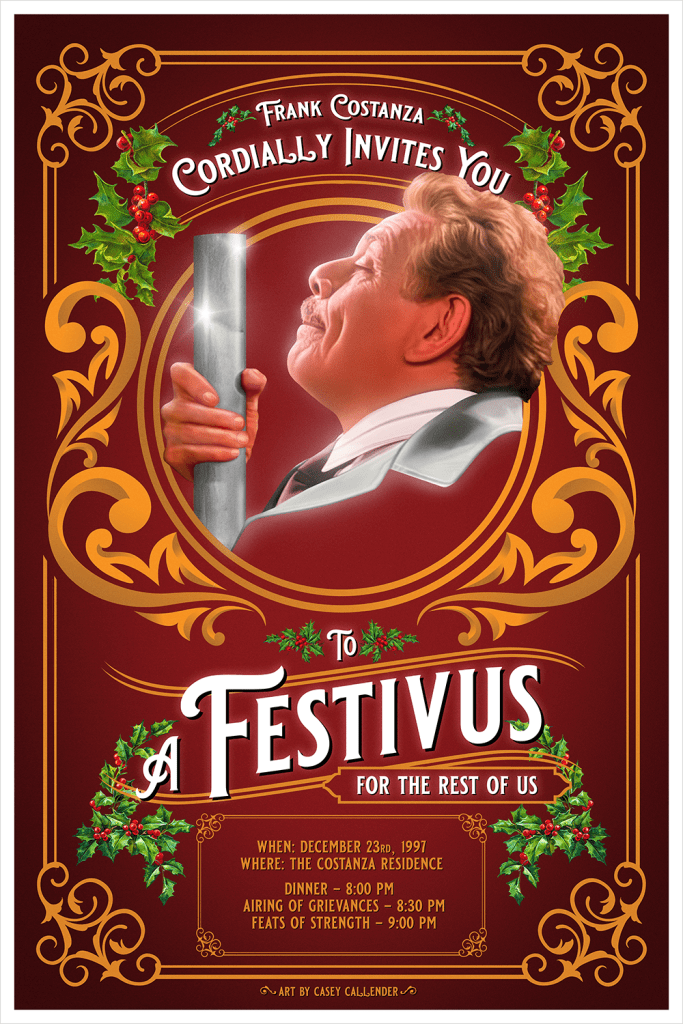
O’Keefe pleaded with his colleagues not to write it into an episode, but by that point Jerry Seinfeld and Larry David, the main creative forces behind the show, were already intrigued and couldn’t be talked out of it.
In a 2017 interview, Dan O’Keefe said he believed his father’s made-up holiday was “too weird” for the TV audience, but Seinfeld has always been about the absurd and the nonsensical.
The audience loved it, and in the almost three decades since, Festivus has grown in popularity. It’s celebrated in homes, neighborhood bars, offices and other places as a non-secular holiday for which people don’t have to worry about bringing gifts and it’s okay to be a little grumpy.
As testament to its widespread popularity and its place in modern American culture, Festivus has been recognized as a culturally significant event by the Library of Congress.
On the surface, Festivus is superficially similar to Christmas. It involves a gathering of family and friends, a holiday dinner and a warm atmosphere.
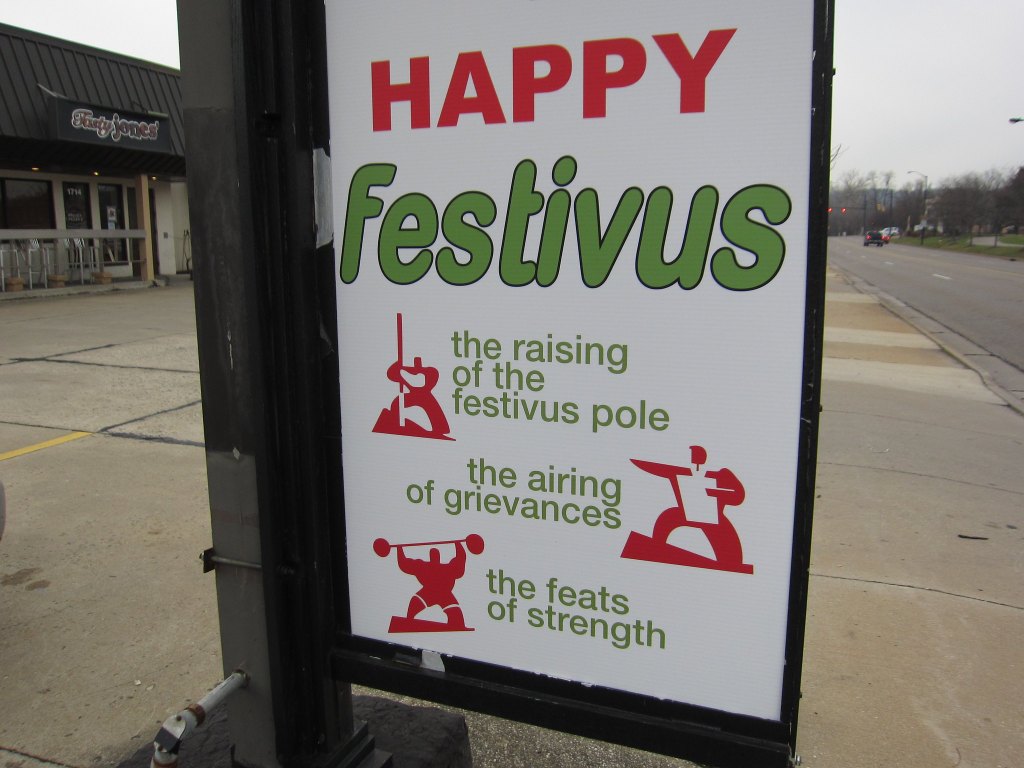
But in a rejection of holiday consumerism, Festivus is not celebrated with a tree or candles. Instead, the primary decoration is an unadorned Festivus pole, usually made out of aluminum. (“I find tinsel distracting,” Frank Costanza explained.)
Festivus dinner begins with the Airing of Grievances and ends with the Feats of Strength.
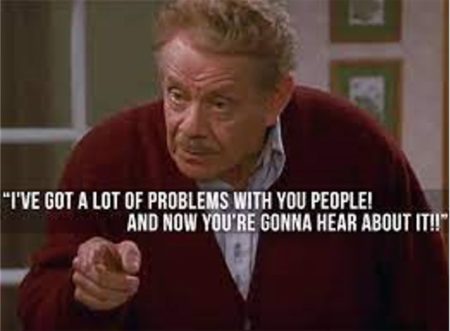
The head of the family declares “I’ve got a lot of problems with you people, and now you’re gonna hear about it!”

It should come as no surprise that cats, who have high standards for service, would have their owh list of disappointments. Behold, Little Buddy the Cat’s grievances for 2025:
Big Buddy: It has come to my attention that you portray me as a wimp on MY blog! Apparently your claims about me running from vacuums and the rustling of paper bags are running jokes in your posts. These heresies shall not go unpunished! I am a tiger!
Readers of PITB: Et tu, friends of Little Buddy? And here I thought I had admirers who appreciate me for being the dashing, beguiling, intelligent and meowscular feline I am. As punishment, I shall refuse to do anything amusing for at least a month, depriving you of stories about my witty ripostes and magnificent adventures.
Smudge the Neighbor Cat: Your time will come soon, my friend. Very soon. Nobody tangles with Buddy and…uh…gets untangled. Or something. You think I don’t know you’ve been surreptitiously marking my front door with your foul stench? I’ll be keeping a close eye on you, so you’d better not try any of your sneaky stuff!
The Jaguars of the Amazon: Once again, you my homies! You know how to make a fellow apex predator feel at home, and you can be reliably called upon when I need a vacuum destroyed or dogs intimidated. I got your backs! I love you guys.
Santa Claws: Last year’s gifts were a bit sub par, if I’m being honest. I’m a good boy, and as a good boy, I deserve toys! I have left the Christmas tree alone this year, I don’t scratch the couch, and I only puked on Big Buddy’s bed once. It’s technically my bed anyway, so it’s not like I did it on purpose. Trust me, I almost felt bad when Big Buddy had to replace the sheets and wash the old ones twice. And I don’t know what you may have heard regarding those vile rumors about me smacking Big Buddy in his sleep, but they’re really light taps with my paw. Smack is such a harsh word. Can I have new toys now?


 Pain In The Bud