WATCH: New Buddy Wildlife Documentary Premieres On PITB!

Watch the premiere of Buddy: Perfect Predator exclusively streaming NOW on PITB!

It’s here!

The long-awaited documentary feature: “Buddy: Perfect Predator” has arrived on PITB.

Join Sir David Cattenborough and his intrepid crew of wildlife videographers as they follow the elusive Buddinese tiger through the dense undergrowth and dangerous terrain of its natural habitat in suburban New York.

Watch never-before-seen footage of the silver-furred Buddy stalking his prey, lounging, sleeping and eating, and follow a tense encounter between the Buddy and a red laser dot.

“I’m extremely proud of the work we’ve done here, and I believe our audience will be thrilled to learn more about this little-known creature, who shares so many qualities with tigers, lions, jaguars and leopards,” Cattenborough said.

“We fell in love with the silver-furred Buddy as we kept our cameras trained on him, and we think our audiences will find him just as charming as we did,” the British naturalist said. “He’s such a good boy!”

(Please ensure your sound is enabled or wear headphones to hear the narration and the atmospheric sounds.)

About this video:

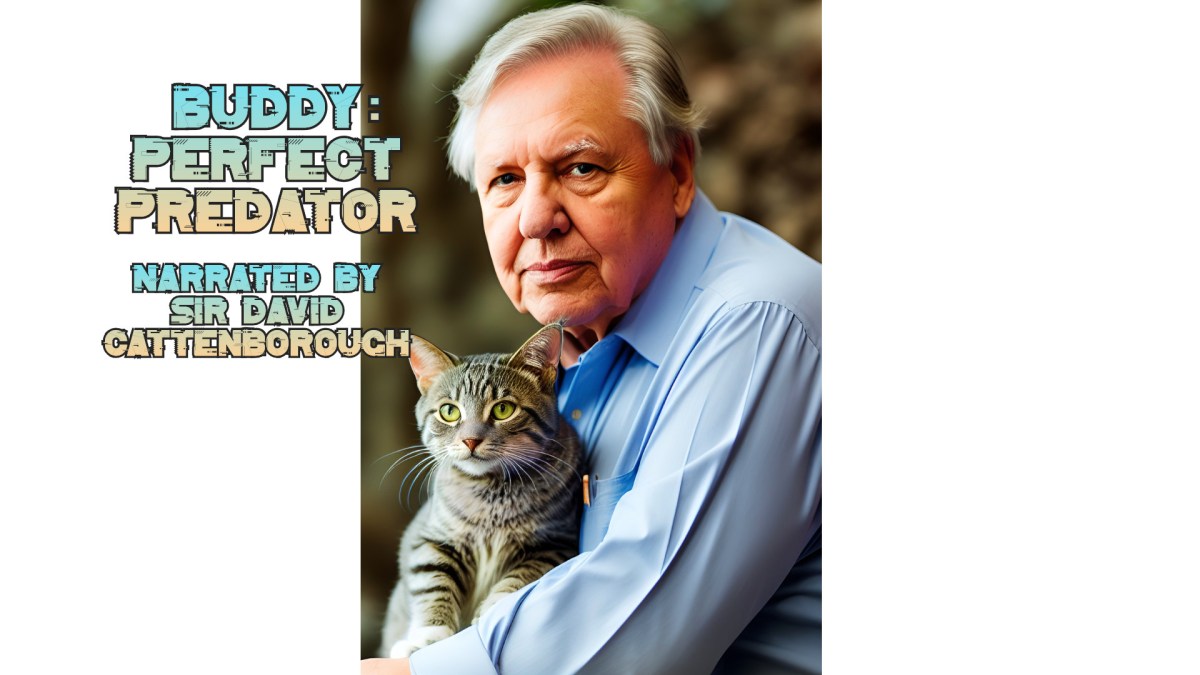
This story was made possible with the use of artificial intelligence tools. To create the images of Sir David Attenborough with Buddy, we used a natural language processing AI trained to output realistic-looking images and Pixlr to refine the images in post. To create the narration, we assembled samples of Attenborough speaking and trained a vocal synthesis AI, based on brand new technology, to mimic Attenborough’s unique pronunciation, cadence and rhythm, then layered the audio with a background of various nature sounds and incidental sounds, such as a tiger roaring.

Just a year ago it would not have been possible to generate images like this or faithfully recreate Attenborough’s famous narrative style, proving AI not only allows users to achieve things that were previously impossible, but has been making major leaps forward in short periods of time.

We believe AI, when properly used, can be a great instrument in the creative toolbox.

Finally, a thank you to Buddy for being a good sport about having cameras in his face. Great job, Bud!

Cattenborough and Buddy
Sir David Cattenborough with Buddy the Cat.

Is Your Cat In Pain? The Feline Grimace Scale Can Tell You

For the first time, veterinarians and regular cat parents have a tool that can tell them if their cats are hurting.

Although there’s been lots of talk claiming cats don’t have facial expressions humans can parse — or even the muscles to noticeably change expressions — that’s not actually true.

It’s more accurate to say feline facial expressions are far more subtle than their human or even canine equivalents, and it takes an expert — a veterinarian or behaviorist with specialized training — to accurately read them.

This is a brand new frontier for veterinary science, and it’s all thanks to the feline grimace scale, a system developed by researchers at the University of Montreal in 2019. Using video clips of cats in various moods and stages of pain or pain-free expression, the researchers built a system that could reliably determine how a cat is feeling. (You can read more about how they did that here.)

“I call it the Rosetta Stone for interpreting how a cat is feeling,” veterinarian Liz Bales says in a new video at dvm360. “It turns out that very subtle changes in cat’s facial expressions can tell us whether or not they’re in pain. It includes the position of the ears, the opening of the eyes, the expression on the mouth, how the cat is holding its whiskers, and how they’re holding their head.”

Each of the five elements of feline facial expression are scored on a three-point scale, then added up. The result provides an accurate assessment of how a cat feels.

“It’s amazing, and it allows us to interpret feline pain in a way we never could before,” Bales says. “The hard part is, it can be a little bit tricky to learn. It is learnable, but I specialize in this and I’m still struggling to get it right every single time.”

Despite the challenge, she says, it’s well worth learning.

“The applications of this are so far and wide, and I think as the technology grows and it becomes easier and easier to use the grimace scale, the more exciting it’s going to be.”

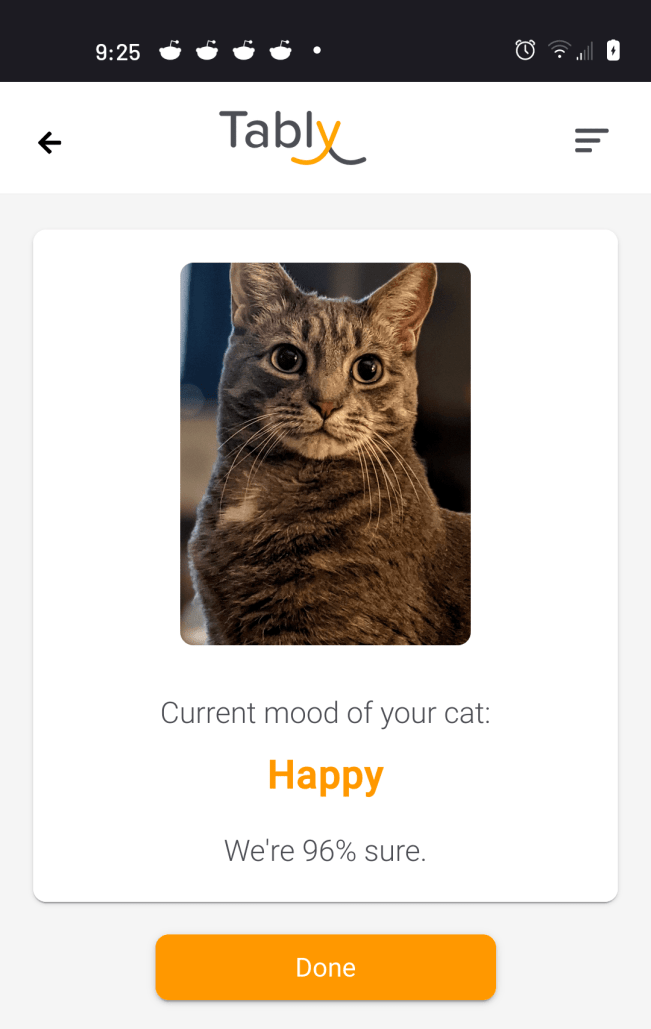
Thanks to an app named Tably, cat servants don’t have to know how to read the most subtle feline facial expressions anymore. By running a photo of your cat through the app’s algorithm, Tably can read your cat’s expression for you.

Tably Bud
Tably gauges cats’ moods in addition to their pain levels. We used the web app to evaluate Buddy last year. Thankfully he was happy!

Bales says she envisions a near future in which pet parents monitor their cats’ health and mood daily, and the scale becomes the standard for end-of-life care. With a “validated, consistent way to measure pain, we can look into more pain drugs for cats, what’s working, what isn’t.”

“A cat in pain looks like a resting cat to most people, but now we have this tool,” Bales says. “And I think as the tool evolves and we give cats a way to really speak for themselves through this Rosetta Stone of the grimace scale, then the more we understand that we can do for them, the more we’re going to do for them.”

We wrote about the feline grimace scale and Tably last year, and noted it had a lot of promise for veterinarians and us cat servants. At the time Tably was in beta and had a web app that allowed anyone to use the technology.

Unfortunately the web app seems to have disappeared, and the app is now available only to iOS users. Since we switched from an iPhone to Android, we can’t access Tably for the time being. (Let’s hope an Android version is forthcoming.) But if you have an Apple device, the app is definitely worth checking out.

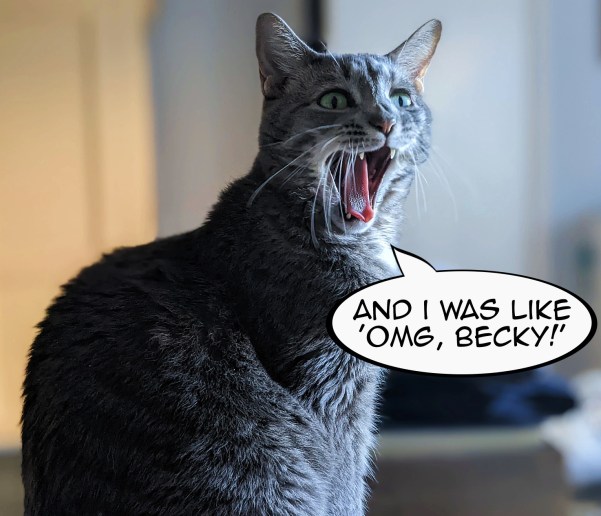
Bud and Becky
“You go, girlfriend!”