Little Elliot was recovering from his ordeal, but developed a deadly blood clot.
This feels like a real gut punch, especially after a South Carolina veterinarian’s heroic efforts to save Juliet, the cat who had 38 hair ties removed from her stomach and died after her health seemed to improve.
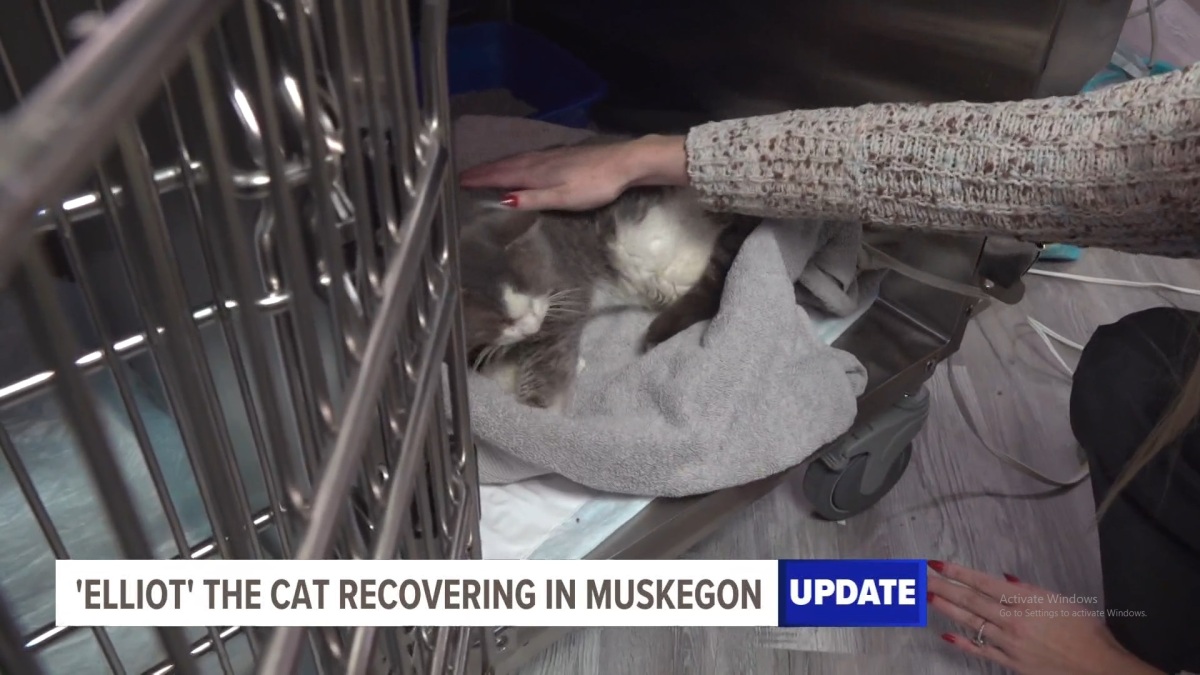
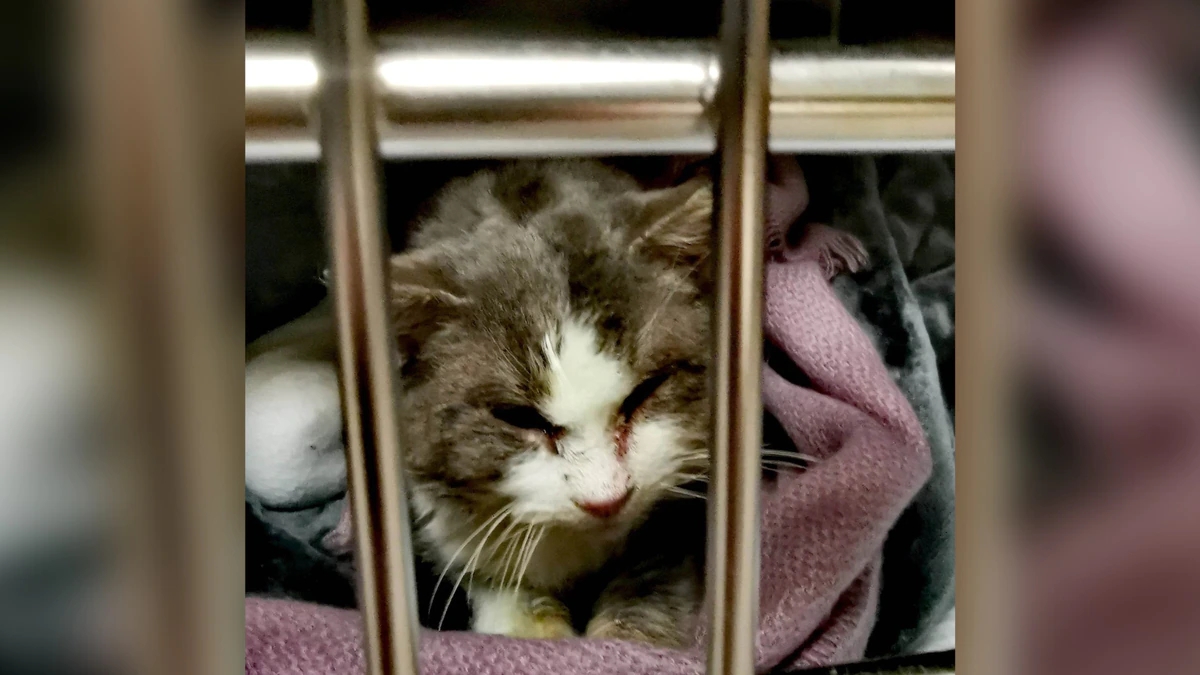
Elliot, you’ll recall, was the poor, sweet stray who was found literally frozen to the concrete on the day after Christmas, when the country was in a deep chill the likes of which we haven’t seen in decades, with temperatures plunging well into the negative. A Good Samaritan found the little guy in a bad way, with his eyes frozen shut and his organs shutting down, but she turned up her truck’s heat and rushed him to Big Lake Community Animal Clinic in Muskegon, Michigan, where the staff took good care of him and named him after the storm he was found in.
They wrapped little Elliot up in warm blankets, gave him fluids and began to slowly raise his body temperature, which was a dangerous 94 degrees. Things started to look up, too: Elliot had a habit of reaching his paw out to the vet techs who were monitoring him, began to regain his appetite, and eventually was able to stand and eat on his own.
But Elliot’s health took a turn for the worse again, and veterinarians determined he developed a saddle thrombosis, which is described as “a blood clot (called a “thrombus”) that lodges at the base of the aorta just as it branches into two distinct arteries, thereby obstructing blood flow to the hind limbs. It is so named because of the saddle-like shape it roughly resembles once it takes up residence in this location.”
For cats who develop a saddle thrombosis, the outlook is not good, and drugs designed to dissolve blood clots are often ineffective.
“Sadly, there was nothing we could have done to prepare for that but we knew it was time to let him be free from the pain and struggle he’s known most of his life,” Big Lake’s staff wrote to supporters.
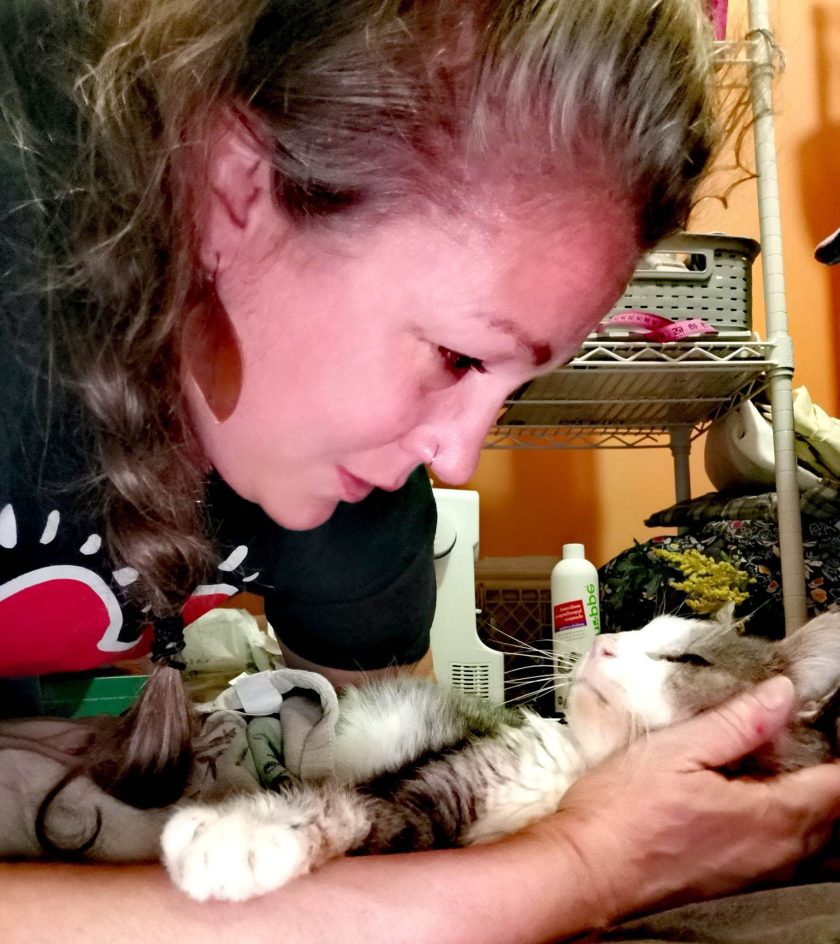
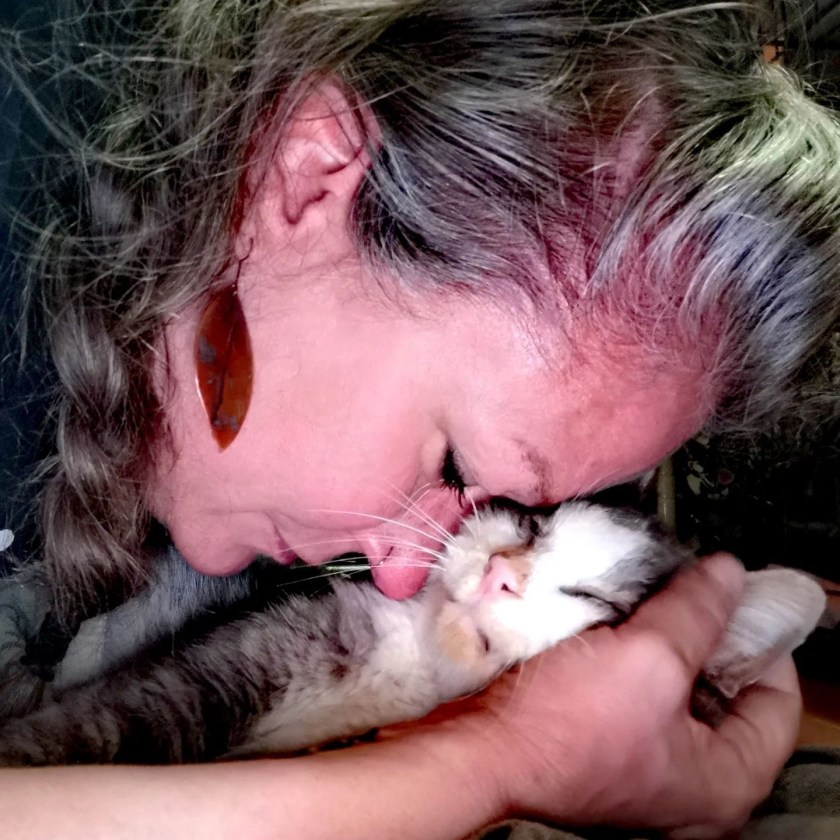
A staffer named Diane Neas, who took Elliot into her home after a few days when he’d stabilized, was particularly hard hit by the loss, and understandably so. Well-wishes and applications to adopt Elliot had come pouring in, and it seemed like the former stray’s suffering would lead to the best reward — a warm home of his own and people to love and care for him.
“We find peace in knowing the last two weeks of his life were spent with people who showed him kindness, care and love,” shelter staff wrote. “We can’t believe the following and support he has gained on this journey to healing; from the bottom of our hearts, thank you all for caring so deeply for him and sending such love and support his way.”
Images courtesy of Big Lake Community Animal Clinic
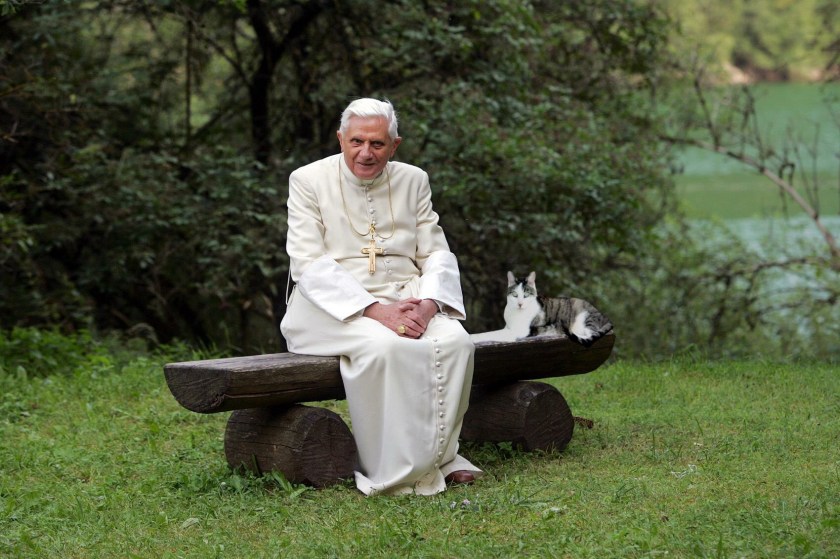
The late Pope Benedict was well known for his lifelong love of cats, but he was also a champion of animals and spoke out about the cruelties visited upon them by humankind.
Long before he was the pontiff, when he was just a young man named Joseph Ratzinger, the future Pope Benedict was known as a cat guy.
Growing up in the village of Hufschlag, about 55 miles southeast of Munich, Benedict’s family always had pet felines and he fed strays who spent time in their garden. During his years teaching theology to students at Bavaria’s University of Regensburg in the 1970s, then-professor Ratzinger was often seen followed by an entourage of cats — the little ones he fed and cared for — as he crossed campus.
“They knew him and loved him,” said Konrad Baumgartner, a fellow theologian at Regensburg.
His affinity for his four-legged friends never faded, even as he took on more responsibility and had more demands on his time. Cardinal Tarsicio Bertone, one of Benedict’s colleagues, said the German clergyman had a natural connection with animals.
“On his walk from Borgo Pío to the Vatican, he stopped to talk with the cats; don’t ask me in what language he spoke to them, but the cats were delighted,” Bertone recalled. “When the cardinal approached, the cats raised their heads and greeted him.”
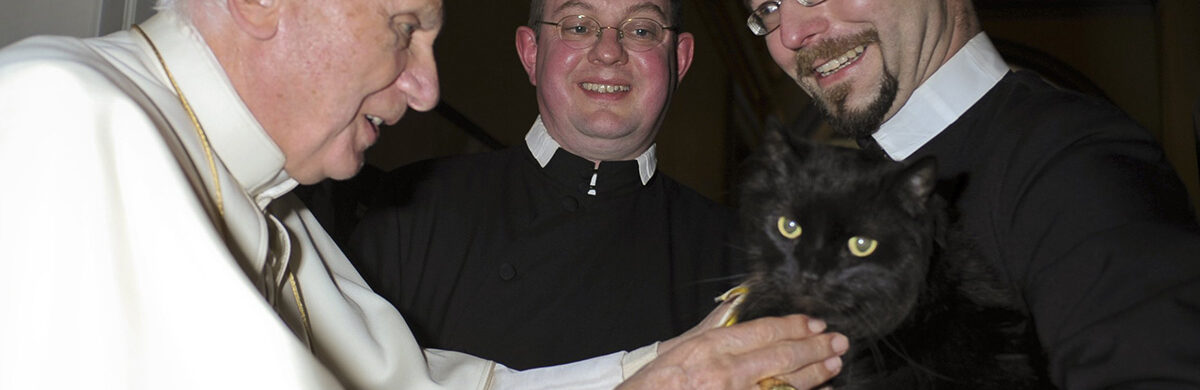
Pope Benedict with one of his cats.
As pope, Benedict continued to care for strays, and had two cats of his own — one who’d been with him since before he was made the leader of the global church, and another he rescued off the streets of Rome.
Photos of Pope Benedict with cats are different than the typical shots showing him meeting with world leaders or waving to crowds. His expression and posture are more relaxed in the presence of felines, and he’s often smiling in the images that show him holding a cat.
But it wasn’t just personal for Benedict.
“Dominion” over animals
For centuries, some people — mostly outside Catholicism, but some Catholics too — have argued that animals exist for the use of mankind, that their purpose on this Earth is to serve as resources. Proponents of the view point to a handful of Old Testament quotes, including a famous quote from Genesis that says God gave man “dominion over the fish of the sea, and over the birds of the air, and over the cattle, and over all the wild animals of the earth, and over every creeping thing that creeps upon the earth.”
Genesis 9:3 attributes this quote to God: “Every moving thing that lives shall be food for you.”
Pope Benedict was well known for his love of cats, from his childhood in Bavaria to his days as pope emeritus living in retirement.
Other verses detail precisely which animals they can eat and remain in His good graces, and many Christian sects see those lines as a clear indication that God intended for animals to serve the needs of men.
But the Old Testament also tells us we can take slaves (Leviticus 25:44-46), that parents can have their kids stoned to death for disobeying them (Deuteronomy 21:18-21), that when children make fun of others, it’s totally cool to call upon righteous bears to maul them to death (2 Kings 2:23-24), and that people with blindness, flat noses and other ugly “blemishes” should wait outside church with the rest of the rejects while the good-looking people pray. (Leviticus 21:17-24).
Don’t even get me started on Sampson and the Book of Numbers.
The point is, if you’re going to be a stickler for things supposedly okayed or forbidden in the Old Testament, animals are the very least of your problems, especially if you trim your beard, let your hair get too long, wear shirts made of two different materials, or have ever placed a bet on DraftKings.
“Animals are God’s creatures”
As we look back on the life of the late pope emeritus, it’s worth noting that Benedict and his successor, Pope Francis, have rejected the view that animals are God’s version of scripted NPC automatons who exist so we can eat steak and wear leather jackets.
“Clearly, the Bible has no place for a tyrannical anthropocentrism unconcerned for other creatures,” Pope Francis declared in 2015.
Benedict spoke out about the cruelty inflicted on animals, the incalculable suffering of animals in industrial farming circumstances, slaughtered by the billions for food after short, brutal lives in which no consideration is given to them as living, sentient creatures.
In a 2002 interview, Benedict called animals “companions in creation” and criticized the modern food industry for its “degrading of living creatures to a commodity.”
“Respecting the environment,” he said in a 2008 interview, “means not selfishly considering [animal and material] nature to be at the complete disposal of our own interests.”
Francis made the church’s position absolutely clear with an encyclical — an official letter to members of the church — called Laudato Si. In it, he condemned the “ruthless exploitation” of animals as commodities and asserts they are individuals who are recognized by God. He urged Catholics to treat them well, to respect and protect wildlife and the environment they depend on.
Animal life has “intrinsic value,” Francis said, adding that Christians must reject the idea that animals are “potential resources to be exploited.”
As if speaking directly to people who use the aforementioned Old Testament quotes to support practices like factory farming, harvesting animals en masse for pelts and hunting for the “fun” of it, Francis said:
“We must forcefully reject the notion that our being created in God’s image and given dominion over the earth justifies absolute domination over other creatures.”
Both popes also noted that, in addition to the suffering we cause, when we exploit animals as are also behaving in a way beneath the dignity of humankind. It’s a stain on our collective identity as a species, a betrayal of our roles as wardens of the planet.
Let’s put aside the moral considerations for a moment. The continued existence of the complex ecosystems on our planet — and indeed of humanity itself — depends on the many roles animals play, from carrying seeds to pollinating plants, limiting the growth of flora that would otherwise dominate and destroy other plants, rerouting water systems by creating dams, controlling the populations of creatures that would otherwise multiply unchecked, and the thousands of other roles they play in maintaining the balance of ecosystems.
Benedict left this Earth on Dec. 31, 2022, at a time when we have killed off almost 70 percent of all wildlife in the entire world. It’s not just a matter of living on a lonely planet, or tucking future children into bed while telling them that, no, they can’t see elephants or tigers because the last of them are dead. Removing keystone species, extirpating entire genera while rendering vast stretches of the planet uninhabitable, purging the oceans of life as they accumulate literal continents of plastic waste, means we’re marching toward a cascade failure most of us won’t even see coming as we argue about carbon credits, politicize common sense, tinker with viruses and edit genomes.
It’s long past time we recognize the fact that we share this planet with billions of other minds and start living in a way that respects them. If we can save them, perhaps we can save ourselves too.
The 1.6 million square kilometer Great Pacific Garbage Patch, which weighs more than 80,000 metric tons.
After a close brush with death during the severe winter storm over the holidays, a former stray cat is recovering and will get a forever home.
Elliot the cat was near death when Kelli Vanderlaan found him literally frozen to the concrete in the early morning hours of Dec. 26, during one of the coldest, most severe storms to sweep the US in decades.
Initially unsure whether the white and gray stray was still alive, as his eyes were frozen shut, Vanderlaan wriggled him free and took him to the Big Lake Community Animal Clinic in Muskegon, Michigan. Although barely able to move and unable to vocalize, Elliot seemed to be grateful for the car’s heat.
“You could tell that he was obviously frozen, so he needed warmth and touch and everything, I think he was pretty happy when I got him into the truck,” Vanderlaan told the local ABC affiliate, WZZM.
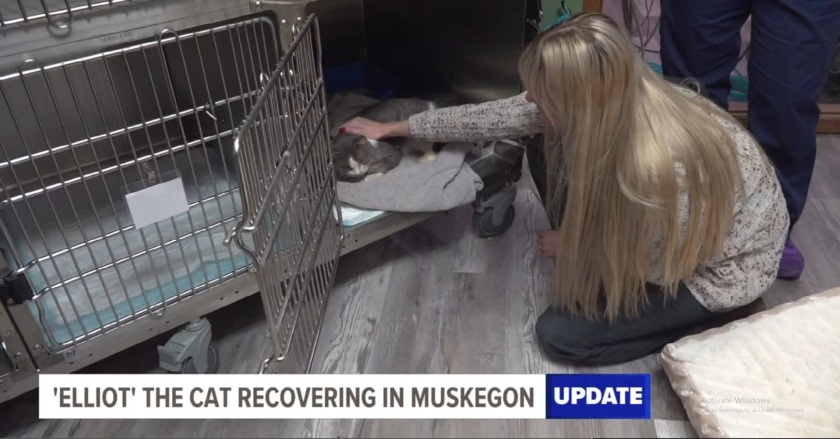
Staff at Big Lake Community Animal Clinic have been nursing Elliot the Cat back to health. Credit: WZZM
Once Vanderlaan and the stray arrived at Big Lake, staff there immediately began gently raising the little guy’s temperature, wrapping him in warm blankets and giving him fluids.
“We weren’t sure what he’s been through,” said Alexis Robertson, executive director of the local Humane Society. “He’s definitely been out there for a while trying to take care of himself, just trying to survive, but it was at a critical point where he was ready to pass.”
After giving Elliot a veterinary exam, cleaning his eyes and making sure he was snug, the staff at Big Lake Community Animal Clinic monitored him closely overnight. His organs had been dangerously close to shutting down when he was brought in, and he still wasn’t out of the woods yet.
Elliot, who was named after the storm that swept the region over the holidays, has continued to improve in the days since. He’s since been able to stand on his own and has regained his appetite, the clinic’s staff wrote on Facebook.
“We are so happy to say he is doing much better and was monitored during the night,” staffers wrote. “He reaches out his paw to the vet tech that has been caring for him overnight, showing her just how happy he is that he is being helped. He still has a long way to go, but we won’t give up.”
Elliot, who was described as an “older” cat who’s been fending for himself, will come out of the ordeal with his life much improved. After surviving the storm — which plunged temperatures well into the single digits, set record lows across much of the midwest and claimed the lives of at least 56 people across the country — Elliot will be put up for adoption, and the clinic has already received inquiries from people who want to open their home to the little survivor. If his will to live and his gratitude toward his rescuers are any indication, the little guy has a lot of love to give.
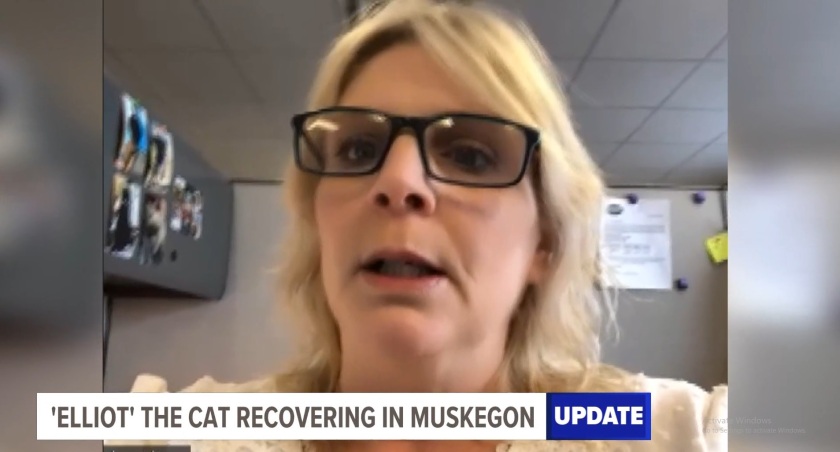
“It’s the most heartfelt feeling in the world to see this cat come from basically nothing and being vocal and happy to be touched and fed, it’s just an amazing thing to watch,” Leah Wetmore, the clinic’s manager, told WZZM.
Kelli Vanderlaan was the Good Samaritan who saved Elliot’s live. Credit: WZZM
For decades witnesses have claimed they’ve seen big cats prowling the English countryside.
A UK couple say they narrowly avoided hitting a big cat that bolted in front of their car Wednesday morning.
Chris and Marion said they were driving on the A303 in Hampshire, a rural road in southern England surrounded by farmland, fields and wooded stretches, at 7 a.m. when the felid leapt across the road and ran into a nearby field, possibly giving chase to prey. While others suggested it could have been a lynx — which went extinct in the UK more than 1,000 years ago — the witnesses ruled out the possibility, saying the cat was “twice the size of a fox” with a tail that was “thick and solid.”
When they made a Facebook post about the encounter, several others claimed they’ve seen a similar-looking “big cat” moving through Hampshire’s fields. There are several groups dedicated to alleged big cat sightings in the UK on Facebook.
It’s the latest in a surprisingly persistent legend of phantom big cats prowling the British countryside. There are no extant big cats in the UK or in Europe. They exist only on other continents: Lions and leopards in Africa, tigers and leopards in Asia, and jaguars in South America. Among felids that are not true big cats but are often grouped with them, pumas exist only in the Americas and cheetahs are exclusively found in Africa.
Despite that, hundreds of witnesses report seeing feliform animals much larger than well-fed ferals or small wildcats. A similar phenomenon exists in Australia, where for years people have insisted they’ve seen big cats slinking through the bush.
“Ghost Cat” illustration by Ken Jovi Credit: Ken Jovi/Artstation
While it’s possible that people in the British countryside or Australian bush are illegally keeping large felids, and it’s possible that a handful could have escaped over the decades, that’s an unlikely explanation for the sightings for several reasons. While big cats are apex predators, animals who have lived in captivity all their lives and have been given food will not know where to go or how to hunt. In places like Texas, where as many as 5,000 tigers live in backyard enclosures, escaped cats are quickly spotted wandering human neighborhoods, confused and looking for food.
If an escaped tiger or leopard was somehow able to rapidly adjust to the English countryside and fend for itself without being spotted, there would be evidence — pug marks, droppings, claw marks denoting territorial boundaries on trees, the carcasses of prey animals, burglarized pens, farm animals missing and terrorized.
That goes double if, as some suggest, there is a breeding population of panthera genus cats. Even a handful of such animals would consume thousands of pounds of meat each week.
Still, as Wednesday’s alleged sighting proves, rumors of large cats stalking the mists of the English countryside are unlikely to die out any time soon.
A Festivus for the Rest of Us…And Our Cats
Festivus is the celebration that keeps on giving.
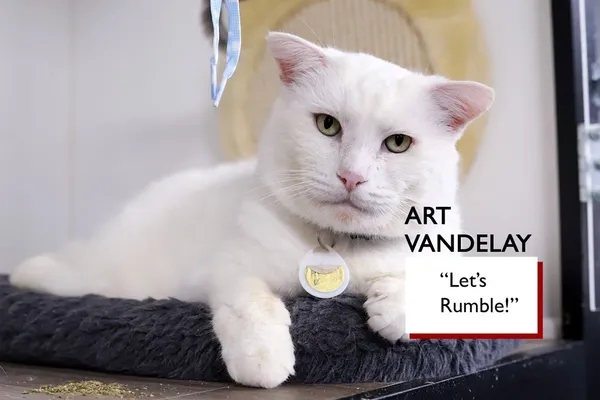
The operators of Tail Town Cats, a cat cafe in Pasadena, California, are hosting a Festivus get-together that will double as a showcase for adoptable kitties and a way to help support adoption efforts.
Hosted by a cat named Art Vandelay — who found his forever home through the cafe — the celebration will include a traditional Festivus pole, the Airing of Grievances and Feats of Strength. (Among the grievances listed in advance are general disappointment with the frequency of treats, displeasure at sharing litter boxes, and humans who recycle cardboard boxes instead of giving them to the felines.)
People in the Los Angeles area can attend in person, while others can watch online.
Art Vandelay found his forever home through the cat cafe and will return to host its first-ever Festivus celebration.
Seinfeld fans will recognize Art Vandelay as George Costanza’s most frequently-used alias. Vandelay is alternately described as an importer-exporter or as an architect. As George famously said: “I’ve always wanted to pretend to be an architect.”
As for Festivus, it’s taken on a life of its own 25 years after it was popularized on Seinfeld.
The made-up holiday had its humble origins in the home of writer Daniel O’Keefe, who introduced it to the nation — and immortalized it in the process — by writing it into “The Strike,” a 1997 episode of the sitcom. At the time, Seinfeld was a ratings juggernaut, averaging more than 30 million viewers an episode. Festivus is celebrated annually on Dec. 23.
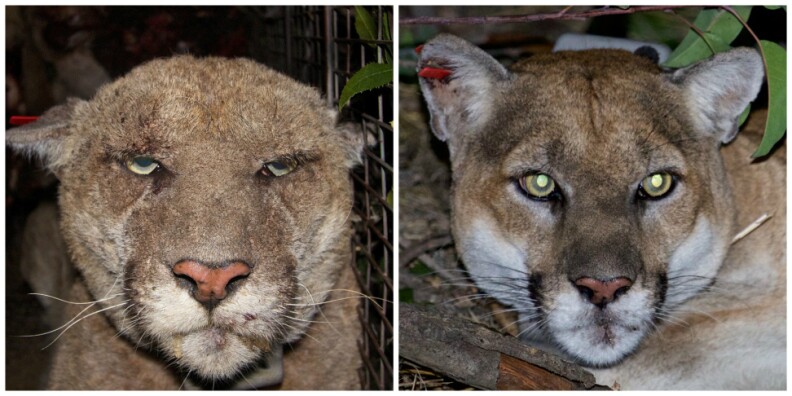
P-22 suffered a skull fracture after he was hit by a car on Sunday evening. The beloved mountain lion was in a bad way when wildlife officials found him.
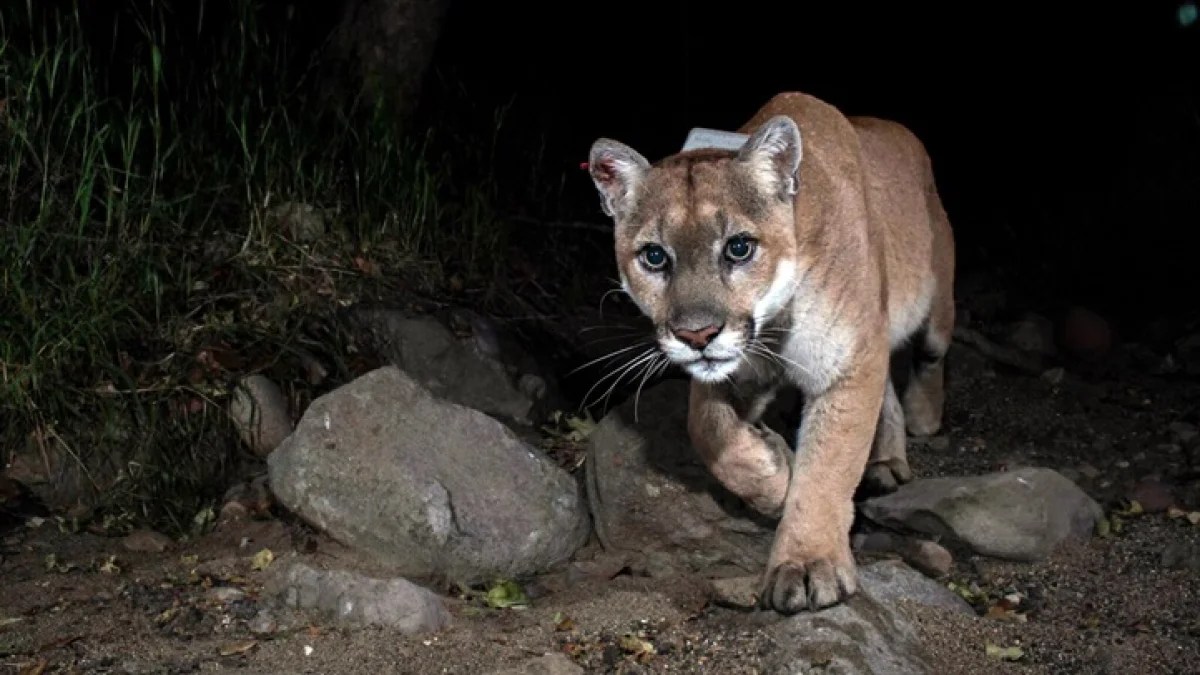
When the puma known as P-22 made headlines a month ago for snatching a pet Chihuahua off his leash on a post-sundown walk, a lot of people were concerned the mountain lion would be put down or hunted in retaliation.
The dog’s owner admitted he was distraught, but also pleaded with the public not to harm the puma, who after all was just being a cat. P-22 didn’t know pet dogs are off-limits, and he showed no aggression toward the other dog or the man walking the pooches. He was hunting after dark, like pumas do.
Sadly, P-22 is now dead, although there does not appear to be a connection to the Chihuahua incident.
Late on Monday morning, Sarah Picchi of Los Feliz opened her door to find fish and wildlife officers on her property. She knew why they were there, as she’d spotted the cougar in her backyard.
“Of course, I knew it was P-22 because I’ve been following the story,” she told the Associated Press.
P-22, who was described by the National Park Service as “a remarkably old cat in the wild” at 12 years old, was showing signs of distress. Veterinarians who have been tracking and protecting California cougars for 20 years tranquilized P-22 and gave him a veterinary examination after receiving reports that he may have been hit by a car on Sunday night.
P-22 when he was healthy, right, and just a few days ago when he was suffering from infections and a fractured skull, left.
Unfortunately it looks like he was indeed hit. The beloved mountain lion, who had famously crossed his state’s busiest highways in his younger days to find a range of his own, suffered a skull fracture, an unnamed skin condition and signs of kidney and liver disease.
Veterinarians said the only option, at his advanced age and in his condition, was to place him in a sanctuary where he could be constantly monitored and cared for, but that’s a dicey proposition for a proud animal who spent his entire life fending for himself, hunting and going where he pleased. P-22 would not have recovered, they said, and would have had poor quality of life even if he lived out his remaining days in captivity.
Ultimately they made the difficult decision to euthanize him this week.
Again, there’s no indication any of the misfortune to befall P-22 had anything to do with the Chihuahua incident, although the driver who hit him without reporting the injury made a selfish choice. It’s not clear if earlier treatment could have saved P-22, but it may have saved him significant suffering.
The famous cat, who called some of Los Angeles’ most well-known neighborhoods home, leaves behind a legacy that includes books and documentaries on his incredible life and journey from southern California to his eventual home in LA. Rest in peace, big guy.
Scroll down to the bottom of this post for more photos and a link to the National Park Service’s tribute to P-22.
Wetumpka will pay the price for petty politics
Reader Leah of Catwoods fame brought our attention to this excellent analysis of the situation in Wetumpka, a town in her home state of Alabama that is now best known for extremely aggressive police officers arresting two women for the “crime” of managing a cat colony.
The women, Beverly Roberts and Mary Alston, were found guilty of two misdemeanors each earlier this week in Wetumpka municipal court. (They also spoke to PITB on Friday, discussing their plans to appeal and their worries about the health and safety of the colony cats.)
The column, by Alabama Political Reporter’s Josh Moon, echoes our own thoughts on the scandal, pointing out the petty nature of the arrests and prosecution:
It’s so utterly absurd. And to be quite honest, it reeks of small town politics. It smells suspiciously like some thin-skinned city official got peeved because some ladies had the gall to question him, and he decided to flex a little muscle, show those little gals where the power lies.
And, lo and behold, in court on Tuesday, one major line of questioning revolved around whether Mayor Jerry Willis had told Wetumpka PD to arrest one of the cat ladies, because she had been continuously critical of the city’s animal control policies and practices. Willis, under oath, denied ordering her arrest. Testimony from a lieutenant from Wetumpka PD sure seemed to indicate that some sort of directive had come from the mayor’s office.
Regardless, bodycam footage of the cops’ interactions with Roberts and Alston show an impressive response – three cop cars and four officers – to a call about a lady possibly feeding cats. On a roadside. With no businesses nearby. Near a wooded area. With plenty of space off to the side so traffic wasn’t impeded. On public property.
As we did, Moon noted Alston and Roberts weren’t breaking any laws by being on public property, and there are no laws in Wetumpka prohibiting feeding stray cats.
And it’s not about feeding stray cats, as Willis claimed in his court testimony. Alston and Roberts were providing a service to Wetumpka, at their own expense, because they love animals. Trap, neuter, return is a proven process that limits and ultimately reduces stray cat populations, and does so in a humane way. Prohibiting the women from managing the cat colony will only make the problem worse as the felines mate and stray further afield looking for food, a fact that Willis and town officials don’t seem to appreciate.
Moon wrote:
A city with a decent government would have worked with Alston and Roberts. It would have given them awards for spending their days performing this public service for free. It would have explored ways to expand the very good thing they were doing.
He quoted attorney Terry Luck, who represented the women, saying “Wetumpka is a laughingstock” for arresting Alston and Roberts, blatantly lying about the reasons and the sequence of events leading up to the arrests, and doubling down on prosecuting them even as the story spread nationally and people understandably shook their heads in disbelief at the insanity of it all.
The small-town trial, Moon noted, was covered by reporters from across the state and from national media outlets. Body camera footage of the arrests fueled public outrage, as officers treated Alston and Roberts like hardened criminals and even laughed at the idea that they were “a bunch of cops beatin’ up on some old ladies.” That’s not what you want your town to be known for.
“The city will pay a hefty price for the bad PR,” Moon wrote. “And the whole time, doing the right thing was free.”
Tribute to P-22
We leave you now with some photos and images that can only hint at how much P-22, the lion of Hollywood, was beloved by the people of LA. He was the subject of at least four books, two documentary movies, various festivals and fundraisers for protecting his kind, and his face graces innumerable posters, t-shirts and pins. Here’s how the National Park Service described the big guy:
Likely born in the Santa Monica Mountains as the son of adult male P-1, he somehow found his way to his tiny, nine-square-mile home in Griffith Park, separated from the Santa Monicas by the 101 and 405, two of the busiest freeways in the world. Defying expectations, he persisted for more than 10 years in the smallest home range that has ever been recorded for an adult male mountain lion.
Although he made frequent appearances on the streets of the Hollywood Hills and even, more recently, of the Silver Lake neighborhood, he was also clearly a wild cat, doing so mostly late at night, and subsisting largely on natural prey such as deer and coyotes.
In the end, he found his way into many Angelenos’ hearts and home surveillance camera footage.







 Pain In The Bud