The soccer pro was slapped with a hefty fine and lost sponsors after widespread outrage over a video that shows him kicking, slapping and throwing shoes at his cat as he and his brother laugh.
Kurt Zouma’s cat is getting the last laugh.
Zouma and his brother thought they were being clever and funny when they uploaded a video showing the professional soccer player drop-kicking the poor kitty, throwing a shoe at it and slapping it in the face while Zouma’s child held the terrified pet.
The UK Sun ran a story about the video, which the Zouma brothers uploaded to Snapchat. The story went viral this week and Zouma has taken an enormous hit to his wallet and reputation.
Zouma’s club, West Ham United, fined the footballer £250,000, which works out to about $338,00, or 20 percent of his yearly salary. In a statement the club said it was the maximum amount it could fine one of its players.
Zouma’s primary sponsor, Adidas, has dropped him, while insurance company Vitality dropped its sponsorship of the entire club and other sponsors may follow.
And on Tuesday night in his first game since the scandal, Zouma was roasted by fans who showed up to watch West Ham play Watford at London Stadium. The rowdy crowd jeered every time Zouma touched the ball.
“Kurt Zouma, he plays at centre-back, he kicks his f—ing cat!” the fans chanted.
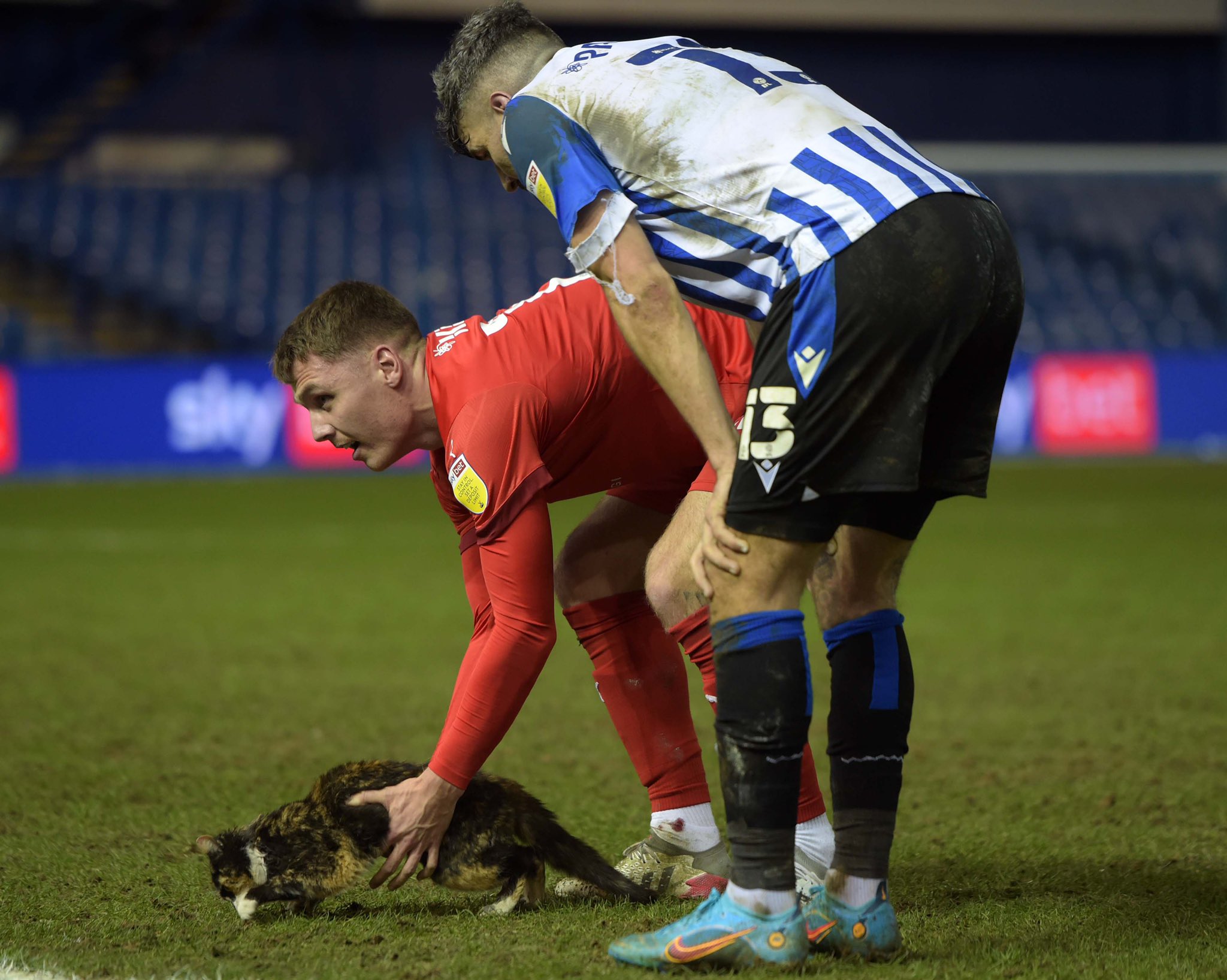
Finally, in a scene that played out like a divine condemnation of Zouma’s treatment of his kitty, a confused stray cat bolted onto the field and interrupted play during Tuesday night’s match between English League teams Wigan and Sheffield. Fans cheered as Wigan’s Jason Kerr carefully picked up the freaked-out feline and carried her off the field, risking a penalty for leaving the playing area during the game.
The British press didn’t miss the opportunity to contrast how the two football pros treated felines.
Scotsman Jason Kerr of Wigan gently scoops up Topsey, a house cat who interrupted play on Tuesday night.
Team staff brought the tortoiseshell to a veterinarian who treated her for injuries, scanned for a microchip, and found she belonged to a family in Wirral, a town in northwest England.
The cat’s name is Topsey and she’d been missing for eight months. Alison Jubb, Topsey’s human, said she was going on vacation and was bringing Topsey to a cattery when the cat got scared and bolted out of her carrier. That was the last she heard of Topsey until late Tuesday night.
“My daughter-in-law rang me last night as they were watching the match and said there was a cat on the football pitch” who resembled Topsey, Jubb told the BBC. “I sort of laughed it off.”
But Jubb said she was no longer laughing when she received a call from a veterinarian telling her Topsey had been brought in by Wigan Athletic staff. Topsey was given pain medication and is under treatment for bite wounds, possibly from a dog, to her neck, per the BBC.
Topsey was reunited with her humans, while Zouma voluntarily surrendered his abused cat and his second kitty to the Royal Society for the Prevention of Cruelty to Animals.
A still from the Snapchat video showing Zouma just before he drop-kicked the kitty while his other cat cowers on the floor.
The sequence of events restored some hope to animal lovers in the UK, who were dismayed when police said they would not charge Zouma for lack of evidence, despite the video clips and Zouma’s admission that he abused his cat.
However, Zouma’s legal troubles aren’t over. The 27-year-old is a French national and could face charges in his home country, where the public was outraged by his behavior and embarrassed that a high-profile Frenchman would harm an animal.
Zouma has been condemned by French politicians and there are calls to remove him from the French national team.
In the meantime, the RSPCA is conducting its own inquiry into the abuse incidents.
“We’re investigating and the cats are safe and in our care,” the group said in a statement. “We have been dealing with this since before the clip went viral online and we need to follow the proper legal process and not discuss due to UK GDPR laws.”
A couple who rented an Airbnb took a man’s cat, believing she was a neglected stray. The man says the cat is well-loved and desperately wants her back.
Troy Farrell’s cat, Nubbins, has been missing since October.
Neighbors told the Sonoma man that a couple who rented an Airbnb two houses down the street had been asking about the nearly tailless tabby and had seemed fond of her. That was Farrell’s only lead, but the owner of the Airbnb rental wouldn’t tell him who rented the place at the time Nubbins vanished.
When I read about Nubbins my first thought was that she was probably snatched up by people who thought they were doing the right thing by “rescuing” a neglected cat.
It turns out that’s exactly what happened.
First a veterinarian from Long Beach, more than 400 miles away, called Farrell and told him Nubbins had been brought into the vet’s practice for a health checkup. When they scanned the kitty’s microchip, Farrell’s contact information came up.
Farrell says he thought his ordeal was over, but the veterinarian — citing obligation to the client — wouldn’t tell him who brought the cat in. Instead, the vet said she’d pass along Farrell’s contact information and ask the couple to return the cat.
When they didn’t return Nubbins, Farrell filed a police report with the Sonoma County Sheriff’s Office, hired a private investigator and implored the local district attorney to look into the case.
“Those are evil people,” Farrell told an interviewer in late January. “Those are people without a conscience, those are people without a heart.”
He said he’s been lost without Nubbins.
“I don’t have kids. She’s my kid and she’s seen me through so many things. And they took her, and I want her back,” Farrell said. “The second I’d open that door or drive up the driveway or go out back … There’s Nubbins just in my lap.”
Nubbins in Farrell’s home. Originally a stray who escaped California’s wild fires, Nubbins gave birth to a litter before Farrell had her spayed and chipped.
The ‘catnapper’ comes forward
Now there’s a new development in the case: A man has come forward and admitted he took Nubbins, describing her as a neglected street cat who had been left outside to fend for herself in the cold without access to food or water.
The man detailed the allegations in a letter to Sonoma County Sheriff Mark Essick, and he’s not hiding his identity or denying he took the cat without asking Farrell. He identified himself as James R. Wakefield, an attorney in private practice out of Irvine, California.
“[W]e were never going to let that cat get put back in the living condition she was in without a fight,” Wakefield wrote in the letter to the sheriff.
While vacationing at the Airbnb in California wine country, Wakefield encountered Nubbins, saying she was “obviously hungry” and “she scarfed down the food” the vacationing couple gave her. Wakefield said that when he asked the Airbnb’s owner about the cat, the man said she was a local stray who needed a home.
Describing him and his wife as “70-year-old catnappers,” Wakefield said they’d do “everything in our ability to protect” Nubbins.
Farrell disagrees. He said the stumped tail and damage to Nubbins’ lip were from her days as a stray, when she escaped California wildfires several years ago and wandered into Farrell’s neighborhood. He took her in, he said, and she’s been his cat since. Nubbins is allowed in and out of the home as she pleases, he said, and always returns after she’s had her day’s adventures.
Nubbins refuses to be an indoor cat, Farrell said, and is well known to neighbors on the block, who also feed her and look out for her. It’s not uncommon for outdoor cats to make small circuits around their neighborhoods, visiting friendly neighbors for snacks and scritches before heading home for the day.
“That cat lives so large it’s not even funny,” Farrell said. “That cat has so many houses, so many people, so many little girls to play with down the block.”
Nubbins lounging outside. Her human, Troy Farrell, says the former stray likes to visit his neighbors every day.
That appears to be true: Farrell’s neighbors have backed up his story to the press, there are videos of the beloved cat hanging out in yards on the street, and one concerned neighbor even wrote a letter to the local newspaper imploring the police to get the situation sorted and return Nubbins to Sonoma.
The police have told Wakefield to return the cat to Farrell, while a spokesman for the district attorney told the Sonoma Index-Tribune that the DA is still reviewing the case. Like many other states, California considers pets as “property,” and authorities would have to determine if Nubbins is “worth” at least $950 to file criminal charges.
If Farrell can’t get Nubbins back via law enforcement his remaining recourse would be a civil trial, the newspaper noted.
Is it ever okay to steal someone’s pet?
This case raises some thorny questions. Farrell seems lost without his cat and has been clearly emotional in interviews with reporters as the saga of Nubbins has stretched on over the months. Meanwhile, I don’t think there’s any doubt Wakefield and his wife thought they were doing the right thing.
At least part of this standoff can be chalked up to misinformation and a lack of information: Matthew Knudsen, the man who rented the vacation home to the Wakefields, told them Nubbins was a stray who didn’t belong to anyone, according to Wakefield’s letter to the sheriff. Farrell said Knudsen owns and rents the house two doors down but doesn’t actually live in the neighborhood and doesn’t know how well Nubbins is cared for.
So from the Wakefields’ point of view, they thought they were rescuing a neglected cat and doing a good thing. At the same time, any cat servant should be able to empathize with the anguish another cat lover feels if their beloved feline goes missing or is stolen.
It’s easy to read the details and think maybe Farrell wasn’t doing right by his cat, and as readers of this blog know, I’m a strong advocate of keeping cats indoors for a long list of reasons, including myriad dangers to outdoor cats and the damage cats can do to local wildlife like birds, small mammals and lizards.
But I also know how easily people tend to toss out accusations of animal abuse and/or neglect. One reader was very upset with me when I posted a photo of Buddy with his paws stuck in the screen door that opens from the living room to the balcony. She strongly felt I was abusing Bud by allowing him to hang there for a few extra seconds while I snapped a few photos.
Buddy has gotten his claws stuck on the screen more times than I can count.
“Lies! The door attaches itself to my claws, that’s why I get stuck!”
Context is important in that case too. Buddy loves to lounge on the balcony in the summer, and he’s gotten his claws stuck on that damn door more times than I can count. (The many claw marks on the screen attest to that.) When he gets stuck he cries pitifully until I drop whatever I’m doing, lift him gently off the ground so he can unhook his claws without hurting himself, and reassure him in a soothing voice that he’s okay. It’s the cat dad equivalent of putting a band aid on a scraped knee.
No matter how many times Buddy gets stuck, no matter how many times I tell him “No!” and try to discourage him from scratching the door, he won’t stop doing it. He’s even got a four-foot-tall, sturdy scratcher literally a foot away, just a step inside the door! Clearly he has alternatives.
Not only is Buddy incredibly stubborn, but the day I took the above photographs, he’d already gotten stuck twice — including 20 or 30 minutes prior.
So yeah, I took the photos. Does that make me an animal abuser or guilty of neglect?
That woman thought so. If she’d been in a position to take Buddy, maybe she would have.
At the very least, the saga of Nubbins provides another good reason to keep cats indoors, even if they’re former strays who like to go outside. (Easier said than done, I realize.) But I don’t think there are any bad guys here, just people who thought they were doing the right thing without complete information.
Willow is the first presidential cat since the Bush family’s black shorthair, India.
Willow’s in the White House!
First Lady Jill Biden promised a cat would reside at 1600 Pennsylvania Avenue as a presidential pet during her husband’s administration, and a year after President Joe Biden was sworn in, Willow the cat has joined the First Family in Washington.
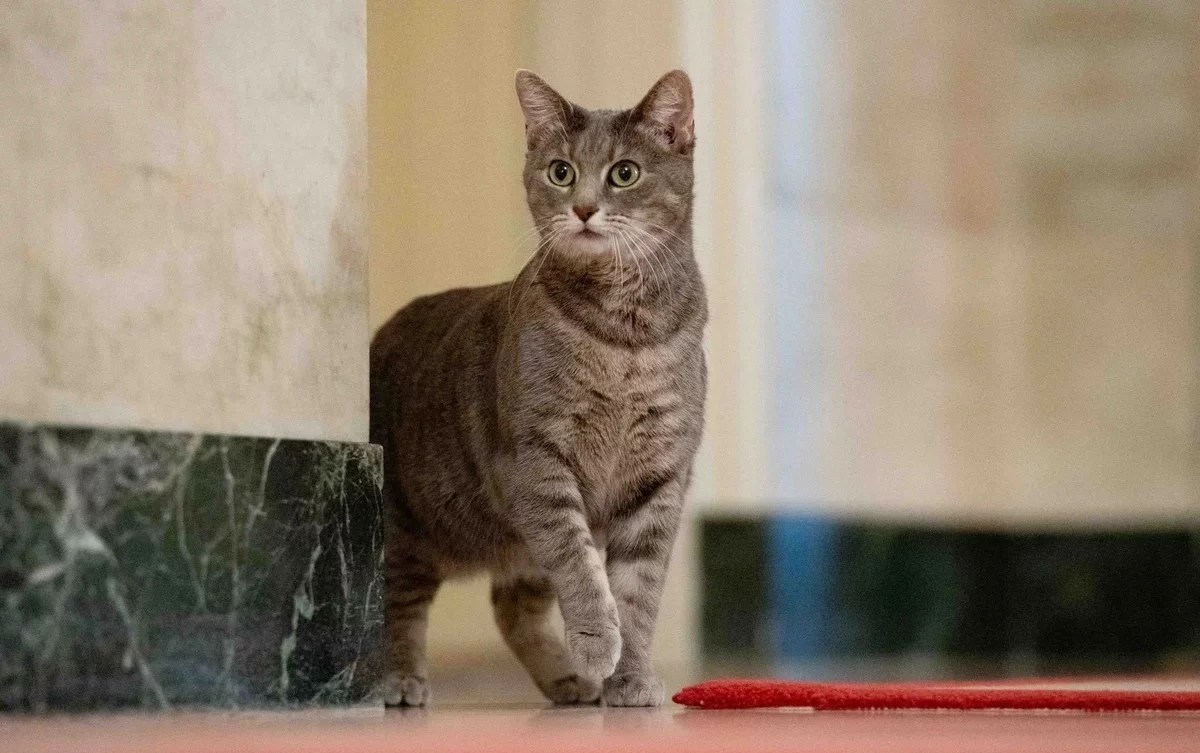
Willow is a gray tabby who got Jill Biden’s attention in a very cat-like way: She invited herself onstage while the First Lady was giving a campaign speech for her husband on a Pennsylvania farm in 2020.
A campaign official later called the farm’s owner, Rick Telesz, and asked if the Bidens could adopt the friendly moggie. Willow is two years old and is the first presidential cat since India, a black American Shorthair who belonged to former President George W. Bush’s daughters, Barbara and Jenna. India lived to the ripe old age of 18, outliving Bush’s two terms as president.
India was named after a Major League Baseball player, not the country. Credit: The White House
India, the Bush family’s cat, didn’t look too thrilled to be part of a Halloween event hosted by then-First Lady Laura Bush. Credit: The White House
The Bidens had another cat lined up, but delayed the cat’s arrival because their dog, Major, wasn’t adjusting well to the White House and was known for biting staff and Secret Service agents. Major’s been sent back to the family home in Delaware, but in the meantime the cat the Bidens were going to adopt got attached to its foster family and became a foster fail.
Willow seems to be doing just fine. Michael Larosa, the First Lady’s press secretary, told reporters Willow has been “settling into the White House with her favorite toys, treats, and plenty of room to smell and explore.”
She’ll be doing a lot of exploring — there are 132 rooms in the White House, and most former presidential cats were given the run of the executive residence as well as the West Wing. Socks, President Bill Clinton’s cat, had access to the Oval Office and was sometimes spotted in the James S. Brady Press Briefing Room, even choosing the famous podium for a lounging spot once.
Willow’s already found sunny lounging spots in her new home. Credit: The White House
Willow’s been making herself at home since she arrived at 1600 Pennsylvania Avenue. Credit: The White House
Cats have a long and distinguished history in the White House, from the incredible fame of Socks to Abraham Lincoln’s Dixie and Tabby. Lincoln once called the former “smarter than my whole Cabinet,” while he often embarrassed his wife by feeding the latter from the White House dinner table. Click here to read our post from last year detailing the lives and adventures of presidential cats.
Socks photographed in the president’s chair in the Oval Office. Credit: The White House
Unlike India, Socks wasn’t forced to wear a costume while helping out with holiday events. Credit: The White House
Thankfully for our furry friends, smaller brains don’t necessarily correlate to lower intelligence. It’s more about the complexity of neural connections.
Cats have gotten a good deal out of domestication: They’re safer, warmer and protected from almost all threats. They know where their next meal is coming from, and won’t hesitate to meow our ears off if dinner is late.
But one tradeoff doesn’t immediately appear beneficial: Domestic cats have smaller brains than the species they’ve evolved from, African and Eurasian wildcats.
“[D]omestic cats indeed, have smaller cranial volumes (implying smaller brains) relative to both European wildcats (Felis silvestris) and the wild ancestors of domestic cats, the African wildcats (Felis lybica),” the research team wrote.
Wild cats have the largest brains on average, followed by wild-domestic hybrids and domestic cats with the smallest brains of the three.
That’s another strong indicator that domestication is the determining factor in feline brain size, although the researchers point out that they are comparing domestic cats to current wildcats, and not the ancient population of wildcats from which domestic cats evolved beginning some 10,000 years ago with the dawn of agriculture and permanent human settlements.
Wildcats with friendlier and bolder dispositions were the first to approach human settlements, drawn by the rodents who were themselves feasting on human grain supplies. Humans realized that the cats were taking care of their rodent problems but weren’t interested in eating the grain, and a beautiful partnership was born.
“I have a yuge, yuge brain, the best brain. It’s tremendous.”
Smaller brains do not necessarily correlate to lower intelligence, however, and cats aren’t the only species whose brains became smaller after they were domesticated. Dog brains are about 30 percent smaller than the brains of gray wolves, but dogs have adapted spectacularly to living with humans and reading human behavioral cues.
“The dog is successful not because of the size of its whole brain per se, but because domestication has led to subtle brain changes with a stunning result: the ability to live in the world of people,” a Smithsonian Magazine article points out, noting dogs are also adept at getting people to do all sorts of things for them.
If brain size alone resulted in higher levels of intelligence, whales and elephants would rule the Earth.
Instead “the complexity of cellular and molecular organization of neural connections, or synapses, is what truly determines a brain’s computational capacity,” neuroscientist Kendra Lechtenberg wrote.
The researchers weren’t interested in drawing any major conclusions about feline cognition with the study. They’re more interested in the phenomena of “domestication syndrome,” which causes changes both physical (floppy ears, coat color variation, shorter muzzles) and behavioral. (Less aggression, playfulness.)
The jury’s still out on why exactly those traits emerge, but some studies have attributed it to differences in embryonic development. Unlike many other domestic animals, cats don’t look much different than their wild felis lybica and felis sylvestris counterparts.
The cat study was published on Jan. 26 to Royal Science Open Science, a peer-reviewed open-access journal. The research team was comprised of biologists from the University of Vienna and data curators from the National Museum of Scotland.
Two viral stories claim schools are allowing students to “identify” as felines, while one district is accused of providing litter boxes in school bathrooms.
Two curious stories relating to cats have been circulating online this week: In the first story, a substitute teacher claims she was fired because she refused to meow back to a student who “identifies as a cat,” while parents in a Michigan school district were infuriated by a rumor that the district was providing litter boxes to cat-identified students in school bathrooms.
First, the obvious, or perhaps not-so-obvious considering the media attention and outrage surrounding bothstories: Neither one is true.
Why did people believe them? Because we’ve gone insane as a society, of course, and basic reality now means different things to different people depending on their political ideologies. If you’re on the left, you might think parents who aren’t sophisticated news consumers are so paranoid about school curricula, they’d believe just about anything. If you’re on the right, you’re might argue that some schools have gone so overboard with political correctness, it’s not a stretch to imagine privileges conferred on the allegedly cat-identified.
For those of us who subscribe to neither ideology, the whole thing is another sad example of the polarization that is destroying the US, the same divisive talk amplified by platforms like Twitter and Facebook.
But that’s beyond the scope of this blog, which is to celebrate cats, have a laugh and occasionally put the spotlight on animal welfare. I don’t want to lose readers by wading into a political landmine field, but most importantly I don’t want anyone to feel unwelcome on this site.
The Michigan incident started when a mom of kids at the Midland School District, about 130 miles northwest of Detroit, spoke at a school board meeting about a rumor — which she took as fact — alleging the school was accommodating “furries” by providing litter boxes in unisex bathrooms.
Lisa Hansen asked other parents to join her to “do some investigating” into the policy
“I’m all for creativity and imagination, but when someone lives in a fantasy world and expects other people to go along with it, I have a problem with that,” Hansen told the Midland school board. “This whole furry thing has just got me. I’m staying calm, but I’m not happy about it, and it’s happened on your watch, and I don’t understand it.”
Here’s the video: (It should start at the relevant section, but if it doesn’t, Hansen speaks at the 32:44 mark)
Hansen’s claims were picked up and reshared by a state GOP chairwoman, Meshawn Maddock, who warned “Parent heroes will TAKE BACK our schools” in a Facebook post.
The school’s superintendent, Michael Sharrow, was forced to do damage control with a public statement, telling parents it’s a “source of disappointment that I felt the necessity to communicate this message to you.”
“There is no truth whatsoever to this false statement/accusation,” Sharrow wrote. “There have never been litter boxes within MPS schools.”
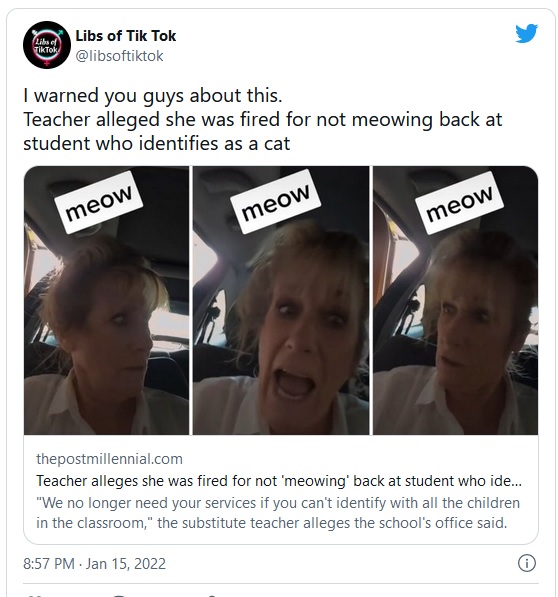
The story about the fired substitute also had its roots in an online video, with a woman who says she’s a teacher relating the story via TikTok. The woman, who uses the handle @crazynamebridgetmichael, said she was taking attendance when a student responded to his name with feline vocalizations.
“I get to the third row and I hear this ‘meow!’ ‘Uhhh, excuse me? Excuse me?'” she said in the TikTok video. “I start looking on the ground, through the fourth row—everything’s good. Go to the fifth row—everybody’s there. Then I hear ‘meow!’ I’m like, ‘Okay, what’s up with that? Who’s doing it?’ And this little girl in the very front row says, ‘You have to meow back at him; he identifies as a cat.’ Are you kidding me?”
The student stormed out of the classroom when she laughed at him, she said, and the school’s administration fired her: “They said ‘We no longer need your services if you can’t identify with all the children in the classroom.'”
The story was picked up by several widely-read sites, included in Tucker Carlson’s daily newsletter, and reshared on prominent Twitter accounts in addition to going viral on Facebook.
The story was widely shared on social media and reported by a few dozen online media outlets.
The only problem is it isn’t true. In a follow-up video the teacher admitted she made up the story to “create awareness of what kids are going through at school.” She didn’t elaborate, so it’s not clear if she was criticizing school policies for allowing students to identify as different genders or arguing that kids’ needs aren’t accommodated. Occam’s Razor would indicate she was just chasing clicks.
The one thing that’s certain, however, is that cats don’t deserve to be in the middle of this mess.
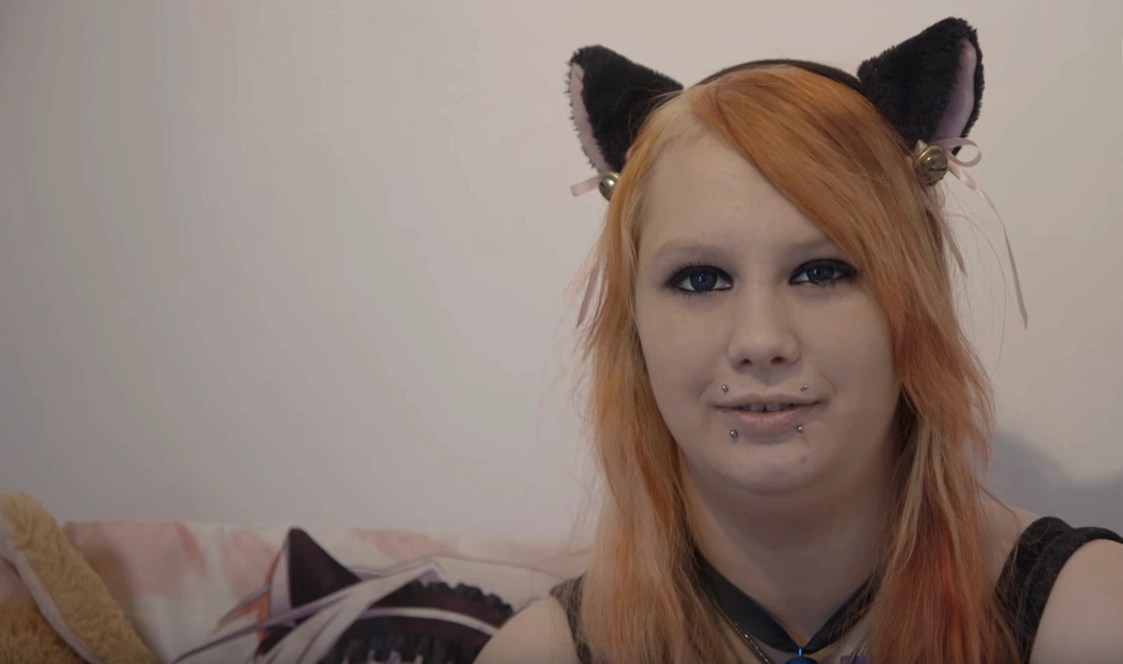
Top image: A 20-year-old Norwegian woman who identifies as a cat. The woman says she was “born the wrong species.” “My psychologist told me I can grow out of it, but I doubt it,” she told an interviewer. “I think I will be cat all my life.”






 Pain In The Bud