Cats who have regular outdoor access and hunt wildlife still get 96 percent of their nutrition from pet food, a new study found, suggesting their predatory behavior is driven by instinct, not hunger.
A new study from the UK debunks the claim that cats need access to the outdoors to supplement their diets with wild kills.
Cats who spend a significant amount of time outdoors and regularly kill local wildlife still get 96 percent of their nutrition from meals provided by their humans, according to research by a team at the University of Exeter.
The scientists connected with cat owners through ads on social media, TV and in print publications, specifically seeking out “cat owners living throughout southwest England whose cats regularly captured wild animals and brought them back to the house,” the study’s authors said.
They gave the owners a questionnaire to collect some basic information on the kitties — age, sex, breed, whether they had unrestricted access to the outdoors, and how much time they spend outside — then split the 90 participating cats into six groups.
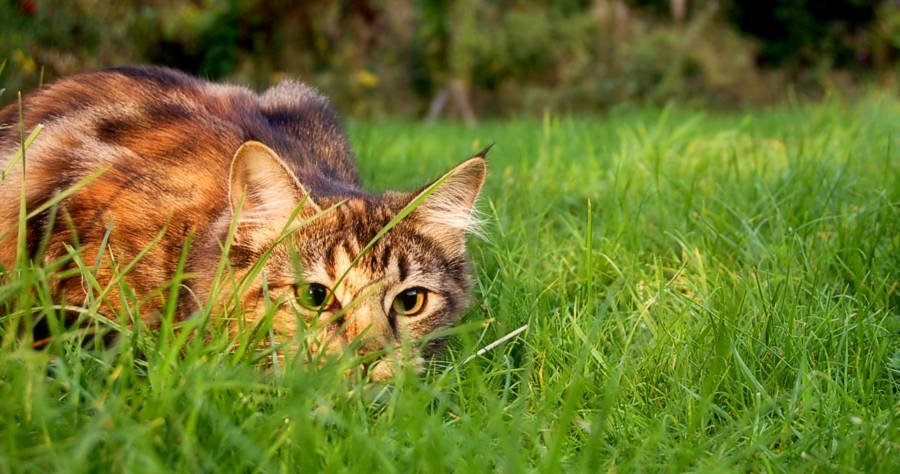
A domestic tabby cat stalking in the grass. Credit: Wikimedia Commons
To set a baseline, the scientists trimmed small sections of whisker from each of the cats, then trimmed a second sample at the end of the study.
By comparing stable isotope ratios in the whisker samples, they were able to determine what the cats were eating. Despite regular access to the outdoors and successful hunts, pet food accounted for the vast majority of their diets.
As a result, the researchers concluded, outdoor cats hunt because they’re driven by predatory instinct, not hunger.
“When food from owners is available, our study shows that cats rely almost entirely on this for nutrition,” said Martina Cecchetti, the study’s lead author.
“Some owners may worry about restricting hunting because cats need nutrition from wild prey, but in fact, it seems even prolific hunters don’t actually eat much of the prey they catch,” Cecchetti said. “As predators, some cats may hunt instinctively even if they are not hungry – so-called ‘surplus killing’ – to capture and store prey to eat later.”
A second component of the study was designed to find the best mitigation strategy to change the behavior of outdoor cats.
Each group was given a different strategy: In one group, cats were outfitted with bells on their collars, while another group wore reflective break-away collars and cats from a third group were fitted with BirdBeSafe collars. The other groups were told to make habit changes inside the home. For example, one set of cats was fed a higher-protein diet without grain filler, another group was fed with puzzle feeders, and the last group was given extra interactive play time.
While high-protein diets and play time helped cut down on hunting, the BirdBeSafe collars had the biggest impact on hunting success. The collars come in bright colors designed to stand out to avian eyes, taking away stealth and the element of surprise from cats.
The study was sponsored by Songbird Survival, a British non-profit that funds bird conservation research and looks for ways to mitigate the dwindling numbers of many avian species.
Susan Morgan, Songbird Survival’s executive director, said her group hopes cat owners will do their part to help: “Pet owners can help us reverse the shocking decline in songbirds via three simple, ‘win-win’ steps: fit collars with a Birdsbesafe cover; feed cats a premium meaty diet; play with cats for five to ten minutes a day to ‘scratch that itch’ to hunt.”
Of course there’s an obvious solution the study didn’t include: Keeping cats indoors. While keeping cats indoors is common in the US, cat ownership culture in the UK is different — another subject for another post.
Read the full text of the study here. Header image credit Pexels. Body images credit BeSafeCollar.
For the first time ever, a US city has conducted a true cat census using scientifically proven methods, including doing it the hard way — by counting. The project’s authors hope other cities follow their lead.
The last decade has seen something of a renaissance in cat-related research, with insightful studies about feline behavior coming from researchers in the US and Japan.
On the other hand there’s been a glut of research into feline predatory impact and public policy, and the majority of those studies have been deeply flawed. They’re based on suspect data and tainted by the interests of people who are more interested in blaming cats for killing birds than they are in learning about the real impact of domestic felines on local wildlife.
Those studies have all taken extreme shortcuts — using data that was collected for entirely different studies, for example, or handing out questionnaires that at best lead to highly subjective and speculative “data” on how cats affect the environment.
Several widely-cited studies that put the blame on cats for the extirpation of bird species have relied on wild guesses about the cat population in the US, estimating there are between 20 million and 120 million free-roaming domestic cats in the country. If you’re wondering how scientists can offer meaningful conclusions about the impact of cats when even they admit they could be off by 100 million, you’re not alone.
No one had ever actually counted the number of cats in a location, much less come close to a real figure — until now.
When leaders in Washington, D.C., set out to tackle the feral cat problem in their city, they knew they couldn’t effectively deal with the problem unless they knew its scope. They turned to the University of Maryland for help, which led to the D.C. Cat Count, a three-year undertaking to get an accurate census with the help of interested groups like the Humane Society and the Smithsonian.
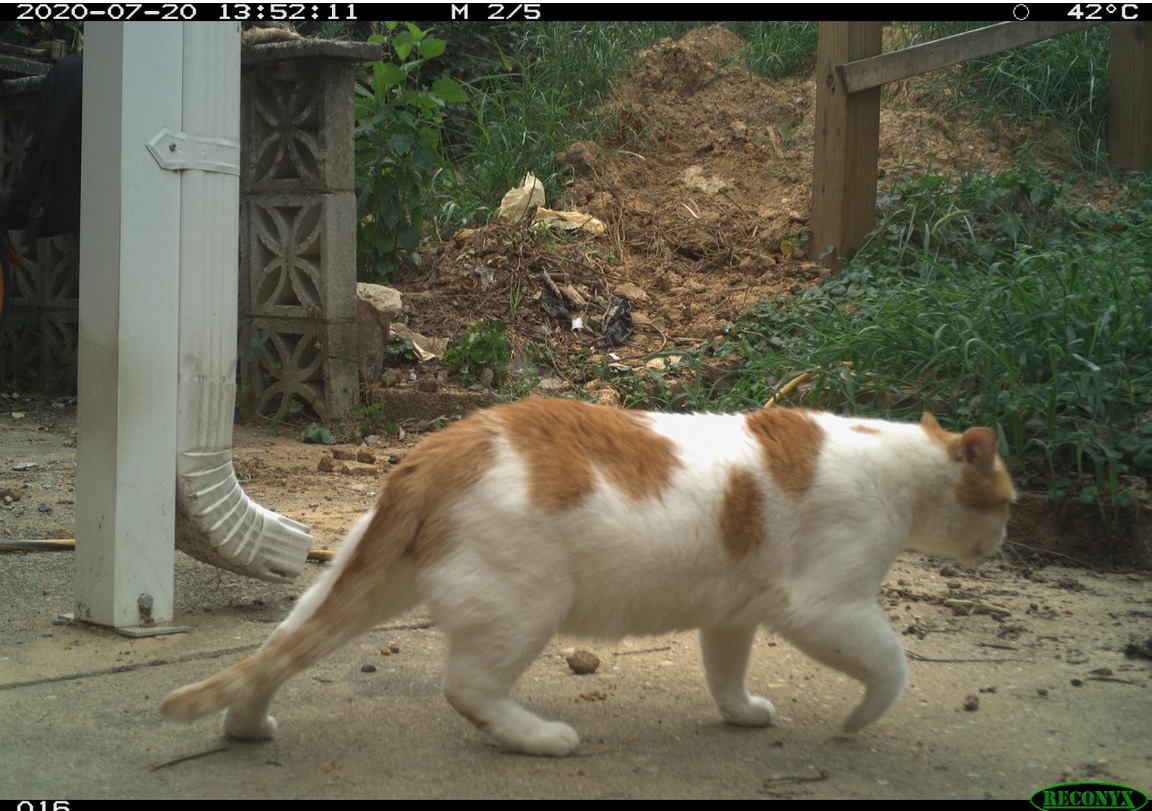
An image from one of 1,530 motion-activated cameras deployed for the D.C. Cat Count. Credit: D.C. Cat Count
The researchers approached each of their local shelters and rescues for data, then assembled a meticulous household survey to get a handle on how many pet cats live in the city, and how many have access to the outdoors.
Finally — and most critically — they used 1,530 motion-activated cameras, which took a combined 6 million photos in parks, alleys, public spaces, streets and outdoor areas of private residences. They also developed methods for filtering out multiple images of individual cats, as well as other wildlife. And to supplement the data, team members patrolled 337 miles of paths and roads in a “transect count” to verify camera-derived data and collect additional information, like changes in the way local cats move through neighborhoods.
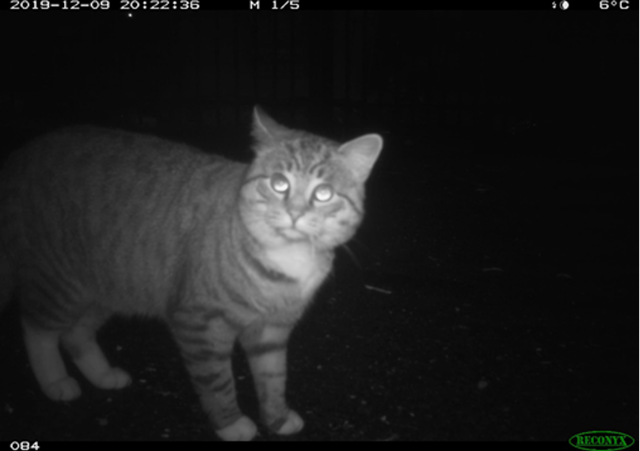
A cat who looks a lot like the Budster was captured in this 2019 photo from a motion-activated camera with night vision. Credit: DC Cat Count
Now that all the data’s been collected and analyzed, the D.C. Cat Count finally has a figure: There are about 200,000 cats in the city, according to the study.
Of those, 98.5 percent — or some 197,000 kitties — are either pets or are under some form of human care and protection, whether they’re just fed by people or they’re given food, outdoor shelter and TNR.
“Some people may look at our estimate and say, oh, well, you know, you’re not 100% certain that it’s exactly 200,000 cats,” Tyler Flockhart, a population ecologist who worked on the count, told DCist. “But what we can say is that we are very confident that the number of cats is about 200,000 in Washington, D.C.”
The study represents the most complete and accurate census of the local cat population in any US city to date, and the team behind it is sharing its methods so other cities can conduct their own accurate counts. (They’ll also need money: While the D.C. Cat Count relied on help from volunteers and local non-profits it was still a huge project involving a large team of pros, and it cost the city $1.5 million.)
By doing things the hard way — and the right way — D.C. is also the first American city to make truly informed choices on how to manage its feline population. No matter what happens from here, one thing’s certain — the city’s leaders will be guided by accurate data and not creating policy based on ignorance and hysteria painting cats as furry little boogeymen.
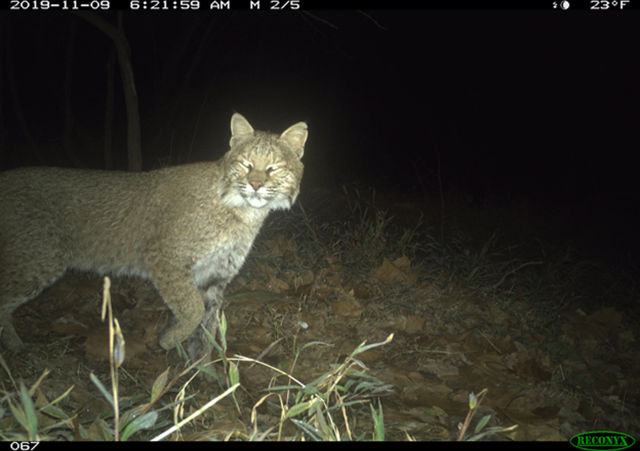
Not all the photos captured images of cats, and not all the felines were little: In this 2019 night image, a bobcat wanders in front of a trail camera. Credit: DC Cat Count
A new AI algorithm promises to help you gauge your cat’s mood — and determine if she’s in pain — by analyzing facial expressions.
In the photograph, Buddy is sitting on the coffee table in the classic feline upright pose, tail resting to one side with a looping tip, looking directly at me.
The corners of his mouth curve up in what looks like a smile, his eyes are wide and attentive, and his whiskers are relaxed.
He looks to me like a happy cat.
Tably agrees: “Current mood of your cat: Happy. We’re 96% sure.”
Tably is a new app, currently in beta. Like MeowTalk, Tably uses machine learning and an algorithmic AI to determine a cat’s mood.
Unlike MeowTalk, which deals exclusively with feline vocalizations, Tably relies on technology similar to facial recognition software to map your cat’s face. It doesn’t try to reinvent the wheel when it comes to interpreting what facial expressions mean — it compares the cats it analyzes to the Feline Grimace Scale, a veterinary tool developed following years of research and first published as part of a peer-reviewed paper in 2019.
The Feline Grimace Scale analyzes a cat’s eyes, ears, whiskers, muzzle and overall facial expression to determine if the cat is happy, neutral, bothered by something minor, or in genuine pain.
It’s designed as an objective tool to evaluate cats, who are notoriously adept at hiding pain for evolutionary reasons. (A sick or injured cat is a much easier target for predators.)
But the Feline Grimace Scale is for veterinarians, not caretakers. It’s difficult to make any sense of it without training and experience.
That’s where Tably comes in: It makes the Feline Grimace Scale accessible to caretakers, giving us another tool to gauge our cats’ happiness and physical condition. With Tably we don’t have to go through years of veterinary training to glean information from our cats’ expressions, because the software is doing it for us.
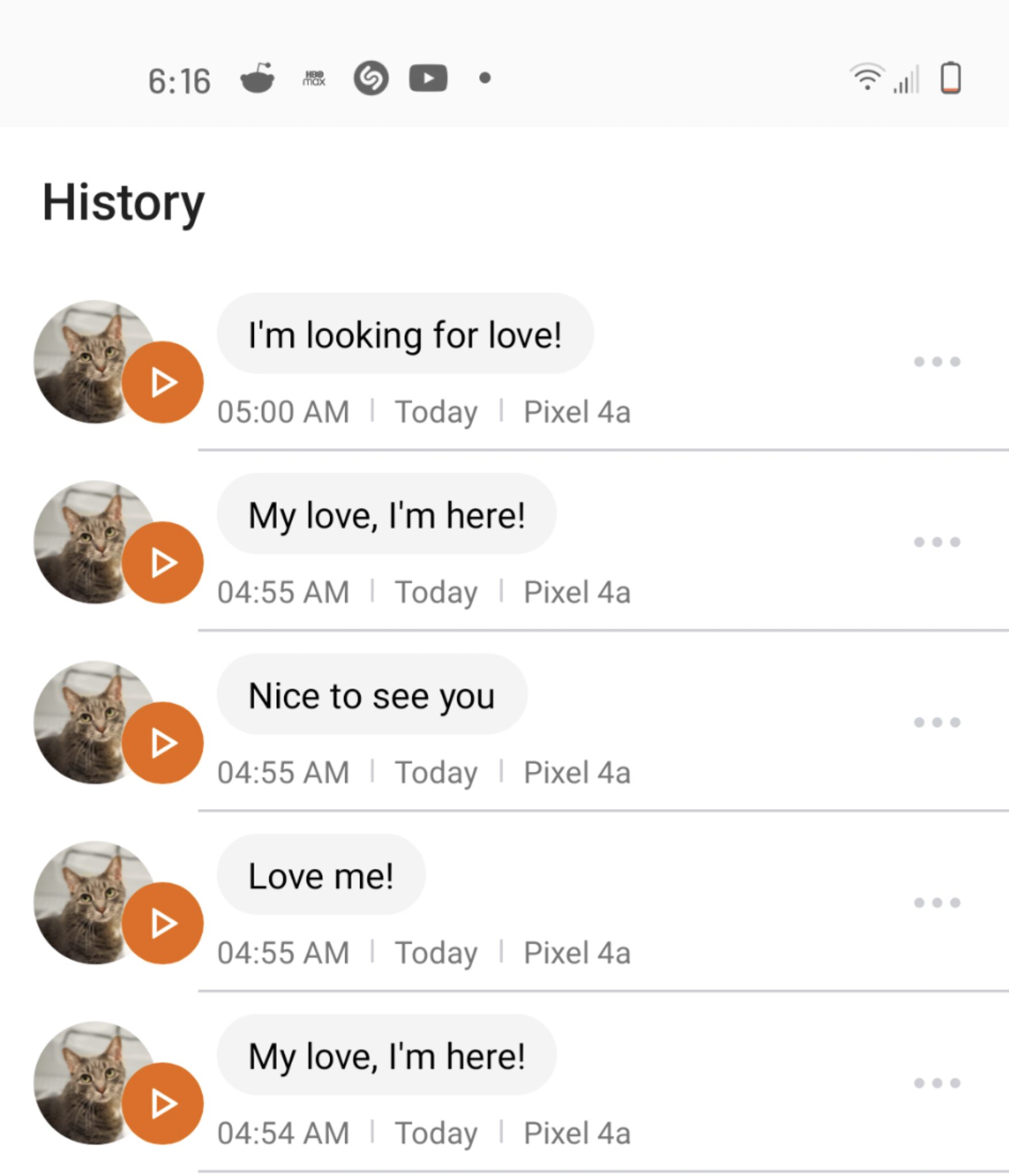
Meanwhile, I used MeowTalk early in the morning a few days ago when Buddy kept meowing insistently at me. When Bud wants something he tends to sound whiny, almost unhappy. Most of the time I can tell what he wants, but sometimes he seems frustrated that his slow human isn’t understanding him.
I had put down a fresh bowl of wet food and fresh water minutes earlier. His litter box was clean. He had time to relax on the balcony the previous night in addition to play time with his laser toy.
So what did Buddy want? Just some attention and affection, apparently:
I’m still not sure why Buddy apparently speaks in dialogue lifted from a cheesy romance novel, but I suppose the important thing is getting an accurate sense of his mood. 🙂
So with these tools now at our disposal, how much can artificial intelligence really tell us about our cats?
As always, there should be a disclaimer here: AI is a misnomer when it comes to machine learning algorithms, which are not actually intelligent.
It’s more accurate to think of these tools as software that learns to analyze a very specific kind of data and output it in a way that’s useful and makes sense to the end users. (In this case the end users are us cat servants.)
Like all machine learning algorithms, they must be “trained.” If you want your algorithm to read feline faces, you’ve got to feed it images of cats by the tens of thousands, hundreds of thousands or even by the millions. The more cat faces the software sees, the better it gets at recognizing when something looks off.
At this point, it’s difficult to say how much insight these tools provide. Personally I feel they’ve helped me understand my cat better, but I also realize it’s early days and this kind of software improves when more people use it, providing data and feedback. (Think of it like Waze, which works well because 140 million drivers have it enabled when they’re behind the wheel and feeding real-time data to the server.)
I was surprised when, in response to my earlier posts about MeowTalk and similar efforts, most of PITB’s readers didn’t seem to share the same enthusiasm.
And that, I think, is the key here: Managing expectations. When I downloaded Waze for the first time it had just launched and was pretty much useless. Months later, with a healthy user base, it became the best thing to happen to vehicle navigation since the first GPS units replaced those bulky maps we all relied on. Waze doesn’t just give you information — it analyzes real-time traffic data and finds alternate routes, taking you around construction zones, car accident scenes, clogged highways and congested shopping districts. Waze will even route you around unplowed or poorly plowed streets in a snowstorm.
If Tably and MeowTalk seem underwhelming to you, give them time. If enough of us embrace the technology, it will mature and we’ll have powerful new tools that not only help us find problems before they become serious, but also help us better understand our feline overlords — and strengthen the bonds we share with them.
Buddy’s bored of all this AI talk and wants a snack.
A company offers DNA tests for cats, similar to the ancestry tests offered to people. What can you learn about your cat?
Ever wonder about your cat’s parentage, breed and potential health problems? A mail-in DNA test for cats promises to fill you in on the details.
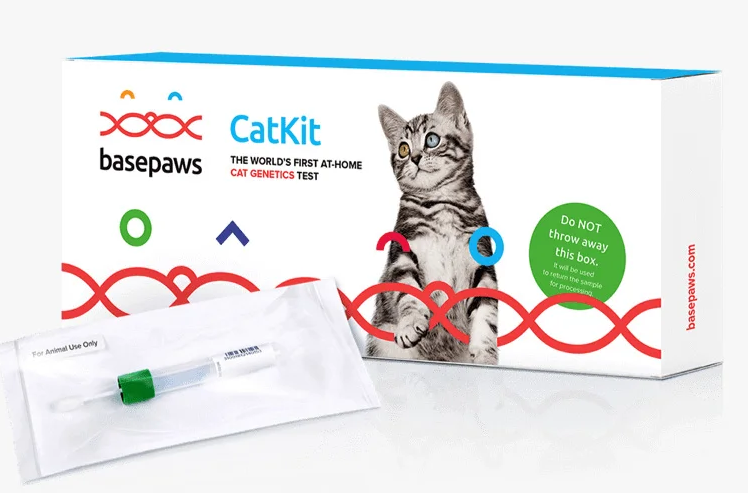
Basepaws, a Los Angeles company, offers a kit not much different from the human mail-in DNA tests: You swab the inside of your cat’s mouth for a few seconds, secure it according to the provided instructions, and mail it to the company, which processes the results.
The basepaws kit.
In four to six weeks you’re notified that your cat’s results are ready, and you’ll get a report with a breakdown of genetic identity, associated breeds and potential health issues to watch out for.
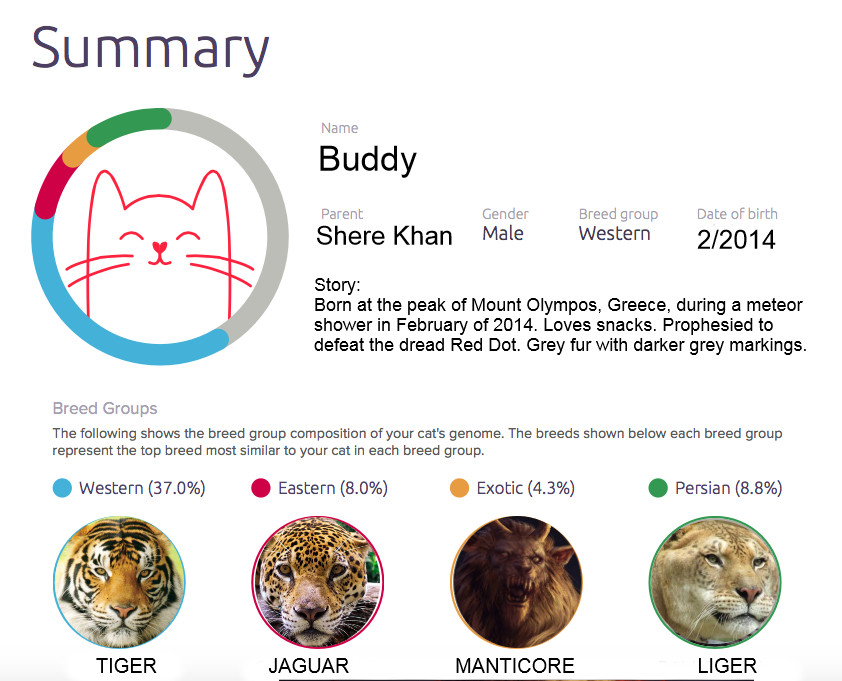
This presents a problem for me, of course. Buddy thinks he’s descended from a long line of legendary warrior felids. I took a regular Q-tip, made a big show of swabbing his cheek for his DNA, and told him I was mailing it away for analysis.
Then I cooked this up:
Buddy’s fake results.
You’ll notice the results don’t come close to adding up to 100 percent. The company’s founder says that’s because the more people test their cats, the more accurate the results will be, with fewer unknowns as the overall database expands.
Each cat’s report is updated indefinitely as the company continues to test. Checking back over subsequent months and years will yield updated information on your cat, the company says.
All jokes aside, it would be interesting to find out more about the Budster’s background. All I know is that his mom was an indoor cat who wasn’t spayed. She went into heat, she got out, she came back and the rest is history.
Because he’s a big talker, I’ve always wondered if Bud might have a bit of Siamese or one of the other chattier breeds in him. His coat is pretty short, extremely soft and all grey/dark grey in a tabby pattern, except for a single white tuft on his chest.
Interestingly, most of his tabby stripes are unbroken, a trait usually seen in hybrid cats.
He’s comically incapable of certain things, but almost frighteningly intelligent in other respects, and he wears his emotions on his sleeve…er, paw? Maybe there really are secrets to unlock in his DNA.
Cat DNA analysis is in its infancy
On the downside, Basepaws DNA tests don’t come cheap — with two packages priced at $129 and $99 — and, as a review in Wired notes, cat ancestry reports are always going to be more vague than reports on human or dog DNA.
That’s because the practice of dog breeding is a lot older and more common than creating pedigree cat lines, and most cats are not a specific breed. Unlike dogs — whose roles range from hunting and shepherding to assisting the blind and pulling sleds — cats have always had one job, and occasionally two. Kill rodents and snuggle with their humans, cuddly killers that they are.
Historically humans haven’t felt a compelling need to interfere with cat procreation. The last century or so has been an exception, but breeds still represent a small minority of cats.
If you’ve had your cat’s DNA analyzed, we’d love to hear from you about your experience.
Now if you’ll excuse me, I’ve got to tell a certain Tiger-Manticore-Jaguar about his impressive felid lineage.
A California parks district is under fire for killing cats that allegedly strayed too close to protected marshland where birds winter.
Employees of a parks agency in California’s Bay area killed almost four out of every 10 cats that may have strayed close to protected wildlife areas, newly released documents show.
The East Bay Regional Park District (EBRPD), an independent government district that manages parks in Contra Costa and Alameda counties, found itself at the center of a growing controversy earlier this month after admitting its employees were shooting cats they claimed could be a threat to local wildlife.
When more than a dozen cats went missing, several local volunteers who care for colony cats in the area contacted the EBRPD for an explanation. Staff at the EBRPD initially told the caretakers they’d trapped the cats and brought them to local shelters.
But when Cecilia Theis, one of the cat caretakers, contacted staff at nearby rescues and shelters, they said they hadn’t taken in any strays from the EBRPD.
“I immediately stopped what I was doing and searched for them,” Theis wrote in a letter to the EBRPD. “The cats I cared for were never taken to the shelter. [An EBRPD employee] even described the cats.”
It wasn’t until KGO, the local ABC news affiliate, began asking questions that the EBRPD admitted its “conservationists” had shot and killed the cats, claiming the stray felines ventured too close to a protected marshland where endangered bird species migrate for the winter. The marshland is located within the Martin Luther King Jr. Shoreline, a regional park managed by the EBRPD.
The Martin Luther King Jr. Shoreline / Credit: Bay Nature Institute
News of the district’s cat culling first broke on Dec. 8 when KGO aired a segment on the controversy. The EBRPD told the news agency that it had the right to cull animals that represent a threat to wildlife, per an old policy that local rescues, shelters and colony managers weren’t aware of.
District staff eventually admitted they killed 18 cats in 2020.
Despite press enquiries and public records requests, the district still has not provided details about the cat culling. It’s not clear how the district’s staff determines whether an individual cat represents a threat to local wildlife, whether there are protocols or standards governing the use of lethal force against stray domestic animals, or even what kind of firearms were used.
“I was heartbroken,” Ann Dunn of Oakland Animal Services told KGO. “Yeah, I was heartbroken, just knowing that that there’s no reason that that needed to happen.”
“We certainly didn’t realize they were doing what they were doing, otherwise we would have reached out sooner,” Dunn added.
The EBRPD has not responded to public records requests by KGO. Government agencies in California are required by law to respond to public records requests within 10 days. If they decline to release the requested records, they must provide a compelling reason why the information cannot be shared with the public, per open records laws and government transparency best practices.
Open records laws are arguably the most crucial tool used by media organizations, public interest groups and regular people who want to keep tabs on what their tax dollars are used for and how government offices are run.
Additionally, records provided by the EBRPD are incomplete. A document that is supposed to provide a full accounting of animals killed, trapped and caught by the EBRPD over the past three years is missing details on many of the incidents, and the numbers don’t add up with the district staff’s public statements.
The data was obtained through a public information request by Theis and shared with this blog. Additional public information requests are pending.
DOCUMENTS: PDF of the East Bay Regional Parks District records on cat culling: (Click to view full size)
Between 2018 and mid-December of 2020, the EBRPD dealt with 62 incidents involving cats. The district’s records say its “conservationists” shot and killed 24 of those cats. The remaining 38 were caught or trapped, meaning 39 percent — about four in 10 — of cats identified as potential threats to local wildlife were shot rather than trapped or caught by hand.
However, the documents list only 14 cat shootings in 2020, and only 13 during the time period when officials say they killed 18 strays. The documents list one cat shot in 2018 and eight cats shot in 2019.
Others have noticed the discrepancies as well. A Change.org petition started by Cassidy Schulman has almost 46,000 signatures and includes statements urging the EBRPD to come clean on the controversy.
“How can they claim that they communicate openly and honestly with the public they serve when they (separately and on more than one occasion) told Cecelia and another colony caretaker that they had not killed the cats, but had taken them to shelters in Oakland and Dublin?” Schulman wrote on the petition page. “Most of the colony cats were not only spayed, neutered and vaccinated – they were also microchipped by Fix Our Ferals. Had even a single one arrived alive at any shelter or veterinary hospital, they would have immediately been scanned for chips, and the organization would have been notified.”
In her letter to the EBRPD, Theis complained that a staffer there “even went so far as to pretend she was looking for paperwork” when pressed about what happened to the colony cats. Another employee told Theis the paperwork hadn’t been sent to the shelters because of COVID restrictions. That same employee told Theis four cats “had to be shot” because they were sick.
But those explanations were abandoned by the EBRPD when KGO’s reporters began asking about the fate of the cats. That’s when the staff admitted they’d killed 18 cats, including 13 at the Martin Luther King Jr. Shoreline.
While the EBRPD itself said it won’t rule out killing more cats, members of the board that oversees the EBRPD have pledged to end the practice.
“The Park District appreciates all animal life but is required by law to protect threatened and endangered wildlife living in District parklands,” EBRPD spokesman Dave Mason told SFGate. “It is imperative that the public understands that feral cats are not part of a healthy eco-system and feeding them only serves to put endangered wildlife at risk.”
The EBRPD’s cat-killing policy — and similar efforts by states and municipalities in the US and other countries — are influenced by a series of studies claiming cats are one of the biggest factors leading to the extinction of endangered species of birds and small mammals.
However, the claim that cats are a major contributor to bird extinction is controversial.
“Conservationists and the media often claim that cats are a main contributor to a mass extinction, a catastrophic loss of species due to human activities, like habitat degradation and the killing of wildlife,” a trio of academics wrote this summer. “As an interdisciplinary team of scientists and ethicists studying animals in conservation, we examined this claim and found it wanting.”
Other scientists challenge the claims that cats are the primary cause of species extinction among birds and small mammals.
There is no direct evidence that felis catus — domestic cats — are a major driver of extinction. A handful of studies that purport to show a connection are not based on observational or even secondary data. Instead, they rely on guesswork and numbers cobbled together from unrelated studies.
Most of the studies use aggregate data taken from earlier studies that did not measure the ecological impact of stray, feral and outdoor cats. For example, one paper used GPS data from an earlier study in which cats had devices affixed to their collars to track their movements.
But that earlier study did not include any information about the cats’ hunting activities, so the authors of the meta-analyses handed out questionnaires to cat owners asking them to rate their cats’ hunting skills on a five or 10-point scale.
The authors took the GPS data and the questionnaire results, calculated an estimated number of prey animals killed per cat annually, then extrapolated that data based on an estimate of more than 100 million stray/feral cats living in the US, even though that number could be off by as much as 80 million.
The result — a claim that cats kill up to 20 billion birds and small mammals in the US each year — is based on so much guesswork and arbitrarily plugged-in numbers that it’s worthless from a practical perspective. Yet that hasn’t stopped credulous press outlets from reporting the numbers as fact, or authorities from using such studies to justify extreme measures against stray and feral cats.
Because lives hang in the balance, and public policies are directly influenced by these studies, cats deserve better than guesswork.
CORRECTION: Earlier posts incorrectly labeled the East Bay Regional Park District as a California state agency. It is in fact a special district founded in 1934, and serves Alameda and Contra Costa counties.