Why Are UK Cat Owners So Intent On Allowing Their Cats To Run Free?

A UK couple created a cat flap that uses algorithmic AI to determine if their cat is trying to come inside while carrying prey in her mouth. If she’s carrying prey, the cat flap won’t open.

Jinx the cat was so grateful to UK couple Martin Rosinski and Michelle Bowyer for giving her a home that she decided to bring them a gift.

“The first time I was working at home, I heard Michelle making a commotion because Jinx had come in with a mouse and dumped it on the carpet in front of her as a ‘thank you’. That’s their way of expressing love. You can’t tell her off, so we thanked her a lot for it and took it away from her,” Rosinski said.

“Then this started happening more and more often to the point where we would be woken up at 2 a.m. as Jinx would meow loudly and announce, ‘Hey I have a gift. If we didn’t get to her fast enough she would decide to eat it herself, which would involve piles of mouse parts being smeared into the carpet. This was happening at 2 a.m., then again at 4 a.m. on many nights and we’d not get any sleep having to deal with this. Her record was four in one night – that night was a frenzy of three mice and one bird. It was something that was a real cause of stress.”

The solution is pretty simple, right? Keep Jinx inside.

The former stray won’t like it at first. There will be an adjustment period when the meowing will be seriously annoying. But it’s better than allowing your cat to play Predator at night and waking up to find your cat sitting on your chest, proudly presenting a twitching mouse to you.

Rosinski and Bowyer didn’t take Jinx inside.

Instead they created a bespoke intelligent cat flap that allows Jinx to come and go as she pleases, but won’t open if she’s carrying prey. They both have backgrounds in tech: he’s a researcher who also tinkers with software and hardware, and she’s a web developer.

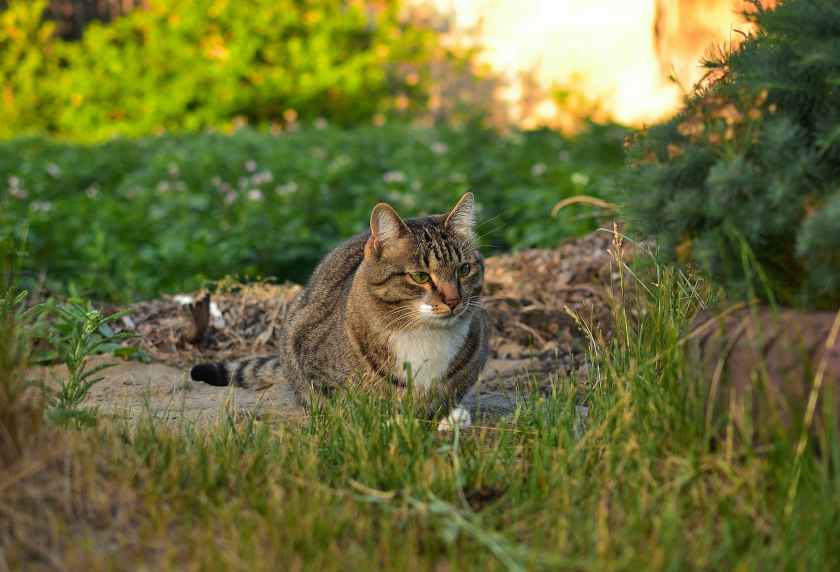
cute brown tabby cat
Despite being domesticated, cats retain their predatory instincts and many will kill small mammals and birds if allowed to wander on their own outdoors. Credit: Aleksandr Gorlov/Pexels

Their system, OnlyCat, uses a camera and an algorithm to determine if Jinx is carrying something in her mouth. If she is, the cat flap won’t grant her access, and Bowyer and Rosinski will get a text informing them Jinx has been up to her hi-jinx again, along with a photo of her entry attempt.

The OnlyCat prototype has prevented Jinx from bringing in 42 prey animals since June of 2021, the couple said. OnlyCat may prevent her from bringing her prey inside, but it hasn’t dissuaded her from killing.

“Two months ago I think something clicked and she realized, ‘I can’t bring these home. It’s just not going to work,’” Rosinski told the UK’s South West News Service. “She still catches them outside but she’s learned that there’s no point even trying to bring them home, which is a relief.”

The couple developed the OnlyCat into a full product, which launches on Aug. 16 at £499. (A little more than $600 USD.) Their site says the retail version of the flap has worked 100 percent of the time in tests, and the developers believe “99%+ accuracy should be achievable for everyone.”

It’s similar to a device built by Amazon engineer Ben Hamm which uses DeepLens, an AI-enabled camera system, and Sagemaker, a software tool for training machine-learning algorithms, to determine if cats are carrying prey.

Hamm’s version, which he created for his cat Metric in 2019, initiates a 15-minute lockout timer if Metric tries to enter while carrying a kill, and automatically sends a donation to the National Audubon Society, which protects birds and their habitats. The algorithm was trained using tens of thousands of images of cats approaching normally, and with prey in their mouths. So far, Hamm hasn’t developed a retail version of his AI-enabled cat flap.

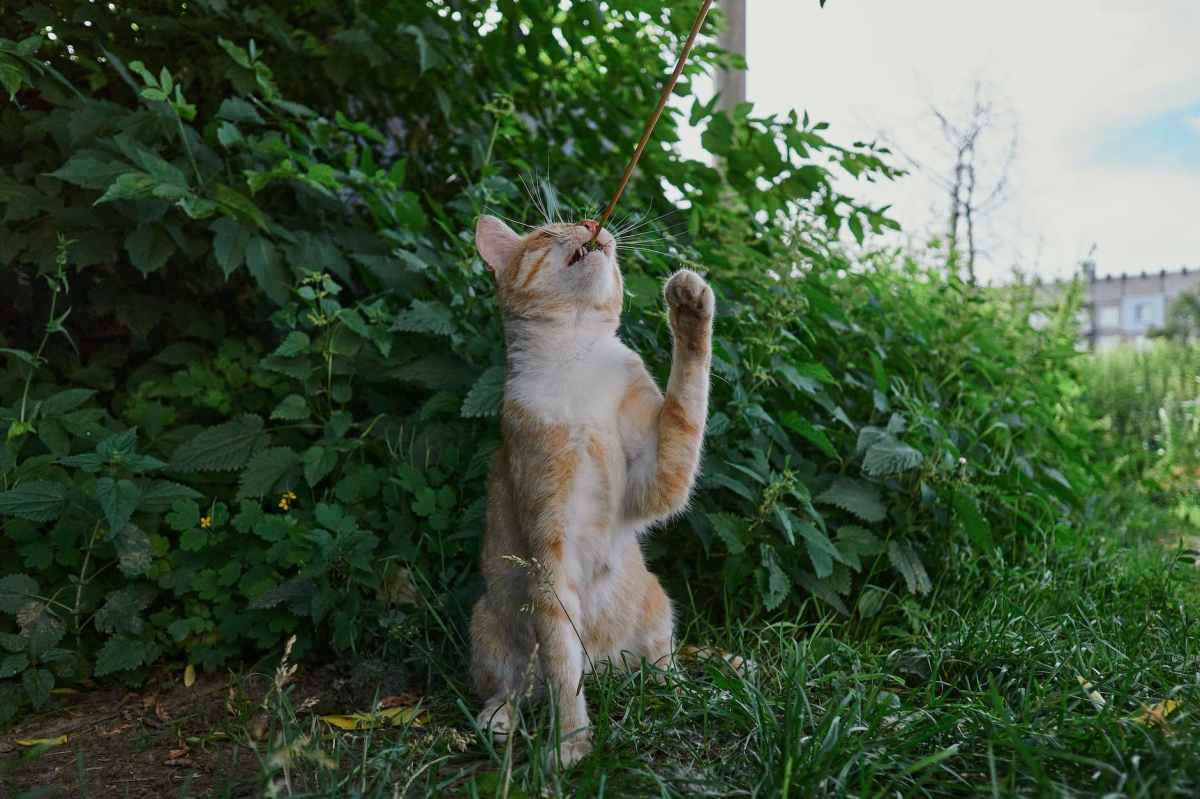
orange tabby cat on gray rock
The feline predatory drive is instinctual. Indoor cats can exercise that drive with wand toy games and by chasing laser pointers. Credit: Aleksandr Nadyojin/Pexels

We don’t think there’s any one way to raise cats, and it’s obvious there are different cat cultures in various countries.

Nevertheless, seven out of 10 cat owners in the UK allow their cats to roam free, and anecdotes like the ones about Jinx, with her multiple kills a night habit, draw the ire of birders and conservationists.

Peter Marra is the author of Cat Wars: The Devastating Consequences Of A Cuddly Killer and co-author of many of the leading studies claiming cats are the primary threat to bird populations. He’s currently making the media rounds and endorsing strict policies — many of them in enacted in response to his studies — that would make it illegal to allow cats outdoors.

The Australian government is airdropping poisoned sausages by the ton in a plan to cull as many as two million cats, a town in Germany tried to ban outdoor cats, a US politician recently suggested starting a “hunting season” for feral and stray felines, and some people — including wildlife biologists and conservationists — have gone vigilante and convinced themselves they’re doing good by randomly picking off cats with shotguns and poisoning feeding stations for strays.

Maybe it’s time for more people to reconsider allowing their cats to roam free. Like putting a cat on a diet or trying to break a bad habit, there’ll be loud and annoying protests in meow, and it’ll get worse before it gets better, but eventually cats always adjust to changes if given long enough.

As domesticated animals they don’t have a natural habitat anymore, and they don’t actually need to be outside. It’s entirely possible to keep things fun and interesting for the furry little guys, and that’s on us. All that’s required is our time, attention and affection. Interactive play time. Toys that can keep a cat occupied by herself. Catnip. Condos and tunnels. Window perches. Cat TV on Youtube. Simple things to play with, like plastic bottle rings, crinkled tin foil and cardboard boxes.

We don’t think anyone should be required to keep their cats indoors, and that’s the point. We have an opportunity to meet conservationists halfway and make a real effort to reduce feline impact on small wildlife. If we don’t, eventually we’ll be forced to comply by laws that’ll be draconian compared to the voluntary measures we could have taken to prevent the government from getting involved.

If Your Cats Aren’t As Brave As Buddy, Keep An Eye On Them This 4th Of July

More cats and dogs go missing this holiday weekend than at any other time of year.

Here in ‘Merica, more pets go missing on July 4 weekend than at any other time in the year.

While you’re firing up the grill, catching up with friends and having a few beers, your poor cat — or dog — could be suffering from spiking anxiety, especially if you live in a neighborhood like mine where kids are constantly setting off fireworks on the nights leading up to the holiday.

Nationally, animal control departments across the nation report a 30 to 60 percent jump in missing pet reports during the holiday weekend, according to statistics compiled by PetAmberAlert. Private shelters see a similar size uptick in lost cats and dogs who end up in the system. All kinds of cats are at risk for bolting, but Persians, Siamese and domestic shorthairs top the list, according to the lost pet tracking service.

We all know that Buddy is a particularly brave cat who once defeated a fly in single combat, has never lost a duel with a stuffed animal, and has a sterling reputation for facing down even the most terrifying threats. Buddy’s also got an advantage thanks to growing up less than a block from a public park where our town hosts its annual Independence Day fireworks show. The little guy has been hearing — and seeing — fireworks this time of year since he was a kitten, so he just shrugs it off.

If your cat isn’t as incredibly brave as Buddy, however, there are precautions you can take:

  1. Make sure Fluffy has a secure, up-to-date collar and a microchip.
  2. Keep your cat(s) in a closed area of the house or in one room before sundown, and make sure there are no open windows. Places to hide are okay as long as you can keep track of who’s hiding.
  3. Distract, and deaden or mitigate the sound. You can distract your furry friends with toys, a new box to play with or some catnip, which can act like a sedative if your cat eats it. Turn on the stereo and choose something you know has a calming effect on your cat(s).
  4. If your little one is especially anxious or jumpy, consider a pheromone diffuser like Feliway and/or a ThunderShirt. Make sure you get one for cats, not dogs.
  5. Play with your feline friend(s) before sundown to tire them out before fireworks start. Things’ll go a lot easier if your cat lays down for a nap and some relaxing music muffles the booming outside.
  6. Screen videos of Buddy the Cat. His heroic demeanor and cool under pressure will inspire your cat(s) to rise to the occasion.

Good luck!

*Claims about Buddy’s bravery are not to be taken literally. Exceptions to Buddy’s bravery include sudden movements, rustling paper bags, vacuums, truck backup beepers, images of Steven Tyler, certain smartphone ringtones, the Seinfeld theme music, blenders, oscillating fans, oven timer chimes, the Windows 10 error sound, Tic-Tacs rattling, certain types of snoring, and the sound of his own farts. This is not a comprehensive list, and Buddy may be startled and/or terrified by other sensory input.

UK Soccer Player Pleads Guilty To Kicking, Slapping Cat

The 27-year-old UK soccer star was fined and lost sponsorships after the release of a video showing him brutally abusing one of his cats.

Remember Kurt Zouma, the soccer player who kicked and slapped his cat in a video posted online in February?

The West Ham United footballer pleaded guilty on May 24 to “causing unnecessary suffering to a protected animal,” the BBC reported. His 24-year-old brother Yoan, who is also a professional soccer player, pleaded guilty to a single charge of abetting the crime when he filmed the violence and posted it to Snapchat.

An RSPCA investigation uncovered new details about the incident. Zouma was reportedly enraged when the cat scratched a chair.

“I swear I’ll kill it, I swear I’ll kill it,” he says in the video.

In the video, the elder Zouma, 27, drop-kicks the Bengal cat “like a football” in the prosecutor’s description, and slaps it hard in the face with a shoe. Both brothers were laughing in the footage, and Zouma’s child was present.

His brother Yoan uploaded the clip to Snapchat, and it would have remained private if not for the disgusted reaction of a woman Yoan asked on a date.

“I don’t think hitting a cat like that is OK – don’t bother coming today,” she wrote in a message to Yoan  Zouma, canceling their meet-up.

“I do not want to associate with people who find that funny, in front of a child as well,” she wrote.

Bengal_Cat_(Fia)
A Bengal cat. Credit: Marius Engesrønning/Wikimedia Commons

The outraged woman reported the brothers, and condemnation was swift: Zouma lost several sponsorship contracts, including his most lucrative deal with Adidas, and he was fined $250,000 by his team, which is the maximum a Premier League club can levy against a player.

The brothers don’t yet know the full consequences of their actions. They’ll return to court for sentencing on June 1, and although Zouma has been contrite and has people vouching for him to the court, there may be other considerations after Zouma’s video apparently inspired others to hit their cats and post the videos online.

People who imitated Zouma’s animal abuse formed an online group, calling themselves the “Kick the Cat Club.”

“Since this footage was put in the public domain there has been a spate of people hitting cats and posting it on various social media sites,” Thames Magistrate’s Court prosecutor Hazel Stevens said.

In the meantime, Zouma’s two Bengal cats have been in the custody of the RSPCA. The cats, Bonbon and Cherie, didn’t suffer any lasting physical injuries from the abuse, and despite enduring trauma, the RSPCA said both cats are friendly and will be ready for rehoming soon.

“What makes this case even more sad is the way the video was filmed and shared, making light of such cruelty,” the RSPCA’s Dermot Murphy said. “We hope this case will serve as a reminder that all animals deserve to be treated with kindness, compassion and respect, and that we will not tolerate cruelty.”

The Other Buddy’s Looking Strong!

Buddy’s Buddy is back on his feet!

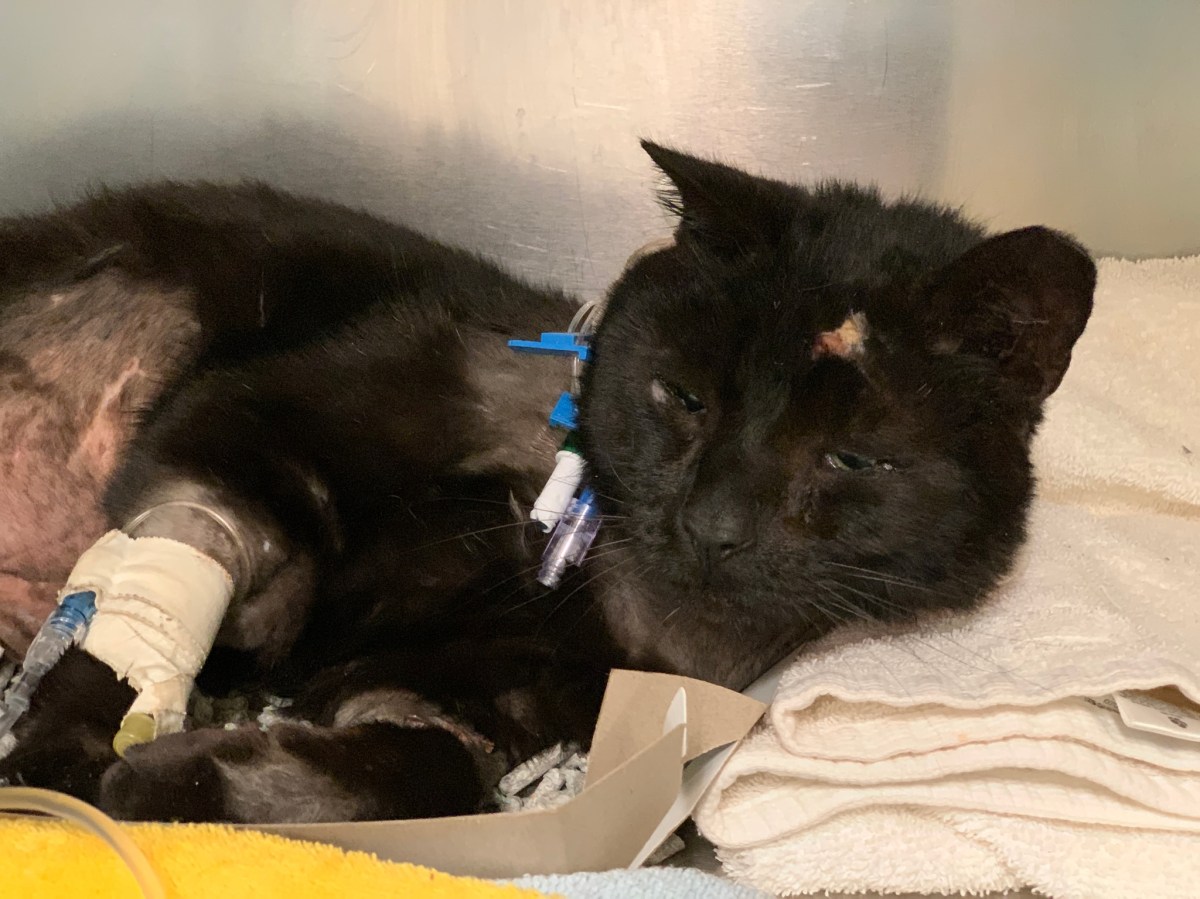
Buddy, the cat who was brutally assaulted when two teenagers sicced their pitbulls on him in Philadelphia last week, is making progress every day.

The little guy began opening his eyes again a few days ago, the Pennsylvania SPCA said, and now they’ve shared a short video of Buddy the Black Cat sitting up, licking his lips and tucking into some yums:

Little Buddy the Cat has been pulling for his fellow Buddy. In the meantime, a lot of people have been asking the SPCA how they can help. Here’s a way to do that and get something in return: A spiffy t-shirt that says “Save Every Buddy” with an original design:

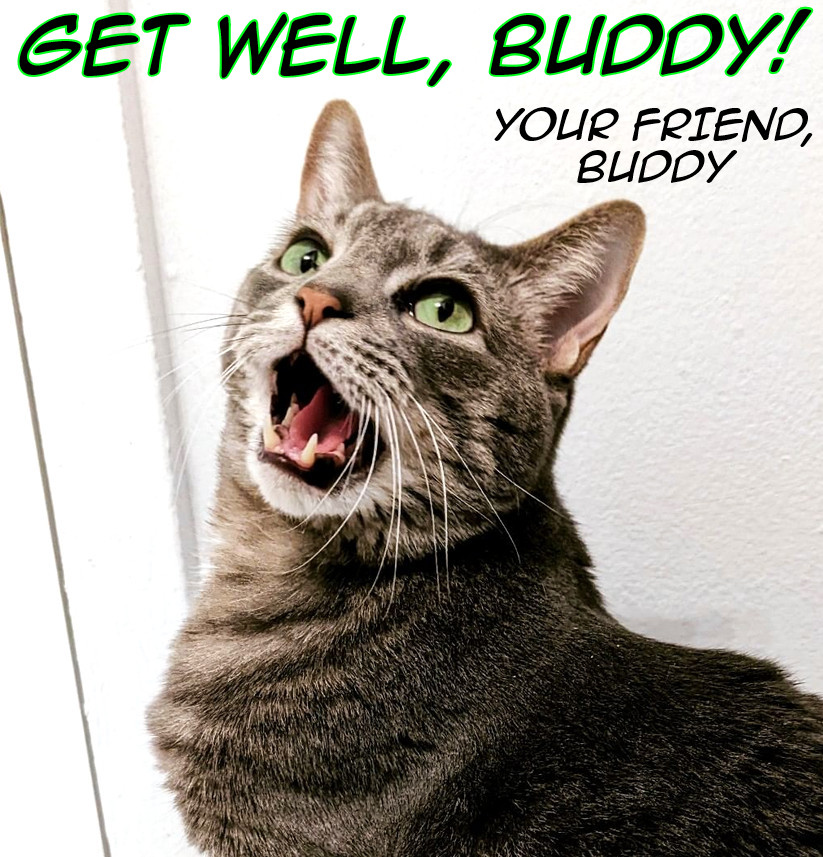
Get well, Buddy!
The League of Extraordinary Buddies.

Bring Your Cats Inside: Thieves Are Snatching Cats From Yards And Selling Them Online

As cat thefts increase on both sides of the pond, a UK woman’s security cameras caught a pair of thieves trying to stuff a neighbor’s cat into a plastic bin under cover of darkness. The cats are later sold online.

A week after a brazen thief stole a Portland family’s cat off their front porch, a pair of cat thieves were caught on security footage snatching a cat from a residential street in the UK.

The latter is not an isolated incident. A group of amateur sleuths, comprised of people whose cats were stolen and others concerned about the spate of thefts, found several of the missing cats listed for sale on a UK pet classifieds site, Pets4Homes.co.uk.

The latest cat-napping happened in East Birmingham, where home security cameras captured footage of a man and a woman creeping along a residential street shortly before 4 am, armed with cat treats, milk and a plastic bin and quietly searching for neighborhood felines.

East Birmingham’s Charlene Jones told the UK Sun that she was woken up by her dogs, who alerted her to intruders on her property.

“I didn’t notice anything until the dogs started barking, and I looked out the window and caught them in the act,” Jones said. “It all happened around 20 to four in the morning, at this point she was just putting the cat into the bin. I opened the window and the cat escaped.”

Cat thieves
In this still from Jones’ security cameras, the cat thieves are seen with the treats, milk and plastic bin they were using to capture neighborhood kitties.

An angry Jones, whose own cat was stolen three weeks ago, confronted the thieves, who claimed they were working for a local animal welfare charity and were trapping strays.

“I went out and spoke to them and she started reeling off all these charity numbers and claiming she worked for them,” Jones said.

When Jones later reviewed the footage she recognized the cat, who belongs to a neighbor a few doors down the street.

“I feel angry,” Jones told the paper. “I have done my own research, she has been selling cats for eight months.”

Jodie Smith of Solihull, a town of about 123,000 about 18 miles from Birmingham, said her family’s cat, Arlo, was stolen in January. A friend later spotted Arlo on Pets4Homes, but the Smiths weren’t able to recover him.

“It’s awful, this is my daughter’s cat,” Smith said. “My daughter can’t go to bed with cuddles from her fur baby. She is absolutely gutted.”

Arlo the cat
Arlo was listed on Pets4Homes but the family was unable to recover him.

Pet thefts on both sides of the Atlantic have been on the rise since the beginning of the Coronavirus pandemic in 2020. As entire countries went into lockdown, demand for companion animals skyrocketed, leaving many shelters bare and breeders sold out.

Criminals saw an opportunity and began stealing pets, mostly dogs at first, from yards, homes and kennels, prompting the owner of one lost pet site to dub 2020 “the worst year ever” for dog thefts, according to the BBC.

With exotic cat breeds commanding large amounts of money on the open market, from a few hundred dollars for breeds like Persians to $20,000 for Savannah cats, opportunistic thieves began targeting felines as well. “Moggies,” cats of indeterminate origin or no particular breed, aren’t exempt either. Some may be stolen because thieves mistake them for exotics, while other thieves apparently find it worth their time to snatch cats that can net them $100 or more on sites like Craigslist and Pets4Homes.

In the UK, cat thefts have increased threefold within the last five years, a trend accelerated by the pandemic and the resulting scarcity of cats, especially those with breed pedigree. Police rarely recover the stolen pets, and authorities say some people are targeted after sharing photos and video of their pets online.

Stealing cats is especially easy in the UK, where the majority of people allow their cats to roam free outdoors and the idea of keeping cats strictly indoors is seen as cruel or improper, even though felis catus are domesticated animals and don’t have a “natural habitat.”

In the Portland case, no one has come forward with any solid information in the theft of Kiki the cat despite two relatively clear shots of the suspect’s face and extended footage of her approaching and taking the cat from the Autar family’s front porch on Feb. 20. Like the UK catnappings, the Portland suspect seemed motivated by profit: The family said their cameras also caught the woman checking for open car doors, and the way she grabbed and held the cat — holding him at arm’s length, dangerously carrying him by the scruff of his neck — indicated she saw him as an object, not a living creature.

Karina Autar told PITB on March 1 that her family hasn’t given up hope.

“We are all just getting by, we are coping by putting in all our energy [into finding] him,” she said.

Cat thief suspect
The thief was caught snatching KiKi off his family’s front porch on Feb. 20.

In the UK, Jones is not the only person to confront the cat thieves. Amy Buckley, 29, told The Sun that the woman seen in Jones’ footage also told her she was an employee of an animal welfare organization.

“She came to mine around January, claiming she worked for the PDSA and that they’d had a report about a large number of stray cats in the area,” Buckley told the paper.

She said she was immediately suspicious because PDSA (People’s Dispensary for Sick Animals) is a charity run by veterinarians that provides care, not TNR or general trapping services.

PDSA confirmed the woman does not work for the organization, while local police told the paper they had taken several reports from people whose cats had been stolen and were investigating the thefts. Meanwhile, an RSPCA spokesperson urged caretakers to have their cats microchipped.

In the meantime the victims are trying their best to locate their stolen furry family members, but they’re also angry at the pain the thieves have caused families and children.

“There are other families going through the same heartbreak,” Smith said. “For a lady to have some money in her pocket, she is destroying little children.”