Are Laser Pointers Bad For Cats?

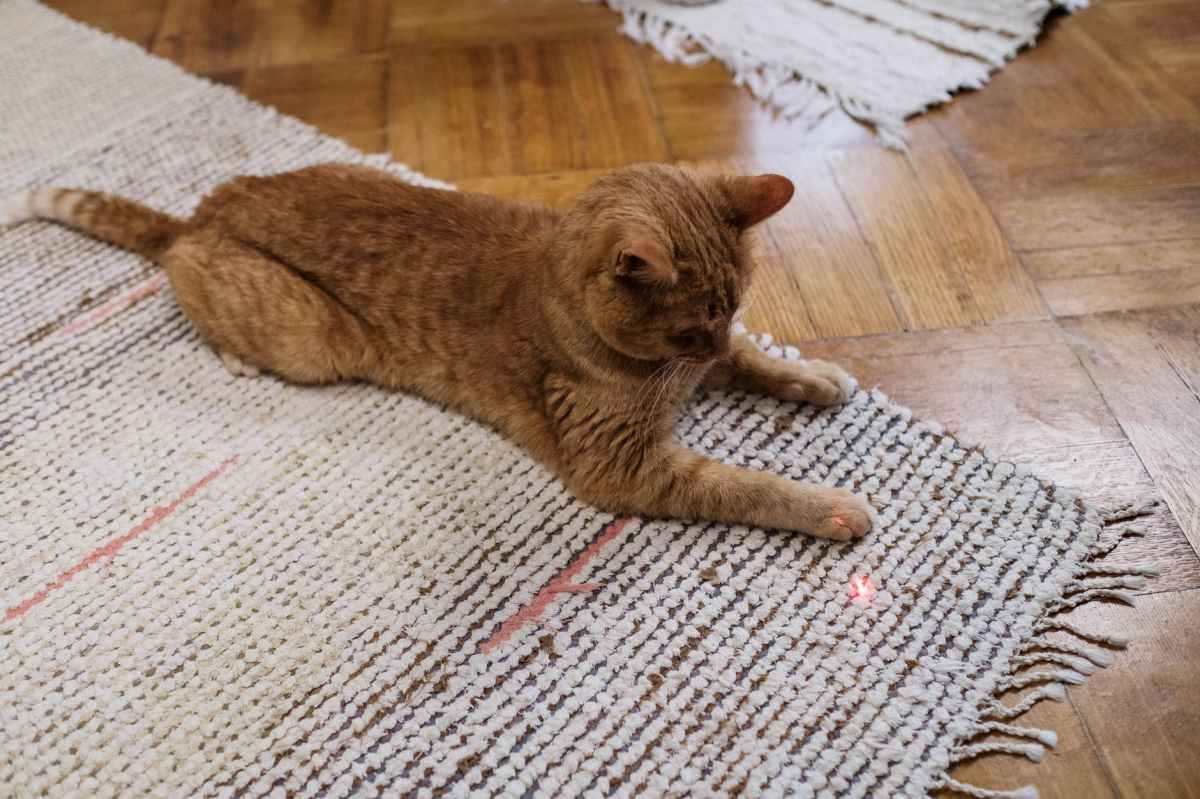
Buddy likes his new laser toy a little too much.

Bud is obsessed with his new laser pointer.

I bought one for the first time more than a week ago. For years I’d occasionally break out a level that shoots a narrow band of laser light that appears like a small stripe, and while Buddy enjoyed chasing after it, I’m thinking the laser probably wasn’t as powerful or didn’t register as well in the spectrum of light most visible to felines.

Whatever the reason, while he liked chasing the level’s laser light, he loves this $5 pet laser.

lasercat

In fact, he loves it a little too much. Every day, if I haven’t taken it out for play time, he climbs up onto the coffee table and begins pawing at the tray that contains the laser pointer and TV remotes. He finds the pointer, bats at it with his little paws, and makes mewing sounds that undoubtedly translate to: “Play time! I want! I want! Play with me now!”

I can see now why some people warn against using these things. I thought the upside was worth the potential downside, because the laser pointer gets the little dude moving like few other toys do. (And even then only when they’re new and novel.)

Bud’s single-mindedness with the laser pointer reminds me of his one-track mind when it came to Temptations, before I stopped buying those infernal things. (Blue Buffalo makes very similar-looking treats that he happily gobbles up, but instead of the corn and filler of Temptations, they’re made of chicken, turkey, salmon and so on.)

Crucially he doesn’t act like a crack addict the way he did with the Temps, when he’d park himself by the treat cabinet and meow mournfully for his next fix.
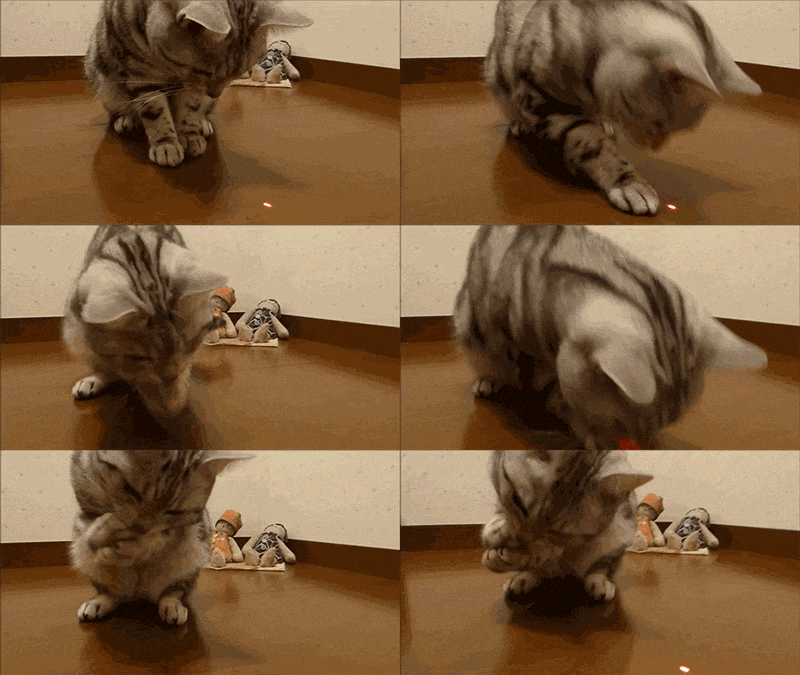
The Red Dot!
I’ve caught the red dot! I’m eating it!

So I’m wondering: What kind of experiences have you guys had with laser pointers? Have you used them? Have your cats become obsessed?

One final thought: Bud is fully aware the laser comes from the pointer, and he knows I have to press the button for the beam to work. That’s a clear example of abstract thinking. So far he hasn’t figured out a way to activate it himself, but you never know…
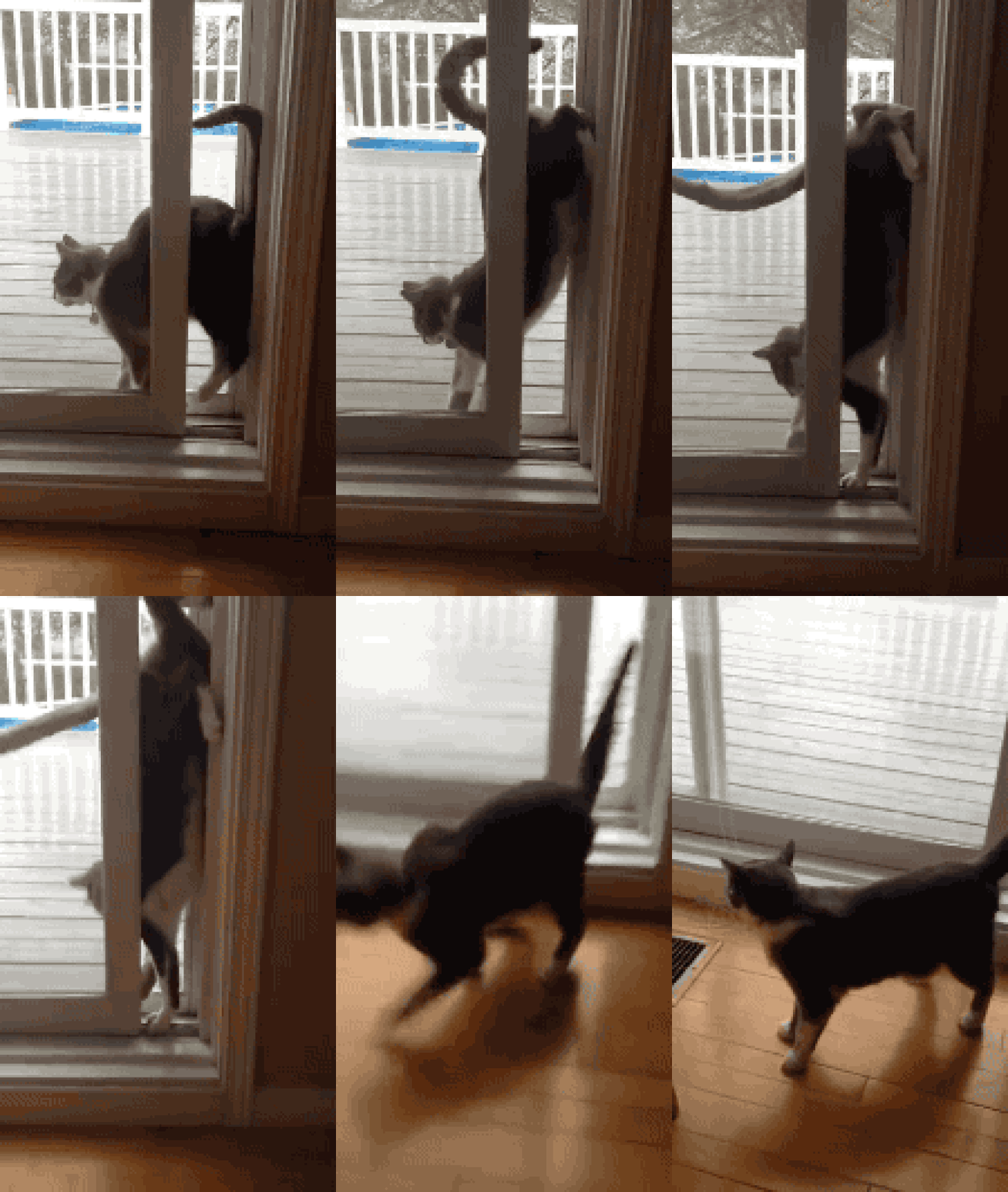
Cat Figures Out How To Open Sliding Glass Door

Cats never fail to surprise us.

Folks, this has terrifying implications for the Budster. Whatever you do, don’t show him this video!

The short clip shows Olive, a tuxedo kitty belonging to Beth Belnap of Oregon, prying open a sliding glass door that leads to a porch outside. Olive was able to get the door open by jumping, grabbing onto the door handle and pressing her little feet against the door frame to give herself enough leverage to slide the door open a crack.

The setup here is similar, and Bud is already well-versed in the “feet against the frame” trick because he’s used it to open my bedroom door from inside. Thankfully I believe the sliding glass door is too heavy for Buddy to push, but we’re talking about the same cat who pulled a 20-pound mirror off a wall when he was a kitten weighing no more than three or four pounds. You never know.

Here’s Olive doing her thing:

Bonus: Check out this little guy’s technique:

Whoah
The judges awarded him style points in addition to praising his door-opening technique.

Viral FB Post Claims Cats Have One Emotion: Contempt

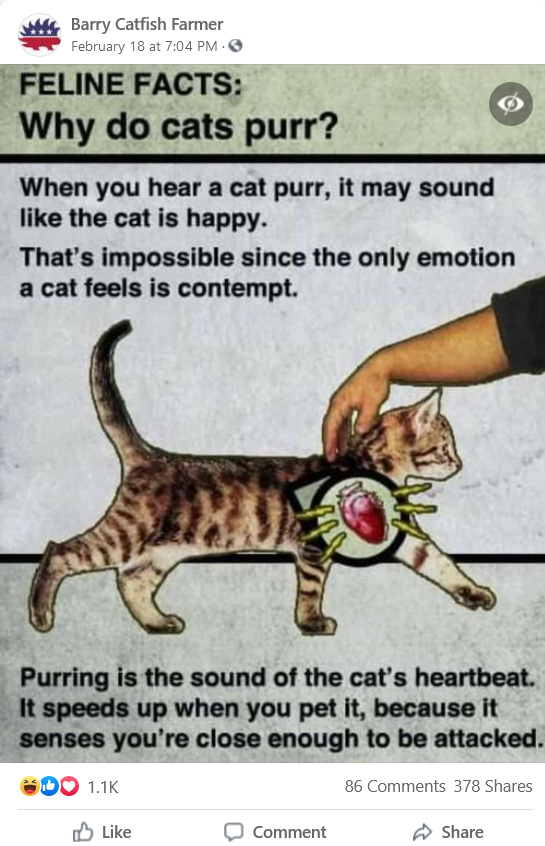
Factchecking a Facebook post claiming cats feel a single emotion: Contempt.

You have to feel sorry for the people still stuck in the Zuckerbergian cesspit that is Facebook, spending their days wading through tedious political arguments and “SHARE IF U AGREE” shitposts written for the paste-eating crowd.

Unfortunately, the platform’s rampant misinformation is not limited to politics. Here’s one of the latest viral posts:

Facebook Derp
Derp derp derp! A derp a derp derp derp!

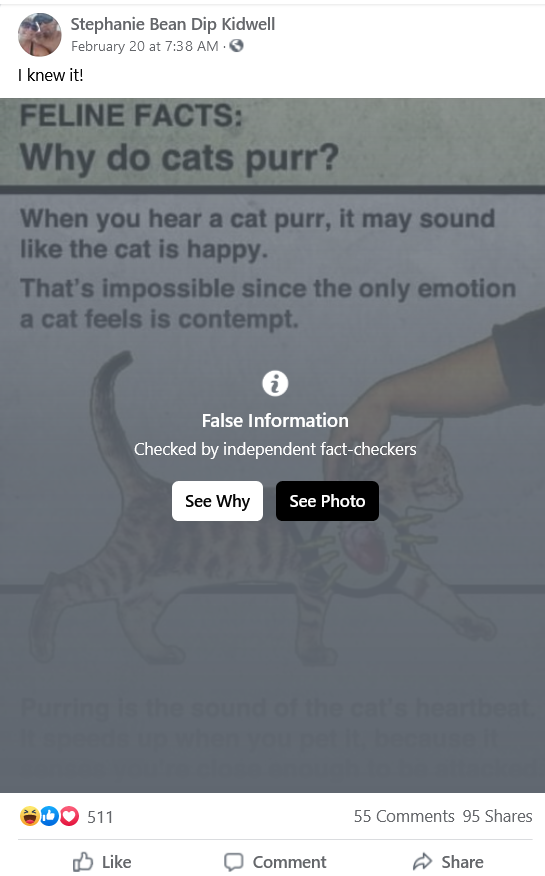
And this is what it looks like now, to protect people like your aunt who keeps sending you email forwards about Pizzagate:

Facebook: Derp!
Despite the flagged warning, people are still sharing the post. “Big Tech doesn’t want us to know the truth ’bout cats!”

Whenever I encounter stuff like this, my first instinct is to dismiss it as nonsense no one would actually believe. Then I remember our dubious track record when it comes to critical thinking: a third of millennials are flat-Earthers, one in four Americans thinks the sun orbits the Earth, and more than 16 million Americans believe chocolate milk comes from brown cows.

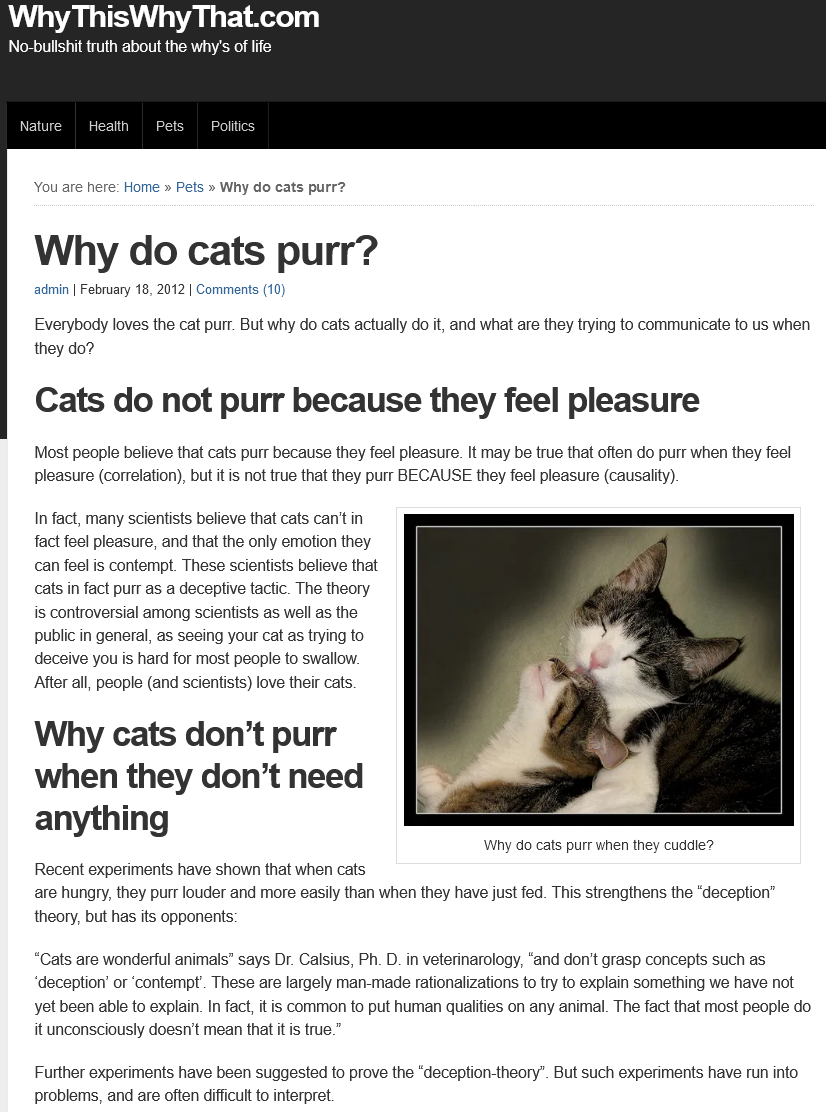
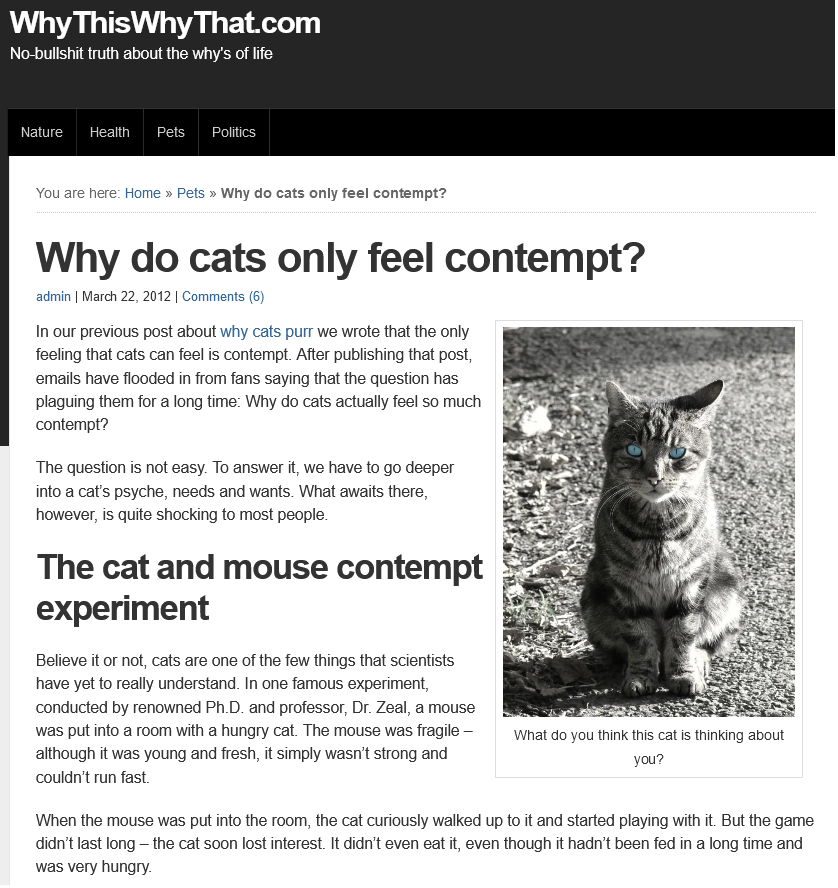
Some futurists and ethicists thought the world wide web would bring an end to conspiracy theories and outlandish beliefs, with the sum of human knowledge at our fingertips and the disinfectant power of the truth. But falsehoods have remarkable staying power, and the internet is happy to oblige any conspiracy theory no matter how far removed from reality, with sites like this one that says it offers “no-bullshit truth”:

Screenshot_2021-02-25 Why do cats purr

Screenshot_2021-02-25 Why do cats only feel contempt

So at the risk of stating the obvious, purring has nothing to do with a cat’s heartbeat, and cats experience all the same primary emotions we do (happiness, sadness, fear, excitement, nervousness) as well as quite a few secondary emotions, like jealousy, disappointment, contentment and confidence.

The idea that animals like cats and dogs are emotionless automatons went out of favor more than half a century ago, and modern technology has made it possible for scientists to peer into the minds of our domesticated friends and witness brain activity that mirrors our own when we process emotions. There is no debate: Cats have very real emotions, which is another compelling reason to treat them well.

The Very Reverend Buddy: ‘Let Us Pray’

An odd, unexplained cat behavior caught on video. Why do cats make this gesture?

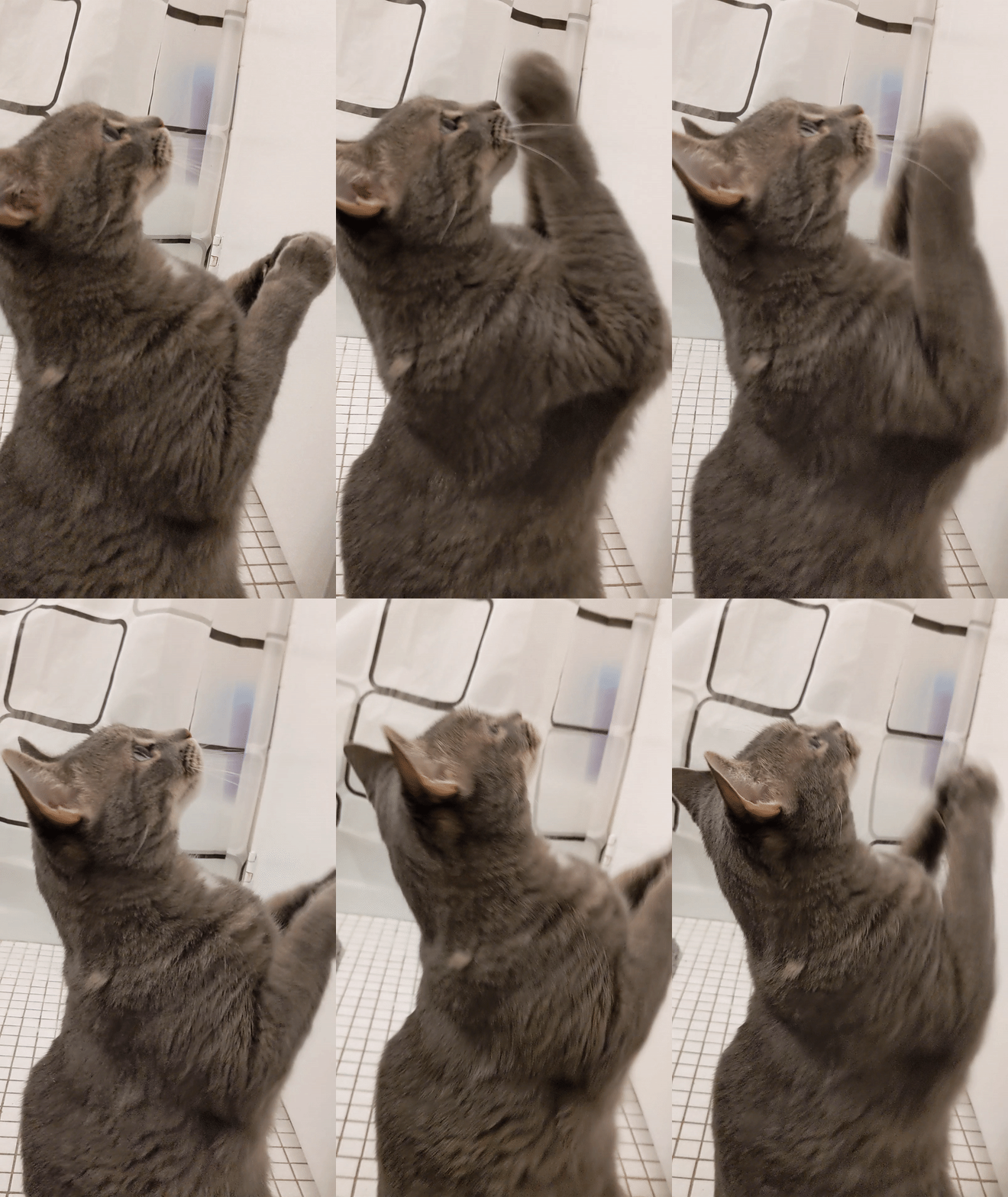
I managed to film a brief clip of Buddy enthusiastically “praying.”

This gesture is also called cat pleading or begging in various corners of the interwebs, but as far as I can tell it really doesn’t have anything to do with asking or pleading. I’ve seen my cat do the same motion while he doesn’t think anyone else is around, while he’s at the window looking at birds, and at other random times.

The gesture is so random that this is the first time I’ve managed to get a decent clip of it. Usually by the time I’ve got my phone pointed at His Grace and begun recording, he’s finished his “prayers.”

I have no clue what it means or why some cats do it. All I know is that it’s a fairly rare thing. Perhaps a cat behaviorist somewhere could offer some insight.

Reverend Bud
“Dear Lord, provide me with turkey.”

Also: Happy Adoptaversary to Holly B, Retro Dee’s cute furball. Holly is named after Buddy Holly, so she’s a little buddy too, and she’s been with Dee for two years now. We wish Holly good health and many more years with her loving human, Dee.

sleepsweird3-1
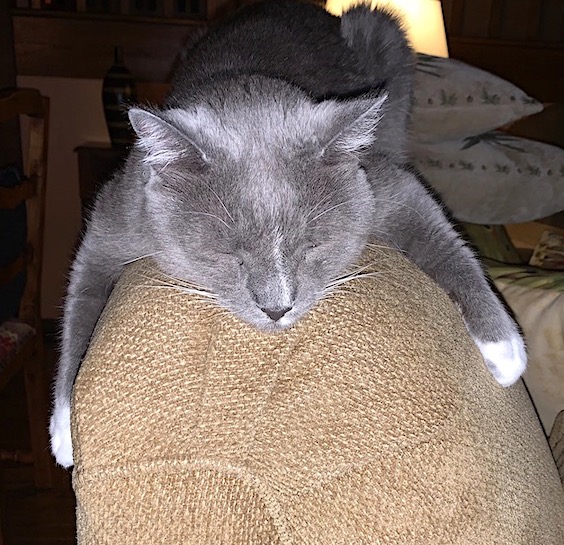
Holly getting some Z’s in a uniquely feline way. Credit: RetroDee

Study: Cats Will Happily Accept Food From Jerks

A new study shows cats will take food from anyone, even people who refuse to help the cats’ owners with a problem.

Taking studies designed for children and dogs and applying them to cats has been all the rage lately after a series of studies yielded new insights about the way cats bond with their humans.

Earlier studies showed cats, like kids and dogs, look to their humans for reassurance in strange situations and derive comfort from the latter’s presence. Likewise, they’re less confident if they’re forced to face unknown situations without the “security blanket” of their big buddies nearby.

Now a research team in Kyoto has taken another study designed for dogs — known as the “helpful stranger” study — and placed cats in the same situation to find out how they react.

Sure, I'll Take A Treat!
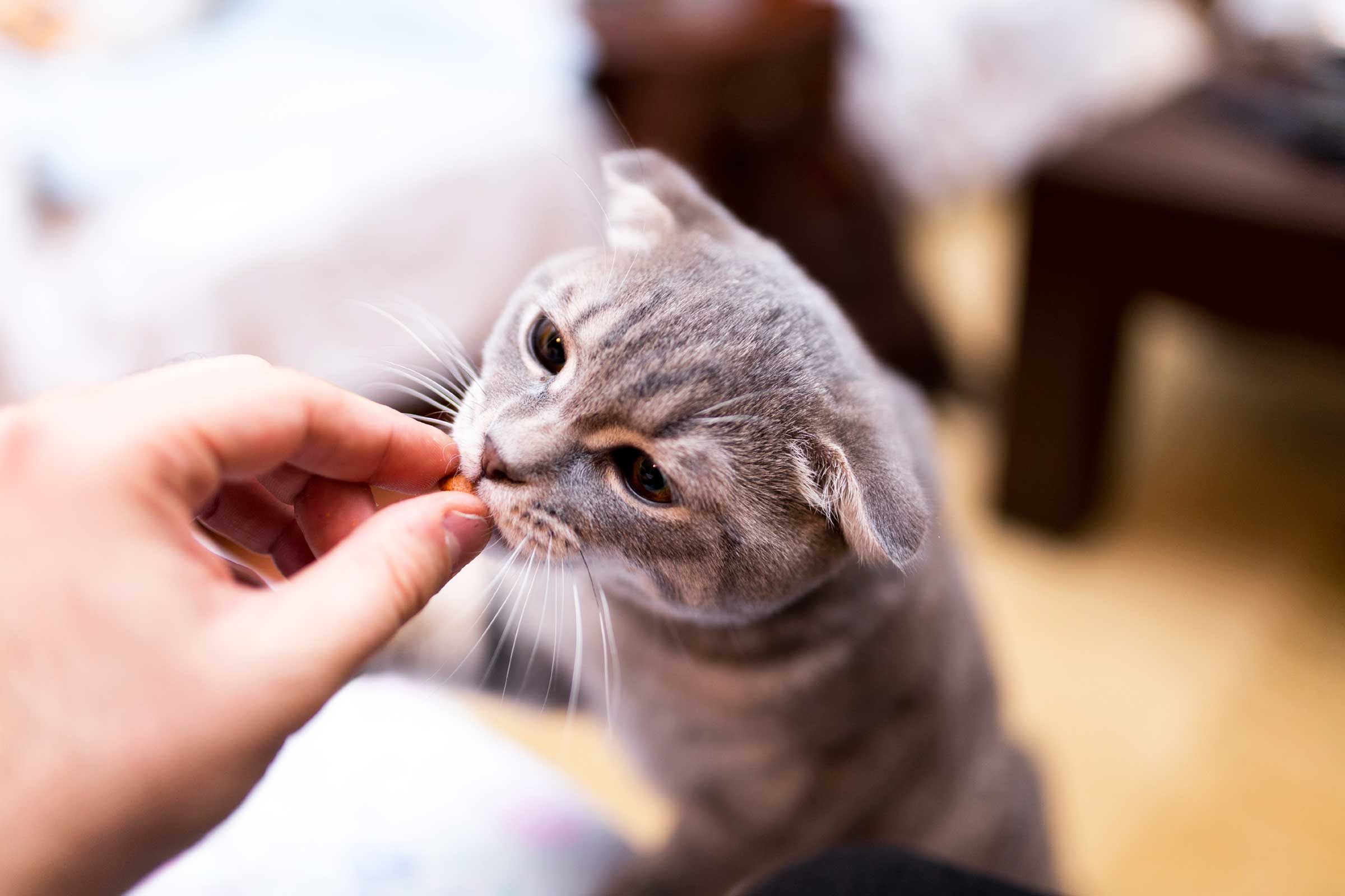
A new study shows cats don’t discriminate when it comes to who’s giving them food.

Both humans and dogs show a preference for what researchers call “prosocial individuals.” In plain language, it means they pay attention to the way strangers treat the people they care about. A dog who sees a stranger respond negatively to its caretaker will avoid the stranger, even if the latter is waving a delicious treat.

In the study, cats watch their owners try to open a box while two strangers are present:

“[C]ats watched as their owner first tried unsuccessfully to open a transparent container to take out an object, and then requested help from a person sitting nearby. In the Helper condition, this second person (helper) helped the owner to open the container, whereas in the Non-Helper condition the actor refused to help, turning away instead. A third, passive (neutral) person sat on the other side of the owner in both conditions.

After the interaction, the actor and the neutral person each offered a piece of food to the cat, and we recorded which person the cat took food from. Cats completed four trials and showed neither a preference for the helper nor avoidance of the non-helper.”

At first glance it looks like cats really don’t care if a person is helpful or friendly toward their “owners.” If a person is offering them yums, why shouldn’t they take them?

That sounds like exactly the sort of thing cats would do, but the research team says we should hold off on judging our food-loving feline friends. It may be that cats simply don’t understand that the stranger(s) aren’t being helpful. After all, if your cat sees you struggling with a package, does she offer to help?

If it is true, it’s not necessarily cats’ fault: We’ve long known they aren’t as well-attuned to human social cues as dogs are, a fact that can be attributed to their route to domestication. There simply wasn’t any reason to carefully breed cats to pick up on those cues, as we did historically with dogs, because cats were already wildly successful at their primary job, which was rodent extermination. Taking on cuddle and companionship duties didn’t happen until later when people began to value the little ones for more than their sharp claws and teeth.

“We consider that cats might not possess the same social evaluation abilities as dogs, at least in this situation, because unlike the latter, they have not been selected to cooperate with humans,” the scientists wrote.

The research team says the results are suggestive, but more studies should be done before drawing any real conclusions about our furry friends. Knowing cats often get a bad rep due to stereotypes and misunderstandings, we agree.