Manly, Heroic Ex-NFL Player Kills Puma For Fun, Cries About Backlash

Wolfe complained to Tucker Carlson when, instead of the praise he expected, online commenters blasted him for killing an animal that was merely surviving.

Derek Wolfe is a badass.

The 295-lb former NFL lineman recently got a license to kill mountain lions, so when he heard about a puma that was “terrorizing” a Colorado community by existing near it, he packed his weapons of war, rounded up his hounds and set off, trailing testosterone like a beefed up Jim Corbett gone to deliver justice to the Champawat tiger.

First he spoke to a local homeowner, who had an ominous warning for him.

“And when we had talked to the landowner, they said, ‘Hey, we have house cats. And the cats are acting weird.’

No doubt the cats were agitated and wanted to get out there to cause havoc with their feline brother by existing and eating stuff. The cats would have to be dealt with later.

Arriving at the scene, Wolfe (what a badass name) found the remains of a recently-killed deer and knew the evil mountain lion hadn’t reformed its ways. By continuing to exist despite the discomfort of people in the area, and continuing to eat, the defiant cougar was practically asking to be hunted down and killed.

bowofrighteous

Moving downwind of the fearsome predator so that it wouldn’t smell the pheromonal cloud of machismo that permanently surrounds him, Wolfe began climbing. The ascent was exhausting — not only is the 6’5″ Wolfe almost 300 pounds, but he was also carrying his sword, his health elixirs and his Bow of Righteous Smiting, a 1,000-DPS legendary weapon he obtained after slaying the Goblin King of Dreadmoore. Wolfe was carrying more than 400 pounds up the slope when he caught sight of the puma and did what men of testicular fortitude do: he released the hounds, who cornered the cat and chased it up a tree.

Then, with righteous fury, Wolfe drew his bow and killed — excuse me, “harvested” — the mountain lion, whose species is notoriously averse to conflict with humans and has killed fewer people in a century than dogs do in a week. But what are a few inconvenient facts between friends, amirite?

When Wolfe descended the treacherous slope with the corpse of the mighty cat like Geralt of Rivia toting the trophy from a monster hunt, the villagers applauded and sang songs of his bravery, then feasted in his honor.

wolfekill
Derek Wolfe, conqueror. Credit: Derek Wolfe/Instagram

But all was not well, for when Wolfe posted the manly photos of himself posing manfully with the corpse of the big not-quite-big cat, a contingent of insignificant peons criticized him on Instagram for killing an animal that was allegedly “just surviving.”

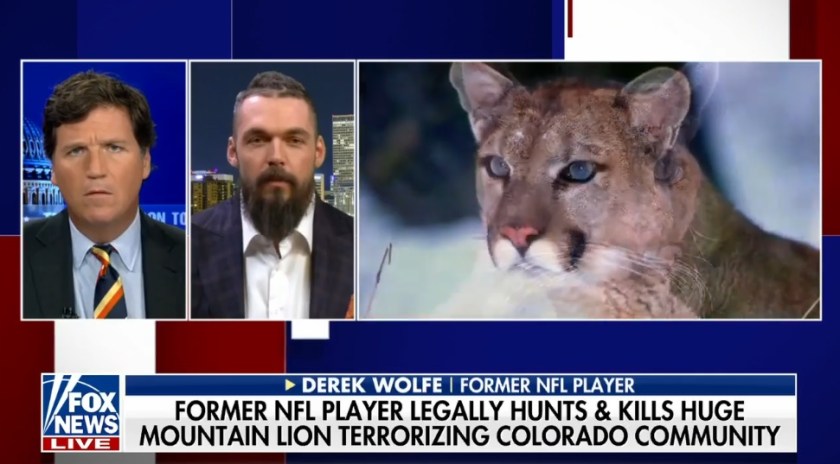
So Wolfe did what men of his stature do, and went on Tucker Carlson’s show to cry about the rodential men and women nipping at his heels.

wolfecarson
Wolfe on Carlson’s TV show. Credit: Fox News

It is said that the combined testosterone of Wolfe and Carlson created a vortex of badassery that threatened to spark untameable hair and muscle growth in anyone who ventured too close. Female assistants had to be ushered out of the studio before the segment began, and the lesser men manning the cameras had to sign waivers absolving Wolfe and Carlson of blame if they were transformed into hulking man-beasts by the combined presence of the former lineman and the scion of a TV dinner empire.

“I’ve been through some tough training camps, brother, but this hunt was –  man – it beat me up bad. I was beat up bad. I’m all cut up and scraped up. I was in full-body cramps [and] barely made it up there,” Wolfe told Carlson.

Wolfe proceeded to regale Carlson with tales of how dangerous mountain lions are. Puma concolor, the scientific name for the species, is responsible for a whopping 27 deaths in the last century. That’s one person every four years, and most of those people triggered the confrontations by getting too close to puma cubs or cornering the animals. By comparison, dogs kill 25,000 people a year via attacks, and another 25,000 by spreading disease, the latter mostly in third-world countries. Cows killed 655 Americans over a nine-year period from 1999 to 2007. More than 40,000 Americans are killed in car crashes annually.

And while you’re 25 times more likely to be killed by a tornado than a shark, there were five times as many fatal shark attacks (144) in the US over the past century compared to fatal mountain lion attacks.

In other words, pumas rank extremely low on the list of potential dangers to people, despite their size and their superficial resemblance to much more dangerous African lions. Pumas/mountain lions, also known as catamounts and cougars, actively avoid humans and try to steer clear of conflict with people. When they kill a deer or even a pet, it’s not because they’re “terrorizing” communities — it’s because they’re obligate carnivores who need to eat meat to survive.

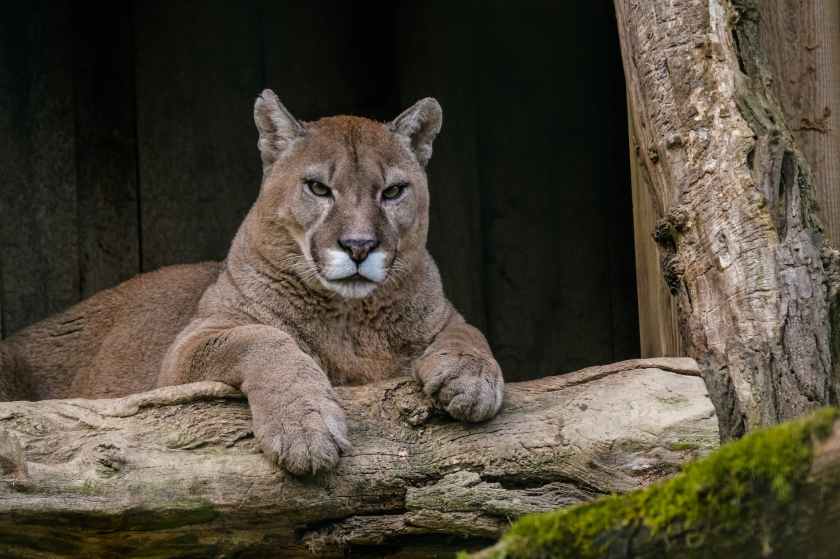
photo of a cougar near a log
A mountain lion. Credit: Nicky Pe/Pexels

Wolfe explained that it’s important to “tree” mountain lions in order to do recon on them and make sure they’re appropriately big and impressive-looking.

“Those full-grown males will kill kittens as well, they’ll kill kittens to get the females to go back into heat,” Wolfe said, confusing terms and the dominance behavior of African lions with American pumas, which are not the same species. “It’s important to manage that herd, right? You have to manage every population of animal out here, especially mountain lions. So we got the dogs on ’em.”

Who knew cats were herd animals? Who knew pumas had decided to give up their solitary lifestyles and live in prides? Who knew former NFL linebackers arbitrarily killing random pumas qualifies as ‘managing a population’? Someone call the wildlife biologists so they can rewrite their field guides!

Despite his ability to scale mountains and slay (mountain) lions, Wolfe was wounded by the backlash when he posted photos of himself with his “harvest.”

“I can’t believe what’s happening to me…They’ve had 200 calls to Colorado Parks and Wildlife trying to turn me in like I did something wrong,” Wolfe complained. “I’ve been harassed.”

Disclaimer: Since this is the internet, and this post is bound to bring in readers unfamiliar with PITB and the fact that we’re sarcastic jerks, allow us to state for the record that Wolfe did not kill the Goblin King of Dreadmoore, does not own the legendary Bow of Righteous Smiting, and we’re not exactly sure if the villagers in the unidentified rural Colorado community threw a feast in Wolfe’s honor after he returned with the corpse of the cat that had been “terrorizing” their community. I mean, they probably feasted him, but we haven’t confirmed it.

Help ID This Woman Who Dumped A Cat In A Garbage Can

If a bystander hadn’t witnessed the event and rescued the cat, it’s likely the little guy would have starved or died of dehydration.

Authorities in a Texas town near Houston need help identifying a woman who tossed a cat, carrier and all, into a garbage can.

The woman parked her car in a nature preserve in Rosenberg, Texas, at about 11 am on Jan. 12, opened the backseat to retrieve a cat carrier and unceremoniously dumped it in a garbage can.

A bystander happened to witness — and film — the entire sequence of events, and after checking the trash it turned out there was a scared two-year-old cat inside the carrier. The bystander brought the cat to Rosenberg’s animal control department.

“If no one would have seen this happening, that cat would have been in that container in that trash can with no access to food, (or) water,” said Omar Polio, the town’s director of animal control. “Not acceptable.”

The cat is a beautiful, affectionate white and brown male the shelter has dubbed King Triton. He’s in their care for the time being. King Triton is healthy, Polio said, and it’s not clear why the woman would have dumped him instead of surrendering him to a shelter.

While shelters are crowded, “we can always find resources that can better suit these animals,” Polio said, imploring people not to abandon or toss animals away like trash.

Polio said his agency would like the public’s help identifying the woman. It’s not clear what kind of charges she might face. Anyone with information can call Rosenberg Animal Control and Shelter at 832-595-3490.

Video of the incident provides a clear look at the woman, but the resolution isn’t high enough to make out the license plate on her car.

Here’s a news segment of the incident with footage of the woman getting out of her car, dumping the cat, casually returning to her vehicle and driving off. She has dark hair that was in a ponytail at the time and was wearing shorts and sunglasses:

Alabama Cat Ladies Raise $85k For Legal Appeal, Plan To File Civil Suit

Mary Alston and Beverly Roberts will return to court for an appeal on February 23 after they were convicted in December of charges associated with managing a cat colony.

Two women who managed a cat colony in their Alabama hometown — and were rewarded with an infamously tone-deaf arrest and criminal conviction for their efforts — have raised $85,000 for their appeal.

This time, their fate won’t be decided by a small-time judge appointed by the same mayor who ordered police to arrest the women in the first place.

Mary Alston and Beverly Roberts of Wetumpka, Ala., were arrested on June 25 after three police cars pulled up and four officers surrounded them on public land, demanding they stop their efforts to trap feral cats and leave the area immediately.

Alston and Roberts, who were in disbelief that four officers had been dispatched and were treating them like hardened criminals, didn’t move fast enough for the cops, who berated them and placed them both in handcuffs before charging them with a pair of misdemeanors each.

Their attorneys fought for months to obtain a copy of the police body camera videos of the arrest, and when they finally obtained that copy, it became apparent why the Wetumpka Police Department fought to keep it out of their hands.

The footage shows officers warning the women the confrontation was “going to get ugly,” insulting them and joking that they were “a bunch of cops beatin’ up on some old ladies.” It showed the police escalated the situation and had little regard for two women who were doing their hometown a service by managing a stray cat colony and conducting TNR — trap, neuter, return — to prevent the cats from breeding and multiplying.

They were convicted in a December trial that was followed by local and national media.

Now Roberts, 85, and Alston, 61, have raised $85,195 for their appeal via GoFundMe, with more than 3,000 donors across the US contributing to the fund.

After filing an appeal on Dec. 19, the women have been notified that their first hearing is set for Feb. 23 in front of 19th Judicial Circuit Court Judge Amanda Baxley, said Mary King, Roberts’ daughter. Baxley was sworn in earlier this month and begins her tenure on Jan. 17 after she was elected to the post in November.

bravecop
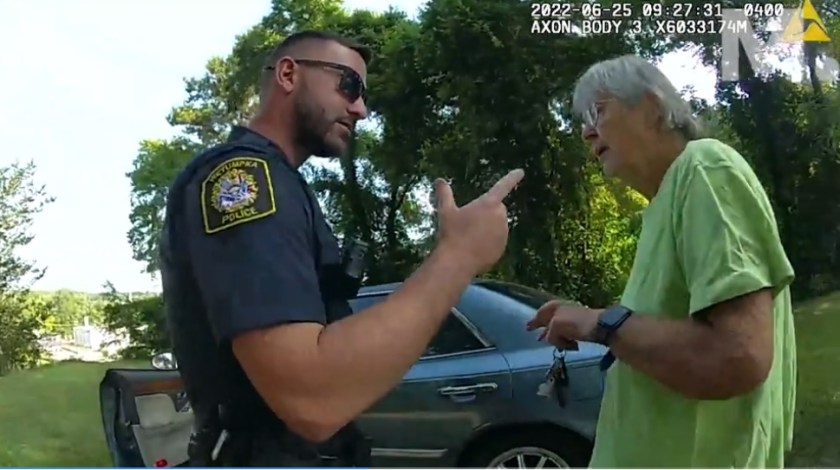
A Wetumpka police officer wags a finger at Roberts, who was 84 years old at the time, before handcuffing her hands behind her back and rifling through her personal possessions.

In a December trial, attorneys for Alston and Roberts revealed it was Wetumpka Mayor Jerry Willis who personally dispatched the officers by calling the assistant chief after spotting Alston’s car parked near a wooded area owned by the county. The lawyers also questioned Willis on his history of feuding with the pair on animal-related issues.

Although Willis testified that he did not tell police to arrest the women, Officer Jason Crumpton testified that he was indeed instructed to make the arrests before he arrived and determined what the women were doing.

Despite the fact that Wetumpka does not have laws against feeding or trapping cats, municipal Judge Jeff Courtney, who is directly employed by the town instead of being answerable to voters, found Alston and Roberts guilty of two misdemeanors each, sparking an outcry in local and national media. Courtney found Roberts guilty of trespassing and disorderly conduct, while he found Alston guilty of trespassing and interfering with governmental operations, an analogue for resisting arrest.

“I thought that they surely had more pressing issues to attend to,” Roberts told PITB in December. “I really thought the judge would dismiss it and tell the city to work it out.”

The arrest and conviction were widely panned by observers, including Alabama Political Reporter’s Josh Moon, who called the drama an “utterly absurd” spectacle that “reeks of small town politics.”

Roberts and Alston hope Baxley will give them a fair trial, which they believe they did not receive under Courtney in Wetumpka.

In the meantime, the colony cats in Wetumpka remain on their own. Willis, who has not responded to requests for comment by PITB, allegedly rejected offers by animal welfare groups in neighboring towns to care for the cats.

“We are very worried about them,” Roberts told PITB last month. “A few animal lovers have said they would help, but we are not sure this will happen. I’m not sure there is enough food available to hunt. The weather is getting colder, and they need protein.”

TikTok’s Latest Viral Trend Is Popping Cat Pimples: Can We Ban This App Already?

Each viral trend on the app is more grotesque than the last.

I’m all out of withering sarcasm, so I’ll just say it: The newest trend on TikTok involves close-up videos showing people popping their Sphynx cats’ pimples.

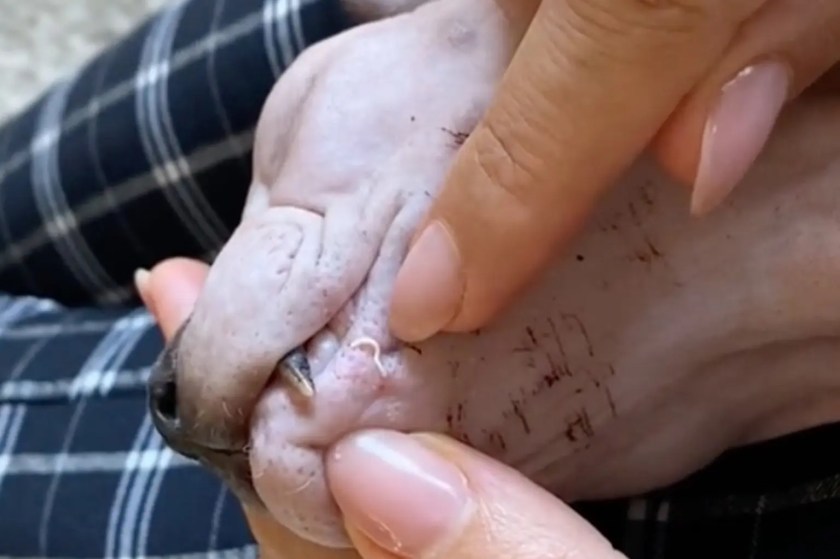
The PewDiePie of the craze, if you will, is one @Sphynx.cleaner, whose videos show a woman’s carefully manicured hands holding a defeated-looking Sphynx cat and popping its pimples between her formidable fingernails.

Tens of millions of people have watched her videos of puss pimple-popping, not including the millions of other views accumulated by lesser practitioners of the grotesque genre.

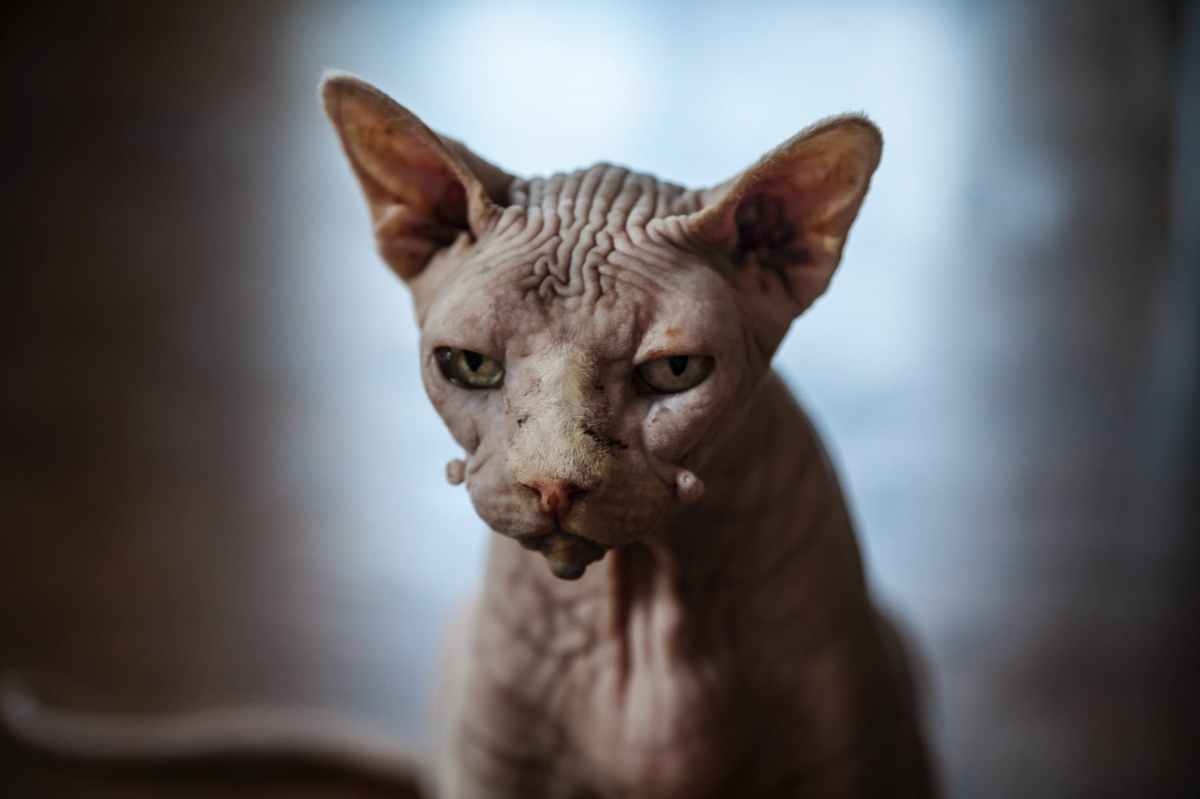
Sphynx cats lack fur and have skin often compared to chamois leather. Fur helps cats absorb and redistribute naturally-occurring oils secreted by the skin, so felines of the Sphynx breed are much more susceptible to acne problems than typical short- and long-haired cats. Without fur to help redistribute them, the skin oils can create a “film” that clogs pores, according to Jessica Taylor, a veterinarian in North Carolina.

Sphynx pimples
Uh, no. Credit: Sphynx.cleaner/TikTok

Not surprisingly, popping a cat’s pimples makes things worse and is not pleasant for the kitty.

“These lesions indicate a disruption in the skin and skin barrier, and squeezing or poking them can introduce bacteria, potentially worsening the lesion, causing pain and infection,” Taylor told Newsweek. “If the lesion is already infected, handling it could spread bacteria to the pet parent.”

As for TikTok, this is not the first time one of the app’s trends has been detrimental to the health and safety of felines, although most of its inanity is focused on humans. I suppose you can view it as some sort of advanced Darwinian engine, accelerating the self-removal of human beings from the gene pool. Among the trends that have gone viral on the app:

  • People who use self-tanning bottles as nasal spray out of some misguided belief that ingesting the stuff will not only achieve the desired effect, but somehow lead to a more even, natural-looking distribution of tanner. It reminds me of former President Donald Trump’s impromptu suggestion, during a national press conference, that ingesting hand sanitizer could be a “tremendous” way to stop COVID.
  • Videos instructing women to eat the tablets inside Clearblue pregnancy tests as a “contraceptive hack,” claiming the tablets — which are designed to absorb urine during the chemical test — are actually morning after pills.
  • People ingesting methylene blue — an anti-fungal fish tank cleaner — because “fitness influencers” say it can “cure” COVID-19, boost metabolism and slow the aging process. Think of the triumph of critical thinking here: These are people who won’t get a vaccine that’s been through three-stages of trials before getting FDA approval, and whose efficacy and safety have been the subjects of rigorous peer review, but they’re willing to drink a chemical manufactured and sold as a cleaning solution for fish tanks.
  • The so-called Nyquil Challenge, in which people use Nyquil instead of cooking oil to cook chicken in a frying pan.
  • Period blood face masks, which are self-explanatory. Another grotesque and potentially dangerous trend started by “influencers” who claim some sort of nebulous expertise and know that “hacks” will net them attention and clicks. The more outrageous, the better.
https __prod.static9.net
“Did you know that urinal cakes are made by Carvel? It’s true! They’re deliciously chocolatey, with just a hint of vanilla, cinnamon and industrial strength anti-bacterial. Mmmmmm!”

Of course, we’ve known for years that Chinese companies are beholden to the Chinese government according to Chinese law, which means the government — and the communist party — can help itself to TikTok user data whenever it wants.

After TikTok’s US-based executives insisted to congress that American users’ data is firewalled and cannot be accessed by the company’s employees in China — and, by extension, the Chinese government — a series of leaks confirmed that China’s government was in fact regularly accessing that data. Absolutely no one, except maybe the politicians who think the internet is a “series of tubes,” were surprised by this revelation.

China’s government can use the data to track journalists, exploit American and European users, program its algorithm to shuffle them toward harmful content, censor content the Chinese government doesn’t like, and even coerce individuals by threatening to release information on their viewing habits.

So can we evacuate TikTok’s US headquarters already, raze it to the ground, and ban the app from every mobile store?

methblue2
“Mr. Darwin! Mr. Darwin let him go! Magnifico!”

Pope Benedict Asked Us To Be Compassionate Toward Cats And Other Animals

The late Pope Benedict was well known for his lifelong love of cats, but he was also a champion of animals and spoke out about the cruelties visited upon them by humankind.

Long before he was the pontiff, when he was just a young man named Joseph Ratzinger, the future Pope Benedict was known as a cat guy.

Growing up in the village of Hufschlag, about 55 miles southeast of Munich, Benedict’s family always had pet felines and he fed strays who spent time in their garden. During his years teaching theology to students at Bavaria’s University of Regensburg in the 1970s, then-professor Ratzinger was often seen followed by an entourage of cats — the little ones he fed and cared for — as he crossed campus.

“They knew him and loved him,” said Konrad Baumgartner, a fellow theologian at Regensburg.

His affinity for his four-legged friends never faded, even as he took on more responsibility and had more demands on his time. Cardinal Tarsicio Bertone, one of Benedict’s colleagues, said the German clergyman had a natural connection with animals.

“On his walk from Borgo Pío to the Vatican, he stopped to talk with the cats; don’t ask me in what language he spoke to them, but the cats were delighted,” Bertone recalled. “When the cardinal approached, the cats raised their heads and greeted him.”

The Pope and the Cat
Pope Benedict with one of his cats.

As pope, Benedict continued to care for strays, and had two cats of his own — one who’d been with him since before he was made the leader of the global church, and another he rescued off the streets of Rome.

Photos of Pope Benedict with cats are different than the typical shots showing him meeting with world leaders or waving to crowds. His expression and posture are more relaxed in the presence of felines, and he’s often smiling in the images that show him holding a cat.

But it wasn’t just personal for Benedict.

“Dominion” over animals

For centuries, some people — mostly outside Catholicism, but some Catholics too — have argued that animals exist for the use of mankind, that their purpose on this Earth is to serve as resources. Proponents of the view point to a handful of Old Testament quotes, including a famous quote from Genesis that says God gave man “dominion over the fish of the sea, and over the birds of the air, and over the cattle, and over all the wild animals of the earth, and over every creeping thing that creeps upon the earth.”

Genesis 9:3 attributes this quote to God: “Every moving thing that lives shall be food for you.”

The Pope and the Cats
Pope Benedict was well known for his love of cats, from his childhood in Bavaria to his days as pope emeritus living in retirement.

Other verses detail precisely which animals they can eat and remain in His good graces, and many Christian sects see those lines as a clear indication that God intended for animals to serve the needs of men.

But the Old Testament also tells us we can take slaves (Leviticus 25:44-46), that parents can have their kids stoned to death for disobeying them (Deuteronomy 21:18-21), that when children make fun of others, it’s totally cool to call upon righteous bears to maul them to death (2 Kings 2:23-24), and that people with blindness, flat noses and other ugly “blemishes” should wait outside church with the rest of the rejects while the good-looking people pray. (Leviticus 21:17-24).

Don’t even get me started on Sampson and the Book of Numbers.

The point is, if you’re going to be a stickler for things supposedly okayed or forbidden in the Old Testament, animals are the very least of your problems, especially if you trim your beard, let your hair get too long, wear shirts made of two different materials, or have ever placed a bet on DraftKings.

“Animals are God’s creatures”

As we look back on the life of the late pope emeritus, it’s worth noting that Benedict and his successor, Pope Francis, have rejected the view that animals are God’s version of scripted NPC automatons who exist so we can eat steak and wear leather jackets.

“Clearly, the Bible has no place for a tyrannical anthropocentrism unconcerned for other creatures,” Pope Francis declared in 2015.

Benedict spoke out about the cruelty inflicted on animals, the incalculable suffering of animals in industrial farming circumstances, slaughtered by the billions for food after short, brutal lives in which no consideration is given to them as living, sentient creatures.

In a 2002 interview, Benedict called animals “companions in creation” and criticized the modern food industry for its “degrading of living creatures to a commodity.”

“Respecting the environment,” he said in a 2008 interview, “means not selfishly considering [animal and material] nature to be at the complete disposal of our own interests.”

Francis made the church’s position absolutely clear with an encyclical — an official letter to members of the church — called Laudato Si. In it, he condemned the “ruthless exploitation” of animals as commodities and asserts they are individuals who are recognized by God. He urged Catholics to treat them well, to respect and protect wildlife and the environment they depend on.

Animal life has “intrinsic value,” Francis said, adding that Christians must reject the idea that animals are “potential resources to be exploited.”

As if speaking directly to people who use the aforementioned Old Testament quotes to support practices like factory farming, harvesting animals en masse for pelts and hunting for the “fun” of it, Francis said:

“We must forcefully reject the notion that our being created in God’s image and given dominion over the earth justifies absolute domination over other creatures.”

Both popes also noted that, in addition to the suffering we cause, when we exploit animals as are also behaving in a way beneath the dignity of humankind. It’s a stain on our collective identity as a species, a betrayal of our roles as wardens of the planet.

Let’s put aside the moral considerations for a moment. The continued existence of the complex ecosystems on our planet — and indeed of humanity itself — depends on the many roles animals play, from carrying seeds to pollinating plants, limiting the growth of flora that would otherwise dominate and destroy other plants, rerouting water systems by creating dams, controlling the populations of creatures that would otherwise multiply unchecked, and the thousands of other roles they play in maintaining the balance of ecosystems.

Benedict left this Earth on Dec. 31, 2022, at a time when we have killed off almost 70 percent of all wildlife in the entire world. It’s not just a matter of living on a lonely planet, or tucking future children into bed while telling them that, no, they can’t see elephants or tigers because the last of them are dead. Removing keystone species, extirpating entire genera while rendering vast stretches of the planet uninhabitable, purging the oceans of life as they accumulate literal continents of plastic waste, means we’re marching toward a cascade failure most of us won’t even see coming as we argue about carbon credits, politicize common sense, tinker with viruses and edit genomes.

It’s long past time we recognize the fact that we share this planet with billions of other minds and start living in a way that respects them. If we can save them, perhaps we can save ourselves too.

Great Pacific Garbage Patch
The 1.6 million square kilometer Great Pacific Garbage Patch, which weighs more than 80,000 metric tons.