Do you have a plan for your cats if the unthinkable happens?
I’ve already made my family swear to me that, should something happen to me, one of them is to take Bud and treat him as an extension of me.
That’s because, as handsome and delightful and meowscular as the little guy is, he can also be a little terror at times, and God forbid he ends up in a shelter, scared and confused, then lashes out at a staffer and gets condemned to the needle.
We’re talking about a cat who has attacked his cat sitter repeatedly, smacked an admirer for petting him too long, and — while he has improved dramatically over the years — has bitten and scratched me many times, usually when he’s freaked out about something.
I love him. Someone else may not. He has to stay with someone who loves me enough to treat him like a part of me, someone who knows how much he means to me.
Although I’m not a fan of linking to TikTok, this video is a reminder why it’s so important to make arrangements. Sunny here found herself at Orange County Animal Services after her human mom died, and she’s not doing well. In addition to losing the human she loved and only home she knew, she’s now in a scary new place with new people and animals, confined to a tiny enclosure.
Photographer Albert Harris, who shot the video, said the shelter has received an application to adopt Sunny since he posted the video online, so let’s hope the distraught kitty finds a new home quickly:
Sunny needs your help. And it’s not 💩 on the blanket. It’s just treats but she is stressed not to eat them. She is at Orange County Animal Services! #catsoftiktok#sheltercat#cattok
Stella’s shooting is the latest in an inexplicable trend of people targeting cats with pellet guns.
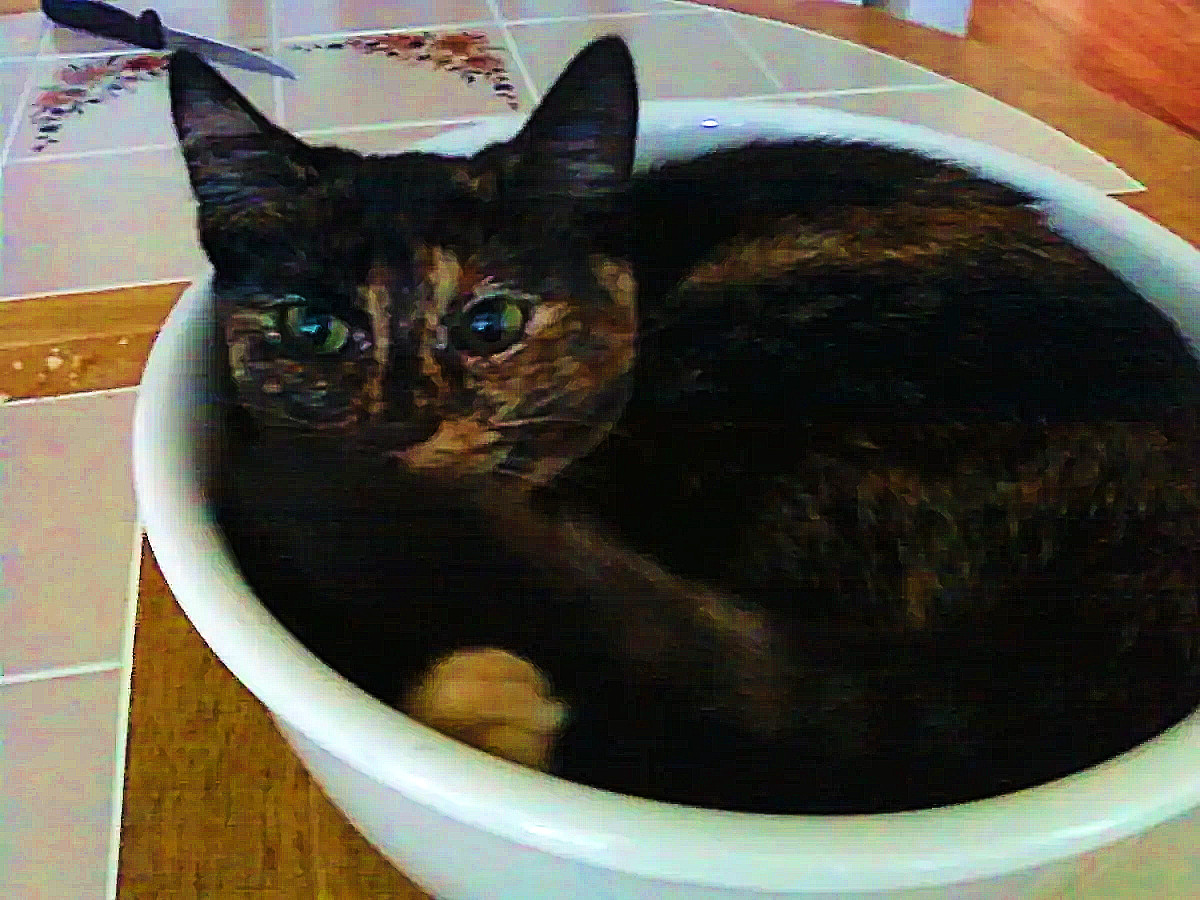
When Margaret Oliva’s husband died eight years ago, her cat Stella helped her through her grieving.
“She was my sanity, you know?” the Long Island woman said.
Oliva’s beloved tortoiseshell went outside on Sept. 1 and didn’t come back that night. Oliva enlisted the help of relatives to find Stella but wasn’t able to locate her until she heard “whimpering cries” on her Ring system’s audio.
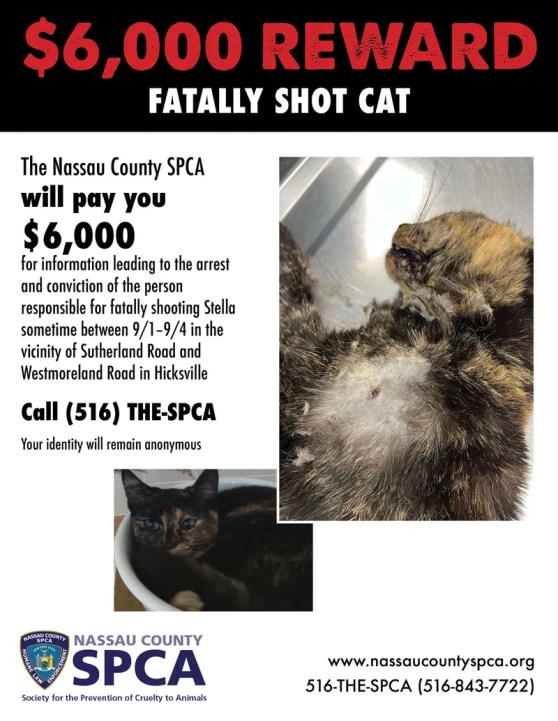
Stella had collapsed near a bush on the front lawn. Oliva rushed her badly injured cat to an emergency veterinarian, where the fading feline fought for her life but succumbed hours later. The vet told the shocked Hicksville woman that someone had shot Stella twice, likely with a pellet gun.
“To have her taken like this…No, I can’t accept that,” Oliva told a local TV news station.
Now the SPCA is offering a $6,000 reward to anyone who provides information leading to the arrest and conviction of Stella’s killer. Matt Roper, a detective with the Nassau County SPCA’s law enforcement division, said he believes Stella was shot by someone in the immediate neighborhood.
The SPCA is offering a $6,000 reward for Stella’s killer.
Studies have shown that house cats who are allowed to wander outside during the day rarely go far. In a paper published in Scientific Reports earlier this year, a team of scientists from the Norwegian University of Life Sciences tracked 100 indoor/outdoor cats by equipping them with GPS collars. The data showed cats spend almost 80 percent of their time within 50 meters — or about 164 feet — of their homes, and a handful of statistical outliers who traveled a longer distance didn’t exceed more than a quarter mile.
The SPCA’s Roper said Stella suffered one projectile to her chest and one to a leg. Her killer is likely nearby and almost certainly knows about the anguish caused to Oliva. If caught, the killer could face a felony charge.
“This could be a high powered pellet gun,” Roper said. “This could be something that could be shot a couple of houses length, a couple of yards in length.”
Young Abraham was left with a pellet lodged in his spine after he was shot in October of 2021 in eastern Long Island.
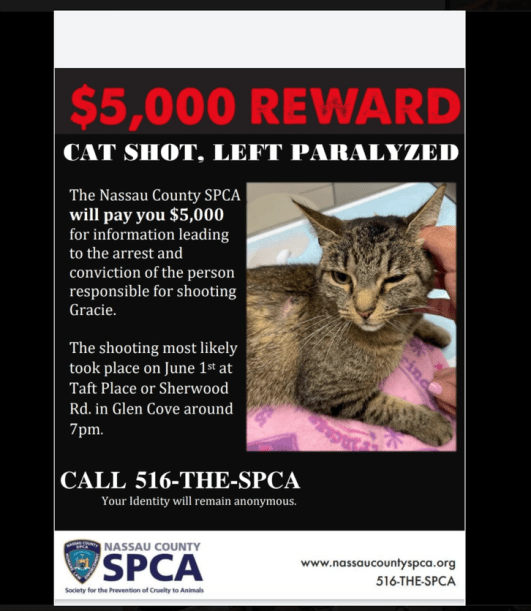
Gracie was paralyzed when she was shot twice with a pellet gun in the summer of 2021.
Oliva’s home in Hicksville is about 10 miles from Glen Cove, where a cat named Gracie was shot and left paralyzed last summer when one pellet hit her stomach and another hit her spine. Poor Gracie was in a neighbor’s yard, dragging herself toward her home while her back legs hung limp. A woman found Gracie after hearing her crying out in pain, Newsday reported.
“What happens is a woman takes her kids for a walk,” said detective Lt. John Nagle of the Glen Cove Police Department. “When she returns to the house she hears an animal crying and goes to investigate. She finds this cat, just beyond the neighbor’s chain link fence, and the animal is crying and it can’t walk. Another neighbor, who happens to be a vet, comes over. She gets a cat cage, places it in the yard — and the cat immediately crawls over to it … She takes the cat to her vet, where she works, thinking maybe it’s been hit by a car. That’s when she finds out it’s not damage from a car, but that there’s two bullets.”
There’s a $5,000 reward for Gracie’s shooter.
In October of 2021, a young cat the rescuers named Abraham was shot with a pellet gun in Suffolk County on eastern Long Island. Like Gracie, Abraham was struck in his spine. The SPCA of Suffolk County, which called Abraham’s shooting “a horrific act of animal cruelty,” is offering a $4,000 reward for information leading to the arrest and conviction of his shooter.
Studies have shown that when people who have pets are victims of domestic abuse, the pets often become victims too.
A Redditor says her beloved cat, Midnight, is missing after her girlfriend stole the innocent kitty and dropped her off on a random road on Friday as a revenge tactic for an argument the couple had the night before.
Midnight is still missing. Midnight’s owner, using a burner account called Throwaway29374639, updated concerned Redditors and said she was putting up flyers, setting up humane traps and looking in the area where her girlfriend claims she abandoned the cat as she was en route to work.
For her part, the Redditor says her girlfriend admitted what she did and “said she just had a moment of rage, but I just can’t even look at her right now. I kicked her out of my apartment and have been crying in my room for the last few hours. I feel so lost without my cat.”
In the thread, which attracted more than 1,400 comments and tens of thousands of views, many people advised her to report her (now presumably ex) girlfriend to the police, as well as to change the locks to her home and any passwords the two might have shared on various accounts.
We’ve talked before about the strange phenomenon of people who take their anger out on the pets of their partners or ex-partners. Studies have found that men are more likely to do so, and they’re much more likely to target cats than dogs because they see cats as an extension of femininity. In cases where domestic abuse is expanded to include a dog or a cat, the abusers view the pets as proxies for their victims.
When woman are abused by their partners, their pets are often abused as well because they’re seen as proxies for the victims. Credit: Sam Lion/Pexels
Regardless, studies show that the pets of domestic abuse victims are likely to suffer at the hands of their owners’ abusers, and statistics show women who check into domestic violence shelters report their pets were also abused in the majority of cases. Some studies found more than 80 percent of pets who belong to domestic violence victims also become victims.
Women who worry about what will happen to their pets are less likely to leave their abusers and seek temporarily relief at shelters. As a result, some shelters also make arrangements for the pets of abuse victims, giving them safe shelter and taking another worry off the minds of their caretakers.
This is why we always say it’s better for cat servants to regulate themselves than allow the government to get involved.
A Karen in Australia issued a $280 fine to a homeowner for allegedly allowing his cats to roam — after she lured the kitties onto the street herself.
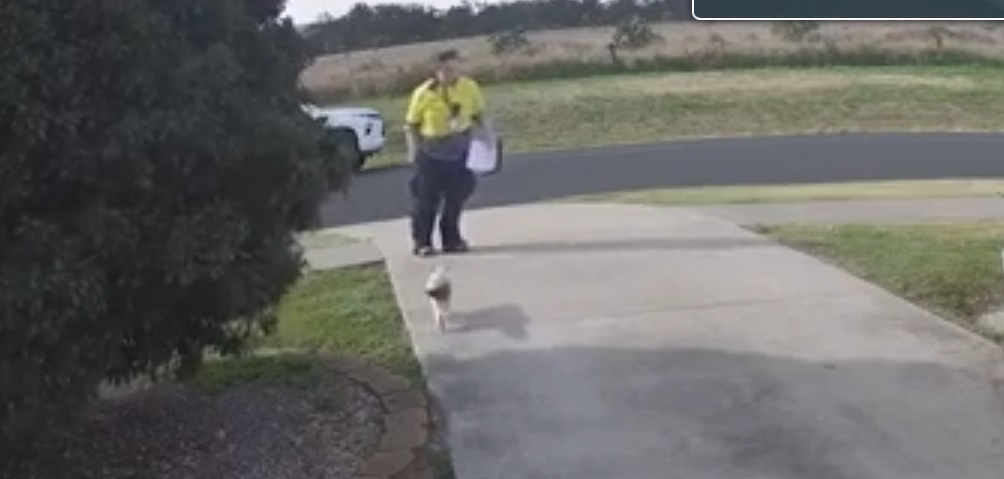
The entire bizarre spectacle was captured on security cameras at the home of Julie and Steven Stephens, a couple in Toowoomba, about 80 miles west of Brisbane. The uniformed Karen, who is employed by the Queensland council, totes a clipboard in one hand as she walks up the Stephens’ driveway in broad daylight.
As one of the curious cats approaches, Karen reaches for a pen in her pocket and starts scribbling on her clipboard, apparently eager to get started on the paperwork, before slowly backpeddling so the kitty will continue to follow her. When the cat reaches the sidewalk, the unnamed woman scoops it up and walks to her government-issued vehicle parked in front of the Stephens’ home.
Steven Stephens was watching the episode unfold via his camera system and bolted outside to stop the government employee from taking his cat, he told Yahoo News Australia.
The Karen wasn’t able to “impound” the cat, but she wrote Stephens a hefty fine for “allowing his cat to roam,” and promised she’d be back to inflict more misery.
“She said she would be back in two weeks with the police to take all but two of our dogs,” Mr Stephens said.
A municipal employee from the Queensland council is seen luring a cat away from its home in this still shot from surveillance video. Credit: Steven Stephens
We’re unable to embed the video, but you can watch it at Yahoo News Australia.
Unbelievably, Toowoomba Regional Council “CEO” Brian Pidgeon doubled down and quoted the relevant section of law on pet roaming when a local newspaper asked him about the incident. Pidgeon did acknowledge his employee was accused of luring the Stephens’ cat, but said he couldn’t talk about that because he’s conducting an “internal investigation,” which is bureaucrat-speak for figuring a way to worm his way out of the situation. There is, after all, clear video showing the Karen luring the cat away. There is nothing ambiguous about what happened.
Stephens admitted he and his wife have “too many” dogs according to local law, which has set arbitrary limits on animal custodianship, but said there are good reasons for that. The dogs sooth his wife, he said.
“A few years ago she had a severe car accident, her partner at the time died, she has a metal plate in her head and now has severe depression and anxiety,” Stephens said. “The dogs help with her anxiety.”
The family has been so rattled by the incident, and apparently has so little faith in their local government to treat them fairly, that they told Yahoo News they’re looking to sell their home and move to “a larger parcel of land in the bush.”
That in itself is an extraordinary admission, indicating they don’t expect basic courtesy, honesty or professionalism from the local authorities.
Now imagine how this would have played out if the Stephens family did not have security cameras. The council worker would have said their cats wandered off the family’s property of their own accord, and that would have been it. The Stephens would be forced to pay the fines, have a legal battle on their hands to get their cats back, and would be fretting over the impending confiscation of their dogs.
I know I sound like a broken record with regard to how local governments, guided by bunk “research” studies, impose themselves on pet caretakers, especially those of us who have cats. That’s why it’s important not to give them any reason to interfere — and to make sure everything is recorded, as the Stephens family wisely did.
Who knows what the government Karen’s motivations were. Was she trying to meet a quota? Does she dislike animals? Does she enjoy flexing the little bit of power she has, or inflicting misery on others? By preempting legislation on cat ownership and roaming, we can avoid putting ourselves at the mercy of such people in the first place, which is in the best interest of cat caretakers, and most importantly cats themselves.
Feline fact fail
I’m sure Nigel Barber, PhD., is a nice guy. I don’t mean to give him any grief. But when you present yourself as an expert on a topic and you write an authoritative column on a trusted site that has millions of readers, you really should make sure you’re not spreading misinformation or providing a picture of a situation that is decades behind the current science.
In a column for Psychology Today titled “Does Your Cat Love You?“, Barber rattles off a list of cliches, half-truths and outright falsehoods about cats, the kind of thing you might have expected 20 or 30 years ago before a wealth of research helped us dispel incorrect assumptions about felis catus.
Credit: Sevra Karakuu/pexels
After mucking up the domestication timeline, Barber says cats are “fearful of people,” “tend to withdraw from strangers,” and paints an outdated picture of aloof animals who technically don’t need human care to thrive. He also says cats attack people, including their caretakers, without warning or provocation.
Then there’s this nugget:
“As essentially wild predators, cats can be quite unpredictable. Many owners who are devoted to their cats complain that the cat often scratches them unexpectedly. One acquaintance had the cat declawed and found that the pet reverted to using its teeth on her!”
Can you believe it?!?! A woman had her cat declawed, and the cat bit her!
It’s not just that we know cats give off plenty of nonverbal warnings when they’re uncomfortable, or that declawing makes a cat much more likely to bite. Organizations like the Humane Society, SPCA, The Paw Project and others have been saying that for years.
It goes well beyond that — studies, including the most comprehensive study to date on the effects of declawing, have proven without a doubt that cats are much more likely to bite when they’re subjected to the cruel and painful declawing procedure. (See “Pain and adverse behavior in declawed cats,” a 2017 paper in the Journal of Feline Medicine and Surgery.)
That’s because declawing a cat not only inflicts a lifetime of physical pain and psychological trauma, it robs felines of their primary defense mechanism, making them feel much more vulnerable. Without claws with which to warn off unwanted handling, the poor declawed cats have only one defensive weapon available to them — their teeth.
An evolutionary psychologist should understand that, and should also understand that scratching is a natural and necessary behavior for cats. It’s not right or wrong, it’s cats being cats. Mutilating innocent animals to protect inanimate objects like furniture is objectively wrong and cruel. When you adopt a cat, scratching comes as part of the package along with all the positives like unconditional love, amusing antics and calming purring.
There are ways to dissuade and train your cats to mostly avoid scratching furniture, but no one should expect their cats will never put a claw on their couches. If you don’t want your furniture scratched, don’t get a cat. End of.
Protecting birds from extinction will take a lot more than passing laws requiring people to keep their cats indoors.
Prompted by the recent news that Polish scientists have added cats to a list of invasive alien species, the New York Times ran an enterprise story on Tuesday titled “The Outdoor Cat: Neighborhood Mascot Or Menace?”
I’m highly critical of print media stories on animals because I’ve been a journalist for almost my entire career, and I know when a reporter has done her homework and when she hasn’t. Unfortunately it looks like Maria Cramer, author of the Times story, hasn’t.
Her story identifies the stray cats of Istanbul as “ferals,” cites bunk studies — including meta-analyses based on suspect data — and misrepresents a biologist’s solutions “to adopt feral cats, have them spayed or neutered and domesticate them.”
Doubtless the biologist understands cats are domesticated, but Cramer apparently does not, and her story misrepresents the domestication process.
Individual animals can’t be domesticated. Only species can. It’s a long, agonizingly slow process that involves changes at the genetic level that occur over many generations. Domestication accounts for physical changes (dogs developing floppy ears while their wolf ancestors have rigid ears, for example) and temperamental ones. A hallmark of domestication is the adjustment to coexisting with humans.
In other words, if cats were wild animals it would take hundreds of years to fully domesticate them, and I’m sure no one’s suggesting we wait hundreds of years to solve the free-ranging cat problem.
Ferals can be “tamed,” but the majority of cats living in proximity to humans are strays, not ferals. The difference? Strays are socialized to humans and will live among us, while ferals are not and will not. Strays can be captured and adopted. In most cases ferals can’t, and the best we can hope for is that they become barn cats.
To her credit, Cramer does make efforts to balance the story and quotes the Royal Society for the Protection of Birds in the U.K., which places the majority of the blame squarely at the feet of humans, noting “the decline in bird populations has been caused primarily by man-made problems such as climate change, pollution and agricultural management.”
Even our structures kill billions of birds a year. That’s the estimated toll just from the mirrored surfaces of skyscrapers, and no one’s suggesting we stop building skyscrapers.
Indeed, Saudi Crown Prince Mohammed bin Salman al Saud (MBS), the de facto ruler of Saudi Araba, has been busy commissioning science fiction city designs when he’s not murdering journalists critical of his policies. The design he’s chosen for his ultra-ambitious future city, which he hopes will rival the pyramids in terms of lasting monuments to humanity’s greatness, is a 100-mile-long mirrored megacity called Neom, which is Arabic for “Dystopian Bird Hell.” (Okay, we made that up. Couldn’t resist.)
Take a look:
INTRODUCTION Depictions in a planning document show The Line as a massive micro that would be located at the Gulf of Aqaba and part of it extends into the sea
The point is, of the many factors driving bird extinction, humans are responsible for the majority of them, and if we want to save birds we have to do more than bring cats inside. Additionally, sloppy research portraying cats as the primary reason for bird extinction has resulted in cruel policies, like Australia’s effort to kill two million cats by air-dropping poisoned sausages across the country.
This blog has always taken the position that keeping cats indoors is the smart play, and it’s win-win: It protects cats from the many dangers of the outdoors (predators like coyotes and mountain lions, fights with other neighborhood cats, diseases, intentional harm at the hands of disturbed humans, getting run over by vehicles), ensures they’re not killing small animals, and placates conservationists.
At the same time, we don’t demonize people who allow their cats to roam free, and we recognize attitudes vary widely in different countries. Indeed, as the Times notes, 81 percent of pet cats are kept indoors in the US, while 74 percent of cat caretakers allow their pets to roam in the U.K.
We have readers and friends in the U.K., and we wouldn’t dream of telling them what to do, or suggest they’re bad people for letting their cats out.
Ultimately, tackling the problem depends on getting a real baseline, which Washington, D.C. did with its Cat Count. The organizers of that multi-year effort brought together cat lovers, bird lovers, conservationists and scientists to get the job done, and it’s already paying off with new insights that will help shape effective policies. To help others, they’ve created a toolkit explaining in detail how they conducted their feline census and how to implement it elsewhere.
Every community would do well — and do right by cats and birds — by following D.C.’s lead.





 Pain In The Bud