‘I Just Beat Your Cat Again. She Can’t Walk. We’re Done.’

This Caturday we look at how pets fare in domestic violence situations, plus a study about obesity in meat-eating and “vegan cats.”

The headline is a quote from a text a man allegedly sent to his girlfriend after abusing her cat so badly that the poor kitty had to be euthanized.

The story is grotesque, tragic, and sadly not uncommon. Between 75 and 89 percent of domestic violence victims who have pets report that their partners threatened, abused or killed their companion animals, according to research from the ASPCA and SafeHouse, a non-profit that provides direct support to victims of domestic violence.

In the incident referenced above, an Indianapolis man was arrested and charged with killing a domestic animal and torturing or mutilating an animal, both felonies. The suspect, Rashawn Bentley, originally tried to stage the violence as the result of a break-in, but was undone by his own menacing texts to his girlfriend as well as photos of the injured cat, according to the local NBC affiliate, WTHR.

Just so it’s abundantly clear how we feel about this issue: if you abuse, harm or kill a cat, you’re not a man. You’re a weak, despicable, cowardly facsimile of a man whose “flex” is taking your frustrations out on an innocent animal one twentieth your size.

You should be arrested, charged with the most severe penalties under the law – even if they’re not commensurate with the horror of the crime you’ve committed – and imprisoned for years. The other inmates should know you killed a cat. You should be removed from society, because if you think taking life is an acceptable way to vent your frustrations, there’s something clearly wrong with your brain and you are a danger to animal and human alike.
Close-up of a curious orange kitten with large, expressive eyes resting on a bed.
Credit: Mayara Caroline Mombelli/Pexels

Of course the majority of these attacks, especially targeting cats, are committed by men, but women aren’t off the hook here either. Some women do try to harm significant others by killing or abusing their cats, in straight relationships and relationships between women.

Ignore that study on supposedly healthy ‘vegan cats’

Headlines about a new study in Frontiers In Animal Science are trumpeting the supposed benefits of vegan diets for cats, who are obligate carnivores.

The media stories style the effort as a large-scale study involving more than 1,300 participants.

In reality it was an online survey that recruited cat caretakers from Facebook and recorded their subjective opinions about the health of their cats.

Everything, including reported weight, mobility, questions about potential physical problems, times fed per day, sex and neuter status, et al, was filtered through the self-selected respondents, not pulled from veterinary records. The respondents weren’t given reference illustrations or standardized criteria from which to base their subjective assessment of their cats’ weight.

There’s no way to determine if the people who participated were being honest, keeping records, guesstimating or just having a bit of fun.

To be clear, most of our criticism here is directed at the way online publications reported the results, not necessarily the authors of the survey, who chose a much more dry, cautious headline: “Impacts of a vegan diet on body weight and related health disorders in 1,305 cats: an exploratory cross-sectional survey.”

Obviously, even a jazzed-up version of that honest headline would never be used by click-chasing modern media.
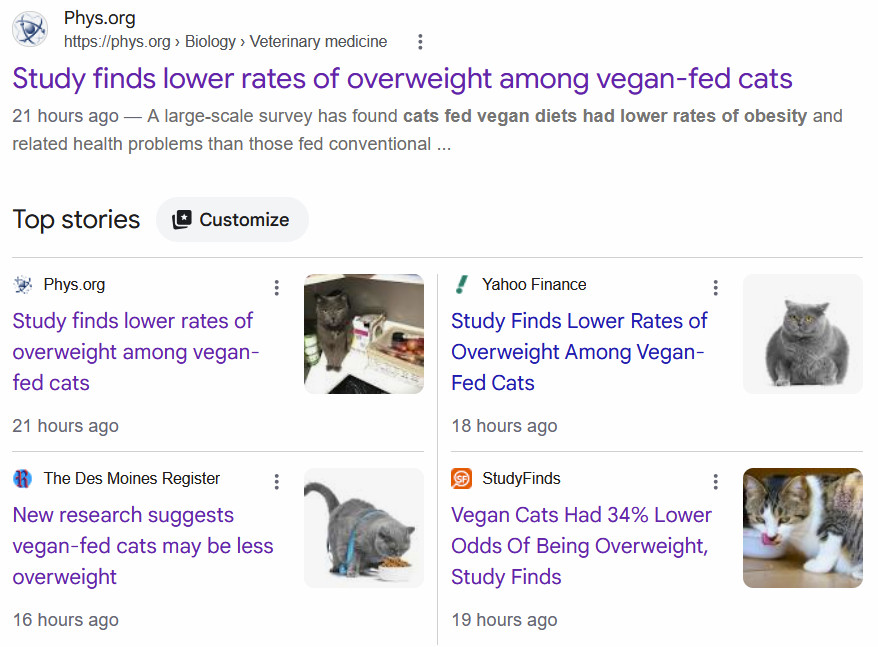
Google search results showing articles about a study on lower rates of overweight among vegan-fed cats.
Notice the bottom right headline, which misinterprets a statistical analysis for “odds” of being overweight.

Ninety percent of the people who responded were female, and 71 percent were from the UK, according to the published paper.

Then the authors kneaded the data with the usual opaquely-named practices: “exploratory regression analysis” (a data-mining technique), regression models (AI-assisted statistical technique that involves comparing existing data with the result you predicted/hope to see), sensitivity analysis (changing variables to assess their impact on the overall findings), and so on.

When all was said and done, 4.1 percent of the meat-eating cats and 3.1 percent of the vegan cats were over their ideal weights, in their humans’ estimation. Meat-eating cats were also more likely to be underweight (2.3 percent) compared to vegan cats (0.8 percent).

The conclusion? The findings were “non-significant,” the researchers wrote, along with the obligatory call for more research on the topic.

We should also point out that in addition to their classification as obligate carnivores, cats require specific proteins and nutrients (taurine, arachidonic acid, vitamins A and B12) from meat-based diets that they cannot synthesize themselves and are not found in plant-based protein. “Vegan cat food” must have those proteins and nutrients added. If cats are deprived of them, they suffer slow, painful declines that result in organ shutdown and death.

Because of their evolutionary history, cats aren’t as adept at breaking down plant-based starches and their bodies don’t produce enough of a specific enzyme (amylase) that breaks down starch and complex carbohydrates.

Human ideas of morality aren’t applicable to cats. Feed them meat.

Open comments Caturday! Although not mentioned in the headlines, today’s the day for open comments: anything off-topic, marriage proposals or modeling contracts for Buddy, updates on your own cats, suggestions on stories to cover and whatever else is on your mind. Happy Caturday!

Header image credit: Pexels
Redditor’s Girlfriend Stole And Abandoned Cat After Argument

Studies have shown that when people who have pets are victims of domestic abuse, the pets often become victims too.

A Redditor says her beloved cat, Midnight, is missing after her girlfriend stole the innocent kitty and dropped her off on a random road on Friday as a revenge tactic for an argument the couple had the night before.

Midnight is still missing. Midnight’s owner, using a burner account called Throwaway29374639, updated concerned Redditors and said she was putting up flyers, setting up humane traps and looking in the area where her girlfriend claims she abandoned the cat as she was en route to work.

For her part, the Redditor says her girlfriend admitted what she did and “said she just had a moment of rage, but I just can’t even look at her right now. I kicked her out of my apartment and have been crying in my room for the last few hours. I feel so lost without my cat.”

In the thread, which attracted more than 1,400 comments and tens of thousands of views, many people advised her to report her (now presumably ex) girlfriend to the police, as well as to change the locks to her home and any passwords the two might have shared on various accounts.

We’ve talked before about the strange phenomenon of people who take their anger out on the pets of their partners or ex-partners. Studies have found that men are more likely to do so, and they’re much more likely to target cats than dogs because they see cats as an extension of femininity. In cases where domestic abuse is expanded to include a dog or a cat, the abusers view the pets as proxies for their victims.

But as recent stories have indicated, women sometimes take their anger out on pets as well.

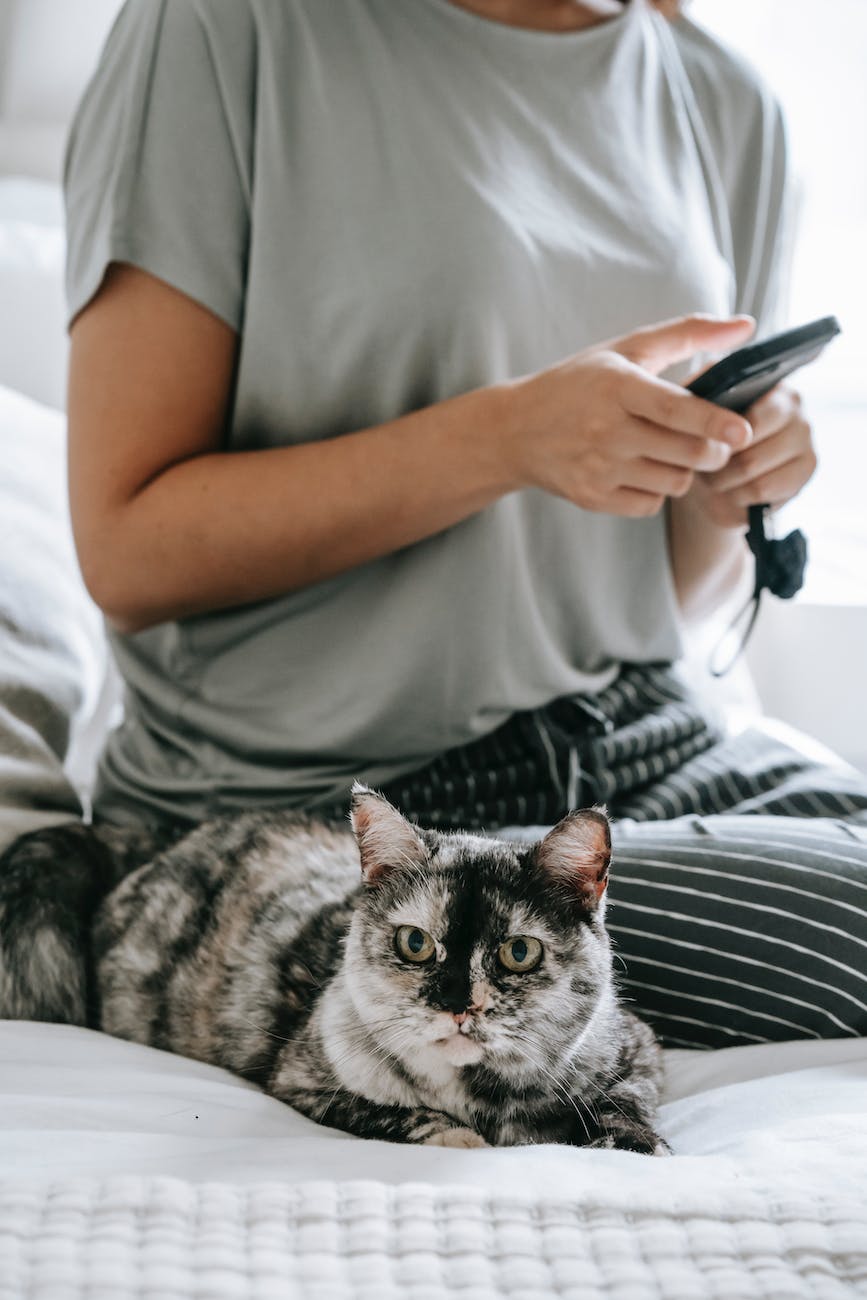
anonymous woman browsing smartphone while sitting on bed near cute cat
When woman are abused by their partners, their pets are often abused as well because they’re seen as proxies for the victims. Credit: Sam Lion/Pexels

Regardless, studies show that the pets of domestic abuse victims are likely to suffer at the hands of their owners’ abusers, and statistics show women who check into domestic violence shelters report their pets were also abused in the majority of cases. Some studies found more than 80 percent of pets who belong to domestic violence victims also become victims.

Women who worry about what will happen to their pets are less likely to leave their abusers and seek temporarily relief at shelters. As a result, some shelters also make arrangements for the pets of abuse victims, giving them safe shelter and taking another worry off the minds of their caretakers.

The links between pet abuse and domestic abuse are in addition to the well-established link between harming animals and “graduating” to harming humans, illustrated most recently by the documented history of feline abuse by the shooters allegedly responsible for massacres in Buffalo, New York, and Uvalde, Texas.

Top image via Pexels and depicts a random cat, not the victim’s cat.

Uvalde And Buffalo Mass Shooters Both Had History Of Killing Cats

The revelations about the shooters underscore the link between animal abuse and violence toward people.

One of the takeaways from the 2019 documentary Don’t F*** With Cats: Hunting An Internet Killer is the connection between violence toward animals and violence toward humans.

The 30-year-old who killed college student Jun Lin previously announced himself to the world with a series of videos in which he killed cats and kittens, then led online groupies on a years-long goose chase, parceling out crumbs of information to keep them interested until he finally “graduated” to humans and murdered Lin.

If police had taken the cat-killing videos more seriously, some of the documentary’s subjects believed, detectives could have caught the killer before he set his sights on a person. Of course, this blog’s position is that animal life has intrinsic value and animal abuse should be investigated for its own sake, but if police are more motivated out of fear that animal abusers could commit violent crimes against people, that helps cats and other animals too.

Now we’ve learned that the 18-year-old gunman responsible for the Texas school shooting and the 18-year-old who gunned down 10 people in a Buffalo, NY, supermarket were both cat killers before they were murderers of human beings. The former murdered 21 people, including 19 children and two teachers at a school in Uvalde, Texas, on May 24 while the latter took the lives of 10 people, all black, in a hate-motivated massacre on May 14.

The Texas shooter filmed himself grinning while holding “a bag of blood-soaked dead cats,” the New York Post reported on Sunday. David Trevino Jr., who knew the shooter, said he was “known for hurting cats.”

“He liked hurting animals,” Trevino told the Post. “I’m told he killed the cats and carried around the bag of bodies for s–ts and giggles The video shows he was not right in the head. He’s not all there. The video raises all sorts of red flags.”

The Buffalo murderer told online acquaintances he’d beheaded a cat, and wrote about it in a journal as well. Like the Texas shooter, his animal abuse wasn’t a secret. His mother knew, and gave him a box to bury the dead animal.

brown tabby cat lying down on gray bed sheet
Credit: Mark Burnett/Pexels

The shooters both fit the profile of animal abusers who move on to hurting people: Most animal abusers are men younger than 30, according to the Humane Society, and studies have found men who abuse cats often target them as an emotional proxy for women. More than 70 percent of women who have companion animals and were in an abusive relationship reported their significant others harming their pets.

Classmates of the Texas shooter described him as “eerie,” “scary” and quick to lose his temper. He was known for physically threatening girls and women, and for harassing them online. One classmate, 17-year-old Keanna Baxter, said he got “super violent” when he dated her friend.

“He was overall just aggressive, like violent,” Baxter said. “He would try and fight women. He would try and fight anyone who told him no — if he didn’t get his way, he’d go crazy. He was especially violent towards women.”

The Texas shooter spent a lot of time creeping on women on social media and in group chat services, which brings us full circle back to Don’t F*** With Cats. In a conversation with a teenage girl on group video chat app Yubo, he told her he “wanted his name out there” like the deranged killer at the center of that documentary.

The shooter, who lurked in group chats uninvited, also showed off the guns he bought after he turned 18 on May 16.

“He would be active every day and join our lives, repeating girls’ names until they paid attention to him,” the girl said.

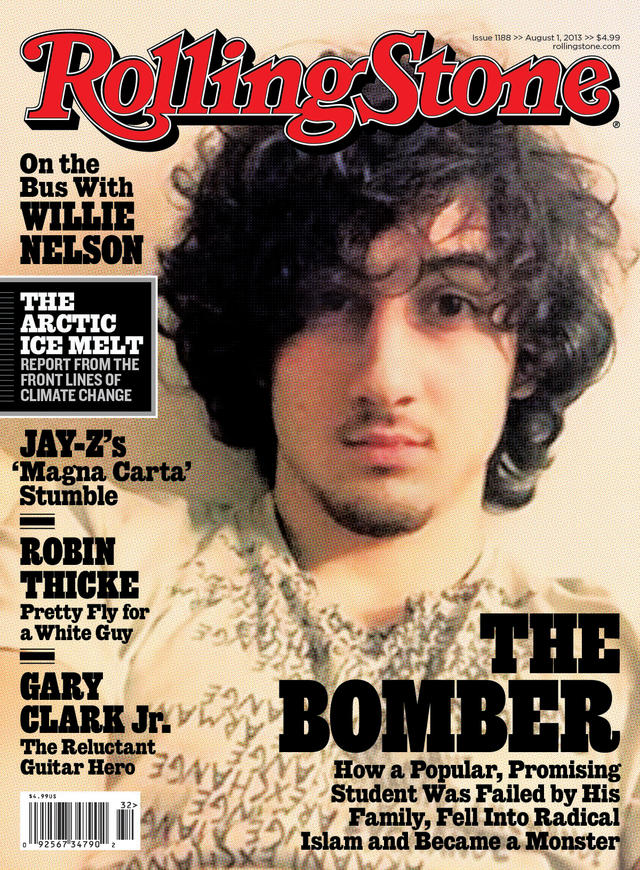
Rolling Stone
Rolling Stone was widely condemned for putting one of the Boston marathon bombers on its cover as if he were a rock star, but the issue was its best selling of the year.

Although the blame game begins while the bodies of the victims are still warm, as shrieking heads speculate on cable news, no one ever talks about the obvious and uncomfortable truth, which is that these disaffected young loners desperately want to show people they’re important, that they matter.

If they can’t find fame, infamy is a second prize they’re happy to embrace, and they’re motivated in part by the notoriety that previous members of their grim brotherhood “achieved” by massacring fellow human beings.

Major media figures aren’t merely willing to grant that wish. They’re wholeheartedly, enthusiastically in on it, filling hours of airtime looping the same short bits of footage, breathlessly reporting every nugget of information, and holding court over panels of “experts” who are happy to speculate on motivations regardless of how little they know. They blame video games, society, the lack of nuclear families, the lack of male role models, white supremacy, bullying, guns — everything but their own role in turning the killers into household names.

After all, almost everyone who was alive in 1999 can name the two trenchcoated murderers who perpetrated the Columbine massacre, back when things like that still shocked the country. But how many of us can name a single one of the 13 victims?

That’s why I won’t name the killers on this blog. It’s just one blog, in one small corner of the internet, and it won’t make a difference. But if everyone stopped naming them, stopped making them household names and the stars of obsessive crime porn, stopped turning them into objects of fascination whose faces are plastered on magazine covers like rock stars, maybe it would change things.

If would-be killers knew infamy was off the table, that if they survive they’ll remain anonymous nobodies without prison groupies begging for face time, journalists begging for interviews, and grief vampires discussing them for years in “true crime” books and on podcasts, would they go through with it?