Osbourne poses for a cartoonishly bloody ad denouncing declawing.
A ban on declawing passed a key committee vote in Florida this week, while Black Sabbath frontman and reality TV star Ozzy Osbourne has become the new face of a PETA campaign against the harmful practice.
Florida aims to become the second US state to ban the elective and harmful procedure after our home state, New York, passed the country’s first statewide ban on declawing in 2019.
The Florida bill, which was introduced in August, was approved by the state senate’s agricultural committee by a 4-1 vote on Tuesday. It’s expected to pass two more committee votes before it goes to a final vote on the senate floor.
The ban would levy relatively stiff penalties for owners and veterinarians who ignore the law. The former would face fines of $1,000 per cat, while veterinarians would be fined $5,000 per cat, as well as discipline from the state’s Board of Veterinary Medicine.
Meanwhile, Osbourne and People for the Ethical Treatment of Animals have teamed up for a public announcement campaign aimed at increasing awareness of the damage declawing does to cats.
The ads feature a striking image of Osbourne holding up both hands, with his fingers severed at the first knuckle to illustrate what’s done to cats during the procedure. It’s bloody, like Osbourne’s long-time stage antics, and controversial, like many PETA campaigns.
“Amputating a cat’s toes is twisted and wrong,” Osbourne said, per PETA. “If your couch is more important to you than your cat’s health and happiness, you don’t deserve to have an animal! Get cats a scratching post—don’t mutilate them for life.”
Ozzy Osbourne poses for a bloody anti-declawing ad in cooperation with PETA. Credit: PETA
Cats are an “emerging audience,” Youtube says as feline-centric videos rack up millions of views.
At first, Buddy wouldn’t look at the TV.
I’d pulled up a live feed of a nature cam on Youtube, hoping my cat would be drawn to it by the sounds of bird calls and the sight of vividly-plumed orioles and robins alighting on a feeder, but he just didn’t seem interested.
Leaving the stream on just in case, I went back to my writing, then checked on the little guy again 20 minutes later to find him glued to the TV, sitting close and staring up like a small child watching Saturday morning cartoons.
Buddy was watching a quintet of Bluejays pick seeds from a tray feeder in Ohio, his eyes following the quick movements of the birds while he chirped in excitement.
The channel, Bird Watching HQ, is one of dozens catering to a rapidly-growing segment of YouTube’s viewership: cats.
Kitty wants the remote
In retrospect it seems like it was inevitable that cats — the stars of innumerable YouTube videos viewed billions of times on the platform — would become viewers too.
Indoor cats get a visceral thrill from watching birds and small mammals the same way people do while watching thrillers, horror flicks or adventures: It’s a way to get adrenaline flowing in a safe environment.
For Scott Keller, the proprietor of Bird Watching HQ, cats weren’t his intended audience, and the fact that felines love his channel is a happy coincidence. It started as a blog “about how to attract wildlife to your backyard,” he said, prompted by how much he enjoyed taking his kids and his dog for walks near his home in Ohio.
“The live cameras were added in September 2018 to show the specific feeders and food that I was currently using,” Keller said. “I was certainly not thinking about entertaining videos for cats.”
Keller now has four live streams for viewers — human and feline alike — to get their nature fix: Two are set up in his backyard in Ohio, one in California is run by a partner whose feeders are frequented by hummingbirds, and the last is in an animal sanctuary in the Czech Republic. The operator of the California cam goes through between 50 and 100 pounds of sugar a week to keep her feathered guests happy, Keller said, and the European bird cam often captures unexpected visitors.
“It has actually been a great way for me to learn the birds of Europe,” Keller told us. “We have even seen owls catching mice at night here.”
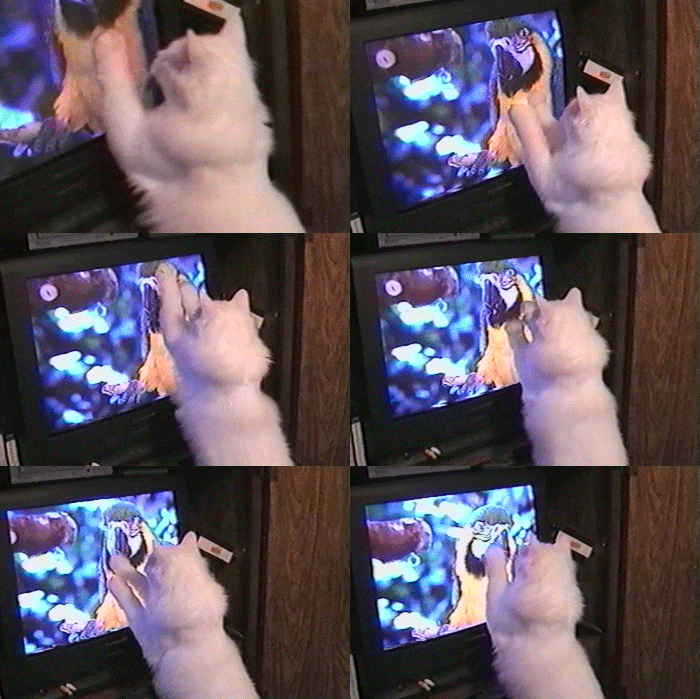
“MUST…KILL…LARGE BIRD!” A cat is determined to break the magic glass and reach the bird inside.
Cats as couch potatoes
If you’re wondering whether it’s a good thing to introduce your cat to TV and Youtube streams, veterinarians say there’s little downside.
“It won’t hurt your kitty’s eyes, so you don’t have to tell Fluffy not to sit too close to the TV,” veterinarian Jillian Orlando told VetStreet.
The only real danger, Orlando said, is your cat getting a little too stimulated and potentially charging at the TV to go after the on-screen birds or rodents. Most cats won’t, but if yours is the type to charge head-first into a window screen after spotting a bird outside, then you might want to keep an eye on kitty as she gets her fix.
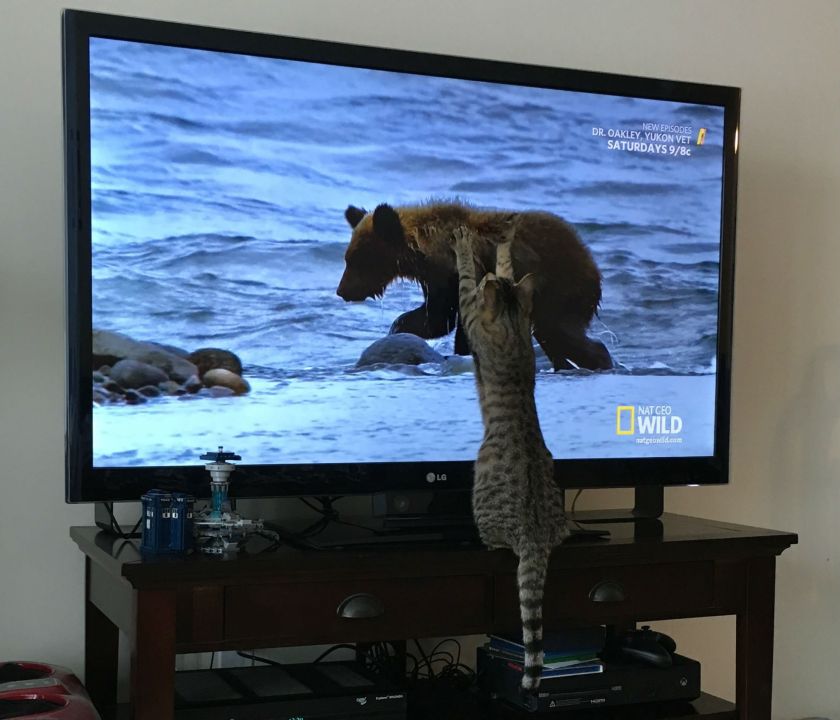
“Not so fast, big guy!” An overexcited kitty attacks a bear on the National Geographic channel. Credit: Mandadadada/imgur
The topic’s been the subject of academic research as well, with a 2007 study concluding TV was effective in relieving the boredom of shelter cats who didn’t have windows to gaze out of. While cats don’t see colors as well as we do, videos featuring prey animals hold “enrichment potential” for indoor cats, the authors concluded.
Cat-centric TV is official
As for the phenomenon of bird-watching videos and channels created specifically for cats, Youtube is well aware of it. Content tagged “videos for cats” was viewed more than 55 million times on Youtube in 2019, Youtube trends and insights lead Earnest Pettie told Wired.
That actual number of feline viewers could be much higher, since it doesn’t count content like Keller’s, which isn’t created for cats but has nonetheless reached them as an audience.
“We now have this world where cats are an emerging audience,” Pettie said, “and movies for cats are an emerging trend.”
As for Keller, he believes indoor cats and humans enjoy the videos and cameras on his channel for many of the same reasons.
“I have also heard from a lot of people that can’t go outside anymore, such as in a retirement home, with disabilities, or special needs children that are using the cameras to get a glimpse of wildlife each day,” Keller said. “There are also many people that are sitting at their cubicles at work during the week that just need some natural sounds.
We’re looking at how cats are portrayed in video games. In this post, we discuss SEGA’s Yakuza Kiwami 2.
I’d been playing Yakuza Kiwami 2 for only a few minutes when I stopped and did a double-take.
My in-game character was standing in the exact same spot I’d been standing in real life six months ago, in Tokyo’s Shinjuku district.
Here’s Karaoke Kan on that street corner in the game:
Shinjuku in Yakuza Kiwami 2.
And the same corner in real life:
The game’s recreation of Tokyo is impressive, featuring a replica of the Shinjuku district that feels alive, buzzing with activity and undiscovered adventures.
Here’s Shinjuku’s Don Quijote in the game alongside the real one in Tokyo:
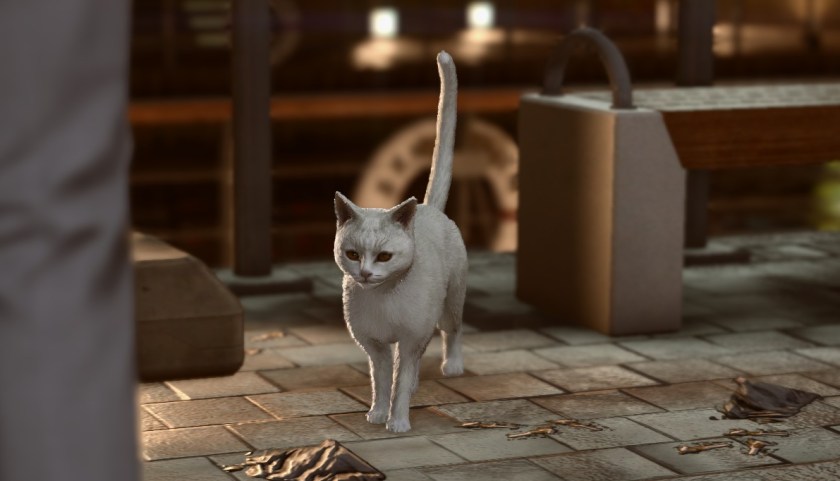
I knew it wouldn’t be long before the game brought a cat into the mix, and it didn’t disappoint. In one scene, a character asks you to find his dear little girl who has been kidnapped, and you’re under the impression you’re searching for his daughter — right up until you find the kidnappers, give ’em a good old Yakuza beatdown, and realize your acquaintance’s “little girl” is actually a cat:
A cat in Yakuza Kiwami 2.
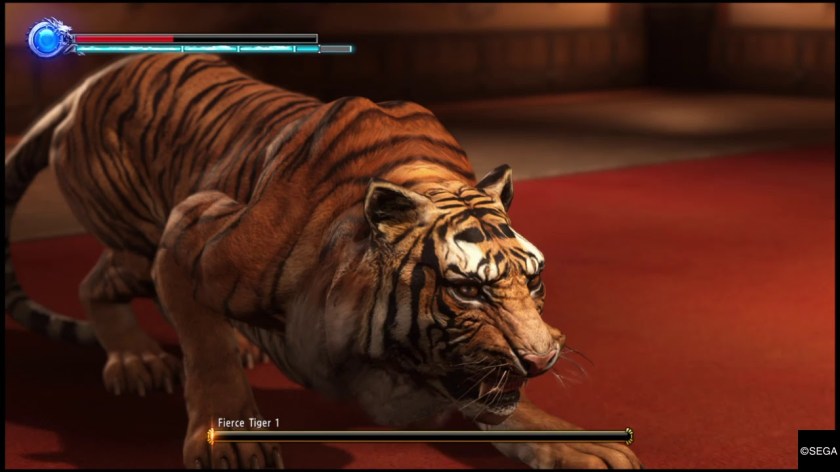
The game, which is little-known in the US but hugely popular in Japan, also features a, shall we say, less amiable encounter with cats:
A viral adoption ad proves it’s possible to find homes for even the most difficult cats.
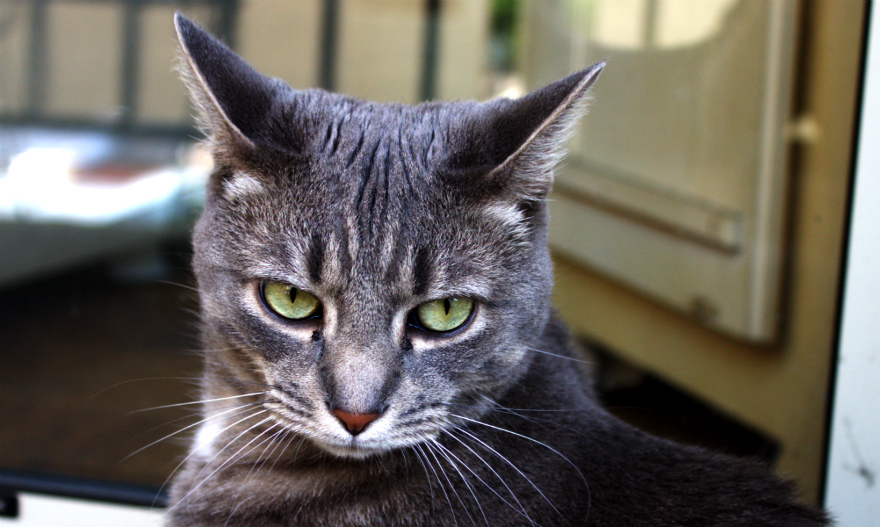
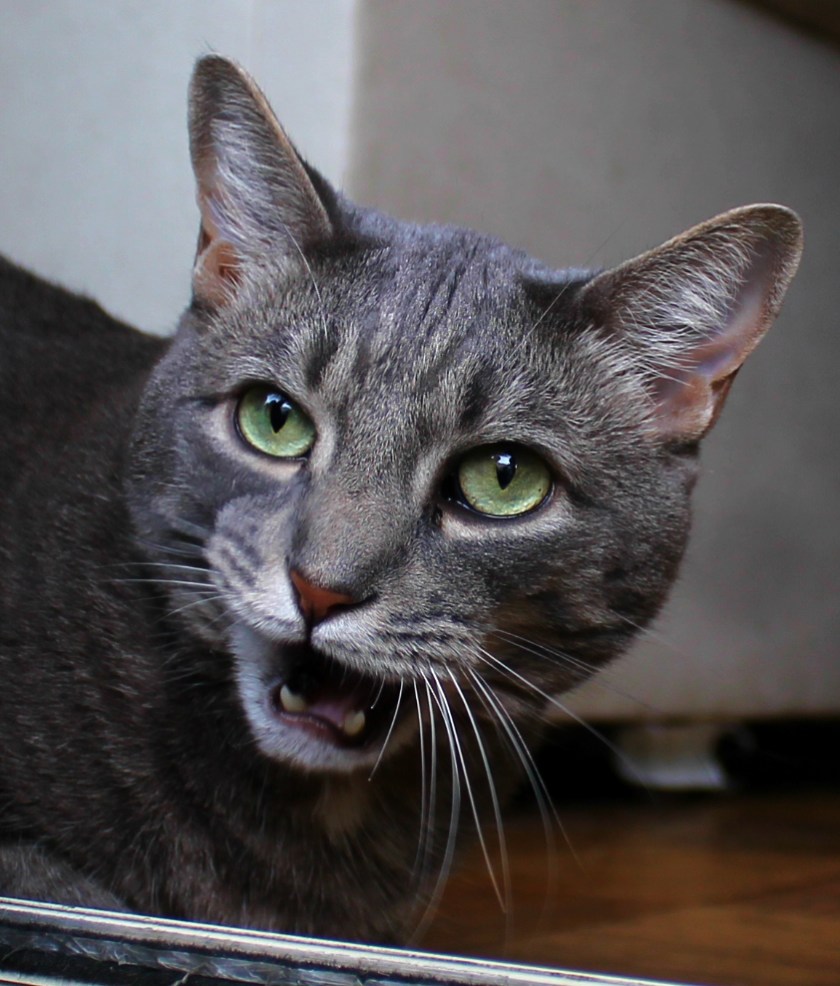
Meet Buddy: Not for people who enjoy peace, caretakers with autoimmune diseases, or anyone who dislikes being smacked in the face.
What this 10-pound grey tabby lacks in size, he makes up for in unmitigated douchebaggery.
LIKES: Turkey, mind-controlling you with toxoplasma gondii, never shutting up, destroying expensive personal belongings (particularly musical instruments), dipping his tail in your beverage just to piss you off. He occasionally enjoys rending human flesh with his claws as well.
DISLIKES: People who don’t give him treats. People who don’t treat him like the center of the universe. Vacuums, tardy service, acts of kindness, substandard service, mirrors, birds, dogs.
Come and meet Buddy, who is free to the first person who’ll claim him! In fact, we’ll play you, and he comes with a litter box, food/water bowls, toys, a harness, treats, scratching posts and heavy duty gloves.
Okay, so clearly I’m not giving Buddy away or taking applications for him. Anyone who wants Buddy will have to pry him from my cold, dead hands. He’s my Buddy.
But this adoption ad from an animal shelter in North Carolina got me thinking about how cats are described to prospective adopters:
Adoption ads for house cats are perfunctory affairs peppered with the same handful of descriptors: Every cat is a sweet, loving cuddle bug looking for a “furrever” home.
If you knew nothing about cats and based your opinion on adoption ads only, you’d think they’re basically cuddly pillows with no variation in personality or disposition.
The person who crafted Perdita’s adoption ad managed to cut through the noise with a funny, brutally honest description of the cat and her many quirks.
World’s worst cat? Even the veterinarian thinks she’s a major jerk? I have to know more.
The ad worked. Not only did it go viral, amassing thousands of shares, upvotes and comments on social media, it’s been talked about on TV and written about in major publications.
Most importantly for little Perdita, the clever ad also prompted more than 50 enthusiastic applicants, and the shelter says it’s “carefully considering” the would-be servants, no doubt trying to find the perfect match for the “World’s Worst Cat.”
At a time when thousands of charitable organizations are competing for donations and deserving pets languish in shelters, Perdita’s story proves rescues can cut through the noise and find homes for even the grumpiest of cats.
“Buddy doesn’t do hugs, okay? Buddy speaks in the third person, Buddy meows insistently for dinner, but Buddy does not do hugs. Deal with it, human.”
His previous owner had dementia and kept feeding him, and feeding him…
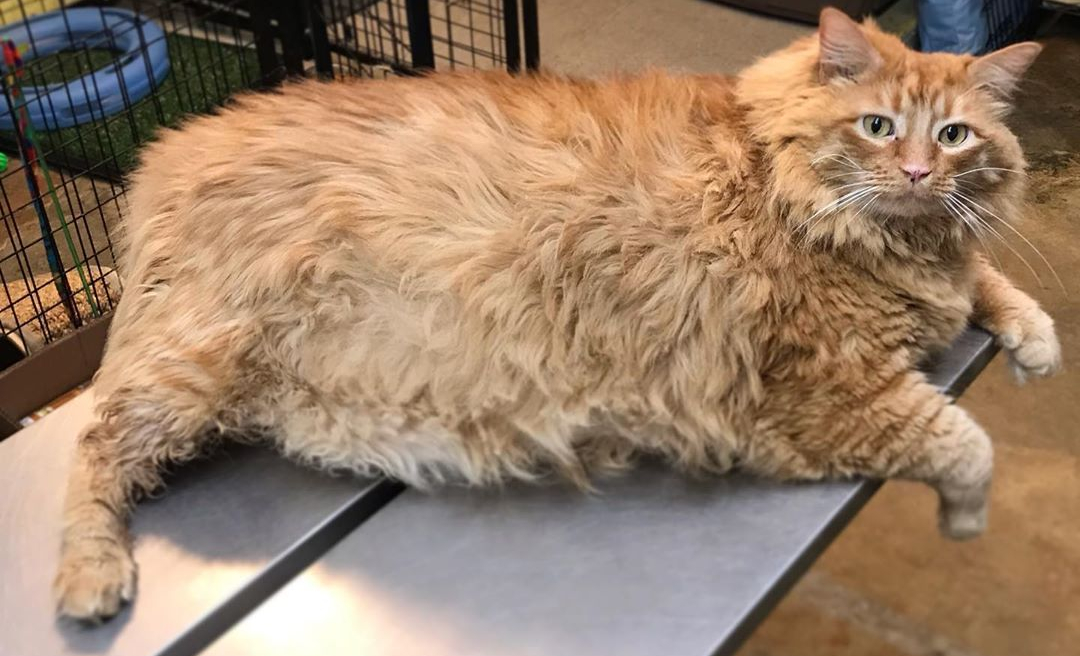
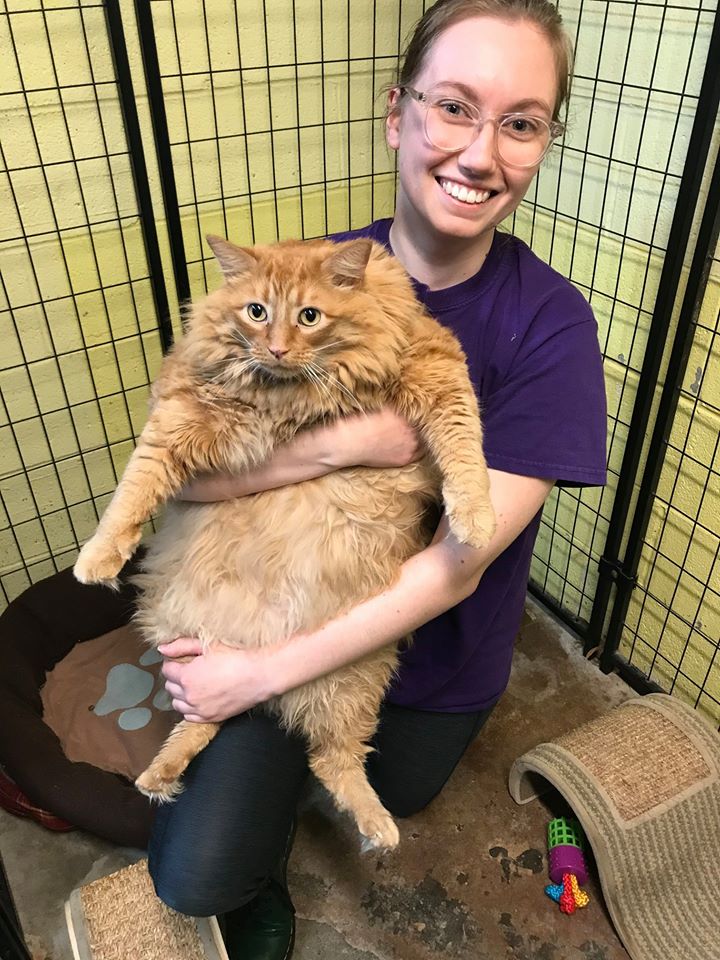
Meet Bazooka.
The orange butterball weighs in at 35 pounds and was surrendered to the SPCA in North Carolina’s Wake County this week after his former owner died.
Although the shelter says some people were initially outraged that a person would let the ginger tabby grow to such elephantine proportions, it turns out there’s more to the story: Bazooka’s owner was inflicted with dementia and, never sure if he’d fed the amiable cat, he just kept feeding and feeding — and feeding — Bazooka, who has apparently never met a cup of kibble or a can of tuna he won’t happily scarf down.
We wouldn’t be surprised if there was some insistent meowing prompting his late human to keep refilling those bowls.
“[Bazooka’s owner] thought he was doing the best thing for his cat by feeding him,” the SPCA’s Darci VanderSlik told North Carolina’s News-Observer. “We need to look on this with a compassionate view. He was loved.”
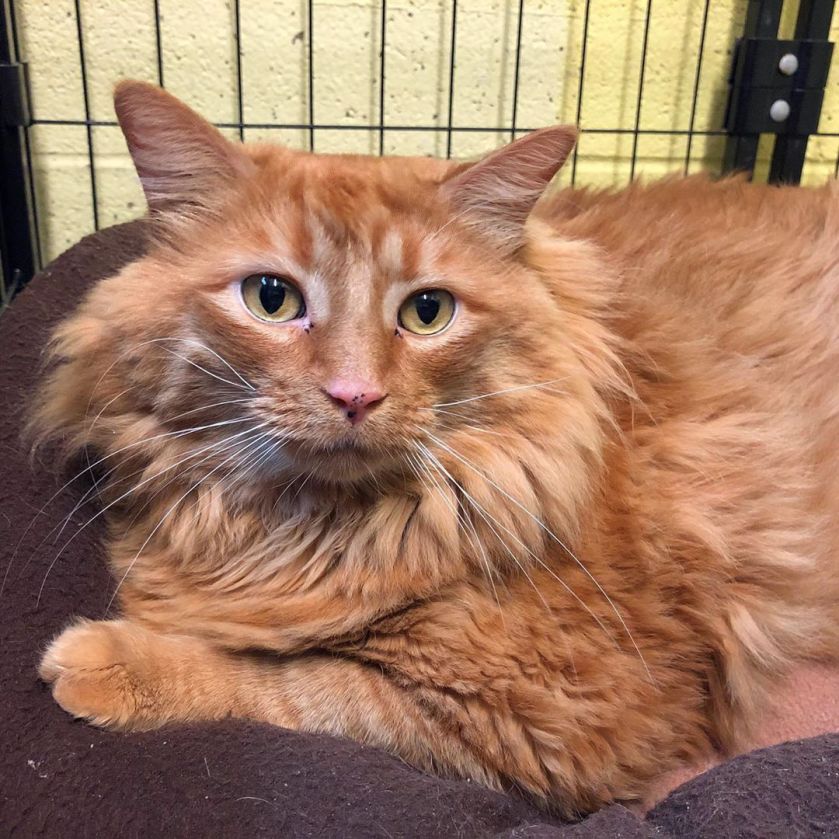
It turns out Bazooka is a loving and chill dude as well.
“He wants to be around people,” said Michelle Barry, the big guy’s foster mom. “He’s happiest lying right next to you. And he’s more active than I expected him to be.”
He’s in for quite an adjustment period, going from a life of on-demand meals to a strictly-regulated diet designed to get him down to a healthy weight. As any cat servant knows, there’ll be lots of agitated meowing in his future.
The ‘Zookster has already been adopted and will soon move into his forever home after the shelter provides some basic veterinary care and draws up a weight loss plan for him. Working with his new human, staff at the SPCA want to get Bazooka down to 20 pounds or so, which they feel is appropriate for his large frame.
They say they’re just glad to help.
“We don’t know a lot of the back stories of the animals we get, but we try not to judge people or make people feel bad about the circumstances that led to their surrender,” VanderSlik said. “We’re really lucky to have the resources to take him in and help him get a home he deserves.”
Bazooka’s a handsome kitty with a lion-like mane. In this photo, he’s thinking about pastrami sandwiches. Credit: Wake County NC SPACA