“The failing Time magazine didn’t even put me on their top 10 cats list. If they did, maybe they would sell more copies! Sad!” Buddy tweeted after the story was published.
Others expressed their outrage at Time’s snub.
”Time magazine has proven itself irrelevant by failing to include the handsomest tabby in America, and quite possibly the world,” gossip meower Pawrez Hilton wrote. “Do they realize thousands of kittens have posters of Buddy on their walls? He’s absolutely dreamy.”
“No Buddy? Absurd!” Meower user @SexyCalico24 commented. “I mean, have you seen his muscles? RAWR!”
Time’s editors were forced to backtrack after a deluge of angry phone calls and emails, along with a hundreds-strong protest outside the magazine’s Manhattan headquarters.
“It was a grave oversight on our part to exclude Buddy from our list, and we apologize,” the magazine’s editors wrote in a statement. “We know it will take time to win back the trust of our readers, but we hope to make it up to them with a 24-page photo spread of Buddy in our April issue.”
Claws Woodward, a purrfessor of feline journalism at the Harvard School for Cat Studies, said the embarrassing oversight is a sign that Time magazine is out of touch with kittens and young cats.
“Buddy is an action hero, like Snacky Chan or Ahnold Schwarzenmeower,” Woodward said. “With his movie star good looks and his rippling muscles, he clearly should have been on that list. I mean, ‘Jealous Cat’? Real Housewives meme cat? Come on! You don’t put Z-listers ahead of one of the most treasured cats of our generation.”
Still, not everyone was convinced Buddy should have made the list. Pop singer Taylor Swift was among those who clapped back at Buddy for his vanity.
“Buddy who?” Swift tweeted, throwing shade at the Budster. “If any cats should be on that list, my kitties should occupy all ten spots. I’m going to write a song about how they were cheated. Let me finish!”
I was driving home on Tuesday night, just about to leave the city limits of White Plains when I saw a cat laying in the road.
I swerved to avoid the cat, saw motion out of the corner of my eye, and pulled over on the nearest side street. There was more traffic behind me and I held my breath as I approached, worried that one of the passing cars would drive over the injured feline.
Using my iPhone as a flashlight, I finally got close. The poor cat was dead. There weren’t any obvious injuries, but his mouth was filled with blood. In retrospect I believe the movement I saw earlier was just the wind blowing his fur.
I picked him up, carried him off the road and set him down on the grass near a street sign. Then I called the police.
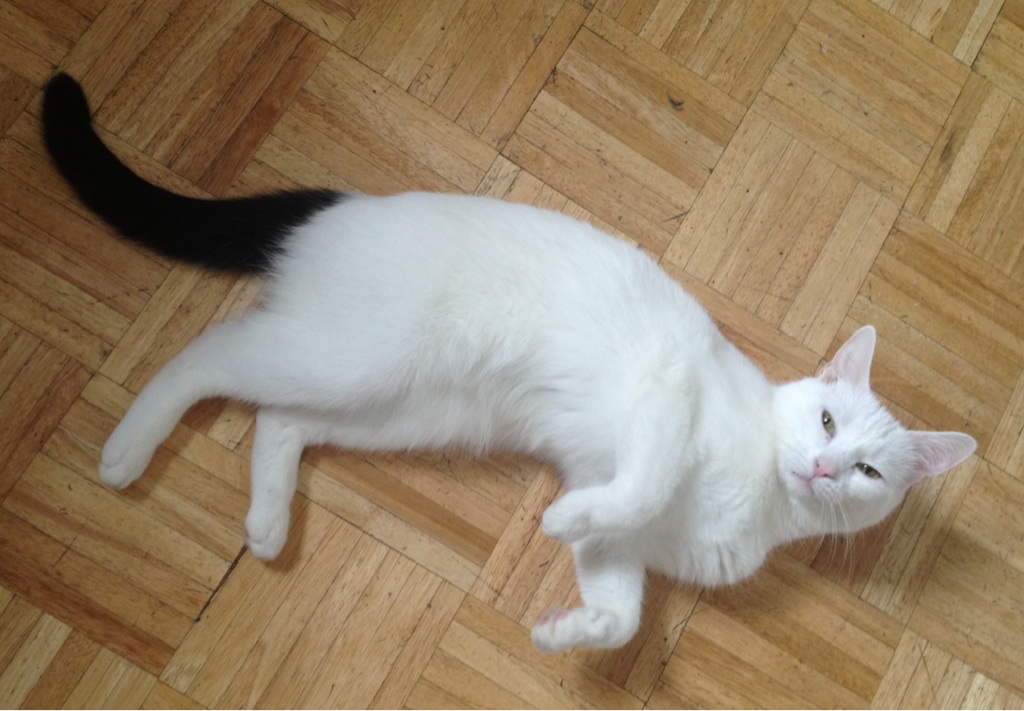
He was well-fed and well-groomed, with a striking coloration — medium-length fur that was pure white except for a single black stripe on his tail.
This was someone’s beloved cat, and that person was going to be rattling a bag of treats and calling out for kitty to come home, wondering where the little guy had gone.
Someone hit or drove over that beautiful cat and kept driving.
It’s one thing to know the statistics, to understand in the abstract that outdoor cats only live three years on average while their indoor counterparts live an average of 16 or more years, and quite another to see a dead cat up close with my own eyes, left there as roadkill.
Many people labor under the assumption that cats belong outside as if it’s their natural habitat. The truth is, cats don’t have a natural habitat. As domesticated animals they’re no different than dogs, pigs or cows — the process of domestication has rendered them human-dependent. They’re genetically distinct from their wild ancestors, molded over thousands of years to be companions to humans.
Domestic cats aren’t as swift or agile as wildcats. While they retain some of their wild instincts, they’re ill-equipped to deal with danger.
Life as a feral or stray is tough, brutal and short. Some can survive for a short while. Most don’t.
They should live indoors, and there’s no reason an indoor life should be boring for them. As caretakers it’s our responsibility to keep them entertained, to provide them with toys, perches, hiding spots and window vantages. Most of all, it’s our responsibility to give them attention and affection.
Please keep your cats indoors and safe from the manydangers of the outdoors.
Note: The featured photo at the top of this post is not a photograph of the cat I encountered, but a similar-looking cat. Header image credit /u/phlebotinum/Reddit.
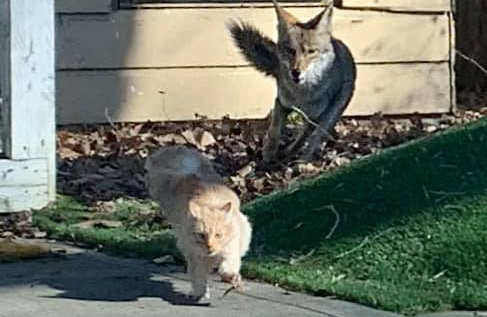
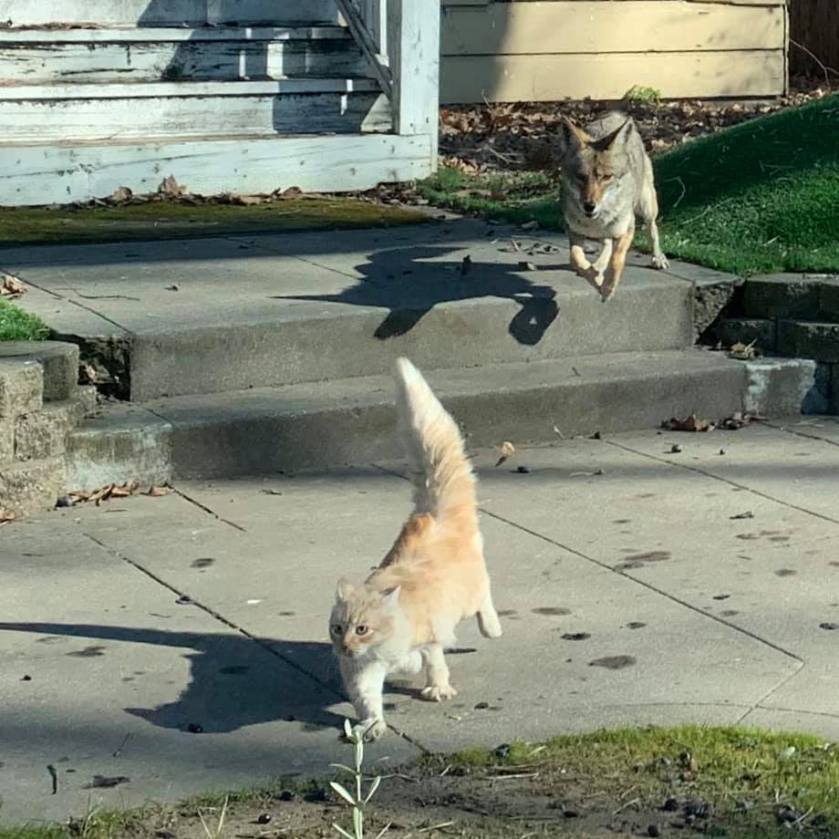
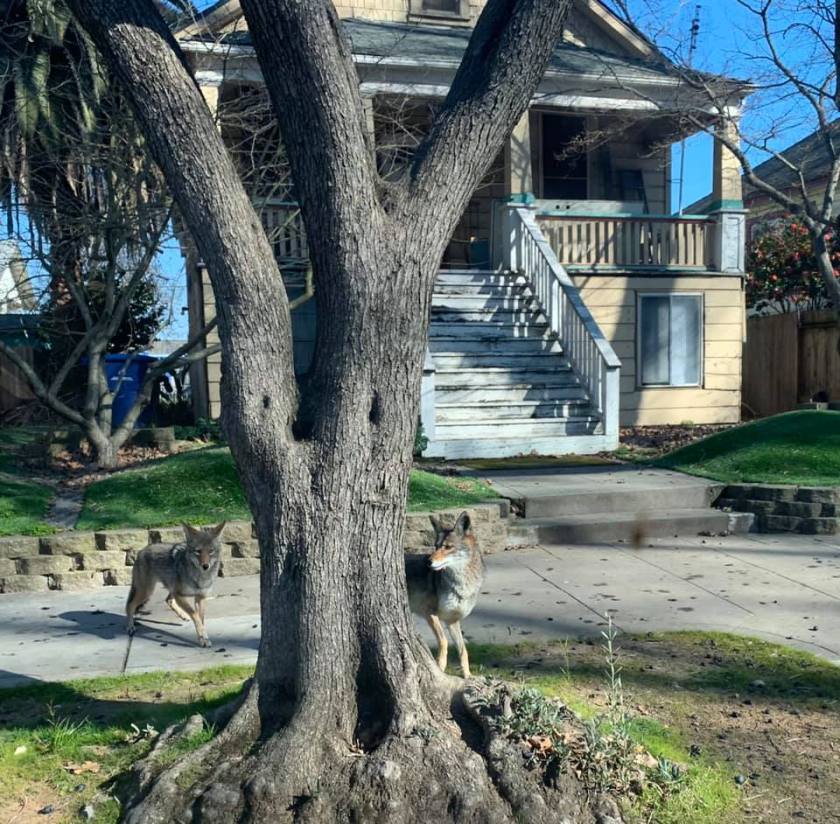
The fast feline narrowly avoided becoming a meal for a pair of coyotes in Sacramento.
Allyson Seconds was driving through midtown Sacramento on Thursday morning when she saw flashes of fur weaving between cars in traffic.
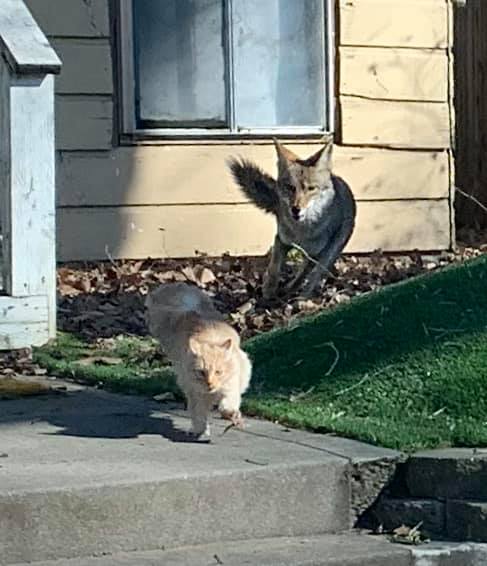
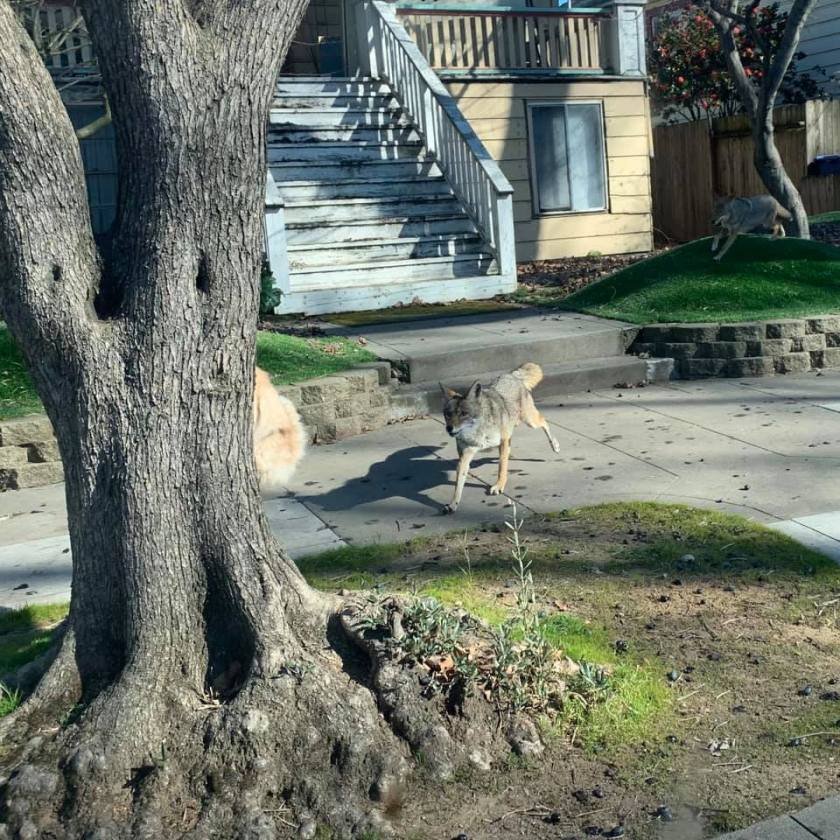
“I pulled over thinking I’d seen two loose dogs crossing the street and went into rescue mode,” the Sacramento woman recalled. “When I saw they were coyotes I grabbed my phone and took just these four shots of them running and jumping up at a tree.”
Seconds didn’t didn’t understand why the coyotes were so worked up until she reviewed the shots.
“I didn’t realize at first that it was a house cat they were after until I looked at the pictures,” she wrote. “That’s one lucky cat!”
The swift tabby managed to stay a stride ahead of his canid pursuers before going vertical and beating a quick retreat up a tree.
This photo shows the telltale signs of a terrified cat: Kitty’s tail is raised, rigid and three times its normal size while its ears are pinned back against its head.
A tabby cat narrowly escapes the jaws of two coyotes on Feb. 6 in Sacramento. Credit: Allyson SecondsThe coyotes were right on kitty’s heels. Credit: Allyson Seconds
The next two photos show the end of the chase: In the first we can see just a flash of fur as the cat scurries up the tree, and in the second shot the coyotes look miffed at being outplayed by a domestic cat.
Credit: Allyson Seconds
As for Seconds, she understands what so many people and local media reports get wrong. There aren’t “more” coyotes, as if they’ve suddenly decided to start becoming prolific breeders. The reason those of us in urban and suburban neighborhoods see them more often is because we encroach on their habitats with every development, cul-de-sac and ugly strip mall we build.
It’s a story that is sadly repeated across the globe as animals as varied — and endangered — as mountain lions, tigers and orangutans find fewer contiguous plains, jungles and forests to hunt and forage within.
“This is not even close to a coyote damning post,” Seconds wrote on Facebook. “Housing developments and more homeless living at the river are certainly driving them inland from their more suitable terrain but guess what? The coyotes are adapting to city life and we are seeing more and more of them in all corners of our town. They aren’t going anywhere.”
She signed off by making a suggestion we’ve advocated many times on this blog.
“And as for those worried about their cats for reasons illustrated in my photos? Time to start keeping kitty inside.”
A new video purports to show a cat speaking fully formed sentence in English. People are buying it.
A new, internet-breaking viral video appears to capture a cat speaking English, prompting a wave of speculation about whether cats are basically furry parrots when it comes to talent for mimicry.
The TikTok clip features a voice saying “Hello” and “Are you coming?” followed by an amused narrator turning the camera on his cat and incredulously asking “What did you just say?”
The video’s viral success has led to a net-wide conversation about animal cognition, and whether cats in particular understand far more than they let on.
“And this is a proof that animals can talk,” one TikTok user commented, summing up much of the online reaction to the clip.
It should be noted the handful of times cats have been recorded producing vaguely human-sounding speech, the sounds were stress vocalizations from terrified or anxious cats.
That’s what’s happening in the famous “Oh long Johnson, oh don piano!” video, in which a stressed out tuxedo vocalizes a few phrases before proceeding with more gibberish. To people who aren’t familiar with cats the video may seem funny, but those of us who care for the little tigers can recognize the signs of extreme agitation.
Here’s the “Oh long Johnson” video:
And here’s the new “Hello!”/“Are you coming?” video:
The viral TikTok video is a whole different ballgame: The words are well-formed, the sound is clear, and the phrase makes sense.
Unfortunately, it’s not real.
First I’ll point out the obvious: The cat is off-camera when it “speaks” because painstakingly editing video to make its mouth move in sync is a much more difficult task than dubbing in a vocal file.
Secondly, a careful listening with headphones makes it clear the “Hello” and “Are you coming?” are not from the same source as the meow, and the directional mix isn’t right. The sound should be distorted and should be directional if it’s coming from a cat in the next room, to the right of the person recording the scene on a smartphone.
This was an audio cut and paste job without much attention paid to detail. The video’s creator didn’t bother panning the clip.
But perhaps most damning of all, the sound looks wrong. I isolated clips of the cat “speaking” in a wave editor — an old copy of the ultra-reliable Cool Edit Pro — and compared them to various samples of cat meows pulled from the Internet and sampled from Buddy himself.
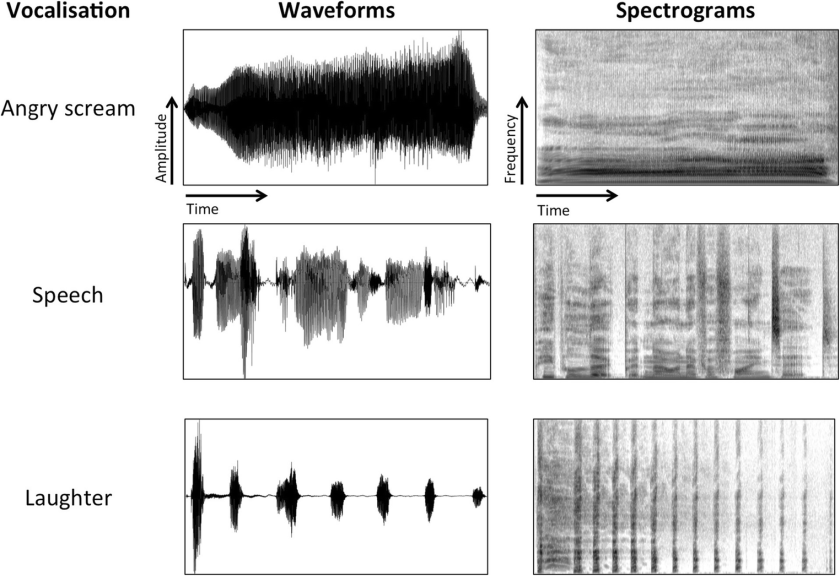
When visualized in an audio editor, “the waveform of speech is complex and variable, reflecting the variety of vowels and consonants that are used and the dynamic nature of speech articulation.”
In other words, you can see the stops and starts of human speech and the articulations of different sounds reflected in how the audio appears visually. This is because we have fine motor control over our vocal apparatus, something animals lack. (A 2016 Princeton study determined macaques, for example, have the necessary vocal anatomy to mimic human speech, but they don’t have the “brain circuitry” to form the precise articulations.)
Cat vocalizations, on the other hand, lack those markers. Additionally, at higher resolutions you can see patterns indicative of rhythmic sounds in samples of cat vocalizations, not unlike isolated drum tracks in a studio recording.
This is because feline meows often have embedded purrs, and trills are naturally quantized. They’re rhythmic sounds. If you’ve ever had a purring cat laying on your chest, this will be familiar to you: You can hear the percussive sound, which persists while the cat is exhaling and inhaling.
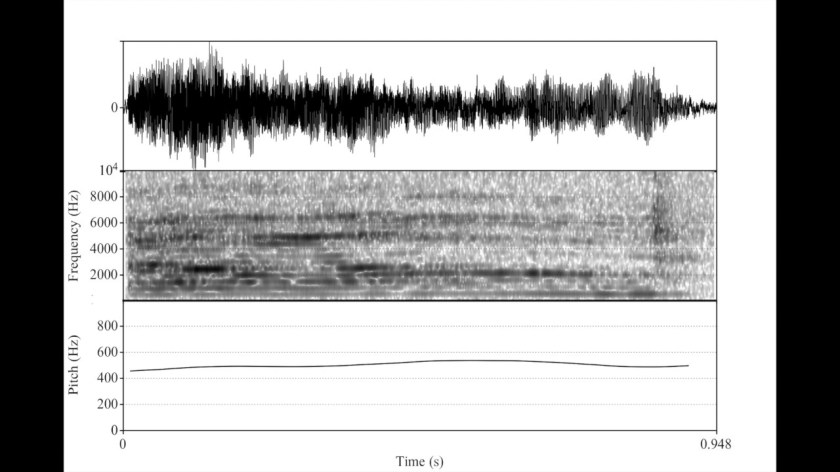
A domestic cat’s meow in waveform. Notice the lack of transients, pauses and variation, which would be indicative of human speech patterns.
Solicitation purrs and even basic meows have similar qualities. It’s a well-known fact that cats communicate with each other via body language — tail, eyes, ears, posture — and scent. Adult cats rarely vocalize to each other, so when they meow to us it’s because they recognize that we don’t “speak” tail or whisker, and they’re trying to communicate with us in a form we understand.
But cats are like macaques — they do not possess the brain circuitry to form the precise articulations necessary for human speech.
As primates, macaques have similarly-formed mouths, tongues, teeth and lips. Cats do not, which presents another set of problems when imagining them mimicking human speech. Think of “t” sounds, both the hard t and the soft “th” — they require us to rest our tongues against our upper front teeth or the roof of our mouths.
Cats don’t have substantial front teeth. They’re more like little shredders.
Likewise, to speak the phrase “Are you coming?” requires fine motor control to form the hard “c” sound. It involves precise control of air flow from the throat to the mouth and subtle placement of the tongue
Although the idea of talking pets may be appealing to generations that grew up on Disney movies and other media featuring anthropomorphized animals, the truth is they do talk to us in their own ways. The least we can do, as the supposedly more intelligent species, is to meet them halfway.
Wilford will have to slim down before moving to his forever home.
It seems like a new super chonk cat goes viral everyday, and it’s always the same story — the cat comes from a home where its owner is either negligent or unable to properly care for kitty, and a rescue is left with the dual responsibility of finding a new home and getting the cat to slim down.
That’s the case with Wilford, a handsome eight-year-old tabby who weighs in at a hefty 28 pounds.
Wilford is living with a D.C.-area foster couple, who have the long-haired dude on a diet and are trying to get him to exercise. They say his ideal weight is about 14 pounds, half of what he weighs now.
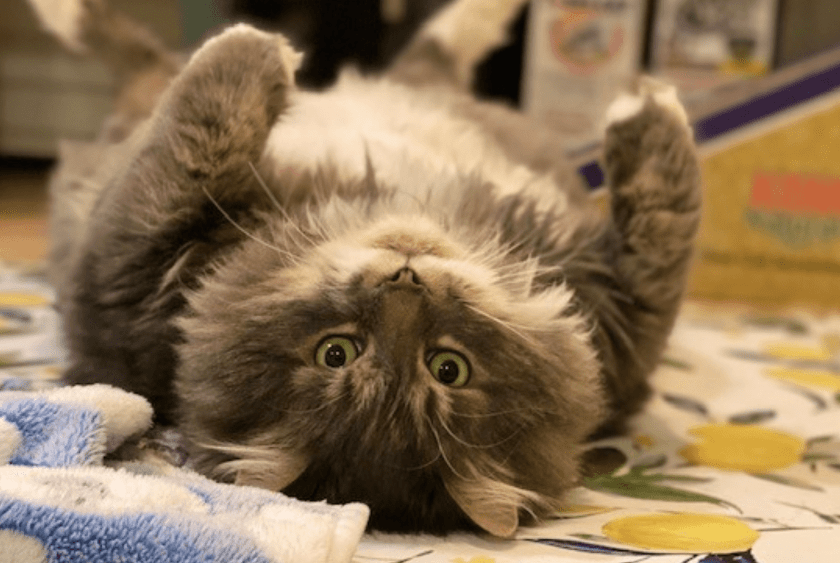
But as the video below illustrates, Wilford is so heavy, “playing” for him means laying on his back and doing “crunches” while batting at his wand toys instead of chasing them:
“Wilford absolutely loves to play- but he only feels comfortable doing so while safely ensconced beneath the dining room table,” his foster humans wrote on Instagram. “Kind of like preferring to work out at home instead of at the gym!”
In a bit of TMI, they say Wilford’s dropped some weight and is ready to start the process of screening for a forever home, but they’re still concerned over his sluggish ways and his “irregular vowel movements.”
Read: If you’re looking to adopt this regal little guy, you shouldn’t be the type who’s squeamish about blown-up litter boxes.
While handling Wilford feels like “picking up a greasy watermelon when you have to move him from place to place,” foster parent Jen tells DCist, “he is an absolute delight and we are so grateful to have the opportunity to spend time with him.”
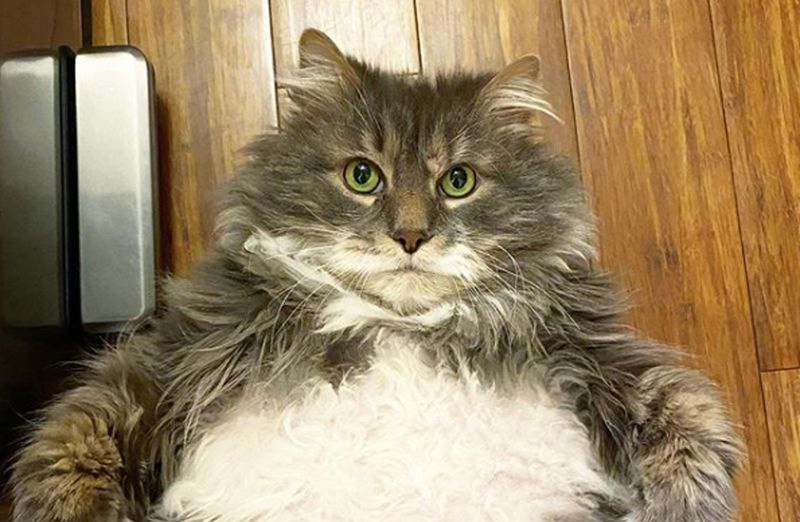
Wilford’s favorite position is laying on his back, and unlike most cats, he actually likes it when humans scratch his belly.
“I mean, he’s just absolutely adorable,” Jen said. “He’s very dramatic, and when he wants something, he’ll roll over and just squeak. And you’re basically like, ‘Alright, Wilford, I’ll give you another tummy rub.’”

 Pain In The Bud