A cat who famously interrupted a soccer match earlier this month will get life-saving surgery thanks to donations.
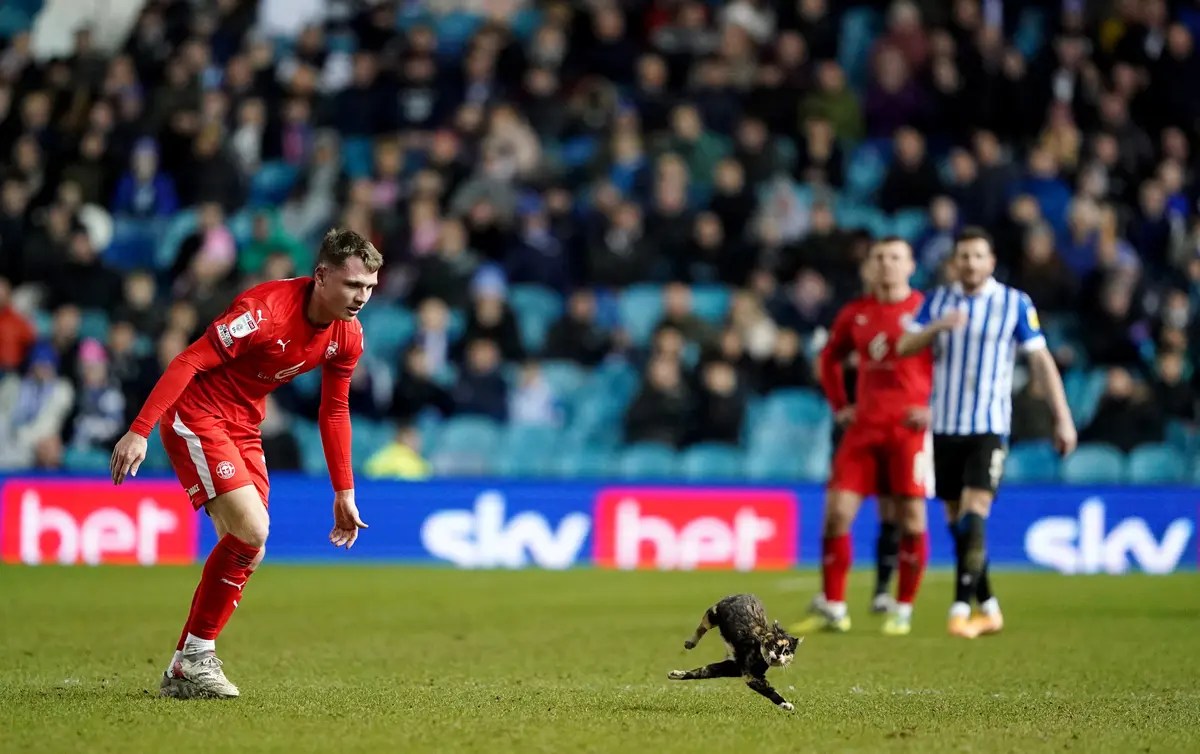
Running onto the field in the middle of a professional soccer game is probably the best thing Topsey the cat ever did.
The nine-year-old tortoiseshell went missing in June of 2021 when her human, Alison Jubb of Sheffield (UK) was going on vacation and taking Topsey to a cattery. Topsey got spooked, bolted from her carrier, and after months of fruitless efforts to find her, Jubb thought she’d never see her cat again.
Then in the 94th minute of a Feb. 8 match between Sheffield and Wigan Athletic, a familiar-looking tortoiseshell dashed onto the field. Wigan’s Jason Kerr risked a penalty to catch and calm the clearly distressed cat while the crowd erupted in cheers.
“My daughter-in-law rang me last night and said, ‘Are you watching the football match?'” Jubb said. “I said ‘No,’ and she said ‘There’s a cat that ran on the football pitch and it just looks like Topsey.’ And I sort of laughed it off because I thought it won’t be.”
But the veterinarian rang the next day and, to Jubb’s surprise and delight, said the Sheffield woman’s cat had been identified via a microchip scan.
One of Sheffield’s season ticket holders happened to be a veterinarian, and when he offered to examine the terrified feline at the stadium, he realized she had serious injuries and brought her to a nearby clinic.
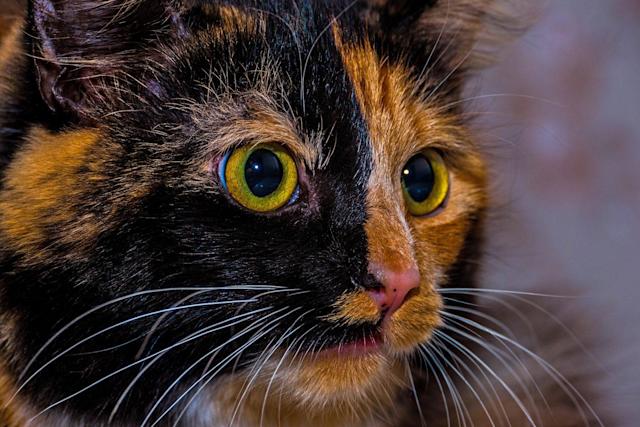
Topsey in better times before she went missing. Credit: Alison Jubb
Topsey had survived her harrowing eight-months away and her bloodwork was okay, but the veterinarian said the tough little kitty had endured an attack by a dog or another larger animal, who picked her by her neck and shook her in its jaws. Topsey suffered broken bones, a damaged spine and had teeth marks on her neck.
The veterinary bill is hefty: Jubb was told she’s looking at about £10,000, or more than $13,000 in US dollars, to cover the exams, scans, surgeries and other necessities to relieve Topsey’s pain and mend her little body.
Generous cat lovers and soccer fans helped Jubb and Topsey reach that goal in just a few days. The campaign’s donations sit at £11,585 as of Feb. 19, and any money left over from Topsey’s veterinary care will be donated to a local rescue.
Topsey can’t walk properly because of her injuries, and in the 11 days since she was rescued, she’s been in veterinary care, recovering and scarfing down food after so many lean months left her malnourished.
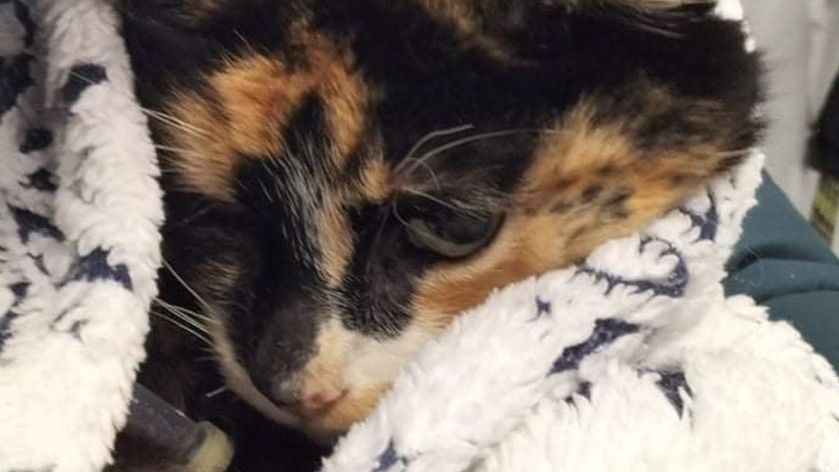
Topsey’s swaddled up in the care of a veterinarian. Credit: Alison Jubb
Despite the severity of her injuries, Topsey is “very comfy and she’s doing really well,” Jubb told the BBC.
Jubb says Topsey is constantly purring and is no doubt thrilled to be reunited with her humans and on the mend.
“Everybody has been brilliant, – my phone’s not stopped all day, it’s amazing,” Jubb said after Topsey was recovered. “And the players, I’d just like to say ‘thank you’ for being so gentle and kind with her and everybody who looked after her [on Feb. 8] because they’ve all been so nice with her and that’s lovely.”
Netflix’s Korean period drama is soaked in political intrigue, action and lots of blood. It also holds a mirror up to today’s pandemic and how our leaders are handling it.
Just when it seems like the zombie genre has run its course, a handful of visionary Korean storytellers come along to remind us there’s still life left in the undead genre.
First there was 2016’s record-setting, multiple award-winning Train to Busan, a film about an overworked father taking his young daughter to her mother’s house in the titular city just as a zombie plague tears human civilization apart.
Together with a core cast of affable characters — including a pregnant woman and her overprotective husband, and members of a youth baseball team — dad and daughter try to survive in a uniquely claustrophobic setting where simply running from the undead isn’t an option. Train to Busan wasn’t just a hit for its horror and action elements — the film packs a surprising amount of social criticism into its one hour and 58 minute run time, turning its lens onto modern Korean society and, by extension, modern life around the globe.
The movie has a 94 percent fresh rating on Rotten Tomatoes and sparked a bidding war for its US rights. A remake set in the US is currently in production by New Line.
Then there’s Kingdom, a Netflix series also called Kingdom of the Gods in Korean, that takes a zombie plague and drops it over a story about political intrigue and power struggles in the Joseun feudal era.
The series picks up at the beginning of the 17th century, when the kingdom of Joseon is three years removed from the second of two brutal Japanese invasions. Poverty is rampant, the common people are starving and the queen consort’s Haewon Cho clan has consolidated power, effectively insulating the king from his closest advisers, friends and family.
The country is desperate for leadership, but the king has disappeared after falling ill with smallpox.
His son, Crown Prince Lee Chang, tries to intervene and find out what’s happened to his father, but he’s repeatedly stopped by the pregnant Queen Consort Cho, who refuses to allow Chang into the royal palace.
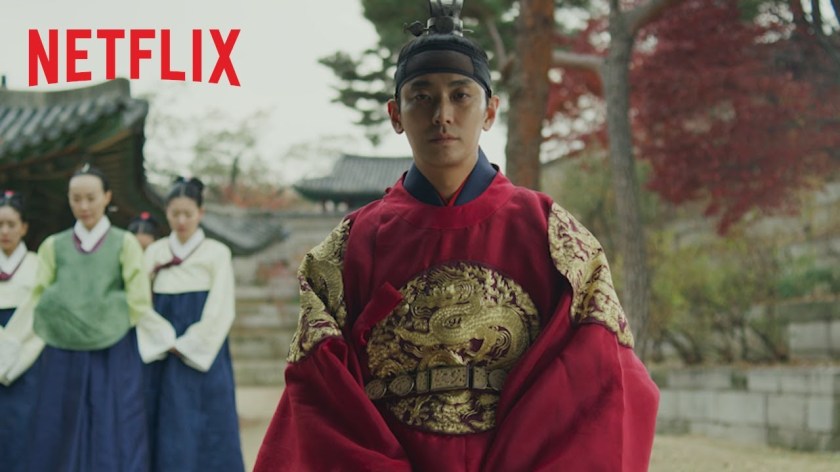
Jeoha: Crown Prince Lee Chang, wearing the distinct dragon robes of Joseon kings and crown princes, tries to gain access to the royal palace to see his ailing father, the king.
Chang is in an extremely precarious situation: Although he’s the Crown Prince and the king’s beloved only son, his mother was a concubine. If Queen Consort Cho gives birth to a son, the boy will be considered the true heir and Chang will be hunted down and executed so there can be no competing claims to the throne.
With the king missing, Crown Prince Chang knows his time is limited and if he doesn’t act, he could be arrested and put to death by the queen’s orders at any moment.
So Chang and his bodyguard/friend Mu-yeong devise a plan to steal the king’s patient journal from the royal palace at great risk to themselves. When they find bizarre entries about doctors administering a “resurrection plant” — and no subsequent entries about the king’s health — they set off south in search of the king’s physician, the one man who can tell them what really happened to the king.
What follows is a spectacular adventure fueled by gorgeous cinematography, an energetic cast of actors who go all-in on the premise, and a historically accurate look at Korea as it existed under a dynasty that lasted for half a millennia.
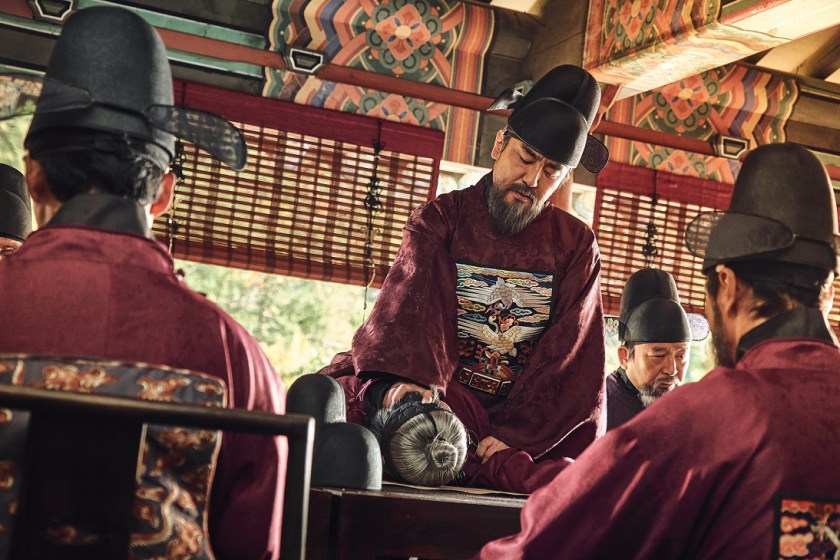
Ryu Seung-ryong plays the scheming top minister Cho Hak-ju, father of the queen consort. The double-swan embroidery on his robe indicates his status as a powerful government official. Credit: Netflix
The zombie plague itself may be the stuff of George A. Romero’s nightmares, but the attention to historical detail in Kingdom is second to none, from the costumes to the historic palaces and the strict adherence to tradition among Joseon’s bureaucrats.
It turns out the real leaders of Joseon did have many of the same dilemmas their counterparts on the show do: Kingdom’s author was inspired by historical accounts of an unprecedented deadly plague that swept through the Korean peninsula after the second Japanese invasion, piling fresh misery onto a population already reeling from Japanese invasions and hunger.
The social order compounded the misery for those at the bottom. The Joseon dynasty was marked by strict divisions between social classes, making traditionally aristocratic societies in the west look almost like pleasant meritocracies by comparison.
Everything a person wore — robes, hats, embroidered designs on their chests and backs — were indicators of class, rank and occupation. Government ministers, who were nobles, dressed in fine silks with intricately embroidered rank badges in animal motifs.
Peasants wore rags and straw hats, while the more fortunate among them wore modest clothes.
Nepotism and corruption were rampant, and the nobles, ministers and administrators who held power saw their positions as conferring privilege, not responsibility.
When a group of aristocrats and government ministers of one region take the last barge out of a doomed city, leaving thousands of vulnerable commoners behind to be eaten and turned by the tidal wave of undead, it seems unspeakably cruel and cowardly until you realize that this is a feature of the society, not a bug.
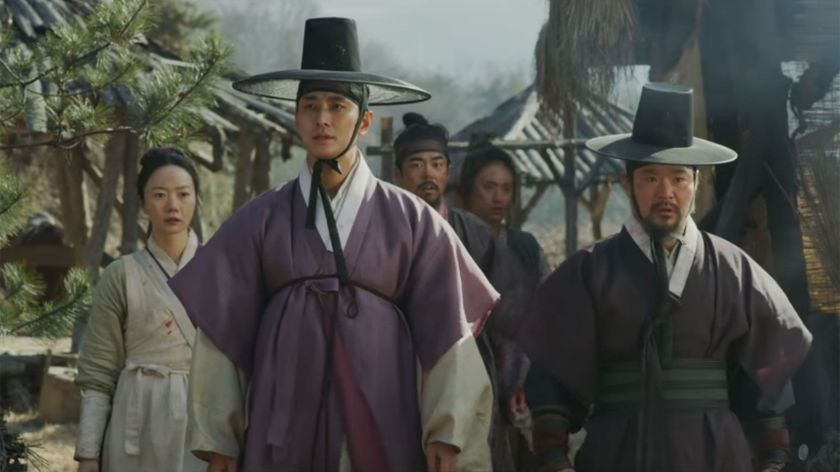
Ju Ji-hoon, center, as Crown Prince Lee Chang, with Bae Doona, left, as the physician Seo-bi and Kim Sang-ho, right, as Chang’s trusted bodyguard Mu-yeong.
When the aristocrats abandon peasants to the zombies, Crown Prince Chang and Mu-yeong risk their lives gathering a small force to protect the people and usher them to the safety of a walled stronghold.
Later, when a group of villagers bury a group of undead, unaware that they’ll rise at sunset and trample the nearest towns, the Crown Prince and his followers head out just before dusk to stop them, knowing they’ll be outnumbered and may not return.
The Crown Prince’s many kindnesses to peasants and children, and his willingness to risk his own life to protect them, draw the notice of characters who become key allies — including a member of the legendary Chakho tiger hunters, and Lord Ahn, a military hero and governor credited with expelling the Japanese during the invasion three years prior.
Crown Prince Chang set off initially to solve the mystery of the king’s disappearance and to protect himself from the scheming Haweon Cho clan, but as he sees the poverty, desperation and vulnerability of his people first-hand, he dedicates himself to a more pressing and noble cause in protecting the people of Joseon from the seemingly unstoppable plague and starvation.
In that effort, he unites people of different classes and backgrounds who fight fiercely and loyally for him, seeing hope for a brighter future if he survives and becomes king.
The physician Seo-bi, played by Bae Doona, attends to a man’s wounds.
The show never misses a chance to show social disparities: The upper classes do everything they can to protect themselves, everyone else be damned. They hide behind walls and ignore thousands of commoners — including women and crying children — who pound on the gates, begging to be let in. They abandon the peasants, and in many cases count on the lower classes serving as a human shield to allow the upper classes to escape danger.
“Are you sure this is okay?” one minister asks his sycophantic assistant as they take the last barge out of a doomed city, leaving throngs of peasants on the docks.
“You and the other nobles are the backbone of the city!” his assistant assures him. “You must survive so you can rebuild.”
As a result, the first waves of undead are the people on the lowest rungs of society. As the virus spreads to another city, a group of confused aristocrats can’t believe what they’re seeing.
“Those peasants are attacking nobles!” one incredulous man in ornate clothing says as undead in rags storm through Dongnae (modern day Busan).
Peasants attacking the upper class was unthinkable in Joseon, and by the time the aristocrats in that scene realize there’s something very wrong, it’s too late.
As the plague spreads, the ranks of the undead grow to include aristocrats in fine robes as well as peasants in rags.
Before long, the legions of undead include just as many people in fine silks and ornate embroidery, finally uniting the classes of Korea in a state of undead purgatory, their reanimated corpses hungering for the flesh of the still-living.
Eventually, though, Chang must confront the Haewon Cho clan and its patriarch, the powerful minister Cho Hak-ju.
Of course the show wouldn’t be a hit if it didn’t provide something for action and horror fans, and it more than delivers on its promises.
The action sequences in Kingdom are spectacular, and the show gives viewers lots of them, from outnumbered warriors holding a narrow pass from the undead, to zombie hordes laying siege to citadels, to close-quarters sword fighting.
The beautifully-shot sequences put shows like The Walking Dead to shame. Whereas the latter show often gives the impression that the money men behind the franchise are counting pennies, Kingdom‘s lavish sets, epic set pieces and impeccable special effects are the kind of thing viewers would expect from a summer blockbuster, not a television show.
Kingdom isn’t all action, and it takes time to breathe with quiet character moments between the narrow escapes and thrilling battles. The series is a period drama just as much as it falls within the action and horror genres. We see the inner workings of a society markedly different than anything most Westerners are familiar with, but driven by the same human ambitions.
KINGDOM
Kingdom
The story is also effective thanks to actors Hye-jun Kim and Seung-Ryong Ryu, who play the Queen and her father, high minister Cho Hak-ju. They’re villainous and power hungry without seeming one-dimensional, and both succeed in becoming focal points of the audience’s anger as they commit one despicable act after another.
Cho Hak-ju manipulates the court with the savvy of Game of Thrones’ Littlefinger and the brutality of Joaquin Phoenix’s Commodus in Gladiator. The other government ministers are terrified of him, and as the man who ostensibly speaks for the king, his word is effectively law.
The Queen, meanwhile, puts in motions schemes that would make Thrones’ Cersei look amateurish in comparison.
Kingdom’s got two seasons under its belt and a stand-alone special episode, Kingdom: Ashin of the North. Fans are eagerly awaiting the third season. It stands out as one of the best historical epics in recent memory.
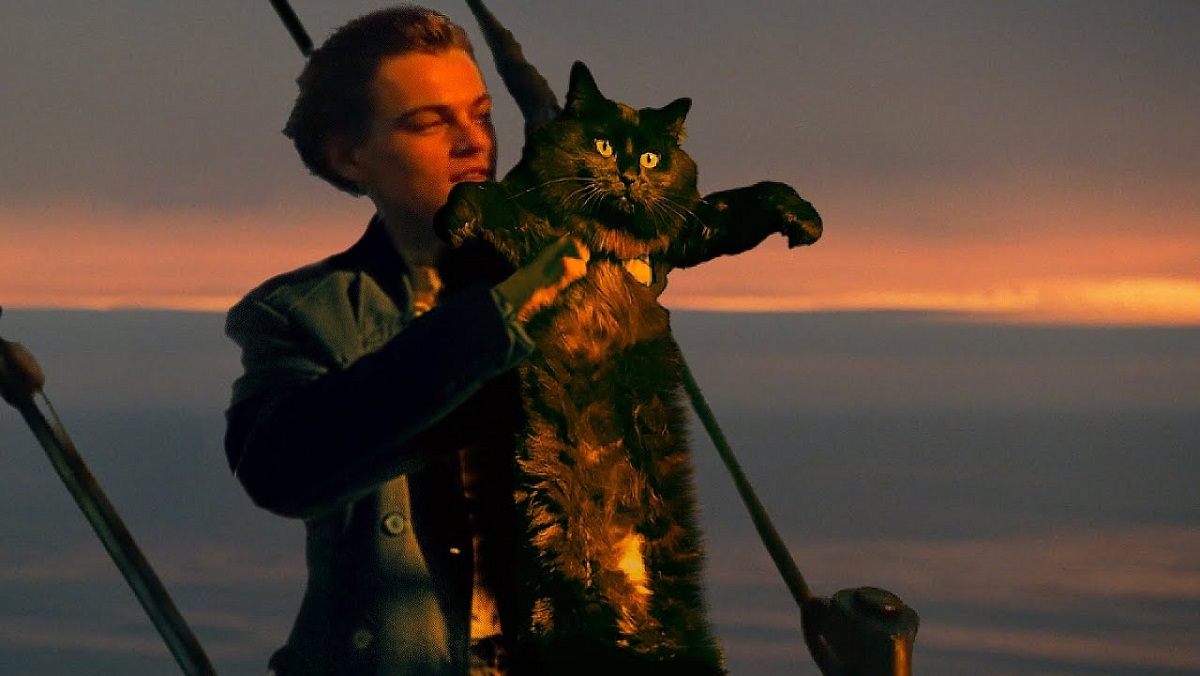
OwlKitty is back and this time she’s sliding into Leonardo DiCaprio’s DMs.
The last time I saw Titanic was in a movie theater 25 years ago when the film was just released, its theme song was befouling airwaves and its director, James Cameron, was playing at deep sea explorer in the Mariana Trench. (Cameron would return for an expedition more than a decade later, matching the depth of a science team who made the dive decades earlier, but doing it solo. His interest had been sparked by the work he did on Titanic.)
I remember feeling restless as the movie dragged out, then incredulous as women and girls all around me sniffled, dabbed at their eyes with tissues and even sobbed! Teenage Big Buddy could not comprehend it.
But this version of Titanic? It’s more my speed, coming in at an economical 1:07 running time and featuringOwlKitty in place of Kate Winslet:
As you can see, Winslet isn’t entirely gone from this cut. She just plays second fiddle to OwlKitty, Leonardo DiCaprio’s first love.
Who’s the Queen of the World now?
Want more OwlKitty? Check out her star turn in Jurassic Park, where she replaced the T-Rex and rampaged around the doomed island looking got catnip and treats.
While the answer is obvious to cat servants, proving feline jealousy in a study is a different ballgame entirely.
Bud isn’t fond of my smartphone.
Like many other humans I spend too much time looking at the damn thing, and that’s not good even though I have the excuse that I use my phone as a reader and my presence on social media ranges from extremely limited to nonexistent.
When His Grace has decided I’ve looked at the screen long enough and it’s Buddy Time, he’ll pad up and slap the phone out of my hands, or if I’m laying down he’ll climb on top of me, nudge the phone out of the way and sit on my chest so he has my full attention.
“No glowing rectangle!” he’s saying. “It’s Buddy Time! Now scratch my chin and rub the top of my head as I purr!”
Naturally I comply, and before long Buddy is leaning in, pressing the top of his head against my forehead, which is his way of saying: “I love you, slow dumb human! You have many flaws and you don’t give me enough snacks, but you’re my Big Buddy!”
Of course, intuitively knowing Buddy is jealous of — or annoyed by — my phone is different than proving it in a well-designed, repeatable experiment.
Psychology Today’s Jessica Wu writes about just such an effort by a team of researchers out of Japan.
Before I offer my criticism of the study, let me first say I have respect for the team at Kyoto University. They’re one of a handful of research teams around the world that routinely produce studies into cat behavior and cognition, and it’s clear that they view it as an important and crucial area of research. That’s significant, because even though we’ve seen something of a renaissance in cat-related studies over the past half-decade or so, many scientists still think cats are nearly impossible to work with.
The team at Kyoto also understands the territorial nature of cats makes it difficult to study them in a lab environment, so they go the extra mile and enlist people who are willing to let them into their homes to study their little tigers.
That’s what the Kyoto team did for their 2020 study on jealousy, splitting their research between typical homes and cat cafes. (Fifty two cats in total participated.) All the cats observed in the study had been living in their homes or cafes for at least six months.
Researchers took a method that’s been used to study human babies and dogs, and adapted it for felines. They brought in a plush cat and a pillow with a corresponding color and texture.
Then they asked the participants to spend time petting the plush cat and the pillow in front of their furry overlords while team members carefully watched the kitties for their reaction. Each experiment was then repeated with a stranger petting the plush and the pillow to gauge whether cats behaved differently when observing someone they aren’t emotionally attached to.
The team found the cats “reacted more intensely” to the plush cats than the pillows, but there wasn’t any marked difference in how they reacted when they watched their humans versus strangers.
Crucially, the cats didn’t show signs that they were upset, like human babies have in such experiments, and they didn’t try to physically separate their humans from the plushies, as many dogs did in their version of the experiment.
“How dare you hand out yums and not include me!” Credit: icanhazcheezburger
The results indicate cats didn’t express jealousy in the experiment, but the Kyoto team are pros, noting that it’s just one study with one approach.
“We consider the existence of some cognitive bases for jealousy to emerge in cats, and the potential effect of cats’ living environment on the nature of their attachment to their owner,” they wrote. “More ecologically valid procedures are required for further study of these issues.”
It’s my non-expert, non-scientific opinion that researchers would get better results using actual cats instead of proxies. That introduces a new set of problems and an experiment involving rival cats won’t be easy, but science isn’t supposed to be easy, and if we really want to understand how cats think, we have to get as close as possible to mimicking real circumstances.
The plush cat used in the Kyoto study. Perhaps the cats involved in the research felt the humans were insulting their intelligence. Credit: Kyoto University
It would also help to expand the scope of the experiment. How much can researchers really glean from a fleeting interaction? Jealousy isn’t something that just bubbles up and disappears. It happens within an emotional context. It’s a secondary emotion that sprouts from elements of primary emotions like fear, anger and confusion.
Scientists are very careful about anthropomorphizing animals, for obvious reasons, but sometimes they’re guilty of over-correcting as well and denying the obvious, which is why the prevailing scientific opinion for almost half a century, until 1959, was that animals don’t have emotions or cognition.
In the meantime, Buddy will continue to make sure Buddy Time is equal to, or greater than, glowing rectangle time.
One lucky cat in Ohio has an aquarium designed just for him.
Cats love watching fish almost as much as they love eating them, but felines and their aquatic counterparts are infamously difficult to keep as pets in the same house.
People who own standard aquariums inevitably learn they tend to double as unintentional treat cabinets for determined kitties who find ways to get at nature’s snacks inside. Some opt for supposedly more secure aquarium covers and resort to the usual tricks — double-sided tape, scent deterrents, foil — to keep their furry friends from climbing up to help themselves to treats.
Others take the easy route, pulling up hours-long Youtube videos of fish tanks for their cats’ amusement.
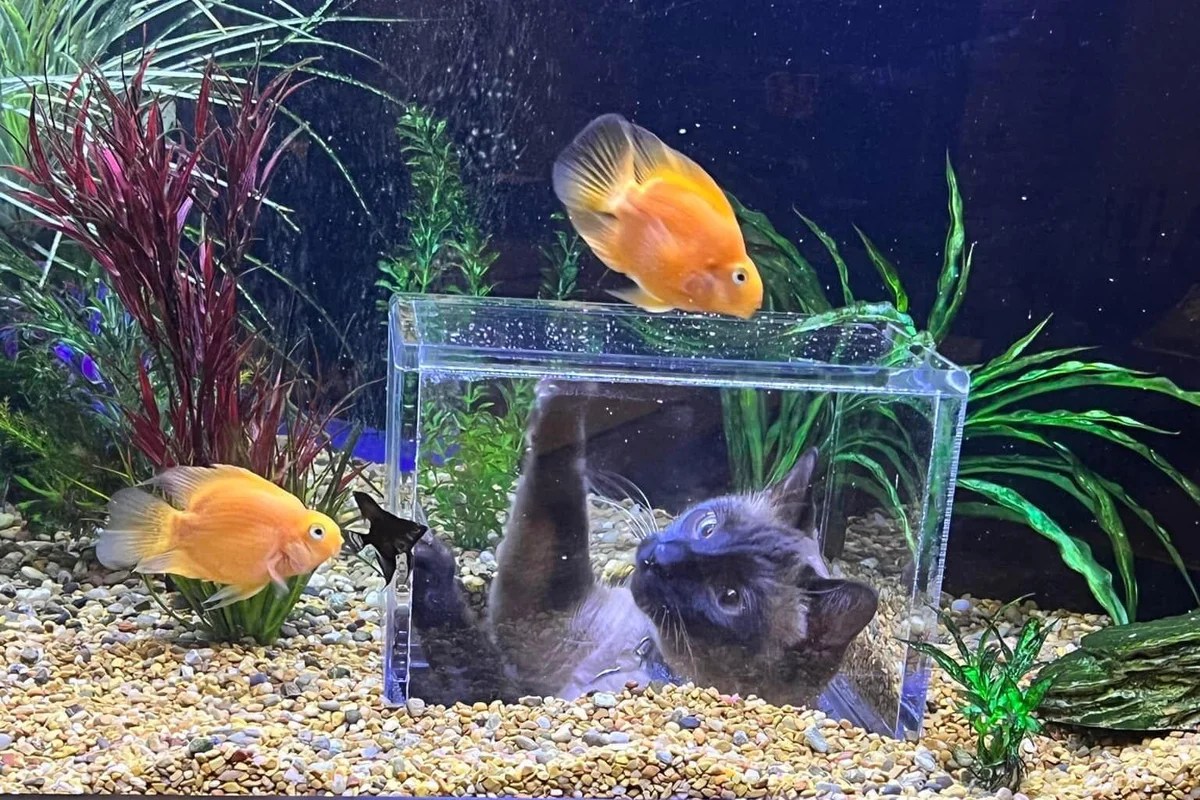
But one cat has the ultimate set-up, cat TV at its finest: A custom-built aquarium that provides him with a 360-degree view of the action from within the tank.
The cat’s name is Jasper, and his human, Melissa Krieger, bought the cat-approved tank from a Cincinatti shop that designs and builds custom aquariums.
There’s a cat-size shelf directly beneath the tank, and an observation blister built into the bottom of the tank itself, big enough for Jasper to poke his head up and get the closest view possible short of diving into the tank. Melissa even put a cat bed on the shelf so her furry overlord can watch the fish in comfort.









 Pain In The Bud