Morbidly Obese Cat Completely Transformed After Shedding Half His Weight

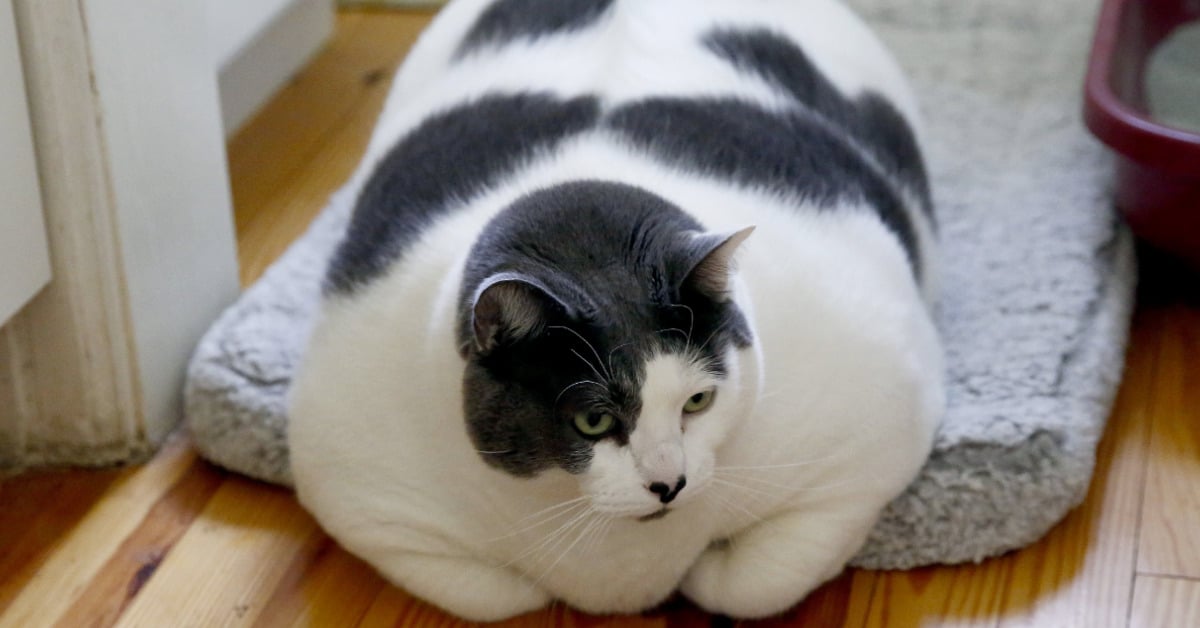
Patches was the biggest cat the staff at a Virginia animal shelter had ever seen, and was within snacking distance of the all-time record.

When Patches was surrendered to a Virginia animal shelter in mid-April of 2023, the staff — including longtime veterans of cat rescue — were taken aback.

The six-year-old feline weighed in at a staggering 40-plus pounds and was so big, the shelter staff had to keep him in an office because the largest crates they had were barely large enough for Patches to turn around.

“We thought we had seen big cats before, but he was definitely the biggest that we’ve ever seen,” Richmond Animal Care and Control’s Robin Young told the Washington Post at the time.

Patches was in dangerous territory for his personal health, and if allowed to continue gaining weight, he’d threaten the world record for a domestic cat, which is more than 46 pounds. (Guiness World Records stopped recognizing the heaviest cats decades ago because the organization didn’t want to encourage people to overfeed their cats in pursuit of the record.)

Top row: Patches in the early days shortly after his adoption. Bottom row: Patches after losing a significant amount of weight.

Last week, Patches reached a new milestone, weighing in at 18.94 pounds after more than two years of eating healthy and getting exercise with the help of Kay Ford, a retired businesswoman who adopted him.

It’s an incredible achievement, and one that was hard-fought, as anyone familiar with cats will know. Many well-fed cats can convince almost anyone they’re starving.

Ford’s pitch to the shelter made it easy for them as they fielded a flood of adoption applications for the chonkster, who had attracted plenty of attention as soon as the shelter posted about him online.

Ford told the shelter she was experienced, committed to helping Patches get down to a healthy weight, and would look forward to the challenge. She’d put on a few pounds during the pandemic, she added, and would lose weight alongside her new pal.

“I’ve had cats all my life,” Ford told the Post at the time. “It just seemed like the right thing.”

Ford with Patches shortly after meeting him. Credit: Richmond Animal Care and Control

She agreed to meetings at the shelter to review a weight loss plan and began documenting Patches’ progress on a Facebook page, Patches’ Journey, which now has more than 53,000 people following the feline’s transformation.

His diet isn’t over, and it’s a lifestyle change meant to be permanent, but there are a lot of people who are proud of the (much less) big guy, who now looks like a completely different cat.

Images via Patch’s Journey/Facebook

California Becomes 6th State To Ban Cat Declawing

Three states have banned declawing so far in 2025.

Six down, forty four to go.

California became the sixth and latest state to ban cat declawing this week when Gov. Gavin Newsom signed Assembly Bill 867, which makes it illegal to remove a feline’s claws unless it’s medically necessary for the health and survival of the cat.

Declawing may sound like a sort of kitty manicure, but the neutral name disguises a cruel form of elective mutilation that involves amputating a cat’s toes at the first knuckle.

It’s the equivalent of chopping off a third of each finger, all to prevent potential damage to inanimate objects like furniture. The procedure has been condemned by every major animal welfare group including the Humane Society and the SPCA.

Credit: Tamba Budiarsana/Pexels

Declawing inflicts a lifetime of pain on cats, changes feline gait and posture, leads to early arthritis and causes a long list of secondary problems. For example, declawed cats are much more likely to bite because they have no other form of defense when they feel threatened, and they’re also much more likely to stop using litter boxes because it hurts to walk on the sand-like and granule texture of the litter with half-amputated toes.

Lawmakers haven’t worked out the details on how the new law will be enforced or what the penalties will be if veterinarians illegally perform the procedure. Other states have implemented a system of increasingly harsh fines and the suspension of veterinary licenses for repeat offenders.

New York became the first state to ban declawing in 2019. Maryland and Virginia followed in 2022 and 2023, respectively, and in 2025 Massachusetts, Rhode Island and now California have all passed similar laws.

Declawing Banned: Rhode Island Becomes 5th State To End Cruel Procedure

Rhode Island’s law has some teeth: veterinarians who violate it will have their licenses suspended or revoked.

Five down, forty five to go.

With a new law going into effect in the fall, Rhode Island joins New York, Maryland, Virginia and Massachusetts in banning the declawing of cats.

Declawing may sound like a sort of kitty manicure, but the neutral name disguises a cruel form of elective mutilation that involves amputating a cat’s toes at the first knuckle.

It’s the equivalent of chopping off 1/3 of each finger, all to prevent potential damage to inanimate objects like furniture.

“Declawing is painful, unnecessary and inhumane. It’s no way to treat any pet,” said Rhode Island state Sen. Melissa Murray, one of the bill’s co-sponsors. “Fortunately, there has been growing awareness of the risks and cruelty of declawing. Our state must recognize that declawing is animal abuse and prohibit it altogether.”

Rhode Island’s new law is more prohibitive than some of the others: veterinarians who declaw cats once the law goes into effect on Sept. 1 will have their licenses suspended or revoked entirely.

Declawing doesn’t “just” cause short term pain from the procedure. It forces cats to change the way they walk and move in general, altering their gaits. As a result, declawing leads to early onset arthritis among a host of other medical problems.

Declawing also results in psychological and behavioral problems. Cats who are declawed often become depressed, and they’re more likely to avoid the litter box since standing on litter is painful for them.

Since the procedure also takes away their primary defensive mechanism, declawed cats are much more likely to bite, which along with litter box avoidance means they’re more likely to end up abandoned in shelters.

Bud’s got this one, which is sold as the Ultimate Scratcher, which is about 3 feet tall and sturdy, offering an optimal place for cats to literally scratch their itch.

Cats should never be declawed!

There are several viable options for keeping them from scratching furniture, including nail caps and redirecting them to scratchers. The latter are a bare necessity if you have a cat, as scratching is a natural feline behavior and our little friends will find something to scratch if we don’t provide them with appropriate scratching surfaces.

Since cats like to stretch while they scratch, I highly recommend getting a large tower scratcher with a secure base. Bud has one, he uses it constantly, and he does not touch the couch or the chair in the living room, nor does he touch any other furniture. It can be done, it just requires patience and consistent redirecting, with positive encouragement.

Negative reinforcement, such as yelling at your cat, will not achieve results. The only thing it will accomplish is damaging your relationship and trust with your cat.

Since New York became the first state to ban declawing in 2019, more states have considered similar legislation. Although routinely opposed by state Veterinary Medical Associations — special interest groups that represent a portion of veterinarians who see declawing as a reliable money-maker — lawmakers have allied with veterinarians in support of bans, as well as groups like the Humane Society, the SPCA, the Animal Legal Defense Fund and the Paw Project to overcome opposition and get bills passed.

Let’s hope the trend of declawing bans continues.

‘They’re A Really Dope Companion’: Jordan Poole Is The NBA’s Most Doting Cat Dad

The Washington Wizards’ Jordan Poole loves cats, and he’s showing his fellow NBA players what awesome little buddies they can be.

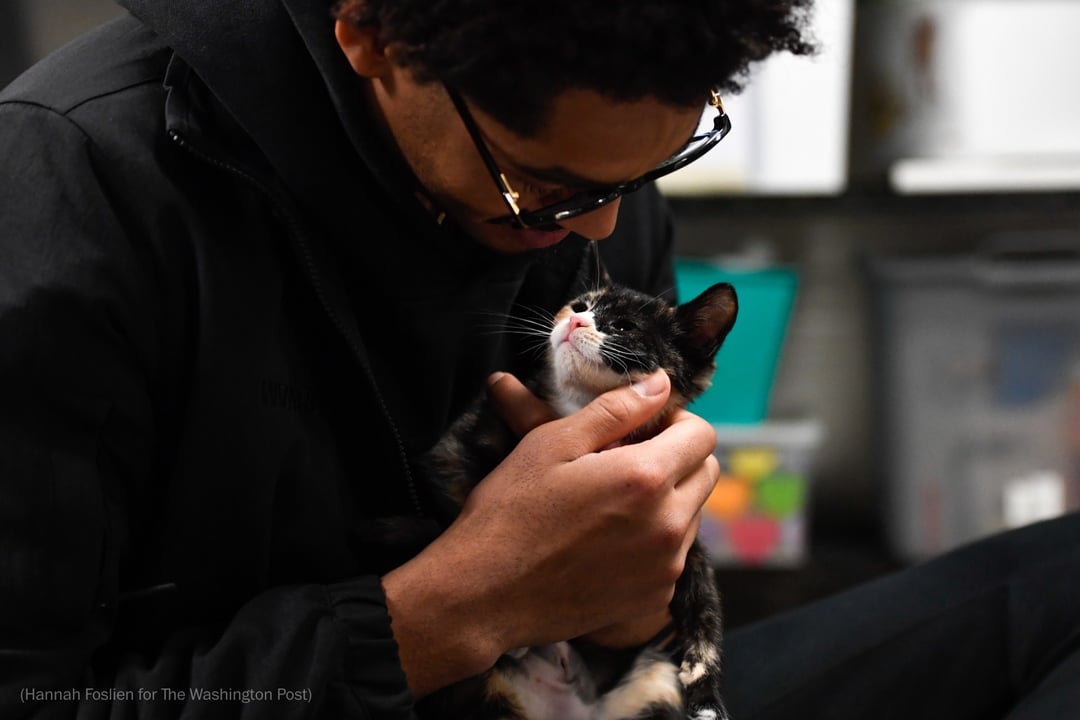
Jordan Poole finds it difficult to leave the Falls Church, Va., animal shelter where he volunteers.

He likes the staff and fellow volunteers, but most of all he hates leaving while knowing the cats he’s interacted with still need homes.

“Every time I come, it’s: ‘Let me leave with all of them! Give me 14 of them right now!’” he joked to the Washington Post’s Candace Buckner, who calls him “the lead crusader of the Secret Society of NBA Cat Dads.”

Some aren’t so secret: teammate Tristan Vukcevic recently adopted a cat after Poole converted him to the dark side, and a coy Poole says he “may have” convinced NBA superstar Stephen Curry to adopt a feline friend.

Poole with one of his tabby cats, brothers he adopted together from a California shelter when he was with the Golden State Warriors. Credit: Jordan Poole/Instagram

In a 2022 profile in The Athletic, Poole’s mother Monet says her son adopted his first cat when he was in high school.

“And when I tell you he fell in love with cats,” she said. “He loves his cats. … And he’s got some pretty cats too.”

When Poole was drafted by the Golden State Warriors in 2019, his cat stayed with his mom back in Michigan because she wouldn’t have adjusted well to the move to the west coast, as well as an empty apartment when Poole was on road trips with the team. Later that year, the then-rookie adopted brother cats who had been abandoned by their former owner.

Since he was traded to the Washington Wizards, Poole has volunteered at a Virginia shelter.

His enthusiasm is one reason why he’s been able to get teammate and friends interested in adopting. The NBA has other notable cat dads, including twins Brook and Robin Lopez, whose cats hilariously can’t stand each other. But Poole takes it to another level.

“A lot of guys are dog people, but just the energy [and] the way I talk about [cats], the pictures and videos and stuff that I show them, it just gives them a little bit more interest,” Poole told the Post. “So I give them a different perspective. Maybe they’re not as much maintenance, but they’re still a really dope companion and friend to have. You don’t have to really take them out three or four times a day. You can still get your rest. Normally [my peers] like to explore it. I’ve had a lot of friends and teammates who are also cat people.”

Former Knicks center Robin Lopez, pictured with his cat Edward, says his brother’s cat is sneaky and evil for attacking Edward: “The second I lay eyes on him, he’ll act like, ‘I’m a cherub. I’m innocent.’ I’m not buying it.”

The 25-year-old Poole is averaging 20.3 points, 4.8 assists, 3.1 rebounds and 1.5 steals per game this season while shooting an excellent .391 on three-point attempts. The 6’4″ guard spent his first four seasons with Golden State before he was traded to Washington.

Today We Celebrate The House Panthers And The Voids

A Virginia man created National Black Cat Appreciation Day, a celebration of melanistic house panthers, in honor of his late sister, who loved her 20-year-old black cat named Sinbad.

Happy National Black Cat Appreciation Day!

A few years after the death of his 33-year-old sister, June, Wayne Morris wanted to do something in her honor. June adored her black cat, Sinbad, who died at 20 years old, just two months after she passed.

So the Virginia man teamed up with Rikki’s Refuge, a sanctuary where he volunteered, and created National Black Cat Appreciation Day in 2011. Morris chose the day of June’s passing, August 17, in her memory, and that first year marked it by holding a fundraiser for Rikki’s Refuge.

Morris was delighted by black cats as well. He often posted about Norman and Batman, his own melanistic miniature panthers, advocated for the adoption of black felines, and painted whimsical scenes of cats, which were auctioned to raise money for Rikki’s.

(Above, clockwise from top left: Batman, Wayne Morris, Norman, Batman again, and one of Morris’s paintings.)

Wayne Morris died in 2022, but the day he founded has continued to grow in popularity. In the 14 years since its inaugural celebration, National Black Cat Appreciation Day has spread via fundraisers for shelters across the country, as well as sites within the online catosphere, like this one.

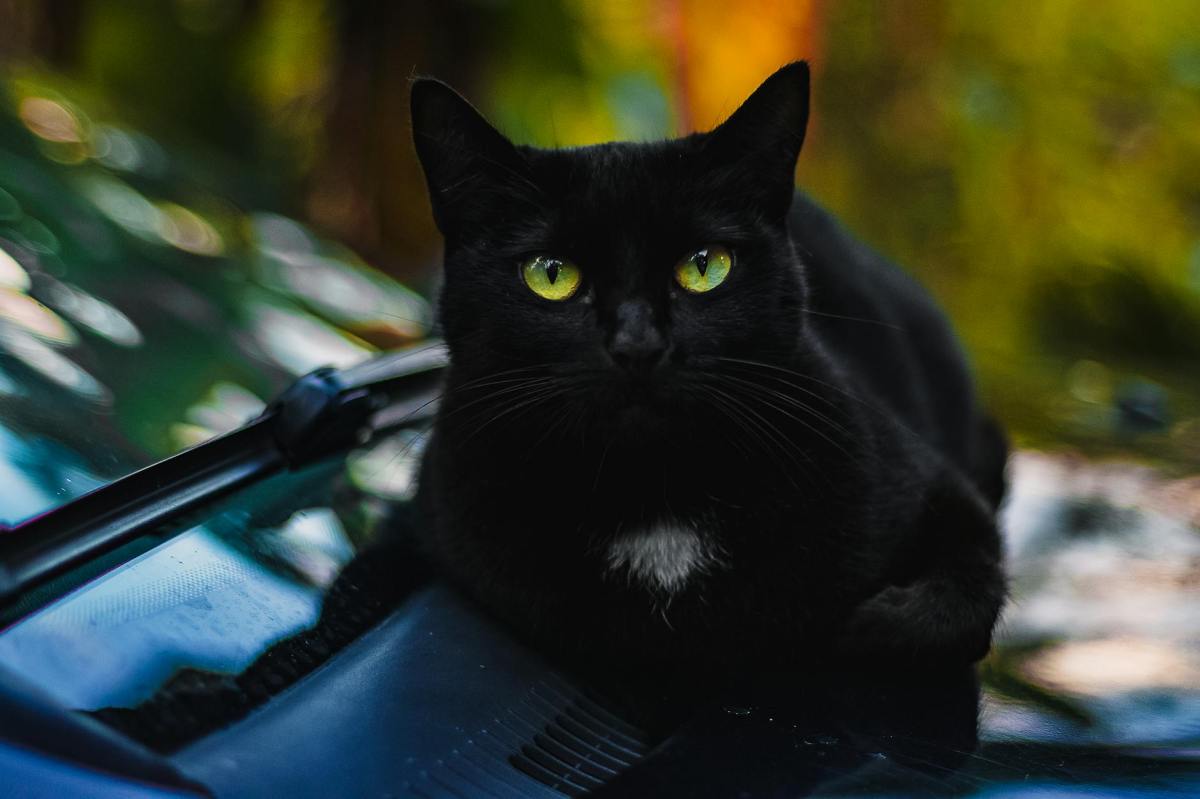
Morris was motivated beyond honoring his sister and raising money for his favorite rescue. Black cats — also affectionately known as voids — have suffered unfortunate reputational damage over the centuries.

Melanistic felines are actually considered good luck in Japan, China and most of Asia, where they can be found in temples and their likenesses are used as maneki neko, the ubiquitous “lucky cats” in homes and businesses. (Black maneki neko are said to ward off evil spirits, diseases and people with bad intentions, while the golden cat statues are associated with wealth and the white neko are thought to bring good health.)

But in much of the western world they’re associated with bad luck, “evil” forces in folklore, and they’ve been invoked in outbursts of moral panic over things like witchcraft.

Black_jaguar_edin_zoo
Big cats can be voids too, like this stunning black jaguar in Scotland’s Edinburgh Zoo. Credit: Wikimedia Commons

A black cat — or a statue of one — was said to be involved in Satanic rituals in Spain by Konrad van Marburg, an inquisitor known for his brutal zealotry. While the effect of that accusation has been exaggerated for years in internet discussions and posts (Pope Gregory IX’s papal bull dealt with a small area of Germany and did not declare that black cats were Satanic), it naturally comes up in superstitions about the animals.

A 2020 study of 8,000 adoptions found black cats were less likely to be adopted and more likely to be euthanized. That study and others found there was “scant evidence” for the dramatic margins suggested by anecdotal accounts circulating online and in some publications, but confirmed the problem is real. Research also suggests that negative perceptions of black cats isn’t correlated to religious preferences, but is tied to general belief in the supernatural.

Interestingly, additional research has hinted at a decidedly more modern and petty reason people may hesitate to adopt black cats: they think voids are more difficult to photograph, which is an issue for people who want to show their pets off online. (We’ve written about that particular hang-up before, and noted it’s possible to take beautiful photographs of voids by being mindful of factors like lighting and contrast between fur color and the background.)

Regardless, the combined effect of the superstitions and negative associations has harmed black-coated felines, and National Black Cat Appreciation Day is also an attempt to push back and show people that black cats are just, well, cats.