In Ukraine, Cats and Dogs Suffer Along With Their Human Companions

Shelters in Ukraine are running out of food, while the country’s stray cats and dogs are particularly vulnerable as war rages around them.

If you’ve got a cat who doesn’t handle the Fourth of July well and gets freaked out by the annual fireworks, imagine that multiplied by about a thousand, with no respite.

Then imagine that, instead of reassurance from calm humans who know the explosions are just part of a celebration, the cats and dogs of cities like Kiev pick up on the anxiety of the people around them, sensing their fear, reading their body language.

War takes a terrible toll on humanity, a fact that’s been well-documented for centuries, but much less has been written about the suffering and fate of animals in the crossfire of forces they can’t comprehend. (One outstanding take on animals in war is 2006’s Pride of Baghdad, a heartbreaking account of four lions who escaped Baghdad Zoo as US bombs rained down on the Iraqi capital. While Pride of Baghdad is a fictionalized account of what happened to those lions, the story is sadly, infuriatingly true and remains one of the lesser-known accounts among the tens of thousands of stories told about the toll of that war.)

In Ukraine, where the Russian military has taken control of the local airspace and destroyed the country’s airports, people are taking their pets and what possessions they can as they try to escape by land via routes to the border that are backed up by 15 miles or more.

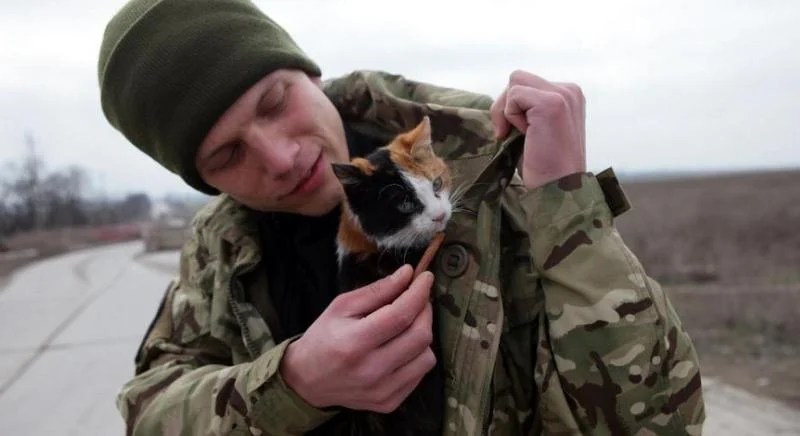
Ukrainian soldier with stray cat
A soldier holds a cat in Mariupol, southeastern Ukraine. Credit: Aleksey Filippov

Meanwhile, as all men of fighting age have been called to stay, stray dogs have been a comfort to Ukrainians on the front line. The soldiers feed the dogs, and the hyper-vigilant dogs alert the soldiers to any unusual activity they pick up on.

“She immediately barks or growls if the enemy is planning an attack. It’s safer and calmer with her – no wonder they say that a dog is man’s best friend,” a 21-year-old Ukrainian soldier named Mykyta told Agency France-Presse as he gave an affectionate pet to a dog adopted by his unit.

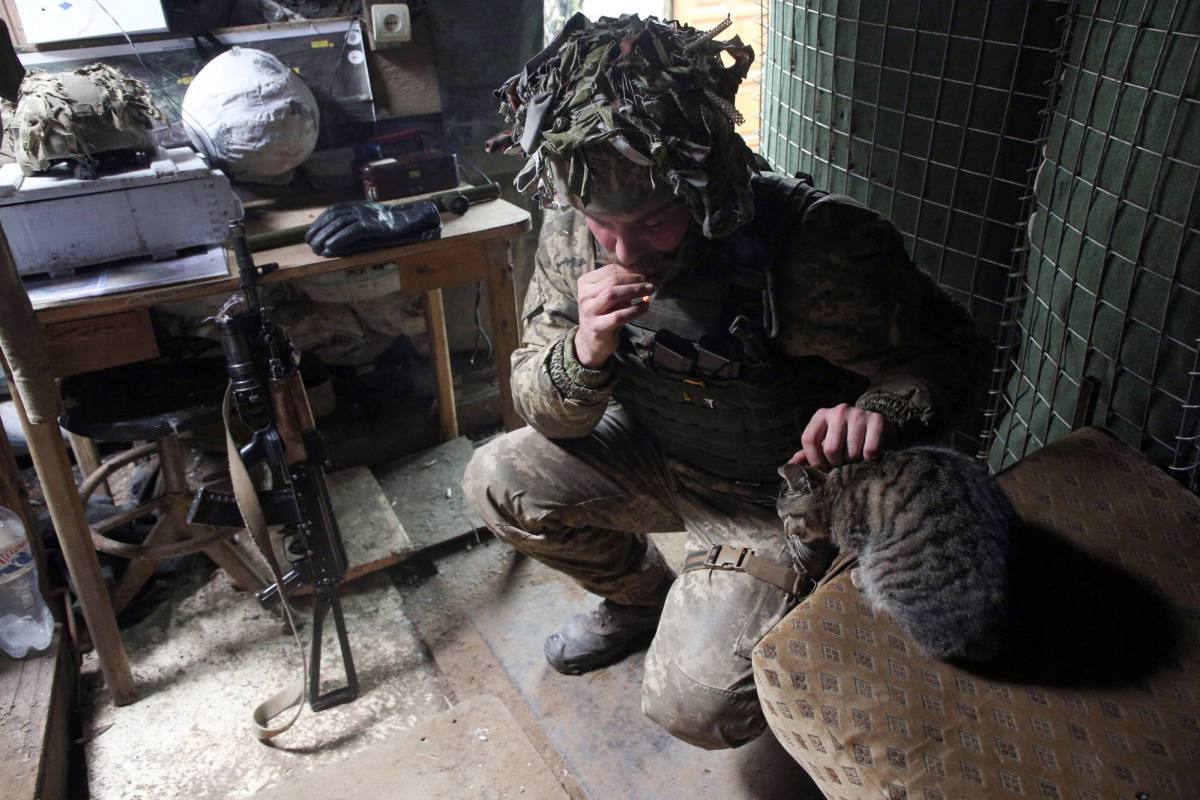
Stray cats are cozying up to the soldiers as well. Dmytro, a 29-year-old soldier, said a black cat he named Chernukha has kept him company and helped him cope.

“You come back to the post, lie down on the bed, and here comes Chernukha,” Dmytro told AFP. Chernukha “lies on your stomach and looks at you as if she wants to be petted. It’s a sedative.”

Like many Ukrainians, staff and volunteers who man the country’s shelters have remained defiant and refused to leave. In Kiev, staff at Best Friends shelter are rationing food and trying to locate more.

“It is very difficult and scary for [the animals] and for us. Due to the fighting, suppliers of food for animals are not working,” a shelter staffer told Newsweek. “We need help now with animal food and its transportation to the shelter. We will also be grateful for the financial support.”

Getting food is already difficult and will become more so as Russian troops push further into the capital and civilians hunker down in homes, basements and bomb shelters.

Nastya Aboliesheva, who works for Kiev-based Happy Paw shelter, said “no one is willing to risk their lives to deliver what is needed.”

“Our work now remains important and necessary, because animals do not understand what is happening and also need food and treatment….the main thing that people can help now is not to throw their animals at random, but to be near them or to evacuate with the animals,” she said. “We very much hope that local authorities in Kyiv and other cities will allow people to take animals in boxes to bomb shelters.”

Top image: A Ukrainian soldier petting a cat. Credit: AFP

Nubbins The Cat: Is It Ever Right To Steal A Kitty You Believe Has Been Abused Or Neglected?

A couple who rented an Airbnb took a man’s cat, believing she was a neglected stray. The man says the cat is well-loved and desperately wants her back.

Troy Farrell’s cat, Nubbins, has been missing since October.

Neighbors told the Sonoma man that a couple who rented an Airbnb two houses down the street had been asking about the nearly tailless tabby and had seemed fond of her. That was Farrell’s only lead, but the owner of the Airbnb rental wouldn’t tell him who rented the place at the time Nubbins vanished.

When I read about Nubbins my first thought was that she was probably snatched up by people who thought they were doing the right thing by “rescuing” a neglected cat.

It turns out that’s exactly what happened.

First a veterinarian from Long Beach, more than 400 miles away, called Farrell and told him Nubbins had been brought into the vet’s practice for a health checkup. When they scanned the kitty’s microchip, Farrell’s contact information came up.

Farrell says he thought his ordeal was over, but the veterinarian — citing obligation to the client — wouldn’t tell him who brought the cat in. Instead, the vet said she’d pass along Farrell’s contact information and ask the couple to return the cat.

When they didn’t return Nubbins, Farrell filed a police report with the Sonoma County Sheriff’s Office, hired a private investigator and implored the local district attorney to look into the case.

“Those are evil people,” Farrell told an interviewer in late January. “Those are people without a conscience, those are people without a heart.”

He said he’s been lost without Nubbins.

“I don’t have kids. She’s my kid and she’s seen me through so many things. And they took her, and I want her back,” Farrell said. “The second I’d open that door or drive up the driveway or go out back … There’s Nubbins just in my lap.”

Nubbins and her kittens
Nubbins in Farrell’s home. Originally a stray who escaped California’s wild fires, Nubbins gave birth to a litter before Farrell had her spayed and chipped.

The ‘catnapper’ comes forward

Now there’s a new development in the case: A man has come forward and admitted he took Nubbins, describing her as a neglected street cat who had been left outside to fend for herself in the cold without access to food or water.

The man detailed the allegations in a letter to Sonoma County Sheriff Mark Essick, and he’s not hiding his identity or denying he took the cat without asking Farrell. He identified himself as James R. Wakefield, an attorney in private practice out of Irvine, California.

“[W]e were never going to let that cat get put back in the living condition she was in without a fight,” Wakefield wrote in the letter to the sheriff.

While vacationing at the Airbnb in California wine country, Wakefield encountered Nubbins, saying she was “obviously hungry” and “she scarfed down the food” the vacationing couple gave her. Wakefield said that when he asked the Airbnb’s owner about the cat, the man said she was a local stray who needed a home.

Describing him and his wife as “70-year-old catnappers,” Wakefield said they’d do “everything in our ability to protect” Nubbins.

Farrell disagrees. He said the stumped tail and damage to Nubbins’ lip were from her days as a stray, when she escaped California wildfires several years ago and wandered into Farrell’s neighborhood. He took her in, he said, and she’s been his cat since. Nubbins is allowed in and out of the home as she pleases, he said, and always returns after she’s had her day’s adventures.

Nubbins refuses to be an indoor cat, Farrell said, and is well known to neighbors on the block, who also feed her and look out for her. It’s not uncommon for outdoor cats to make small circuits around their neighborhoods, visiting friendly neighbors for snacks and scritches before heading home for the day.

“That cat lives so large it’s not even funny,” Farrell said. “That cat has so many houses, so many people, so many little girls to play with down the block.”

Nubbins the Cat: Lounging
Nubbins lounging outside. Her human, Troy Farrell, says the former stray likes to visit his neighbors every day.

That appears to be true: Farrell’s neighbors have backed up his story to the press, there are videos of the beloved cat hanging out in yards on the street, and one concerned neighbor even wrote a letter to the local newspaper imploring the police to get the situation sorted and return Nubbins to Sonoma.

The police have told Wakefield to return the cat to Farrell, while a spokesman for the district attorney told the Sonoma Index-Tribune that the DA is still reviewing the case. Like many other states, California considers pets as “property,” and authorities would have to determine if Nubbins is “worth” at least $950 to file criminal charges.

If Farrell can’t get Nubbins back via law enforcement his remaining recourse would be a civil trial, the newspaper noted.

Is it ever okay to steal someone’s pet?

This case raises some thorny questions. Farrell seems lost without his cat and has been clearly emotional in interviews with reporters as the saga of Nubbins has stretched on over the months. Meanwhile, I don’t think there’s any doubt Wakefield and his wife thought they were doing the right thing.

At least part of this standoff can be chalked up to misinformation and a lack of information: Matthew Knudsen, the man who rented the vacation home to the Wakefields, told them Nubbins was a stray who didn’t belong to anyone, according to Wakefield’s letter to the sheriff. Farrell said Knudsen owns and rents the house two doors down but doesn’t actually live in the neighborhood and doesn’t know how well Nubbins is cared for.

So from the Wakefields’ point of view, they thought they were rescuing a neglected cat and doing a good thing. At the same time, any cat servant should be able to empathize with the anguish another cat lover feels if their beloved feline goes missing or is stolen.

It’s easy to read the details and think maybe Farrell wasn’t doing right by his cat, and as readers of this blog know, I’m a strong advocate of keeping cats indoors for a long list of reasons, including myriad dangers to outdoor cats and the damage cats can do to local wildlife like birds, small mammals and lizards.

But I also know how easily people tend to toss out accusations of animal abuse and/or neglect. One reader was very upset with me when I posted a photo of Buddy with his paws stuck in the screen door that opens from the living room to the balcony. She strongly felt I was abusing Bud by allowing him to hang there for a few extra seconds while I snapped a few photos.

Context is important in that case too. Buddy loves to lounge on the balcony in the summer, and he’s gotten his claws stuck on that damn door more times than I can count. (The many claw marks on the screen attest to that.) When he gets stuck he cries pitifully until I drop whatever I’m doing, lift him gently off the ground so he can unhook his claws without hurting himself, and reassure him in a soothing voice that he’s okay. It’s the cat dad equivalent of putting a band aid on a scraped knee.

No matter how many times Buddy gets stuck, no matter how many times I tell him “No!” and try to discourage him from scratching the door, he won’t stop doing it. He’s even got a four-foot-tall, sturdy scratcher literally a foot away, just a step inside the door! Clearly he has alternatives.

Not only is Buddy incredibly stubborn, but the day I took the above photographs, he’d already gotten stuck twice — including 20 or 30 minutes prior.

So yeah, I took the photos. Does that make me an animal abuser or guilty of neglect?

That woman thought so. If she’d been in a position to take Buddy, maybe she would have.

At the very least, the saga of Nubbins provides another good reason to keep cats indoors, even if they’re former strays who like to go outside. (Easier said than done, I realize.) But I don’t think there are any bad guys here, just people who thought they were doing the right thing without complete information.

PITB readers: What’s your take on this story?

Pa. Man Charged With Felony For Running Over Cat With His Truck

A former local councilman in Pennsylvania faces animal cruelty charges for allegedly running over a cat earlier this month.

A former councilman in rural Pennsylvia faces two animal abuse charges after trying to run down a group of cats — and hitting at least one — with his truck earlier this month.

Frank Pagani Jr. was charged with aggravated cruelty toward animals, a felony, as well as a misdemeanor animal cruelty charge, according to a story by Beaver County Times reporter Garret Roberts.

Neighbor William Bittner, who helps care for the neighborhood strays, captured the Dec. 1 incident on his home security camera. The clip (embedded below) shows Pagani’s truck speeding up on the residential street and swerving toward cats who were in the road before blowing through a stop sign. Pagani Jr. then made a left turn to a side street and pulled into his driveway a few hundred feet away.

The 31-year-old was behind the wheel of the truck and his father, Frank Pagani Sr., was in the passenger seat during the incident, according to the Times. The Paganis live in New Galilee, a town of 379 people in rural Pennsylvania about 50 miles north of Pittsburgh.

In this still from Bittner’s video, Pagani’s white pickup truck aims for a cat, circled, in the road. The cat hasn’t been seen since.

Bittner said last week that Pagani Jr. called him after he realized the incident was caught on video and said he’d resign his council seat.

“He thinks that’s the end of it,” Bittner said at the time. “You just can’t let an act like that go on without someone being charged.”

Bittner and his neighbors have been caring for the stray colony for years. In addition to feeding the strays, they’ve run a trap, neuter and return (TNR) program, fixing 28 cats, and have found homes for kittens who were born to the colony cats.

The Pagani family apparently panicked when they realized Bittner had captured the incident on video and posted it to Facebook. Per the Times:

“The police affidavit also details repeated phone calls were made to the homeowner who caught the incident on camera by Pagani, his father and his mother. Voicemails received by police detail the family asking for the video to be taken down.”

The video shows Pagani’s truck striking at least one of the cats, who immediately ran off with the other strays. It’s not clear how badly the cat was injured, and Bittner said “he’s not showing up” at regular feeding times.

“We’ve been searching and searching and we can’t find him,” he told WKDA, the local CBS affiliate.

Locals who reacted to the video on Facebook were horrified by the footage.

“I adopted one of those kittens,” one woman commented. “This breaks my heart.”

Pa. Politician Resigns After Running Over Stray Cats With His Truck

“We don’t need his idea of animal control,” says one neighbor, who has been caring for the local cat colony for years.

Neighbors who live on a quiet street in rural Pennsylvania were horrified when a man in a white pickup truck intentionally tried to run over stray cats last week, hitting at least one.

Now, thanks to one neighbor who captured part of the attack on video, they’ve identified the man at the wheel, and he’s a local politician.

Frank Pagani Jr. resigned from his seat on the municipal council of Galilee, a rural Pennsylvania town with a population of 379. Video shows Pagani Jr. speeding up and swerving to hit one of two cats who were in the road at the time. He was going so fast he blew through the stop sign at the end of the street.

The brazen politician then made a left turn and casually pulled into his own driveway on a side street.

William Bittner, who captured part of the Dec. 1 hit-and-run on video, said Pagani called him afterward, admitted what he’d done, and said he would resign his council seat.

“He thinks that’s the end of it,” said Bittner, who takes care of the cats along with other neighbors on the street. “You just can’t let an act like that go on without someone being charged.”

The Beaver County Humane Society said its humane officers were investigating the incident, but Pagani Jr. hadn’t been charged as of Dec. 6. Neighbors told the Beaver County Times that police officers were going door to door on Dec. 3 to speak to witnesses. Pagani has not returned calls from at least two local media outlets.

Pagani works with his father in their family business, Pagani and Son Trucking LLC, which contracts with the United States Postal Service to shuttle mail in bulk to and from a processing facility to individual post offices in the area. The company has had three USDOT violations in 2020 and 2021, records show.

As for the cats, their fate remains unknown. The video appears to show Pagani’s truck hitting or running over the tail of one cat, who immediately bolted along with the other cat who was in the street at the time. Those two cats took off with a larger group that was on the nearby sidewalk. The injured cat hasn’t been seen since.

“He could have hit the undercarriage of the front, he could have had his tail run over, he could have been bruised,” Bittner told KDKA, the local CBS affiliate. “We’ve been searching and searching and we can’t find him.”

”And when I feed him in the morning and night, he’s not showing up. So we don’t know whether [he] ran off to die or…” Bittner said, trailing off.

In a follow-up post on Facebook, Bittner explained that the strays are part of a managed TNR colony, with neighbors pitching in to help feed the cats and adopt out kittens. So far, 28 cats have been trapped and fixed.

People in the neighborhood believe Pagani was taking matters into his own hands, which follows a disturbing trend of vigilantism toward cats by people who either hate them or think they’re protecting local wildlife by killing cats.

“We don’t need his idea of animal control,” Bittner wrote.

The Cat Houses of Istanbul: ‘Everybody Accepts Cats Must Have Their Own Life Spaces In The City’

Thanks to a young architect’s impulse, cat houses — miniature shelters for strays and ferals — are now common all throughout Turkey.

We’ve written quite a bit about Turkey and how it serves as a model for co-existence and fondness between humans and cats, as well as other animals.

In Turkey — and especially in ancient Istanbul, the most populous city in Europe — cats are fed, welcomed into homes and shops, and taken care of by the entire community. Pets are still a thing there, but Istanbul’s stray population is the best cared-for in the world. They have their own parks, they’re protected by the people, and they’re even given miniature shelters which famously dot the city of 15 million.

“The whimsical structures — more like miniature apartment buildings than single-kitty houses — can be found in parks, outside shops and cafes, abutting private homes, and on university campuses, providing shelter for the city’s estimated 125,000 strays,” Reason to Be Cheerful’s staff wrote.

Cat house Turkey
A custom-built wooden cat house in Turkey.

The practice of creating shelters for strays and ferals began in 2008, when a young architect named Didem Gokgoz would pass strays in Istanbul’s Mistik Park as she walked to and from work every day.

“Every day I passed the park and saw them looking for a place to get some warmth during the winter, and I felt desperate,” Gokgoz said.

At first she began making small shelters from recyclable materials, but the compact structures weren’t always tolerated in parks and other places where people felt they were an eyesore, so after meeting with the city’s mayor, Gokgoz engaged in an experiment: She built larger, more aesthetically acceptable permanent structures in the park, including one that looks like a large catio with a sloping, house-like roof, draped in greenery and nondescript among the park’s other features.

Mistik Park cat house
The Mistik Park cat houses are protected by a catio-like structure. Only volunteers can use the human-size door, while small cat-size openings allow felines access. Credit: Transitions.

The project was a success, and soon she found herself with requests to build more. But they aren’t just built and installed: Each cat house is run by about a dozen volunteers who keep track of the local cats, feed them, get them spayed/neutered and see to their other needs.

Almost 14 years later, cat houses have become a permanent fixture not only in Istanbul, but in other Turkish cities as well.

“It became something normal; individuals make requests for cat houses,” Gokgoz told the Turkish journalism site Transitions. “That was our main goal, and we’ve reached it. Today, everybody accepts that cats must have their own life spaces in the city.”

Istanbul cat houses
Credit: Istanbul Metropolitan Municipality