Scientists Finally Figure Out Why Some Cats Are Orange, PLUS: Are Street Cats Really ‘Taking Over?’

More Americans say they can’t afford to keep their cats because of inflation, leading to an increase in surrendered and dumped cats in some places.

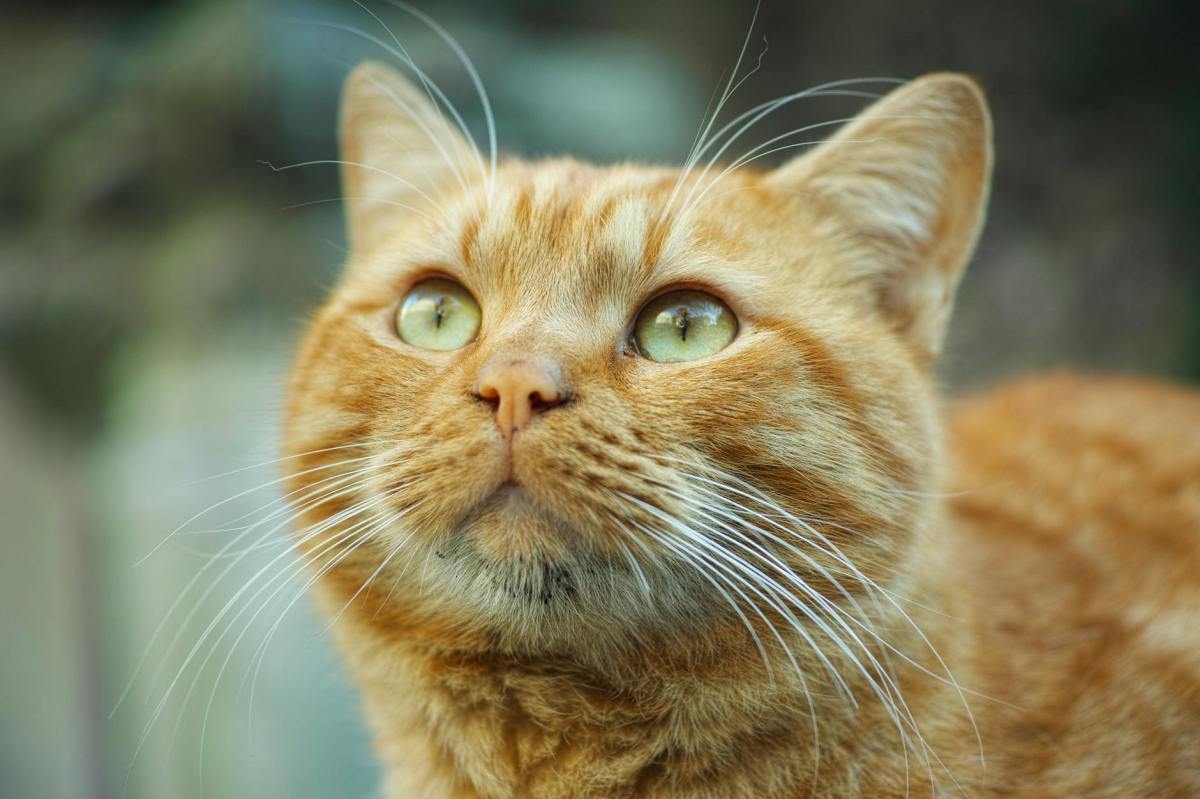
More than 110 years ago, American geneticist Clarence Cook Little developed a theory explaining why some cats have orange coloring and some don’t.

Now Little has been proven correct thanks to the work of separate teams in Japan and the US, which discovered the mechanism that leads to orange coloring, including fully ginger felines as well as calicos and tortoiseshells.

The explanation may be a bit too heavy on genetics for some readers, but essentially the researchers found the specific gene that leads to the growth or orange fur. They’ve known about the gene for a long time, but didn’t realize the totality of its function. Its official name is ARHGAP36, but for the sake of simplicity, scientists are calling it “the orange gene.”

“The orange gene has a known role in hair follicle development, but scientists didn’t previously know it is also involved in pigment production,” a team of geneticists and biotechnologists wrote in The Conversation, a science publication. “This means that a new pathway for pigment production has been discovered, opening the way for exciting and important research into a basic biological process.”

calico cat relaxing on wooden bench outdoors
In partially orange cats like calicos and tortoiseshells, the blotches of color are the result of imperfect gene copies and a secondary pigment-related gene switching “on and off.” Credit: Mehmet Guzel/Pexels

Ginger cats are usually male, but the pigmant can also appear in female cats due to an error in gene copying which deletes one segment of the orange pigment-producing genetic code.

That’s why calicos and tortoiseshells have orange blotches or mixed orange fur. “[T]he orange gene is persistently switched on in orange areas but is mostly switched off in non-orange areas of a cat’s coat,” the authors wrote.

Are there more strays in 2024?

Time magazine has a story examining the problem of stray cats in America’s urban and suburban population centers, why it’s happening, and what can be done about it.

First, might as well get this out of the way: We don’t know if there are “more” cats. The claim that there are more relies on anecdotes, and there’s no hard data to back that up. You have to be highly motivated to invest the time and money into a proper census like the D.C. Cat Count, and it’s an understatement to say most towns and cities are either not willing to do that, or don’t have the resources.

What we do know is there may be more cats in certain areas, with individual shelters in some places reporting record numbers of surrenders and cats scooped up by animal control.

close up of a stray cat on the metal railing
Rescuers say people who can’t afford food, supplies and veterinary care are surrendering or dumping their cats in larger numbers than in years past. Credit: Dou011fu Tunce/Pexels

The story quotes rescuers who say they’ve seen more surrendered pets, as well as data from Shelter Animals Count, which tallies self-reported information from shelters and rescues. The latter says 32 percent of cats taken in were owner surrenders in 2024, compared to 30.5 percent in 2019.

“It’s a combination of people surrendering their pets and people not adopting because they’re not sure they can take on the financial commitment,” Animal Care Centers of NYC’s Katy Hansen told Time.

Rescuers say that’s reflected in their experiences trapping the felines, who are friendly and acclimated to humans.

The people surrendering their pets cite inflation, not only impacting the cost of essentials like food and litter, but also more expensive veterinary care.

The story additionally includes this eye-popping detail:

“At Veterinary Care Group, a private equity-owned practice in Brooklyn, the cost of spaying or neutering a cat has soared to $850 per animal. By contrast, at the nonprofit veterinary clinic Zweigart recently founded in Brooklyn, the cost of spaying or neutering a cat is $225 and a mid-sized dog is $300.”

The lesson here: Steer well clear of veterinary clinics that aren’t vet-owned or are obtuse about their ownership. Private equity groups don’t buy clinics out of love for animals.

a close up shot of a tabby cat
The cost of spay/neuter procedures ranges dramatically at different veterinary practices. Credit: Tima Miroshnichenko/Pexels

As for solutions to local spikes in stray populations, the story doesn’t offer any. It mentions TNR (trap, neuter, return) but only in the context of a lawsuit against the San Diego Humane Society for its neuter/vaccination program.

That said, there probably isn’t a one-size-fits-all technique. What works for a small town won’t necessarily work in a city, and there are dozens of factors that could influence the prevalence of stray cats and colonies. Still, city councils and town boards don’t need to reinvent the wheel. Chances are if they look, they’ll find a municipality similar to their own where locals have successfully stabilized feline populations.

As for the Buddies, I’d live in my car before giving Bud up. He wouldn’t be thrilled about that situation, and we’d have to head south because the winters here are brutal, but as long as Bud has his servant, he’s good.

A previous version of this post incorrectly described cat chromosomes. The story has been updated to remove the error.
Local Politicians Have No Clue How To Manage Cats

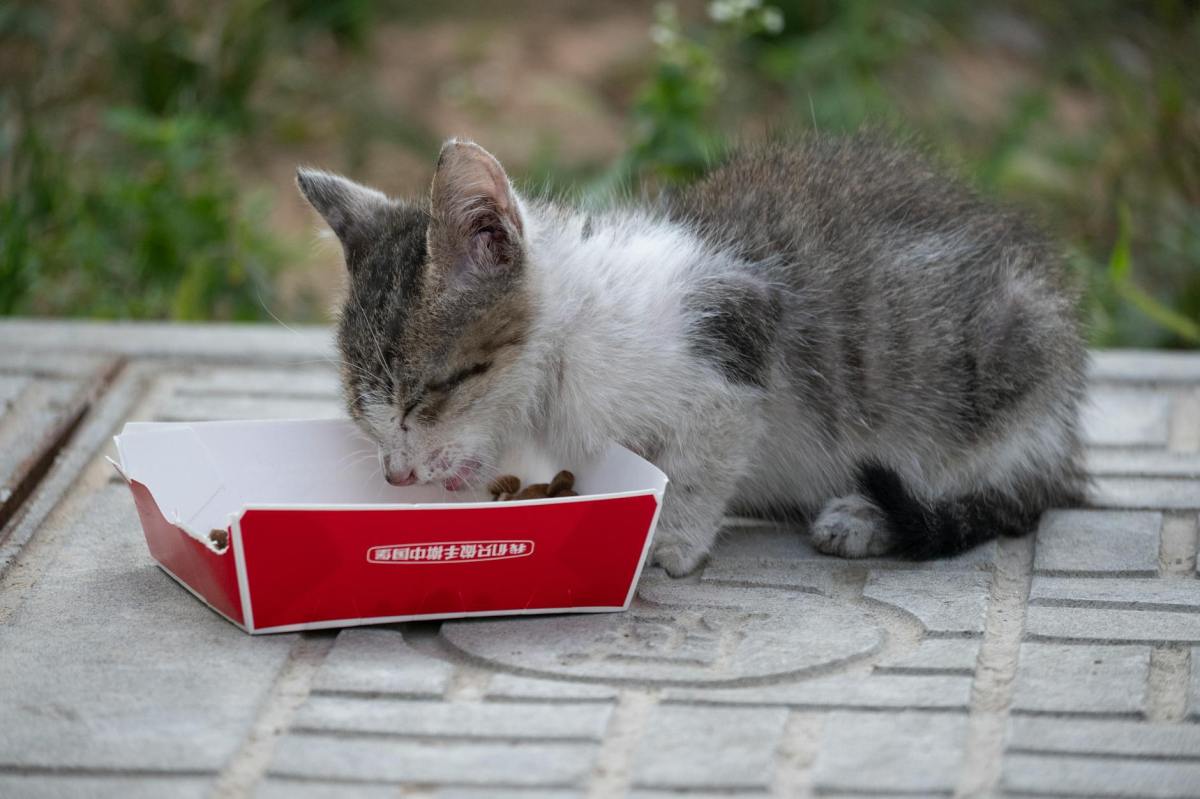
Feeding strays is now punishable by a $150 fine in an Ohio town, the latest municipality whose elected leaders chose to ignore expert guidelines on managing feline populations.

Every time the stray cat issue comes up, local town boards and city councils act as if they need to reinvent the wheel.

Imagining that they are the first to deal with this extremely common problem, they make decisions from positions of ignorance, dismissing the concerns of people who actually work with cats. Or they “do the research” and come up with their own ineffective policies instead of simply looking at what other towns and cities have tried in the past.

At least that way, you know what works and what doesn’t, and how much your decision’s going to cost taxpayers.

But that would be the smart thing to do, which is why our local elected leaders don’t do it. Instead they pull stunts like the village board of Mogadore, Ohio, a town of 3,700 about 10 miles east of Akron.

The Mogadore board just passed a law that makes feeding strays and ferals punishable by a fine of up to $150, as if that will stop cats from finding food and breeding.

Tellingly,  Mogadore’s elected leaders say their ordinance applies to “wild, stray, or un-owned” cats, which means they don’t understand they’re all the same species.

Apparently neither do the reporters at WOIO, a local news station in Cleveland. A story from the station is confidently incorrect in telling readers “[d]omestic cats that have become wild, meaning live outdoors, roam free, and rarely interact with humans, are also considered feral.”

Stray cat and kitten
Credit: Sami Aksu/Pexels

Felis catus is a domestic animal. By definition a domestic cat is not wild and cannot become wild. Evolution cannot happen to a single animal.

While evolution is a constant process, speciation — wolves becoming dogs, wildcats becoming house cats, wild boar becoming docile farm pigs — is a species-wide shift that takes at least a few hundred years but often much longer, “from human-observable timescales to tens of millions of years” depending on the species.

The whole process results in changes at the genetic level. The transition from wildcats to domestic cats, for example, involved changing only 13 genes.

This is not rocket science, it’s basic stuff we all learned in high school science classes.

But that’s almost beside the point.

Fining people for feeding stray cats, including caretakers who voluntarily manage cat colonies, will not solve the problem. It doesn’t work. It has never worked in any town anywhere in the world.

It also creates a needlessly adversarial relationship with the passionate people doing the hard work of managing the feline population, often thanklessly and at their own expense. Why make enemies of them when they’re doing a public service?

Mogadore’s village board had a representative from Alley Cat Allies and people from local rescues on hand to inform them that fines don’t work, and to offer the humane and effective option of trap, neuter, return. TNR may not be perfect, but it’s better than anything else people have tried.

Mogadore’s board and mayor ignored the experts and went ahead with their plan to fine people instead.

They’re not alone. This happens thousands of times across the US, Europe, Australia and most other places where domestic cats live. Japan and Turkey take a more humane approach, and they’re better for it. But here in the US, we often deal with issues by ignoring precedent and engaging in wishful thinking.

If the residents of Mogadore are lucky, their elected officials will realize their mistake sooner rather than later.

Stray cat eating
Stray and feral cats already have a difficult existence without ill-advised laws making it illegal to care for them. Credit: Mehmet Fatih Bayram/Pexels

Family’s Cat Keeps Coming Home Wearing New Sweaters

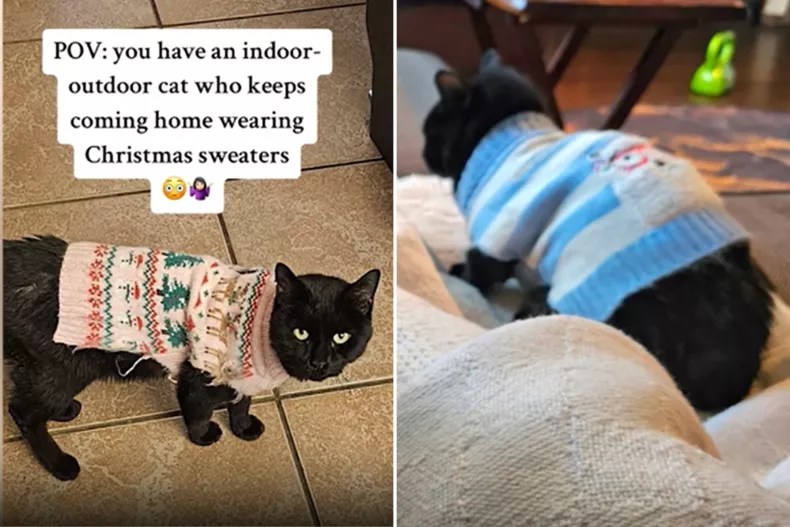
Papa Legba, a cat from El Paso, has made friends with one of his neighbors who likes to make sure he’s warm on his neighborhood rounds.

When Crystal Robert and her family adopted a stray cat in 2019, they quickly learned he was an expert in sneaking out even though they tried to keep him indoors.

Now they know he’s got at least one “other family,” because Papa Legba, as they call him — named after the mythical intermediary between the physical and spiritual worlds in west African folklore — frequently returns wearing sweaters.

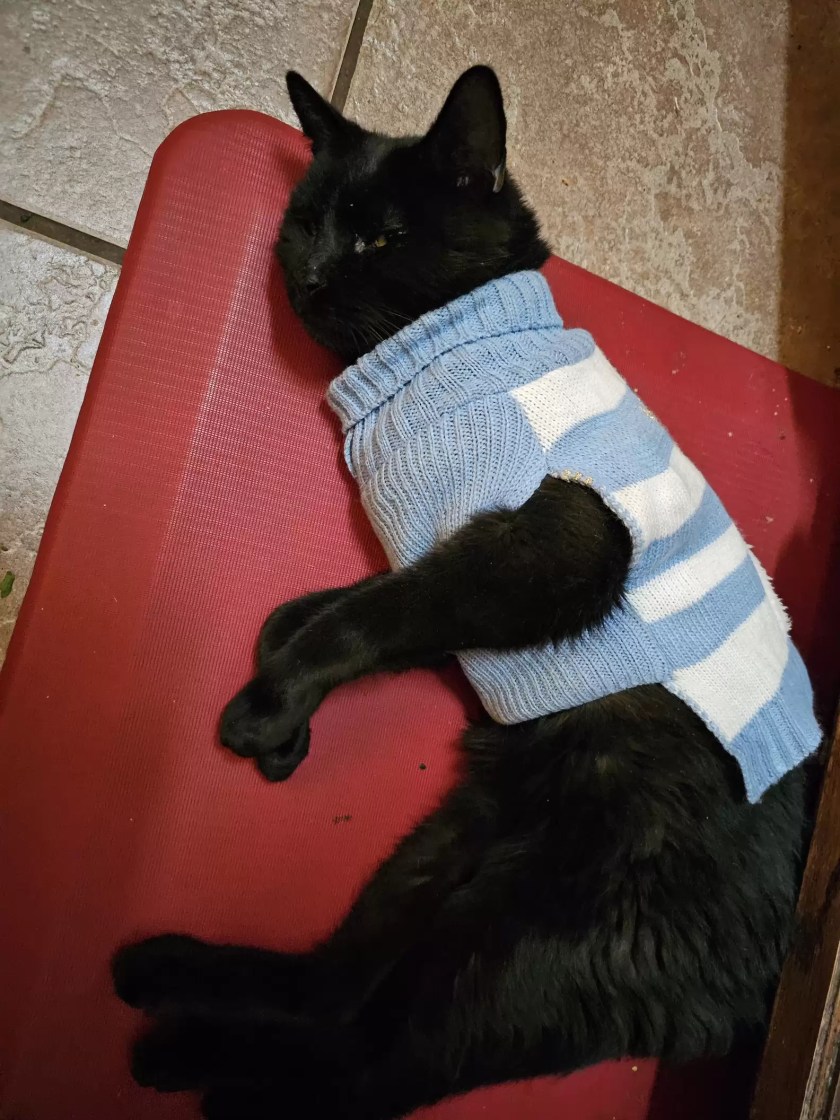
Yes, that’s plural. Papa’s mystery second family has sent him home wearing a blue striped sweater, a solid-colored pink sweater and, for the holidays, a traditional “ugly” Christmas sweater. He’s also been given a shirt that says “Born To Be Awesome.”

papalegbacat

Robert, who lives in El Paso, Texas, says Papa is usually averse to any kind of collar or accessories, but she believes the sweaters “humble” him because he’s cuddlier when he wears them.

“He seems more docile [when wearing the sweaters]” she told The Dodo. “Or maybe embarrassed.”

She told a local news outlet she hasn’t yet pinned down his second family, but she wants to thank whoever’s been treating the little guy well.

“I have already met with five families,” she said. “I haven’t met his other family yet, but I hope we can continue to ‘share’ custody.”

She said she’s narrowed it down to a few houses and plans to come knocking with baked goods to thank the neighbors for their kindness.

“I hope people can keep their pets at home, inside,” Robert told The Dodo. “They are our family and they are safest when with their owners, but if you have a wily cat like ours, I hope you are blessed with generous and lovely neighbors like mine.”

White Sox Photog Saves Scruffy Stadium Stray, PLUS: Super Rare Male Calico Born in Colorado

A young ginger tabby made himself at home at the former Comiskey Park in Chicago, feasting off of ballpark food shared with him by fans.

The Chicago White Sox opened the baseball season on the road, then headed home where they hosted the San Francisco Giants — and a scrappy, hungry stray who helped himself to heaps of stadium food.

The cat appeared in the park for three consecutive nights of the homestand, emerging from a hiding spot in the bowels of the stadium to sidle up to fans eating ballpark grub and meow for them to share. And share they did, according to Block Club Chicago, with fans holding the little guy and feeding him “shredded chicken off the top of their ballpark nachos.”

“He was just super chill and very comfortable roaming the park, like it’s his territory,” White Sox fan Alexis Lopez told Block Club.

Beef the Cat
The stray, now named Beef, is enjoying his forever home and his doting human servant. Credit: Darren Georgia

The cat, who was “a little scruffy and thin” according to Lopez, took an overly enthusiastic bite of some stadium food and accidentally punctured the skin on her cousin Antonia Denofrio’s finger. Stadium staff treated Denofrio at the park and thought they were in for a thorough search for the kitty, but the night after the White Sox finished their home series against the Giants, the orange tabby “jumped right up onto a security golf cart and was super friendly,” White Sox team photographer Darren Georgia said.

Georgia brought the cat home, got him fixed and examined by a vet and named him Beef. Now they’re best buds.

“He’s outgoing, loves to play and snuggle,” Georgia told The Block. “Just everything you’d hope for in a cat.”

The unicorn of cats

When Alli Magish, a foster for NoCo Kitties in Colorado, took home a mom cat and her five kittens, she realized one of them was incredibly rare: a male calico.

calicomale
Charlie the male calico kitten is now 11 weeks old. Credit: NoCo Kitties

Magish brought the little guy, now named Charlie, to two veterinarians to confirm, and for all of them Charlie is their first male calico. Only about one in 3,000 calicos are male, the Coloradoan reported, citing statistics from the Cornell College of Veterinary Medicine.

“We will probably get huge adoption fee offers for him, but we want him to go to the best home, and that’s not necessarily the one that could be the highest bidder,” Davida Dupont, founder of NoCo Kitties, told the Coloradoan.

Typical adoption fees for kittens at the rescue are $195, but Dupont says she wants to organize a fundraiser around the little guy before settling on the best place for his forever home. (Shhhh, no one tell Chloe Mitchell.) Since she spoke to the Coloradoan on April 1, NoCo Kitties has received a flood of adoption applications, and in a follow-up Facebook post  Dupont says she hopes some of them will consider adopting the many other lovable cats at NoCo who are looking for homes.

calicomalecharlie

Check Out This Beautiful Gallery Of Larry The Cat, PLUS: A New Game Features A Furious Feline

Cats, real and anthropomorphized.

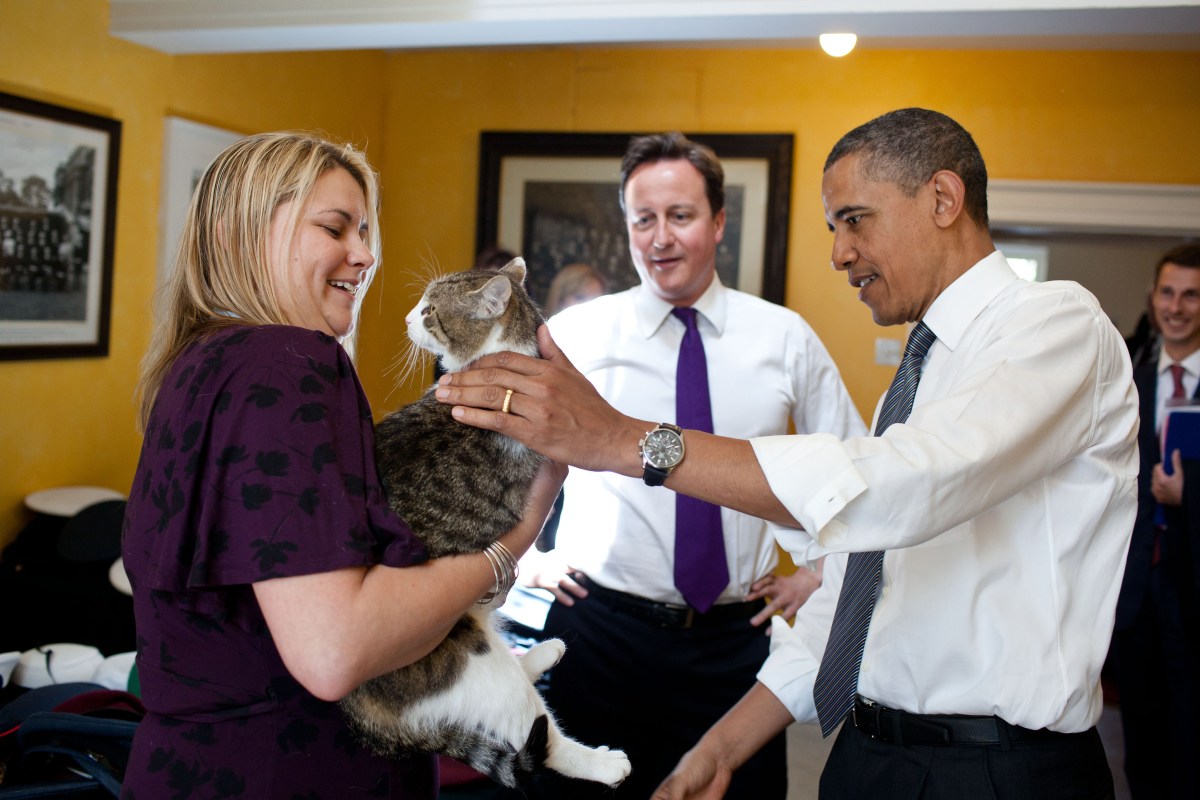
As we noted on Sunday, Larry the Cat just celebrated his 12th anniversary as chief mouser at No. 10 Downing St., the UK prime minister’s residence and office. The Atlantic has a new gallery featuring photos of Larry’s adventures over the years, and it’s fantastic.

See Larry chase a pigeon, tolerate former President Barack Obama, pose for the press, bolt from a Mitsubishi bigwig, cautiously supervise a police dog working on his turf, hang out with photographers and steal the show during meetings of world leaders.

The gallery also includes rare photos of Larry inside No. 10 (during which he’s mostly gazing longingly at his turf outside) and other amusing moments from his long tenure as de facto head of government in the UK.

(Top image credit: Pete Souza/White House photo)

Cuddly carnage!

The camera pans from a wet, neon-lit street to the jagged remains of a wall spray painted with “Death to Humans” when a tiny head pops up, with the unmistakable shape of cat ears and the markings of a ginger tabby.

Zoom in: An orange tail speeds by, its owner just out of the frame, then the guitars kick in and Gori the cat stylishly disembowels some freak monster from atop his trusty Back To The Future-style hoverboard.

The game is called Gori: Cuddly Carnage, and it looks completely ridiculous, absolutely glorious and a hell of a lot of fun.

cuddlycarnage2
Gori stylishly puts down a monster. Credit: Angry Demon Studio and Wired Productions

It’s from Angry Demon Studios and Wired Productions, the same people behind the well-received 80s/90s nostalgia trip Arcade Paradise, so the production values look great and Gori shares some elements of the retrowave aesthetic prevalent in Paradise.

It probably won’t get the kind of hype that the feline-centric Stray received, nor will people laud it for educating players about cat behavior, but that’s okay. It’s not that kind of game. Gori: Cuddly Carnage is still in development with no announced release date, but we’ll be keeping an eye on it.

ss_65c72aebb98390d4a3cda988cffa50065f871cf7.1920x1080
Gori the “ultimate pet cat” on his hoverboard. Credit: Angry Demon Studio/Wired Productions