Paleontologists Recover Shockingly Intact Saber-Toothed Kitten Buried For 35,000 Years

The find is extraordinary, allowing scientists to directly study the extinct cat’s musculature, fur, head shape, and even its claws and whiskers.

A team in Russia stumbled on the find of the century when they located the stunningly well-preserved remains of a saber-toothed kitten in Siberia.

The kitten, which was found near the Badyarikha River in northeastern Siberia, was about three weeks old when it died, scientists estimate.

Unlike typical finds — a fang here, a mandible or partial skeleton there — this specimen still had its fur, claws, whiskers and muscles, which means scientists have already learned more about the species, Homotherium latidens, than they have with almost any other long-extinct animal.

homotheriumpawpads
Images of the extinct cub’s paws compared to (D), the paw of a 3-week-old lion cub pictured on the bottom right. The Homotherium paw is thicker but less elongated. Credit: Borissiak Paleontological Institute, Russian Academy of Sciences, Moscow, Russia

While the saber-toothed cub is a true felid, it boasts adaptations unlike any surviving member of the panthera genus.

It has wide paws wrapped in heavy fur, a short tail and a stockier, lower-to-the-ground build than modern lions and tigers. Those adaptations, scientists believe, made it easier for Homotherium latidens to traverse environments with ice and heavy snow.

Its head shape is slightly different, with smaller ears than modern big cats, and its neck is enormous, more than twice as thick as the neck of a comparable three-week-old lion cub which was used for comparison. Likewise, its mouth is capable of opening significantly wider, although the team did not compare it to the jaguar, which has the widest-opening jaw among extant felids.

Homotherium cub
A photograph of the cub, top, and a scan revealing facial, ear and neck structure, below. Credit: Borissiak Paleontological Institute, Russian Academy of Sciences, Moscow, Russia

The frigid, arid clime of Siberia made it possible for the cub’s body to endure for so long. The team that made the discovery conducted radiocarbon dating that puts the cat at between 35,000 and 37,000 years old, according to reports.

It’s not clear how the cub died, although its species went extinct about 10,000 years ago, likely as a direct result of fewer prey animals in the frigid zones it occupied. Additional bones belonging to the rear of the cub skeleton were encased in a large cube of ice immediately next to the intact upper body.

The cub’s remains were recovered in 2020, but the results of the research team’s analysis were just released on Nov. 14 and published in the journal Nature. The paper’s authors have a lot more to share about the species’ physical characteristics, they noted in the text, and plan to follow up soon with a second paper going into more detail about what they learned from the cat’s intact musculature.

Top image: An artist’s impression of an adult member of homotherium.

Homotherium cub
Credit: Borissiak Paleontological Institute, Russian Academy of Sciences, Moscow, Russia

Spectacular Tigress Image Wins Wildlife Photo Of The Year

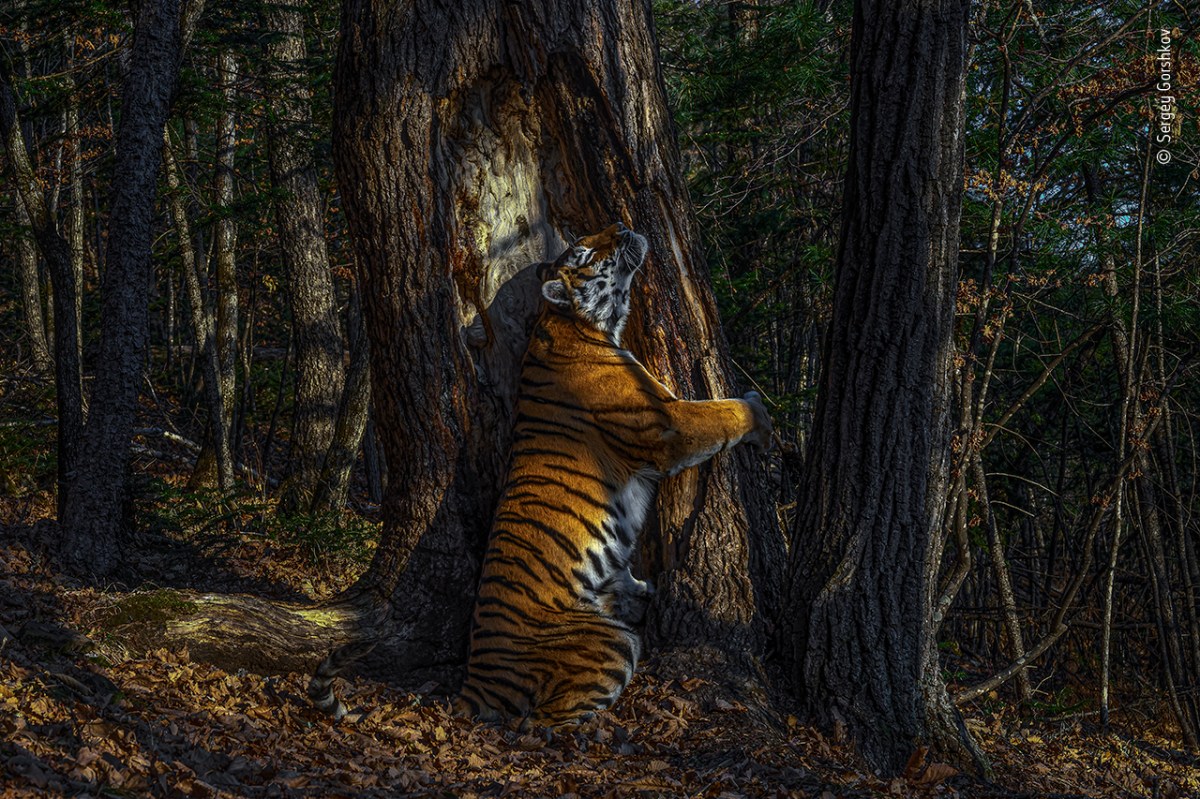
An ethereal photo shows an Amur tigress scent-marking an ancient tree in Siberia.

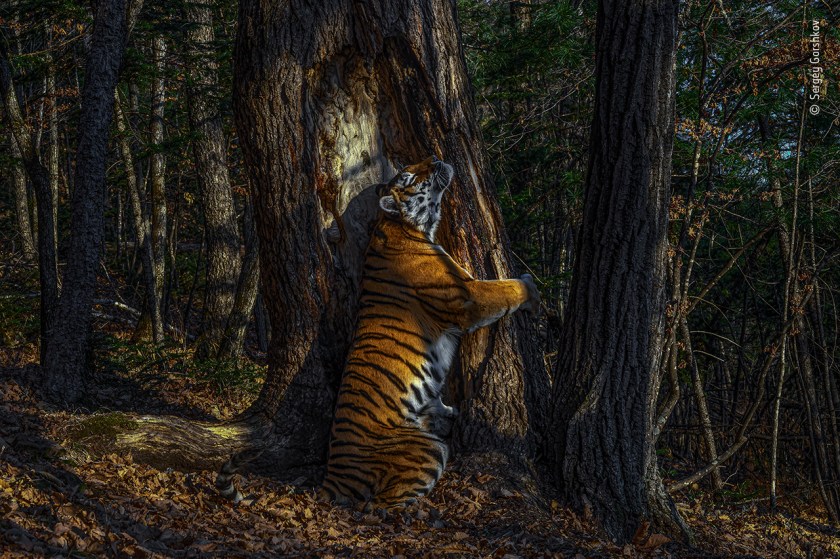
A photo of a tigress hugging a tree in Siberia has won the prestigious Wildlife Photo Of The Year from London’s Natural History Museum.

Photographer Sergey Gorshkov beat out almost 50,000 other entrants with his winning photograph, taken in Land of the Leopard National Park, a large reserve for tigers and leopards in Far East Siberia.

Gorshkov set up his camera facing a tree that already had claw marks, signaling that it’s been used as a territorial marker by at least one of more than 30 adult tigers in the park.

Sure enough, a tigress stopped to claw new marks on the tree and rub her scent on it, which is the same behavior we see with house cats when they rub on objects — and people — in the home. Cats have scent glands on their faces and paws which allow them to mark objects with pheromones. It’s a cat’s way of leaving a “sign” saying “This is mine.”

The photo has an ethereal quality, with the tigress and tree illuminated by shafts of sunlight poking through the canopy of the ancient forest.

Wild and free Siberian Tiger!

An announcement from the park’s staff describes the scene:

The photo titled “Hugs” shows the moment in which the rarest Amur tiger hugs a century-old fir to mark the target tree with its scent. Sergey Gorshkov, with the support of professional guides from Land of the Leopard, took a picture using a professional camera with a motion sensor.

“This is a scene like no other, a unique look at an intimate moment deep in a magical forest,” said Rose Kidman Cox, chairwoman of the contest’s jury.

The photo “inspires hope” for the endangered Amur tiger, Cox said. In addition to the 30-plus tigers, Land of the Leopard National Park is also home to at least 10 tiger cubs and almost 100 leopards.

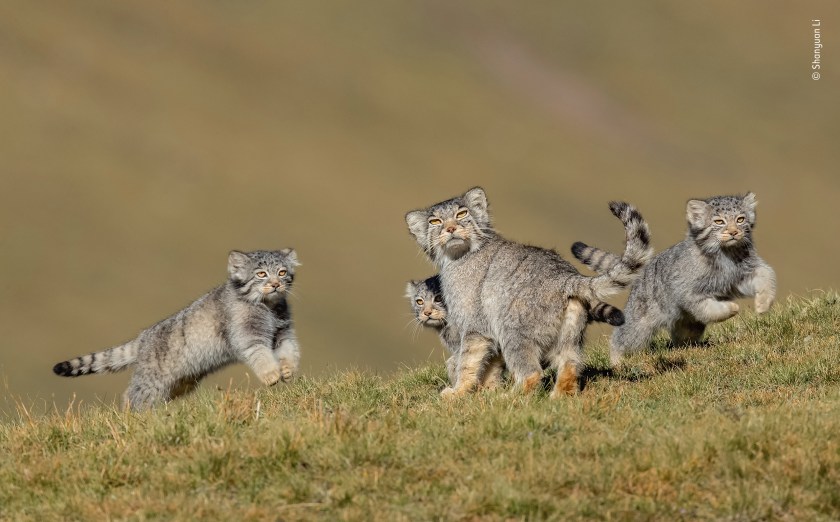
Gorshkov’s photo wasn’t the only feline winner this year. “When mother says run,” a photograph by China’s Shanyan Li, shows a trio of Pallas’ cubs with their mother “on the remote steppes of the Qinghai-Tibet Plateau in northwest China.” The photograph won in the mammalian behavior category.

4b3cafb5-321e-44ba-a7d0-468b2447f9f8