

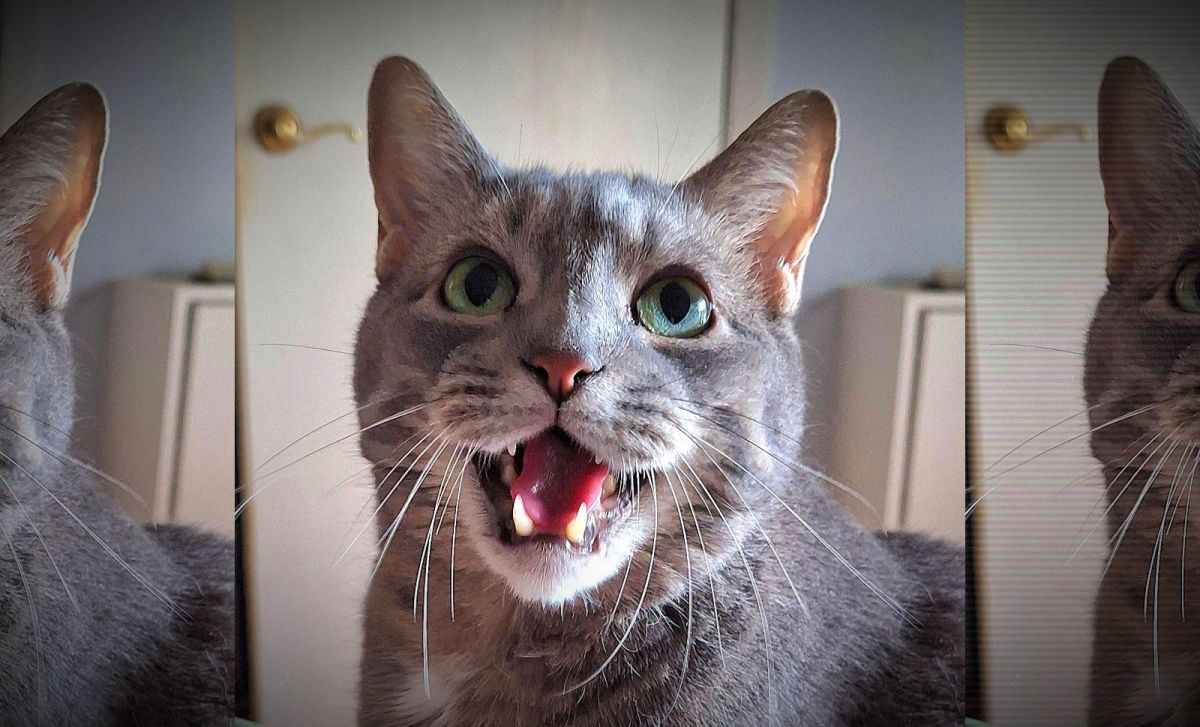
Is he yawning? Screaming in terror before dashing behind my legs? Reacting to someone spilling the tea about a friend? Awestruck at a giant turkey?
Well, that’s up to you!

Caption a photo of the world’s most Buddinese feline!
Is he yawning? Screaming in terror before dashing behind my legs? Reacting to someone spilling the tea about a friend? Awestruck at a giant turkey?
Well, that’s up to you!
Buddy is many things, but he’s NOT quiet. His incessant chattiness can kill my sleep and my peace and quiet, but in the world of A Quiet Place, it would kill me! Would your cat get you killed in the movie franchise’s monster-stalked reality?
As a cat lover, big time science fiction fan and appreciator of the first two A Quiet Place installments, the very first thing I thought when I saw the trailer for A Quiet Place: Day One was “I hope the cat doesn’t meow!”
My second thought? Bud and I would be so, so dead.
Dead immediately. Dead a thousand times over.
Apparently I’m not the only one, because fans have taken to social media to participate in the “Quiet Place Challenge,” which involves reenacting some of the scenes from the movie with their own cats to see if their furry overlords can stay silent.
As PITB readers know, Buddy never shuts up. He’s got something to say about everything, he often narrates his activities in real time, and he’s got an entire meowing ritual that starts at least a half hour before Food O’Clock, gaining in volume and annoyingness until a fresh bowl of turkey is placed before him. His personal patois, the Buddinese dialect, makes heavy use of trills, chirps, grunts, chuffs and sniffs to elaborate on his meows.
If you’re unfamiliar with the Quiet Place movies, they imagine a world that’s been invaded by so-called Death Angels, dread creatures of extrasolar provenance who are completely blind, but have extraordinarily sensitive hearing. The first movie, about a family surviving on their farm in upstate New York months after the initial invasion, was universally lauded for its taut script, effective tension and novel use of a quiet/loud dynamic that is a marked departure from the usual horror-thriller formula.

In A Quiet Place (2018), its 2020 sequel and the recently-released prequel, Day One, entire minutes pass soundlessly. As a viewer you can’t help but wince and tense up when a character errs and makes noise, knowing the consequences can be immediately tragic.
There’s simply no way Bud and I would survive more than five minutes, and if I had to put money on it, I’d wager we’d probably be dead within 60 seconds of the terrifying monsters showing up.
Indeed, the movie doesn’t dither: the Death Angels make planetfall at around the 12 minute mark. Mild spoilers from the beginning of the film follow:
12:31 – On Chinatown’s ruined Pell Street, within a haze of dust so thick you can’t see more than a few feet in any direction, a man shouts loudly into his smartphone, telling the person on the other end that something meteor-like had landed just a few hundred feet away. He’s pulled suddenly and violently into the smog, his scream ending as abruptly as it began. Verdict: Death by Buddy. He’d probably meow in protest at the dust and get us both killed immediately.
12:53 – A female National Guard soldier sees Nyong’o’s Sam and shouts at her to take cover. The guardswoman’s radio crackles with the panicked screams of her comrades saying the enemy is everywhere, and then she’s dispatched as quickly as the guy on the phone. Verdict: Death by Buddy. He’d almost certainly huff derisively at the soldier’s order to take cover, and we’d both be crushed underneath the foot of one of the lumbering beasts.
13:34 – Sam huddles behind a vehicle with another woman when a panicked man screams, drawing the aliens like moths to a flame. Verdict: Death by Buddy. Little dude’s default reaction when he’s scared is to run screaming and hide behind my legs. He’d draw the monsters right to us and we’d die.
13:50 – Sam wakes up inside a theater several minutes after an explosion knocked her out. She’s about to speak when Djimon Hounsou’s Henri clamps a hand over her mouth and raises a finger to his lips. Unfortunately that doesn’t work with a cat. Verdict: Death by Buddy. Attempts to get him to shut up would be fruitless, and while I’d know my only chance for survival would be to throw him like a football so the aliens track his indignant screech, I wouldn’t have the heart to do it. We’d die together.
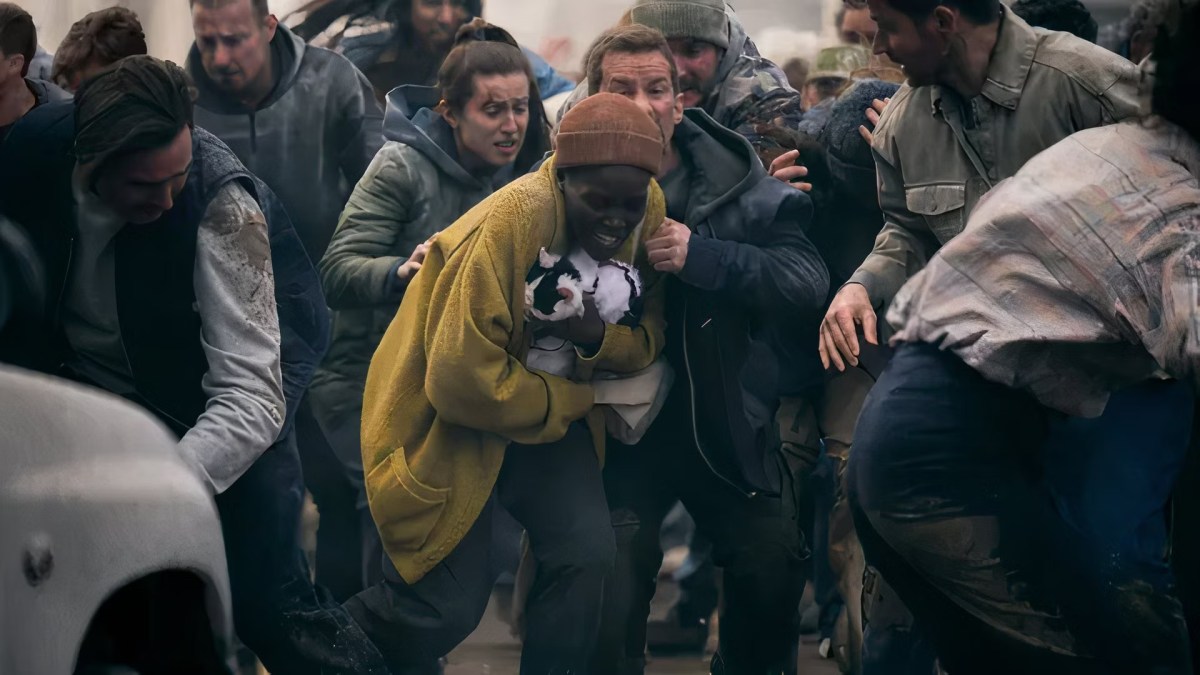
Frodo, the feline co-star of Day One and “service cat” to Lupita Nyong’o’s Sam, is precisely the opposite. He’s a Good Boy extraordinaire, consistently calm in his mother’s arms and reliably silent when he needs to be.

Without meows to rely on, director Michael Sarnoski gets quite a performance out of Nico and Schnitzel, the two cats who play Frodo. They’re expressive felines who could teach Nicolas Cage a thing or two about how to emote with subtlety, as in one scene when Frodo sees a man emerge gasping from a flooded subway station. Frodo regards the stranger with curiosity, his little face registering surprise at the man’s sudden appearance with just the slightest twitch of his mouth and whiskers.
It’s effective and very cute, but we never forget about the incredible danger that faces Frodo and Sam as they return the One Ring to Mount Doom navigate the ruins of New York City amid blind predators with extraordinarily sensitive hearing.

If Day One’s world was reality — and I’m extremely thankful it’s not — I suppose it’s possible I’d get lucky if we were in a deep subterranean level of a building for some odd reason, and if Bud decided it’s not worth disturbing his nap to investigate the ruckus above.
But the moment his belly rumbles and he starts screeching for yums, or the second he gets it into his little head that he just has to tell me his latest theory regarding entangled subatomic particles, it would all be over, for me at least. I could totally see Bud making noise, then dashing to his customary hiding place behind my legs while a “Death Angel” impales me with one of its giant claws.
What about the rest of you? Is your cat a Frodo, a Bud or another sort entirely? Would you be dead as quickly as we would be, or do you think you could survive with your furry pal?
After an Amazon delivery driver stole their cat from their driveway, a Washington state family went to great lengths to recover their beloved tabby — without the help of the online retail giant, which declined to put them in touch with the driver.
Feefee’s back home.
The tabby cat, who belongs to the Ishak family of Everett, Washington, has been reunited with her humans after an 11-day ordeal that started with her abduction by an Amazon Flex delivery driver on July 21 and ended with a long and determined search by her family that led to an apartment complex about six miles from their home.
“My wife and I drove around over the last three days concentrating on apartment buildings until [Thursday] when I spotted a car that matched [the driver’s],” Ray Ishak told PITB. “I have been in the car business for 26 years. I know what to look for. Perfect match, even missing the front wheel cover, just like in the [home security camera] video.
“We went to the leasing office and explained we were looking for our cat and reason to believe it might here. The office employees immediately commented that the police were there a few days ago asking about the cat. We knew then we were at the right place.”


Ishak and his wife spent the next few hours searching the grounds around the apartment complex, which are covered in heavy brush. While they didn’t find Feefee, they spoke to several children playing nearby who confirmed they’d seen the missing tabby. They gave their phone number to the kids, asking them to call if they spotted Feefee again.
“Around 6 pm they called,” Ishak told PITB. “We took off and found her in very heavy brush and sticker bushes.”
The couple gave the kids rewards for their crucial help, then gently coaxed their frightened cat from out of the brush where she’d been hiding.
A video taken afterward shows a famished Feefee digging into a large bowl of food after her long ordeal. She’d clearly not been eating over the past week and since she’s been home she’s been doing little else besides sleeping and eating.
Ishak said his grandchildren, who are particularly close to Feefee, were “elated” when told she’d been found.
For the family, the reunion comes after lots of worry, stress, taking time off work to search for her — and frustration that neither Amazon nor the driver who stole Feefee helped them recover her.
“What is infuriating is the area where [Feefee was found] is right behind the building where that person’s car was parked. That cat has been out there for days with no food and multiple people have seen her on multiple days. [The Amazon driver] just let her out and could have very easily told us and we could have very easily found her days ago and all this would be put to rest.”
The driver stole Feefee from the family’s driveway after delivering a package on July 21. Footage from the Ishaks’ security cameras shows the female driver squatting down in their driveway to pet the 13-year-old cat. The motion-activated camera timed out momentarily, then was triggered a second time as the Amazon driver left with Feefee in her car.
When confronted with video evidence, Amazon admitted the driver had taken the cat and told Ishak the driver went to the police to return her. That wasn’t true: Ishak checked with the Everett police as well as the county sheriff’s office, and neither had been contacted by anyone trying to return a stolen cat.
Then the driver’s story changed. An Amazon rep told Ishak that the driver claimed Feefee had escaped and was missing.
When Amazon would not put Ishak in touch with the driver, he pleaded with them to at least point him in the right direction, suggesting the driver could make a burner email address or call from a blocked number — anything just to get a lead on where Feefee might be.
The woman refused to cooperate.
“She knew where the cat was for over a week and still refused,” Ishak fumed. “She purposely left that cat outside to basically die, while everyone online was calling us bad people for letting our cat be an indoor outdoor cat and that she is better off with that person.”
The online retail giant never gave Ishak an explanation for why one of its drivers would steal his cat, and said only that she no longer works for the company. In an email exchange with Amazon, Ishak pointed out that his family had been victimized in a crime committed by a company employee, yet Amazon was treating it like a customer service issue and protecting the driver.
In the meantime, the family was frustrated by online comments criticizing them for allowing their cat outdoors on their own property. Feefee was diagnosed with asthma years ago and benefits from fresh air, Ray Ishak said. The cat was in the family’s driveway, just a few feet from their home, when she was stolen.
“I took time off work and after a few days of pure determination looking for a needle in a sea of haystacks we found her,” Ray Ishak told PITB. “I guess we’re not so bad after all.”
Videos and photos in this post courtesy of Ray Ishak.
Amazon’s response not only leaves a lot to be desired, it’s also an example of precisely what not to do when an issue goes beyond a simple customer service complaint. The company missed an opportunity to respond with compassion and earn a family’s gratitude.
An Amazon delivery driver took a Washington family’s cat and drove away with her on July 21.
Since then, Amazon has admitted its driver has the cat, but has offered little more than carefully-worded customer service responses mixed with boilerplate language about valuing the family’s business and feedback.
Ray and Karin Ishak have video of the driver petting and playing with 13-year-old Feefee in the family’s driveway during the delivery. The motion-activated camera timed out, according to a report by Seattle ABC affiliate KING5-TV, but when the camera began recording again, triggered by the driver pulling away, Feefee was gone.
“The driver [was] driving away and there’s not a cat in sight. It’s pretty obvious the cat disappeared in those seconds,” Ray Ishak told the station, adding he filed a report with the Snohomish County Sheriff’s Office.

Amazon has chosen to deal with the incident via email, as if it’s a dispute over a returned item rather than a living being who is valued as a family member by her people.
A company customer service representative told the Ishaks that the driver said she contacted the police to return Feefee, but the family called the sheriff’s office and the police in Everett, Washington, where they live, and both agencies told them they hadn’t heard from the driver or from Amazon.
The Ishaks asked Amazon if the company could at least tell them the town or city where the driver lives, figuring the driver may have contacted police there instead of the departments that have jurisdiction over their hometown. Amazon declined to provide that information.
When the Ishaks followed up with Amazon again, a customer service representative said she’d be happy to help — if the police approach Amazon. She provided an email address for law enforcement use only, said Amazon will cooperate if the police contact them, and ended the reply with a request to “vote about your experience today.”
This is an awful response by Amazon, and the company deserves any bad PR it gets as a result. The very first thing the company should have done was escalate the ticket to a manager empowered to take care of the case directly, and that manager should have picked up the phone, called the family and promised to get their cat back immediately.
If the company doesn’t have anyone in its customer care hierarchy who understands why it’s important to make that kind of judgment call, then it’s done a poor job of hiring and training its employees.
Alternately, Amazon’s known for keeping its employees on an extremely short leash — the company is notorious for watching its employees via cameras, has been fined tens of millions of dollars for “excessive surveillance” of its own workers, has forced employees to “justify” things like bathroom breaks, and operates on founder Jeff Bezos’ belief that employees are “inherently lazy” — so if the email-only response was due to strict company policy, that’s another negative that can be chalked up to a toxic corporate culture.
Treating this like a routine complaint only exacerbated the Ishak family’s stress and uncertainty regarding the fate of their beloved cat. Putting the onus on the family and the police to sort out of the problem makes things worse, and you’d think any halfway competent customer service rep would skip the “rate your service” pitch, at least until after the problem is solved and Feefee is back with her family.
It doesn’t matter how massive and successful the company is, there has to be a better way to handle issues like this without requiring even the police to approach Amazon like customers dialing a service line, or supplicants petitioning a king to turn his gaze toward a situation that normally falls beneath his notice. There’s also no recognition of the impact on Feefee, who is almost certainly confused and stressed at being separated from the only home and family she’s known for her entire life.
Lastly, Amazon missed an opportunity to respond with compassion and earn the gratitude of a family whose members are obviously very concerned about their cat. A PR win like that is worth a thousand commercials, and can earn enormous good will with customers. Instead, people will hear about how the company treats a problem like this as if a customer is returning a shirt that’s too small.
As for the Ishak family, they say they’re giving the driver the benefit of the doubt. Maybe she thought Feefee was a stray. But, as Ray Isha told KING5, it’s been made abundantly clear that Feefee is a beloved member of the family, and she needs to be returned.
“Maybe you did this out of the kindness of your heart,” Ray Ishak said. “I appreciate it, but bring me my cat back.”
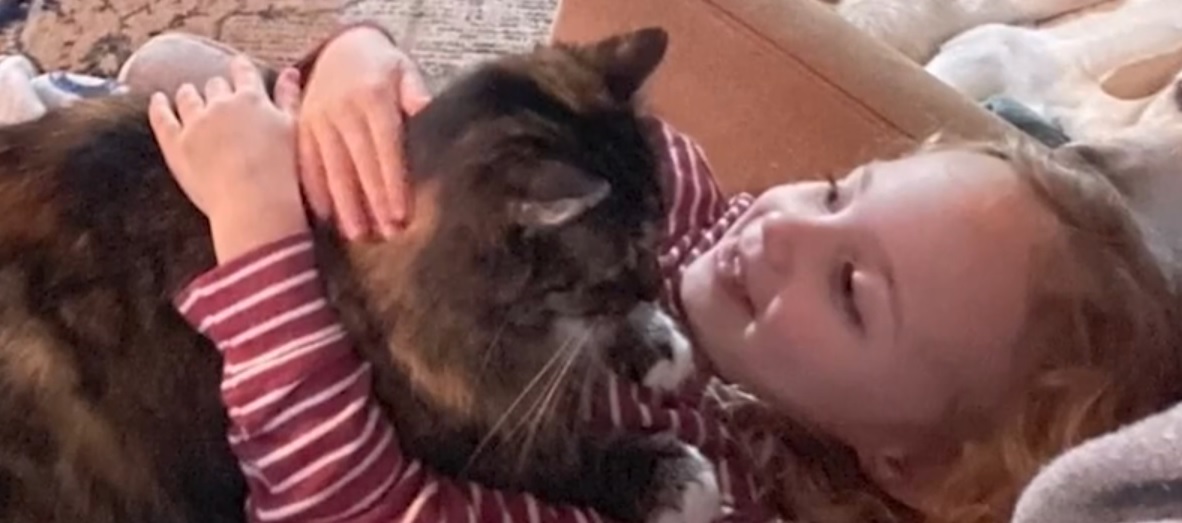
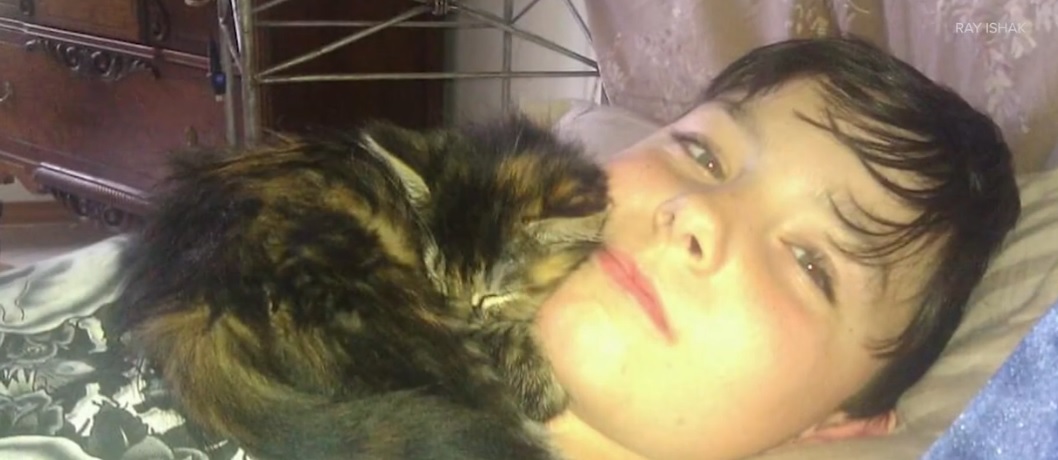
Top image of Feefee as a kitten with one of Ray Ishak’s grandchildren courtesy of Ray Ishak, via KING5.
Vakuum, the terror of many a cat, was put on notice by Buddy’s display of astonishing bravery. If AI and robots ever try to take over the Earth, Buddy is a natural choice to lead the combined armies of cats and men to victory over the machines.
NEW YORK — Buddy the Cat was particularly pleased with himself on Thursday after he successfully scared off one of his mortal enemies by using his powerful roar.
The gray tabby cat had just finished his second Food O’Clock meal of the day and was settling down for 5th Nap when the infernal machine known as Vakuum the Disturberizer encroached upon the Buddesian domicile and began its high-pitched shriek.
While previously he’d hiss at the accursed machine and retreat to the safety of the bedroom, Buddy decided to put his paw down, sources said. It was time to make a stand.

Rising up to his full height of almost a foot, Buddy let loose a mighty, blood-curdling roar — and was shocked when Vakuum immediately stopped making its pestiferous racket.
“That machine took one look at me and decided it didn’t want a piece of this,” Buddy said, his primordial pouch jiggling as he flexed. “It helps to be a meowscular and intimidating cat, you know. We jaguars are quite ferocious when we need to be.”
A spokescat for the Yguara Nation of the Americas confirmed that while Buddy is an honorary jaguar and was bestowed the name Kinich Bajo, meaning “Tiny Sun-Eyed One,” he is not in fact an actual jaguar.

 Pain In The Bud