People Think This Nebula Resembles A Smiling Cat, PLUS: What Kind Of Music Soothes Felines?

Your cat’s taste in music may or may not align with your own.

Before we get into today’s cat news, I received an email asking why there hasn’t been much Buddy on the site lately.

Fear not, friends of Buddy! The little guy is down in the Amazon visiting his jaguar pals, but he’ll be home in time for the most important holiday of the year, Turkey day. He wouldn’t miss it for the world!

Buddy with a jaguar buddy in the Amazon, where there’s a special felid conference on new napping techniques.

A smiling cat?!

A story on Space.com says people see a “smiling cat” in images of a nebula, although we’re not so sure.

The nebula in question is Sh2-284, or Sharpless 284. It spans about 150 light years and sits about 15,000 light years from our star system near the edge of the Milky Way, in an outer spiral arm.

From a certain orientation, there may be suggestions of cat-like ears and eyes, although if there is a smile, it’s crooked and deranged-looking. Maybe the cat’s on pain pills from the vet?

There’s an opportunity here, since the nebula doesn’t have a nickname. The Buddy Nebula has a nice ring to it!

Here’s an image from NASA:

This spectacular picture of the Sh2-284 nebula has been captured in great detail by the VLT Survey Telescope at ESO’s Paranal Observatory. Sh2-284 is a star formation region, and at its centre there is a cluster of young stars, dubbed Dolidze 25. The radiation from this cluster is powerful enough to ionise the hydrogen gas in the nebula’s cloud. It is this ionisation that produces its bright orange and red colours. This image is part of the VST Photometric Hα Survey of the Southern Galactic Plane and Bulge, led by Janet Drew at the University of Hertfordshire in the UK.

And here’s an annotated image from astrophotographer Jim Thommes that shows us what we’re looking at and the immediate galactic neighborhood:

In Star Trek there’s always a convenient nebula nearby when the Enterprise — or Voyager, Titan or Discovery — needs to “hide” from some well-armed belligerent, and science fiction in general creates the impression that they’re like space swamps.

In reality nebulas are regions where the interstellar medium — the space between stars — is filled with gas, cosmic dust and inert matter. Some are stellar nurseries — places where stars are “born” — and some are the remnants of dead stars and the planets that orbited them.

They can seem to glow red, orange, green or blue depending on the elements present. Some of them reflect starlight while others are like filters, with the gases and dust lending their color to the nebulae structure.

Cats are pretty well-represented in the cosmos, from a human perspective. From the cat’s paw nebula to the Cheshire Cat galaxies, to the Lynx, Leo and Leo Minor constellations, astronomers have seen cats in the sky for millennia.

Does music help cats relax?

Although the research is limited, some studies have indicated certain genres of music can help our little buddies chill out. And if research into the canine response to music is any indication, we should expect to see more evidence for cats enjoying tunes.

When it comes to what kind of music is most effective, studies point to classical music with a slow tempo, as well as reggae and soft rock “with simple rhythms, slower tempos and no heavy percussion,” according to a new story from the BBC.

Just listening to some meowsic!

A 2016 study looked at the effect of music on 12 female cats who were recovering from spay surgery. The research team played “three different genres of music: classical music (CM), ‘Adagio For Strings (Opus 11)’ by Samuel Barber; pop music (PM), ‘Torn’ by Natalie Imbruglia; and heavy metal (HM), ‘Thunderstruck’ by AC/DC.”

The team measured heart rate, breathing rate and pupil dilation, concluding that classical music was most effective, followed by the Imbruglia song and AC/DC last. (Maybe next time they can slide The Tony Danza Tapdance Extravaganza in there for some extra fun.)

Anecdotally, Bud did not respond well to composer David Teie’s Music for Cats, but he hangs out and nods along to funk, classic 90s New York hip hop, retrowave, nu-disco, reggae and certain kinds of rock, which is almost certainly because he grew up hearing that stuff with me.

So maybe there’s a nature vs nurture element to feline musical preferences, although I wouldn’t hold out hope for cats who enjoy the Tony Danza Tapdance Extravaganza. Some things are best left alone.

Does Your Feline Overlord Have A Favorite Genre Of Music?

Cats have exceptional hearing abilities and can detect sounds in frequencies well beyond what the human ear is capable of hearing, but can they appreciate music?

The question of whether cats appreciate music is an interesting one, and we still don’t have definitive answers despite attempts to make music for our furry friends and study the way they respond to sound.

We’ve mentioned the ongoing efforts to make tunes for felines on this blog before, and previously experimented by playing composer David Teie‘s Music for Cats for our brave volunteer, Buddy.

Excited by the possibility of music specifically designed for cats, and a study in the Journal of Feline Medicine and Surgery that found it had a calming effect on the species, we queued up a track and watched the Budster’s reaction:

“Using Buddy as my test subject, I went to Youtube, selected the track Cozmo’s Air from “Music for Cats” and sat back, expecting Bud to start nodding his furry head at any moment.

Instead his ears pricked up, did their radar-dish swivel toward the speakers, and his eyes went wide. As the song gained volume and intensity, Bud’s ears and whiskers snapped back and he let out a clearly anxious “yerrrrrrrrrrppp!” I tried to calm him down, to no avail, and a second track didn’t improve things.

He wasn’t having it.”

Over at Catster, Christopher Bays writes about his cat, Olga, and her relationship with music.

Olga “has listened to classic rock, jazz, blues, classical, heavy metal, punk (or new wave?), and accordion tunes from Hungary, and it all sounds the same to her,” Bays concludes.

djfunkybud
“Spinning the megamix, bro.”/PITB

Noting that our tastes change as we age, Bays said he’s thankful Olga wasn’t around during his teenage punk and metal phase (ditto), and notes she’s not particularly interested in any sounds coming from electronic devices, with the exception of the roaring MGM lion. (Fun fact: The famous “lion’s roar” is actually a recording of a tiger played over footage of a lion yawning. The creators apparently felt lions don’t sound sufficiently badass enough.)

Bays points out our cats don’t exactly have control over what we play, and while that’s true, if you’re a genre-hopper like me, you’ve probably observed your furry friend’s reaction to various types of music.

Given the fact that the small amount of research done so far indicates cats do respond to tunes — and the existence of music-loving animals like Kiki and Snowball — I think felines probably are capable of enjoying the organized, rhythmic arrangements of sounds we call music.

I can’t say whether a favorite track can unleash a wave of emotion, nostalgia or energy the way it can for us humans, but I’ve played a lot of music around Bud and even played music for him on my guitar and keyboard.

He seems very comfortable with old jazz, soul and funk, he comfortably loafs when I’m in the mood for classic 90s hip hop, and he seems to tolerate the prog rock of Coheed and Cambria well enough. More recently he’s been on a 90s nostalgia trip with me: Blues Traveler, the Spin Doctors, Nirvana, Oasis, Better Than Ezra, Letters to Cleo, Ash, Weezer, Blur, The Roots.

And he seems especially chill in the sonic presence of synthwave, also called retrowave, an EDM-inflected genre that evokes nostalgia for an era that never really existed outside of 80s retrofuturism. It’s highly rhythmic, with steady 4/4 beats and vintage synthesizers cranking out arpeggios that rise and fall like waves, which may be a source of comfort to a species that likes things just the way they are without any big surprises.

Have you noticed your cats responding to music? What’s your kitty’s favorite genre or song? Is there anything they clearly don’t like?

This Cat Can’t Stand His Human’s Singing

So he takes matters into his own paws…

A girl records herself singing an emotional ballad, and her cat is having absolutely none of it:

@killa_kaye_

I thought he was enjoying it… #fyp #vocals #fail

♬ original sound – Kaye

“I thought he was enjoying it,” she wrote.

Well at least he’s honest.

Buddy can sympathize, as he’s been subjected to the horrors of my singing voice in the car. I’m pretty sure he would’ve smacked me in the mouth too if he wasn’t in his carrier.

It seems we humans still have a lot of work to do in figuring out what kind of music sounds good to kitties. Bud was not a fan of Music for Cats, but he seems to dig funky music. And gangsta rap. He knows all the lyrics to every Notorious BIG track.

This Music Calms Cats, But It Scares The Hell Out of Buddy

Our usually-brave (lol) hero didn’t take well to feline-centric tunes.

In case you didn’t know, music written specifically for cats is a thing.

I’d heard about it a while back, and the project seemed impressive: “Music for Cats” composer David Teie is a soloist with the National Symphony Orchestra, and he worked with animal behaviorists and veterinarians to come up with kitty-soothing sound textures and test the music’s efficacy on cats visiting the veterinarian.

A 2019 study in the Journal of Feline Medicine and Surgery concluded “Music for Cats” could help our furry friends relax and ease their stress. Keeping in mind an earlier study that suggested cats prefer “feline-centric sounds,” Teie incorporated audio of events cats associate with happy times, like kittens suckling milk from their mothers.

Using Buddy as my test subject, I went to Youtube, selected the track Cozmo’s Air from “Music for Cats” and sat back, expecting Bud to start nodding his furry head at any moment.

Instead his ears pricked up, did their radar-dish swivel toward the speakers, and his eyes went wide. As the song gained volume and intensity, Bud’s ears and whiskers snapped back and he let out a clearly anxious “yerrrrrrrrrrppp!” I tried to calm him down, to no avail, and a second track didn’t improve things.

He wasn’t having it.

scaredcat2
This pretty much sums up Buddy’s reaction to cat music. Credit: Creative Commons

Teie’s cat music is back in the news with the release of the Kickstarter-backed Music for Cats 2, and there are quite a few imitators on Youtube hawking their own supposedly cat-soothing musical efforts. (Though your cat might think she’s in Guantanamo Bay if you subject her to six-hour videos of “cat lullabies.”)

Should I test some of the new music on Buddy to see if he responds more favorably? And for our fellow readers and cat servants, have you played any of this stuff for your cats? If you have, how’d it work out?

Cat TV Is Legit

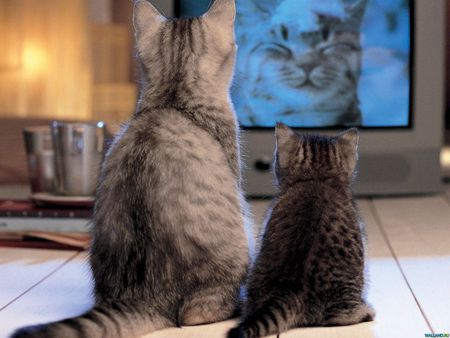
Birds, fish and rodents are the stars of cat TV.

This is not music for cats.

I tried that a few years ago after reading a story about composer David Teie, who’d designed tracks especially for felines, incorporating tones and rhythms that supposedly have a calming influence on cats.

Here I was thinking it would be something nice for my cat, so I queued up one of the tracks — and Buddy lost his shit!

Bud’s reaction didn’t leave any room for ambiguity: Ears flattened to his head, whiskers pulled back, crouched in a defensive position and hissing at the TV. It was a full-fledged freak-out.

As anyone who’s read this blog knows, Buddy’s a weirdo even among cats, so I don’t doubt Mr. Teie’s music does calm some kitties. Just not this one.

After that experience you can understand how I was hesitant to give “cat TV” a go. Turns out I was worried over nothing.

Buddy usually ignores the TV, but when the video started and the first bird flittered on screen, pecking at some seeds scattered on a tree stump, little man got really interested.

After a few seconds he settled in like a kid watching Saturday morning cartoons, mesmerized as he stared up at the screen.

There were a few times when he looked back at me over his shoulder, seeking a bit of social reassurance as if to say “Can I watch the birdies, Big Bud?” Then he started chirping!

Cat TV isn’t all about the visuals. Sound plays a key element and Paul Dinning, the Youtuber who produces the videos, captures an omnidirectional array of flutters, birdsong and the background hum of nature.

Buddy bounced on the balls of his feet once or twice as if he was ready to pounce on the screen, but he never did. He didn’t look for birds behind the TV either, which is apparently a common reaction. Maybe he understands what he’s seeing isn’t real, but he’s entertained nonetheless.

So it’s with Buddy’s ringing endorsement I can report cat TV is legitimate kitty entertainment. If you ever need to buy yourself an hour or two to get something done without a furry personal assistant getting in the way, cat TV can provide a nice distraction.