Archaeologists Uncover Ancient Mayan Jungle City Where Buddy Was Once Worshiped As A Feline Deity

The city, which was abandoned after a natural disaster, was an important hub of civics, trade, napping and indigenous dishes such as the cheeseburger.

XQOCHOATL, Yucatán — Archaeologists announced the discovery of a vast and prosperous ancient Mayan jungle city whose inhabitants once worshiped an unusually handsome gray tabby as a feline god.

X’Budiso was an important center of trade, religious life, architecture and art, according to Ferdinand Lyle, an archaeologist with the British Museum of London and lead researcher on the project.

His team located the long-lost city using LiDAR — light detection and ranging — a technology that allowed them to peer beneath the cover of heavy jungle and detect the ruins beneath.

Previously, there was only one indication that humans had once inhabited the area — a feline paw holding a cheeseburger, rendered in stone and poking out of a thick tangle of jungle flora. When archaeologists cleared the brush and trees, they revealed the rest of the statue which depicted a regal-looking cat on a plinth, holding the cheeseburger aloft in triumph.

Budacoatl with offerings
An artist’s impression of the Mayan deity Budacoatl surrounded by offerings of cheeseburgers, dipping sauces and artisanal cheeses inside the Temple of a Thousand Snacks. A cult devoted to Budacoatl, the Ancient Order of Yums, was responsible for taste-testing the snackly offerings.

The city was a bustling metropolis for hundreds of years before its abrupt abandonment, which researchers said was likely caused by a natural disaster such as a flood or pestilence.

“The Budiso people worshiped a pantheon, and at the top of that pantheon was Budacoatl, the tabby jaguar god of snacks, handsomeness and war,” Lyle explained. “Our research indicates that doom fell over the city, likely in the form of a plague, and that its inhabitants believe they may have angered Budacoatl by skimping on their offerings of snacks.”

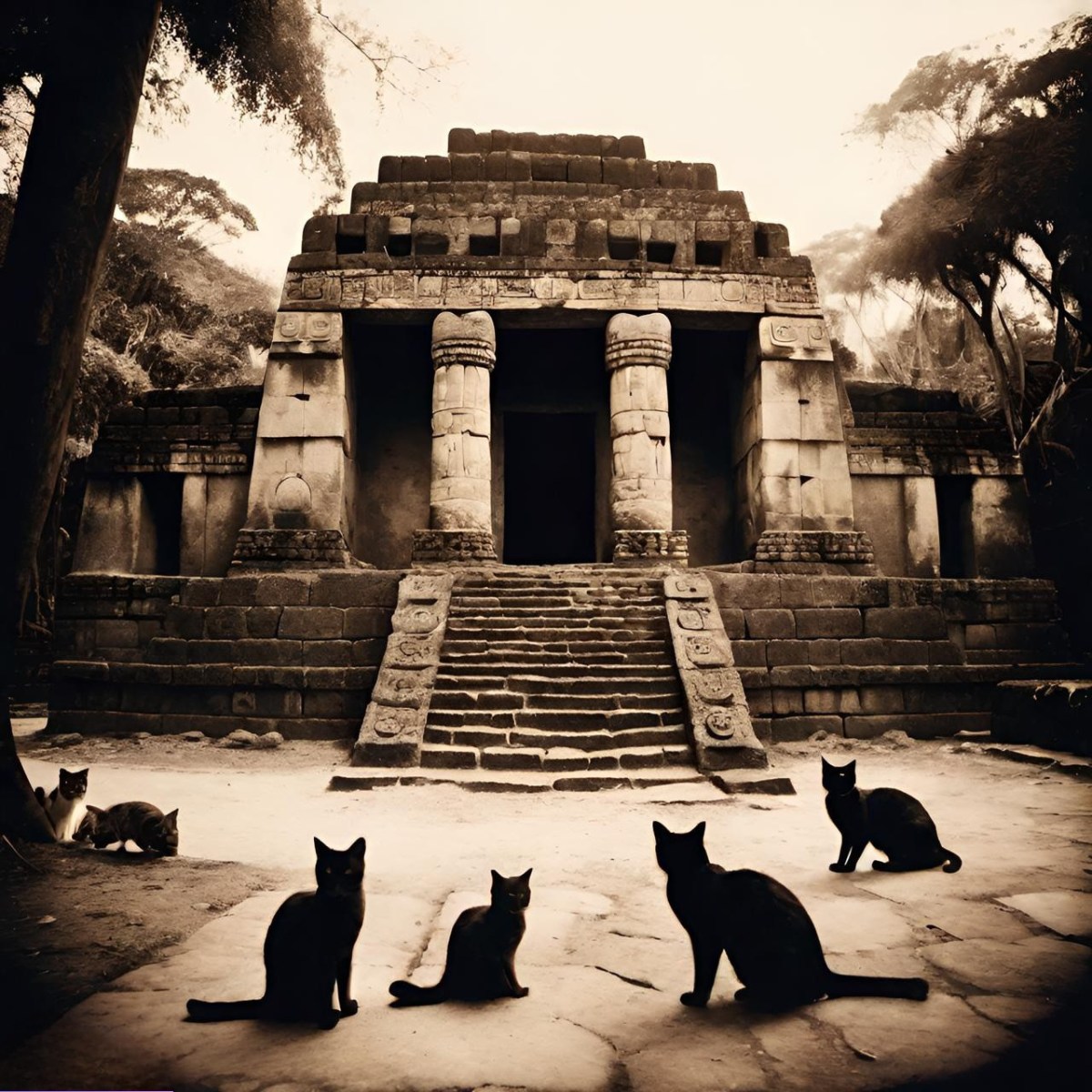
Cats in front of the Temple of Turkey
Feral felines, like the pair pictured here in front of the Temple of Turkey, still live on the grounds of the long-lost city. Source: Buddesian University Archaeological Department

Partially translated glyphs tell of unprecedented growth for the once-prosperous city, which the people believed stemmed from the favor they enjoyed from Budacoatl. Employing a force of more than 100,000 laborers, they built a magnificent temple to the feline deity in the very center of their city.

An architectural wonder, the Temple of Budacoatl featured more than 500 depictions of the feline in statues and relief carvings. The structure was comprised of tiered gardens with artificial waterfalls and tribute chambers, while gilded food and water bowls were placed at regular intervals for the hundreds of mortal cats who lived on the temple grounds.

A nearby structure, the enigmatic Grand Napitorium, was possibly the first sound-proof building in history and affirmed the X’Budiso people’s communal commitment to satisfying siestas.

The city gained a reputation for culinary innovation, and is considered the birthplace of aji sauce, deep fried turkey, huevos rancheros and Temptaciones, the ancient precedessor to Temptations.

The Artisanal Guild of Nectarean Condiments and the Sacred Order of Saucemasters were two particularly prosperous factions in the ancient city, which developed a reputation in the pre-Conquistadorial world for producing  the tastiest guacamole.

“It was said that Budacoatl was particularly fond of sandwiches, and the people sang hymns about his power, influence and ripped physique,” Lyle said. “An epic poem, chiseled into the edifice of the temple, told of battle in the heavens between Budacoatl and the mighty Vakuum, scourge of the Maya. Budacoatl prevailed over Vakuum, banishing him to the underworld where his screeching could not be heard by the inhabitants of the Earth.”

Relief carvings
Richly detailed relief carvings from the Palace of Pâté depict figures from the feline pantheon. Source: Buddesian University Archaeological Department

At the foot of the wall where the poem is inscribed stands a statue of Budacoatl, one paw holding a pastrami sandwich and the other raised in a sign of peace.

“Budacoatl was a big deal among the Maya,” Lyle said. “At one point he was bigger than Gozer and Zuul, ruling atop the pantheon. As a result, cats enjoyed enormous favor in the city.”

Ferdinand Lyle
Professor Ferdinand Lyle, foreground, stands in front of the Napitorium, where the Budiso people would take siestas. Napping was an important part of the culture. Source: Buddesian University Archaeological Department

Buddy The Cat And The Search For The Lap Of Luxury

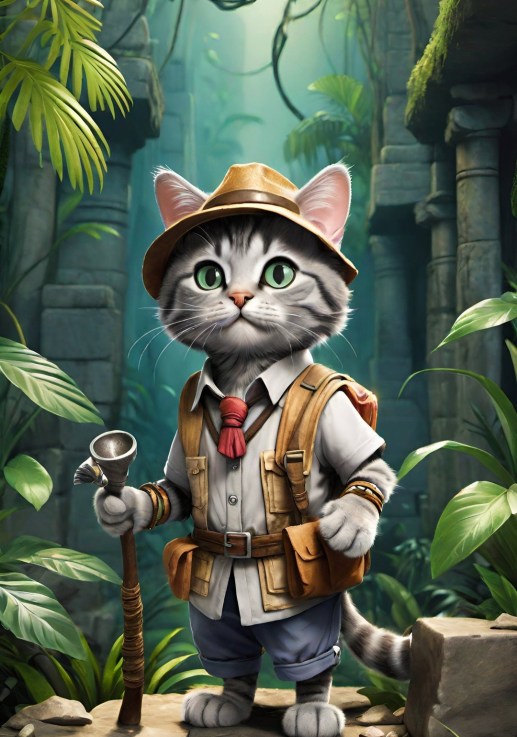
Sir Buddy leads an expedition into the jungle to find the legendary Lap of Luxury.

AMAZON RAINFOREST — At the peak of the hill, still well within the darkness of the tree canopy where only a few slabs of light penetrate through the understory to the jungle floor, a path stops abruptly.

In its place is a steep drop and the mouth of an underground chasm carrying water over the edge, creating one of the planet’s most spectacular waterfalls — and a sweeping vista of the lake and its shores below, where structures from deep antiquity seem to exist only as outlines in the mist.

It is here in the Lost City of Casarabe that intrepid explorer Buddy the Cat believes he’ll find the legend his species has sought for more than a thousand years.

It is, he believes, the site of the Lap of Luxury.

“Many explorers have braved these jungles in search of the legendary Lap of Luxury,” Sir Buddy says as members of his team pad around their camp. “I stand on the shoulders of some pretty big cats here, on the cusp of history, to finally achieve what so many felines set out to do.”

buddy_archaeologist2
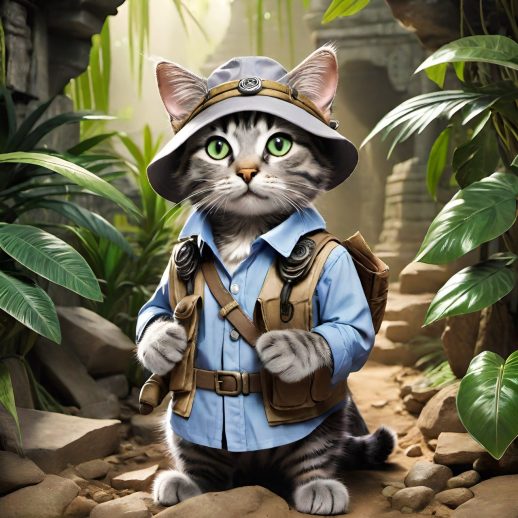
Buddy on the hunt for the legendary Lap of Luxury, which may be located in the Lost City of Casarabe.

Buddy believes the Lap of Luxury will be found in this ancient city, which was abandoned more than a thousand years ago for reasons that so far elude the experts accompanying him. Only a very small part of the Lost City of Casarabe is visible even this deep in the jungle. The flora here is too dense and the jungle floor too dark to give up its secrets so easily.

Under Sir Buddy’s direction, teams have cleared a thick network of vines to reveal a stepped pyramid, the twelve spires of a temple dedicated to a mysterious jaguar deity, and a remarkably well-preserved palace that Buddy believes once belonged to an aristocratic feline.

Some seventy rooms are contained in the palace, including a chamber the team has dubbed the Hall of a Thousand Naps, where stunning stone-carved reliefs depict an advanced felid civilization that engaged in napping not only as a biological necessity, but a function of religious fervor.

“The Caztecs were known for their brutality and the Layans were known for their enduring empire, but the hallmark of Casarabian society was the elevation of napping into high art,” says Ferdinand Lyle, an expert on South American antiquities with the British Museum. “Indeed, grand murals depict a civilization that measured time in naps and meals, and even military disputes with neighboring powers were scheduled around shut-eye. To the Casarabians, violating the sanctity of the Nap Schedule was considered an affront to the very fabric of society.”

jaguar lying on tree log
Otorongo, one of Buddy’s buddies, met the intrepid explorers deep in the jungle and accompanied them to the Lost City, facilitating a cultural exchange of napping technique. Credit: Benni Fish/Pexels

Legends and the surviving records of neighboring civilizations mention the Lap of Luxury using a dictionary’s worth of superlatives to describe its magnificence. Aztec scholars called it “simultaneously radiant and outrageously comfortable, always the perfect temperature, the substrate upon which kings enjoyed serene naps and gentle massages while being fed candied figs.”

It is alternately described as gilded, soft, gem-like in its facets and silken in tactile sensation.

“Of its comforts, it knows no equals,” wrote 19th century explorer Percy Fawcett, who spent the latter part of his life searching for Casarabe. “If today’s artisans were capable of emulating such perfection, which they are obviously not, all of civilization would grind to a halt as millions fall into deep, satisfying slumber.”

Khalbalique, a jaguar historian and contemporary of the Casarabians, wrote that the Lap of Luxury “thrillified me down to my paws.”

“Such was the lazification of this tremendulomentous relaxatory,” the big cat wrote, “that I found it extraordinatiously operose to extractify my personage from its embraculations.”

buddy_archaeologist
Sir Buddy strides fearlessly through the jungle, determined to find the Lost City and its most precious treasure, the Lap of Luxury. Here he poses for a portraitist who will send his likeness back to the Explorer’s Club to be hung on its walls alongside Mewis and Clarke, Claward Carter, Catto the Navigator and other intrepid legends.

Regardless of the conflicting accounts, all agree on one thing: the Lap of Luxury is magnificent.

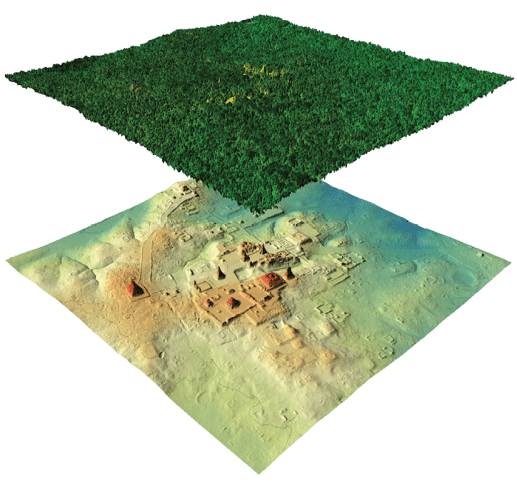
Sir Buddy and his team are working out the details of bringing a helicopter into the deep jungle in order to use LIDAR, or light detection and ranging, to sweep the area. Using a mix of near-infrared, ultraviolet and visible light, a team using LIDAR from the air can digitally “remove” the dense jungle to reveal the structures underneath, natural and man-made.

For the intrepid explorers it’s an advantage their forebears never had, and it’s one reason why Sir Buddy believes he will succeed where those who came before him did not.

“With this technology we can map the entire city and find its most opulent palaces and temples, the places most likely to house the elusive Lap of Luxury,” Sir Buddy says. “When we find it, it shall be my honor to be the first cat in more than two hundred years to settle into it, get comfortable and have a nice nap.”

lidar
LIDAR reveals the jungle’s secrets by peering through the trees and the thick blanket of foliage that has swallowed once-glorious cities.