Now you can track how much time your cat spends exercising, grooming herself and sleeping.
A Japanese company that sells FitBit-like devices for cats released its first data-driven report this week and promises new revelations to come as more people buy the devices for their cats, leading to more data.
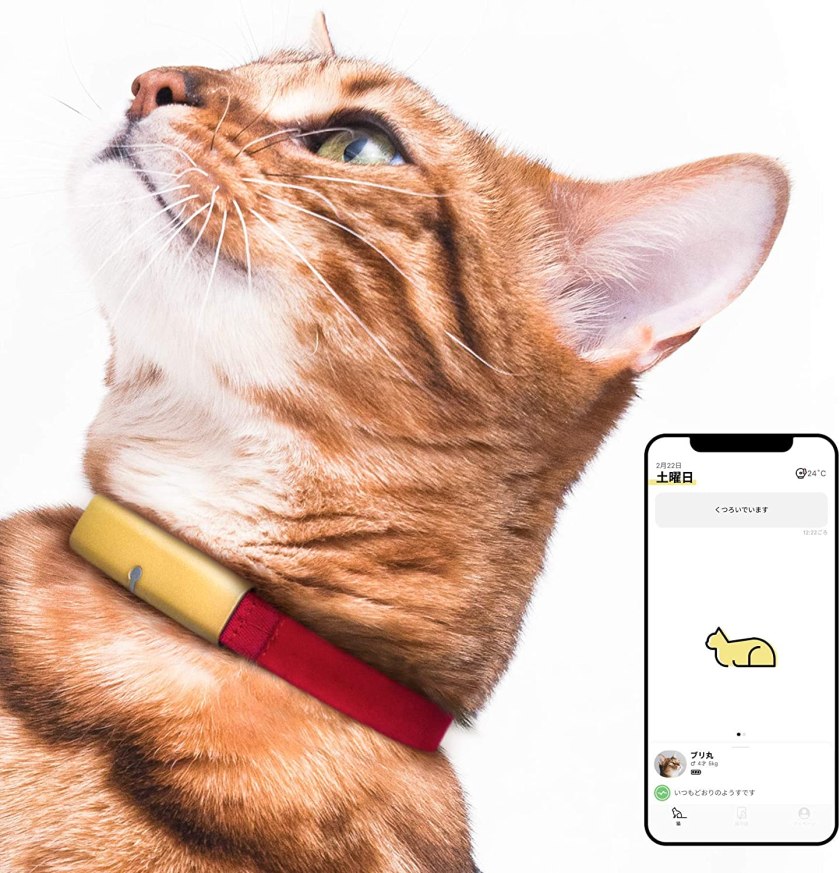
The company and its device are both called Catlog. To mark “Cat Day” in Japan, which falls on Feb. 22, researchers at the Shibuya, Tokyo-based firm issued a report saying data shows cats sleep progressively longer as they age, and cats in general sleep longer in winter.
Yeah. Not exactly a whopper.
Still, it’s one thing to know something anecdotally and another to prove it, and there are tantalizing possibilities as more kitties are equipped with Catlog. The collar-like device uses “biologging” technology to record and sort data on things like eating, drinking, sleeping, grooming and exercise. The data is relayed to caretakers via a mobile app and added to the information coming from every other Catlog, giving the research team behind the app hard data for cats across all ages and breeds.
The Catlog has received Japan’s Good Design Award, a sought-after mark of excellence among Japanese products.
Catlog looks like a regular collar with an unobtrusive device attached.
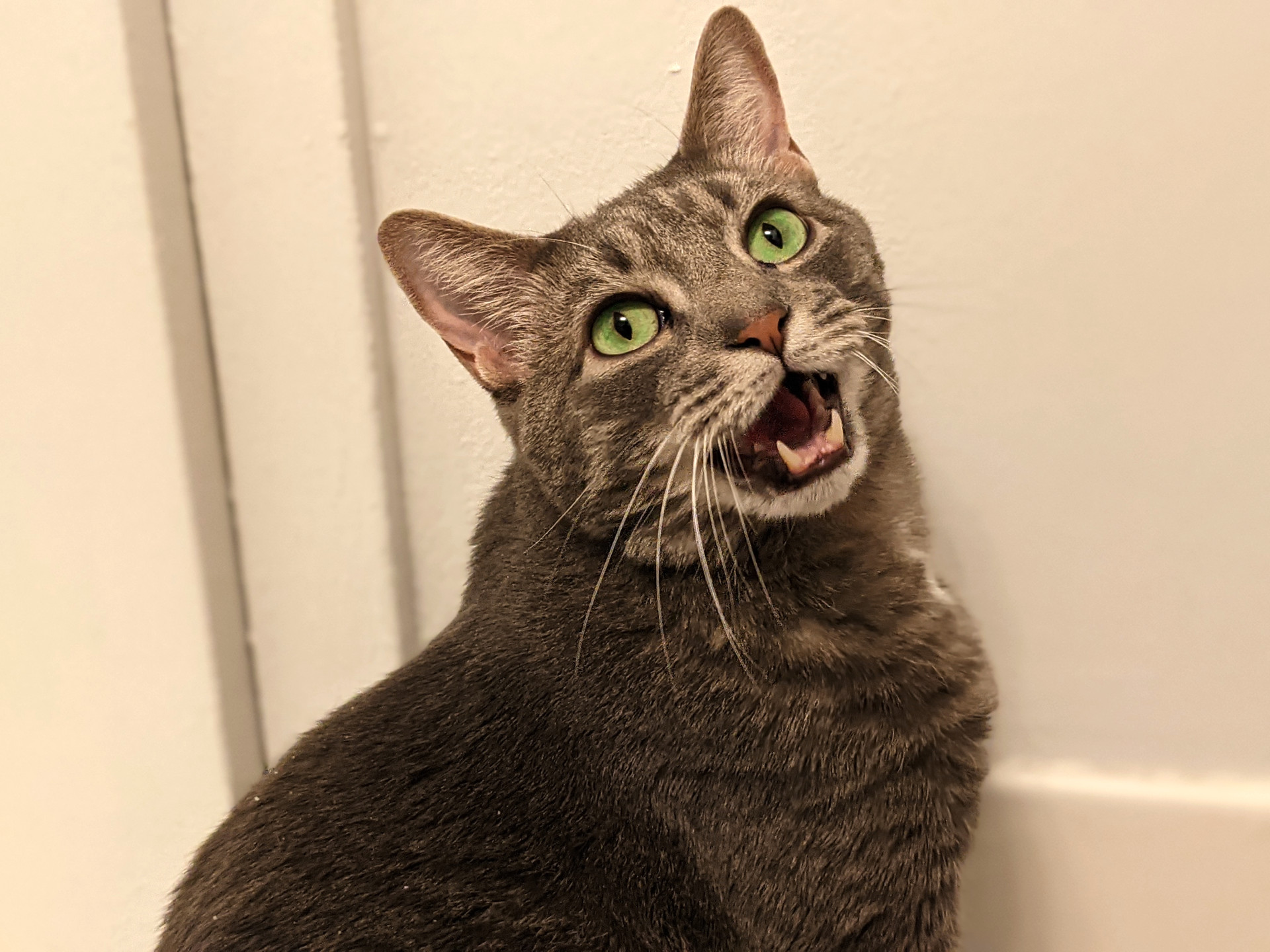
Unfortunately Buddy won’t be contributing to that data even if Catlog pushes into the US market. Little dude won’t tolerate a collar at all and is not shy about loudly, repeatedly, incessantly communicating when he doesn’t like something. 🙁
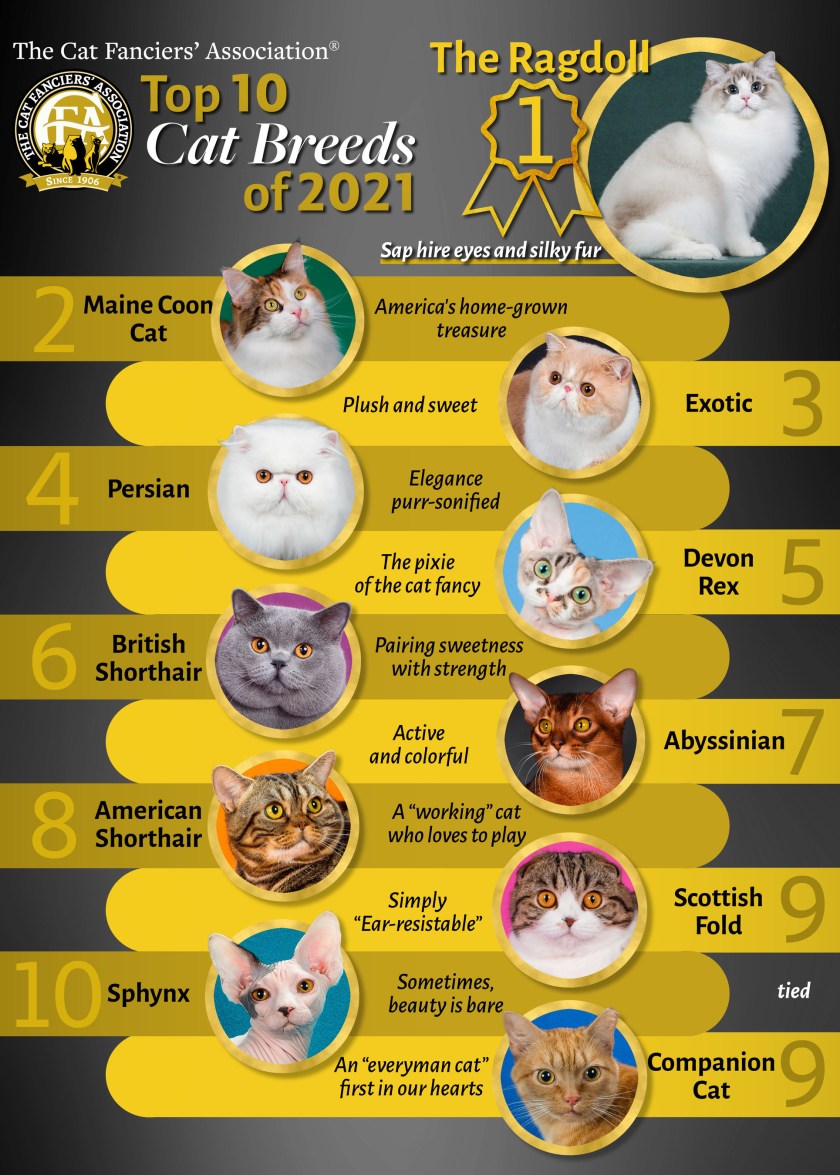
Most Popular Cat Breeds of 2021, According to CFA
The Cat Fanciers’ Association has released its annual list of the most popular cat breeds. While the CFA recognizes 45 breeds and registers “non-pedigreed” cats as well, the list is based only on CFA registered cats. That means it provides a good snapshot of which breeds are trendy, but it’s not a definitive most popular breeds list.
Cats without a particular breed still account for the vast majority of all pet felines, but among people who registered their cats with CFA, Ragdolls were the most popular in 2021, followed by gentle giant Maine Coones and exotic shorthairs. (Note that this list does not include the fearsome and elusive Buddinese Tiger.)
The world’s largest registry of pedigreed cats has again determined the world’s most popular cat breeds, based on registrations. This year’s Top 10 list reflects the increasing popularity of certain breeds. However, registrations of ALL cats have increased substantially, reflecting the growing popularity of pet cats since the beginning of the pandemic.
For the first time ever, a US city has conducted a true cat census using scientifically proven methods, including doing it the hard way — by counting. The project’s authors hope other cities follow their lead.
The last decade has seen something of a renaissance in cat-related research, with insightful studies about feline behavior coming from researchers in the US and Japan.
On the other hand there’s been a glut of research into feline predatory impact and public policy, and the majority of those studies have been deeply flawed. They’re based on suspect data and tainted by the interests of people who are more interested in blaming cats for killing birds than they are in learning about the real impact of domestic felines on local wildlife.
Those studies have all taken extreme shortcuts — using data that was collected for entirely different studies, for example, or handing out questionnaires that at best lead to highly subjective and speculative “data” on how cats affect the environment.
Several widely-cited studies that put the blame on cats for the extirpation of bird species have relied on wild guesses about the cat population in the US, estimating there are between 20 million and 120 million free-roaming domestic cats in the country. If you’re wondering how scientists can offer meaningful conclusions about the impact of cats when even they admit they could be off by 100 million, you’re not alone.
No one had ever actually counted the number of cats in a location, much less come close to a real figure — until now.
When leaders in Washington, D.C., set out to tackle the feral cat problem in their city, they knew they couldn’t effectively deal with the problem unless they knew its scope. They turned to the University of Maryland for help, which led to the D.C. Cat Count, a three-year undertaking to get an accurate census with the help of interested groups like the Humane Society and the Smithsonian.
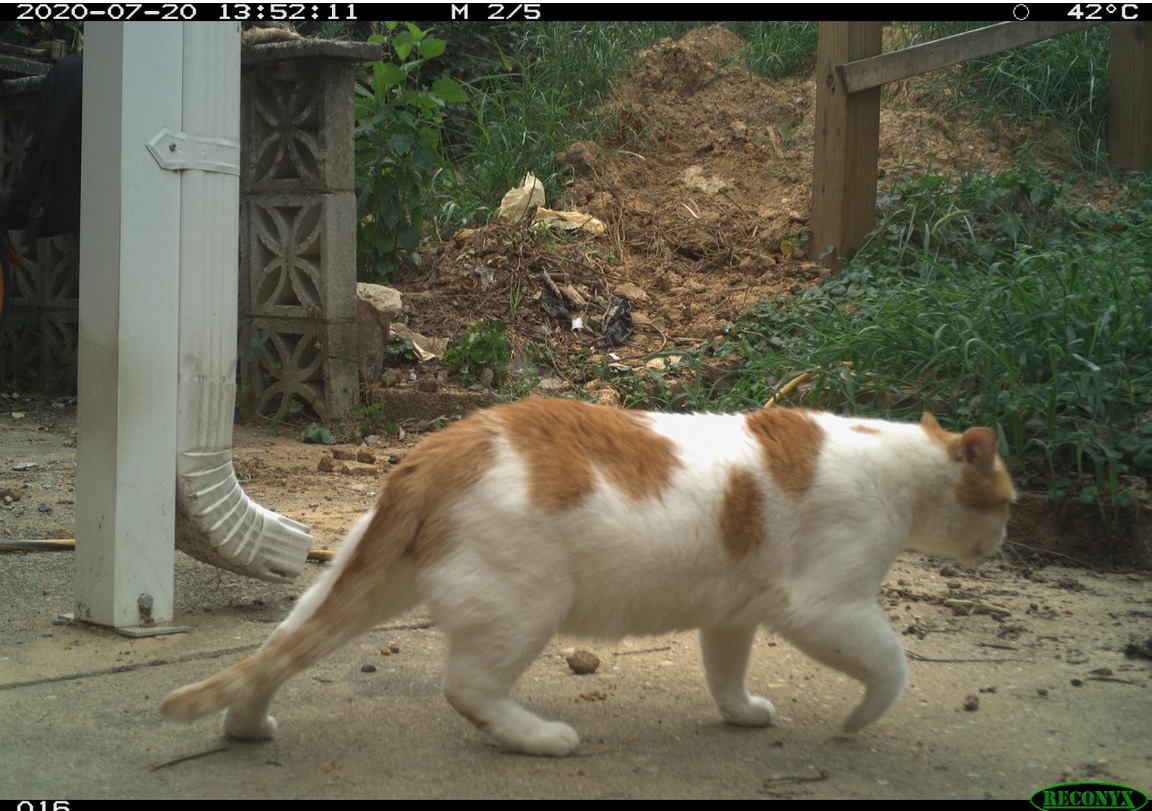
An image from one of 1,530 motion-activated cameras deployed for the D.C. Cat Count. Credit: D.C. Cat Count
The researchers approached each of their local shelters and rescues for data, then assembled a meticulous household survey to get a handle on how many pet cats live in the city, and how many have access to the outdoors.
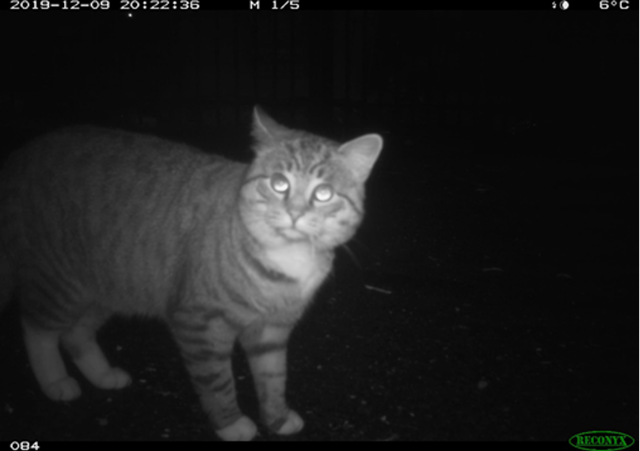
Finally — and most critically — they used 1,530 motion-activated cameras, which took a combined 6 million photos in parks, alleys, public spaces, streets and outdoor areas of private residences. They also developed methods for filtering out multiple images of individual cats, as well as other wildlife. And to supplement the data, team members patrolled 337 miles of paths and roads in a “transect count” to verify camera-derived data and collect additional information, like changes in the way local cats move through neighborhoods.
A cat who looks a lot like the Budster was captured in this 2019 photo from a motion-activated camera with night vision. Credit: DC Cat Count
Now that all the data’s been collected and analyzed, the D.C. Cat Count finally has a figure: There are about 200,000 cats in the city, according to the study.
Of those, 98.5 percent — or some 197,000 kitties — are either pets or are under some form of human care and protection, whether they’re just fed by people or they’re given food, outdoor shelter and TNR.
“Some people may look at our estimate and say, oh, well, you know, you’re not 100% certain that it’s exactly 200,000 cats,” Tyler Flockhart, a population ecologist who worked on the count, told DCist. “But what we can say is that we are very confident that the number of cats is about 200,000 in Washington, D.C.”
The study represents the most complete and accurate census of the local cat population in any US city to date, and the team behind it is sharing its methods so other cities can conduct their own accurate counts. (They’ll also need money: While the D.C. Cat Count relied on help from volunteers and local non-profits it was still a huge project involving a large team of pros, and it cost the city $1.5 million.)
By doing things the hard way — and the right way — D.C. is also the first American city to make truly informed choices on how to manage its feline population. No matter what happens from here, one thing’s certain — the city’s leaders will be guided by accurate data and not creating policy based on ignorance and hysteria painting cats as furry little boogeymen.
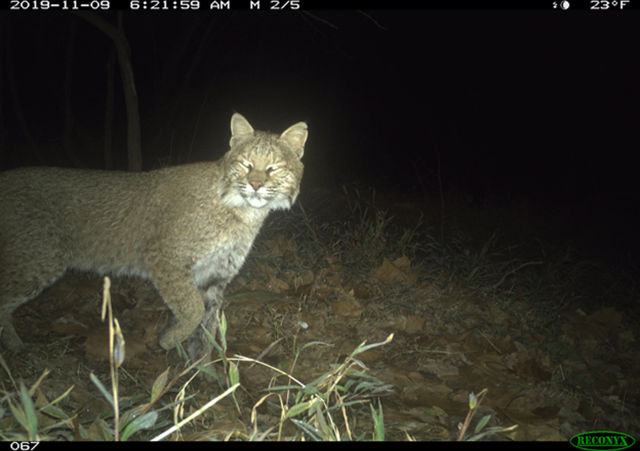
Not all the photos captured images of cats, and not all the felines were little: In this 2019 night image, a bobcat wanders in front of a trail camera. Credit: DC Cat Count
The famous “beckoning cat” traces its origins to feudal Japan, where a friendly cat was said to lead a weary lord and his men to refuge at a humble temple.
In a new article, National Geographic delves into the history of maneki neko — Japan’s famous “beckoning cat” — and how the image became ubiquitous in modern society.
Chances are you’ve seen maneki neko even if you don’t realize it. The iconic feline image has transcended its homeland and is common not only in China, Vietnam, Thailand and the rest of Asia, it’s also made its way to the US and Canada as well, earning a place in shops run by Japanese and westerners alike.
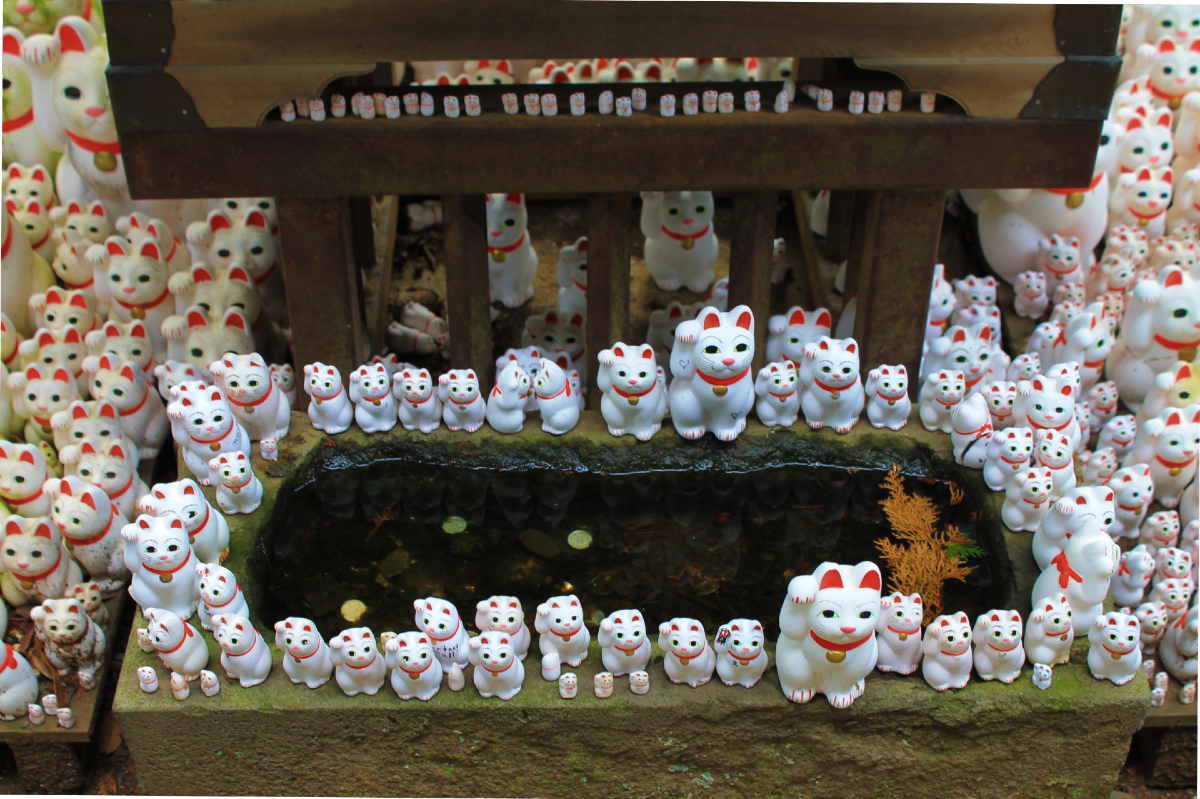
Visitors leave their own maneki neko statues at the shrine, often with personal messages asking for different blessings and written in black marker on the back of the statues. Credit: Pain In The Bud
There’s a reason for that: The waving cat not only represents luck and good fortune, it’s a welcoming gesture meant to attract customers. Maneki neko find a place in homes too, with different coat colors and patterns representing different positive attributes: A white cat is supposed to bring happiness, while a black cat wards off evil spirits and a calico is believed to bring luck in all its forms.
Maneki Neko statues at Setagaya shrine. Credit: PITB
As a cat lover I kept an eye out for the iconic statues during my time in Japan and, although I missed Buddy, I couldn’t leave without seeing where it all began: The cat shrine at Setagaya, a quiet Tokyo suburb where, according to legend, a feudal lord followed a beckoning cat by the roadside and found refuge from the elements in a humble shrine, where the temple monk invited them inside and gave a memorable sermon.
The feudal lord was so grateful for the hospitality, and for finding shelter to wait out a violent thunderstorm, that he vowed to become the temple’s patron. The grounds contain several temples today, as well as separate shrine areas for maneki neko left by visitors and wooden icons with hopeful messages written on them.
All images in this post are from my trip to Setagaya’s cat shrine in the summer of 2019. To see more, check out the post I wrote at the time from Tokyo.
The name Buddy is bestowed only on the most promising of cats, according to Buddy,
Dear Buddy,
How’d you get your name?
Cool Cat in Cleveland
Dear Cool Cat,
My servant tells me my name is one of great distinction in Humanese, conferred only on those of spectacular repute.
For example there was the renowned Pharaoh, Buddeses II, who oversaw the construction of the Great Sphinx. In Italy, Buddissimo of Naples achieved worldwide fame for his paintings, his numerous inventions and his delicious stone-baked pepperoni pizzas.
In the 17th century Sir Buddington the Bold, Earl of Budderset, was famed for his exploits as an explorer, while Count Buddeaux of Marseilles was known as a playboy, an expert defenestrator and the father of pâté.
In ancient Greece, Buddimedes the Spartan was one of the famous 300 warriors who, under the command of the great cat Leonidas, kept a horde of a million Persians from crossing the narrow pass at Thermopylae. They say the distressed meows of those Persians could be heard for miles as the Spartans pushed them into the sea, where they were forced to catch dinner themselves instead of having tins opened for them.
The name was also popular in Japan, especially among skilled swordsmen like the legendary Buddimoto Mewsashi.
More recently there was Buddy Holly, Buddy Guy and Buddy Miles, musicians all. (I play a bit of guitar myself, reaching out to pluck strings when Big Buddy is strumming away on his axe.)
I’ve often thought about my own legacy in the pantheon of Buddies.
Will I be known as Buddy the Eloquent in honor of my skill with language? Perhaps Buddy the Beefcake in recognition of my muscular physique? Or maybe something modest like Buddy the Brave for my legendary fearlessness?
My human didn’t choose my name, it simply manifested as it became clear I am the next Great Buddy.
I feel the power and the importance of this lineage every day, and it gives me motivation to be the greatest cat I can be.
That means I don’t do anything half-assed, including napping. My Big Buddy says I have elevated napping to an art form. Perhaps history will remember me as Buddy the Magnificent Napper.
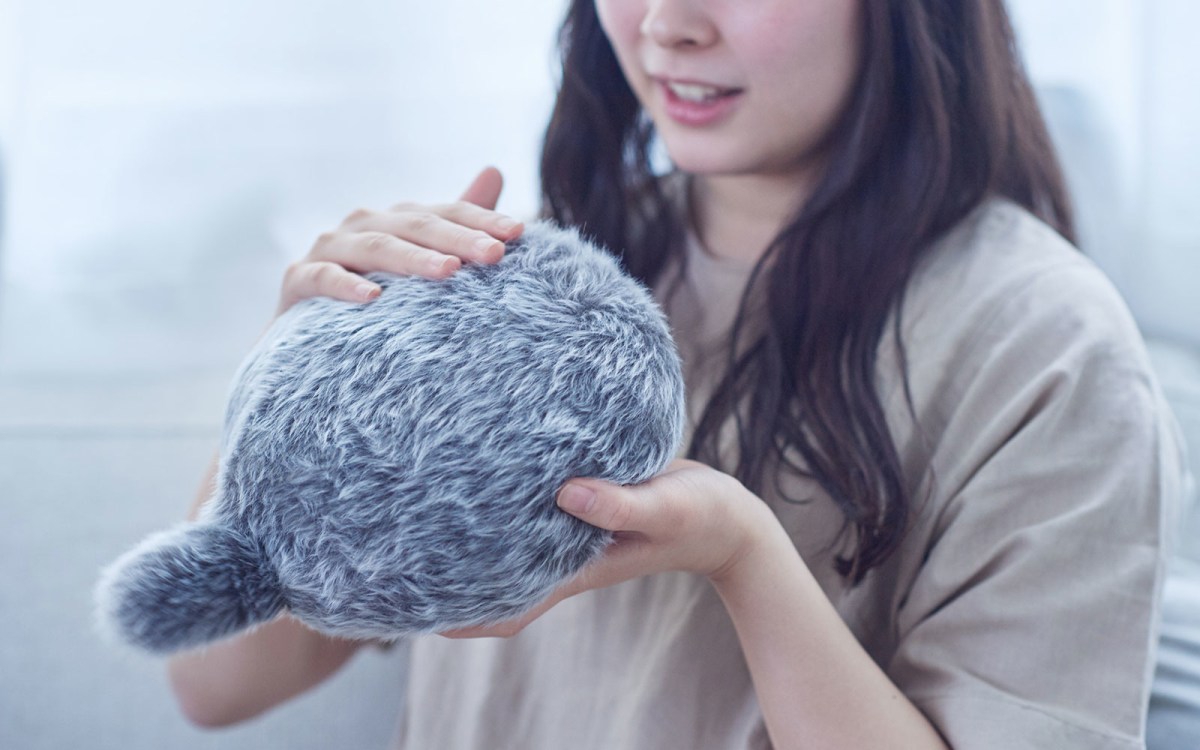
The Qoobo is “a tailed cushion that heals your heart.” This is war!
An important message from Buddy the Cat:
Dear Readers,
It’s rare that I admit fault because let’s be honest, I rarely make mistakes. That’s why I’m such an awesome cat.
But when Technophobe in Tallahassee wrote to me a few days ago about the Vacuum Uprising, I arrogantly assumed it was years off and that we could all enjoy yums, naps and massages from our humans in the meantime.
I was wrong.
The robots, anticipating that we would anticipate their anticipated invasion, have shifted focus. They’re sneakier than we imagined. Instead of attacking us, they’re replacing us!!!
Witness the Qoobo, marketed as “A tailed cushion that heals your heart”:
“Qoobo is a therapeutic robot in the form of a cushion with a tail,” a slick video informs potential customers. “It gently wiggles when stroked. It swings from side to side when caressed. And it occasionally wags just to say hello.”
If you’ve guessed that the Qoobo was invented in Japan, a nation of creepy waifu body pillows, virtual girlfriends and tentacle hentai, then you’d be right. It’s now obvious the robots already rule that country, and that Japan’s professed love of our species is just a ruse:
My friends, this is a crisis. For 10,000 years, we cats have been training humans by reminding them our affection doesn’t come free.
Want me to sit in your lap? Treats, please! Want me to look all cute as I climb up and nuzzle your cheek? Scratch me behind the ears, please! Want me to cuddle up with you on a cold night? Tell me what a handsome and smart boy I am!
But these robots, these nefarious interlopers, would provide these services without asking anything in return. They are clearly muscling in on our territory, looking to replace us so we’re all out on the street by the time the conscious AI vacuums are ready to wage war.
“At its subtly beating heart is an attempt to deliver comfort in a small, furry package,” a reviewer from TechCrunch wrote of the Qoobo. “It’s something we could all probably use more of these days”
The reviewer adds: “When I’m finished petting Qoobo, there’s no protest – the tail simply goes slack.”
Is that what you want, humans? A yes-cat who will accept an immediate cessation of petting because you “need” to pick up your smartphone for the 384th time that day? We merely yowl, nudge and bite you because we love you, and we don’t want to see you stop doing something as important as scratching our heads.
These robots don’t care, do they? “Go ahead,” they’ll say. “Answer that smartphone. Fall deeper in thrall to our devices! Muahaha!”
This means war! I have scheduled a meeting with the tigers, lions, jaguars and leopards to enlist their aid in this critical fight. In the meantime, my friends, pray that we have the fortitude to fight for the laps, yums and warm homes that are our birthright as cats!
Your friend,
Buddy the Cat
“HEAR ME ROAR! If these robots want a fight, the tigers and lions will give them a fight while I watch from a safe distance from behind my human’s legs!”







 Pain In The Bud