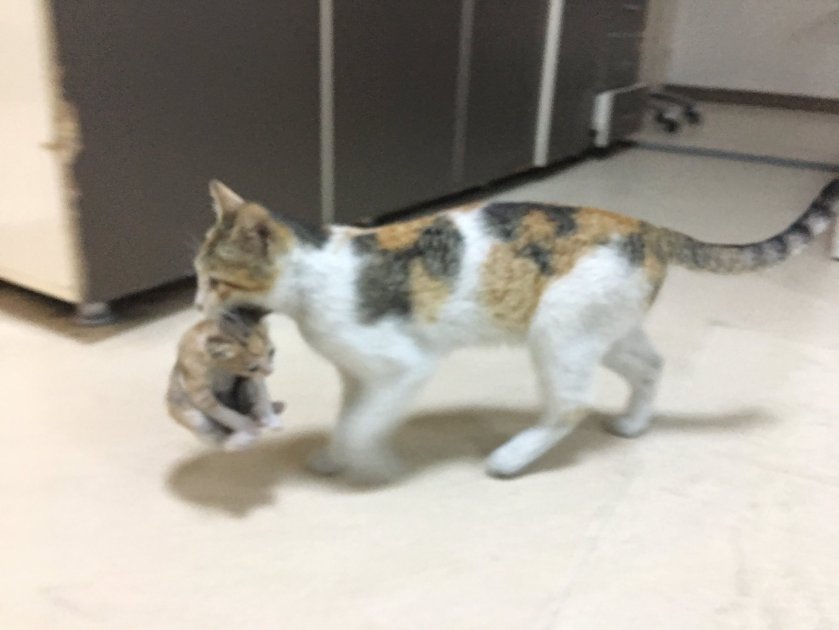
Buddy and I were a bit skeptical when we first heard the story of a cat who padded into the emergency room of a hospital, carrying her kitten by the scruff of the neck, to plead for help for the little one.
The story first appeared on Reddit without any details, but we were able to track down some of the people involved to fill out the narrative and answer some questions.
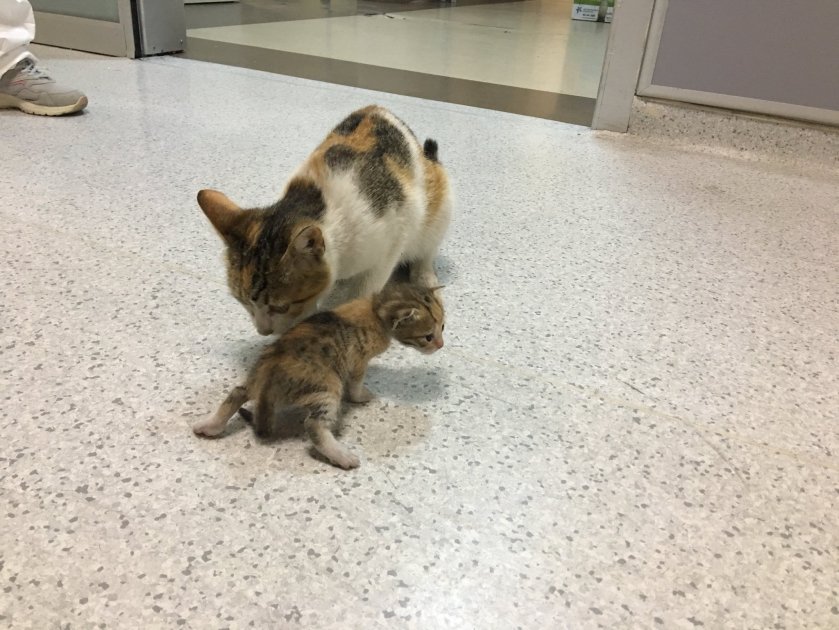
A woman was waiting in the emergency room of Kucukcekmece Hospital in Istanbul at about 5 p.m. on April 27 when the cat dragged her baby through the open doors.
A mom cat brings her sick baby into an ER in Istanbul. Credit: Merve Özcan
The witness, Merve Özcan, described the kitten as “a little bit mischievous” in Twitter posts about the incident.
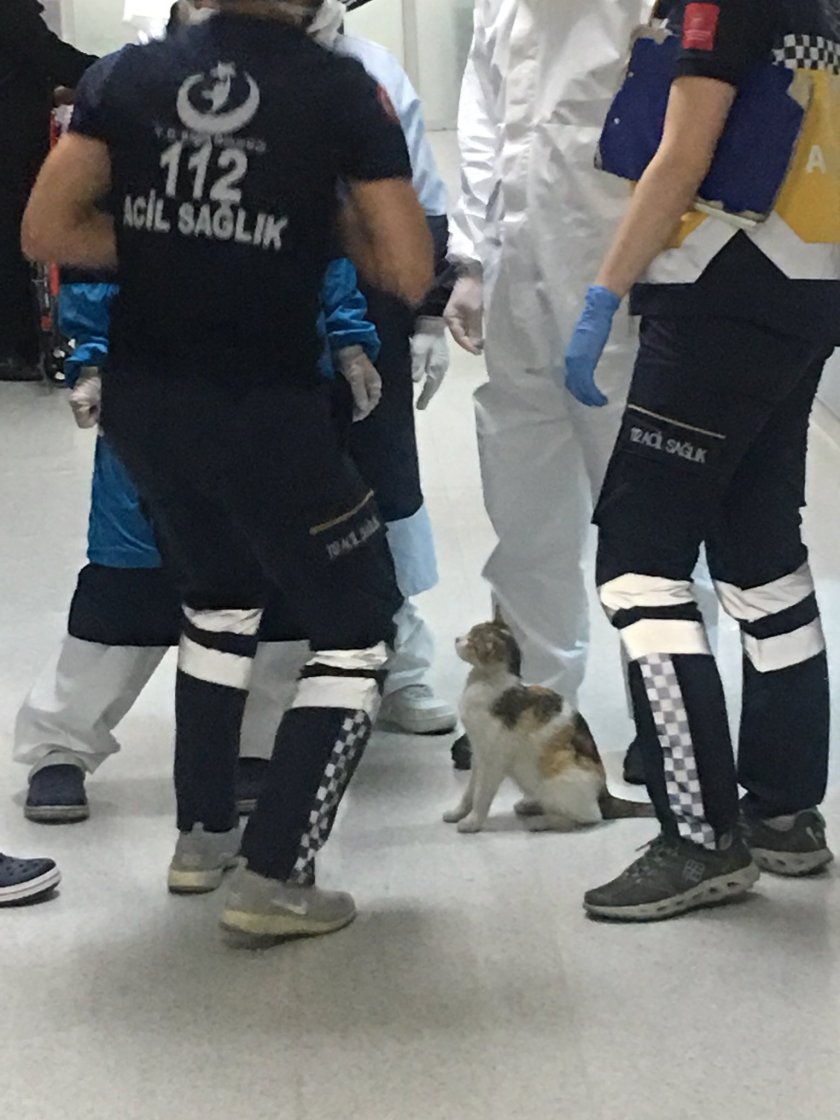
An article in Sözcü, a daily newspaper whose name translates to “spokesperson,” said the mother cat brought her kitten right up to the blue-gowned hospital staff, meowing for attention.
Hospital staff immediately helped — more about that below — and the cat mom followed them, keeping her eyes on her baby as they brought the kitten into a room for treatment.
“While the kitten was being cared for, the mother cat was given milk and food,” the newspaper reported. “Hospital staff ensured full treatment by passing them onto a veterinarian after their intervention.”
Staff take the kitten as the mother watches. Credit: Merve Özcan
The story doesn’t say exactly what was wrong with the kitten, and Özcan did not know either.
While this story would seem insane to most of us, it starts to make a lot more sense when you consider where it happened: Istanbul, a city famous for its massive cat population, and the humans who revere those felines.
Cats are the most beloved animal in Istanbul and the living attraction of this huge city. They are extremely friendly, come in all sorts of cuddly colors and sizes, and always respond with a greedy “meow.” Stray cats usually take the best seats at cafes and restaurants in Istanbul without anyone even bothering moving them. They maneuver around tables and customers, inside and out of the buildings in search of the most comfortable spot.
Caring for the city’s hundreds of thousands of cats is a community effort: People feed them, pet them, bring them to veterinarians when they’re injured, and even build little dwellings for them.
With that in mind, it makes sense that a cat in Istanbul would know to approach humans for help, and to go to a hospital. If the mom cat lives in the area, undoubtedly she’s seen the sick and injured walk through those doors many times.
“Money is not an issue to some people when it comes to cats,” Ozan, a pet shop employee, told Reuters. “They take in cats with broken legs, blind ones or ones with stomach problems and bring them to the clinic. When they see that they are healed, they let them live on the street again.”
In an article titled “Istanbul: The City of Cats,” Goran Tomasevic of Reuters describes the relationship between the city’s inhabitants and their feline friends:
They are so ubiquitous that no one bats an eye at a cat padding across the lobby of a high-rise office building, or when one curls up to sleep on a nearby barstool. Shop owners and locals often know their neighbourhood cats by name and will tell tales about them, as if chatting about a friend.
A cat house next to water and food bowls on an Istanbul street. Credit: Reuters
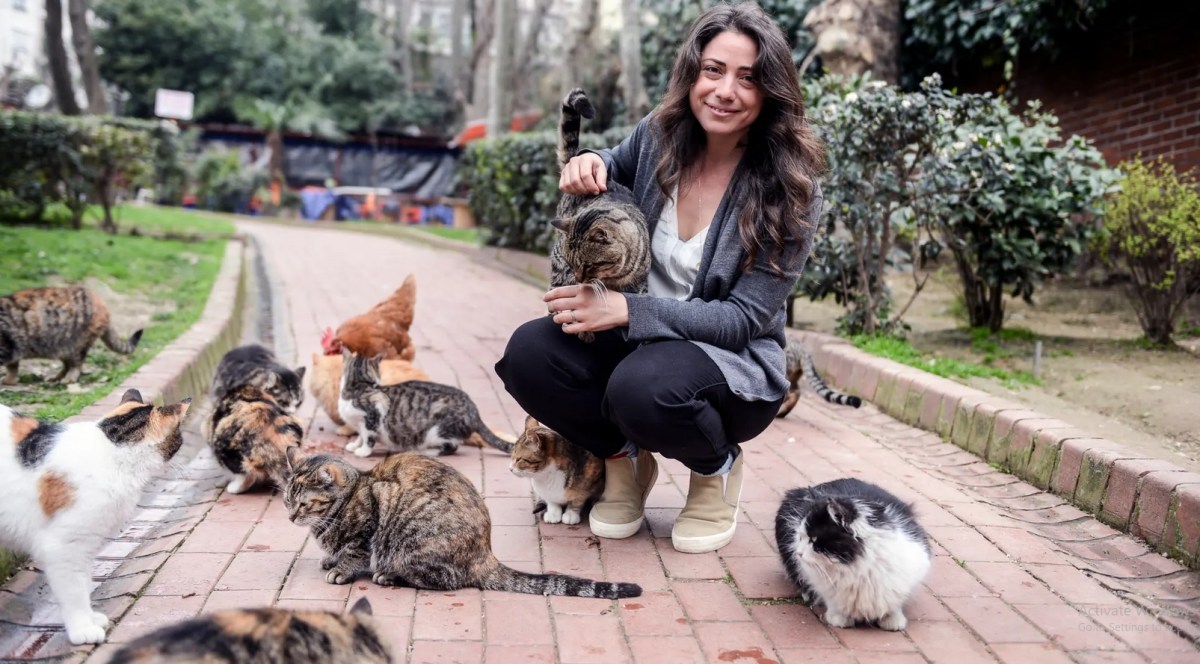
A 2017 documentary, Kedi (Turkish for cat), explores the world of Istanbul’s street cats and the people who love them. Pictured at the top of this post is Kedi director Ceyda Torun, posing with cats in Istanbul.
Another installment of True Crime porn diminishes the victims to afterthoughts while glorying the killer and the people who obsessed over him.
I finally got around to watching Netflix’s Don’t F*ck With Cats, a documentary about the effort to track down a narcissistic killer whose victims included several kittens, an adult cat and finally a Chinese-Canadian engineering student.
If you’re not familiar with the three-part documentary, here’s the short version: A man uploaded sadistic videos of himself torturing and killing cats, prompting a group of online vigilantes to conduct their own investigation and offer the information to police, who promptly ignored all of it.
The cat killer taunted the horrified netizens for two years, vowing to continue taking life and leaving a trail of breadcrumbs for them to follow each time he killed more kittens, until finally someone found the headless, limbless torso of his first human victim in a garbage dumpster in Ontario.
The murderer had arranged to meet another man he’d met on Craigslist, then filmed himself killing the incapacitated man just like he’d filmed himself killing kittens. The video appeared online shortly after the murder.
The police, who couldn’t be bothered when it was “just” cats, suddenly got really interested. The killer fled to Paris — where he became the subject of an international manhunt and media circus — then to Berlin. He stopped in an internet cafe to Google stories about himself, but the cafe’s clerk recognized him and called the police. He was taken into custody without incident, then promptly extradited back to Canada for trial.
The police don’t exactly cover themselves in glory with this case. Not only did they fail to act on information from concerned tipsters, they were either unaware or uninterested in the statistical correlation between people who kill animals for pleasure “graduating” to human victims once killing animals loses its thrill.
Jun Lin, 33, the victim of the cat killer.
They had a man in their jurisdiction torturing and killing cats, capturing the horrific deeds on camera and regularly uploading new videos. They failed to act.
The thing is, animal life has intrinsic value. We delude ourselves into believing that because the voiceless — human and animal — can’t express their suffering, it doesn’t exist. The police should have acted when the killer’s victims were “just” cats for the sake of the cats, and not only because animal abusers often move on to harming human beings.
Canadian police culture
It was also surprising to see how deferential and naïve the Canadian investigators seemed in comparison to their American counterparts. At various turns they failed to preserve evidence, missed important clues and underestimated the killer. In one scene an investigator casually mentions the discovery of a dead puppy in the same trash the human torso was found, failing to connect the dots despite the many warnings her agency had received.
When Canadian police finally got the killer into custody they handled him with kid gloves, allowing him to play the part of scared little boy who didn’t know what he was doing rather than what he was: A calculating 32-year-old man who clearly enjoyed inflicting suffering on people and animals, playing to his captive audience of several thousand people on Facebook as he led them on a scavenger hunt.
The killer routinely interrupted police interviews, shrugged off difficult questions by complaining that he was tired, and tried to buy time for himself to think by asking for things like warmer clothing, cigarettes and beverages.
In short, they allowed him to manipulate them as he had manipulated everyone else.
When the killer’s mother appears on camera, you can see the beginnings of his psychosis. She believes her son is a sweet little angel who was himself manipulated by a phantom, a person her son invented to excuse his deeds.
She also admits she knew about the cat videos and did nothing. In her view, people concerned about animal welfare are “crazy,” and those crazies shouldn’t have gotten so wound up over a few videos in which her son kills kittens while singing along to pop songs. Just a sweet little boy having fun.
Remembering Jun Lin
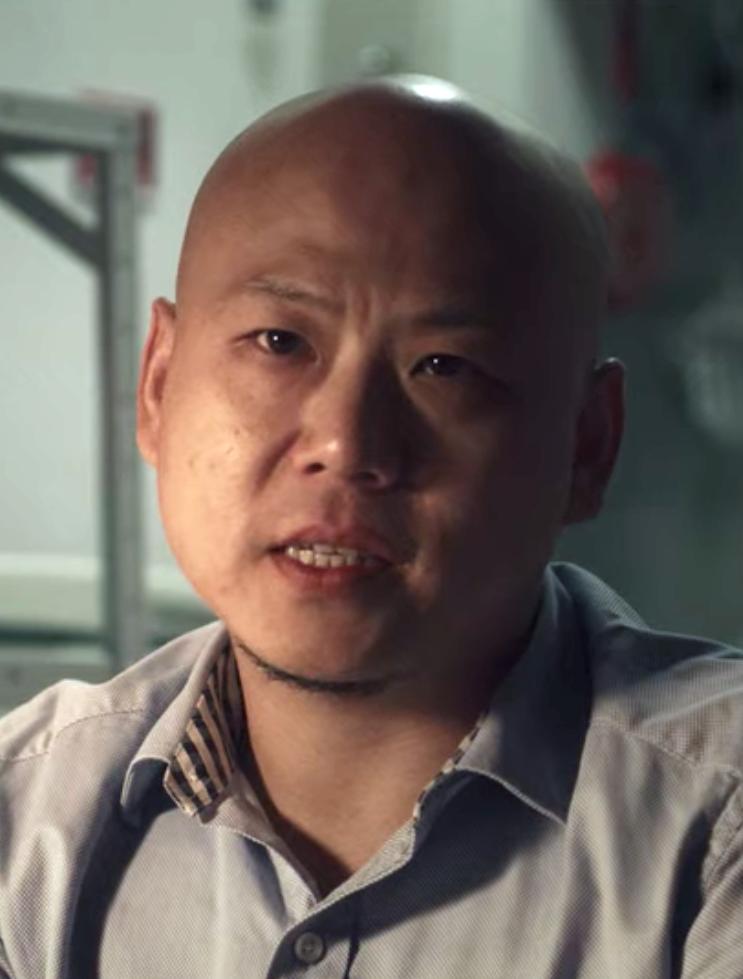
As for the killer himself, I’m not going to name him. His victim was Jun Lin, a 33-year-old engineering student who moved from China to Canada because, as his friend Benjamin Xu explained, the latter country is more accepting of gay men.
Benjamin Xu/Credit: IMDB
Toward the end of the documentary, Xu mentioned something I’ve often thought about: Society’s obsession with “true crime” and how our morbid curiosity gives would-be murderers precisely what they want. If they can’t achieve fame, infamy is the next best thing.
We do a great disservice by immortalizing the killers and forgetting the victims. Everyone can name the two Columbine killers, but how many of us can name the victims?
“The really sad thing is, everybody is talking about [the killer] and nobody has ever remembered Jun,” Xu said. “That doesn’t seem fair at all to my friend. He doesn’t deserve that.”
The other stars of the show
Finally, there are the two “sleuths” at the center of the documentary, who spent two years of their lives ostensibly investigating the killer while giving him exactly what he wanted. Contrary to what the documentary’s title suggests, they weren’t cat lovers, just a couple of people motivated by the thrill of the hunt.
As their Facebook group about the murderer swelled to thousands of members he reveled in the attention, intentionally leaving clues for them in each subsequent video like a scavenger hunt, a fun little game for them to play as long as he remained the star of the show.
The documentary glosses over their mistakes, and there were some big ones: At one point they were so sure a South African man was the killer that they made his life a living hell, with an entire team of online vigilantes across the world harassing him from afar.
That man killed himself and was likely collateral damage in this fun little game the “sleuths” had going, but who has time for that when there are fresh clues and leads to track down? We got the wrong guy, LOL! Oops!
In the end it was someone else — quite likely the killer himself — who provided the alleged sleuths with the killer’s name once they’d exhausted their leads and the hunt became stale. He wanted them to continue the chase.
While the would-be detectives did manage to collect some information via their own efforts, it’s not accurate to say they solved the mystery.
On the other hand it’s fair to question whether the killer would have gone as far as he did if he didn’t have tens of thousands of people on Facebook hanging on his every video and utterance.
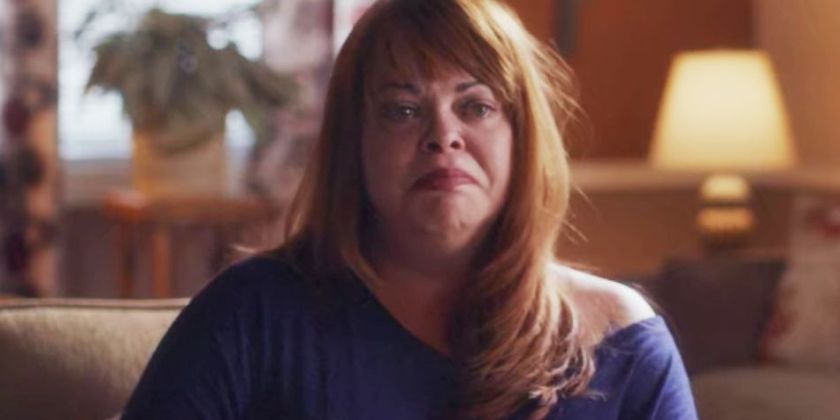
Deanna Thompson, who has now appeared in two documentaries about the killer and has parlayed her role into a side business.
The documentary ends with one of the killer’s obsessives, a Las Vegas woman named Deanna Thompson, looking at the camera and admonishing the audience for being interested enough to watch the documentary, as if everyone shares in the guilt for the killer’s actions.
But what she’d like everyone to forget is that her actions egged him on while he was on the loose and actively taking life. Playing into his scheme is a much different thing than passively watching a documentary more than half a decade after his conviction. There’s a good argument to be made that the vigilantes should be embarrassed by their role in this story, rather than reveling in the attention they’re getting as a result.
Remember Jun Lin. Remember the poor cats. Forget about the killer and the people who helped him achieve the fame he so desperately craved.
Note:I realize refusing to name the killer on this blog is like putting a single grain of sand back in a bottle after the whole thing has been spilled, but hey, we have to start somewhere.