The Mixed Legacy of CC the Cloned Cat

Scientists now clone animals for experimentation and genetics companies clone pets.

Like Dolly the sheep, CC the cat’s arrival into this world was accompanied by apocalyptic pronouncements, grave concerns about man’s hubris at playing God and warnings that human clones wouldn’t be far behind.

At the time cloning was revolutionary, something that was only supposed to exist in science fiction movies. Most people were uneasy with it, and much of the public debate centered around ethical concerns.

It was 2001: The world had just gotten over the Y2K scare, the Sept. 11 attacks and an abundance of turn-of-the-century, end-of-the-world prophesies. When people thought of cloning, they pictured tyrannosauruses rampaging through Jurassic Park and Jeff Goldblum’s scientist character lecturing the park’s proprietors on playing with the awesome power of nature.

CC passed away on March 4, 2020 at 18 years old — a full life by feline standards. The real consequences of her existence were less dramatic than predicted, but ultimately disappointing.

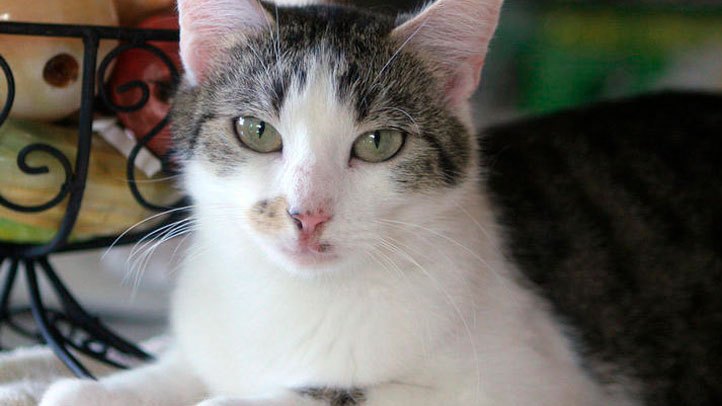
CC the Cat
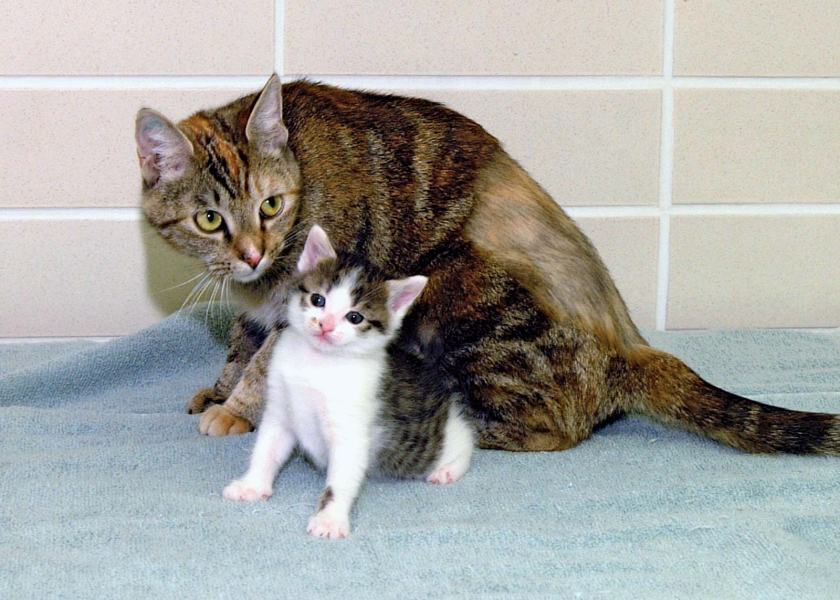
CC with her surrogate mother, Annie. Credit: Texas A&M

Copy Cat’s birth didn’t herald an age of human cloning, but it did open the door to widespread animal cloning — including, as of last year, non-human primates — and eventually, to pet cloning.

A Mixed Legacy

Mark Westhusin, a scientist who was part of the team that successfully cloned CC, sees it as progress.

“CC’s passing makes me reflect on my own life as much as hers,” Westhusin said Wednesday. “Cloning now is becoming so common, but it was incredible when it was beginning. Our work with CC was an important seed to plant to keep the science and the ideas and imagination moving forward.”

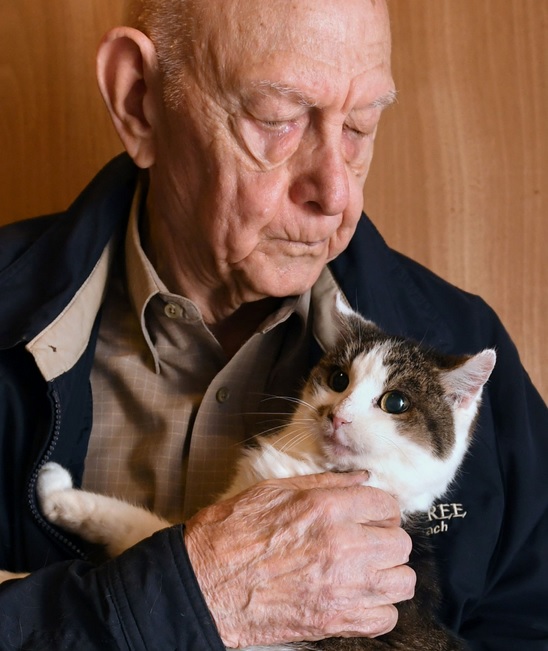
CC lived as any typical house cat would, according to Shirley and Duane Kraemer, who adopted the famous feline. Duane Kraemer was also part of the research team involved in CC’s cloning.

cckraemer
Kraemer with CC. Credit: The Eagle (Bryan, Texas)

When Barbra Streisand admitted she had her dog cloned in 2017, she responded to the backlash by writing an editorial in the New York Times, defending cloning as a way to get over the heartbreak of losing a pet.

There are now several genetics companies that offer pet-cloning services for people who want to bring their dear dogs and cats back to life.

“The human–animal bond is a pretty strong thing,” said Kerry Ryan, a veterinarian who works for pet cloning firm Viagen. “Our pets truly are a part of the family, and people want to have a piece of their pets around forever.”

Clones, But Not Your Real Pets

Except, of course, they really aren’t bringing cats and dogs back to life, and the animals won’t be around forever. Viagen’s customers get a genetic copy, but that doesn’t mean the clone will look or even act the same.

“It can be a genetically identical animal that can come out looking differently than the animal that you had,” veterinarian Katy Nelson told WTOP in 2018.

To the people who can afford dropping between $25,000 and $50,000 to clone their cats and dogs, it doesn’t seem to matter that both nature and nurture will ensure differences.

Pet cloning has also drawn the ire of animal welfare activists and major organizations like the Humane Society and SPCA, who point out that every cloned cat or dog means one less home for strays in shelters.

The Humane Society “opposes cloning of any animals for commercial purposes due to major animal welfare concerns,” HSUS’s Vicki Katrinak told National Geographic. “Companies that offer to clone pets profit off of distraught pet lovers by falsely promising a replica of a beloved pet. With millions of deserving dogs and cats in need of a home, pet cloning is completely unnecessary.”

False Starts, Gene Splicing and Clone Experimentation

Then there’s the truly dark side of cloning.

Each cloning attempt involves implanting eggs into several surrogate cat (or dog) moms, and no one wants to know what happens to the other clones, whether or not they make it to term. There’s no law requiring the companies to disclose the fate of those animals, so for now it remains a mystery.

Not all clones end up in loving homes, either. The lucky handful do, but others are birthed into the world to be experimented on, like a quintet of monkeys cloned by scientists in China.

Cloned Monkeys from China
Scientists edited the DNA of these monkeys to remove a gene that regulates sleep, resulting in depression and anxiety, among other problems. Three of the five monkeys pictured here are sucking their thumbs, which is a sign of stress when primate infants are taken from their mothers. Credit: Institute of Neuroscience, Shanghai

The scientists who brought the monkeys to life also edited their genes, “cutting out a gene involved in regulating the sleep/wake cycle.” A 2019 story on Phys.org explained the consequences:

“The gene removal created multiple effects in edited monkeys, such as reduced sleep time, increased movement during the night, changed blood hormone levels, increased anxiety and depression, and some schizophrenia-like behaviors.”

Which was precisely the point: The research team wanted to study the unintended consequences of gene-editing on animals to learn more about how it could impact humans.

To be sure, none of this is Copy Cat’s fault.

The famous cat, who was delivered by a surrogate mother, lived for 18 years, a year or two more than the average house cat. She spent the remainder of her days as a typical house cat, albeit one whose vet visits and blood work were carefully pored over as geneticists confirmed she was as healthy as any other kitty.

But as science barrels forward and labs — many of them in countries with no regulations — are bringing cloned animals into this world, we should think about the consequences for animals and the human race.

Chinese Government to Citizens: ‘Deal With’ Your Pets, Or We Will

Chinese authorities threaten pets as Coronavirus fears grow.

It shouldn’t come as a surprise that a government with no respect for any kind of life — human or animal — would threaten the mass extermination of cats and dogs.

It’s par for the course in China, where authorities in dozens of cities and provinces are urging people to “deal with” their pets in the wake of the Coronavirus threat — or the government will, media reports say.

The warnings have been issued in Wuhan, the epicenter of the Coronavirus, as well as Shanxi, Beijing, Tianjin, Shandong, Hebei and Shanghai, according to the Humane Society International.

Yet there’s no evidence the virus has been transmitted by domesticated pets like cats and dogs, and no evidence those animals can catch it from humans, experts say.

In Wuhan, residents have been told to keep their pets indoors, and warned that any cats or dogs spotted outdoors will be “killed and buried on the spot,” the UK’s Metro reported.

But experts say it’s the government’s fault that the virus jumped from wild animals to humans in the first place. China has refused to shut down so-called “wet markets,” where live animals are sold next to the carcasses of recently-slaughtered animals, despite the fact that SARS and other viruses originated from those markets.

9798BD46-4531-416F-8620-684F4B91C3D2
A Chinese wet market. Credit: Nikkei

Officials believe the Coronavirus originated at the Huanan Wholesale Seafood Market, one of many “wet markets” described as “filthy, crowded places where animals are displayed alive in small cages” and “are often slaughtered on site.”

China has been “mired in long-held beliefs about the benefits of eating exotic and often endangered animals for good health,” the Humane Society said in a statement, referring to traditional Chinese “medicine” and other folk practices that use animal parts in ineffective and dangerous tonics and elixirs.

In addition to creating the circumstances for viruses to jump from wild animals to humans, the illegal wildlife trade has pushed animals like tigers and pangolins to the brink of extinction.

“Chinese society is boiling with anger at wildlife policy failures,” said the Humane Society International’s China policy specialist, Peter Li. “Social media is full of posts condemning the refusal to shut down the wildlife markets. This is the worst Chinese New Year in China’s recent history.”

Reason #127 To Keep Your Cats Indoors: Bad Guys

Neither the law nor other people will respect the bond you share with your cat.

“Hey! Sorry for stealing your cat. I felt really guilty about it, so I abandoned him by the side of the road in another town. Totes a bad impulse decision lol! I never meant to be the bad guy! I hope you can forgive me, but don’t worry, if you don’t I forgive you! Buh-bye!”

That about sums up the bizarre letter a Minnesota woman received on Dec. 11, three months after her cat, Dot, went missing.

She last saw Dot on Oct. 10, when Byron Thomas Vieau delivered a package to her home in Watertown, 20 miles west of Minneapolis. Vieau was visibly taken with Dot, the cat’s owner would later tell police, and bent down to pet the 12-year-old tabby as he delivered the package.

Security footage shows Vieau encountering Dot on his way over, and it’s clear the cat follows Vieau, but the 23-year-old Minnesota man likely nabbed Dot on the driver’s side while walking back to his truck because we don’t get an angle on the theft itself:


Vieau completed his delivery, and Dot was never seen again. Dot’s worried owner called the cops, who questioned Vieau, but he denied knowing anything about the missing moggie.

“Byron lied to me (twice) immediately after Dot was stolen, he lied to police the next day, I feel he is still lying about what he did to Dot,” Dot’s owner wrote in a Facebook post. “In my world this is such an unnecessary tragedy and I wish this upon nobody!”

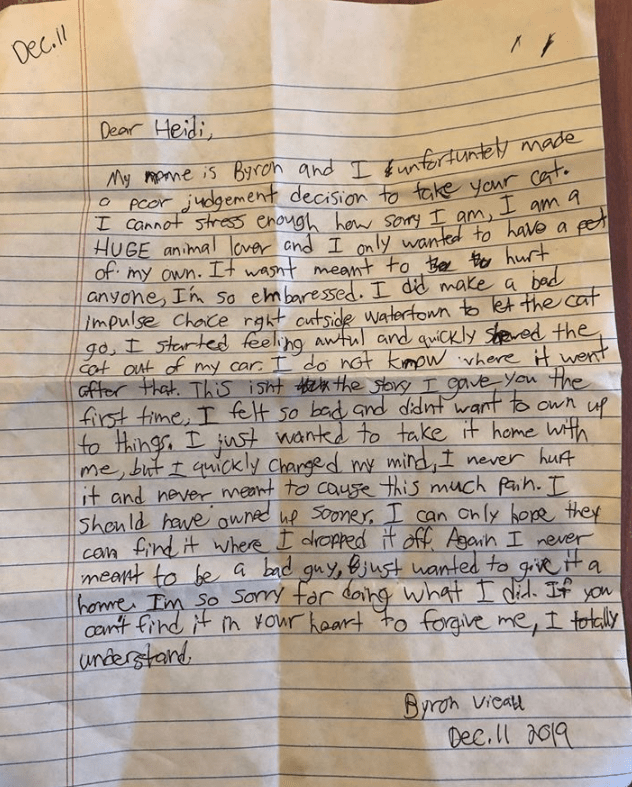
Then in mid-December, Dot’s owner received this batshit-crazy letter from Vieau:

note-from-thief

The letter reads:

Dear Heidi,

My name is Byron and I unfortunately made a poor judgment decision to take your cat. I cannot stress enough how sorry I am, I am a HUGE animal lover and I only wanted to have a pet of my own. It wasn’t meant to hurt anyone. I am so embaressed [sic]. I did make a bad impulse choice right outside of Watertown to let the cat go, I started feeling awful and quickly shoved the cat out of my car. I do not know where it went after that. This isn’t the story I gave you the first time, I felt so bad and I didn’t want to own up to things. I just wanted to take it home with me, but I quickly changed my mind. I never hurt it and I never meant to cause this much pain. I should have owned up sooner. I can only hope they can find it where I dropped it off. Again, I never meant to be a bad guy, I just wanted to give it a home. I’m so sorry for doing what I did. If you can’t find it in your heart to forgive me, I totally understand.

Byron Vieau
Dec. 11, 2019

What stands out is the lack of genuine awareness, of any consideration for the victim’s feelings or the welfare of the cat. Everything’s about Byron. Every sentence is “I wanted” and “I didn’t mean to” and “I can only hope.”

Every action is minimized: Byron Vieau didn’t steal the cat, he “made a poor judgment decision.” He’s a HUGE animal lover, and all he wanted was a pet of his own! Byron didn’t heartlessly shove a house cat — who doesn’t have the skills to survive as a stray — out of his car and abandon it on the roadside, he simply “made a bad impulse choice to let the cat go.”

Vieau tells us he was “embaressed,” he “didn’t want to hurt anyone,” and “never meant to be a bad guy.” He doesn’t mention how Heidi pleaded for the return of her beloved cat, or her anguished posts on Facebook as she asked for help looking for the “clearly well-loved” tabby.

He’s looking for forgiveness and absolution from his victim without troubling himself with considering her feelings, because he wants to feel better about what he did.

Police have arrested Vieau and charged him with misdemeanor theft and misdemeanor animal abandonment, which carry extremely light penalties. Under Minnesota law, Dot’s theft is a minor property crime of the same severity as the theft of say, a toaster, but not as severe as a shiny new flatscreen TV.

In the meantime, Dot is still MIA. Dot is primarily white and black, with traditional tabby markings on his head, and he weighed about 14 pounds at the time he was taken, according to police.

Any readers in the Carver County or Watertown area of Minnesota can call Detective Neil Kuhnau of the Carver County Sheriff’s Office at 952-361-1212 if they’ve spotted the missing moggie.

We hope Heidi and Dot are happily reunited.

How Long Is Too Long To Leave A Cat Alone?

Your cat isn’t a house plant that can be left alone for a week.

“If you want a pet but you don’t have time to walk a dog, get a cat.”

“As long as they have food, cats are fine. They don’t care if they’re left alone.”

“Cats are solitary creatures who are content to ignore you.”

Despite taking over the internet and solidifying their status as one of the most endearing animal species, cats are still widely misunderstood, as these oft-spoken sentiments illustrate.

Of course, as we cat servants know, our furry friends do care very much about remaining in the company of their favorite people.

In a new column on Psychology Today, bioethicist Jessica Pierce backs up something we’ve been saying for ages: Cats are social animals, and it’s harmful to think of them as one step above a plant, content to live a solitary existence as long as they’re fed and watered.

The myth of the aloof, independent cat feeds another misconception: that cats are just fine when we’re not around. Indeed, a common piece of advice for someone thinking about acquiring a pet is “if you are gone a lot and don’t have time for a dog, get a cat instead.” Many people believe that cats can be left alone for long hours every day, and can even safely be left alone for days or even weeks, as long as food and freshwater are made available to them.

This is bad advice and does cats a great disservice because domestic cats kept as companion animals in homes likely need their humans just as much as companion dogs do.

So how long is too long to leave a cat alone? Unfortunately no one knows for sure.

There haven’t been studies on the topic, in part because many behavioral scientists still believe cats are too difficult to work with in research settings.

1495125423076
The big tough guy who cries by the door when I step out of the house for 20 minutes.

But new studies — including the research out of Oregon State that showed cats view their humans as parent-like figures — show cats form strong emotional connections to their people, mirroring the behavior of dogs and even human children.

Other recent studies demonstrated that cats crave human attention and affection even more than food, and look to their humans for reassurance when they’re uncertain about things.

Some people will say that’s all fairly obvious and unremarkable, but there are two primary reasons the findings are significant: First, in the scientific community something has to be proven in a controlled, replicable study. Anecdotes don’t count. Secondly, there’s finally enough research to confirm cats absolutely form bonds with their humans, and those bonds are genuine.

Although felines are superficially aloof, when you get to know them better it becomes clear they’re simply good at pretending they’re nonchalant.

buddynotamused
“No more computer, it’s Buddy time!”

While cautioning that cats are individuals with their own personalities and quirks, Pierce suggests looking to research on dogs and loneliness.

“The rough guidelines for dogs—that about four hours alone is comfortable, but longer periods of alone time may compromise welfare—may be a reasonable place to start for cats,” Pierce wrote, “but further research into cat welfare is needed in order to develop empirically-grounded guidelines for leaving cats alone.”

As for Buddy, who is known to meow mournfully and park himself by the front door when I leave, his one-off limit is about 12 hours, or half a day. I’m okay with leaving him alone overnight after he’s been fed, and while he may not like it, he’s fine if left alone for an extended period once in a while. I wouldn’t do that regularly.

Anything more than that, however, and I’ll enlist the aid of a friend to stop by, feed him and play with him. Maybe that way I won’t get the cold shoulder and resentful sniffs when I return.

Cat Haters Are Out In Full Force

Defending innocent animals and innocent people aren’t mutually exclusive things.

Earlier this week New York became the first state in the US to ban cat declawing, which is a major victory not only for the many people who have been pushing for a ban for years, but especially for the potentially millions of cats who won’t be mutilated for the sake of someone’s couch or drapes.

It’s a time to celebrate, revel in a rare legislative victory for animal welfare, and look ahead toward similar proposals in other states. If more states follow New York, it could pave the way to a national ban.

Innocent, sentient creatures won’t be harmed as they have been for a long time. What could be better than that?

Here come the cat-haters

The thing is, legislation like this brings out the crazies and lots people who think protecting the innocent is a zero-sum game. In their world, helping animals and helping humans are mutually exclusive things instead of two goals that should be part of any coherent moral belief system.

Just because people are suffering in some parts of the world doesn’t mean we can’t help animals, just as helping animals doesn’t preclude us from helping people.

Declawing bans don’t take resources away from starving children in Somalia or America’s urban poor. Compassion for animals doesn’t somehow detract for compassion for people. In fact, all the research points to the opposite: That the way a person treats animals is a strong indicator of how they treat other human beings.

Twat
A comment on a story about New York’s historic declawing ban.
qcomment2
The zero-sum game that isn’t.

Animal abuse and violence crime

That’s why there’s a link between animal abuse and violent crime against people. Animal abusers are five times more likely to commit violence against fellow humans, research shows. Criminologists have been aware of this link for many years, and smart investigators know to keep tabs on animal abusers because they often “graduate” to hurting humans.

That was the case with Luka Magnotta, a notorious animal abuser who, among other crimes, filmed himself feeding a young kitten to a python. Magnotta went on to kill a man with an ice pick, a crime that could have been prevented had detectives in Canada taken Magnotta’s animal abuse more seriously. Animal life has intrinsic value, and Magnotta should have been imprisoned for killing the kitten.

Cats scratch. Get over it.

Then there are the declawing advocates, the people who inexplicably argue that it’s okay to brutally mutilate living, feeling creatures in order to protect inanimate objects like couches and drapes.

One thing should be absolutely clear to anyone looking to adopt a cat: Scratching is completely natural behavior, and it’s your responsibility as caretaker to make sure you provide adequate scratching posts, as well as redirect your cat to those posts and vertical scratchers.

If you can’t or won’t accept that responsibility, you should not adopt a cat.

Cute Kitty
“Don’t touch my paws!”

Of course there are people who will insist declawing has no negative effects on cats. They’re wrong. That’s not a matter of opinion, it’s fact: A 2017 study, the most comprehensive of its kind, detailed a long list of negative effects that result from declawing.

Declawing is NOT a manicure

Declawing, which is the amputation of a cat’s feet up to the first knuckle — and not “kitty manicure” — causes lifelong pain in cats. Because cats are digitigrade animals, meaning they walk with their weight on their toes, the act of walking itself becomes painful. That leads to cats altering their gaits to limit the pain, which in turn leads to poor posture, which ultimately leads to early-onset arthritis and other physical problems, according to the 2017 study in the Journal of Feline Medicine and Surgery.

It’s a cascade of physical problems that leads to misery.

Because cats are famously stoic, doing everything they can not to show pain — they are prey animals as well as predators, after all — it may not be obvious, but declawing hurts them. A lot.

While people may think they’re solving a problem by declawing their cats, they’re creating new ones. Declawed cats are several times more likely to bite because they no longer have their claws for defense. They’re five times more likely to stop using the litter box, because the simple act of standing on litter granules is painful on their raw toe stumps. They’re more likely to be aggressive and ill-tempered.

Insult to injury

Those are all prime reasons why people surrender cats to shelters, causing another type of cascade: One in which a negligent owner has his or her cats declawed, then surrenders the cats because they’re acting out. Declawed cats are twice as likely to be surrendered to shelters as cats who are not declawed.

That directly contradicts claims by proponents of declawing, who say declawed cats are more likely to be adopted. In fact, declawed cats are more likely to end up without homes.

It’s 2019. The information is out there for anyone to look up, and ignorance is no longer an excuse. Declawing is wrong.

Here’s to hoping New York is just the first of many states to ban the barbaric practice.

budhanging2
“You don’t wanna tangle with these talons, bro. I’ll cut you. I’ll cut you for real. And then you’ll have to lather anti-bacterial cream all over your skin, and you’ll smell like medicine. Hah!”