Study: Cat Brains Have Gotten Smaller

Thankfully for our furry friends, smaller brains don’t necessarily correlate to lower intelligence. It’s more about the complexity of neural connections.

Cats have gotten a good deal out of domestication: They’re safer, warmer and protected from almost all threats. They know where their next meal is coming from, and won’t hesitate to meow our ears off if dinner is late.

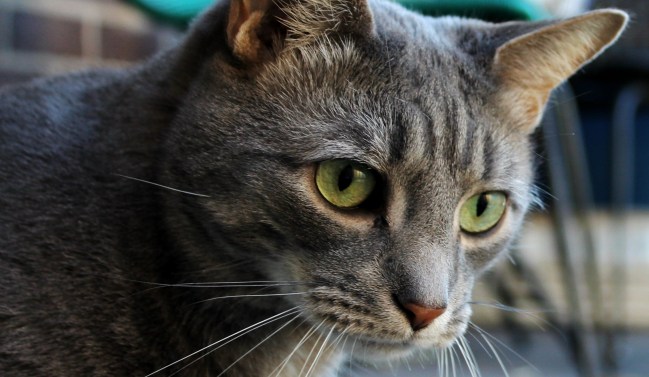
But one tradeoff doesn’t immediately appear beneficial: Domestic cats have smaller brains than the species they’ve evolved from, African and Eurasian wildcats.

“[D]omestic cats indeed, have smaller cranial volumes (implying smaller brains) relative to both European wildcats (Felis silvestris) and the wild ancestors of domestic cats, the African wildcats (Felis lybica),” the research team wrote.

Wild cats have the largest brains on average, followed by wild-domestic hybrids and domestic cats with the smallest brains of the three.

That’s another strong indicator that domestication is the determining factor in feline brain size, although the researchers point out that they are comparing domestic cats to current wildcats, and not the ancient population of wildcats from which domestic cats evolved beginning some 10,000 years ago with the dawn of agriculture and permanent human settlements.

Wildcats with friendlier and bolder dispositions were the first to approach human settlements, drawn by the rodents who were themselves feasting on human grain supplies. Humans realized that the cats were taking care of their rodent problems but weren’t interested in eating the grain, and a beautiful partnership was born.

superhandsomebuddy1
“I have a yuge, yuge brain, the best brain. It’s tremendous.”

Smaller brains do not necessarily correlate to lower intelligence, however, and cats aren’t the only species whose brains became smaller after they were domesticated. Dog brains are about 30 percent smaller than the brains of gray wolves, but dogs have adapted spectacularly to living with humans and reading human behavioral cues.

“The dog is successful not because of the size of its whole brain per se, but because domestication has led to subtle brain changes with a stunning result: the ability to live in the world of people,” a Smithsonian Magazine article points out, noting dogs are also adept at getting people to do all sorts of things for them.

If brain size alone resulted in higher levels of intelligence, whales and elephants would rule the Earth.

Instead “the complexity of cellular and molecular organization of neural connections, or synapses, is what truly determines a brain’s computational capacity,” neuroscientist Kendra Lechtenberg wrote.

The researchers weren’t interested in drawing any major conclusions about feline cognition with the study. They’re more interested in the phenomena of “domestication syndrome,” which causes changes both physical (floppy ears, coat color variation, shorter muzzles) and behavioral. (Less aggression, playfulness.)

The jury’s still out on why exactly those traits emerge, but some studies have attributed it to differences in embryonic development. Unlike many other domestic animals, cats don’t look much different than their wild felis lybica and felis sylvestris counterparts.

The cat study was published on Jan. 26 to Royal Science Open Science, a peer-reviewed open-access journal. The research team was comprised of biologists from the University of Vienna and data curators from the National Museum of Scotland.

What Kind Of Cat Is This?

Domestic kitty or some kind of wildcat?

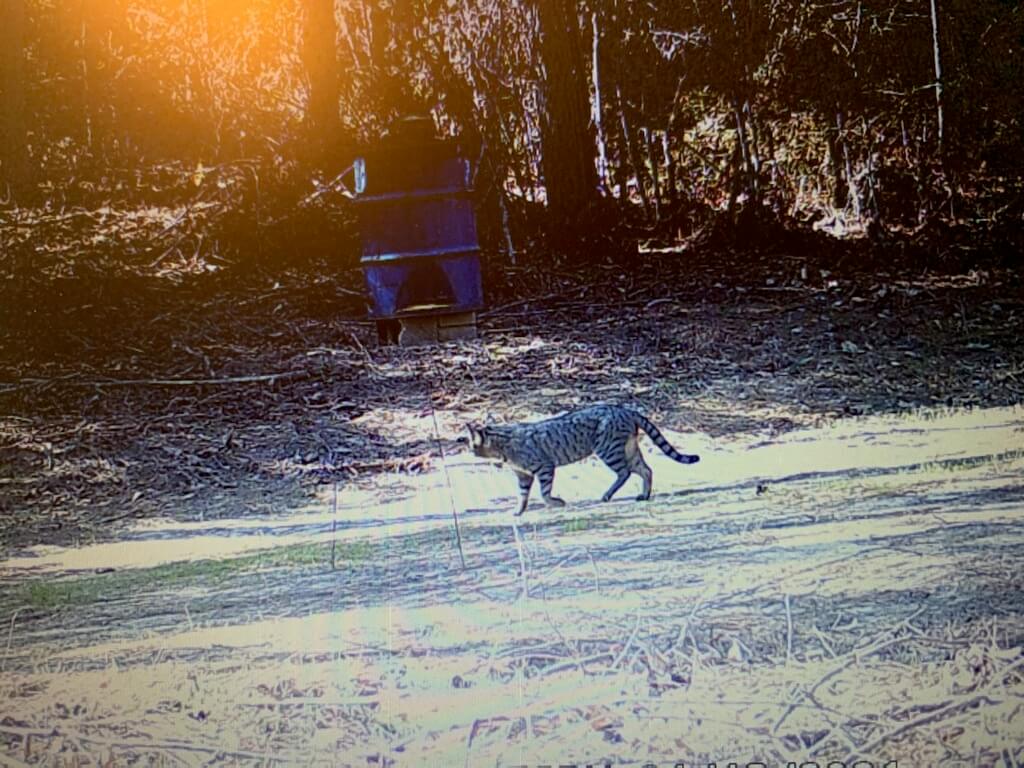
A reader in Alabama sent this image to the Bangor Daily News and asked for help identifying the cat.

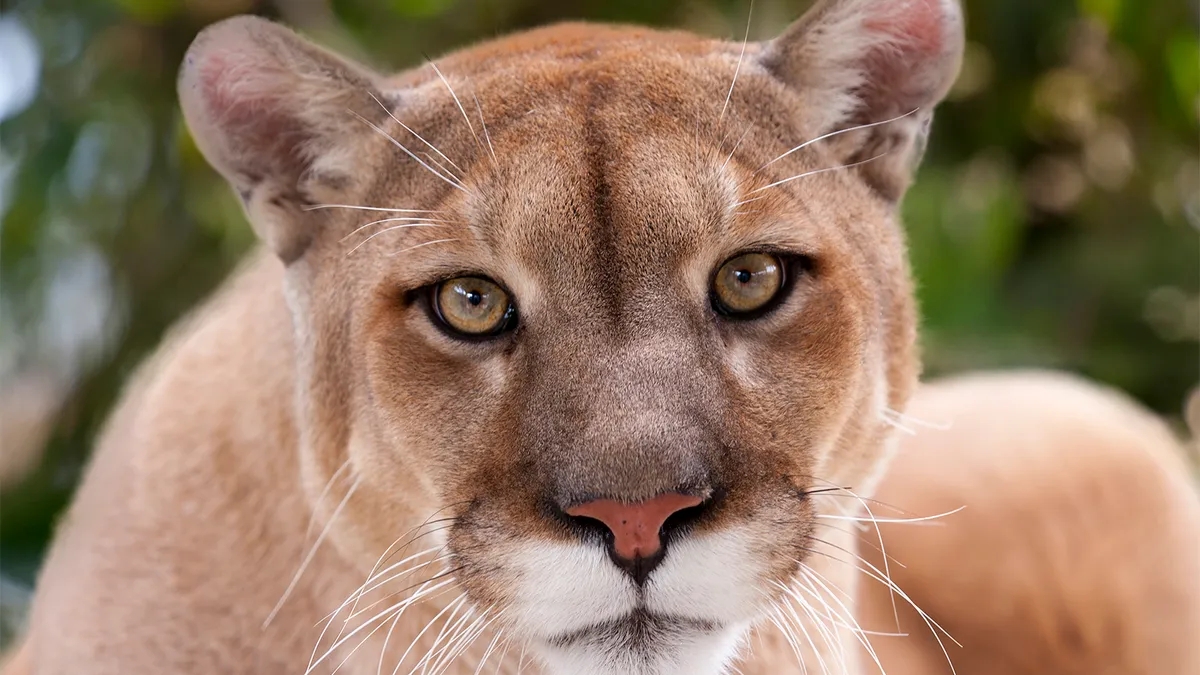
Like many other states, Alabama is home to bobcats and cougars, but we can cross them both off the list: The long tail eliminates the possibility of a bobcat, while the coat pattern and build of the cat rules out a puma.

Aside from puma, bobcats and the lynx, almost all other species of wild cat in the western hemisphere are found only in South America.

The cat in the photo is muscular and looks like it’s taking a leisurely stroll, but something in the wooded area has caught its attention. The dipped tail may indicate uncertainty. Its tabby stripes are well-defined but broken, a trait often seen in domestic cats.

Finally, although Bangor says there’s not much to help put the cat’s overall size in context, it’s almost certainly smaller than it looks, judging from the barrel in the background. In fact, if you expand the image and look closely at the barrel, you can see there’s an arched entry cut out of it, and it’s secured to some kind of foundation. Who knows, maybe someone converted it into a small shelter for this cat and other strays.

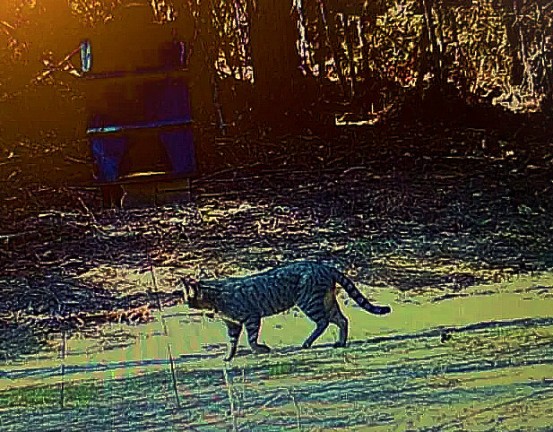
I took the image, cropped it close, tried to enhance the details as much as possible without ruining the data, and got this:

The mystery cat of Alabama

My verdict: It’s a domestic cat.

The proportions, tail and gait are all consistent with a domestic cat, as is the coat pattern. The cat in the photo doesn’t resemble any local wild cats, and the cat isn’t as large as it may initially appear.

What do you think?

‘Social Influencer’ Thinks He Saw A Panther…In New Zealand

Local papers are calling the mystery cat the Canterbury Panther.

A New Zealand man says he filmed a “panther” after taking blurry footage of a house cat.

Kyle Mulinder does his best Steve Irwin impression with a breathless “Look at that thing! Amazing!” while zooming in on what looks an awful lot like a domestic cat.

Mulinder continues to provide commentary and generously estimates the cat at “four foot high” as it dashes off a dirt road into a wooded area in New Zealand’s Hanmer Springs Heritage Forest.

Here’s a screenshot of the cat. I wasn’t able to embed the video, so you’ll have to visit the New Zealand Herald to watch it.

Screenshot_2020-11-30 Canterbury mystery Is it a cat or is it a panther - NZ Herald

A handful of New Zealanders have said they’ve seen a large cat since at least this summer, long enough for the local press to dub the cat the Canterbury Panther. Various reports identify the cat as grey, tawny or black.

Mulinder, who calls himself Bare Kiwi online, demonstrated a flair for the dramatic while telling his tale to the Herald.

“It was about 50 metres away, strolling in the other direction but it sat down, turned and looked into my soul,” Mulinder said. “It was a very emotional experience. I was fearing for my life.”

(Insert terrifying Buddy joke here.)

junglebuddy_horizontal

Yolanda van Heezik, a zoologist at New Zealand’s Otago University, said the chances of a big cat on the loose are “extremely unlikely.”

Aside from the lack of convincing footage of the Canterbury Panther, there aren’t any obvious signs of a mountain lion, jaguar or leopard, van Heezik said. Those signs could include scratches from large claws high up in trees, widespread scent-marking and the trail of prey that would be left by a large carnivore.

“No one’s ever caught one, no one’s ever got really good evidence that they are something different from just a large feral cat,” she said earlier this month. “And there’s also a complete lack of evidence that is indirect like if you had a really big cat like that you would expect there to be more stock kills, for example, but we don’t really have that evidence either.”

blackjaguar

Aside from the cat’s small size, there are other obvious reasons why it’s unlikely to be a panther. The word panther can refer to a cougar, also known as a mountain lion or puma. It can also refer to a jaguar or a leopard.

None of those cats are found on New Zealand: Pumas and jaguars are native to the Americas, while leopards exist in Africa and parts of Asia.

Of course it’s possible someone purchased a big cat from the illegal wildlife market and the animal escaped or was let go, but those cases are rare and big cats tend to be the “toys” of the ultra-wealthy. Local authorities have ruled out the possibility of a large cat escaping from any nearby zoo or wildlife facility, according to the Herald.

Watch Adorable Black-Footed Kittens Enjoy Their Yums

Tiny black-footed kittens were born at the San Diego Zoo during the Coronavirus lockdown.

Zoos around the US are closed because of the Coronavirus, but that doesn’t mean we have to miss out on the milestones of baby animals like the San Diego Zoo’s Ryder and Skyler, two black-footed kittens.

Black-footed cats are notable not only for their diminutive size — typically maxing out at two or three pounds — and their cuteness, but also for their astonishing hunting skills. The tiny terrors have voracious appetites and a 60 percent success rate when hunting. That eclipses the 25 percent success rate of lions, 32 percent success rate of domestic cats and the zero percent success rate of Buddy.

Ryder, a male, and Skyler, a female, were born in April. They haven’t started hunting yet, but they’ve now reached the stage where they’re eating meat instead of milk, as this video shows:

Spectacular Photos Show Big Cats As They’re Meant To Live

These are some of the most stunning images of leopards and tigers you’ll ever see.

One photo shows a melanistic leopard — better known as a black panther — cautiously but curiously poking its head out from behind a tree. Another shows the same cat, tail raised and ready to spring as it stalks prey in the jungle mists.

The photos went viral this week, accumulating millions of views as people hailed the leopard as the second coming of Rudyard Kipling’s Bagheera, the beloved leopard from The Jungle Book.

Both photos come from the lens of Shaaz Jung, known as the “Leopard Man of India” for his astonishing shots of the majestic cats taken deep in the country’s jungles and forests.

“When people see these pictures, they think there are several leopards, but actually there’s just one black panther where we are — one melanistic leopard in the dense forest of Nagerhole. So it was like finding a needle in a haystack,” Jung told BusinessInsider.

The leopard has been named Saya by local wildlife enthusiasts, and he’s a bit out of his element in the deciduous Kabini forest, which is also home to a tiger preserve. Normally, leopards like Saya live in dense jungle, where the thick canopy and lack of light play to their advantage.

Jung patiently followed Saya, snapping photos of the big cat hunting, fighting and courting potential mates.

“He’s not just surviving, he is thriving,” Jung said.

Jung is a wildlife photographer, NatGeo’s director of photography for films and a big cat specialist in his own right. He also photographs India’s tigers, and his shots reveal a connection to — and a deep appreciation of — these regal apex predators who have been pushed back by human development and the resulting habitat loss.

shaazjung
The man behind the camera: Shaaz Jung.
shaaztiger3
Tigers share a quiet moment as they trade scents. Photo: Shaaz Jung
shaazpanther3
Leopards are known for their exceptional climbing ability as well as their preternatural hunting skills. Photo: Shaaz Jung
shaazpanther4
A leopard enjoys a mid-day respite from the sun — and bothersome rivals — on a broad tree branch. Photo: Shaaz Jung
shaaztiger
A tiger stops for a drink with the water reflecting its wary gaze. Photo: Shaaz Jung
shaaztiger2
Tigers are the world’s largest, heaviest cats, the apex predators among apex predators. This close-up is a reminder of how beautiful and regal they are. Photo: Shaaz Jung