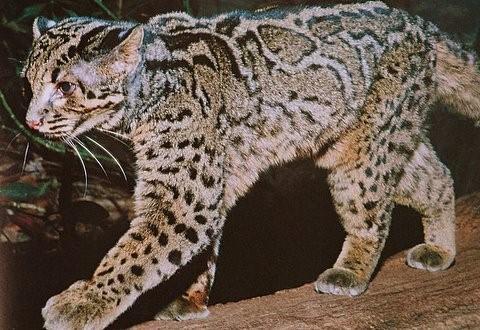
The semi-arboreal marbled cat is arguably the most elusive feline on the planet.
Dear readers, before you think this is a joke entry about Bud, let me emphasize we’re talking about the marbled cat, not the well-marbled cat.
“I am NOT chubby, I am meowscular!”
“I’ve never heard of a marbled cat,” you might be thinking, and there’s a good reason for that.
These little guys are incredibly elusive, live far from most humans and are found only in Asia. They’re extremely difficult to track and locate in the wild and haven’t been the subject of any comprehensive field study, granting them an air of mystery in an era when you can find almost anything you want to know about almost any animal with a few clicks.
There’s a whole lot we don’t know about marbled cats, including their behavior in the wild, how long they gestate, what they eat and how they’ve successfully adapted to so many varied habitats.
Credit: Wildcats Magazine
The singular species is semi-arboreal. Almost all cats can climb trees. The problem is getting down afterward, which is why so many domestic cats get stuck in trees. They can’t descend head-first and they’re wary of descending tail-first, which makes them vulnerable. Marbled cats have unusually flexible claws that enable them to descend head-first with ease, so they don’t balk at climbing. Their large paws keep them sure-footed on tree limbs and they’re confident off the ground.
In 2011, a trail camera in Indonesia was tripped by a marbled cat, finally giving us a close-up view:
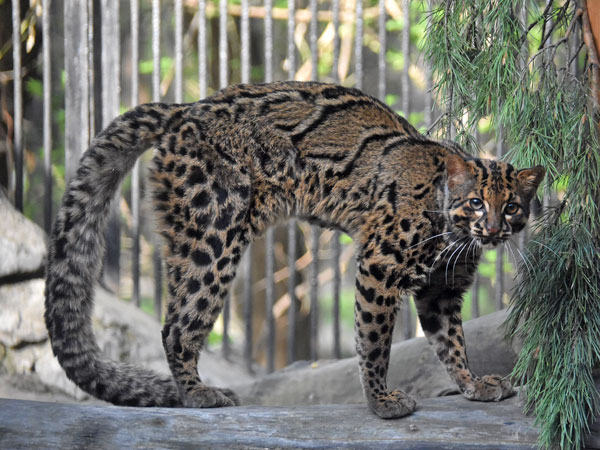
The striking felines are sometimes called “miniature clouded leopards,” and you can clearly see why.
The species is native to the eastern Himalayas, mostly in Nepal, Bhutan, Myanmar and tiny corners of China and India, as well as countries like Thailand, Cambodia and Indonesia. They’re extremely adaptable and live in a variety of habitats, from the forests of high-elevation mountain slopes to the humid jungles of Indonesia’s Borneo and Sumatra.
Marbled cats are about the same size as domestic cats, but they’ve got incredibly big, fluffy tails that are longer than their own bodies, which serve as formidable counter-weights for their tree-hopping. Their ears are a bit more round than the ears of their domestic cousins. They tend to have larger paws, and they have unique clouded coat patterns that are unlike any breed of domestic feline or close wildcat relatives.
Despite their relatively large natural habitat and the difficulty in pinning down population numbers, conservationists estimate there are fewer than 10,000 marbled cats. They’re threatened by the same deforestation by the palm oil industry that has devastated orangutan and clouded leopard habitats, although their strongholds in steep, high-elevation forests are safe for now. Marbled cats are listed as endangered by some authorities and as near-threatened by others, though like all wildlife their numbers are in decline.
The little-known, Lilliputian species of feline thrives in some of the harshest environments on Earth, proving cat species are capable of remarkable adaptations to their surroundings.
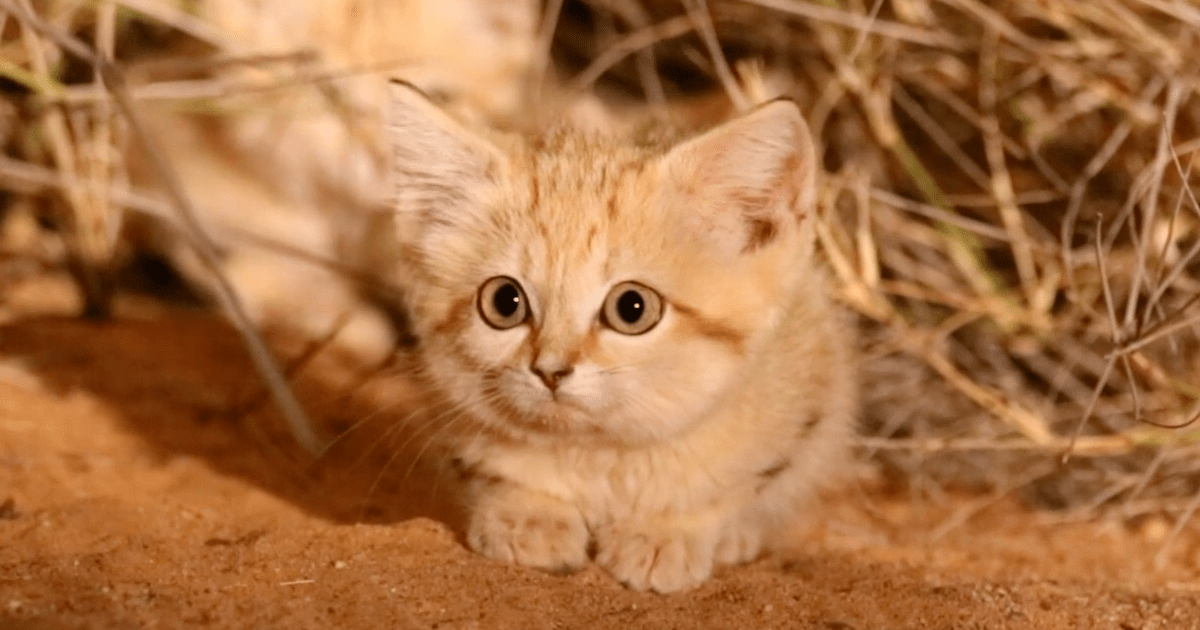
There’s a lot we don’t know about felis margarita, so much so that kittens of the elusive and stealthy species weren’t photographed in the wild until 2017.
Now a study has unveiled a surprising fact about sand cats: despite being tiny in stature, they occupy huge ranges that can rival the size of territories claimed by big cats like tigers and jaguars. One cat claimed 1,758 square kilometers — about 1,093 square miles — for himself according to Gregory Breton, the study’s author, who said the cat’s behavior showed sand cat ranges are “considerably larger than previously estimated.”
That individual maintained his impressive range for more than six months before moving on. His behavior and the movement of 21 others tracked via radio collars suggests the species could be semi-nomadic, moving or adjusting their ranges as they look for prey and water in some of the hottest, most arid environments on the planet.
“If true, this type of movement in response to rainfall is previously unrecorded among wild cat species,” wrote Breton, who is managing director of the cat conservation group Panthera in France.
In addition to following sources of water, the cats may maintain such large ranges because prey are more spread out compared to biomes like jungles, forests and wetlands where other species of cats make their homes.
A mother sand cat with her babies.
(Above: Tap or click the images for full resolution versions.)
Impressive ranges weren’t the only surprise the tiny cats had for researchers. Breton and his colleagues managed to catch and examine more than 40 sand cats before releasing them back into the wild and noted they were all healthy, with few scars, no fresh wounds and no broken teeth.
The lack of wounds “means that it is likely that sand cats exhibit little territoriality and tolerate each other across their ranges,” Breton wrote “This beloved cat may indeed share habitat with others of its species — maybe their perception does match their nature, at least towards other sand cats.”
Sand cats can be found in the Algerian Sahara, the deserts of the Arabian Peninsula and countries like Chad, Niger and Morocco. The Panthera team tracked the Lilliputian felines in the latter country, traversing the desert and arid landscapes of southwestern Morocco where temperatures peaked at 122 degrees Fahrenheit (50 degrees Celsius) during the day.
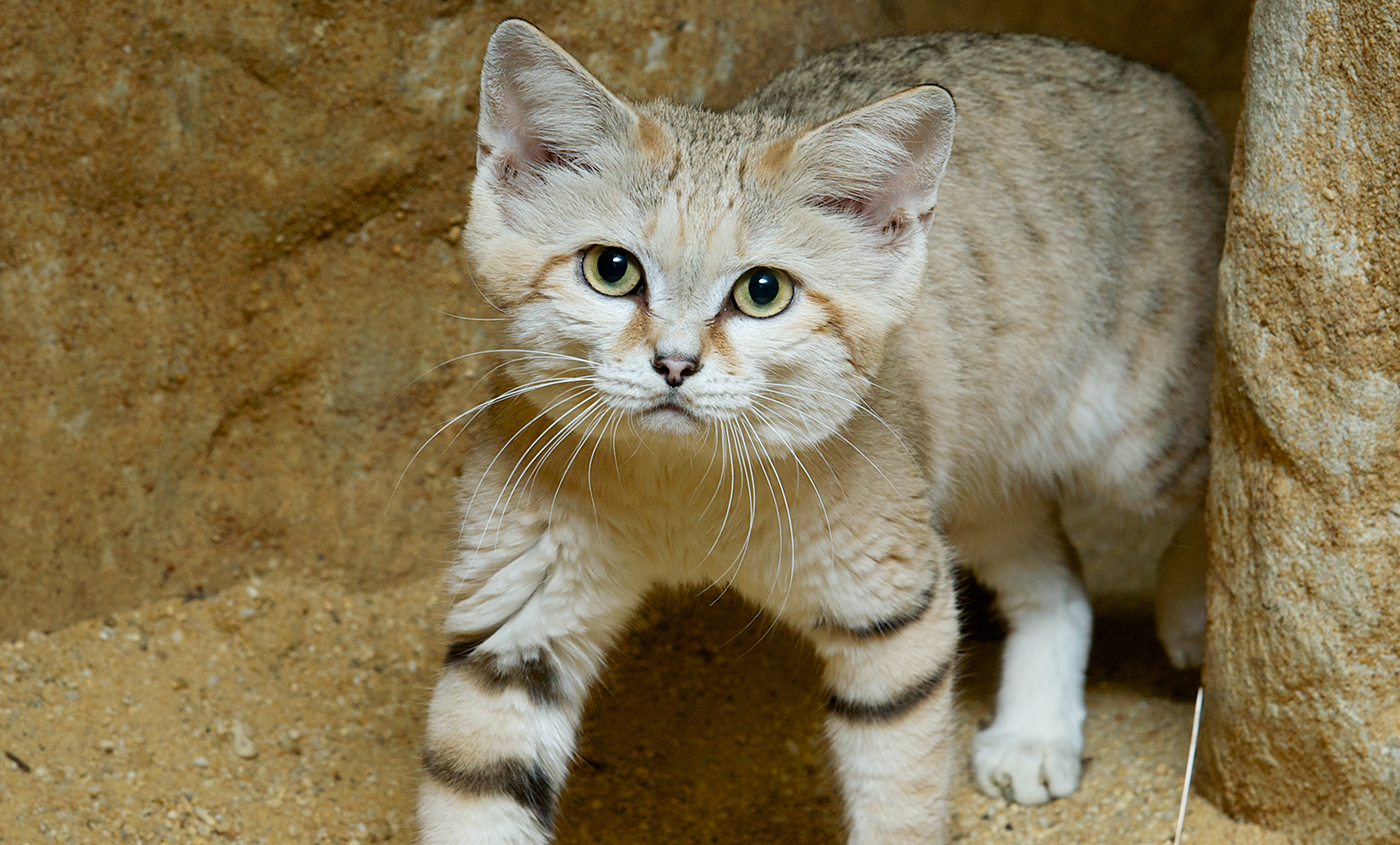
Sand cats have what Breton describes as “whimsical faces,” sporting wide, swept ears to go along with the general horizontal appearance of their heads.
They have golden, classic tabby markings and sand-colored fur with well-defined dark rings on their limbs, allowing them to expertly blend into their surroundings. Sand cat camouflage is so effective and the species is so quiet that one of the best ways to find them is at night, using search lights to pick out their reflective inner eyelids amid the desert landscape.
They’re also considerably smaller than house cats, weighing up to 7.5 pounds.
Breton said his team’s research is critical for estimates of sand cat population, which in turn will help authorities determine the conservation status of the elusive feline.
Big Cat Rescue will pivot to conservation efforts across the world. Meanwhile, TikTok “influencer” Hasbulla says people are attacking him for “nothing” over a video showing him abusing his cat.
We start with some great news: Big Cat Rescue is shutting down because its services will no longer be needed.
Of course there are still plenty of tigers, lions, jaguars, leopards, pumas, lynx and cheetahs in the non-profit sanctuary’s care, but the passing of the Big Cat Public Safety Act has finally put an end to the cruel, abusive and absurd practice of keeping big cats as pets.
The animals will be moved to Turpentine Creek, an accredited animal sanctuary in Arkansas. Big Cat Rescue will continue to fund their care and will sell its existing land in Florida as it transitions to programs to prevent the extinction of big cat species, almost all of whom are critically endangered.
“We have always said that our goal was to ‘put ourselves out of business,’ meaning that there would be no big cats in need of rescue and no need for the sanctuary to exist,” Big Cat Rescue wrote in a memo released this week. “Supporting our cats in larger enclosures at Turpentine Creek, at much lower cost per cat than we incur by continuing to operate Big Cat Rescue, will free up resources to let us do much more to save big cats in the wild.”
Credit: Waldemar/Pexels
The Big Cat Public Safety Act has not only made it illegal to own tigers and other wild cats as pets, it also puts an end to the cub-petting business used by roadside zoos, in which cubs are taken from their mothers as infants so the roadside zoos can charge customers to pet the cubs and pose for photographs with them. While big cat “pet owners” are grandfathered in, many have been rescued and there will be no more pets after the current group dies out.
Influencer Hasbulla says people “are attacking me for nothing” over video in which he abuses cat
Hasbulla, the Russian influencer whose videos have been viewed more than 10 billion times on TikTok, says people are making a big deal over “nothing” in response to a video showing him abusing his cat.
Hasbulla is 20 years old but has a child-like appearance due to a genetic condition.
The 3’4″ social media “star” is known for frequently talking about “acting like a man” and in addition to being an enthusiastic supporter of Russian President Vladimir Putin and his war in Ukraine (he’s called Putin “a lion” on several occasions), he holds typical Russian views on the way men are “supposed” to act.
Hasbulla said he was merely disciplining his cat for “misbehaving.”
“Those brothers who think that I was beating the cat, pulled the ear, this and that. I pulled the ear gently,” Hasbulla said in a video accompanying a Twitter post. “I know that people are waiting for the moment, if I write something wrong, to just attack me like this. Like, ‘you do this, you do that’. She was misbehaving and I just pulled the ear and that’s it. I love my cat more than you. If I didn’t love the cat, I wouldn’t have it at home. My most lovely animal is a cat. And when she disobeyed, I scolded her a little. And you are attacking me for nothing.”
Of course anyone with common sense knows cats are not capable of “misbehaving” because they have no concept of what behaving means by human standards, and Hasbulla is being dishonest when he claims he was “gently” disciplining the cat.
In the video, which the Russian voluntarily uploaded, he’s seen grabbing the terrified cat by her ear and yanking violently. The cat runs from him and retreats to a cardboard box where she tries to soothe herself, but Hasbulla follows, scolding her in his native language and hitting her several times on her head and body.
Unfortunately there is little concern for animal rights in Hasbulla’s country, so it’s very unlikely he’ll run afoul of any Russian laws, and even less likely that an animal welfare organization will confiscate the abused feline.
Nicholas was orphaned and severely injured as a cub as he and his mother tried to cross a busy highway. He’s settling into his new home, where he will have his own habitat, den and even his own pond.
Nicholas the mountain lion has a beautiful home waiting for him with his own pond, a rock den, a grassy area where he can run around and several other little hideaways where he can enjoy some privacy and naps.
But first the three-year-old puma will have to clear quarantine and become more comfortable with his new surroundings and new caretakers.
“He’s doing really well but he’s still very scared, he’s a very timid cat, so we’re just taking it really slow, day by day and the keepers are taking some quiet time with him,” said Bobbi Brink, the founder of San Diego County-based Lions, Tigers and Bears, Nicholas’ new home.
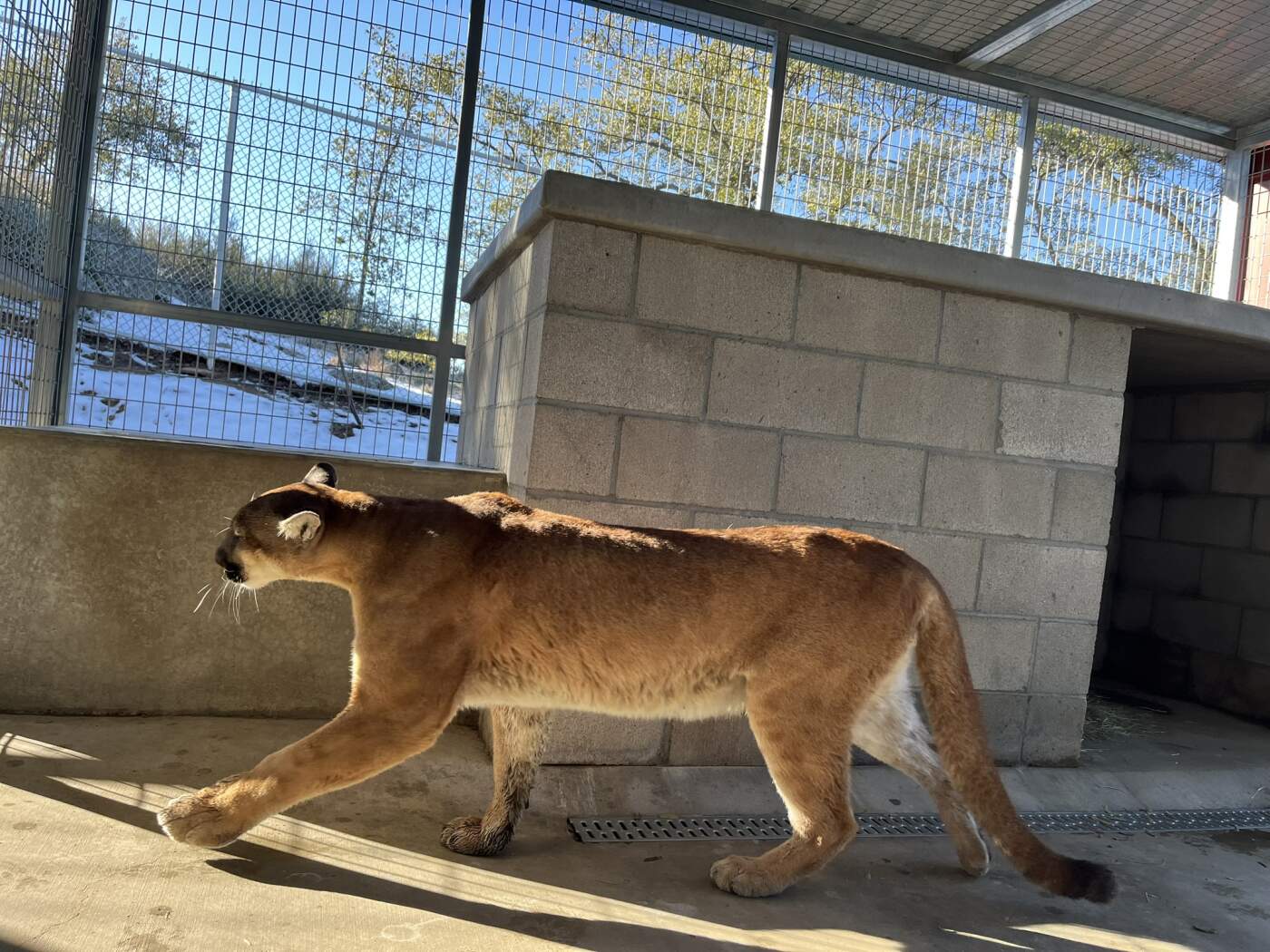
Nicholas stretches his legs in quarantine as he awaits the move to his own habitat. Credit: Lions, Tigers and Bears
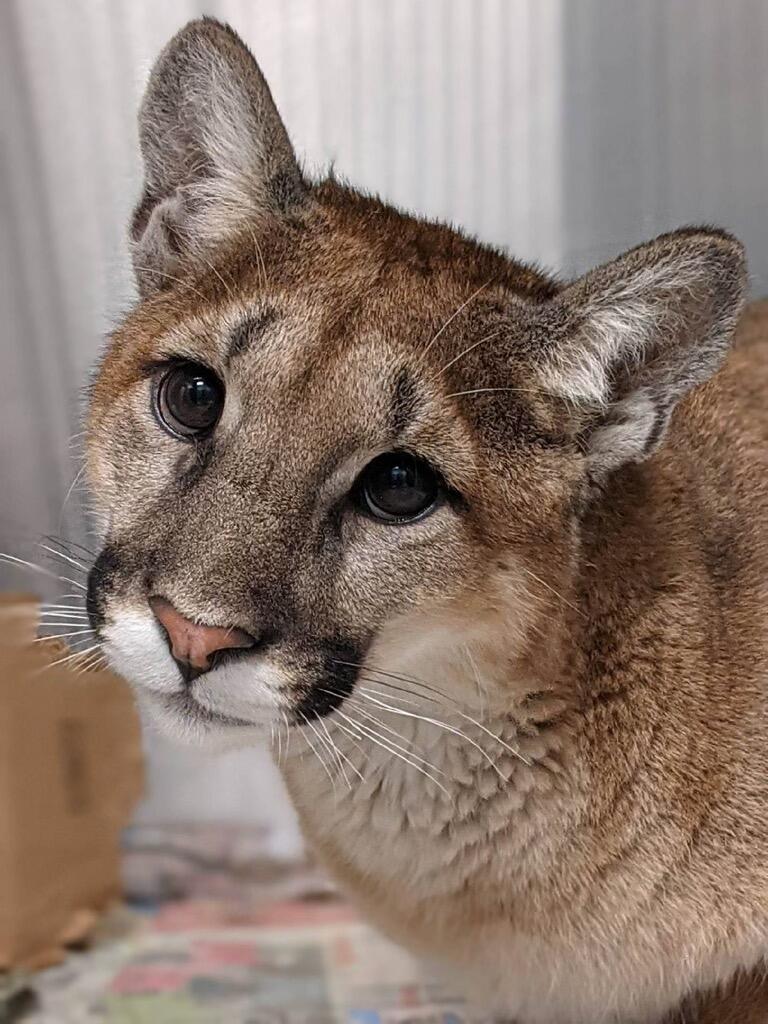
The golden-coated feline with an expressive face has had a tough journey to the 93-acre sanctuary that will be his permanent home.
In 2020 when he was just a cub, Nicholas was following his mother across a busy highway when both were struck by a car. Nicholas was badly injured and his mom was killed in the collision, an unfortunately common fate for members of their species as their longtime habitats are increasingly fragmented by new developments and highways.
Because they require about two years with their mothers to learn how to survive on their own, it’s almost impossible to release orphaned pumas back into the wild. Unlike, say, the orphaned orangutans of Borneo and Sumatra, who can usually be taught to successfully fend for themselves because humans can show them how to physically manipulate their surroundings, there’s no way to teach orphaned pumas how to select prey, stalk, pounce and deliver kill bites.
A sanctuary in northern California provided a home for Nicholas for about three years, but recently went bankrupt, so the staff at Lions, Tigers and Bears secured him, prepared a habitat for him and took on the Herculean task of transporting him to San Diego County.
Nicholas’ case is even more complicated because he has lasting neurological damage from the car crash that killed his mother, including a pronounced head tilt that worsens when he’s scared.
Brink told PITB it’s normal for cats like mountain lions to be spooked by the commotion and uncertainty of a move, as well as leaving everything they know behind. Nicholas is simply obeying his wild instincts, which urge him to be guarded. But he’s got a loving team of caretakers who will work with him, as well as veterinary specialists who are well versed in caring for animals with neurological damage.
“Sometimes it can take (animals like Nicholas) a month, sometimes it can take three months to build up that trust,” Brink said. “His biggest need is he’s very afraid, so we’re gonna have to work around his fear so we don’t scare him more.”
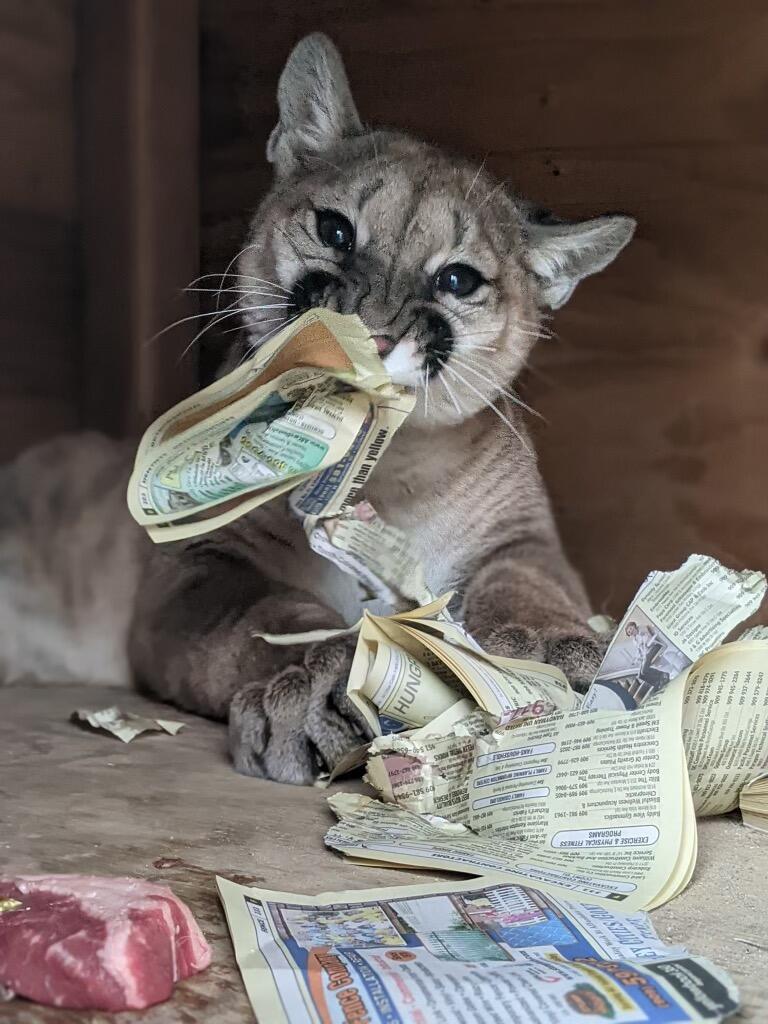
Despite their impressive size, pumas are more closely related to domestic cats than the big cats of the panthera genus. Like their house cat cousins, pumas enjoy tearing up paper and playing with toys. Credit: Lions, Tigers and Bears
While Nicholas will have his own habitat and can keep to himself as much as he likes, recent observations of his secretive species have shown that pumas have “secret social lives,” and Nicholas will have the opportunity to meet and interact with other mountain lions if he’s comfortable with it.
Pumas — which are known by the scientific name puma concolor and are also called mountain lions, cougars, panthers, catamounts, screamers, painters, gato monte and many other names — are among the most adaptable felids in the world and range from the southernmost edge of South America to just over the Canadian border. They’re able to thrive in mountains, tropical regions, deserts, forests, human-adjacent rural areas and even in urban population centers, as the famed “Hollywood Mountain Lion” P-22 did for more than a decade in Los Angeles.
Their ability to adapt has served them well in a changing world, but they’re not immune to the pressures of human expansion.
In California their habitats have been carved up by the state’s busy and deadly highways, leaving the cats in genetically isolated pockets. Pumas who strike out in search of their own ranges are extremely vulnerable to vehicle traffic. P-22 famously crossed several of the world’s busiest highways to reach his eventual home in LA’s Griffith Park, but others like Nicholas and his mom aren’t so lucky.
Solutions like the $90 million Wallis Annenberg Wildlife Crossing, currently under construction in Los Angeles County, can connect fragmented ranges and give pumas, coyotes, foxes, deer, rabbits and other animals safe passage. But experts point out that they are just one component in a long-term solution that must include more careful zoning, fences to funnel animals toward safe crossings, and options like tunnels that run under highways, since not all animals will use overpasses.
As planners and wildlife experts figure out new ways to ensure the survival of wildlife in an increasingly crowded, human-dominated world, sanctuaries like Lions, Tigers and Bears play a crucial role by caring for the innocent animals who are injured, displaced and rescued from bad circumstances.
To learn more about Lions, Tigers and Bears or support their ongoing efforts to provide safe, stimulating and comfortable homes for wild animals, visit the non-profit’s site. To receive updates on Nicholas and the other animals at the sanctuary, follow Lions, Tigers and Bears on Instagram and Facebook. Readers who live in the California area can book guided educational tours or visit during one of the sanctuary’s special events. Thanks to Bobbi Brink and Olivia Stafford for allowing PITB to tell Nicholas’ story. All images and videos of Nicholas courtesy of Lions, Tigers and Bears.
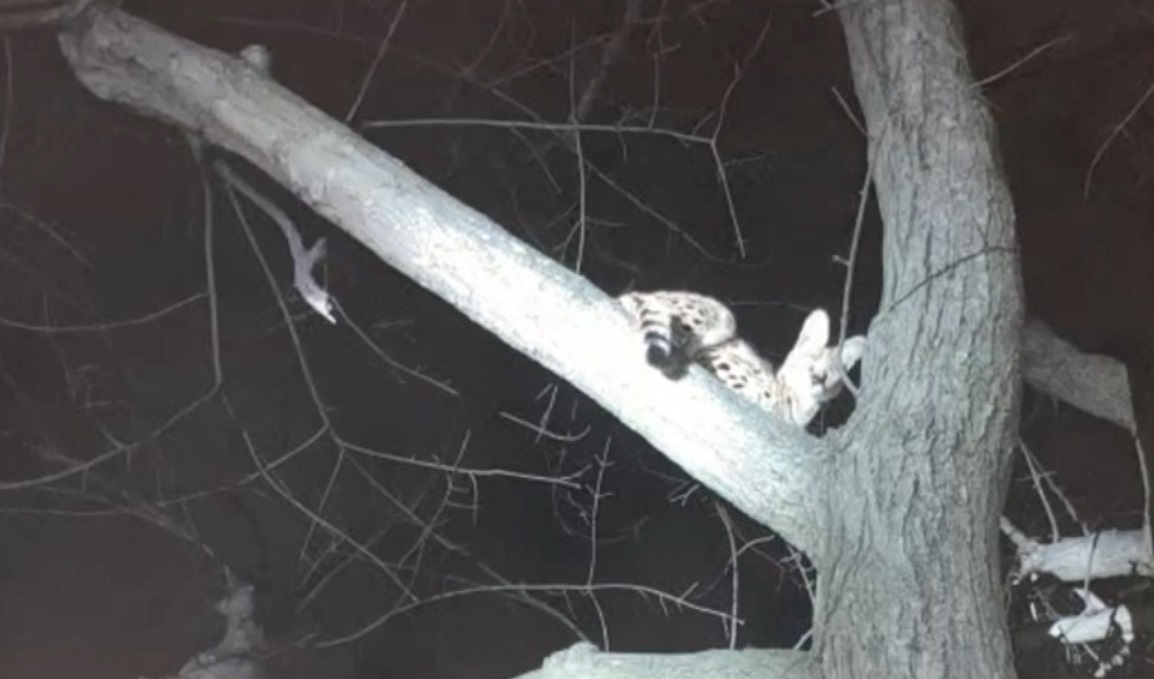
The spooked serval bolted through an open window and scurried up a tree during a traffic stop in Cincinnati.
We wish we could say this story is a viral marketing stunt for the recently-released movie Cocaine Bear, but authorities say they’re not joking.
Cincinnati police pulled a car over in what they thought would be a routine traffic stop in late January. But when officers approached the vehicle a large cat inside got spooked, jumped through an open window and took refuge in a tree.
Cops called the city’s animal control staff, initially reporting a “leopard” on the loose.
“[They weren’t] sure what they were dealing with,” Cincinnati Animal Care’s Ray Anderson told WXIX. “Hindsight being 20/20, it probably would have involved a whole lot more people.”
Animal control officers who arrived on scene thought they were dealing with an F1 Savannah, a hybrid between a domestic cat and a serval, and were able to get the cat down from the tree, but not without some difficulty. The exotic wildcat suffered a broken leg in the process. (See video of the cat in the tree here.)
The serval took refuge in a tree. Credit: Cincinnati Animal Care
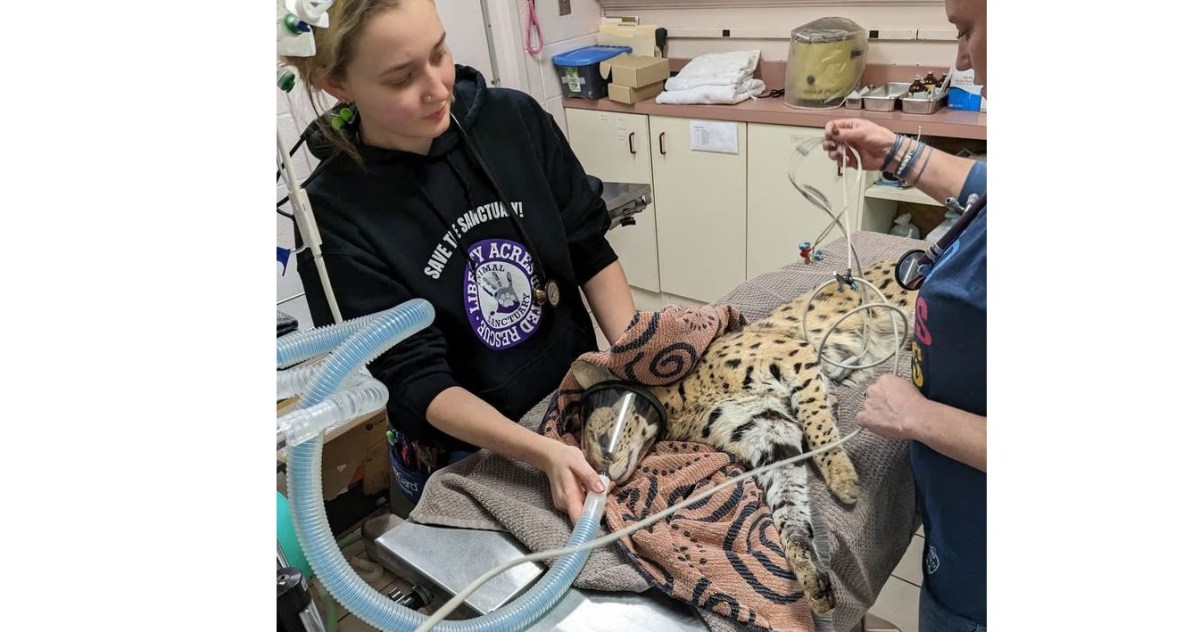
They brought the injured cat to the Cincinnati Zoo, where they were in store for several surprises: The felid was a serval, a medium-size African wildcat, and blood tests showed it had cocaine in its system. A subsequent DNA test confirmed the cat is a serval and not a Savannah hybrid.
The responding animal control officers were “pretty lucky because this cat could’ve shredded us” Chief Troy Taylor of the Hamilton County Dog Warden’s Office told Cincinnati’s WKRC.
The serval, whose name is Amorie, remains in the zoo’s care for now. Taylor said Amorie was given pain meds during treatment and is recovering. It’s not clear what will happen to him, and lots of questions about the incident remain unanswered. Local media reports say the driver was arrested during the traffic stop, but also said the driver is cooperating and has not been charged in relation to the cat or the narcotics.
It’s illegal to own wild cats in Ohio, and unless the serval found himself a bag of cocaine in the fleeting seconds between bolting from the car and scurrying up a tree, it seems the driver has some ‘splainin’ to do.