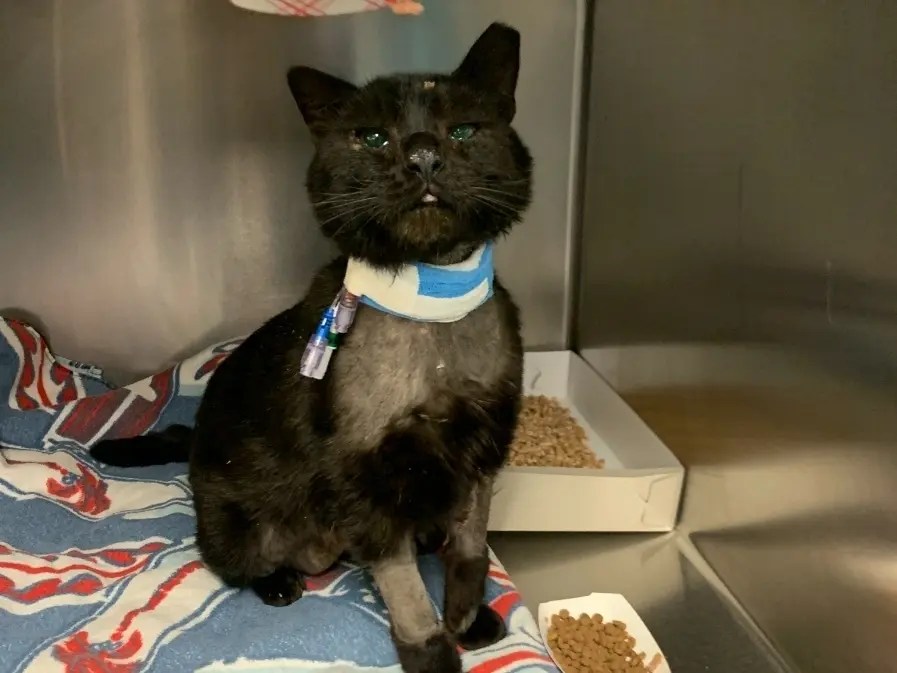
Buddy, the cat who survived an attack by two dogs, continues to recover in a foster home, where he lives with the emergency vet who cared for him after the attack.
Two Philadelphia minors will head to trial in May after they sicced their dogs on a cat sitting on a porch a month ago.
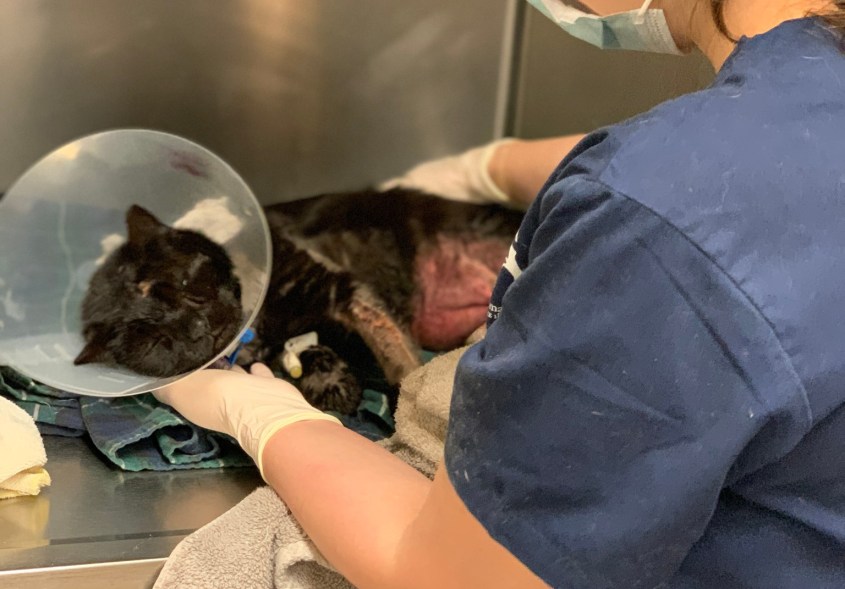
The juveniles, who are 17 and 12 years old, were walking their dogs in Philadelphia on March 22 when they set them loose on Buddy, a black cat who was cared for by a local family but spent most of his time outside. They shouted encouragement as their dogs mauled Buddy on his family’s porch and Buddy would have been killed if the commotion hadn’t drawn attention from inside.
When one of Buddy’s caretakers stepped outside and tried to stop the dogs, the teens pulled their canines back and fled. They turned themselves in to authorities a few days later after the story went viral and they realized the attack was captured by a doorbell camera system.
They each face felony and misdemeanor charges for animal cruelty, inflicting harm on an animal and other alleged offenses. Since they’re charged as minors the court system is not releasing their names, which is common practice in juvenile cases in most states.
Buddy was so badly injured that veterinarians weren’t sure if he’d make it at first. With a lot of care and love, the little guy pulled through the first few critical days and continued to recover until he was well enough to go to a foster home in early April.
His new caretaker is Katie Venanzi, a veterinarian who specializes in emergency care and operated on him that first day when he was brought in to Blue Pearl Vet Hospital by the Pennsylvania SPCA.
“He was kept secluded in one room initially, but now he has a run of the house and he is doing so well with his foster sibling cat Teddy. His foster parents affectionately say they are the two most awkward cats in Philadelphia, but their relationship is blossoming and we hope it continues that way so that Buddy can officially stay in that home forever,” the SPCA’s Gillian Kocher said. “Hopefully in the coming weeks, we will have some additional details and will let everybody know when we can make an official announcement about Buddy’s adoption, but for now he’s doing wonderfully.”
The reason Buddy was outside in the first place is that, as a stray, he resisted an indoor life when his original family tried to keep him inside.
Venanzi told a local radio station that her and her husband are trying to help Buddy adjust to an indoor life and hope they can adopt him.
“We want to do whatever he needs,” she said. “We understand that he used to live outside. If he is not comfortable living in our house, we are willing to work with other people who are going to give him an opportunity to be in a safe environment but still exposed to the outdoors. We are going to take it day by day and see how he does, but we are really hoping to keep him.”
When Buddy’s story went viral, people around the world responded by making donations to the Pennsylvania SPCA and buying t-shirts with Buddy’s likeness on them, allowing the group to raise thousands. Meanwhile, in a post to social media, the Pennsylvania SPCA noted it had taken in 158 abused animals since Buddy was attacked: “That’s more than five Buddys a day.”
Some of those dogs and cats were shot or stabbed, while others were neglected or starved, Kocher said. Leftover money from Buddy’s surgeries and treatment will be used to help the other abused animals in the SPCA’s care.
Two U.S. states have now banned declawing as ‘Merica inches closer to joining the rest of the civilized world in prohibiting the brutal practice.
With a stroke of Gov. Larry Hogan’s pen, Maryland became only the second state to ban declawing, joining New York, which outlawed the practice in 2019. Like New York’s version, the new Maryland law prohibits declawing unless it’s deemed medically necessary.
As most cat lovers know, declawing isn’t the manicure-like operation it sounds like. It’s the totally unnecessary, horrific amputation of a cat’s toes up to the first knuckle.
Declawing inflicts a lifetime of pain on cats, changes feline gait and posture, leads to early arthritis and causes a long list of secondary problems. For example, declawed cats are much more likely to bite because they have no other form of defense when they feel threatened, and they’re also much more likely to stop using litter boxes because it hurts to walk on the sand-like and granule texture of the litter with half-amputated toes.
The fact that so much misery is inflicted on innocent animals to protect furniture is indefensible.
The law goes into effect on Oct. 1, and veterinarians who perform the procedure after that time face fines of $1,000 and disciplinary action by the state veterinary board. We’d have preferred immediate implementation and stiffer penalties to prevent a last-minute rush on declawing appointments and discourage anyone considering breaking the law, but a win is a win, and all the major animal advocacy groups are celebrating, as they should.
The people of Dubrovnik are not happy with the leaders of a local museum, who evicted a beloved local cat from the grounds of the historic building.
UPDATE, 8/7/2022:Anastasia has been allowed back on the palace grounds, but without the custom shelter a Dubrovnik carpenter built for her. Click here to read our latest story about Anastasia’s saga.
Original text:
In a city that stood in as a filming location for King’s Landing in the hugely popular series Game of Thrones, it was only fitting that a regal cat named Anastasia would choose a palace as her home.
Anastasia chose the Rector’s Palace, a historic building in Dubrovnik, Croatia, as her royal abode, and she’s become a local fixture there for the past 17 years, a familiar feline face appreciated by locals and tourists alike.
People who run shelters in the city of 42,000 have tried to find a home for Anastasia in the past, but she always returns to the Rector’s Palace, so a group of volunteers set up a small cardboard shelter for her on the grounds.
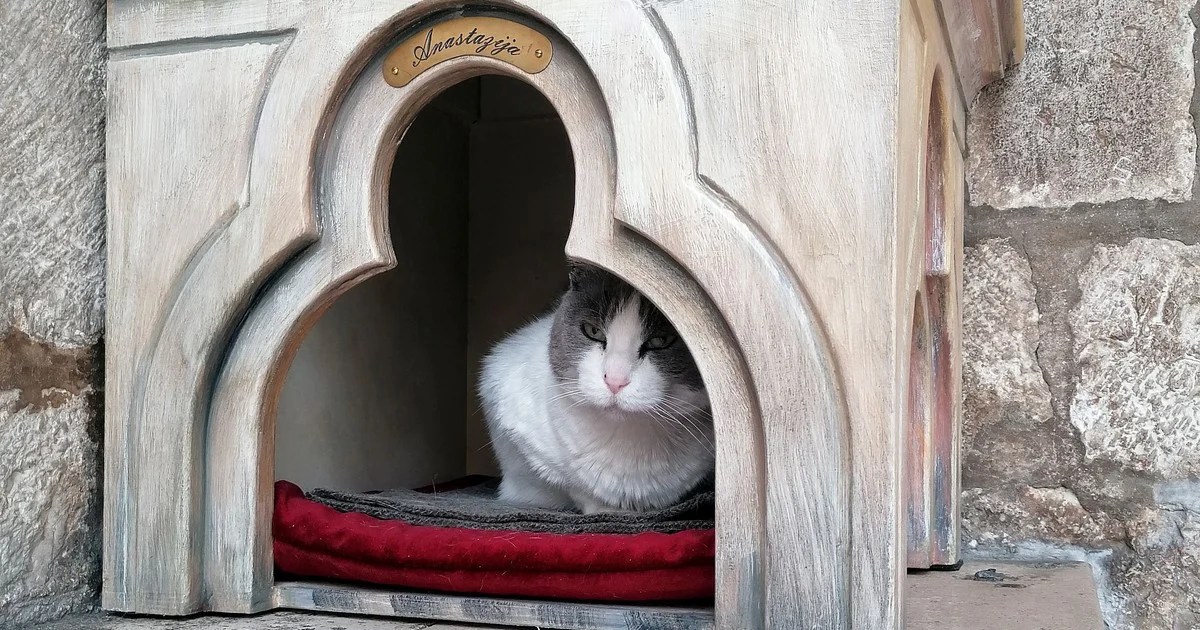
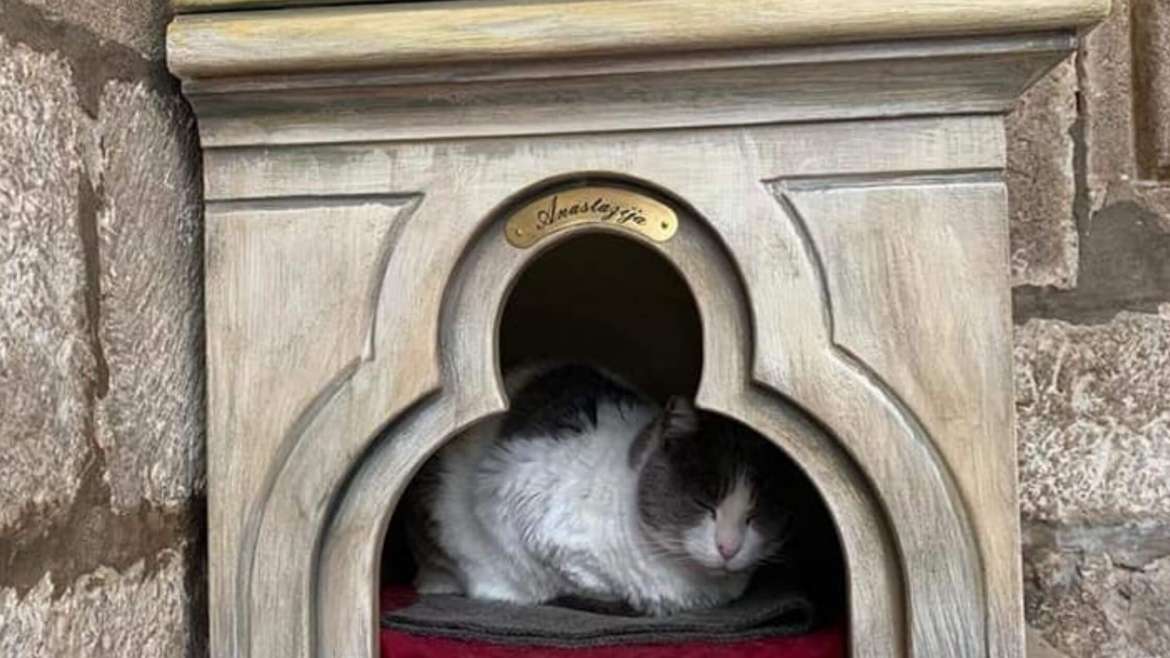
But the snooty museum authority didn’t like the little dwelling and had it removed in May of 2021. In response a local woodworker named Srdjan Kera built a beautiful wooden cat house for Anastasia that combines elements of the palace’s gothic and baroque architecture, boasts a distressed finish that matches the five-century-old building’s facade, features a velvet bed for its resident feline princess, and even has a golden nameplate with “Anastasia” etched into the metal. (Spelled Anastazija in Croatian.)
The little cat palace blends right in under the larger palace’s arcade and even emulates the stonework patterns, but the people who run the museum authority still weren’t impressed and earlier this month ordered the eviction of Anastasia for a second time.
(Credit: Videographer Zvonimir Pandža, clip courtesy of DuList. Click through to see more photos of Anastasia, her local admirers in Dubrovnik and her beautiful cat palace by Srdjan Kera.)
“The opinion of the Dubrovnik Museums is still the same,” the museum authority’s leadership wrote. “The cat house has no place in front of the Rector’s Palace, be it a cardboard box or a stylized dwelling. We emphasize that no one has anything against the cats that stay here for many years and which until recently had no housing,”
The people of Dubrovnik aren’t having it. A petition to return Anastasia to her rightful palatial place has garnered more than 12,000 signatures, a huge number for such a small city. In addition, some 90 percent of readers said they wanted Anastasia to stay at the palace when polled by a local newspaper.
“Anastasia needs her house! Give it back,” one local wrote on Facebook. “Apparently, cultural institutions are run by people without culture.”
Kera even told the museum’s leaders that he would pay a fine if it meant Anastasia could stay, pointing out that at her age, she needs a stable, stress-free existence.
“It’s her home,” Kera said. “We’re only talking about one cat, not 70 of them.”
Anastasia in her miniature cat palace. Credit: Srdjan Kera
Dubrovnik is a historic city that has been inhabited for more than 1,300 years. Its Mediterranean location and walled old city made it the perfect stand-in for King’s Landing, the capital of Westeros in HBO’s Game of Thrones. Credit: KingsLandingDubrovnik.com
A night view of an arcade at Rector’s Palace. Note the detail on the stone benches, which Kera emulated for Anastasia’s cat house. The interior of the palace was used as a shooting location for a scene in season two of Game of Thrones. Credit: Diego Delso/Wikimedia Commons
Armed with real data, there’s a chance to stop horrific policies designed to kill millions of cats who are blamed for driving small wildlife species to extinction.
For the past two decades, a handful of birders and “conservationists” have claimed cats kill as many as 3.7 billion birds and 22.3 billion small animals every year in the US alone.
“They’ve got to taste good,” an Australian scientist who helped develop the sausage formula said. “They are the cat’s last meal.”
Now who’s the serial killer?
Sadly, few people have thought to question the studies that claim jaw-dropping numbers of birds and small mammals are slaughtered by cats every year.
How did the studies arrive at those numbers? Their formula hasn’t varied much from “study” to “study,” and more or less looks like this:
Assemble your data from old studies that have nothing to do with cats preying on wildlife, or hand out questionnaires to a handful of cat owners and ask them how many animals they think their free-roaming cats might kill.
Since you don’t know how many stray, feral and free-roaming cats exist in the US, invent an arbitrary number. Most of these “studies” put the number of cats anywhere between 25 and 125 million, but higher numbers are better because they make for more apocalyptic predictions and generate more credulous headlines.
Completely ignore the primary factors driving avian extinction in the world, which are human-caused: Habitat destruction, habitat defragmentation, wind turbines, pesticides, cars, high tension wires and windows, which are by far the biggest bird-killers.
Attribute all of the above to feral, stray and free-roaming cats.
Take your original “data” and, without making any adjustments for climate, regional variation, migration patterns, other predatory impacts — or anything else, really — simply extrapolate the total number of bird deaths by multiplying your small dataset by the total number of free-roaming cats in the US, which you invented back in Step 2.
Package the entire thing as a rigorous study by Serious Conservationists, write some apocalyptic press releases and hype up your claims in your abstracts, because you know the vast majority of web aggregators and overworked reporters will not have the time to take a deep dive into the text of your study.
Encourage activist groups and lawmakers to push for the mass culling of cats, based on your studies.
Please, don’t take my word for it. Read the text of any of the widely-cited studies that have been reported as gospel in the last 20 years. You’ll be astonished at what passes for rigorous scientific work, and how policies that determine the fates of millions of cats are largely shaped by these studies.
The D.C. Cat Count and the importance of a baseline
But there’s hope: A coalition of groups in Washington, D.C., spent more than three years methodically taking a “census” of that city’s cat population using a variety of methods.
They surveyed thousands of households within the city limits to find out how many cat owners allow their pets to roam free. They set up 1,530 trail cameras in wooded areas, ditches, alleys, alongside streams. The cameras are motion-activated and they produced more than five million images — including more than 1.2 million images of cats and more than four million images of local wildlife. The cameras captured photos of squirrels, coyotes, raccoons, possums, deer and even wild turkeys.
They assembled teams of dozens of volunteers to personally survey areas where cats are known to congregate. Then, when all the data was collected, they spent months sorting the results, carefully keeping tally, sorting duplicate sightings of individual cats and confirming data when necessary.
Credit: Pixabay/Pexels
When all was said and done, after three years, $1.5 million and countless man-hours, the study determined there are some 200,000 cats living in Washington, D.C., and only about 3,000 of them are truly feral, meaning they’re not pets and not part of managed cat colonies.
The team — which brought together conservationists, bird lovers, cat lovers, shelter volunteers and others who would normally oppose each other on cat-related policies — also documented every step to provide a toolkit for other cities and local governments to conduct their own methodical head counts. They don’t have to reinvent the wheel to take D.C.’s admirable lead.
The leaders of the D.C. Cat Count went to all that trouble because they understood that without knowing exactly how many cats they’re dealing with, where they congregate and how they behave, any policies attempting to deal with their potential impact would be flawed and could end up doing more harm than good.
Making informed decisions about managing outdoor cats
Anyone who continues to cite the old, sloppy studies should be reminded, loudly and often, that they have led to years of failed policies, heartbreaking outcomes, enmity between cat lovers and birders, and widespread misunderstanding of how cats behave and the impact they have on wildlife.
Now the next phase begins: Dispensing with the hysteria and finding real, useful ways to minimize the predatory impact of cats on local wildlife populations.
One of the first follow-up studies to bear fruit comes, not coincidentally, from a research team in nearby Fairfax County, Virginia, and yields some surprising revelations about free-roaming cat behavior and impact.
The biggest takeaway: Because free-roaming cats almost always stick to small areas (spanning only 550 feet, or 170 meters), “cats were unlikely to prey on native wildlife, such as songbirds or small mammals, when they were farther than roughly 1,500 feet (500 meters) from a forested area, such as a park or wooded backyard. We also found that when cats were approximately 800 feet (250 meters) or farther from forest edges, they were more likely to prey on rats than on native wildlife.”
That’s it. In other words, small buffer zones are “the difference between a diet that consists exclusively of native species and one without any native prey,” the study’s authors wrote.
“Our findings suggest that focusing efforts on managing cat populations near forested areas may be a more effective conservation strategy than attempting to manage an entire city’s outdoor cat population,” wrote Daniel Herrera and Travis Gallo of George Mason University.
Credit: Phan Vu00f5 Minh Ku1ef3/Pexels
In other words, minimizing the predatory impact of cats is likely a hyper-local affair, and not something that can be effectively managed on a one-size-fits-all city-wide or county-wide basis.
This is just a first step in the right direction, and follow-up studies will yield further insights that will hopefully lead to fine-tuning strategies in managing free-roaming cats.
We still feel keeping cats indoors — for their own safety, as well as the safety of other animals — is the right thing to do, and all the evidence supports that view.
But what these efforts have shown us is that there is a way forward, and it’s not the contentious, divisive and irresponsible work that has guided cat management policy for two decades. It’s not just possible, but necessary, for all sides to work together to find solutions.
Let’s hope more people realize that, and the old “studies” are relegated to the dustbin where they belong.
Viagen, the only US company to offer cloning services, says the process becomes more popular every year.
The Washington Post has a story today about pet cloning, and thankfully it doesn’t sugar-coat the process.
It does take 10 paragraphs for the story to get to the negatives, but it offers a solid explanation of the cloning process before this quote by Columbia University bioethicist Robert Klitzman:
“People think, ‘Oh, I’ll just press a button and out will come Fido,’ but that’s just not the case. So you may love Fido, but do you really want several animals to die and suffer in order to have the one healthy Fido?”
That’s because even with the advancements made in the 21 years since CC the cat became the first of her kind to be cloned, the process still only has a 20 percent success rate. The other 80 percent of attempts end in still births, animals who die shortly after birth due to genetic defects, or animals who survive but suffer from flaws that make them “unsuitable” for the clients who are paying tens of thousands of dollars to clone their cats and dogs.
A terrifying prospect! (And a massive monthly turkey bill.)
As we’ve noted before, cloning doesn’t actually guarantee that you’ll get animal who looks like the departed pet. Fur color, length and coat patterns are all variable, and temperament is even more of a crapshoot thanks to the many variables in both nature and nurture.
Klitzman puts it in stark terms.
“I can either pay thousands of dollars to create a new pet that’s actually going to have a different history and personality,” he told the Post. “Or maybe I could adopt an animal that would otherwise be killed in a shelter. Those are things that ethically need to be considered.”
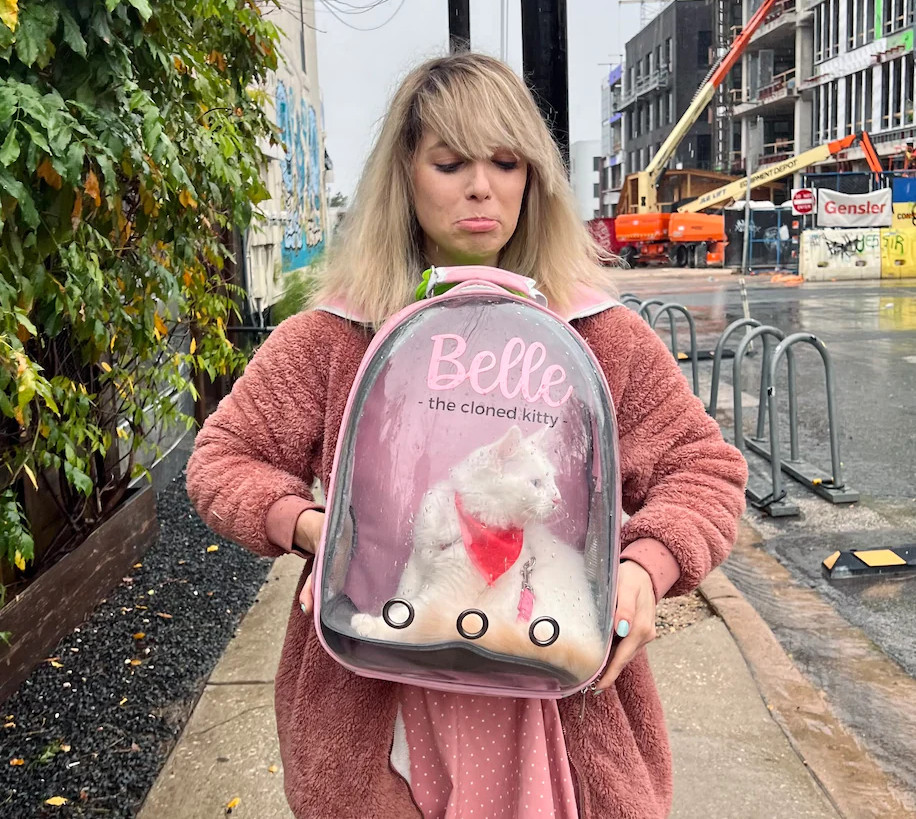
The Post’s article centers on Kelly Anderson and her cat, Belle. If the names sound familiar, that’s because we’ve written about them in earlier posts. Belle was cloned from Anderson’s beloved cat, Chai, and has her looks but not her disposition.
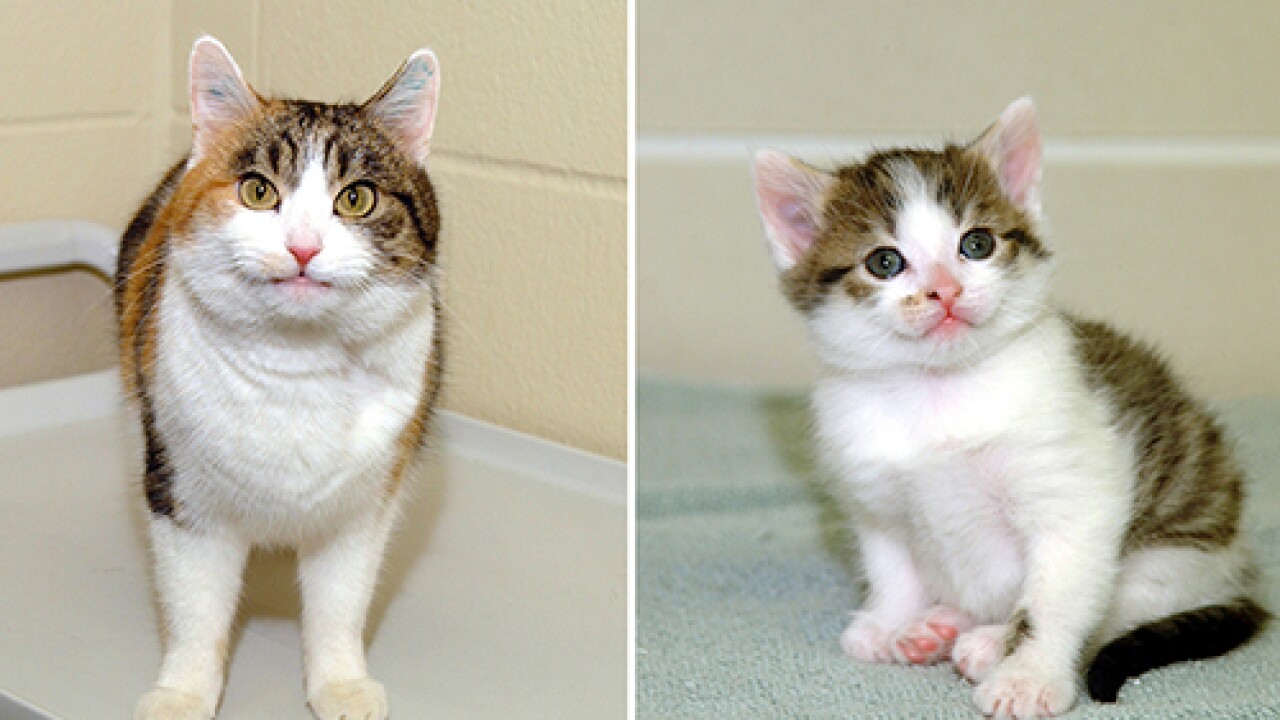
CC was famously different from Rainbow, the cat she was cloned from. While Rainbow had a Calico pattern with tabby stripes on her head, CC had tabby stripes on both her head and her sides. As the BBC noted in 2002, shortly after CC’s birth was announced, the cloned cat’s coat differed from her “mother’s” “because the pattern of colours on multicoloured animals is determined by events in the womb rather than by genes – a reminder that clones may be genetic copies of their parent but are never quite identical.”
Rainbow, left, and her clone, CC, short for CopyCat.
John Mendola, a retired NYPD officer from Staten Island, features in a BBC story posted last week on the increasingly popular cloning option.
Mendola paid $50,000 to have his dog, Princess, cloned. It’s not clear how many unsuccessful attempts were involved — and Texas-based Viagen doesn’t reveal that information — but the successful litter produced two dogs who look like Princess, which Mendola named Princess Ariel and Princess Jasmine. (Dude really loves Disney animation, apparently.)
Viagen charges between $25,000 and $35,000 to clone cats, according to different press reports. Grieving pet parents who haven’t made up their minds can have their late pets’ DNA preserved with the company for $1,600. There’s a short window after death during which viable cells can be harvested, but once they’re stored, they can last years or even decades thanks to cryopreservation methods. In one case, a client decided to clone a dog after storing the DNA for 17 years, Viagen’s Melain Rodriguez told the Post.
Viagen doesn’t disclose figures, but the company said it’s cloning more animals — dogs, cats and horses — every year, and has cloned “hundreds” for clients so far.
Blake Russell, the company’s president, likened cloning to a cat or dog having a littermate separated by time.
“A cloned pet is, simply put, an identical genetic twin,” he said, “separated by years, decades, perhaps centuries.”
Animal welfare groups remain staunchly opposed, not only because of the suffering among cloning failures and surrogate mothers, but also because millions of unwanted cats and dogs are euthanized annually.
“Animals’ personalities, quirks, and very essence simply cannot be replicated,” PETA UK Director Elisa Allen told the BBC. “And when you consider that millions of wonderful, adoptable dogs and cats are languishing in animal shelters every year or dying in terrifying ways after being abandoned, you realise that cloning adds to the homeless-animal overpopulation crisis.”




 Pain In The Bud