Athens Gets Its First Cat Cafe

The proprietors say they wanted to create a space that “calms and relaxes” guests and gives Athens’ street cats a chance to find forever homes.

Natalie and Dimitris went all in on their dreams for a cat cafe.

After experiencing similar places overseas and falling in love with the concept, they quit their jobs in tech and hospitality, found a nice spot in the Athenian neighborhood of Thissio — known for its prime views of the acropolis and Parthenon — and established the first cafe in Athens’ 3,000-year history.

0-6-1024x656
Guests film their favorite cats as the little ones play on a network of walkways and cat trees. Credit: Greek City Times

When I visited a cat cafe in Tokyo, slots were segmented into 30 minutes at 2,000 yen (about 13 bucks) per and coffee was from a vending machine. (To be fair, Japan’s vending machines are excellent and many of them brew fresh coffee internally.) Cat cafes in New York tend to operate in a similar manner, although without the vending machines and with strict separation between food prep areas and the sections where the cats roam, lounge and poop.

But Natalie and Dimitris wanted a cafe that reflected the pace of Greek life, so appointment is by reservation, there aren’t any limits on how long people can hang out, and half the cafe’s space is a fenced-in yard where people can enjoy the cats and the Mediterranean weather.

People can even serenade the kitties, who are all former strays by sitting down and playing a piano inside the cafe.

But ultimately, the couple told the Greek City Times, they opened the cafe — called simply Cat Cafe — because they love cats. Unlike their Turkish neighbors across the Aegean, Greeks aren’t known for caring for street cats despite many of them eking out a living in Athens and other cities.

In Greece, Natalie and Dimitris said, cats are “very misunderstood animals.”

“From the beginning, our goal was to bring people who don’t have cats into contact with cats,” they told Greek City Times. “To interact with them and get to know them. And decide to adopt one.”

Note: The original interview was in Greek and translated to English for the Greek City Times, so there’s some funky phrasing. Readers who are fluent in Greek can read the original here. Top image credit: Pexels

When Animal Abuse Is Presented As ‘Cute’: The Brutal Existence Of Monkey Pets

Youtube is home to thousands of videos depicting the torture of baby monkeys, many of them presented as “cute” examples of pet ownership.

Look at what Youtube’s algorithm has served up for me: an “adorable” video of a baby monkey who loves to carry his equally small backpack!

Look at him. He loves it!

“That’s the cutest thing I’ve ever seen,” gushed one Youtuber.

“WHY IS THIS SO CUTE HELP ME,” another asks.

Others dub the video “so adorable,” “so cute” and call baby monkey Pika “the most adorable little baby I’ve ever seen.”

The video has five million views in four weeks. A handful of viewers might instinctively know something’s wrong while the vast majority of those people never give a second thought to what they’ve just watched.

Let me tell you what you’re looking at.

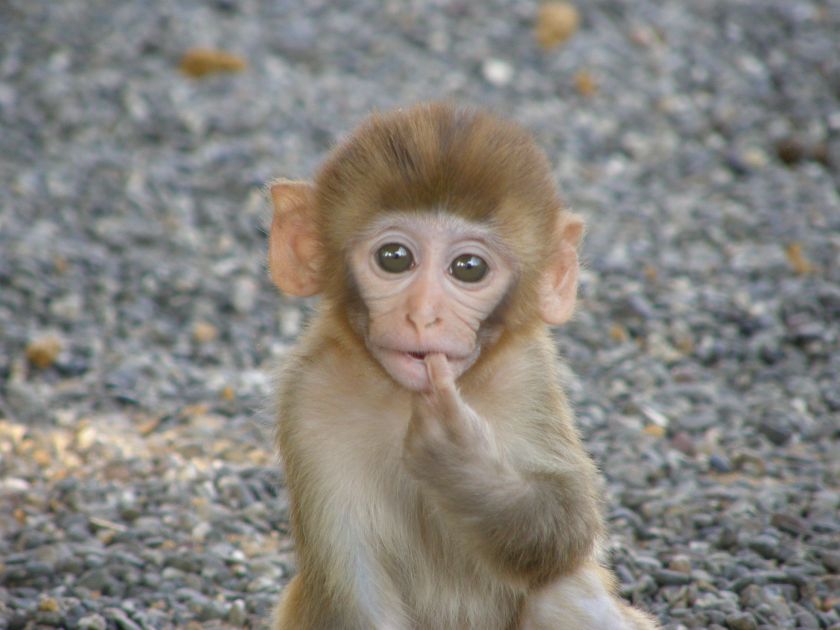
“Pika” is an infant rhesus macaque, about four weeks old by the look of him.

He is the “pet” of a woman in China, and to become her pet he was ripped out of his screaming mother’s arms as she fought tooth and nail to keep her grip on her baby. It’s at least a two-person job and the people who steal baby monkeys, either directly from the wild or from enclosures they own on breeding farms, up-armor themselves before going into the cage to protect from vicious bites and scratches.

Such is the fury of a mother whose baby is being taken from her.

(Above: An “adorable” video of an infant rhesus macaque who has been stolen from his mother and sold as a pet and has spent the first few weeks of his life being tortured to force him to walk on two feet. Right: A still from a video from a man who hunts monkeys titled “Baby Monkey Headshot”)

Pika was taken within a few hours to a few days after birth. No one wants adult monkeys so it’s imperative that the babies are swiftly “pulled” from their mothers, photographed and matched with buyers online. In the US an infant macaque will set you back about $5,000, but in China it’s considerably cheaper because the monkeys are native to Asia and certain parts of China, as well as neighboring countries and the territory of Hong Kong.

Being torn from his mother is just the first of many traumas Pika will endure in his guaranteed-to-be-miserable life.

Baby monkeys are a big thing in China, especially among the Mandarin-speaking nouveau riche of the mainland who have considerable disposable income and look for ways to signal their economic status to their peers. Expensive clothes, designer handbags, rare trinkets, you name it. If you’re a young upper class man perhaps you buy a sportscar. If you’re a young woman, you get a baby monkey, create a social media page and show everyone what a fantastic mother you’re going to be by clothing, feeding, training and disciplining the baby.

“Don’t monkeys walk on four legs?” you might be thinking. “They’re not bipedal, are they?”

No, they are not.

To walk upright, Pika has already endured the second major trauma of his young life: The human “mothers” take the little babies, tie their hands behind their backs, then tie a small rope or string around their necks. The other end is tied to an immovable object and the baby is given just enough slack that he can continue breathing if he remains upright.

Topeng Monyet training
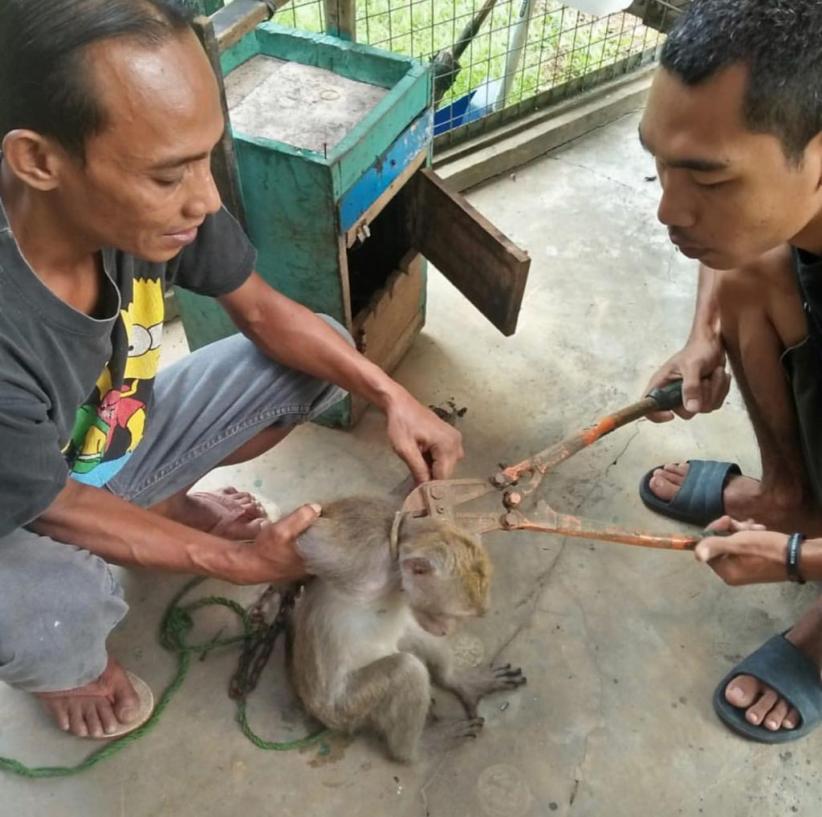
This baby monkey has his hands bound and is just beginning his brutal topeng monyet (dancing monkey) training in Indonesia.

This technique, borrowed from the topeng monyet (literally “dancing monkey”) trainers in Jakarta, forces the young monkey’s leg muscles to develop and forces his spine to become accustomed to rigidity.

For the first session, baby Pika would have been left like that for two, maybe three hours, likely screaming for his mother the entire time if his “owner” doesn’t put a stop to it with violence.

The intervals would increase steadily until he’s left like that overnight. Each time the rope is given less slack so Pika is forced to stand rigid.

Topeng monyet training
Topeng monyet training in Indonesia: This is the next phase of training after baby monkeys endure several weeks of being strung up by their necks. Here, a “trainer” is forcing a baby long-tailed macaque to hold an object, which will be part of the “monkey show for kids” the baby will be forced to star in for the next few years of his life. Credit: Jakarta Animal Aid Network

Because they must have the strength and fine motor control to hold onto their mothers’ fur in the wild, macaque infants are ambulatory almost instantly, unlike the helpless infants of their primate cousins like orangutans and, well, humans.

The rope technique allows infants like Pika to quickly become accustomed to walking upright, but they will immediately revert to walking on all fours because that’s how they naturally move and that’s what their muscular-skeletal system is designed for.

That’s why Pika has a “cute backpack.” The backpack is filled with a counterweight so Pika must walk upright or fall over, giving his “owner” what she wants: A “cute” video to share on social media.

Of course Pika could simply refuse to walk, but then he’ll go hungry. Note the reason why he’s laboring, at just a few weeks old, with a counterweight on his back, with an unnatural gait to reach the other side of the room: the demon who purchased him is holding his bottle. No walk, no bottle. Walks, plural, because undoubtedly there were several takes.

(Pika may or may not have a tail. The “owners” often amputate them — without anesthetic — because they’re impediments for preemie diapers, and cutting tail holes in the diapers increases the chances of “accidents” spreading.)

Macaques are hyper-social creatures and they’re so similar to humans socially that psychologist Harry Harlow conducted his infamous maternal deprivation studies on infant rhesus monkeys like Pika.

babyrhesusmonkey
A rhesus macaque baby of about four months old. Rhesus macaques, who are extremely social and nurse from their mothers for up to two years, were used in psychologist Harry Harlow’s infamous maternal deprivation experiments. Credit: Wikimedia Commons

In the wild babies like Pika will spend the first year of life clinging to mom and rarely straying more than a few feet from her. The mother-baby bond is so strong that daughters stay with their mothers for life, and sons stay until they’re five or six years old, at which time they’re booted from their home troops to avoid inbreeding.

The mothers do everything for their babies. They nurse them, groom them, protect them, soothe them when they scrape a knee and scoop them up when an older monkey is bullying them. Macaque babies nurse until up to two years old and they can frequently be seen hugging their mothers.

Through cruel experimentation Harlow found that the tactile feeling of being held in a mother’s arms is absolutely crucial to normal psychological development in primates, humans included. Harlow took infant rhesus monkeys from their mothers within hours and placed them in total isolation. Some babies were given inanimate “surrogate mothers” made of wire, while the others were given surrogates made of cloth. Both groups had major developmental and psychological problems, but the babies with wire “mothers” were far worse off.

That means Pika, who has already been stolen from his mother and forced to endure physical cruelties just weeks after his birth, has also been deprived of something intangible, something so important that it will have an indelible impact on his life.

That is why when you see pet monkeys, you always see them clinging desperately to stuffed animals. The stuffed animals and blankets aren’t their “lovies” like a child would have. It’s much sadder than that. Those inanimate objects are their surrogate mothers which they turn to for comfort and a crude approximation of what it feels like to hold onto their moms.

Some “owners” don’t like that, so they place babies like Pika in barren cages. No matter how horrifically they abuse the babies, when the “owners” let them out in the morning the first thing the baby does is cling to his abuser. That is his nature.

So what happens to Pika?

There’s a timer on cuteness. Pika will be an adorable baby for about a year, which will fly by. By that time he’ll already be showing signs of extreme discontent. He’s got no mother, no friends to play with, no troop, no one to groom or to groom him. He won’t be allowed to climb and explore like he would in the wild, nor can he forage. Food is something placed before him, not something he finds and picks from trees.

Pika, hardwired by hundreds of thousands of years of genetic heritage, will know something’s missing, but he won’t know why. He’ll start to “act out,” only he won’t think of it as acting out because he does not, and cannot, understand human social etiquette, nor what it means to keep things clean by human standards.

As he acts out, he’ll be punished, often severely. He’ll become more of a problem until at about 18 months his “owner” will get rid of him. Some people will take their pet monkeys to sanctuaries, but those are few and far between in China, spots are very hard to get, and the owner will be on the hook for monthly payments for as long as Pika lives, which could be up to 25 years.

So it’s more likely that Pika will be poisoned or simply dropped off somewhere in the woods far from home where he’ll starve or be killed, because he doesn’t have the skills to survive and his kind live in troops. If he’s dropped off where there are other monkeys his chances will be even more slim, since macaques will not accept troop outsiders and can get violent if they perceive an interloper in their territory.

As for Pika’s owner, if she’s not tired of the whole business she’ll buy a new baby. Some women are one and done, but others see it as practicing for parenthood and/or they enjoy the dopamine rush of online attention and praise. I’ve seen some Chinese women go through half a dozen babies, often buying two or three at a time so they can stage spectacularly cruel contests, like dropping a single bottle into a cage and filming the babies fight over it.

What I’ve written here doesn’t even scratch the surface of the cruelty involved with the baby monkey “pet” fad, but don’t make the mistake of believing this is a thing that only happens in China, Thailand or Cambodia. Some 15,000 baby monkeys are purchased every year by Americans, who fare no better when it comes to reaching that 18-to-24-month point when formerly cute, docile babies grow into resentful, frustrated juveniles and become destructive.

While sanctuaries like Jungle Friends exist, they are overcrowded and the same challenges apply to American monkey “owners” as they do to their Chinese counterparts.

We’ll revisit this whole nasty business in a future post, but in the meantime, I ask you to question “cute” animal videos, especially where wild animals and humans are involved.

A note about Youtube and Google: Youtube is owned by Google, whose founders often bragged about their motto: “Don’t be evil.” Youtube and its content moderation teams are well aware their platform hosts tens of thousands of animal abuse videos, including innumerable videos of monkeys — often babies — being abused in horrific ways. There are entire channels, monetized and in good standing with Youtube, that cater exclusively to a depraved audience of self-described monkey haters who call infant macaques and other monkeys “tree rats” and not only provide steady advertising income to the channel operators — which can be life-changing money in countries like Vietnam and Cambodia — but send money via PayPal and Venmo to them with requests for specific kinds of torture

Youtube has been aware of this for almost a decade at least. Going back to 2014, I was one of a group of dozens who mass reported channels to Youtube, tagging blatant and horrific animal abuse. Every report was ignored. The only thing that prompted Youtube to action was when I contacted a friend who worked for PETA at the time and got them to pressure Youtube directly to take down a handful of notorious monkey abuse channels. Youtube took action, but those channels were quickly replaced by new ones, creating a game of wack-a-mole. 

To this day, and despite steady pressure and negative coverage in the press, Youtube takes little more than symbolic action on animal abuse videos, particularly those involving monkeys.

Stray Walks 5 Miles In One Day To Get Back ‘Home’ After He’s Given Away

Max didn’t like his new “home” in a barn in Amish country and returned to the man who first showed him kindness.

Brad Bennett said Max the stray was in a bad way when he showed up.

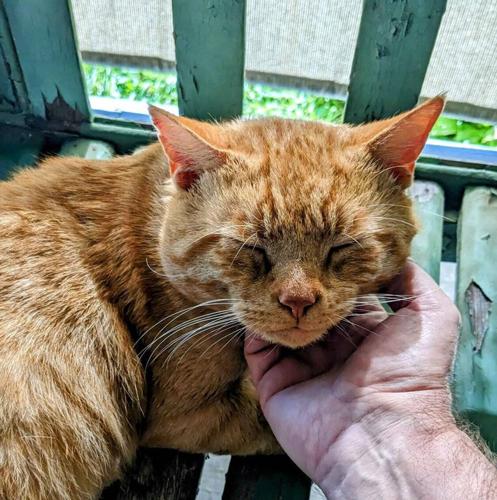
The young cat was malnourished, missing patches of fur and was suffering from infections when Bennett saw him on the property of a western Pennsylvania home where he works as a personal caretaker, first via trail cameras set up to catch images of local wildlife, then in person.

The orange tabby cat was drawn by stale cat food Bennett had thrown out, but he was extremely cautious. He hissed at Bennett the first time the 58-year-old approached him and tried to attack him.

Bennett, who thinks Max may have been abused in the past, earned the stray’s trust and was eventually able to deworm him and give him flea and tick medication, he told local newspaper the Tribune-Democrat.

“I started feeding him and working with him,” Bennett told the paper. “Three months later, [he] was on my lap with me on the swing.”

maxthecat
Max the cat. Credit: Bill Bennett

Bennett, who has two cats of his own, said he couldn’t afford to keep Max because he was “tapped out” by thousands of dollars in veterinary bills, but he knew the little guy needed a home before winter so he made arrangements to take him to a nearby Amish farm which was in need of a mouser.

Max clearly wasn’t taken with the farm because he walked five miles and crossed a major interstate (376) to get back to the home where Bennett works — in one day.

“I kept having feelings of guilt about sending [him] off, not knowing what was going to happen,” Bennett said. “Part of me was kind of excited to see him.”

Bennett knew he couldn’t send Max back to the farm. After he wrote a Facebook post about Max’s situation, Jill Powell, a volunteer with Homeless Cat Management in Pittsburgh, drove about an hour from Pittsburgh to pick Max up. He’ll stay with a foster family until Powell and her organization can find him a forever home.

Whoever opens their home to him will find a grateful cat who knows what it’s like to struggle on his own.

“I was able to hold him, he meows and he reaches for petting,” Powell said. “He seems very sweet.”

Jury Awards Oregon Man $1.4 Million In Stolen Cat Case

The man’s attorney styled the decision as a victory for animal lovers.

An Oregon man didn’t get his cat back but he could be almost $1.4 million richer after a jury decided in his favor in a cat-napping case.

Joshua Smith, 41, adopted a cat he named Frank in 2017 after finding the little guy, apparently a stray, in an alley.

At the time Smith was living in a single room in a group drug recovery home in Portland, according to the Oregonian. The terms of his lease didn’t allow him to keep pets so when Smith’s landlord — a man named Devon Andrade — discovered Smith had been keeping a cat, Andrade took matters into his own hands and stole Frank, admitting under oath he’d taken the tabby and given it to his girlfriend, who then took Frank to a local shelter.

Smith and Frank were never reunited: It turns out Frank has a microchip and he was returned to his original family, the people who were his caretakers before he went missing and Smith discovered him more than six years ago.

Frank the cat
Frank the cat, as seen in a photo Fuller showed to the jury.

But it took a jury less than two hours to decide against Andrade and Pine Street LLC, the company behind Pine Street Recovery Housing. The defense argued that even though Andrade should not have acted unilaterally, Smith was still in violation of his lease agreement, but the jurors weren’t buying it.

“The jury’s message should be loud and clear to landlords,” said Michael Fuller, Smith’s lawyer. “You need to respect the rights of tenants, especially when it comes to pets.”

The jury awarded Smith a shocking $1.375 million although it’s not clear how much of that Smith will see. An earlier story, published in 2019, said Smith had sought $250,000 in damages. It’s not clear why the jury went with the much larger amount.

Fuller credits the jury, saying there were several sympathetic animal lovers in the juror box.

Smith said he’s been successfully sober for years. He’s since married, moved to California and opened his own barber shop.

“The most important thing was that I got my day in court,” Smith said. “I got really lucky because I told the truth, no matter what.”

Help Track Down This Cat Thief And Return Kitty To Her Loving Family

A Nebraska family is heartbroken after a woman stole their cat right off their porch in broad daylight.

Mr. Kitty was taken under duress, and her absence has left a cold spot on her human’s bed — and in her family’s hearts.

Despite her name, Mr. Kitty is a female calico Manx rescued about eight years ago by Benjamin Strimple, who found Kitty with her leg caught in a racoon trap.

“When we got this cat, it just became my everything,” Strimple said. “Became like my best friend. Every single night I sleep with her.”

Now he’s worried for her safety and hoping for her return after his Ring doorbell caught a woman walking directly up to his porch in Omaha, NE, and taking the unwilling Mr. Kitty by force in broad daylight on Oct. 20.

The video shows the woman approach and hold out a hand. The friendly cat sniffs her hand at first, but pulls away as she leans forward. Mr. Kitty fights back as the woman tries to corral her, but a close look at the video shows the woman using what appears to be some sort of spray device before picking the cat up with both hands.

mrkittyringscreenshot
A screen shot of the Ring doorbell footage showing the suspect stealing Mr. Kitty from her family’s Omaha, NE, porch.Click here to view the video.

She carries Mr. Kitty back to a silver Chevy Malibu and drives away. The suspect is a black female with long hair who was wearing an orange skirt, a brown or black shirt and dark sneakers in the footage. Strimple says he doesn’t know the woman but she looks familiar and he may have seen her in the neighborhood before.

Mr. Kitty does not venture off his property, he said, and spends most of her time indoors or on the family’s porch, where neighbors are accustomed to seeing her.

“I feel like it was like their plans. You know, they seen my cat,” he told KETV Omaha, an ABC affiliate. “I’m pretty sure everyone on the street knows that cat belongs to this house.”

Omaha Crime Stoppers and the Nebraska Humane Society are offering a $1,000 for information leading to the arrest of the woman and the return of Mr. Kitty. Anyone with information on the theft can contact Omaha Crime Stoppers at 402-444-STOP or www.omahacrimestoppers.org. If you know anyone in the Omaha area, please share the story and encourage them to share it on social media.

The theft is not only traumatic for the family, but for Mr. Kitty too, pointed out Nebraska Humane Society’s Pam Wiese.

“I’m sure that [s]he’s probably like, what? What just happened?” Wiese said. “I was just loving up on someone and now I’m no longer home.”

Strimple said the only thing he cares about is getting his furry friend back.

“There’s a lot I want to say, but I would just say, just give her back,” Strimple said. “You know, that’s pretty messed up. We have a lot of family, a whole family sad. Just give her back.”

mrkittyomaha