Cats Know Where We Are Even If It Seems Like They’re Not Paying Attention

New research offers more evidence that despite their poker faces, cats do care about where their humans are and what they’re doing.

A new study from Japan found cats keep track of their humans even when they’re not looking at them.

A research team from the University of Kyoto conducted the experiments in a cat cafe and in individual cats’ homes. Each cat was placed in a room without their humans. Then the researchers tested the way felines reacted to hearing their people calling their names from outside the room, followed by their reactions to hearing them inside via speakers.

When the cats heard their humans calling them from inside the room the furballs were surprised, expressing their confusion with ear twitches, whisker movement and uncertain body language.

On the other hand, when cats heard “non-social stimuli” — scientist-speak for sounds other than familiar people calling to them — they didn’t react to changes in the location and direction.

Some people might shrug and wonder what the fuss is about, but the experiment actually confirms a great deal about feline intelligence. It’s a test of what scientists call “socio-spatial cognition,” meaning cats form a mental map of things that are important to them, and nothing’s more important to a house cat than the person who provides food, security and affection.

That’s significant because it’s confirmation that cats understand object permanence, and that they are more than capable of abstract thought. Abstract thought — the ability to picture and think about something mentally, without having to see it — is hugely important in intelligence, allowing everything from creativity to understanding that other animals and people have their own points of view. For context, it takes about two years for human children to develop rudimentary abstract thinking skills.

Cats “may be thinking about many things,” Saho Takagi, the study’s lead author, told CNN.

“This study shows that cats can mentally map their location based on their owner’s voice,” Takagi said, per The Guardian. “[It suggests] that cats have the ability to picture the invisible in their minds. Cats have a more profound mind than is thought.”
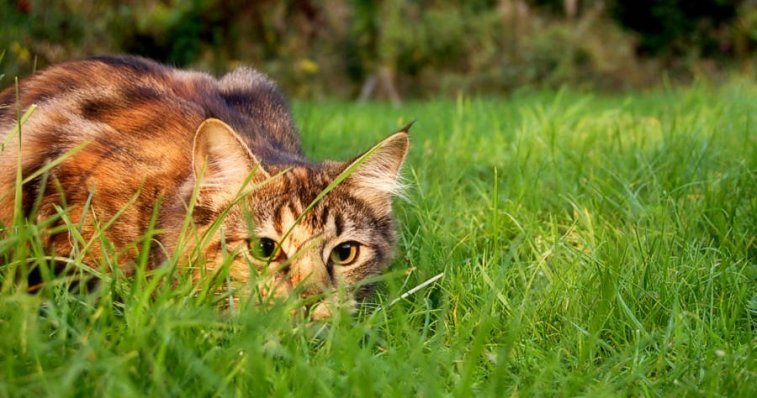
Things like object permanence and spatial awareness were necessary for cats to thrive as hunters for the millions of years they’ve existed on Earth.

The results aren’t surprising from an evolutionary perspective, biologist Roger Tabor said.

“That awareness of movement – tracking things they cannot see – is critical to a cat’s survival,” Tabor told The Guardian.

“A lot of what a cat has to interpret in its territory is an awareness of where other cats are. It is also important for hunting: how could a cat catch a field vole moving around beneath the grass if it couldn’t use clues, such as the occasional rustle, to see in its mind’s eye, where they are? A cat’s owner is extremely significant in its life as a source of food and security, so where we are is very important.”

The study is also another piece of evidence showing cats are just as aware of — and concerned about — their people as dogs are, even though the conventional wisdom says they don’t care most of the time. That has implications for the way people bond with their cats, and the decisions we make about caring for them — like, for instance, how long we’re willing to leave them on their own while planning a trip.

“This is a great example of elevating our expectation of the cat a little bit,” cat behavior consultant Ingrid Johnson told CNN, “and realizing that they do have the capability of having that bond in that relationship where they actually will take comfort in their people.”
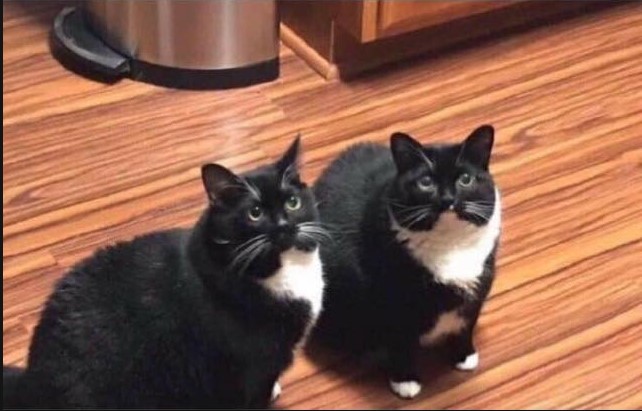
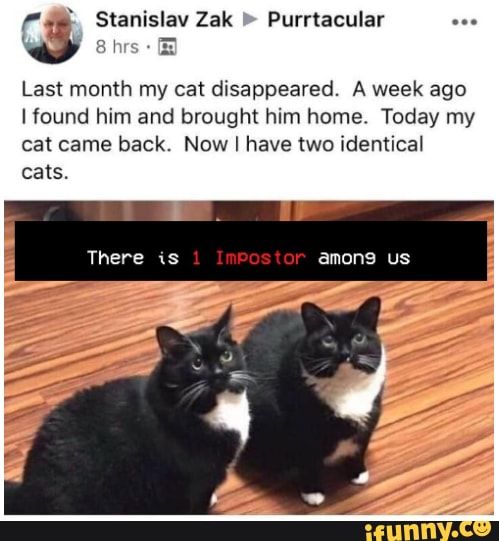
Does Your Cat Have A Doppleganger?

A man ends up with two identical cats after “reuniting” with what he thought was his lost cat, only to have his original cat come home the following week.

I may be late to the party on this one, but I’m fascinated by this story about a guy who lost his cat and recovered what he thought was his little guy three weeks later, only for his actual cat to come home the following week.

94e5e16b6f87dd2d2089ee202767fe6b

Some people commenting on the photo claim there are obvious differences, but in my opinion the differences are very small and probably indistinguishable unless the moggies are side by side. The markings are virtually identical on both cats, and the deviations look mostly like they’re attributable to angle, position and shadows.

People who aren’t familiar with cats might wonder how someone can “reunite” with a cat who doesn’t know them, but that can also be explained away by feline quirks: It’s not unusual for cats to behave differently, even to people and other kitties they know well, after a period of separation.

If the cat was acting a bit off, it would be easy to chalk it up to readjustment and re-acclimating to the sights, sounds and smells of home.

The most unbelievable aspect, for me at least, is how both cats in the photo seem to be cool with having a doppleganger and sharing territory.

Maybe the photo’s not representative of their interactions, but if somehow I found Bud’s doppleganger on the street and brought him home, the consequences would include an epic shitstorm of proportions I probably cannot even imagine.

“WTF is THIS?!?” I can imagine Bud thinking, expressing his incredulity with annoyed chirps and meows. “This is a joke, right? Right? Speak before I murder you!”

“I’m Little Buddy, yes I’m the real Buddy, all you other Little Buddies are acting all funny, so will the real Little Buddy please stand up? Please stand up, please stand up!”

The truth is I’ve never seen a Bud doppleganger, or a Buddyganger, if you will. Over the years I’ve done more than a few image searches for gray tabbies while looking for funny photos of cats who look like Bud, and none of them bear more than a superficial resemblance to His Grace.

Bud has three major characteristics setting him apart from other cats with the same coat pattern and coloring:

main-qimg-71545019fd341552e20753a1743f261f

  • His bright green eyes complemented by “guyliner,” which itself is ringed by neat white lines.
  • The unique white patch on his chest. It’s just a tuft of white fur, but I’ve never seen a gray tabby with a marking that matches its size, shape and position.
  • Most of all, his pronounced mouth and nose area, alternately called a muzzle, snout or rostrum on various species, terms which are sometimes used for cats as well.

The latter was one of the first things I really noticed after meeting him for the first time and taking him home. Even as a baby it was pronounced in a way that very few cat mouths are.

Finally, while it doesn’t have any bearing on the strictly visual comparison with similar-looking kitties, I can’t imagine another cat acting like Buddy. He’s such a weirdo, so unique in his voice, vocalizations and habits, so opinionated and willing to express those opinions as loudly and often as possible, that I just can’t picture another cat fooling me.

Does your cat have a doppleganger?

How Long Can You Leave Your Cat Alone?

“Cats take care of themselves,” the conventional wisdom insisted for decades. These days we know that’s not true.

Back in the Dark Ages of kitty cognitive knowledge, when scientists wouldn’t go near a cat with a 20-foot pole because they were considered impossible to work with, the conventional wisdom was that as long as a cat was fed and watered, its needs were met.

Going away for three days? Leave a few bowls of dry food and water and you’re good to go, or if you really want to splurge, get an automatic feeder, the prevailing wisdom went. Gonna be away for a week or two? Get someone to check in on the cat a few times a week just to make sure food and water is available.

“If you want a dog but you don’t have time to meet all of its needs, get a cat,” people would say. “They take care of themselves.”

It didn’t take me long to realize how wrong the “prevailing wisdom” on cats really was, and thankfully in recent years we’ve seen a boom in research into cat behavior, intelligence and emotional needs. Among the many things verified by those studies is the fact that cats absolutely are emotional animals and are not the cold, indifferent automatons many people insisted they were.

One reason for that enduring myth may be cats’ famous stoicism. Ignore a dog and she might cry, become destructive or pee in your house, but one thing’s for sure — she’s going to let you know she’s not handling the isolation well. Ignore a cat, and he’ll just withdraw.

I’ve seen plenty of examples of the latter in the homes of friends and acquaintances. The cats are just sort of there, existing like the furniture or plants, interacted with rarely and given affection only occasionally. Those poor cats are quiet, seemingly indifferent, expecting nothing and sadly accepting of their place. They are neglected.

But when you pay attention to your cats they come out of their shells, so to speak. They warm to you. They reveal their hidden emotional core.

Of course, when you raise a cat with attention and love, that’s there from the very beginning, and they WILL let you know when they’re not happy with your absence.

Who do we know who’s like that? His name sounds like Bum, or maybe Bunny, or…oh yeah! God forbid I should ignore Buddy. I’ll never hear the end of it. In fact, he’s on my desk right now, butt parked next to the mouse, and I’m sure any minute now he’s going to decide that I’ve been writing for too long and declare it’s Buddy Time.

Of course, the little jerk attacked his own cat sitter, a friend who has been caring for him when I’m away since he was a kitten! That complicates things.

“Oh servant! Servant, come here at once! I’d like a massage!”

If you’ve made it this far, you might be wondering how long you can really leave your cat alone. The answer is no more than 24 hours without someone dropping by to check on kitty, refill the water and food bowls, and give him some attention.

If you’re gone longer you’re going to want to make concrete plans for a cat sitter to be there every day.

“You should not leave your cat alone for a prolonged period,” veterinary postdoc Mikel Delgado told Inverse. “Cats also have emotional and social needs that can’t be met when they are left alone for extended periods.”

If your cat likes to play, that’s great, but even if the little one doesn’t, your cat sitter can make things easier by simply hanging out, Delgado said.

Now if you’ll excuse me, His Grace needs me…

Reason #488 To Keep Your Cats Indoors: They Hunt Whether They’re Hungry Or Not

Cats who have regular outdoor access and hunt wildlife still get 96 percent of their nutrition from pet food, a new study found, suggesting their predatory behavior is driven by instinct, not hunger.

A new study from the UK debunks the claim that cats need access to the outdoors to supplement their diets with wild kills.

Cats who spend a significant amount of time outdoors and regularly kill local wildlife still get 96 percent of their nutrition from meals provided by their humans, according to research by a team at the University of Exeter.

The scientists connected with cat owners through ads on social media, TV and in print publications, specifically seeking out “cat owners living throughout southwest England whose cats regularly captured wild animals and brought them back to the house,” the study’s authors said.

They gave the owners a questionnaire to collect some basic information on the kitties — age, sex, breed, whether they had unrestricted access to the outdoors, and how much time they spend outside — then split the 90 participating cats into six groups.

Cat hunting
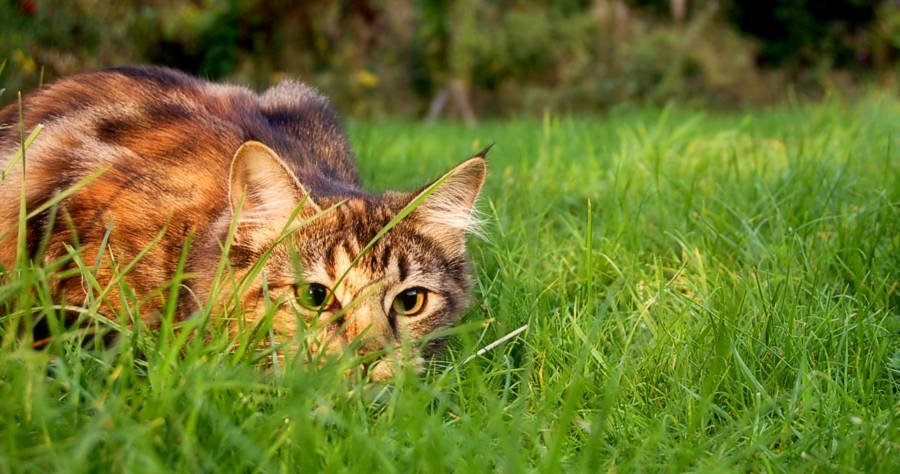
A domestic tabby cat stalking in the grass. Credit: Wikimedia Commons

To set a baseline, the scientists trimmed small sections of whisker from each of the cats, then trimmed a second sample at the end of the study.

By comparing stable isotope ratios in the whisker samples, they were able to determine what the cats were eating. Despite regular access to the outdoors and successful hunts, pet food accounted for the vast majority of their diets.

As a result, the researchers concluded, outdoor cats hunt because they’re driven by predatory instinct, not hunger.

“When food from owners is available, our study shows that cats rely almost entirely on this for nutrition,” said Martina Cecchetti, the study’s lead author.

“Some owners may worry about restricting hunting because cats need nutrition from wild prey, but in fact, it seems even prolific hunters don’t actually eat much of the prey they catch,” Cecchetti said. “As predators, some cats may hunt instinctively even if they are not hungry – so-called ‘surplus killing’ – to capture and store prey to eat later.”

A second component of the study was designed to find the best mitigation strategy to change the behavior of outdoor cats.

Each group was given a different strategy: In one group, cats were outfitted with bells on their collars, while another group wore reflective break-away collars and cats from a third group were fitted with BirdBeSafe collars. The other groups were told to make habit changes inside the home. For example, one set of cats was fed a higher-protein diet without grain filler, another group was fed with puzzle feeders, and the last group was given extra interactive play time.

While high-protein diets and play time helped cut down on hunting, the BirdBeSafe collars had the biggest impact on hunting success. The collars come in bright colors designed to stand out to avian eyes, taking away stealth and the element of surprise from cats.

The study was sponsored by Songbird Survival, a British non-profit that funds bird conservation research and looks for ways to mitigate the dwindling numbers of many avian species.

Susan Morgan, Songbird Survival’s executive director, said her group hopes cat owners will do their part to help: “Pet owners can help us reverse the shocking decline in songbirds via three simple, ‘win-win’ steps: fit collars with a Birdsbesafe cover; feed cats a premium meaty diet; play with cats for five to ten minutes a day to ‘scratch that itch’ to hunt.”

Of course there’s an obvious solution the study didn’t include: Keeping cats indoors. While keeping cats indoors is common in the US, cat ownership culture in the UK is different — another subject for another post.

Read the full text of the study here. Header image credit Pexels. Body images credit BeSafeCollar.

Previously:

1024px-Florida_panther_kittens
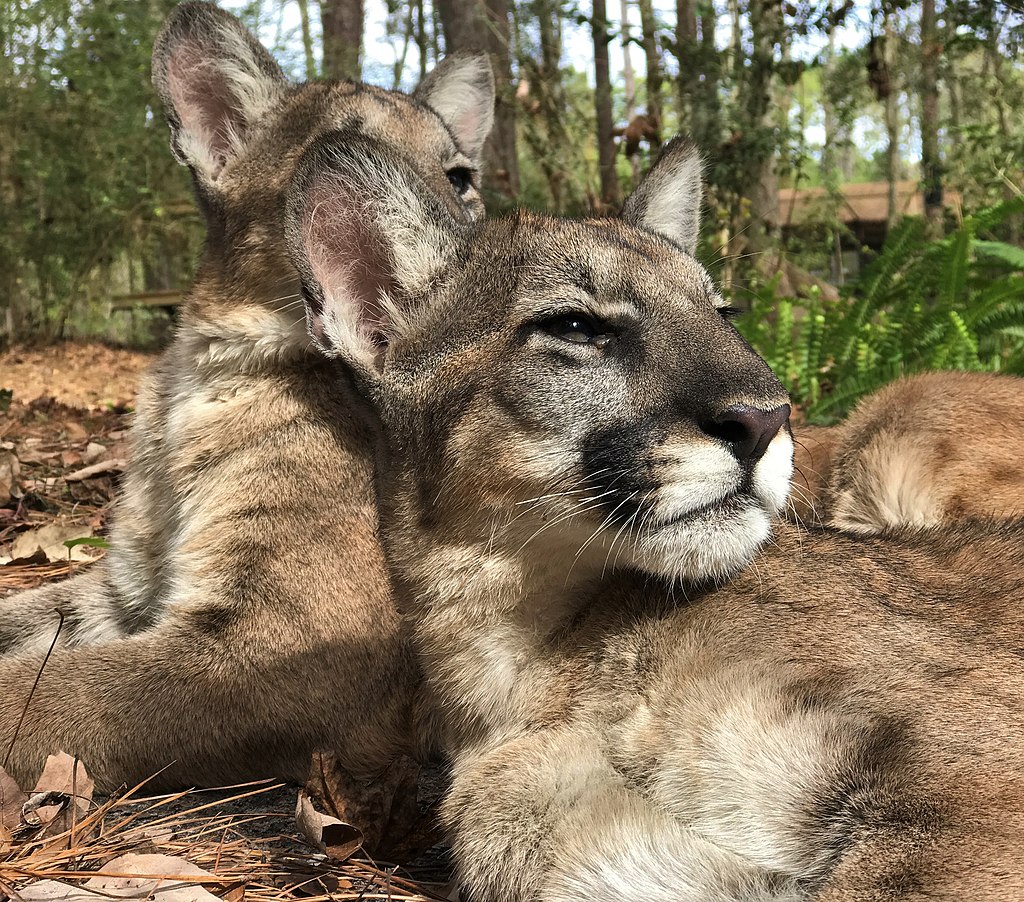
A pair of young mountain lions in Florida. Credit: Wikimedia Commons/WOConservation

The Most Important Cat Study Ever Has Been Completed, And The Results Are In

For the first time ever, a US city has conducted a true cat census using scientifically proven methods, including doing it the hard way — by counting. The project’s authors hope other cities follow their lead.

The last decade has seen something of a renaissance in cat-related research, with insightful studies about feline behavior coming from researchers in the US and Japan.

On the other hand there’s been a glut of research into feline predatory impact and public policy, and the majority of those studies have been deeply flawed. They’re based on suspect data and tainted by the interests of people who are more interested in blaming cats for killing birds than they are in learning about the real impact of domestic felines on local wildlife.

Those studies have all taken extreme shortcuts — using data that was collected for entirely different studies, for example, or handing out questionnaires that at best lead to highly subjective and speculative “data” on how cats affect the environment.

Several widely-cited studies that put the blame on cats for the extirpation of bird species have relied on wild guesses about the cat population in the US, estimating there are between 20 million and 120 million free-roaming domestic cats in the country. If you’re wondering how scientists can offer meaningful conclusions about the impact of cats when even they admit they could be off by 100 million, you’re not alone.

No one had ever actually counted the number of cats in a location, much less come close to a real figure — until now.

When leaders in Washington, D.C., set out to tackle the feral cat problem in their city, they knew they couldn’t effectively deal with the problem unless they knew its scope. They turned to the University of Maryland for help, which led to the D.C. Cat Count, a three-year undertaking to get an accurate census with the help of interested groups like the Humane Society and the Smithsonian.

DC Cat Count
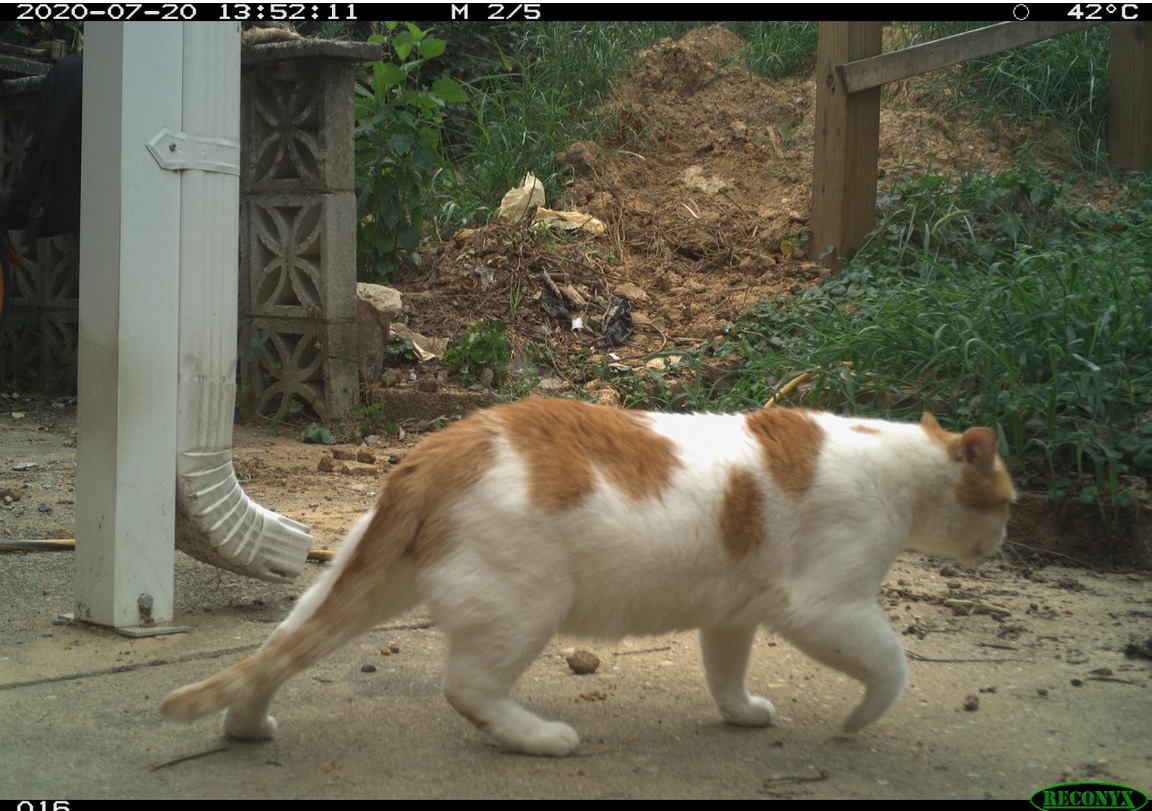
An image from one of 1,530 motion-activated cameras deployed for the D.C. Cat Count. Credit: D.C. Cat Count

The researchers approached each of their local shelters and rescues for data, then assembled a meticulous household survey to get a handle on how many pet cats live in the city, and how many have access to the outdoors.

Finally — and most critically — they used 1,530 motion-activated cameras, which took a combined 6 million photos in parks, alleys, public spaces, streets and outdoor areas of private residences. They also developed methods for filtering out multiple images of individual cats, as well as other wildlife. And to supplement the data, team members patrolled 337 miles of paths and roads in a “transect count” to verify camera-derived data and collect additional information, like changes in the way local cats move through neighborhoods.

DC Cat Count
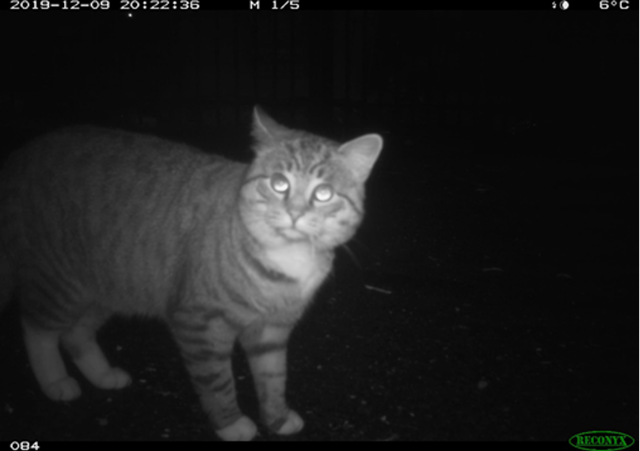
A cat who looks a lot like the Budster was captured in this 2019 photo from a motion-activated camera with night vision. Credit: DC Cat Count

Now that all the data’s been collected and analyzed, the D.C. Cat Count finally has a figure: There are about 200,000 cats in the city, according to the study.

Of those, 98.5 percent — or some 197,000 kitties — are either pets or are under some form of human care and protection, whether they’re just fed by people or they’re given food, outdoor shelter and TNR.

“Some people may look at our estimate and say, oh, well, you know, you’re not 100% certain that it’s exactly 200,000 cats,” Tyler Flockhart, a population ecologist who worked on the count, told DCist. “But what we can say is that we are very confident that the number of cats is about 200,000 in Washington, D.C.”

The study represents the most complete and accurate census of the local cat population in any US city to date, and the team behind it is sharing its methods so other cities can conduct their own accurate counts. (They’ll also need money: While the D.C. Cat Count relied on help from volunteers and local non-profits it was still a huge project involving a large team of pros, and it cost the city $1.5 million.)

By doing things the hard way — and the right way — D.C. is also the first American city to make truly informed choices on how to manage its feline population. No matter what happens from here, one thing’s certain — the city’s leaders will be guided by accurate data and not creating policy based on ignorance and hysteria painting cats as furry little boogeymen.

DC Cat Count
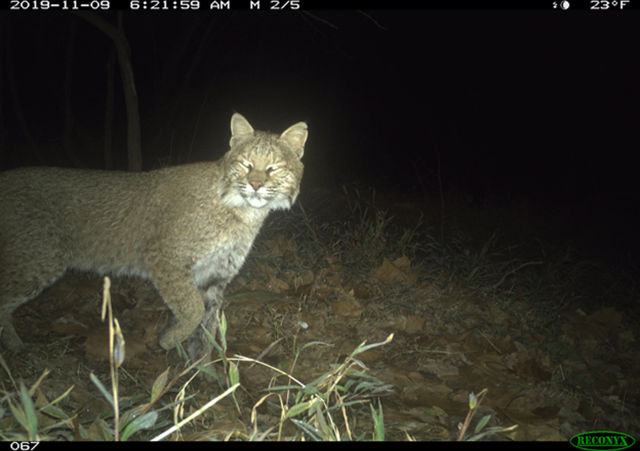
Not all the photos captured images of cats, and not all the felines were little: In this 2019 night image, a bobcat wanders in front of a trail camera. Credit: DC Cat Count