Buddy’s Gate Crashing My Dreams

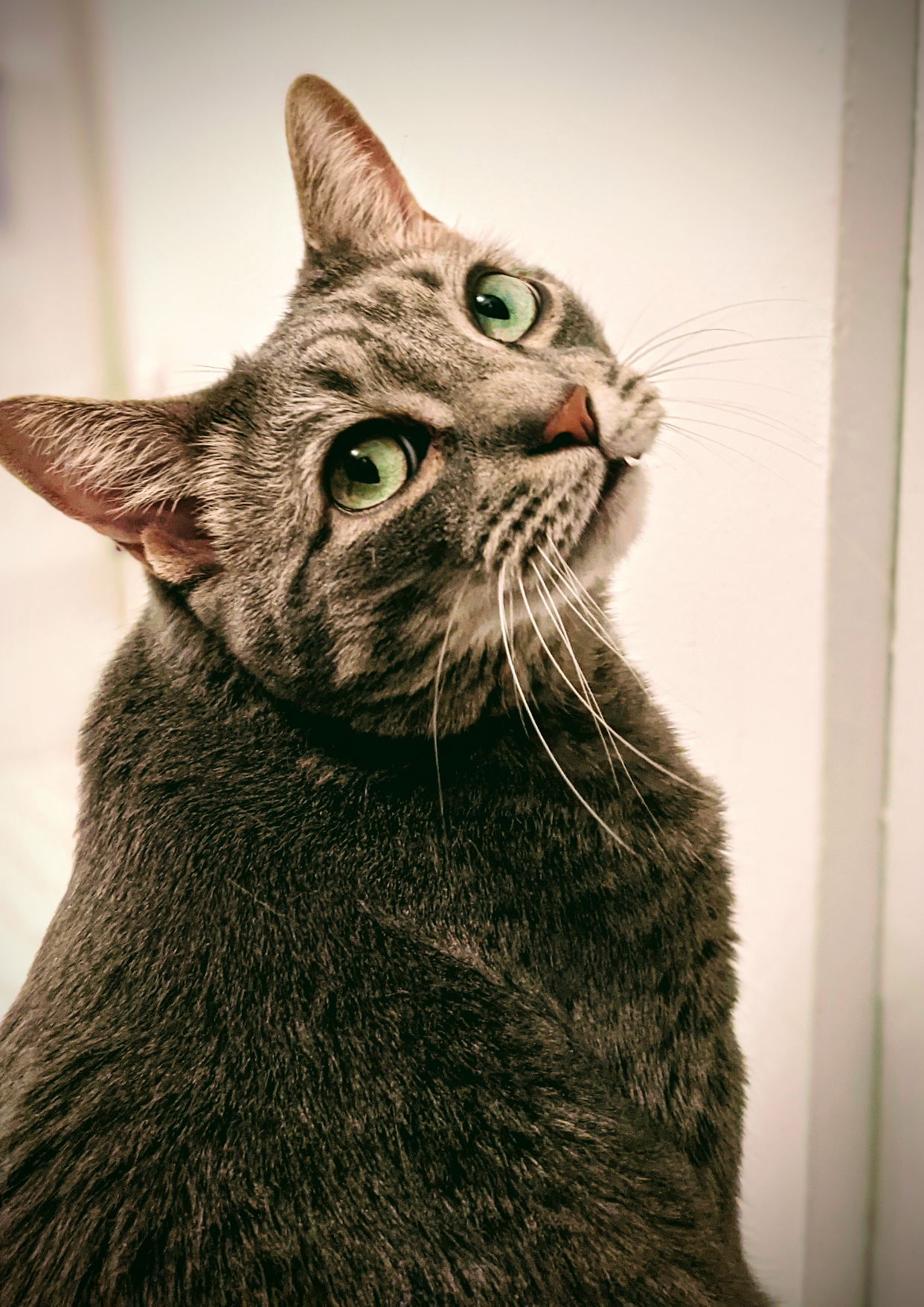
Bud makes himself comfortable in my consciousness so he can annoy me on an entirely different plane of existence!

Buddy has a tendency to show up in my dreams, which I attribute to his relentless insistence on messing with me while I’m asleep, whether it’s yowling in my ear for breakfast, deciding my nose needs grooming or just burrowing into me with a soft “Mrrrrrp!”

Last night, however, was a doozy. I dreamt I was back in high school, but instead of being in class I was in the newsroom at my first-ever newspaper job, which somehow occupied the third floor of the school building. I excused myself to go have a smoke — which I don’t do anymore — and walked down to the first floor where Bud was waiting for me near the door leading outside.

To say I was alarmed to find him just hanging out unsupervised in my high school-slash-workplace would be an understatement.

“Bud!” I said. “What the hell are you doing here?”

“I came here with you, remember?” Buddy answered, speaking as if it was the most natural thing in the world. “We took the Celica.”

I sighed.

“I can’t have you running around here where someone could snatch you,” I said. “You’re going back in the car until I’m done for the day.”

“No I’m not!”

“Yes you are!”

“Oh yeah?” Buddy asked. “Where’s the car?”

Celica
A black Celica just like the one I owned until it died one day on the highway en route to Long Island.

And that’s when my dream morphed into a recurring nightmare, which is that I’m walking through a parking lot and can’t find my car. (In this case the car I got at 19 years old, a black Celica hatchback that was all sleek looks and underwhelming engine power. I still miss that car!) In these dreams I start to panic, redouble my efforts, and realize the parking lot is so huge, so endless that I’m gonna need a lift, someone to drive me around so I can look for my car

Buddy smile
“I’m a little Buddy, short and sweet! Here are my clawses, here are my feet!”

Maybe I can ease my anxiety in future dreams by dispatching Buddy to look for the car, but in last night’s dream he was clearly responsible for moving it.

“Bud…” I said. “What’d you do with the car?”

Dreams have a way of making it seem perfectly reasonable that a 10-pound house cat can not only speak, but drive a car.

I was absolutely sure that little jerk had hidden my car! (And here’s the standard disclaimer for all new readers: “little jerk” is a term of endearment when it comes to Bud. I love the little guy, obviously.)

I know it was just a dream, but it’s probably not a bad idea to hide my keys from now on…

Bud’s Book Club: The Man-Eaters of Kumaon & The Game of Rat and Dragon

Join us in reading stories of cats in space and big cats in the jungles of India.

Welcome to the inaugural post of Buddy’s Book Club, where we’ll read stories about cats and stories involving cats!

We’re going to start things off easy with a classic short story of the cat canon, which is available for free online via Project Gutenberg, and a seminal book about big cats from a man whose name is indelibly linked with them.

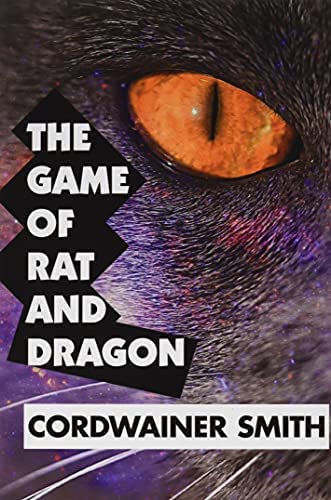
The Game of Rat and Dragon (1954) by Cordwainer Smith
51Aneono5KS._AC_SY1000_

Read it here for free from Project Gutenberg, a collaborative effort to create a digital archive of important cultural literary works that have fallen into the public domain. For those unfamiliar with Project Gutenberg, it’s completely above-board, legal and safe for your devices, and the story opens in plain HTML with illustrations included as image files. You can read the story in a browser or download it onto a reading device, tablet or phone.

The Game of Rat and Dragon first appeared, as so much short fiction of the era did, in a digest. Although Smith had penned it the year before, the story was published in Galaxy Science Fiction’s October 1955 issue and became an instant classic among cat-lovers and science fiction aficionados. (There is considerable overlap between the two, not surprisingly: Introverts whose imaginations run wild when they look to the stars tend to have many of the same personality traits as people who prefer the more sublime antics of cats.)

The Game of Rat and Dragon imagines a far future in which humanity has become a star-faring culture, meaning we’ve conquered interstellar flight and have begun to colonize planets in star systems other than our own.

There is, of course, a problem. The dark, lonely void between stars isn’t as empty as we thought it was, and is inhabited by invisible (to the human eye), inscrutable, inexorable entities eventually dubbed “dragons.”

When dragons attack they leave only death and insanity in their wake, putting the entire idea of interstellar travel at risk. Imagine if there was a not-insignificant chance of your passenger jet being attacked by impervious creatures every time you hopped on a plane. It wouldn’t be long before the entire air industry collapsed and the world suddenly became a much bigger place, with other continents unreachable by air.

Who can help humans with this problem? Cats, of course! To say more would be to spoil the fun. Meow!

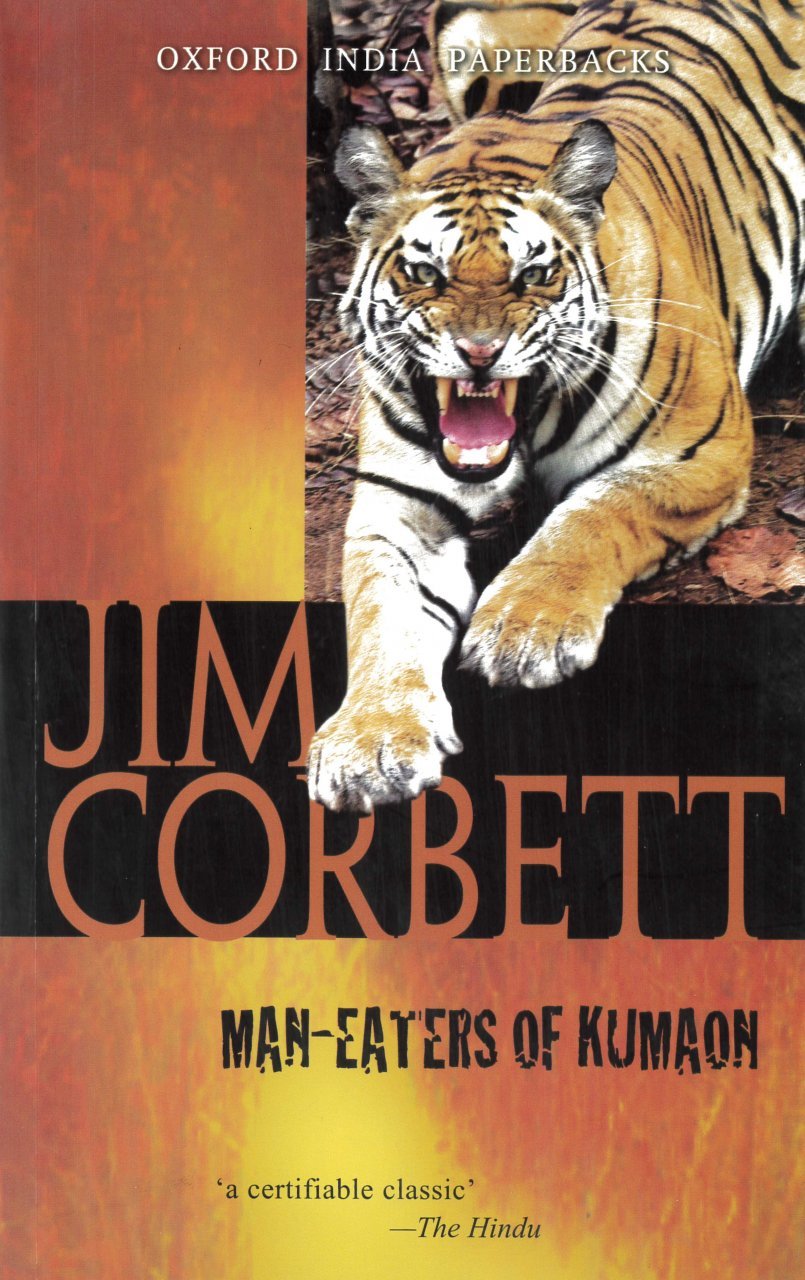
Man-Eaters of Kumaon (1944) by Jim Corbett
201355

Available as an ebook for 99 cents from Barnes and Noble.

Jim Corbett was a sportsman, the son of a government official in the British Raj who was raised in India’s jungles and came to know them intimately. He’s best remembered as the fearless hunter who finally brought down the infamous Champawat tigress, who officially claimed 436 lives over a years-long rampage as a man-eater, and likely many more that went unrecorded.

To understand the gravity of Corbett’s accomplishments, it’s necessary to understand the effect of a man-eater on rural India. The people living in India’s tiny villages are subsistence farmers. If they don’t farm, they don’t eat.

But when a man-eater as dangerous as the Champawat tigress claims an area as its hunting grounds, everything grinds to a halt: Farmers refuse to tend their fields, villagers disappear behind locked doors, and a simple walk to a neighboring village becomes an impossibility unless escorted by a group of two dozen or more armed men. Even then it’s a risk, for as Corbett notes, when tigers become man-eaters they have no fear of humans and will kill people in broad daylight, even when they’re in groups.

And yet for all their power and predatory instincts, tigers are never deliberately cruel and don’t harm humans willingly. Tigers become man-eaters by unfortunate circumstance, usually due to negligence or stupidity on the part of humans.

The Champawat tigress, for example, was like any other big cat until a human hunter took aim and shot her in the mouth, destroying one lower canine completely and shattering another. The tiger could no longer take down her usual prey, or at least not without serious difficulty. At some point — perhaps after encountering the body of a person it did not kill — the tigress realized she could survive on human flesh.

If that hadn’t happened, those 436-plus souls wouldn’t have been lost, an entire region wouldn’t have been brought to its knees, and the tigress would have continued life as normal.

The vast majority of the time, tigers are content to let humans be.

“I think of the tens of thousands of men, women and children who, while working in the forests or cutting grass or collecting dry sticks, pass day after day close to where tigers are lying up and who, when they return safely to their homes, do not even know that they have been under the observation of this so called ‘cruel’ and ‘bloodthirsty’ animal,” Corbett writes.

Despite his reputation as the man to enlist when a man-eater terrorized a region, Corbett saw the way things were trending a century ago, and begged people to let the big cats live undisturbed.

“A tiger is a large-hearted gentleman with boundless courage,” he wrote, “and that when he is exterminated — as exterminated he will be unless public opinion rallies to his support — India will be the poorer by having lost the finest of her fauna.”

Corbett would undoubtedly be deeply disturbed by the situation today, with only some 4,000 wild tigers remaining in the entire world, and the glorious species mostly reduced to spending life in captivity, constantly sedated so that idiots can pay to take selfies with them.

The Man-Eaters of Kumaon follows Corbett on 10 hunts of man-eating tigers and leopards. It’s also a story of life in the British Raj, rural life in India, Corbett’s jungle adventures, his love for his loyal hunting dog and his turn toward conservation.

Schedule:

We can do the short story in a week, yeah? Let’s shoot for one week for The Game of Rat and Dragon, and two weeks for The Man-Eaters of Kumaon. We’ll adjourn and discuss in follow-up posts. Happy reading!

There Won’t Be A Cat In The White House Any Time Soon, Thanks To The Dog

First Lady Jill Biden says she hasn’t brought a cat into the White House as promised because the Biden family dog, Major, has been an aggressive biter lately.

First Lady Jill Biden generated hundreds of headlines late in 2020 and again earlier this year as she promised she and her husband would welcome a feline pet to the White House for the first time since the George W. Bush administration.

Since then we haven’t heard anything — until today’s edition of the New York Times, which includes the first sit-down interview with the First Lady since her husband took his oath of office back in January.

It turns out the Bidens did pick a cat, and that cat has been living with a foster family because the Bidens’ other family pet, Major the German Shepherd, has a bit of a biting problem.

White House spokeswoman Jen Psaki downplayed Major’s biting incidents, telling reporters he nipped White House staff twice, but emails obtained by the group Judicial Watch show Major’s biting isn’t so minor: In the first week of March, an internal Secret Service email said “an agent or officer has been bitten every day this week.” The dog also bit a visitor to the White House that same week, according to the email.

Since then there have been other incidents, and the pooch has been shuttled between the White House and Delaware, where he’s spent more time with trainers in an attempt to curb the bad behavior.

The president and First Lady didn’t want to subject their new cat to the stress of living with a bite-happy Husky, so the kitty remained in foster care. It seems the cat is now a “failed foster.”

“The cat is still being fostered with somebody who loves the cat,” Jill Biden told the Times. “I don’t even know whether I can get the cat back at this point.”

The Natural Order of Things
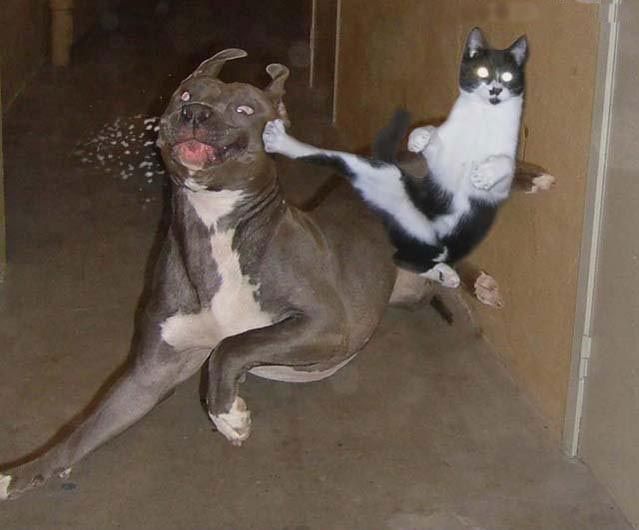
A brave and heroic cat executes a glorious karate kick to the face of a slobbering, clumsy dog, proving once again that felines are superior.

In related news, Buddy the Cat — whose track record of biting to get what he wants is second-to-none — volunteered himself to help solve Major’s behavioral issues.

“I’ll straighten him out right quick,” Buddy said, lifting a paw and flexing. “If my razor sharp claws, vicious fangs and intimidating size don’t deter him, my huge meowscles will. I guarantee he’ll want no part of this.”

Buddy the Cat: Handsome and Meowscular
Bud is not only smart and good looking, he also has huge meowscles and is known for his bravery

Worship Us, Oh Puny Humans!

Originally posted on Pain In The Bud:
Dear Buddy, Did you hear the news about the cat mummies and the big trove of cat statues found by archaeologists in Egypt? My dad says Egypt is a special place ‘cause that’s where humans used to worship us a long time ago. Is that true? Why did…

thebigbuddy's avatarPain In The Bud

Dear Buddy,

Did you hear the news about the cat mummies and the big trove of cat statues found by archaeologists in Egypt? My dad says Egypt is a special place ‘cause that’s where humans used to worship us a long time ago. Is that true? Why did they stop?

Kitten in Kentucky


Dear KiK,

Your dad is right! Egypt is a magical land, a place where humans were once keenly aware of our status as the most awesome species on Earth.

Egypt is where you’ll find the biggest litter box on the planet. It stretches for miles and miles until finally the horizon reveals a huge weather-worn statue of a cat and three stone pyramids jutting out of the litter.

The Great Sphinx and Pyramids of GizaThe Great Sphinx of Giza keeps watch over the world’s most sacred litter box.
It is said that by pooping in front of the Great Sphinx and reverently burying…

View original post 369 more words

Words of Wisdom From Buddy

Buddy shares his philosophy on life and slumber.

Hark! Upon this day rejoice, for we bring you wise words from Buddy the Cat!

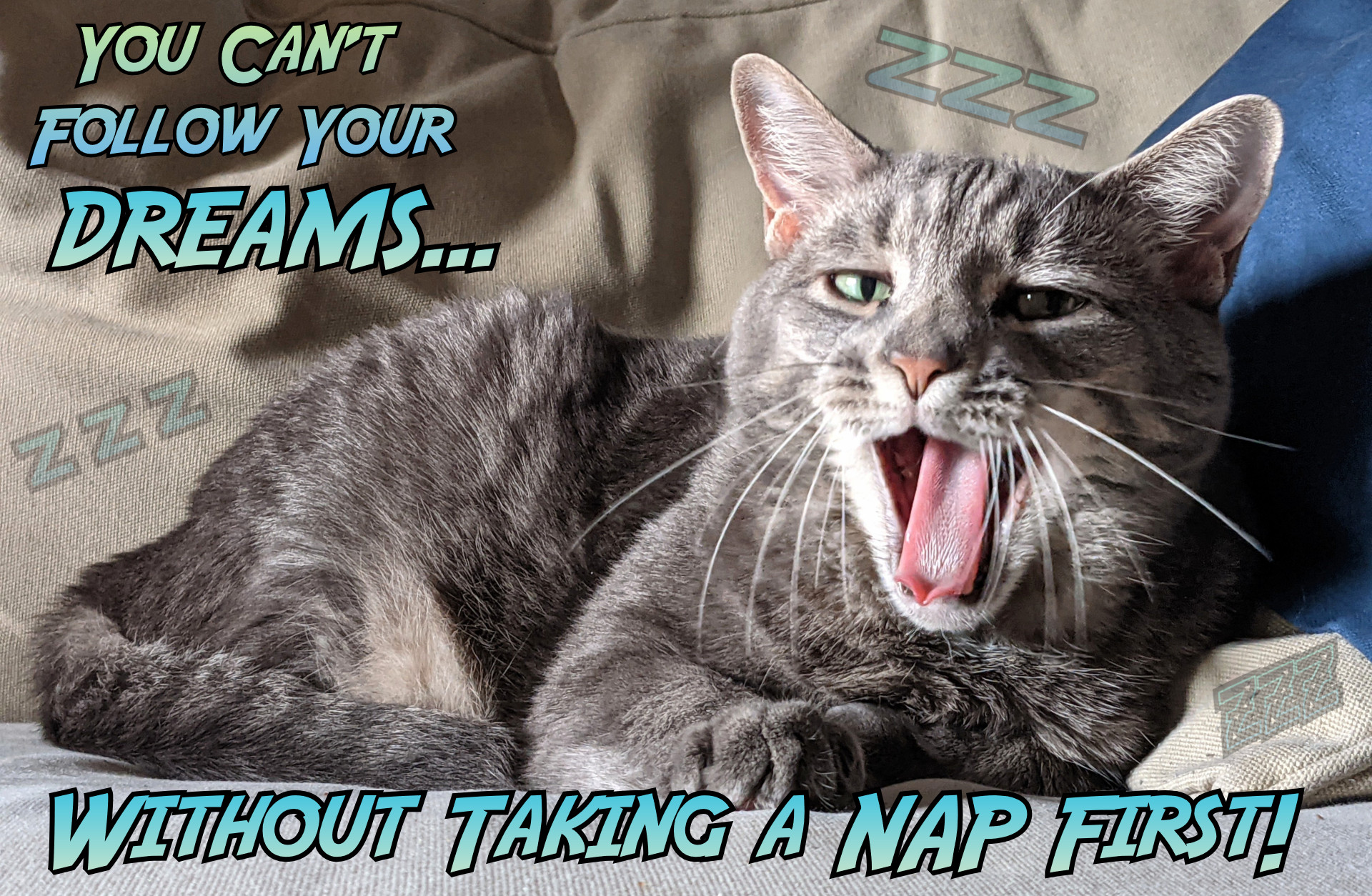
We’re often told to follow our dreams, but how many shareable quotes on social media actually tell us how to do so? It turns out there’s a critical step: To follow your dreams, you need to have dreams first! This is where Buddy sagely instructs us to begin, surrendering to sweet slumber so our unconscious can tell us what we really want:

buddy_napquote3
An important and common sense bit of wisdom from Bud.

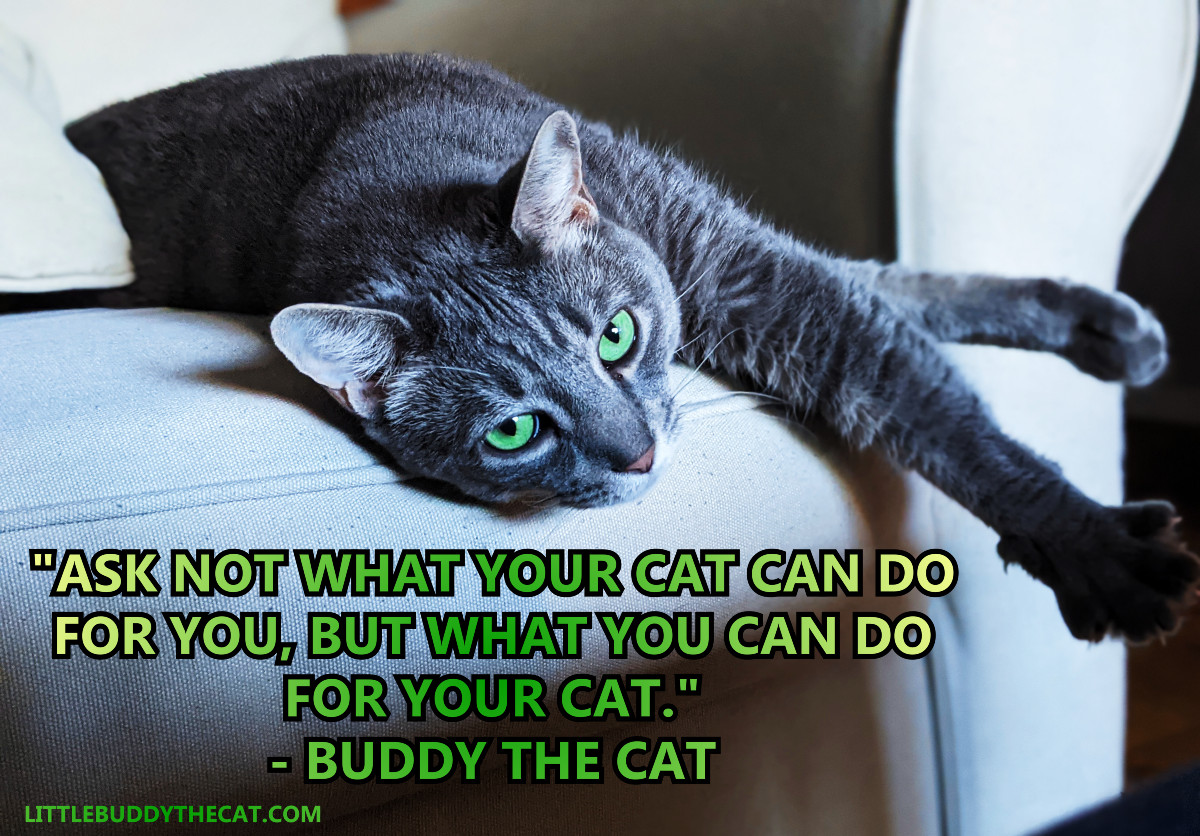
On Jan. 20, 1961, John F. Kennedy was inaugurated at 43 years old, making him the youngest president since Theodore Roosevelt — and the youngest elected president. (Roosevelt assumed the highest office after then-President William McKinley was assassinated in 1901.) While an impressive feat, it was Kennedy’s speech that continues to reverberate throughout history: “Ask not what your country can do for you,” the newly-sworn-in president told the nation. “Ask what you can do for your country.”

Those were simpler times, before we made the wise decision to politicize viruses, rip each other’s throats out over vaccines, and apprentice ourselves to intellectual giants like Tucker Carlson and Joy Ann Reid, tuning in nightly to drink of their limitless sagacity as they educate us on how to cherry pick facts that support our respective world views and ignore everything that contradicts them.

Still, there are lessons to be learned from those innocent times, and Buddy has repurposed Kennedy’s quote to give it a deeper, more profound (and useful) meaning:

buddy_asknot
JFK has nothing on Buddy.

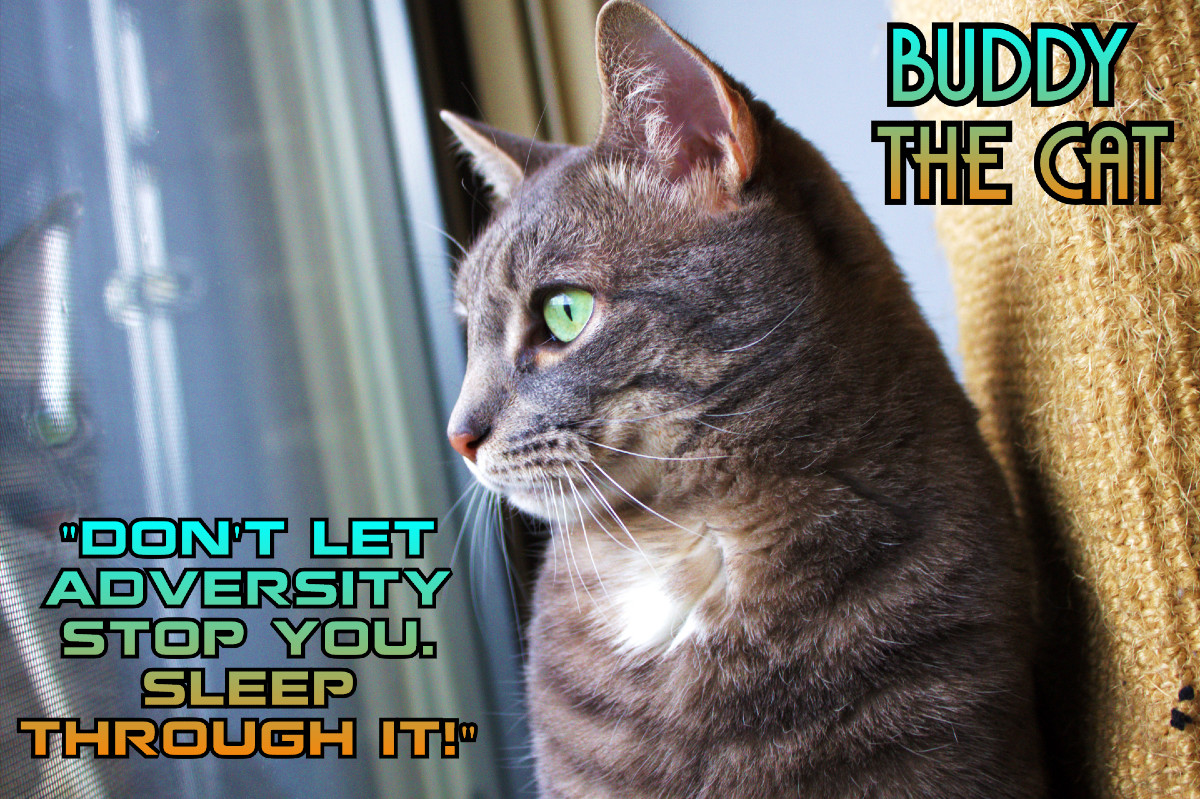
For our final bit of Buddesian wisdom, we return to the solution to so many of life’s problems: Sleep.

Why confront adversity when you can just take a nap? In this quote, Buddy advises the path of least resistance, a crucial strategy for anyone who finds themselves dealing with stress or anxiety:

buddy_adversityquote
Sink to meet the challenges of life!