Wilford will have to slim down before moving to his forever home.
It seems like a new super chonk cat goes viral everyday, and it’s always the same story — the cat comes from a home where its owner is either negligent or unable to properly care for kitty, and a rescue is left with the dual responsibility of finding a new home and getting the cat to slim down.
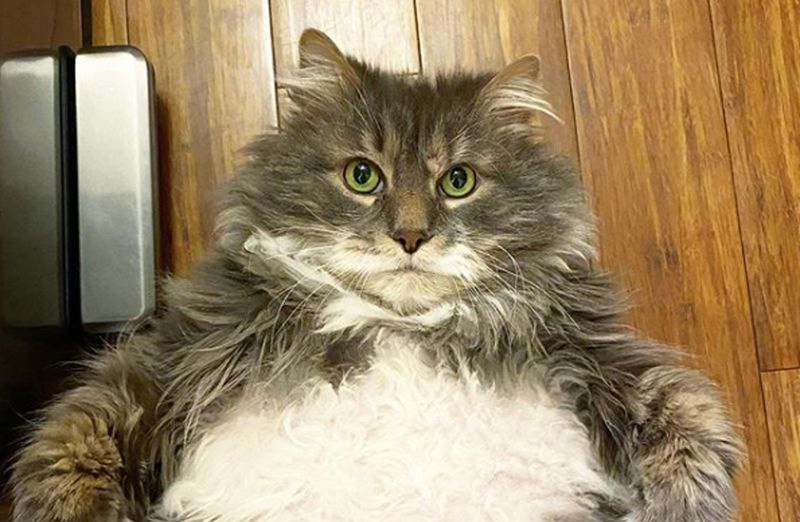
That’s the case with Wilford, a handsome eight-year-old tabby who weighs in at a hefty 28 pounds.
Wilford is living with a D.C.-area foster couple, who have the long-haired dude on a diet and are trying to get him to exercise. They say his ideal weight is about 14 pounds, half of what he weighs now.
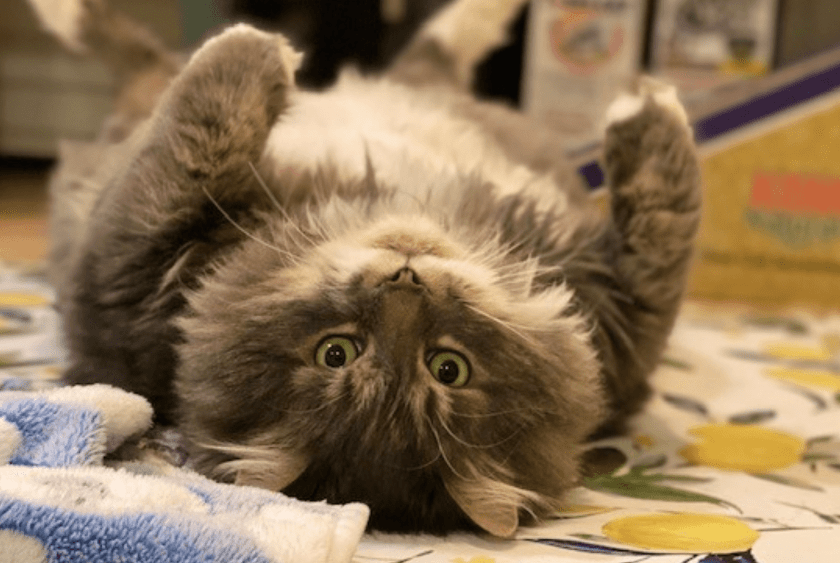
But as the video below illustrates, Wilford is so heavy, “playing” for him means laying on his back and doing “crunches” while batting at his wand toys instead of chasing them:
“Wilford absolutely loves to play- but he only feels comfortable doing so while safely ensconced beneath the dining room table,” his foster humans wrote on Instagram. “Kind of like preferring to work out at home instead of at the gym!”
In a bit of TMI, they say Wilford’s dropped some weight and is ready to start the process of screening for a forever home, but they’re still concerned over his sluggish ways and his “irregular vowel movements.”
Read: If you’re looking to adopt this regal little guy, you shouldn’t be the type who’s squeamish about blown-up litter boxes.
While handling Wilford feels like “picking up a greasy watermelon when you have to move him from place to place,” foster parent Jen tells DCist, “he is an absolute delight and we are so grateful to have the opportunity to spend time with him.”
Wilford’s favorite position is laying on his back, and unlike most cats, he actually likes it when humans scratch his belly.
“I mean, he’s just absolutely adorable,” Jen said. “He’s very dramatic, and when he wants something, he’ll roll over and just squeak. And you’re basically like, ‘Alright, Wilford, I’ll give you another tummy rub.’”
Chinese authorities threaten pets as Coronavirus fears grow.
It shouldn’t come as a surprise that a government with no respect for any kind of life — human or animal — would threaten the mass extermination of cats and dogs.
It’s par for the course in China, where authorities in dozens of cities and provinces are urging people to “deal with” their pets in the wake of the Coronavirus threat — or the government will, media reports say.
The warnings have been issued in Wuhan, the epicenter of the Coronavirus, as well as Shanxi, Beijing, Tianjin, Shandong, Hebei and Shanghai, according to the Humane Society International.
Yet there’s no evidence the virus has been transmitted by domesticated pets like cats and dogs, and no evidence those animals can catch it from humans, experts say.
In Wuhan, residents have been told to keep their pets indoors, and warned that any cats or dogs spotted outdoors will be “killed and buried on the spot,” the UK’s Metro reported.
But experts say it’s the government’s fault that the virus jumped from wild animals to humans in the first place. China has refused to shut down so-called “wet markets,” where live animals are sold next to the carcasses of recently-slaughtered animals, despite the fact that SARS and other viruses originated from those markets.
A Chinese wet market. Credit: Nikkei
Officials believe the Coronavirus originated at the Huanan Wholesale Seafood Market, one of many “wet markets” described as “filthy, crowded places where animals are displayed alive in small cages” and “are often slaughtered on site.”
China has been “mired in long-held beliefs about the benefits of eating exotic and often endangered animals for good health,” the Humane Society said in a statement, referring to traditional Chinese “medicine” and other folk practices that use animal parts in ineffective and dangerous tonics and elixirs.
In addition to creating the circumstances for viruses to jump from wild animals to humans, the illegal wildlife trade has pushed animals like tigers and pangolins to the brink of extinction.
“Chinese society is boiling with anger at wildlife policy failures,” said the Humane Society International’s China policy specialist, Peter Li. “Social media is full of posts condemning the refusal to shut down the wildlife markets. This is the worst Chinese New Year in China’s recent history.”
His previous owner had dementia and kept feeding him, and feeding him…
Meet Bazooka.
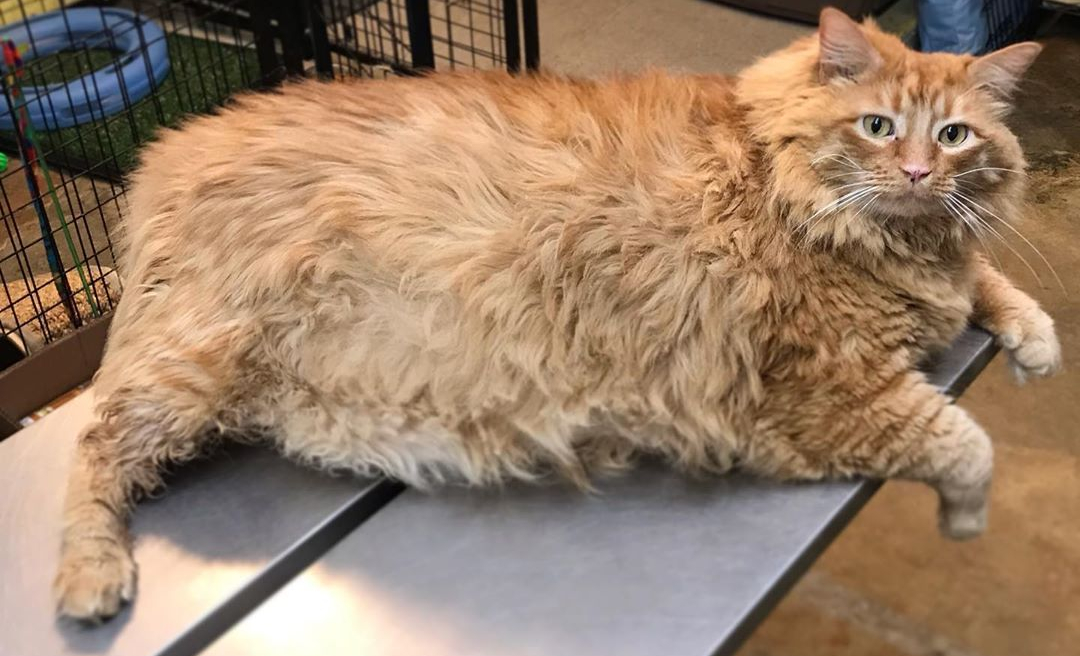
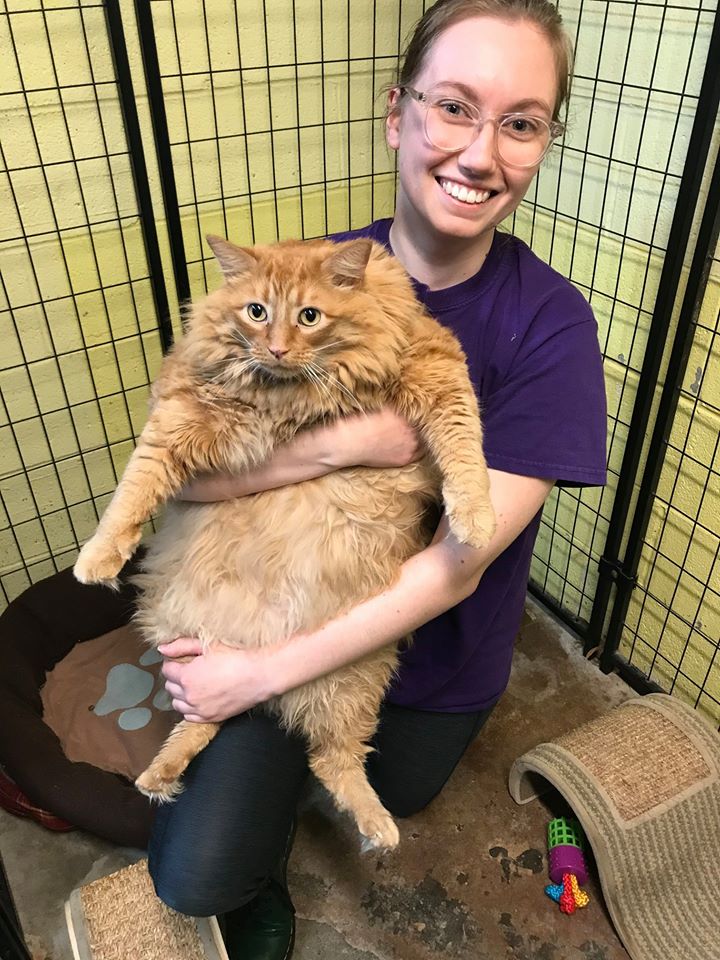
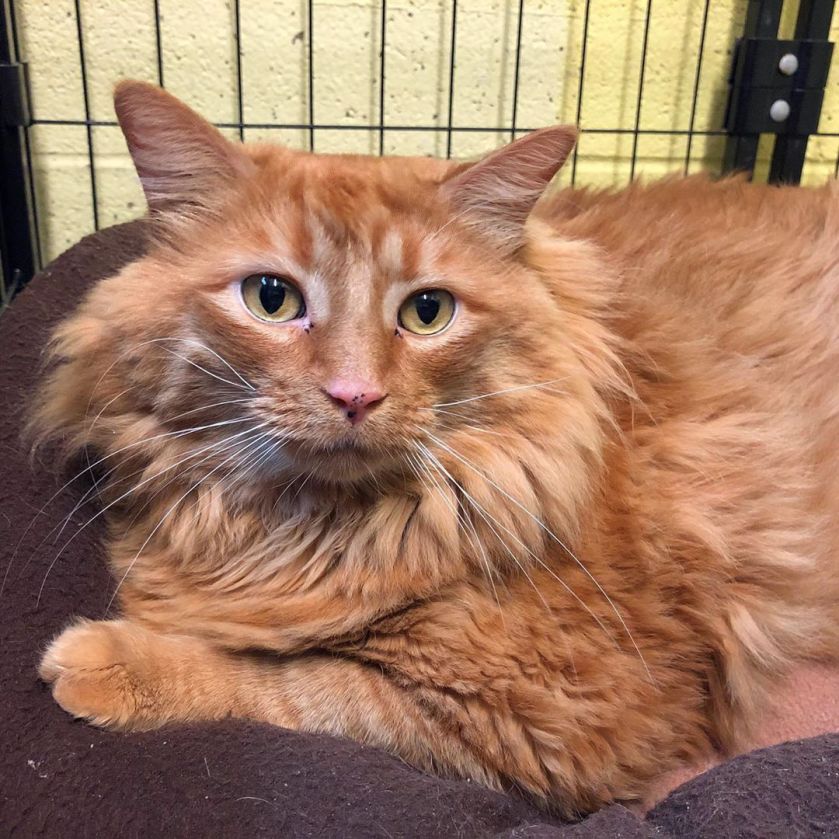
The orange butterball weighs in at 35 pounds and was surrendered to the SPCA in North Carolina’s Wake County this week after his former owner died.
Although the shelter says some people were initially outraged that a person would let the ginger tabby grow to such elephantine proportions, it turns out there’s more to the story: Bazooka’s owner was inflicted with dementia and, never sure if he’d fed the amiable cat, he just kept feeding and feeding — and feeding — Bazooka, who has apparently never met a cup of kibble or a can of tuna he won’t happily scarf down.
We wouldn’t be surprised if there was some insistent meowing prompting his late human to keep refilling those bowls.
“[Bazooka’s owner] thought he was doing the best thing for his cat by feeding him,” the SPCA’s Darci VanderSlik told North Carolina’s News-Observer. “We need to look on this with a compassionate view. He was loved.”
It turns out Bazooka is a loving and chill dude as well.
“He wants to be around people,” said Michelle Barry, the big guy’s foster mom. “He’s happiest lying right next to you. And he’s more active than I expected him to be.”
He’s in for quite an adjustment period, going from a life of on-demand meals to a strictly-regulated diet designed to get him down to a healthy weight. As any cat servant knows, there’ll be lots of agitated meowing in his future.
The ‘Zookster has already been adopted and will soon move into his forever home after the shelter provides some basic veterinary care and draws up a weight loss plan for him. Working with his new human, staff at the SPCA want to get Bazooka down to 20 pounds or so, which they feel is appropriate for his large frame.
They say they’re just glad to help.
“We don’t know a lot of the back stories of the animals we get, but we try not to judge people or make people feel bad about the circumstances that led to their surrender,” VanderSlik said. “We’re really lucky to have the resources to take him in and help him get a home he deserves.”
Bazooka’s a handsome kitty with a lion-like mane. In this photo, he’s thinking about pastrami sandwiches. Credit: Wake County NC SPACA
The chonktacular Barsik has shed almost a fifth of his body weight since he began a veterinarian-supervised diet earlier this year.
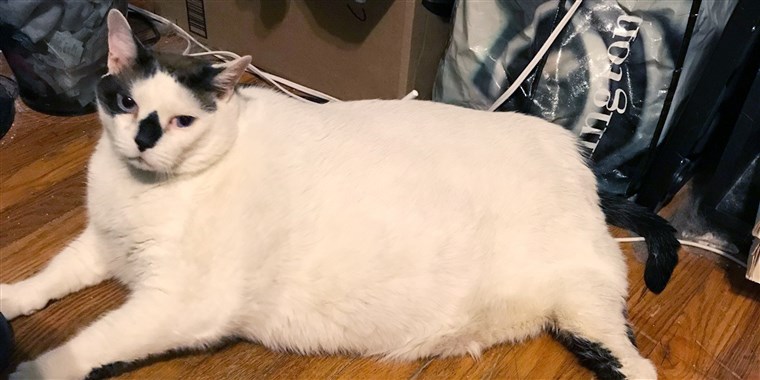
Barsik the cat made headlines about five months ago when he was surrendered to a Manhattan animal shelter at a whopping 41 pounds.
The five-year-old was kept in the shelter’s office because he couldn’t comfortably fit into a standard cat cage, and a regular carrier couldn’t contain him either so he was carted in a stroller, according to the New York Post.
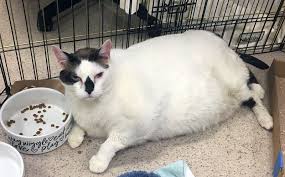
An unamused-looking Barsik sits next to an empty food bowl.
To add insult to injury, when staffers at the shelter wheeled Barsik inside, an amused visitor dug out her cell phone, laughed as she snapped a few photos and asked: “Did he eat another cat?”
Barsik has come a long way since that depressing day.
The big guy has been in the foster care of Angelique Iuzzolino of New York’s Anjellicle Cats, and he’s been steadily dropping weight.
Barsik weighs 34.9 33.3 pounds, according to Iuzzolino, who has been posting updates on Barsik’s Instagram. He’s still extra chonk, but he’s no longer in danger of matching the 46-pound Guinness record for a cat. Most importantly, he’s making progress.
He certainly looks a lot happier than he did when he was abandoned by his former people:
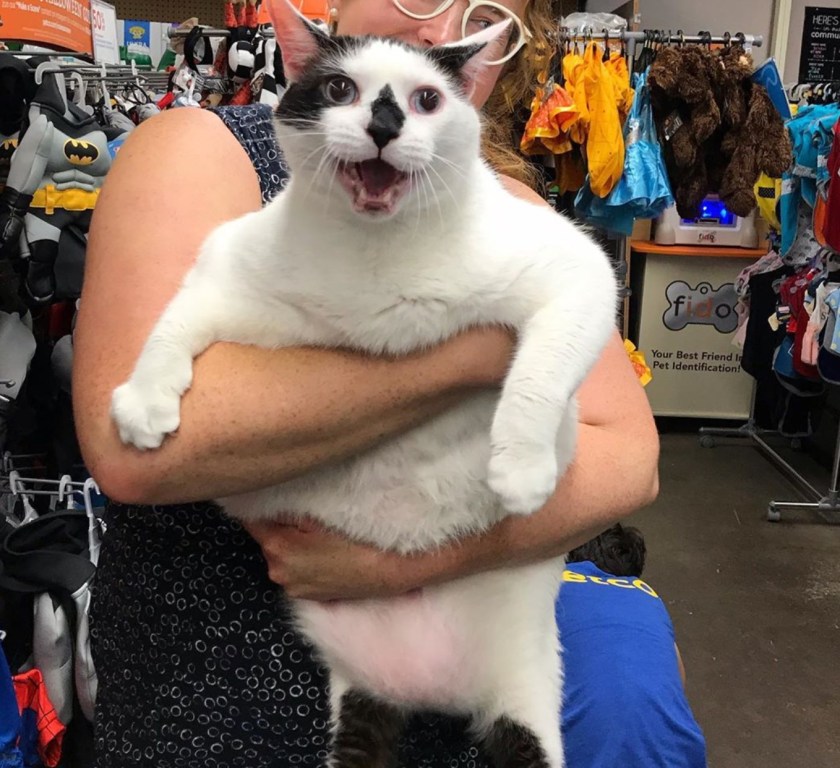
Barsik has dropped about 19 percent of his body weight.Barsik is on a veterinarian-supervised diet.
Barsik will be up for adoption, but if you’re interested in the big guy you’ll have to wait. He’s got a few more pounds to lose before he goes to his forever home.
UPDATE: Barsik is now up for adoption! Prospective servants have until Nov. 10 to fill out an application.
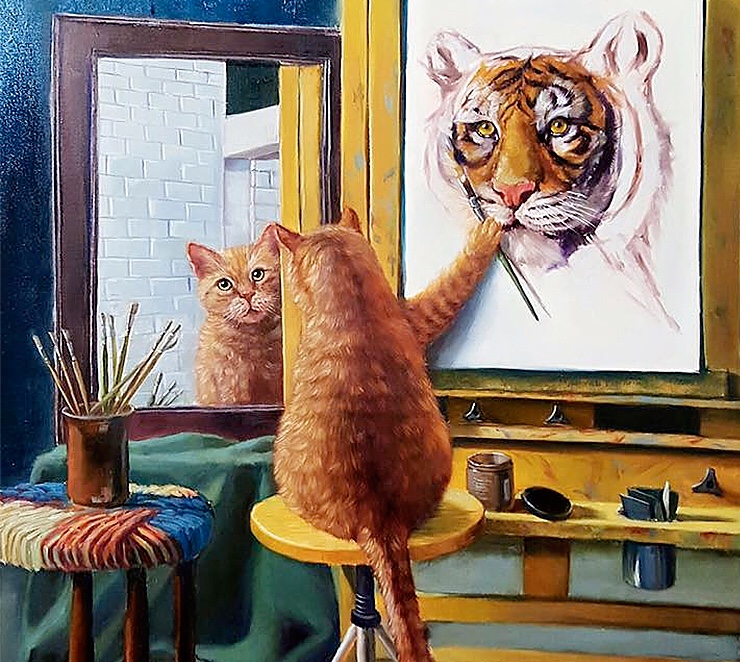
The traditional mirror test might fall short when it comes to determining the self-awareness of cats and other animals.
The mirror test has been the de facto gauge of animal self-awareness since it was invented in 1970 by psychologist Gordon Gallup Jr., mostly because no one’s figured out a better way to determine if animals understand who they are.
The procedure is simple: When the animal is asleep or sedated researchers will add a smudge of red paint, a sticker or some other visible mark on the animal’s face. Then they place a mirror nearby.
If the animal wakes up, looks in the mirror and tries to probe or wipe away the new mark, it passes the self-awareness test. It means the animal understands the image in the mirror is a reflection of itself and not another animal, according to researchers.
The list of animals who have passed the self-awareness test is quite short: It includes great apes like orangutans, bonobos and chimpanzees, as well as elephants, dolphins, orcas and crows.
Cats, who are notoriously difficult to work with in controlled studies, have never passed the mirror test. Dubbed “the world’s most uncooperative research subject,” cats are a challenge even for the most seasoned animal cognition experts.
“I can assure you it’s easier to work with fish than cats,” one scientist told Slate magazine. “It’s incredible.”
It’s not clear if cats don’t recognize themselves or simply can’t be bothered. Indeed, one of the primary criticisms of the mirror test is that, like most measures of animal cognition, it employs a human perspective to gauge non-human intelligence. It assumes that animals use vision as their primary source of information, as humans do, and it assumes that animals will be immediately driven to touch or remove an unfamiliar mark.
Buddy has a long and tumultuous history with mirrors. As a tiny kitten he once pulled down a thick, heavy wood-framed mirror from a wall, smashing the glass on impact. Thankfully he avoided injury.
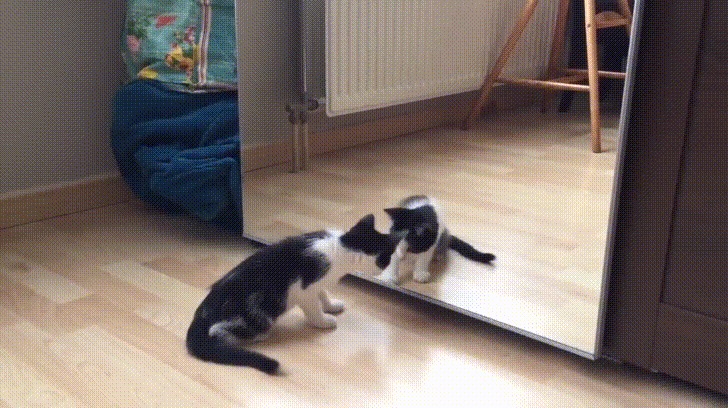
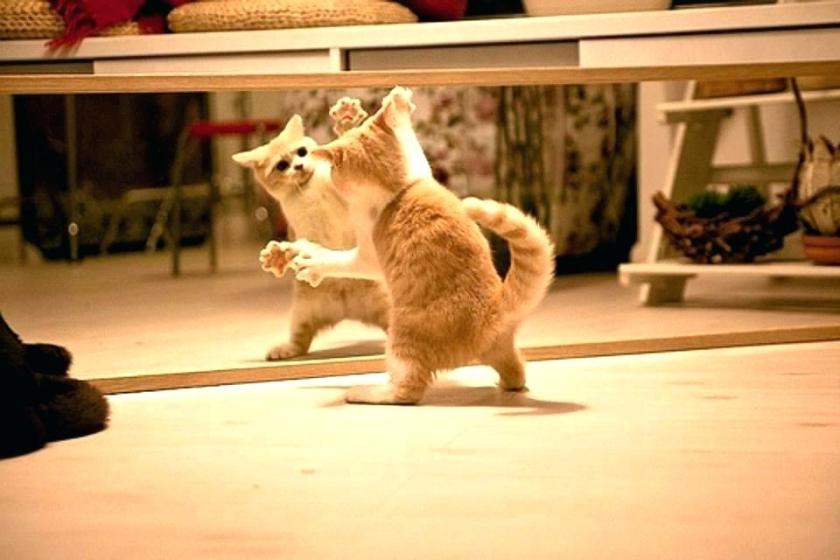
As he got older, Buddy graduated to his boxing phase: He’d stand in front of a mirror, put his weight on his back legs and “box” the Buddy in the mirror with a series of quick jabs. Even from another room I knew instantly when he was boxing his reflection thanks to his high-pitched trills and the THWAP-THWAP-THWAP!! of his little paws against the glass.
The boxing phase eventually gave way to the narcissism phase, when Buddy would park himself in front of the mirror and stare at his reflection, occasionally raising a paw to the glass or waving at himself.
Was this evidence of self-awareness? Did little Bud now realize he was staring at his own reflection? After all, even humans don’t pass the mirror test until they’re two years old, so it’s entirely possible a cat can come to understand what it’s seeing in the mirror just like kids can.
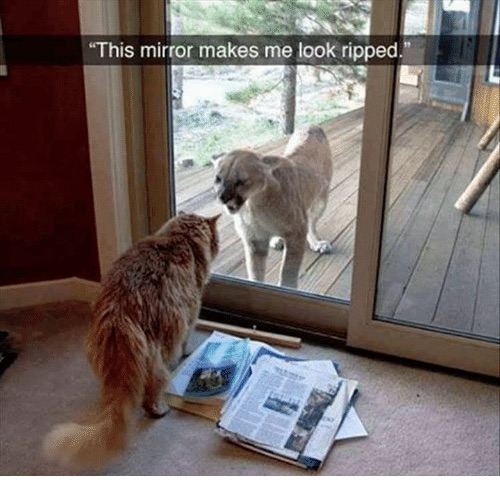
So ripped.
Then one day I was shaving with the bathroom door open when Buddy padded up behind me and meowed to get my attention. Instead of turning to face him, I kept shaving, locked eyes with him in the mirror and gave him a slow-blink of recognition. He blinked back.
Finally, yesterday the roles were reversed: Buddy was sitting in front of the mirror while I was reading a few feet away.
“Hi, Bud!” I said, putting my tablet down.
Buddy, still staring into the mirror, met my gaze and blinked at me. Then in a moment that might have been confusion or dawning comprehension, he turned from the mirror-me to the real me, then turned back to the mirror. He blinked at me again.
Is that evidence of self-awareness? If Buddy still thought that the images in the mirror were different animals, wouldn’t he freak out upon realizing there are now two Big Buddies? Or would he meow with joy at the serendipitous development of a second Big Buddy to do his bidding?
He didn’t do any of those things. He took it in stride and reacted to mirror-me the same way he always reacts to regular me.
Skeptics will say this little anecdote proves nothing. It is, after all, just an anecdote, and it’s a far cry from a well-designed, controlled study with a few dozen feline participants.
That’s all true. But maybe we’re onto something here. Maybe instead of the traditional mirror test, which cats don’t seem to be interested in, a new mirror test could gauge how cats react to their owners as seen in a mirror.
Cats are never satisfied with doing things the “normal” way. Why should the mirror test be any different?



 Pain In The Bud