The plan would allow bodega owners to certify their cats, eliminate city fines for keeping them, and help find homes for working felines if their stores shut down
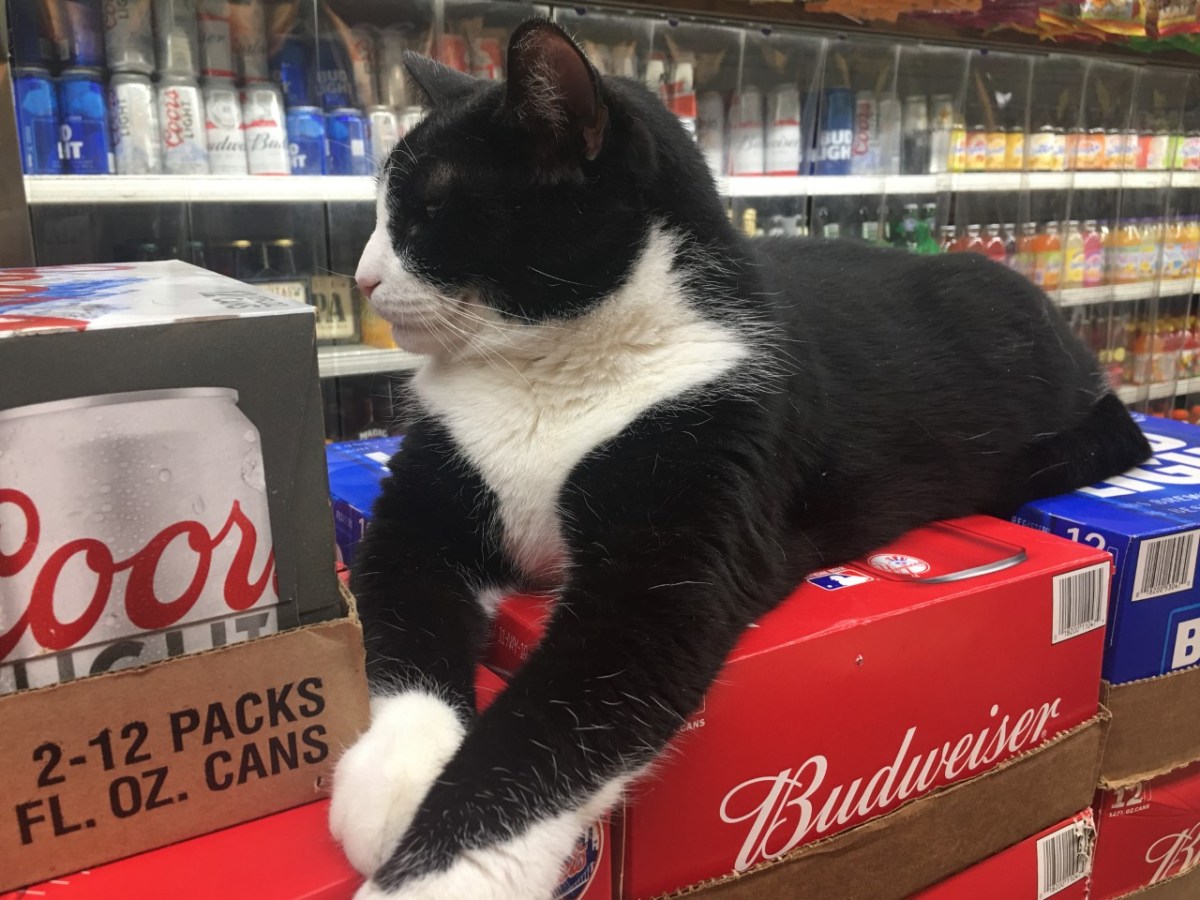
Cats have been a fixture in New York City’s bodegas for decades, but technically they’re illegal.
The fact that they’re so widespread, and owners of the small groceries/delis don’t try to hide them, underscores the absurdity of the situation. The fine for keeping a cat in a bodega in New York is $200 for the first offense, capping out at $300, but the fine for a rodent infestation starts at $300 and can rise to as much as $2,000 for repeat offenses. That’s in addition to the cost of bringing in pest control to get rid of the rats, which can easily add hundreds or more to an expensive problem.
So given the option between a maximum $300 fine with a clean, rodent-free shop, and potentially crippling fines — plus infestation — for rodents, thousands of bodega owners opt for the former. It’s a no-brainer.
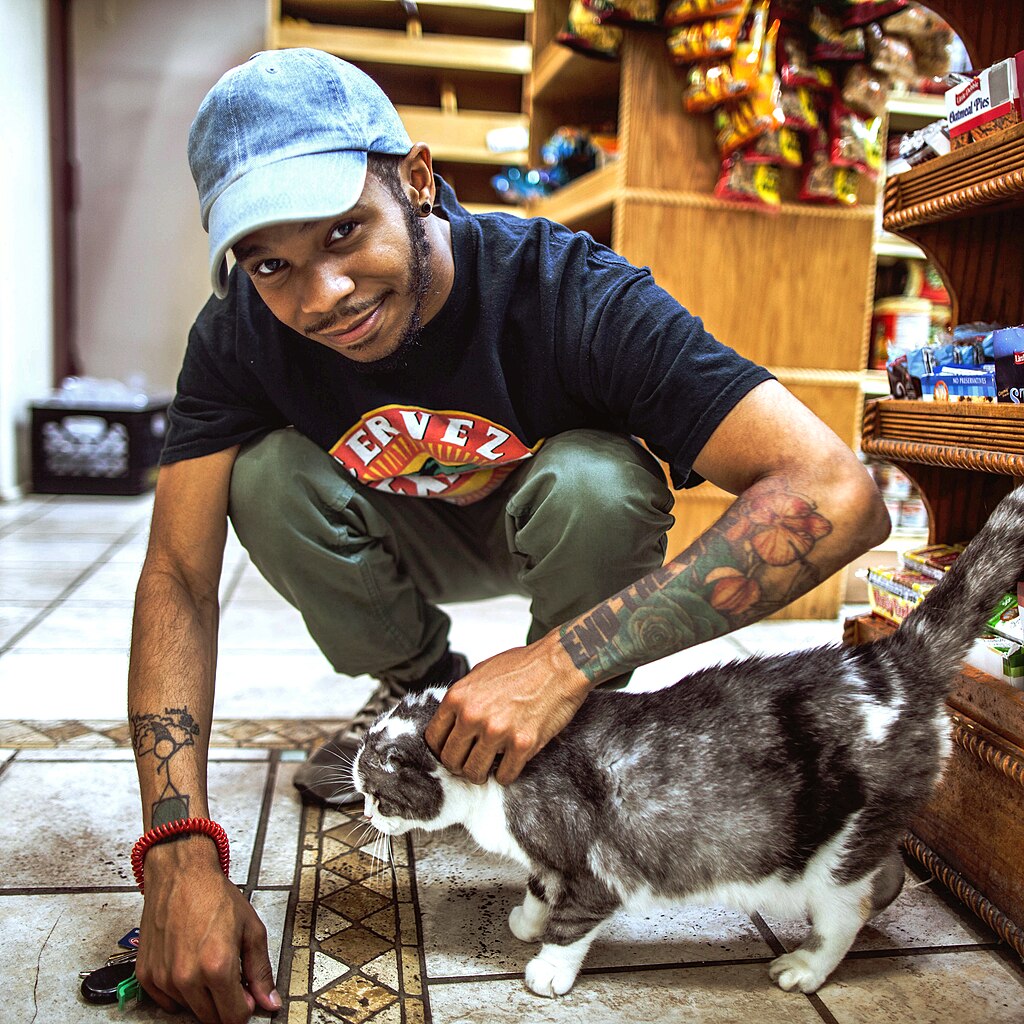
Kota, a bodega cat from Brooklyn. Credit: Wikimedia Commons
The cats are also favorites of customers, and bodega owners don’t hesitate to talk to media when their cats go missing, nor do they turn down Dan Rimada, who runs the extremely popular @bodegacatsofnewyork Instagram page.
Now Rimada is the man behind a petition that seeks to eliminate fines for the store-dwelling felines, establish a voluntary shop cat certification, and help bodega owners get veterinary care for their little helpers.
Rimada proposes soliciting seed money from city government as well as deep-pocketed donors in the pet food industry — “think Purina, Chewy, PetCo” — to establish a veterinary care fund for the city’s working cats.
“Through years of hands-on experience, I’ve witnessed both the charm of well-cared-for bodega cats and the harsh reality of neglect when standards aren’t met,” Rimada wrote in the petition, which has almost 5,000 signatures as of Feb. 28. “In conversations with rescue organizations and experts in public policy, business, and technology, we’ve designed a realistic, community-driven solution.”
Credit: @bodegacats_/Twitter
The fund would help cover the costs of care, with additional “micro-loans” available for emergencies.
Rimada envisions it as a triple win for the shop owners, rescuers who will be compensated for their time, and most importantly, the cats. If city leaders are willing to engage, Rimada says he hopes to conduct a year-long pilot program to see what works and what would need tweaks, with input from rescuers, veterinarians and the people who care for the cats.
The petition and resulting plan was inspired by cases like that of Kobe, a Hell’s Kitchen bodega cat who almost died of a urinary infection when the owners of the bodega balked at paying veterinary bills.
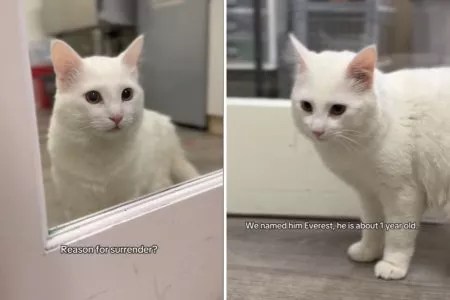
A woman surrendered a cat she’s had since kittenhood. Her reason? He sheds.
The moment Everest the cat was unceremoniously dumped at an Atlanta animal shelter, he freaked out.
The little guy had just lost the only home he’d ever known, his home since kittenhood, and the woman who agreed to be his caretaker for life simply ditched him with a curt “I don’t want this cat.”
No sentiment. No apologies. Just annoyance that Everest, a white cat, was apparently shedding too much for her liking.
Everest the Cat. Credit: FurKids Midtown Atlanta
Shelter employees realized a short time later that the woman had never taken Everest to a veterinarian, had never gotten him shots or had him neutered. Now they’re tasked with rehabilitating a very scared, confused little guy who doesn’t understand why he’s been abandoned.
“We also think he may be deaf but need to conduct tests,” the manager of Furkids Midtown Atlanta Center said in a post on TikTok. “If he is deaf, it’s even more heartbreaking. We don’t think his original owner knew he was deaf, she didn’t seem to care when she surrendered him – she walked in saying, ‘I don’t want this cat.'”
“Karen With A Cat Demanding To See The Manager,” oil on canvas by Buddy the Cat, aka an AI image of what I imagine Everest’s negligent owner looks like. And yes, I used Theresa Caputo in the prompt!
The upside is that the shelter is taking Everest’s health seriously, and they’ll have him neutered and nursed back to health before adopting him out. They’ll also make sure he goes to a home where he gets the love and respect he deserves as a sentient animal with feelings.
Staff at the shelter said they’re determined “to find him the best home. He deserves so much more than the life he’s lived so far.”
“He’s still a little scared,” the shelter manager said. “He is processing what’s happened since now he’s in a shelter where there’s a lot of noises and people.”
This incident, and many others like it, are precisely the reason we need databases listing people who are abusive or negligent to their pets, so they can’t ruin more innocent lives by abandoning cats and dogs when they simply tire of them, or decide they don’t like the fact that they behave precisely the way they’re supposed to as members of their respective species.
It should be done in a way that shelters and rescues in every state can access the database, and contributions should be limited to them as well, with shelters signing their names to the entries. That would prevent people from abusing the list for malicious purposes and ensure that abusive and negligent pet owners can’t simply go to another county or state to evade bans.
“I don’t like Karens.” – Buddy the Cat, The Book of Buddesian Wisdom
Every time I read about a case of cat abuse or an incident like this, I think of Bud and what his life could have been like if he was adopted by someone who didn’t appreciate him. His curiosity, boldness and fire would have been snuffed out, and he would not have been given the love he deserves. Likewise, he would have been deprived of giving back love, and he has a lot to give.
All cats are little buddies, and they all deserve people who love and care for them.
When I ran this by Buddy himself, he agreed.
“That’s right, human,” he said. “Now fetch me a snack!”
The more bunk studies claim cats are driving wildlife to extinction, the more people in media and government call for extreme measures to contain them.
Seventy nine cats.
That’s how many felines stood in for the entirely of the UK in a 2022 study, which is the genesis for the claim that cats kill 270 million birds and small animals in that country.
Using GPS collars, owner questionnaires and samples of prey brought home by those 79 outdoor cats, a research team from the University of Reading applied data from a mix of studies dating as far back as 23 years ago, extrapolated and massaged numbers using things like “kernel density estimates” and “generalized mixed models,” and came up with that 270 million figure, which is cited routinely and credulously by UK media.
Actually, their estimate was between 140 and 270 million. An earlier study put the number at 92 million, and a 2016 study estimated UK cats kill 55 million birds and small animals. That’s a range of 215 million!
The Reading team even quotes the infamous US meta-analysis that claims domestic cats kill as many as 4 billion birds and 22.3 billion mammals a year here. That paper, as skeptics in the science community have noted, has virtually no relationship with reality, involves no original research, and relies on data from unrelated studies and surveys in which cat owners were asked to rate their pets’ hunting prowess on a point scale while imagining what the little ones get up to when they’re outside.
All of this is to say that aside from the thorough, labor-intensive and expensive D.C. Cat Count, which brought together cat lovers, birders and scientists to work cooperatively, the 2022 UK study and its counterparts in the US and Australia are exercises in pushing an agenda masquerading as honest academic research.
That’s how we get editorials like The Spectator’s “We need a cat lockdown now” by Zoe Strimpel. Though the tone isn’t tongue in cheek, I can’t imagine Strimpel dislikes cats nearly as much as she claims, and the post was probably written with wry anticipation for the click-generating fury of cat lovers indignantly sharing it on Facebook and X.
Still, it quotes the Reading study without skepticism and portrays cats as furry little wretches who abuse their human caretakers with their claws and their disdain while gleefully eating their way through endangered birds.
A cat stares down a mouse. Credit: Wikimedia Commons
Cats are predators, that much we can agree on, and outdoor cats are much more likely to negatively impact local wildlife, for obvious reasons.
Likewise, I can understand the concern with cat culture in the UK, where allowing pet cats to roam outside is the norm.
But every time the media cites the above-mentioned studies, more people are given an inaccurate impression of feline ecological impact, and more lawmakers at the local and national level consider “solutions” ranging from prohibiting people from keeping pet cats, as a government commission in Scotland recently proposed, or exterminating them outright, as some Australian states and municipalities in New Zealand have tried to do.
It’s worth pointing out that there is no data, not even a single study, showing that air-dropping poisoned sausages or arbitrarily shooting cats actually has any positive impact on birds and small mammals. All it does is terrorize sentient, intelligent domestic animals who have real emotions and experience real fear and pain.
The primary drivers of declining bird and small mammal populations — including habitat loss, environmental destruction, wind turbines and glass buildings — have nothing to do with cats. We have killed off 73 percent of the planet’s wildlife since 1970 and every species of iconic megafauna — from orangutans and gorillas to tigers and pangolins — is headed toward extinction. Are domestic cats responsible for that too, or can we be adults and fess up to our role as the main antagonist here?
An orange tabby and a mouse. Credit: Wikimedia Commons
Strimpel actually goes even further, claiming cats don’t have real affection for their caretakers and are more like psychopaths, faking love because it gets them what they want, primarily food and shelter.
Dogs have true affection for their humans but cats do not, she additionally claims, while adding that cat people are undateable because they share qualities with the “loutish and numerous creatures” they care for.
There was a time when I would have been ambivalent about Strimpel’s attitude toward cats, if not her cavalier treatment of basic facts. But then a drool-happy, friendly tuxedo cat showed me I could interact with his species without my allergies going haywire, and a tiny gray tabby kitten became my animal cognition teacher while blindsiding me with love.
Now every time I hear about some psychopath abusing cats, or terribly misguided politicians advocating a plan to kill millions of domestic felines, I think about my Bud. I think about how he cries for his Big Buddy when he’s hurt or stuck, how he meows and trills with excitement when he experiences something new, and how he began shaking, then threw up from overwhelming relief and happiness the first time I returned from a vacation after adopting him.
Buddy the Cat chillin’ on the balcony in the summer. Credit: PITB
He’s got a vibrant mind in his little head, with strong opinions and emotions. So does every cat on the street, in a shelter cage, and in the cross hairs of a birder or biologist playing God by “culling” or “harvesting” cats to protect another species.
Real science, not activism packaged as science, has proven that many times over in recent years. If people want to do harm to cats because they think birds and other animals will benefit, the burden of proof is on them to show not only that their methods work, but that the results could somehow justify the fear and misery they would inflict on innocent animals to achieve their goals.
Cats are obligate carnivores who don’t have a choice. We do.
The bishop of Little Rock called the allegations “disturbing” and said Thessing would not serve his two home parishes while the criminal case plays out.
An Arkansas priest was suspended by his diocese this week, one day after police found dead cats during a search of his home.
Charles Thessing, a 63-year-old “senior priest” and pastor at St. Michael Church in West Memphis and Sacred Heart Church in nearby Crawfordsville, was charged with two felonies on Tuesday. Police, working from information provided by a tipster, found a pair of dead cats, a water tank where Thessing allegedly drowned the felines, and animal traps, according to the West Memphis Police Department.
The Rev. Charles Thessing. Credit: Diocese of Little Rock
The tipster initially contacted a shelter on Feb. 7 with the information, according to police.
“We were very fortunate that someone, a concerned citizen brought our attention to the situation and we addressed it immediately,” Kerry Facello, Director of West Memphis Animal Services, told local CBS affiliate WREG. “The West Memphis Police Department worked so fast in obtaining a search warrant and allowing us to investigate further and see exactly what was going on.”
In a letter to parishioners at St. Michael and Sacred Heart, Diocese of Little Rock Bishop Anthony Taylor confirmed the arrest, adding “the allegations are disturbing, and as your bishop I take them very seriously.”
“Having heard from numerous voices within the parish, the school, and the broader community; having consulted with others; and having given this matter much prayer and consideration, I have determined that Fr. Thessing cannot continue serving as an effective pastor for your parishes,” Taylor wrote.
Thessing also has supporters, Taylor noted, while asking for parishioners to pray for the priest.
Thessing’s mugshot. Credit: West Memphis Police Department
Thessing, who has not spoken publicly since his arrest, smiled in his mugshot, which was released by West Memphis police. Per the bishop, Thessing will not minister to his parishes or perform any of his regular duties while the case reaches a disposition. The bishop did not say what could happen if Thessing pleads to the charges or is found guilty.
Thessing has been a priest for 37 years, according to the diocese.
Police say their investigation is ongoing, and they’re asking anyone with more information about Thessing to contact them. Under Arkansas state law, aggravated cruelty to animals is defined as “knowingly torturing a dog, cat, or equine,” and is a felony.
If Thessing drowned the cats, as police allege, that would put him at odds with the church. Pope Francis has been particularly outspoken on animal welfare. He was born Jorge Mario Bergoglio, and chose Francis as his name for his papacy, after the Catholic patron saint of animals.
His 2015 encyclical, Laudato Si, was the church’s strongest and most unambiguous condemnation of human treatment of animals, including cruelty, factory farming, exploitation and pushing animals toward extinction with our behavior and our public policies.
In the encyclical, Pope Francis condemned “tyrannical anthropocentrism unconcerned for other creatures” and stated clearly that animal life has intrinsic value, rejecting the argument often used by literalists who claim that God, through Bible verses like Genesis 1:26, created animals and the Earth for our use, as if they’re merely tools or resources for the advancement of the human race.
“[N]owadays we must forcefully reject the notion that our being created in God’s image and given dominion over the earth justifies absolute domination over other creatures,” the pope wrote.
He also echoed psychological concerns about the mistreatment of animals as a strong indicator that a person will harm humans.
“We have only one heart,” Francis wrote, “and the same wretchedness which leads us to mistreat an animal will not be long in showing itself in our relationships with other people.”
The cat survived but her personality has radically changed from loving and affectionate to distant and wary, her human said.
A councilman in a rural UK village resigned from his post and is the subject of renewed police scrutiny after allegedly trying to blow up a neighbor’s cat twice in 2023.
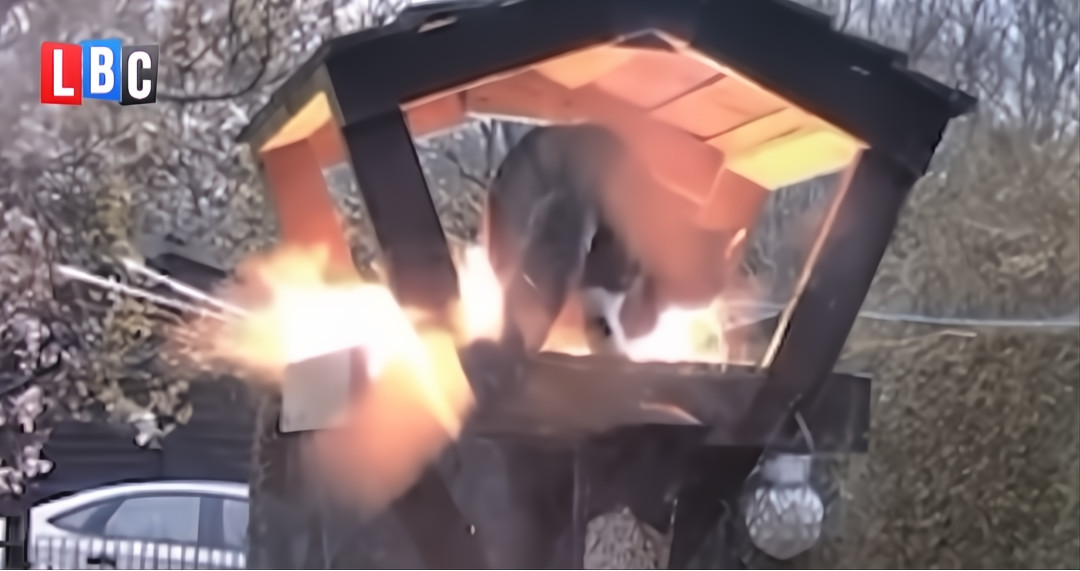
Councillor James Garnor was reportedly trying to stop the cat from climbing into a bird feeder, and decided the best way to do it was to rig the feeder with explosives and lure the curious feline in, according to a report on UK broadcaster LBC’s website.
Garnor was apparently so amused by his handiwork that he distributed video of the incidents to his friends. The footage shows a cat named Suki leaping onto the bird feeder on April 9, 2023, and nibbling on some of the bird feed before the explosive detonated. An injured Suki took off immediately and ran home.
She “came home one day missing her whiskers on her face – they looked like they’d been dissolved – so I put a post in my local community page on Facebook… just to warn people in case there was something she’d rolled in that had dissolved them,” said Suki’s human, a woman named Nikki.
Suki’s whiskers were singed off by the heat from the explosion. Image credit: Provided by owner to LBC News
“But somebody contacted me to tell me it wasn’t what I thought it was, that somebody had actually blown my cat up – and that it was my neighbour and local councillor. It made me feel physically sick.”
After she received the video, Nikki filed a complaint with local police, who elected not to arrest Garnor. However, after a second video surfaced with a clearer view of Garnor’s alleged actions, police responded to the public outcry and said they were reviewing the case again.
Per LBC, which broke the story:
“The incident is one of at least two occasions that cats in Whittlebury, Northamptonshire, were allegedly targeted by Councillor James Garnor in 2023 using remote-detonated explosives.”
It’s not clear if the new video shows a second attempt, or a different angle on the first. Garnor “was dealt with using anti-social behavior legislation,” a type of civil admonishment usually associated with things like noise complaints, littering and damaging public property, not trying to kill an animal.
Still images from a video showing Garnor allegedly setting off an explosion targeting Suki the cat. Credit: Photos provided by owner to LBC
Garnor resigned from his post on Feb. 7, and the council distanced itself from him, saying its members “understand the concerns raised by the community and want to assure everyone that we take all matters of animal welfare seriously.”
That hasn’t mollified people living in the small community, who are wondering why police didn’t press charges the first time they were presented with evidence of the attempt on Suki’s life.
“You can clearly see the videos have been slowed down [and] edited. It’s very set-up: the animal has been enticed on the bird table with food whilst said individual was sitting there with the detonator waiting for [the cat] to appear,” a neighbor told LBC. “He is a member of our parish council, so it makes you worry what decisions are being made there by the individual… he has offered no apology [and] shown no remorse.”
In the meantime, Suki has been permanently impacted by the incidents. The tabby was affectionate and friendly, Nikki said, wrapping her little body “like a scarf around your neck.”
“Now she very rarely comes near you, and if she does, she’s got her claws out – she hisses, she growls,” Nikki added. “She’s not the loving cat she used to be – and I don’t blame her… the change in her happened pretty much overnight.”










 Pain In The Bud