The famous “beckoning cat” traces its origins to feudal Japan, where a friendly cat was said to lead a weary lord and his men to refuge at a humble temple.
In a new article, National Geographic delves into the history of maneki neko — Japan’s famous “beckoning cat” — and how the image became ubiquitous in modern society.
Chances are you’ve seen maneki neko even if you don’t realize it. The iconic feline image has transcended its homeland and is common not only in China, Vietnam, Thailand and the rest of Asia, it’s also made its way to the US and Canada as well, earning a place in shops run by Japanese and westerners alike.
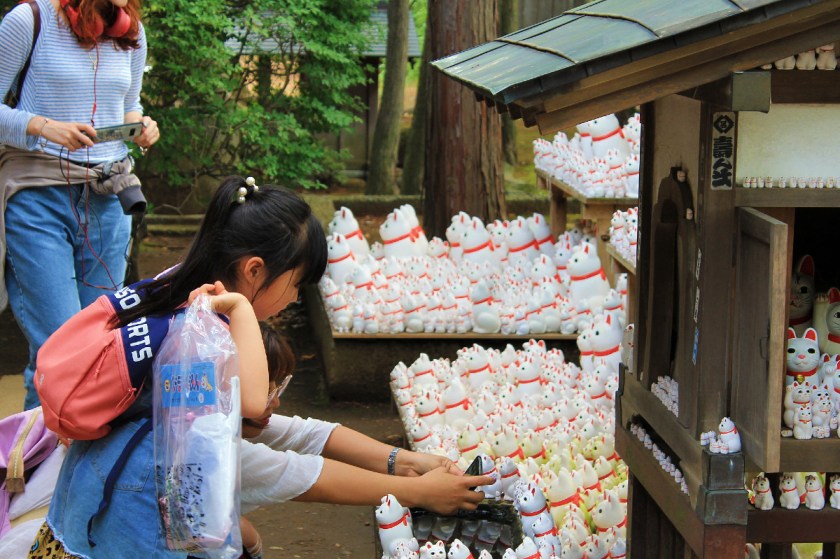
Visitors leave their own maneki neko statues at the shrine, often with personal messages asking for different blessings and written in black marker on the back of the statues. Credit: Pain In The Bud
There’s a reason for that: The waving cat not only represents luck and good fortune, it’s a welcoming gesture meant to attract customers. Maneki neko find a place in homes too, with different coat colors and patterns representing different positive attributes: A white cat is supposed to bring happiness, while a black cat wards off evil spirits and a calico is believed to bring luck in all its forms.
Maneki Neko statues at Setagaya shrine. Credit: PITB
As a cat lover I kept an eye out for the iconic statues during my time in Japan and, although I missed Buddy, I couldn’t leave without seeing where it all began: The cat shrine at Setagaya, a quiet Tokyo suburb where, according to legend, a feudal lord followed a beckoning cat by the roadside and found refuge from the elements in a humble shrine, where the temple monk invited them inside and gave a memorable sermon.
The feudal lord was so grateful for the hospitality, and for finding shelter to wait out a violent thunderstorm, that he vowed to become the temple’s patron. The grounds contain several temples today, as well as separate shrine areas for maneki neko left by visitors and wooden icons with hopeful messages written on them.
All images in this post are from my trip to Setagaya’s cat shrine in the summer of 2019. To see more, check out the post I wrote at the time from Tokyo.
Party time, the First Cat, filthy plagiarists and more!
We’re celebrating Buddy’s belated adoptaversary this weekend. I don’t know exactly when he was born, so we usually mark the occasion on the third weekend in April, which is when I brought Buddy home.
What better way to celebrate than with catnip, Buddy Biscuits treats and his beloved laser pointer?
It’s partay time! Nom nom!
Hilaria buys an Espanish cat, PETA doesn’t approve
Hilaria Baldwin, the indefatigable child collector, has added another little one to her family, but this time it’s a cat. As the San Jose Mercury News notes, as Hilaria “tries to move past her Spanish heritage scandal, she’s been flooding her Instagram with cute family photos from her busy ‘Baldwinito’ household.”
The new cat, Emilio Cookie Baldwin, is a Bengal purchased from a breeder who “specializes in producing pricey, exotic-looking hybrid cats that originate from crossing a domestic cat with an Asian leopard.” In an unusually mild rebuke (the Baldwinitos are donors to the charity), PETA issued a statement saying there’s “no doubt that [the Baldwins] didn’t realize what the impact of buying a cat from a breeder is” and that, “had they known, we’re sure that they would have gone to an animal shelter and adopted a cat who might otherwise die for the lack of a good home.”
No word yet on whether Emilio knows “how you say in English, cucumber.”
After announcing they were going to adopt a cat, the Bidens have been unusually coy about the who, what and when. Now Jill Biden says a female cat is “waiting in the wings” and will join the family soon. The arrival of the mystery cat will mark the first time since the George W. Bush administration that a cat has occupied the White House. Before India, the Bush family’s cat, there was the Clintons’ cat Socks, who became so famous the White House had a full-time staffer answering his fan mail. Socks even had his own video game in development, which was sadly unreleased but is available for download as abandonware for anyone who can’t get enough Socks.
Socks was a popular little fellow. Credit: The White House
Plagiarists and content thieves be warned
After I went searching for one of my old posts this week and found it had been plagiarized, a casual search turned up five (!) sites that have stolen my work, stripped it of credit, and posted it as their own content — and that was based on search strings from only three of my posts. Who knows how many others have been lifted?
Two of those posts were stolen by sites that copy the Bored Panda model of finding content on the internet and monetizing it. At least Bored Panda contacts the content owners, credits them and links back to them. These other guys just steal content from people like me, present it as their own and profit off of it.
Take a look around: This site does not have a single ad. I have no Patreon account and I don’t ask for donations. This site is a labor of love. At some point I probably will implement limited and tasteful ads, but in the meantime it’s kind of a slap in the face to find your own content has been stolen and has been used to make money for thieves.
So a fair warning to anyone else who might be tempted to steal content from PITB: I’ll go right to Google, file a DMCA and get your AdSense account suspended. I have zero tolerance for plagiarism and content-scraping. It’s no different than walking into a store, stealing products off the shelves and turning around to sell them. Worse, actually, since writers are rarely well-compensated. Fall back!
Starlin is a petite, friendly little cat who loves chasing the red dot, cuddling with her family and eating eggs.
Cat name: Starlin
Cat’s age: 10
Cat’s human servant: Barreleh from Cape May
Starlin’s origin story:
Starlin, aka The Star Baby, “began life in a friend’s backyard,” according to her human, Barreleh.
“At the time, I was a Philly PAWS (Philadelphia Animal Welfare Society) volunteer, and I was pretty sure I could get that tiny gray kitten into one of the PAWS shelters,” Barreleh recalled. “[I] lent my friend a humane trap, and told her to call me when the kitten was in it.”
Barreleh had barely left before she got the call and turned around.
“I returned to pick up the kitten, and took her into the room in my home where all foundlings spend their time until they’re ready to either be adopted out, or join the furmily,” she said. “As soon as I got her out of the carrier, she WIGGED OUT, and spent the next few weeks under the furniture. Every time I came in the room to feed her and do litter duty, the second she heard the door open, under the furniture she went.”
Barreleh knew only a gentle approach was going to cut it with the skittish kitten, so she sat on the other side of the closed door and began talking to Starlin in calming tones: “Sweet nothings, mostly,” she said.
Giving the scared little one some space paid off, as did the soft-spoken reassurances.
“I could hear her purring on the other side of the door,” Barreleh said.
A week later, Barreleh was at home when her husband called her upstairs. The previously fearful kitten was sitting on his lap. That’s when the couple decided to keep her and named her Starlin.
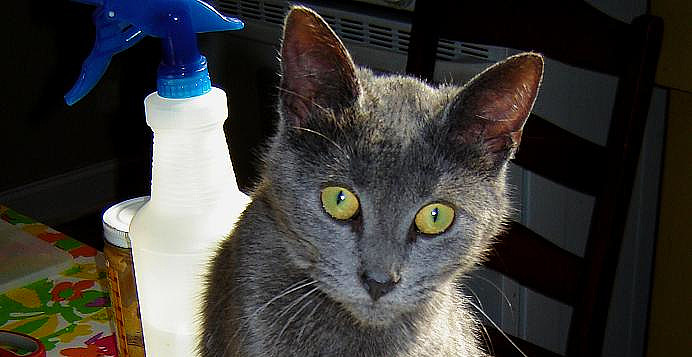
Starlin the cat. Credit: Barreleh
The tiny kitten grew up to be a petite cat, living in Philadelphia with her humans and her four feline siblings, including “The Looney Toon Brothers,” Ivy Spivington and Lucinda.
Five years ago, the family packed up and was ready to move to Cape May, New Jersey. They awoke early to corral the cats, believing the easygoing Starlin would be the easiest to handle. Things were going smooth, with the cats — “even the outdoor stray/feral cat I had been feeding, and couldn’t bear to leave behind” — getting into their carriers generally without complaint.
Not Starlin.
The next hour played out like a slapstick comedy, with Starlin leading Barreleh and her husband on a chase up and down the stairs and around the house.
“Finally one of us was able to grab her, kicking and howling like a banshee, and somehow got her into the cat carrier,” Barreleh said. “From there, there was not a peep out of her for the whole 2-hour trip. When she finally exited the carrier, she morphed back to being her adorable self.”
Starlin’s favorite things are her beat-up old wand toy, catnip parties, chasing the infamous red dot, cuddling with her humans — and eating eggs.
“She loves, loves, loves eggs,” Barreleh said.
Little Starlin is about to turn 10, but she’s almost as active as a kitten when it comes to play time.
“She is sooooooooo sweet, and sooooooooooo cuddly, and still loves to chase the little red dot,” Barreleh said. “And when I sing out ‘Where’s my baby?’ she comes running.”
We profile our readers’ cats regularly. Would you like to see your cat featured here? Send us a message via our contact page and tell us all about your furball. Previous featured cats: Meet Tux (4/21/2021), Meet Bowie (4/12/2021)
The name Buddy is bestowed only on the most promising of cats, according to Buddy,
Dear Buddy,
How’d you get your name?
Cool Cat in Cleveland
Dear Cool Cat,
My servant tells me my name is one of great distinction in Humanese, conferred only on those of spectacular repute.
For example there was the renowned Pharaoh, Buddeses II, who oversaw the construction of the Great Sphinx. In Italy, Buddissimo of Naples achieved worldwide fame for his paintings, his numerous inventions and his delicious stone-baked pepperoni pizzas.
In the 17th century Sir Buddington the Bold, Earl of Budderset, was famed for his exploits as an explorer, while Count Buddeaux of Marseilles was known as a playboy, an expert defenestrator and the father of pâté.
In ancient Greece, Buddimedes the Spartan was one of the famous 300 warriors who, under the command of the great cat Leonidas, kept a horde of a million Persians from crossing the narrow pass at Thermopylae. They say the distressed meows of those Persians could be heard for miles as the Spartans pushed them into the sea, where they were forced to catch dinner themselves instead of having tins opened for them.
The name was also popular in Japan, especially among skilled swordsmen like the legendary Buddimoto Mewsashi.
More recently there was Buddy Holly, Buddy Guy and Buddy Miles, musicians all. (I play a bit of guitar myself, reaching out to pluck strings when Big Buddy is strumming away on his axe.)
I’ve often thought about my own legacy in the pantheon of Buddies.
Will I be known as Buddy the Eloquent in honor of my skill with language? Perhaps Buddy the Beefcake in recognition of my muscular physique? Or maybe something modest like Buddy the Brave for my legendary fearlessness?
My human didn’t choose my name, it simply manifested as it became clear I am the next Great Buddy.
I feel the power and the importance of this lineage every day, and it gives me motivation to be the greatest cat I can be.
That means I don’t do anything half-assed, including napping. My Big Buddy says I have elevated napping to an art form. Perhaps history will remember me as Buddy the Magnificent Napper.
Police arrested one of three women who attacked a Brooklyn cat owner after the latter’s cat was killed.
A woman involved in a brutal attack that led to the death of a well-known cat — and emergency surgery for one of his owners — faces assault charges after she was identified and arrested, the NYPD said.
Evelyn Serrano, 42, was caught on video tackling and beating Chanan Aksornnan, a 34-year-old woman who had been walking her cat, Ponzu, on a lead in Brooklyn’s McCarren park.
Evelyn Serrano. Credit: Asian-Dawn.com
Aksornnan suffered minor injuries, her boyfriend suffered a broken nose and had to undergo emergency surgery, and Ponzu lost his life in the chain of events that lead to the beat-down.
Bystanders say the incident began when a 12-year-old boy, who may be related to Serrano, either tripped over or tugged on the lead Aksornnan was using to walk Ponzu. The three-year-old cat was launched in the air and hit the ground hard, losing all his claws. He died of a heart attack shortly after a horrified Aksornnan scooped him up in her arms.
Serrano and her alleged accomplices showed “no remorse,” Aksornnan told Brooklyn news site Greenpointers, and acted as if Aksornnan was being unreasonable by being upset about the cat.
“That’s what you get for walking your —ing cat, b—,” a woman with Serrano said.
When Aksornnan referred to Ponzu as her “child,” the women mocked her, yelling “That’s why you got no kids.”
Video shows Serrano — who at 5’7″ and 200 pounds is considerably larger than Aksornnan — launch herself at the grieving victim and tackle her to the ground.
Two other women with Serrano joined in, kicking and punching the victim while Serrano had her pinned down, video shows.
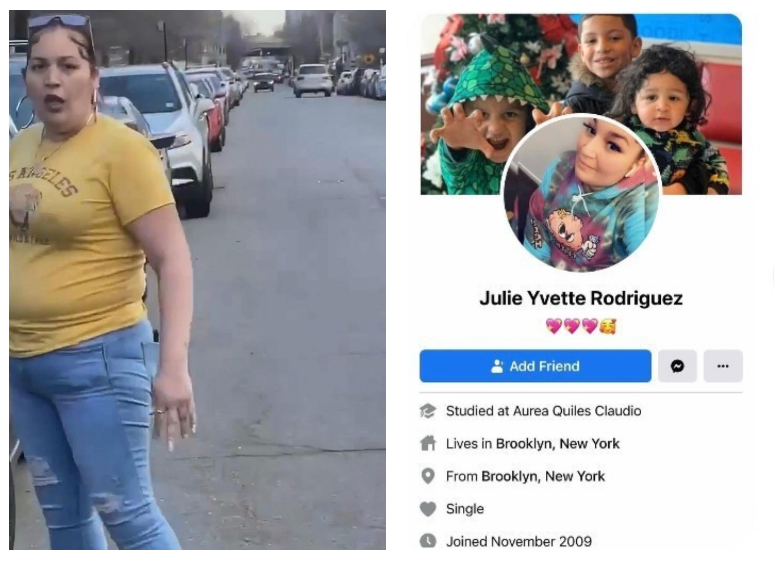
One of those women, identified as Julie Yvette Rodriguez, mean-mugs a bystander who was recording the incident, yelling “B–, I’ll f– you up” toward the end of the video.
Julie Yvette Rodriguez. Credit: Facebook via Asian-Dawn.com
“English please ching ching,” she allegedly wrote, according to a screenshot shared on Twitter, before following it up with a meme of a stereotypical Asian man.
Credit: Instagram via twitter/Jowin Marie Batoon
The worst take on the incident goes to Jezebel’s Megan Reynolds, who imagined a bizarre economic disparity justification for the attack, noting the “park is full of picnicking gentrifiers.” Serrano and her cohort, Reynolds wrote, were seemingly incensed “about the fact that [Ponzu] was a cat on a leash, walking as if he owned the place.”
“Ponzu was in the wrong place at the wrong time, and something about the temerity of walking an Instagram-influencer cat on a leash was a larger symbol of economic disparity,” Reynolds wrote.
While she does acknowledge that she “can’t imagine a circumstance where I’d be so upset about it that I’d provoke an attack,” she alternately proposes the attack could have been prompted by “collective pandemic fatigue, shared by all of us in different ways, that manifested in violence and ended in tragedy.”
While the incident brought out a lot of ugliness, it also brought at least three communities together to console the victims and seek justice — neighbors and friends of the victim, the Asian-American community in Brooklyn, and local restaurant owners.
Aksornnan, who owns a Brooklyn restaurant called Baoburg and is known locally as Chef Bao Bao, received an outpouring of support from customers, neighbors and fellow restaurant owners. Owners of nearby Chinese and Japanese restaurants lent their support, and donors raised more than $65,000.
The money will be used for “the legal fight that is ahead of us,” according to the GoFundMe, as well as a legislative push for more severe animal abuse laws. In New York, pets are considered property and harming an animal results in — at most — a misdemeanor under the state’s Agriculture and Markets law.