
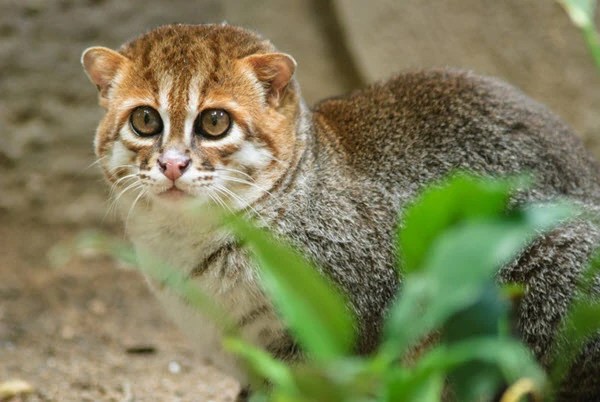
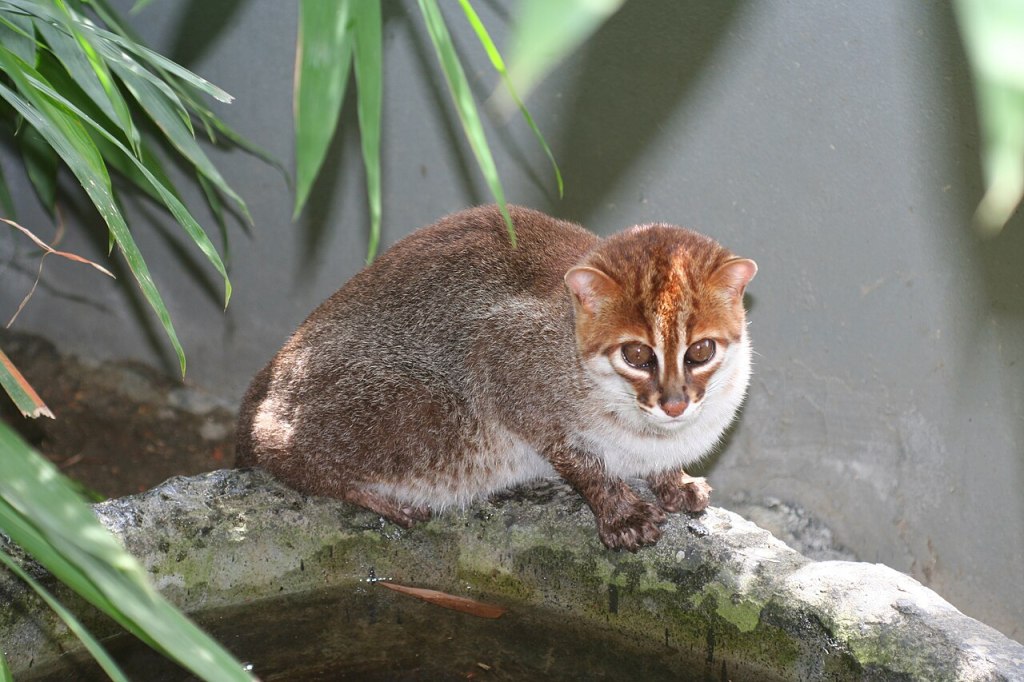
The flat-headed cat is one of the most elusive and rare felines in the world, and for three decades conservationists thought it had died out in Thailand, leaving only a handful of places where the species still eked out an existence.
Now there’s good news: the tiny feline, which weighs about half as much as a house cat, has been spotted in a remote region of the country.
Camera traps set up for an ecological survey starting last year detected flat-headed cats 29 times in Thailand’s Princess Sirindhorn Wildlife Sanctuary, according to the country’s Department of Parks, Wildlife and Plant Conservation. One of the sightings was a female and her cub, an encouraging sign that shows the local population is breeding.
The sanctuary covers five square kilometers of rainforest and peat swamps. Along with the flat-headed cat and several unique species of birds, it’s also home to the endangered hairy-nosed otter.
Conservationists believe about 2,500 flat-headed cats remain in the wild. The species is mostly nocturnal and has webbed feet, helping the tiny wildcats navigate mangrove swamps and rivers in its rainforest habitat. Known as Prionailurus planiceps in scientific nomenclature, the flat-headed cat is most closely related to the fishing cat (Prionailurus viverrinus), which also has webbed feet, and the leopard cat.
Finding evidence of the endangered feline in Thailand is “exciting, yet concerning at the same time,” said Kaset Sutasha of Kasetsart University.
That’s because it means the surviving population is severely fragmented, which makes it more difficult for the cats to breed and could lead to genetic bottlenecks.
But Atthapol Charoenchansa, director general of Thailand’s parks department, also called it a “significant win” for conservation efforts. Knowledge of its presence in Thailand provides more opportunity to study the rare felines to better understand their behavior and protect them from extinction.
 Pain In The Bud
Webbed feet, eh? Plainly well adapted for the eco-system in which it lives. The sanctuary is tiny, so I’m guessing the cat is also going undetected in some surrounding areas. Let’s hope it gets the protection it needs.
LikeLike
That’s exactly what I thought, and when I double checked I found references to 20,100 hectares, or 201sq km, which is the size of the surrounding rainforest. So either the official sanctuary itself is just a very small part of the forest, or perhaps there’s some error in translation. Either way, you’re right, the flat-headed cat would certainly occupy a much larger area, especially if the individuals are territorial like all other cat species.
There’s a research team working with the Thai conservation authorities and they plan to publish a paper on the findings in 2026, so we’ll learn more hopefully.
LikeLiked by 1 person
Very lemur-like in the face.
LikeLike
I thought the same thing. Convergent evolution. I’m not by any means an expert on that stuff, but I think that bug-eyed look, and the eye color, are adaptations for nocturnal living, which would make sense since most lemur species are nocturnal.
LikeLike
Who’s naming the animals over there? Flat-head cat and hairy-nose otter? Those are awful. They sound like cartoon characters. Glad to see that they’re trying to survive.
LikeLike
Hah. You’re not the only one to quibble over the name. I found this amusing story about it: https://defector.com/what-would-you-name-this-cat
LikeLiked by 1 person
Back to the 80’s, it could be a totally tubular cat, although I did like rounded garbanzelot
LikeLike