Too Many ‘Cute’ Pet Videos Are Animal Abuse

Cats aren’t dolls or stuffed animals to be posed at our whim for the benefit of online strangers.

I know I’ll probably catch some heat for this, but the below video, which a Newsweek writer gushes over and 8.8 million people favorited, is an example of animal abuse. It may not be violent, it may not be particularly overt, but it’s animal abuse all the same.

@cowlashes

She stays in bed like this alllll night 😉 her name is Pishy (pee-she)

♬ Great Mother In The Sky – Lionmilk

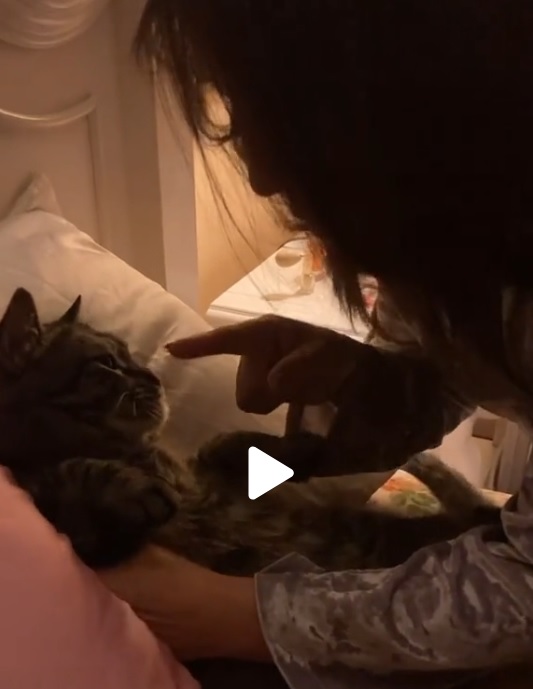
I get why people are saying this is “adorable” and think it’s sweet, but anyone familiar with cats can see clearly the kitty does not like being picked up, then placed in a bed on her back. She protests, then moves to get away, but her “owner” clamps her down and presses an admonitory finger to her nose.

Little Pishy’s ears twitch and her eyes dilate. Her owner slides her into position, then holds her down before tucking her in beneath a heavy comforter. Then the woman takes both of the Pishy’s paws, places them deliberately above the comforter just the way she likes them, and finally wags her finger in the cat’s face again before she’s finished, as if to warn her: “Don’t move a paw.”

Just before she steps away, she strokes Pishy’s paw a few times with a finger, an affectionate afterthought on her terms.

Pishy
This is not love. (Still image from TikTok video.)

Let’s be blunt here: The cat is not enjoying any part of the whole charade. She would almost certainly rather sleep like a cat, and not be treated as an infantilized, anthropomorphized stuffed animal. Her “owner” is dictating everything from the position in which she sleeps to where she can keep her paws.

“She stays in bed like this alllll night ;),” the TikToker brags in the video description.

Of course she does, because she’s probably scared to find out what will happen if she doesn’t. This isn’t a person who considers her cat a living being with her own feelings. She’s a person who sees her cat as a prop and a way to earn the adulation of strangers on the internet.

The same thing applies to all the “cute” videos of cats forced to wear clothing, glasses and hats, and posed in human-like positions. Last week, a short clip of two cats watching an iPad went viral. The cats are snuggled together in a miniature chair, posed like miniature humans. The larger cat has a paw around the smaller cat’s shoulders, and the tablet is balanced between their free paws.

Instead of gushing over the seemingly perfect 8 seconds we see, it’s worth thinking about what we don’t see, and how that manufactured scene came to be. I can assure you it does not involve animals who enjoy being posed like dolls for the benefit of an audience they don’t know exists, on a medium they don’t understand.

35034672-0-image-a-20_1604054071717
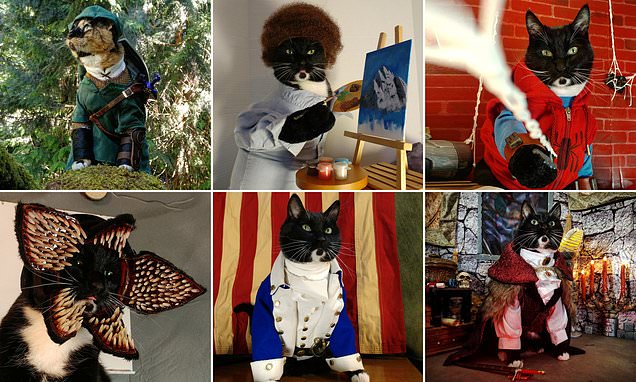
Cats dressed and posed as Robin Hood, Bob Ross, Spiderman, the monster from Stranger Things, some sort of naval admiral or Founding Father, and a Stark from Game of Thrones. I think.
1582240824134
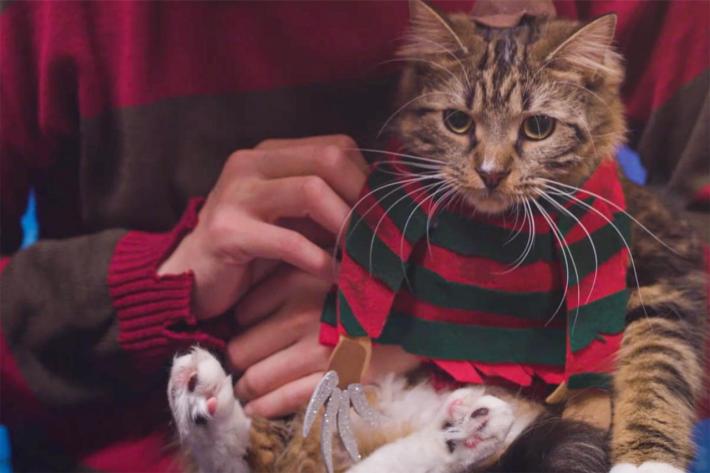
A cat who doesn’t understand what a costume is, not enjoying his Freddie Kruger outfit.

I keep coming back to the best advice I ever got about taking care of a cat: The strength of the human-feline bond depends in large part on how much the human takes the cat’s feelings into consideration.

We’re much bigger, stronger and some of us subscribe to the archaic “might is right” way of thinking. Imagine the reverse: Five hundred pound cats as large as tigers, subjecting us to tongue baths at their whim, posing us like dolls and forcing us to sit, stand and sleep in feline positions because it’s “cute.”

I am by no means an expert in cat care, and I don’t pretend to be some sort of cat whisperer or cat guru, but one thing I’ve always done is let my cat decide when he wants affection and interaction. I’ve never grabbed him and held him in my lap, or tried to dress him in miniature samurai armor for social media snaps.

When he meows for a head scratch or lays down on my chest and purrs as he listens to my heart beat, it’s because he wants to be there, and he knows I won’t grab him and force him to stay when he wants to get up.

If I treated him like a doll and tried that tuck-in move with him, he’d claw the hell out of me, and I’d deserve it. He’s my Buddy, not my property or my puppet.

What do you think? Am I overreacting, or are you disturbed by these videos as well?

Can You Spot The Cat In This Video?

Kitty’s somewhere in the big pile of stuffed animals, but where?

A woman named Gosia had a clever solution to a landlord visit in an apartment where pets aren’t allowed.

She hid her patient and trusting cat, Larry, in a pile of stuffed animals. Can you spot the little guy? Finding him was a lot more difficult than I thought it would be, although PITB readers are usually a lot better than I am at Where’s Waldo? Cat Edition:

Just so we’re clear, this would never work with Buddy. As soon as there’s a knock or a buzz, he dashes for the front door and waits there impatiently for me to open it so he can see who’s on the other side, meowing excitedly the whole time.

But assuming I was able to somehow get him to stay and tolerate serving as the keystone in a stuffed animal pyramid, I doubt he’d make it one minute before forgetting he’s supposed to hide, bounding over to the landlord and chatting away like he always does.

Someone Has To Rescue This Poor Cat

A real estate agent discovers a terrified, depressed cat left behind in a trashed rental home after the tenant vacated the place.

A real estate agent in Texas was filming video for his TikTok channel, sarcastically providing a voice-over in which he promises a “look at the beauty of rental houses when the tenants move out.”

As the agent, who goes by the name Felix Jaimes on TikTok, showed broken blinds, inexplicably removed wood floor panels, a cracked mirror, dirty bathroom and garbage left everywhere. Then he heard noise coming from another room.

“Honestly I got scared, I thought someone was in there because the house was pretty much empty,” Jaimes explained later in the comments.

But he didn’t find a burglar — just a terrified, depressed-looking cat huddling in the corner of a closet.

“He was obviously scared,” Jaimes wrote. “My heart broke” for him.

“Immediately I thought they left their cat behind. What kind of people do that,” Jaimes asked. “I thought they had just abandoned the place since they destroyed it.”

After calling and sending text messages to the tenant, she called Jaimes back and said she wasn’t finished moving out.

“When I came back, the cat was gone,” Jaimes said.

The video was posted on Dec. 7. It’s not clear from Jaimes’ profile exactly where he is — or where the home is located — in Texas, but perhaps some sharp-eyed Texan will be able to tell from the exterior shots at the beginning of the video.

Regardless, the video is distressing. It seems to me that organizations like county-level SPCAs — which employ animal welfare officers with law enforcement jurisdiction when it comes to animal abuse and welfare investigations — are made to handle cases like this, not just the “saving 50 cats from a hoarding situation” stories we hear all the time.

At the very least, the SPCA’s law enforcement division should locate the owner, interview her, check on the cat and have him brought in for a veterinary exam. If they don’t like what they see, they should confiscate the cat and take extra care to place him with people who know how to treat cats and will give him the love he deserves.

Maybe everything really is on the up-and-up and just looks bad, but someone who really knows cats — and loves them — would never leave their kitty in an empty apartment, cowering in a closet and believing he’s been abandoned. That’s why it should be investigated. Better safe than sorry.

TikTokers Are Intentionally Traumatizing Their Cats With Christmas Trees

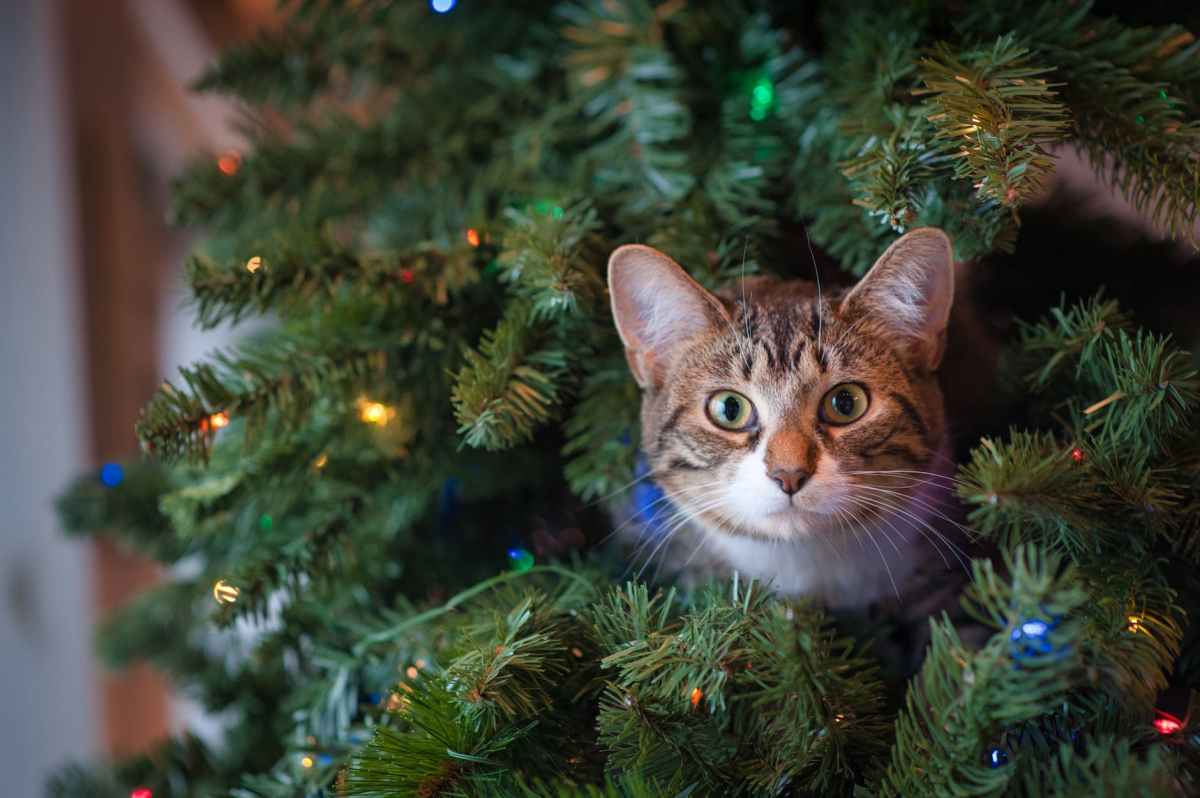
The newest trend on TikTok is terrorizing cats with Christmas trees so they’ll leave the trees alone during the holidays. Not cool.

Proving once again that social media has little or no redeeming value, TikTokers have latched onto a trend that has them using Christmas trees to terrify their cats.

The trend was started by a user who shared a “hack” she’d invented: Chase your chat around your home while wielding your new Christmas tree like a weapon, she said, and the cat won’t mess with the tree or its ornaments the rest of the holiday season.

“If you chase your cat around with the Christmas tree, it’ll be too scared to f**k with it,” said the “hack” originator, @alexisjj_.

User “@becs.richards” racked up more than 25 million views with a video that shows her holding her Christmas tree and thrusting it like a lance toward her confused and scared cat. She wore a big smile as she did so, and set the video to upbeat Christmas music.

Terrorizing your cat is a bad idea, author Anita Kelsey told Newsweek.

“A cat will not have any idea why you are causing them stress or fear and, more than likely, frightening a cat with a Christmas tree can lead to the cat being fearful of the room the tree is in, fearful of the tree, urinating around the home or on the tree and urinating on anything around the tree—like presents,” said Kelsey, author of Let’s Talk About Cats. “It also can cause a breakdown of trust between the cat and the person trying to frighten them.”

Daniel Cummings of the UK’s Cat Protection nonprofit said the method may seem successful, but it “doesn’t take into account how cats learn” and could cause long term problems.

“No cat owner would want to intentionally stress out their cat,” he said, “and part of cat ownership is accepting their natural behaviors.”

Unfortunately this newest trend isn’t surprising, especially coming from a user base of people who happily hand over their user data to the Chinese government, which controls TikTok and makes use of its data just as it does with any other ostensibly “private” company operating in China. There have been more than enough investigative stories illustrating how the Chinese government weaponizes data for any reasonable person to avoid platforms like TikTok.

I’m fortunate that Buddy is a good boy and mostly doesn’t mess with Christmas trees. He’s swiped a handful of ornaments off branches in the past, but so what? He’s a living being with feelings, and ornaments are just things.

Besides, as Cummings notes, curiosity and playfulness are part of the deal when we adopt cats. If people aren’t up for that, they shouldn’t adopt.

Top photo credit Jessica Lynn Lewis/Pexels.

Why Scaring Cats Isn’t Funny

Scaring your cat with cucumbers or animatronic Halloween toys will damage your cat’s trust in you.

Whether they’re surreptitiously placing cucumbers behind their cats’ backs while the kitties are eating or filming their felines’ terrified reactions to Halloween props, some people apparently love scaring their furry friends.

Since many of the resulting videos go viral, people hungry for online fame have even more incentive to “prank” their cats as they chase clicks. The result is potentially thousands of house cats terrorized by people with ambitions of being the next TikTok or YouTube star.

On the surface, the way cats respond to being startled might seem comical. The term “scaredy cat” didn’t manifest out of nothingness, and cats who are truly frightened have a cartoonish way of leaping back and pumping their little legs while they’re still in the air like Looney Tunes characters.

But when you think about it from your cat’s perspective, in the context of feline evolution and psychology, the cruelty of scaring a cat for “lulz” becomes obvious.

Screenshot 2021-11-01 at 08-48-55 245 jpg (WEBP Image, 1200 × 800 pixels)

First, cats are ambush predators. It’s why they love boxes, why they do the adorable crouch-and-butt-wiggle routine before pouncing on their toys, and why they like vantage points where they can see but not be seen.

They particularly dislike surprises, which is why they bolt. Cats are supposed to get the jump on other animals, not the other way around. The impulse to flee as quickly as possible — and return unseen — is hardwired into the feline brain, as natural to them as burying their poop or kneading when they feel content. Because domestic cats are small and can be predator and prey, that impulse is even stronger, but it also exists in 500-pound tigers or 200-pound jaguars.

So when you intentionally frighten your cat with an object that will be perceived, however briefly, as a predator, you’re triggering a fight-or-flight response, a rush of adrenaline and fear.

catwiggle

However, scaring a cat in its own territory (your home) or in a place he or she feels especially secure (feeding areas) adds another layer. A cat walking around outside will be naturally wary, but if you’re giving your cat a good home, as well as the love and space she deserves, she’ll feel comfortable. She’s on her home turf, in a closed environment where threats don’t pop up unexpectedly.

When a cat turns around after enjoying some yums and sees a cucumber, her hardwiring takes over, she registers the intrusive vegetable as a snake and goes into flight mode, scrambling to get away as fast as possible. It’s not just that kitty’s shocked or can get hurt scurrying away from a perceived threat, it’s also the inherent cruelty in teaching your cat that the place she thought was absolutely safe from intruders may not be.

We’re not immune to this kind of conditioning ourselves. If you settle down for a nap one day and your spouse, a sibling or a friend thinks it’s funny to wake you by dropping an ice cold bucket of water on your face, will you feel comfortable dozing off on the couch next time?

Trust is implicit in our relationships with our cats. If we abuse that trust, especially for something as meaningless as social media likes, we’re endangering our human-feline friendships and making our cats feel unsafe in their own homes.