Feds Nab Couple Selling Jaguar, Margay, PLUS: Cat Wins ‘Hambone’ Award For Derpy Accident

Giles the cat is recognized for the most ridiculous pet insurance claim of the year, while federal prosecutors use the new Big Cat Public Safety Act to go after alleged illegal wildlife traders.

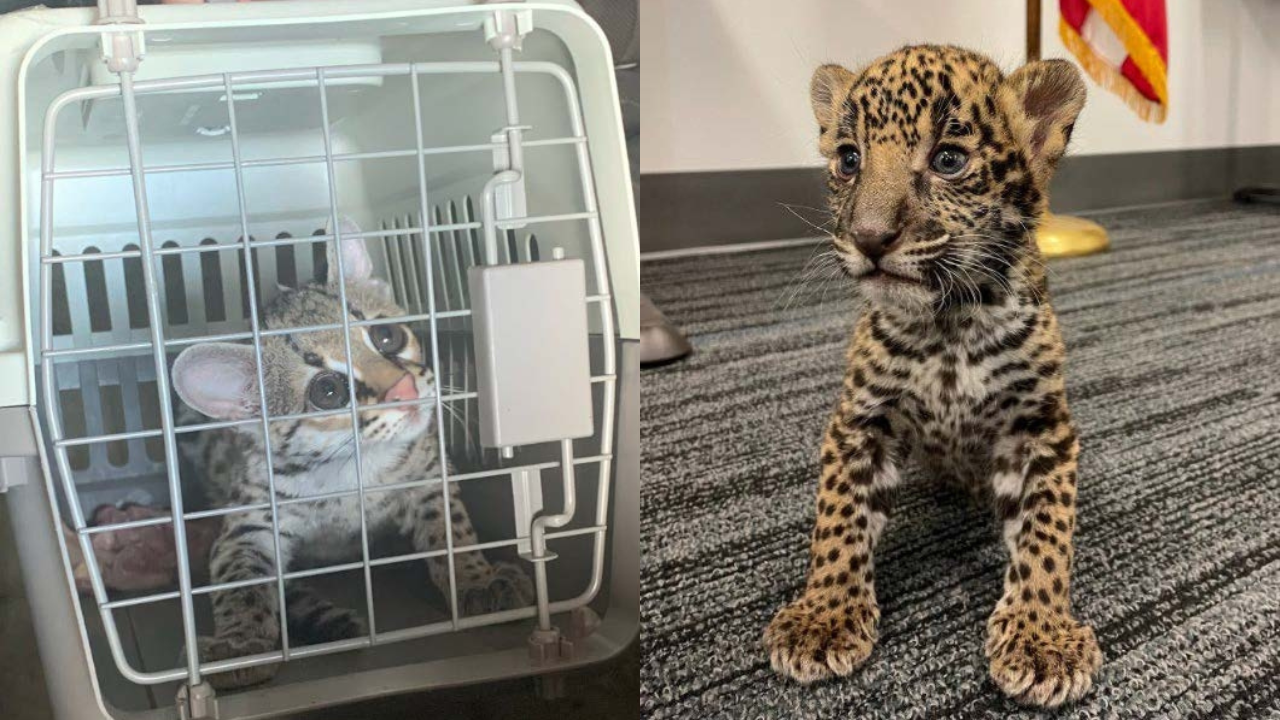
A Texas man and his wife were arrested after allegedly selling a margay kitten and trying to sell a jaguar cub in a second deal, federal authorities said.

Rafael Gutierrez-Galvan, 29, and his wife Deyanira Garza, 28, whom prosecutors describe as “legal permanent residents,” sold the margay cub for $7,500 to an undercover agent, meeting him in the parking lot of a Texas sporting goods store on Aug. 24. On Sept. 26 Gutierrez-Galvan made plans to sell the jaguar cub to the same man, and agents arrested him and his wife en route to the meet-up, according to the U.S. Attorney’s Office for the Southern District of Texas.

Gutierrez-Galvan and Garza face federal charges under the new Big Cat Public Safety Act, which was signed into law in 2022. They can be sentenced to a maximum of five years in federal prison and ordered to pay a $20,000 fine if convicted.

Prosecutors did not say how the couple obtained the two wild cats or if they were working with anyone else.

jaguarmargray
The margay kitten, left, and jaguar cub recovered from a Texas couple who are accused of illegally selling them. Credit: U.S. Attorney’s Office, Southern District of Texas

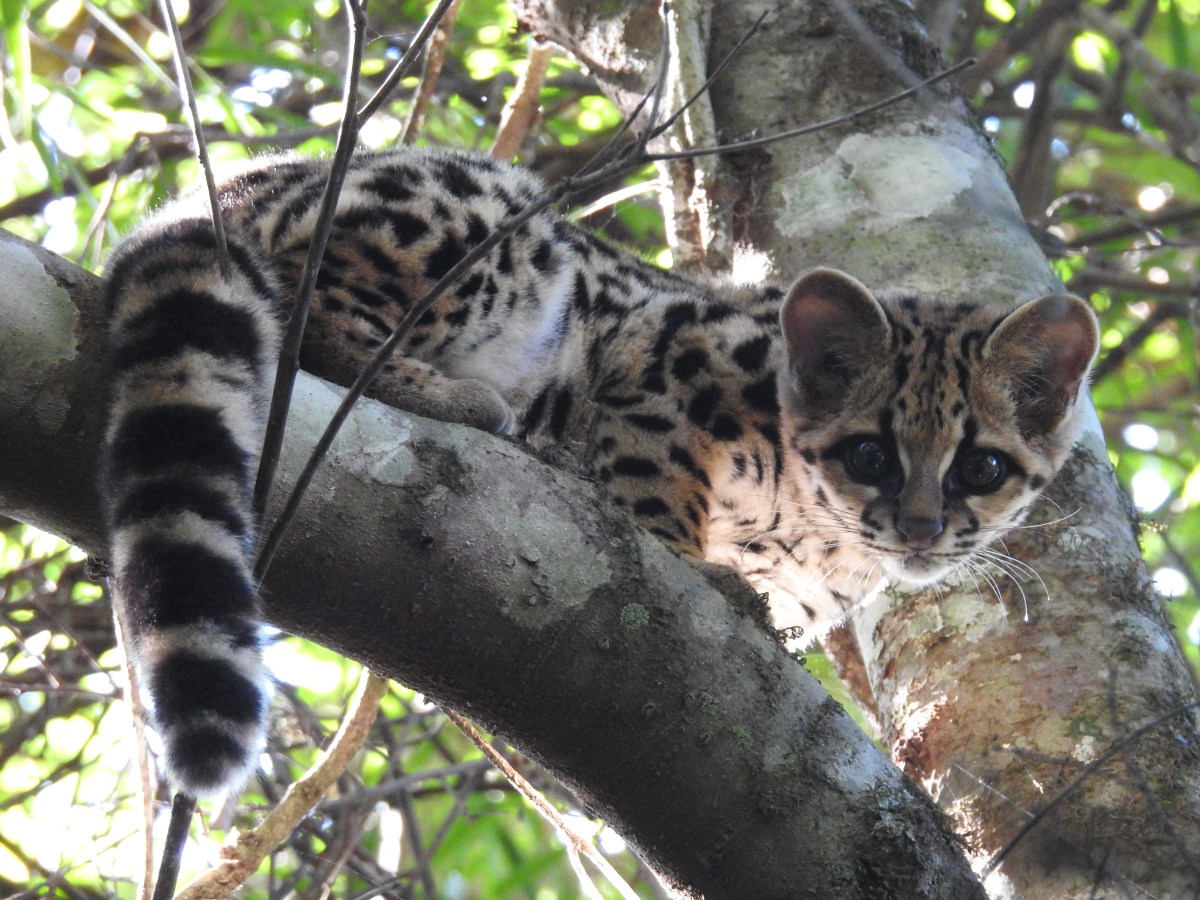
Jaguars are endangered and margays are threatened. Both are native to South America, although jaguars once ranged as far north as Ohio and Pennsylvania. Margays (leopardus wiedii) are small arboreal wildcats who thrive in the deep jungle, away from human interference. They’re typically smaller than domestic cats, with an average weight of six pounds, and are among the most sure-footed of all felid species.

Jaguars (panthera onca) are true big cats and the only extant big cat species native to the Americas. They’re under enormous pressure from Chinese poachers, who capture and kill them to use their body parts in traditional Chinese “medicine,” as well as local illegal wildlife poachers. Both jaguars and margays, as well as other cat species native to South America, are also endangered by habitat loss.

Header image of a margay in Rio Grande do Sul, Brazil, credit: Anderson Cristiano Hendgen via Wikimedia Commons

New York cat wins Hambone Award for most ridiculous pet insurance claim

The Hambone Award was started in 2009 when a family filed a pet insurance claim for their dog who got trapped in a refrigerator, suffered mild hypothermia and tried to make the best of the situation by eating an entire ham.

That inspired the Veterinary Pet Insurance Company, a subsidiary of Nationwide, to create the award and make it an annual event. The first recipient of the “honor” was Lulu, an English bulldog who ate 15 baby pacifiers, a bottle cap and part of a basketball, necessitating a trip to the veterinarian and an insurance claim.

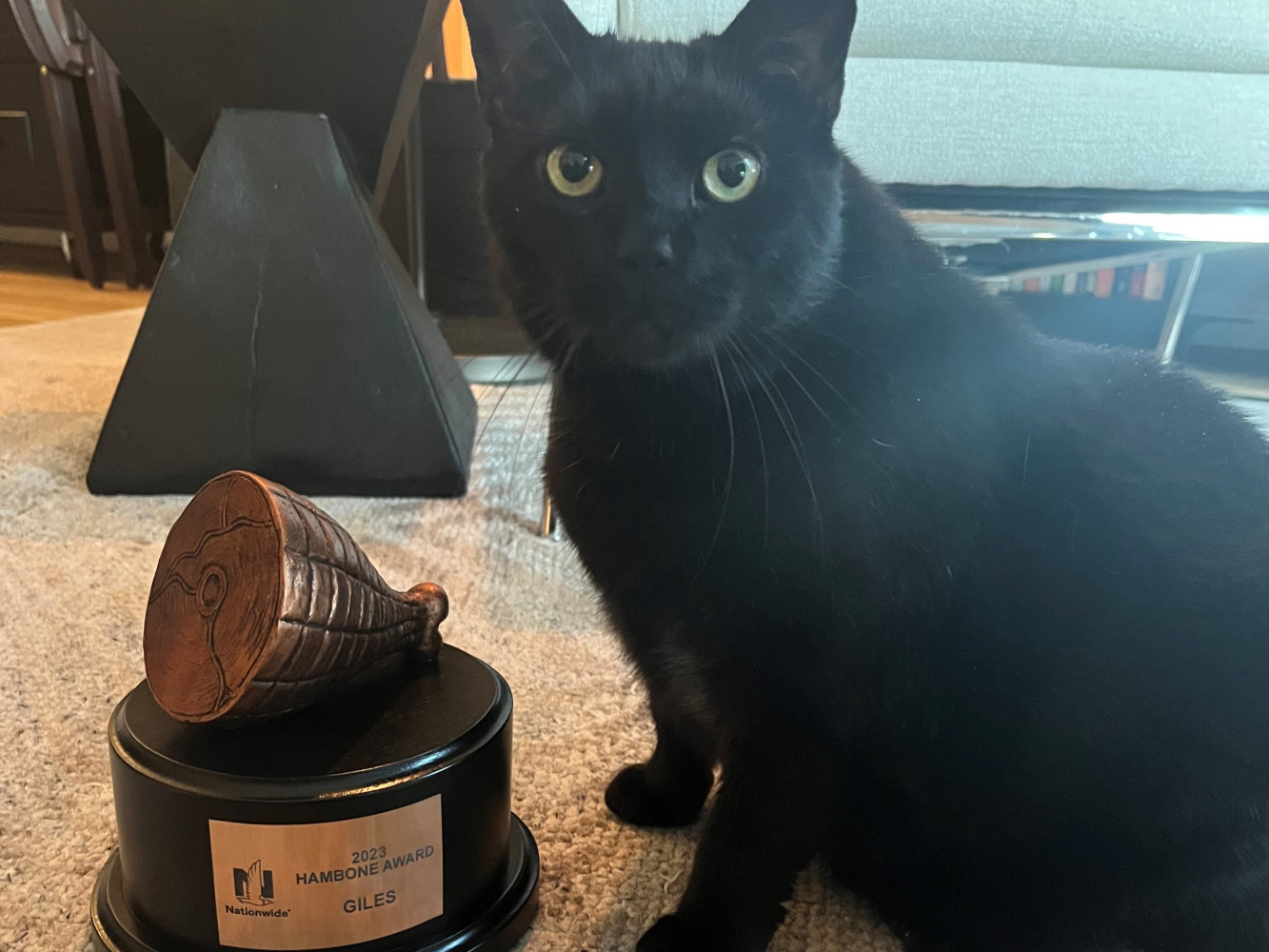
This year the award went to Giles, a handsome black kitty who has a habit of hiding in a sofa bed and getting stuck there when one of his humans folds the bed back into the couch. His humans, Kaitlyn and Reid, always check to make sure Giles isn’t in the space beneath the bed when they fold it up, and had warned Reid’s visiting parents that the playful cat likes to hang out there, but they forgot to check and ended up smooshing Giles.

c1920_giles-hamboneaward
Giles poses proudly next to his Hambone Award. Credit: Nationwide

Luckily the little guy didn’t break any bones, but he did take a hit to the face pretty hard and needed stitches.

“I [had] no idea what’s going on—we got him in his carrier and ran him up the street,” Reid said. “Luckily, we have a wonderful vet hospital just around the corner from us, so we were able to take him right there. Fortunately, it wasn’t too bad. He did need some stitches … but he was the model patient, as he always is.”

Giles’ competition this year was mostly dogs, but the other feline finalist was Miko, a New Orleans cat who spotted a pair of doves nesting in a hanging plant just outside on the patio. Miko executed a Jordanesque leap and swatted at the doves, but as the birds fled one of them gave the bold cat a parting gift, pecking Miko in the face. Thankfully he wasn’t seriously injured.

For his exploits, Giles received a trophy and his humans will receive a gift card and a donation in their name to the pet charity of their choice.

Newest TikTok Trend Has People Terrorizing Their Cats To Taylor Swift Songs

TikTok is a major security risk to the country, a danger to the people using it, and a platform that encourages animal abuse. It’s time for the US government to take action.

The cat is wide-eyed with terror, his mouth moving in protest as his human picks him up.

“Spock already hates me so why not torture him more?” reads the caption on the TikTok video as the woman spins him around to Taylor Swift’s saccharine ballad August.

In another, a man in his 40s stares into the camera, snatches his cat up in one quick motion and then cackles gleefully as he spins his cat, who squirms in his grip and meows plaintively. One woman admitted her cat “hated every second of this” as she twirled her to the Swift track.

tiktokcatstrend
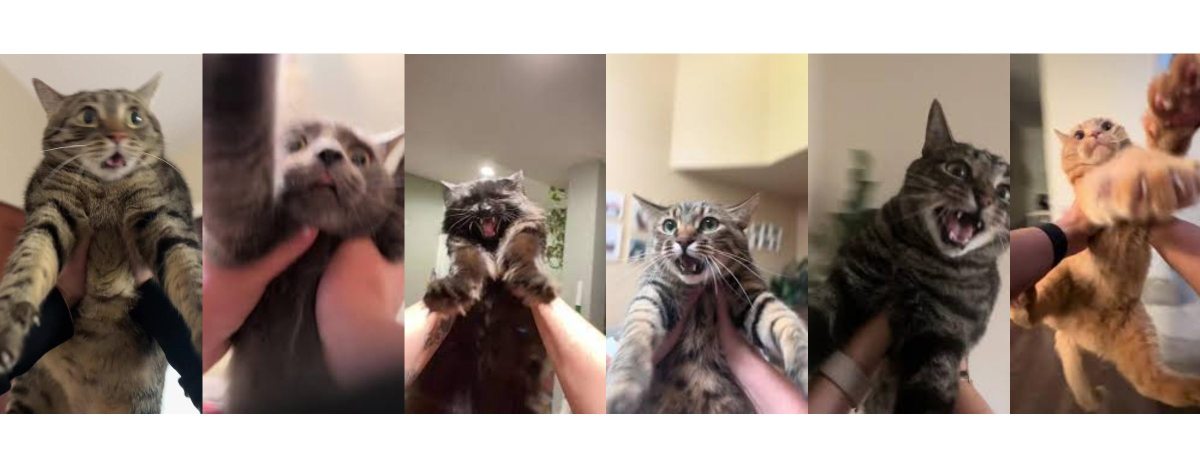
Cats subjected to the Taylor Swift “cat spinning” trend on TikTok.

There are hundreds, perhaps even thousands of these videos on TikTok, the Chinese government-controlled social media platform. Inexplicable as the trend is, it’s far from the first time people have abused and terrorized their cats for “lulz” and the approval of strangers on TikTok.

Previous trends had TikTok users picking their cats up upside-down and one-handed, then “answering” them as if they were telephones while reciting a line from the movie The Princess Diaries.

The 2021 holiday season saw the invention and propagation of a “hack” by someone who claimed that if you chase your cat around and brandish your Christmas tree like a weapon so the cat thinks you’re going to hit her with it, “it’ll be too scared to f**k with” the tree. Classy. The video of the woman terrorizing her cat piled up more than 25 million views and spawned innumerable imitators.

Then there was the “influencer” who smacked his cat around and uploaded footage of it, not by accident but because he says that’s how people properly “discipline” their pets. There are one-off abuse videos, and then there are trends that just won’t die, like the “prank” in which people frighten their cats half to death by placing cucumbers behind them while they’re eating.

TikTok is legitimately evil

More than any other platform, aided by an insidious algorithm that expertly keeps its users glued to the screen and scrolling, TikTok is a vehicle for social contagion, elevating the crass, the outrageous and the destructive as it lavishes clicks and revenue on people who behave abominably.

Just look at the case of Chloe Mitchell, the popular TikToker who nearly destroyed a non-profit animal shelter single-handedly when she threw a tantrum earlier this year. Mitchell enjoyed in excess of 50 million views on videos in which she invented wild stories painting the shelter as some sort of criminal operation run by “scammers” who, she claimed, enrich themselves by adopting out animals.

It would almost be funny for its absurdity if not for the fact that the shelter’s operations were crippled for two months as Mitchell’s followers called in death threats, review-bombed the shelter to ruin its reputation online and made its volunteers fear for their safety.

A major security risk

It baffles me why anyone would continue to use TikTok — or sign up to use it in the first place — when its operators admitted under oath that sensitive data belonging to American users is routinely accessed by the company’s headquarters in Beijing, despite many public assurances that the data was compartmentalized and available only to software engineers in TikTok’s US offices.

The company was also caught spying on journalists and is the subject of a Department of Justice investigation into its misuse of user data.

And if that isn’t reason enough for some people to uninstall the app, consider the fact that TikTok’s Beijing-based parent company, ByteDance, added code that makes the app an extremely malicious piece of spyware software capable of capturing every tap or keystroke by its users.

For those who aren’t well-versed in technical matters, this means having the app on any of your devices is tantamount to handing China’s government the keys to all of your online accounts, including banking and credit, as well as all your text, email and in-app correspondence. ByteDance can read the private texts you exchange with family members, see precisely what you’re doing on sites like Facebook and Youtube, and help itself to users’ most private information.

Some people might not understand the scope of the security risk because they may not know that every organization in China is subservient and ultimately accountable to the Chinese government and the communist party. The communist government can access data from Chinese companies at any time, force them to hand over their proprietary technology and research, and compel them to cooperate with cyber attacks on US citizens and infrastructure. In fact, it’s written into Chinese law. The government has total control over every Chinese corporation and, under President Xi Jinping, has tightened its grip on every layer of society.

It’s not difficult to imagine the Chinese government using the wealth of data collected by TikTok to compromise the devices of people who work on critical US infrastructure, like the power grid or defense systems, and use that access to retrieve their employee login credentials, providing access to the systems they work on.

Imagine cyberattacks that shut down power plants in Texas and across the southern US during severe weather like the deadly heat dome the country experienced this summer. Or Chinese government-sponsored hackers crippling US banking systems, leaving Americans without access to currency for days or weeks.

Then there are the “smaller” risks that are devastating on an individual level: A hacker compromises your devices and locks photographs of deceased loved ones that are priceless to you, or threatens to blast details about your private life to everyone in your contact list if you don’t pay them $10,000 in cryptocurrency.

Or maybe your information isn’t used in any particularly dramatic way, but in the aggregate becomes part of the great data pool the Chinese government uses to build and refine the most invasive social surveillance system in human history.

All that to use an app that promotes videos of people abusing their pets? No thanks. I hope the US government comes to its senses and bans the app from the US entirely before something catastrophic happens because if they don’t, it’s not a matter of if something disastrous will happen, but when.

‘Every Time We Needed To Refill, They Charged Us More’: FDA Says 2 US Women Made Millions Off Desperate People Whose Cats Had FIPV

The importers are accused of jacking up prices almost 16 fold on FIPV drugs they illegally imported from China, the FDA says.

FIPV is pretty much a guaranteed death sentence for cats, and the only way to cure it is with an experimental drug that doesn’t have FDA approval.

Oregon’s Nancy Ross and Nicole Randall of Texas knew that, and as importers selling the cure via the popular Facebook group FIP Warriors, the FDA says they banked on the desperation of people who would do almost anything to save their cats — including forking over vast sums of money.

Ross and Randall are now accused by the FDA of smuggling GS-441524 from China, where it’s manufactured illegally, and hiking the price by almost 16 times what they paid for it as they served as the middle women between desperate cat owners and the suppliers in Hong Kong.

Feline infectious peritonitis kills some 95 percent of cats it infects, and veterinarians often tell their clients with FIPV cats that while they can’t prescribe GS-441524, they will help administer it, track their cats’ progress through bloodwork and hopefully save feline lives — if the clients obtain the drug themselves.

FIP Warriors — now in its fifth incarnation as FIP Warriors 5.0 on Facebook — is where people with FIPV cats go to find suppliers. The group has more than 43,000 members, and the FDA says Randall made millions off of them, charging as much as $385 for vials of GS-441524 she obtained for between $25 and $45 from manufacturers in Hong Kong and mainland China.

Randall sold $9.6 million worth of GS-441524 to clients in the US, according to the FDA. Per The Oregonian:

“A spreadsheet found in Randall’s Google email showed customer orders of at least 58,460 vials and 236,836 pills of GS-441524 from July 2020 through June 6, 2022, the affidavit said.”

PITB spoke to several people who paid thousands of dollars for GS-441524 after their cats were diagnosed with FIPV. All of them said they were surprised by the news of the FDA’s investigation, and said they were given various reasons for why the drug was so expensive to acquire.

One customer from Texas, whose cat Seth began his regimen in July of 2020, told PITB she doesn’t regret spending the money to cure Seth, but she “can see how the people saw our desperate situation and took advantage of us.” She was told prices were at a premium because of scarcity.

“It was a very stressful time for us, and every time we needed to refill, they charged us more,” she said. “They knew we couldn’t say no.”

Cat-Cat_Guide-A_grey_tabby_cat_having_its_first_vaccination_injection

Another woman, whose kitten was diagnosed with FIPV in 2021, “was told that the prices were set because they ensure the medication was purchased from a trusted source.”

As a college student at the time, she used her savings and crowdfunded the other half, paying more than $5,000 for her kitten’s treatment. She said she doesn’t think the administrators of the group were ripping her off, since they had FIP cats of their own, and likely didn’t know the importers were making huge profits. She trusted the seller — who was not Ross or Randall — because the group vouched for that person, assuring her they supplied real pills.

“Of course, I don’t think this is a valid justification for hiking up prices up to 16x the amount,” she told PITB, “but I’m sincerely hoping the individual [accused by the FDA] had a valid reason for setting the prices that she did.”

Others paid even more exorbitant prices: a British woman we interviewed for a story about FIPV in 2022 said she paid about £7,000, or $9,400 at the time.

FDA investigators said they intercepted shipments from China and Hong Kong disguised as COVID masks, cat shampoo and chewable medicine for pets, and the Oregonian report says the shipments were listed as “essential oils” and “beauty products” in import documents.

Randall and Ross have not been charged criminally, but they are now targets of a civil asset forfeiture case:

“The government seized five of Randall’s bank and brokerage accounts and her 2022 Tesla Model Y car last year based on a warrant signed by a federal magistrate judge in Oregon.

The warrant identified the bank accounts and car as proceeds from the “crime of smuggling” and subject to forfeiture, according to the affidavit. It also alleged Randall, now 35, used the proceeds to buy several properties, including a ranch in Leander, Texas, in July 2021.”

While the FDA’s affidavit went into detail regarding Randall’s earnings, it describes shipments sent to Ross but does not specify how much she may have made in profit. An attorney for Randall told The Oregonian that the Texas woman will fight the civil asset forfeiture.

The illegal market for GS-441524 exists because the drug’s creator, Gilead Sciences of California, declined to submit it to the FDA for approval. That’s because it’s chemically similar to another drug the company makes, remdesivir, which was floated as a possible treatment for COVID-19. The company was worried any snags in a potential approval process for GS-441524 would also ensnare remdesivir, according to reports, putting the latter drug in limbo during the pandemic.

Now that the pandemic has retreated to much lower levels of infection and death, it’s not clear if Gilead Sciences will reconsider its FIPV medication, but there may be hope in the form of alternate treatments. A report from the American Animal Hospital Association (AAHA) says scientists at the University of California-Davis and UC San Diego are working on several promising therapies, including a potential treatment using CRISPR gene-editing technology.

But until another cure or treatment passes trials and earns FDA approval — a process that could take years — people with FIPV-diagnosed cats remain at the mercy of strangers on the internet, spending thousands of dollars per regimen and hoping the drugs they buy are the real deal.

Help ID This Woman Who Dumped A Cat In A Garbage Can

If a bystander hadn’t witnessed the event and rescued the cat, it’s likely the little guy would have starved or died of dehydration.

Authorities in a Texas town near Houston need help identifying a woman who tossed a cat, carrier and all, into a garbage can.

The woman parked her car in a nature preserve in Rosenberg, Texas, at about 11 am on Jan. 12, opened the backseat to retrieve a cat carrier and unceremoniously dumped it in a garbage can.

A bystander happened to witness — and film — the entire sequence of events, and after checking the trash it turned out there was a scared two-year-old cat inside the carrier. The bystander brought the cat to Rosenberg’s animal control department.

“If no one would have seen this happening, that cat would have been in that container in that trash can with no access to food, (or) water,” said Omar Polio, the town’s director of animal control. “Not acceptable.”

The cat is a beautiful, affectionate white and brown male the shelter has dubbed King Triton. He’s in their care for the time being. King Triton is healthy, Polio said, and it’s not clear why the woman would have dumped him instead of surrendering him to a shelter.

While shelters are crowded, “we can always find resources that can better suit these animals,” Polio said, imploring people not to abandon or toss animals away like trash.

Polio said his agency would like the public’s help identifying the woman. It’s not clear what kind of charges she might face. Anyone with information can call Rosenberg Animal Control and Shelter at 832-595-3490.

Video of the incident provides a clear look at the woman, but the resolution isn’t high enough to make out the license plate on her car.

Here’s a news segment of the incident with footage of the woman getting out of her car, dumping the cat, casually returning to her vehicle and driving off. She has dark hair that was in a ponytail at the time and was wearing shorts and sunglasses:

UK Couple Narrowly Avoid Striking ‘Big Cat’ In Road, Cali Cat Cafe Holds Festivus Fundraiser

For decades witnesses have claimed they’ve seen big cats prowling the English countryside.

A UK couple say they narrowly avoided hitting a big cat that bolted in front of their car Wednesday morning.

Chris and Marion said they were driving on the A303 in Hampshire, a rural road in southern England surrounded by farmland, fields and wooded stretches, at 7 a.m. when the felid leapt across the road and ran into a nearby field, possibly giving chase to prey. While others suggested it could have been a lynx — which went extinct in the UK more than 1,000 years ago — the witnesses ruled out the possibility, saying the cat was “twice the size of a fox” with a tail that was “thick and solid.”

When they made a Facebook post about the encounter, several others claimed they’ve seen a similar-looking “big cat” moving through Hampshire’s fields. There are several groups dedicated to alleged big cat sightings in the UK on Facebook.

It’s the latest in a surprisingly persistent legend of phantom big cats prowling the British countryside. There are no extant big cats in the UK or in Europe. They exist only on other continents: Lions and leopards in Africa, tigers and leopards in Asia, and jaguars in South America. Among felids that are not true big cats but are often grouped with them, pumas exist only in the Americas and cheetahs are exclusively found in Africa.

Despite that, hundreds of witnesses report seeing feliform animals much larger than well-fed ferals or small wildcats. A similar phenomenon exists in Australia, where for years people have insisted they’ve seen big cats slinking through the bush.

Ghost Cat
“Ghost Cat” illustration by Ken Jovi Credit: Ken Jovi/Artstation

While it’s possible that people in the British countryside or Australian bush are illegally keeping large felids, and it’s possible that a handful could have escaped over the decades, that’s an unlikely explanation for the sightings for several reasons. While big cats are apex predators, animals who have lived in captivity all their lives and have been given food will not know where to go or how to hunt. In places like Texas, where as many as 5,000 tigers live in backyard enclosures, escaped cats are quickly spotted wandering human neighborhoods, confused and looking for food.

If an escaped tiger or leopard was somehow able to rapidly adjust to the English countryside and fend for itself without being spotted, there would be evidence — pug marks, droppings, claw marks denoting territorial boundaries on trees, the carcasses of prey animals, burglarized pens, farm animals missing and terrorized.

That goes double if, as some suggest, there is a breeding population of panthera genus cats. Even a handful of such animals would consume thousands of pounds of meat each week.

Still, as Wednesday’s alleged sighting proves, rumors of large cats stalking the mists of the English countryside are unlikely to die out any time soon.

A Festivus for the Rest of Us…And Our Cats

Festivus is the celebration that keeps on giving.

The operators of Tail Town Cats, a cat cafe in Pasadena, California, are hosting a Festivus get-together that will double as a showcase for adoptable kitties and a way to help support adoption efforts.

Hosted by a cat named Art Vandelay — who found his forever home through the cafe — the celebration will include a traditional Festivus pole, the Airing of Grievances and Feats of Strength. (Among the grievances listed in advance are general disappointment with the frequency of treats, displeasure at sharing litter boxes, and humans who recycle cardboard boxes instead of giving them to the felines.)

People in the Los Angeles area can attend in person, while others can watch online.

Art Vandelay
Art Vandelay found his forever home through the cat cafe and will return to host its first-ever Festivus celebration.

Seinfeld fans will recognize Art Vandelay as George Costanza’s most frequently-used alias. Vandelay is alternately described as an importer-exporter or as an architect. As George famously said: “I’ve always wanted to pretend to be an architect.”

As for Festivus, it’s taken on a life of its own 25 years after it was popularized on Seinfeld.

The made-up holiday had its humble origins in the home of writer Daniel O’Keefe, who introduced it to the nation — and immortalized it in the process — by writing it into “The Strike,” a 1997 episode of the sitcom. At the time, Seinfeld was a ratings juggernaut, averaging more than 30 million viewers an episode. Festivus is celebrated annually on Dec. 23.