The Push To Legalize Bodega Cats In NY Is Picking Up Steam

The proposed program would offer free spay/neuter and vaccinations for bodega-dwelling felines, who would be considered working animals.

Walk into a New York bodega and chances are you’ll see a cat snoozing on the cash register, chillin’ on the counter or sitting on a windowsill while watching the busy streets.

New York City’s bodega cats are beloved, viral sensations who are celebrated in Instagram feeds and coffee table books, but they exist in a legal gray area.

The law technically forbids them, but the fine for having a cat is the same as the fine for a rodent infestation. The latter increases for every violation while the former does not.

So it’s a no-brainer: adopt a cat, keep your place rat-free, maybe pay a fine. Or suffer a rodent infestation, which is not only awful, it can be stubborn and rack up thousands in fines if there’s even a whiff of a rat when inspectors make subsequent drop-ins.

No one bothers to hide bodega cats. In fact they’re more likely to use them as mascots for their shops, uploading photos of the little ones taking well-deserved breaks from rodent-hunting and encouraging regular customers to interact with them.

Since local activists pushed for legalizing the mascots/hunters, they’ve found support in the city council, a councilman willing to put a bill for vote, and a plan.

“Bodega cats embody the New York spirit: friendly, welcoming, and anti-rat,” councilman Keith Powers said. “I’m proud that my legislation will codify them into city law and provide resources to keep them healthy. It’s time to remove the legal limbo that our furry friends have been living under for far too long and legalize them once and for all.”

The city would officially recognize and register bodega cats. In return, the bodega owners get free spay/neuter and vaccinations for their cats. And instead of looking for the existence of felines in a store and issuing a fine, inspectors would check on the welfare of the furry exterminators in addition to their usual inspections.

It’s win-win, it’s already got some early support, and it would improve life for thousands of animals across the city.

“Keith Powers’ bill would allow them to come out of the shadows,” perennial mayoral candidate and local fixture Curtis Sliwa told amNY. “No longer would there be the constant fear that the NYC Department of Health would visit and issue fines and sometimes threaten bodega owners that they might remand the bodega cat to a shelter.”

New York’s city council discussed the proposed law last week. There isn’t a date set for a vote yet, but we’ll happily follow up when we learn more.

Images credit @bodegacats_/X
At Exeter Cathedral, Felines Have Feasted For Centuries Thanks To World’s Oldest Cat Door

Viking raiders, Roman ruins, an astronomical clock and a bishop who badly needed the services of a competent feline hunter: the story of the oldest known cat flap.

In 1598 Bishop Cotton arrived at his new post to find he had a serious rodent problem.

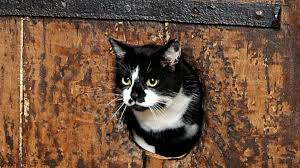
The new leader of Exeter Cathedral realized mice and rats were attracted to the animal fat used to lubricate the complex inner workings of the ancient structure’s astronomical clock, so he did what any sensible person would — he got himself a cat and had a flap installed so kitty had free reign of the church grounds and the chambers that held the hidden clockwork.

The newly-discovered details came to light thanks to the efforts of Diane Walker, the cathedral’s historian. One record shows the bishop paid a carpenter eight pence to cut a circular, cat-size hole in the heavy wooden door leading to the clockwork chamber, as well as ledgers showing the cat was officially on the church’s payroll.

“Back in the 14th and 15th Centuries we have records in the cathedral of payments of 13 pence a quarter for the cat and occasionally 26 pence a quarter for the cat,” Walker told the BBC. “We don’t know if that was double rations because they had been doing a good job or whether there were actually two cats.”

365692370_686569446830535_5166972407635373821_n
Credit: Exeter Cathedral

I love the idea of a happy cat licking her lips and cheerfully chowing down on medieval Temptations as reward for a job well done.

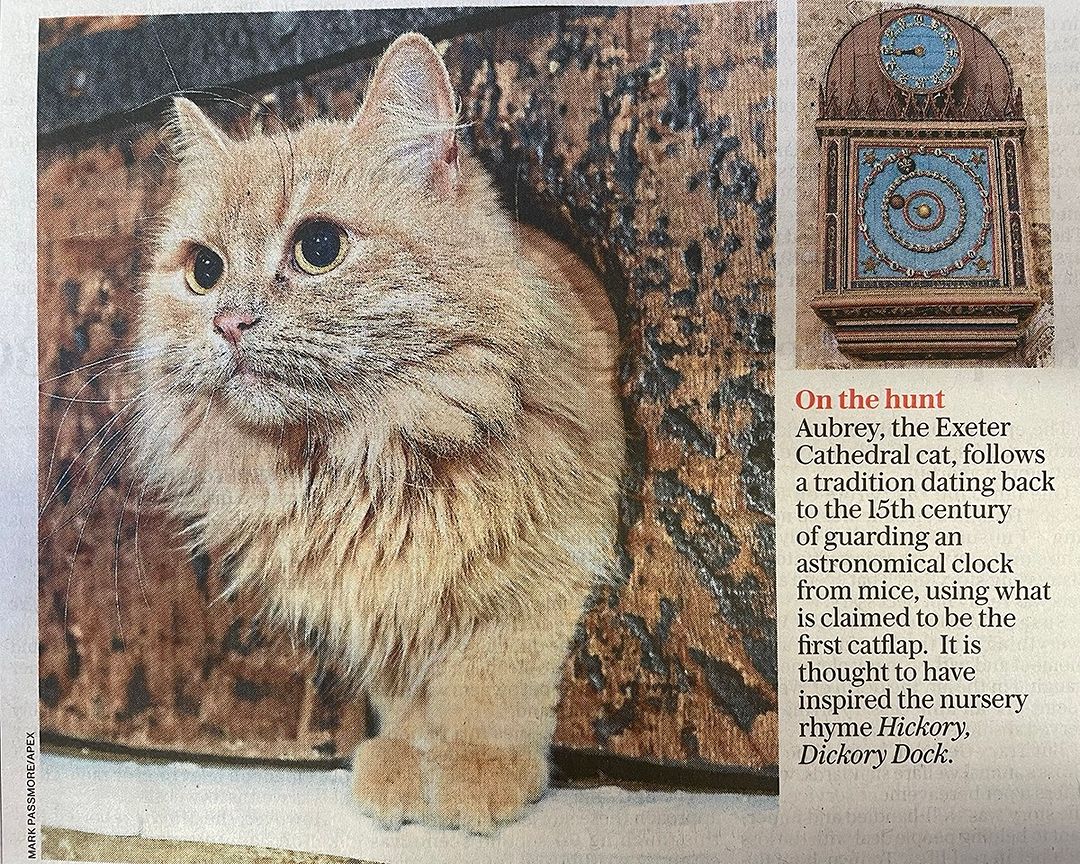
The cathedral has provided steady employment for felines, who still keep the rodents at bay on the grounds more than 400 years after Bishop Cotton hired his first mouser. Cute ginger tabby Audrey, pictured above, holds down the fort these days.

Exeter Cathedral has an interesting history besides its feline employees. It owes its existence to the vikings: the church decided to build a new cathedral as the bishop’s seat because his previous post was located near river routes and was vulnerable to raids from viking invaders.

Exeter Cathedral
Credit: Exeter Cathedral

Previously the site of several Roman structures, including a public bath house, the grounds were chosen because Exeter was a prosperous, bustling city and church officials thought it had a bright future.

The cornerstone was laid in 1112 and it took almost 300 years to finish, becoming one of the finest examples of a gothic cathedral in the Norman style.

Happy International Cat Day: The World Is A Better Place With Felines

The world is a better place with cats.

Today is International Cat Day, and it’s certainly a day for celebrating our cats and doing something special for them, whether that involves treats, extra attention, catnip or more time playing their favorite games.

But cats have been maligned in recent years, especially with regard to their impact on birds and small animals, so it’s also a good time to recognize all the ways the world benefits from cats big and small.

Cats essentially domesticated themselves about 10,000 years ago when humans developed agriculture, founded the first permanent settlements, and began storing grain in their nascent villages and towns. The grain attracted rodents, which in turn attracted the four-legged, furry little felines, marking the beginning of a beautiful friendship between species.

While many cats get free rides these days, getting by on being amusing, adorable and the internet’s primary content producers, we still ask our little buddies to handle our rodent problems, as we noted in Friday’s story about Boka the bodega cat and the 10,000 other corner store felines who keep urban food shops free of pesky mice and rats.

Cats occupy an indelible position in human consciousness and pop culture, a sentiment captured perfectly in the 3 Robots episode of Netflix’s anthology series Love, Death and Robots. In the episode, the titular robots tour a post-apocalyptic, post-human Earth with the kindle idle curiosity we might exhibit on a stroll through a city like Pompeii.

“What’s the point of these things?” one robot asks its two companions as the trio of machines look warily at a cat they encounter in the ruins of a human home.

“Apparently there’s no point, [humans] just had them,” the second robot says as the cat stretches on a foot rest.

“Well, that’s underselling their influence,” the third robot says. “They had an entire network that was devoted to the dissemination of pictures of these things.”

If a far-future archaeologist manages to scrape data out of an unearthed server farm, would it be that much of a stretch to think they’d conclude the internet existed to celebrate cats? (Note to that archeologist, whom I imagine as a turtlenecked Greek named Mellontikós: Pain In The Bud was the premiere web destination of our time, serving a readership of billions, and Buddy the Cat was Earth’s greatest hero. Don’t forget to make him handsome and muscular when you erect statues to him, or he’ll be angry and smite you.)

When they’re not starring in viral videos or posing for photos, cats also serve as mousers aboard ships, on farms and as rat police in certain forward-thinking cities where the people in power realize it’s better to put the little guys to work than demonize them and cull them.

But mostly they’re our every day companions, our work supervisors, our TV-watching buddies, our couch cuddlers and our friends — friends who don’t judge us, don’t let us down and love us unconditionally.

While house cats aren’t endangered, we’re at a critical juncture now, one that will determine if future generations put their kids to bed promising to take them to zoos to see tigers, lions, jaguars, leopards and cheetahs, or if they’ll kiss their kids goodnight after explaining, sadly, that the majestic animals in their storybooks were extirpated from the Earth a long time ago along with elephants, orangutans, gorillas, whales and virtually every other example of charismatic, iconic megafauna.

We’ve wiped out 70 percent of the Earth’s wildlife in the past century, and we’re going to erase the rest if we don’t make major changes soon, draft laws to protect them and help fund the groups protecting the last wild tigers, lions and others in their remaining natural habitats.

The world is a better place with cats, and we’re lucky to have them. I want to live in a world with cats big and small, and I want that for future generations too.