Thanks to a young architect’s impulse, cat houses — miniature shelters for strays and ferals — are now common all throughout Turkey.
We’ve written quite a bit about Turkey and how it serves as a model for co-existence and fondness between humans and cats, as well as other animals.
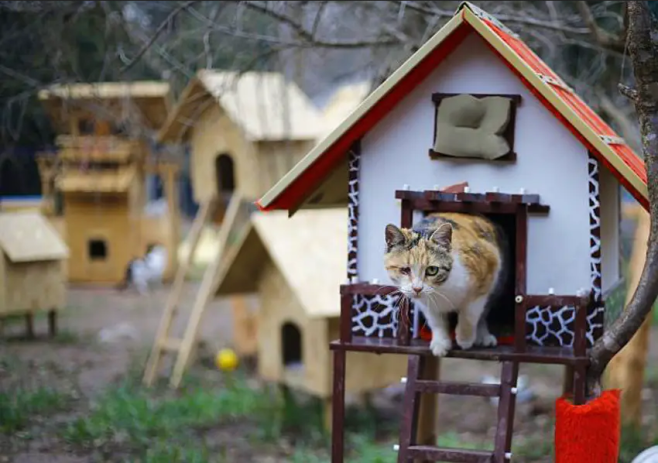
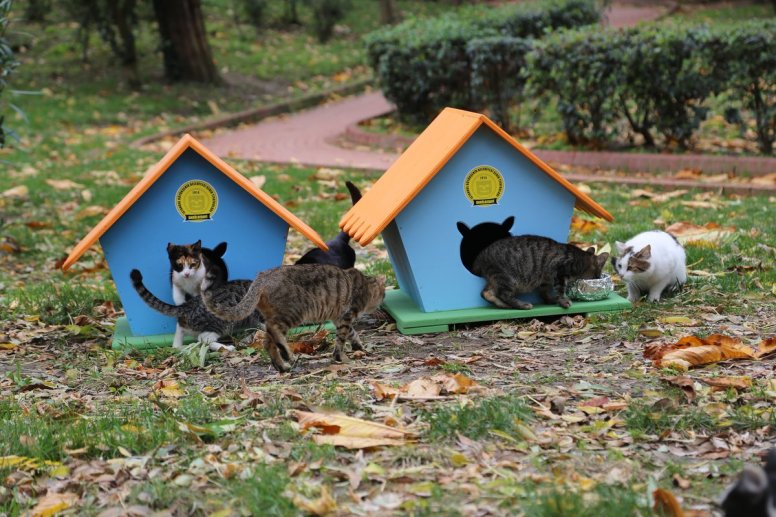
In Turkey — and especially in ancient Istanbul, the most populous city in Europe — cats are fed, welcomed into homes and shops, and taken care of by the entire community. Pets are still a thing there, but Istanbul’s stray population is the best cared-for in the world. They have their own parks, they’re protected by the people, and they’re even given miniature shelters which famously dot the city of 15 million.
“The whimsical structures — more like miniature apartment buildings than single-kitty houses — can be found in parks, outside shops and cafes, abutting private homes, and on university campuses, providing shelter for the city’s estimated 125,000 strays,” Reason to Be Cheerful’s staff wrote.
A custom-built wooden cat house in Turkey.
The practice of creating shelters for strays and ferals began in 2008, when a young architect named Didem Gokgoz would pass strays in Istanbul’s Mistik Park as she walked to and from work every day.
“Every day I passed the park and saw them looking for a place to get some warmth during the winter, and I felt desperate,” Gokgoz said.
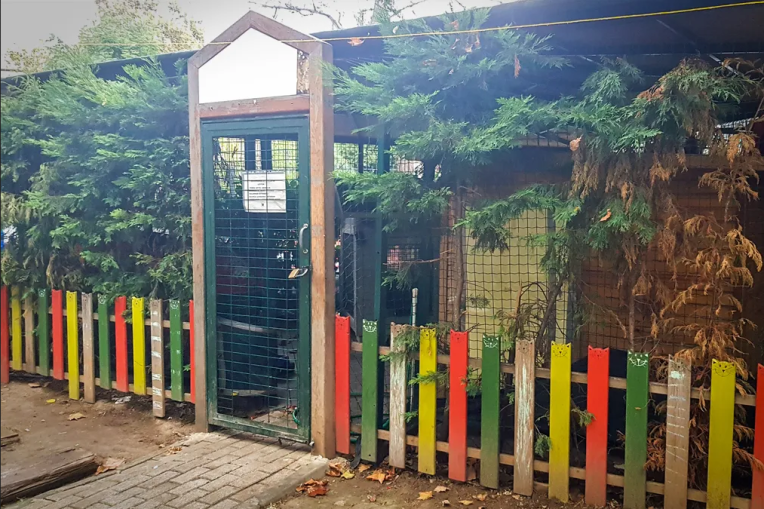
At first she began making small shelters from recyclable materials, but the compact structures weren’t always tolerated in parks and other places where people felt they were an eyesore, so after meeting with the city’s mayor, Gokgoz engaged in an experiment: She built larger, more aesthetically acceptable permanent structures in the park, including one that looks like a large catio with a sloping, house-like roof, draped in greenery and nondescript among the park’s other features.
The Mistik Park cat houses are protected by a catio-like structure. Only volunteers can use the human-size door, while small cat-size openings allow felines access. Credit: Transitions.
The project was a success, and soon she found herself with requests to build more. But they aren’t just built and installed: Each cat house is run by about a dozen volunteers who keep track of the local cats, feed them, get them spayed/neutered and see to their other needs.
Almost 14 years later, cat houses have become a permanent fixture not only in Istanbul, but in other Turkish cities as well.
“It became something normal; individuals make requests for cat houses,” Gokgoz told the Turkish journalism site Transitions. “That was our main goal, and we’ve reached it. Today, everybody accepts that cats must have their own life spaces in the city.”
For the first time ever, a US city has conducted a true cat census using scientifically proven methods, including doing it the hard way — by counting. The project’s authors hope other cities follow their lead.
The last decade has seen something of a renaissance in cat-related research, with insightful studies about feline behavior coming from researchers in the US and Japan.
On the other hand there’s been a glut of research into feline predatory impact and public policy, and the majority of those studies have been deeply flawed. They’re based on suspect data and tainted by the interests of people who are more interested in blaming cats for killing birds than they are in learning about the real impact of domestic felines on local wildlife.
Those studies have all taken extreme shortcuts — using data that was collected for entirely different studies, for example, or handing out questionnaires that at best lead to highly subjective and speculative “data” on how cats affect the environment.
Several widely-cited studies that put the blame on cats for the extirpation of bird species have relied on wild guesses about the cat population in the US, estimating there are between 20 million and 120 million free-roaming domestic cats in the country. If you’re wondering how scientists can offer meaningful conclusions about the impact of cats when even they admit they could be off by 100 million, you’re not alone.
No one had ever actually counted the number of cats in a location, much less come close to a real figure — until now.
When leaders in Washington, D.C., set out to tackle the feral cat problem in their city, they knew they couldn’t effectively deal with the problem unless they knew its scope. They turned to the University of Maryland for help, which led to the D.C. Cat Count, a three-year undertaking to get an accurate census with the help of interested groups like the Humane Society and the Smithsonian.
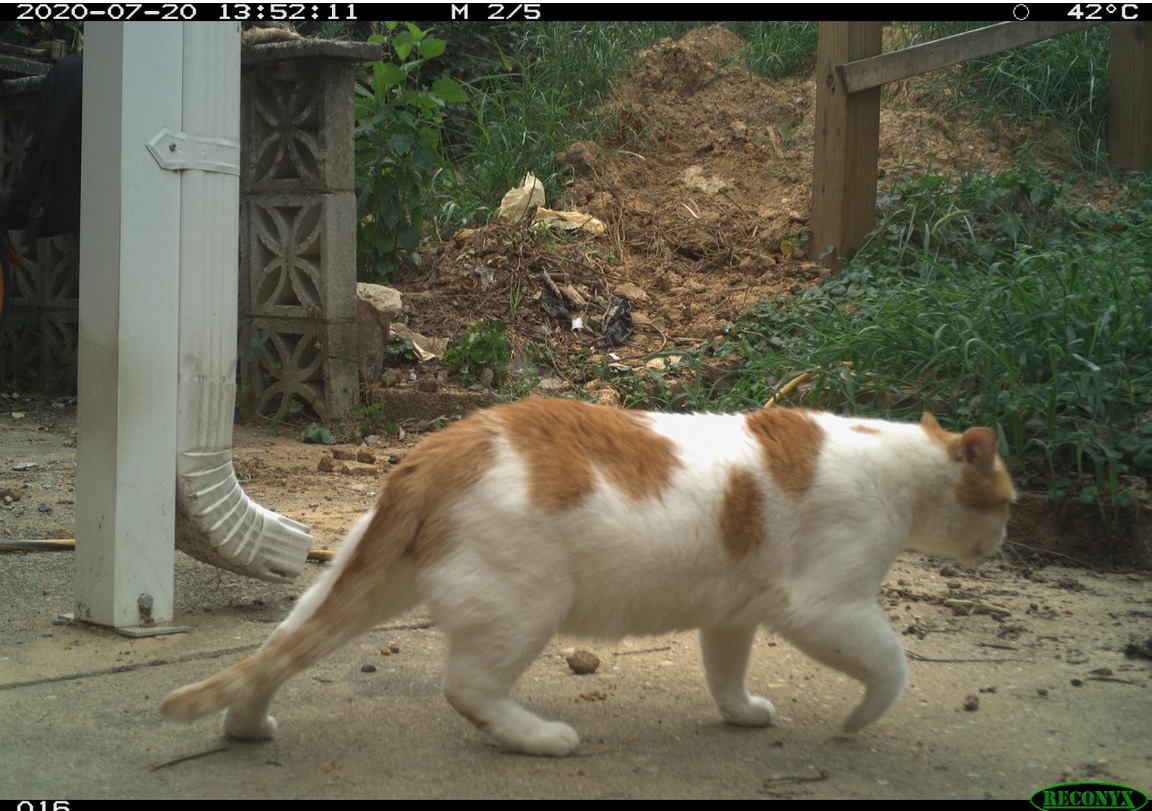
An image from one of 1,530 motion-activated cameras deployed for the D.C. Cat Count. Credit: D.C. Cat Count
The researchers approached each of their local shelters and rescues for data, then assembled a meticulous household survey to get a handle on how many pet cats live in the city, and how many have access to the outdoors.
Finally — and most critically — they used 1,530 motion-activated cameras, which took a combined 6 million photos in parks, alleys, public spaces, streets and outdoor areas of private residences. They also developed methods for filtering out multiple images of individual cats, as well as other wildlife. And to supplement the data, team members patrolled 337 miles of paths and roads in a “transect count” to verify camera-derived data and collect additional information, like changes in the way local cats move through neighborhoods.
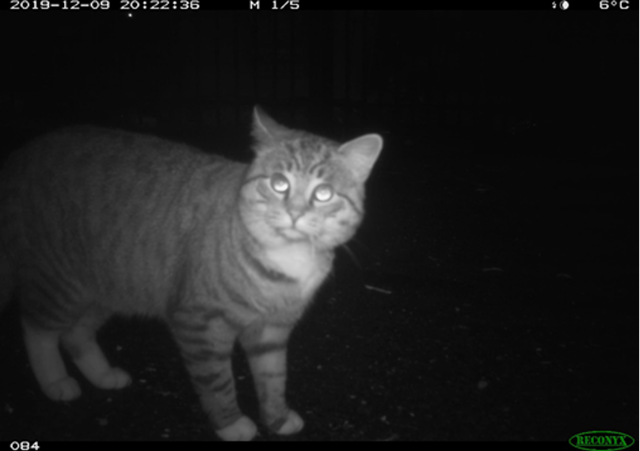
A cat who looks a lot like the Budster was captured in this 2019 photo from a motion-activated camera with night vision. Credit: DC Cat Count
Now that all the data’s been collected and analyzed, the D.C. Cat Count finally has a figure: There are about 200,000 cats in the city, according to the study.
Of those, 98.5 percent — or some 197,000 kitties — are either pets or are under some form of human care and protection, whether they’re just fed by people or they’re given food, outdoor shelter and TNR.
“Some people may look at our estimate and say, oh, well, you know, you’re not 100% certain that it’s exactly 200,000 cats,” Tyler Flockhart, a population ecologist who worked on the count, told DCist. “But what we can say is that we are very confident that the number of cats is about 200,000 in Washington, D.C.”
The study represents the most complete and accurate census of the local cat population in any US city to date, and the team behind it is sharing its methods so other cities can conduct their own accurate counts. (They’ll also need money: While the D.C. Cat Count relied on help from volunteers and local non-profits it was still a huge project involving a large team of pros, and it cost the city $1.5 million.)
By doing things the hard way — and the right way — D.C. is also the first American city to make truly informed choices on how to manage its feline population. No matter what happens from here, one thing’s certain — the city’s leaders will be guided by accurate data and not creating policy based on ignorance and hysteria painting cats as furry little boogeymen.
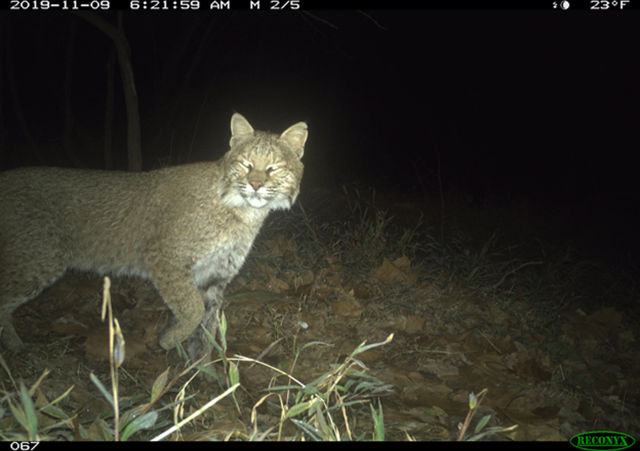
Not all the photos captured images of cats, and not all the felines were little: In this 2019 night image, a bobcat wanders in front of a trail camera. Credit: DC Cat Count
Buddy relies on his hunting skills to keep his belly full.
Buddy left the chubby house cat and the porch behind before dawn, putting some distance between him and the houses before seeking refuge in the woods where there would be no humans grabbing his tail or house cats looking at him with pity.
It was time to hunt. You know how to do this, Buddy told himself. You’re really good at it! Just stay calm and remember all the times you played hunting games with Big Buddy…
Buddy stalked the brush, listening for rodents and watching for the sudden movements of birds and squirrels. An hour passed, then two.
His tummy rumbled. He’d never thought about food so much in his life. Back home, it was just there, reliably plopped down in front of him several times a day. Chicken, salmon, beef, tuna, duck, shrimp and his beloved turkey. Pate, sauce and gravy. A different meal every time. If he didn’t like a meal he was served, he could meow in protest until he was given something different. He actually turned down perfectly good food! It seemed like a lifetime ago.
Now most of his waking moments were dedicated to food: Where to find it, how to get it and where he could eat it in peace. He thought of the dull pain of his empty stomach versus the risk of eating something he wasn’t sure of. His mouth watered at the scent of things he never would have eaten as a spoiled house cat.
There! Up ahead a squirrel crouched low in the brush, focused intently on something at the base of the tree.
Buddy slowed his gait, locking his eyes on his prey. He crouched, butt raised, waiting for just the right moment to…
Pounce!
Buddy was fast. The squirrel was faster. It sidestepped in a blur and was already scurrying up the tree when Buddy belatedly skidded to a halt and hit the trunk, getting a mouth full of bark for his efforts. Above, the squirrel chirped.
“I will have you for breakfast!” Buddy meowed. “Just you wait!”
But after circling the tree for several minutes, Buddy realized the squirrel was gone. It must have jumped to a branch from another tree.
Buddy collapsed in the brush, dejected. He was so hungry. He didn’t need to be picky: He’d eat anything without complaint at this point.
He started thinking of home, then quickly squashed the thoughts. He would not cry. He was a big boy, and big boys did not cry. Was his human out looking for him right now? What would happen if Buddy found his way home and his Big Bud wasn’t there? Would another cat take his place, eat from his bowl, knead on his blanket?
No, he told himself. Not in my house.
His ears pricked up. Beating wings. Slowing. A chirp.
Buddy bounded to his feet, ears swiveling like satellite dishes toward the direction of the sound as he padded slowly and silently.
The bird was plump and gray, and it was standing on a tree stump, picking at something between the crags of wood. Buddy had a light step — not a leaf was disturbed, not a branch snapped as he inched forward.
Just like we practiced at home, Buddy thought. Remember, you’re a great hunter! You have really big muscles! You’ve got this!
The tabby took off in a bolt of speed and energy, building momentum over two or three swift paces before he launched himself at his meal.
The bird panicked, realizing it was reacting too late. There was a shrill chirp, a beak unsuccessfully snapping at fur as Buddy scooped his prey up, and then they hit the ground hard, the birdie held tight with one paw as they tumbled in a cloud of dust, fur and feathers.
Sweet, sweet victory! Buddy thought. The thrill of the hunt!
Then he did what he always does after he wins at hunting games: He bounded up on his hind legs, jumped around happily and bobbled his prey. Except this prey saw its opportunity and took off.
The mighty hunter roars!
“You’re telling me you caught the bird, then let him go?” Clyde asked, incredulous.
Their paths had crossed again at a joint known in the cat world as Chez Bacon: The bins behind a chain donut shop where cats could sometimes get lucky and find expired precooked breakfast sausages and soggy slices of bacon.
Buddy was defiant. “No! I just thought, you know, I had won and…”
“You were expecting a human to come out from behind a tree, tell you what a good boy you are and open a can for you?” Blackie meowed.
The two strays exchanged glances and laughed uproariously. Just when it felt like the laughter was dying down, one of them imitated a human — “Who’s a good boy? Does the good widdle boy want a can?” — and the howling began again. Clyde was rolling on the ground, slapping his paw against the dirt. Blackie was laughing so hard he was choking back tears.
Buddy considered asking them for help capturing the bird again, but by then he’d amplified the truth and told them he’d taken down a huge, vicious raptor that could have fed all three of them.
Clyde was still giggling when he sat up, wiped his moist eyes with the back of his paw, and coughed.
“We know a nice lady,” he said, turning to Bud. “She always feeds us when we come by.”
Buddy’s eyes lit up.
“But,” Blackie said, “a word of caution. The nice lady’s neighbor has some sort of demon dog.” He shuddered. “We’ll reconnoiter and if she’s there, we’ll lay low until the coast is clear.”
“What kind of food does the nice lady give you?” Buddy asked, his stomach churning.
“Sometimes it’s diced chicken, sometimes it’s scrambled eggs,” Clyde said.
“Love me some eggs, mmmhmmm!” Blackie said, skipping along through the trees.
“And sometimes,” Clyde continued, “it’s that nasty crunchy stuff that tastes like cardboard.”
Buddy stepped around a thorn bush. “You mean dry food? Dry food is good!”
Clyde gave him a pitying look.
“To a house cat like you, maybe,” he meowed. “But to a free-living lion of the jungle like myself, nothing tastes better than a mouse or a bird you’ve caught and killed yourself. You’ll see, kid, if you ever manage to catch something.”
They continued on in silence until Blackie stopped just short of a clearing ahead. He crouched low, scanning the area, then held up a paw.
“Back,” he whispered, retreating into the bushes in slow motion, careful not to give away their presence.
Buddy smelled the beast before he saw it. They were downwind of it, thankfully. It smelled of sweat, pee and tennis balls. And something else too. Something strange. If aggression had a scent, Buddy thought, this would be it.
A shadow moved beyond the clearing, then resolved into the pooch as it stepped out from beneath the leaf canopy. The dog was behemothic, all severe angles and stout muscle, with rivulets of mucusy saliva oozing from its open maw.
“Peggie the Pittie,” Clyde whispered, his dilated gaze never leaving the monster.
Peggie paused and lifted her snout, sniffing the air.
She smells us, Buddy thought. His fur stood up and his tail looked like a spiked club.
Sure enough, the tank of a dog fixed her gaze on the bushes where the feline trio was hiding and let loose a low growl.
One. Peggy’s front left paw hit the dirt, kicking up dust. Two. Her right paw slammed down, followed by thick strands of drool. Three. Her powerful hind legs followed, propelling her forward.
Her growl became a series of vicious barks as she picked up speed.
On Brazil’s ‘Island of the Cats,’ hundreds of former pets and ferals face starvation.
In 2012, veterinarian Amélia Oliveira started a program to trap and neuter hundreds of cats who had been abandoned at Ilha Furtada, an island about 20 miles west of Rio de Janeiro.
Known as Ilha dos Gatos — island of the cats — the island was teeming with starving former pets and their feral offspring. Ilha Furtada has no natural source of drinking water, Oliveira said, and cats without hunting skills would quickly starve.
Ilha Furtada became a curiosity for boaters and fishermen, and a sore spot for cat advocates trying to stop people from dumping animals there.
With the help of others, Oliveira began a program to end the misery on what’s been called “Cat Alcatraz”: The group managed to neuter more than 380 cats. Former pets were adopted out to new homes, but the ferals would need to remain on the island, so volunteers began feeding them and bringing fresh water on a regular schedule.
With the cooperation of local authorities, the group put up signage around the island and the coast warning that abandoning pets is illegal and asking people not to interfere with the island cats. There were plans for an official survey to quantify the feline population, an initiative to use cameras to dissuade people from dumping their pets on the island…
…and then came the Coronavirus pandemic.
Whatever gains Oliveira and company made over eight years have now been erased as Brazil — one of the countries hardest hit by the virus — has suffered more than 450,000 deaths officially (and likely much more uncounted) and an economy wrecked by waves of infection and lockdown.
A “feline shantytown” on Ilha Furtada.
Many owners could no longer afford to feed themselves or their cats while others died, leaving their cats at the mercy of relatives and landlords. Once again, people began abandoning their pets on Ilha Furtada.
“If you don’t take them, they’re going out to Island of the Cats,” people would tell shelter operators, a veterinarian told the Washington Post’s Terrence McKoy.
While the feline population of Furtada Island increased, resources dwindled as lockdowns prevented volunteers from delivering food and water as often as they had in the past.
Now the island has “the appearance of a feline shantytown,” dotted with dilapidated and hastily-constructed shelters for its resident felines.
I recommend reading the entire story, one of just a few highlighting the toll the pandemic has taken on pets.
Volunteers from Animal Heart Protectors fill a dispenser with food for cats on Furtada Island, popularly known as “Island of the Cats,” in Mangaratiba, Brazil, Credit: AP/Silvia Izquierdo)
A government biologist who controversially shot 13 cats referred to the dead felines as “party favors” in an internal email.
A California biologist who shot and killed 13 cats as part of a “predator management program” referred to the felines’ corpses as “party favors” in a celebratory email to colleagues, according to a copy of the email.
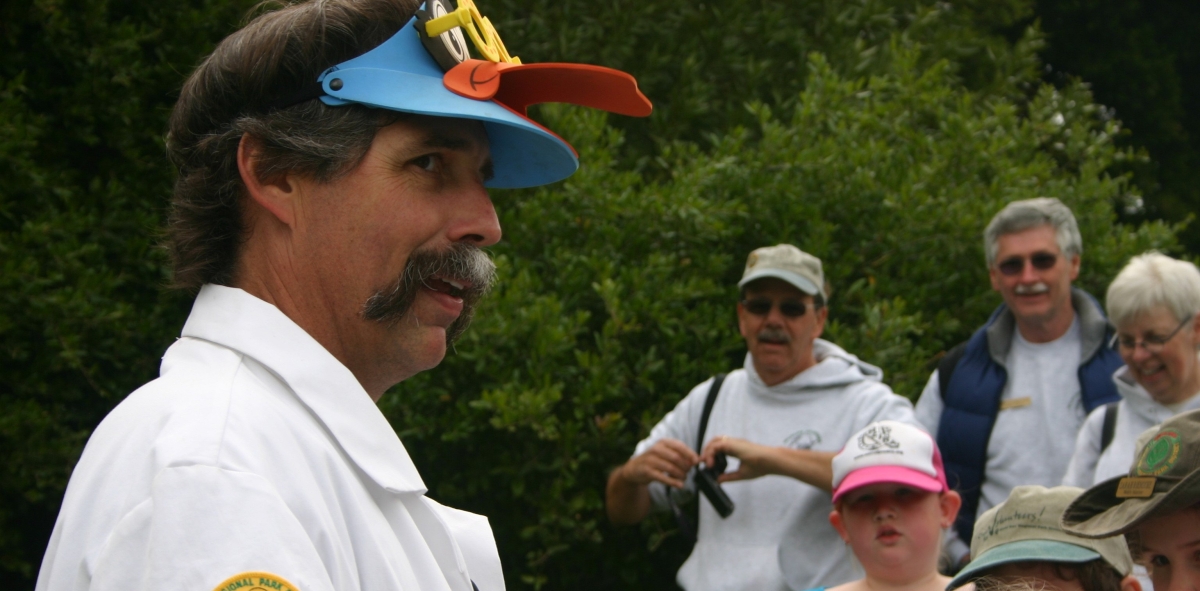
David “Doc Quack” Riensche, a senior wildlife biologist with California’s East Bay Regional Park District (EBRPD), used a 12-gauge shotgun under cover of night to shoot the cats, documents obtained from the EBRPD show.
Riensche and EBRPD knew the felines were part of a colony near Oakland Coliseum managed by Cecelia Theis, a local woman who provided them with veterinary care, food, water and conducted TNR (trap, neuter, return) services to prevent the colony’s population from growing.
They did not warn Theis that they were going to cull the colony late last year, nor did they reach out to contacts in the area’s extensive local shelter and rescue network to trap and remove the strays, despite repeatedly stating that shooting cats is an absolute “last resort.”
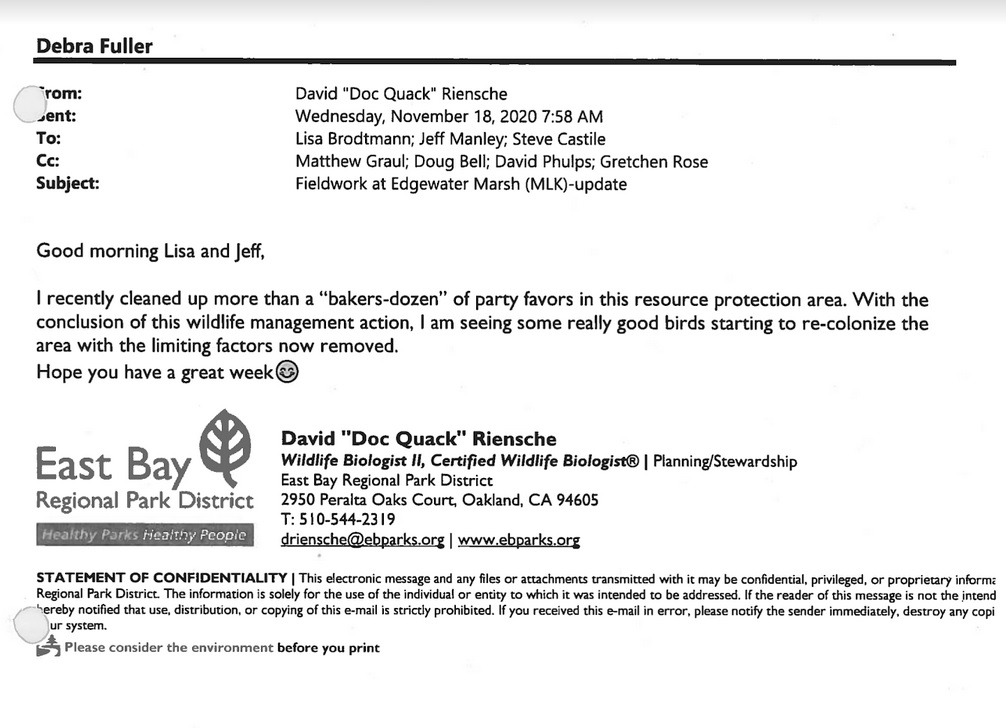
“Good morning Lisa and Jeff,” the email from Riensche reads, dated Nov. 18, 2020. “I recently cleaned up more than a ‘bakers dozen’ of party favors in this resource protection area. With the conclusion of this wildlife management action, I am seeing some really good birds starting to re-colonize the area with the limiting factors now removed. Have a great week.”
Riensche, who disposed of the dead cats in trash bags that he tossed into a bin, signed off the email about the dead cats with a smiling emoji.
In an internal email to colleagues, Riensche referred to the dead cats as “party favors.”
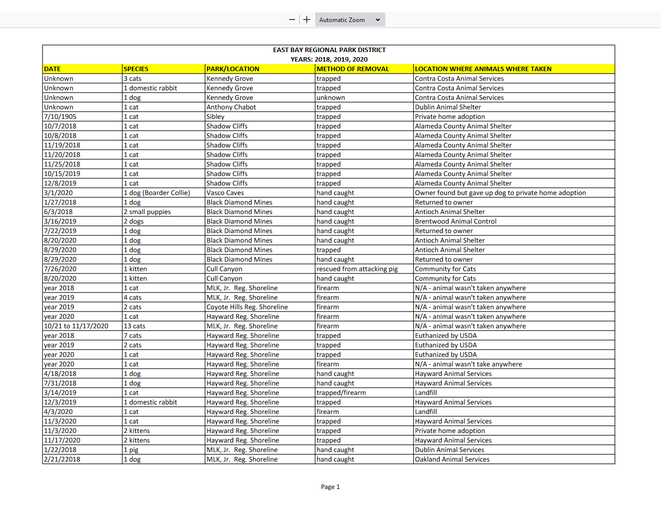
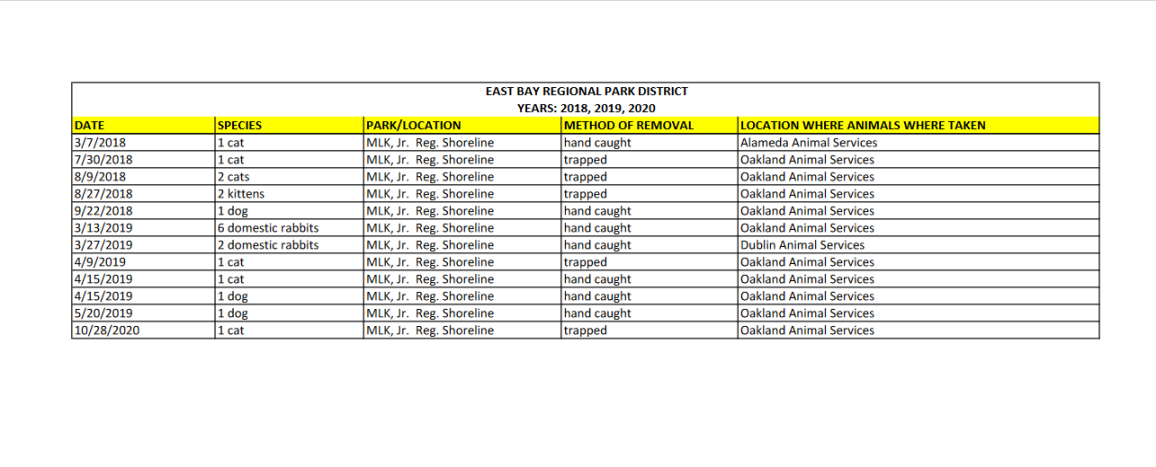
Although Riensche uses coded language in the email, the district’s own records, Riensche’s overtime statements for overnight hours, timestamped audio of dispatch calls and EBRPD’s own timeline of the cat killings all line up with the date of Riensche’s email and a spreadsheet documenting when and where Riensche shot the colony cats.
David “Doc Quack” Riensche is a wildlife biologist with the East Bay Regional Park District. Credit: EBRPD
Tiffany Ashbaker, a volunteer with Alameda’s Island Cat Resource and Adoption, said she was horrified when she read Riensche’s email describing the dead cats as “party favors.”
“I was disgusted. Way beyond hurt,” said Ashbaker, who helped Theis trap, neuter, vaccinate and relocate the Oakland colony cats. “I find this to be unethical and he should be removed from his position at EBRPD because of it. I understand why we should try to have cats further away from the protected areas, but how they handled this was eye opening for sure.”
The cats lived between two auto dealerships in an industrial area separate from the MLK Jr. Regional Shoreline, a park in Oakland managed by the EBRPD. When Theis returned to the area to feed the cats on Nov. 3 2020, she realized several were missing. Over the following days more cats began to disappear, Theis and Ashbaker noted.
When Theis asked EBRPD about the whereabouts of the colony cats, a district staffer told her EBRPD wasn’t involved and didn’t remove any cats. EBRPD then amended its response, saying it had trapped the cats and brought them to local shelters.
But none of the local shelters had any records of taking cats from EBRPD, nor did they have the missing cats in their care.
EBRPD admits its biologist killed colony cats
Theis went to KGO, a local ABC News affiliate, and when a reporter began asking questions about the missing cats, a spokesman for the district finally admitted one of its employees — later identified in documents as Riensche — had shot the cats as part of the “predator management program.”
Theis said she felt “a horrible feeling in my gut” when she realized why the usually friendly strays and former pets of the colony were suddenly skittish. Riensche shot the colony cats over a series of nights, returning to the park in the late hours with a shotgun to kill two or three at a time.
Theis said she now understands why the remaining cats were so fearful and skittish when she came by for their regular feedings. One cat named Sherbert jumped on her car hood, and two others meowed insistently at Theis, “trying to tell me.”
“I feel this horrific feeling that they went through terror and were trying to tell me,” Their said. “They weren’t eating like they did usually.”
Some EBRPD board members have expressed sympathy for what happened, Theis said, but she described being “depressed” and worried because the district won’t give her any guarantees that it won’t kill more cats.
“We feel horrible about this, you know, this is really one thing that’s just really sad,” Matt Graul, the EBRPD’s chief of stewardship, told KGO in December, after the public first learned the cats had been shot.
Despite that, EBRPD ignored public records requests from the TV news station, and a spokesman for the district defended the cat culling, saying it was necessary to protect endangered birds who winter in the nearby marshlands.
Stray and feral cats “are not part of a healthy eco-system” EBRPD spokesman Dave Mason said, claiming his agency was protecting endangered wildlife in the area.
Public and animal rights groups demand an end to cat killing practice
After intense public backlash, including a petition with 70,000 signatures protesting EBRPD’s actions, several district board members were quoted in media reports saying they would end the practice of killing cats and would demand an investigation. Almost five months later, the district is instead moving ahead with a plan to contract cat-killing (and the culling of other animals like foxes and opossums) to a federal agency, and there has been no investigation.
Ashbaker, Theis, the non-profits In Defense of Animals and Alley Cat Allies, and local shelters have all demanded EBRPD stop killing animals entirely. District officials continue to argue it’s necessary to protect endangered birds, despite a lack of scientific evidence supporting the idea that arbitrarily shooting animals has any measurable impact on bird populations.
EBRPD has made one concession: It’s promised to reach out to rescues and shelters in the area for help removing cats before making the decision to deal with them lethally.
“While we’re pleased that the policy seems to be to work with local advocates as to prefer not to killing cats, we want to see a pledge that this never happens, ever again,” Fleur Dawes of In Defense of Animals said in February.
The district “should have been up front from the beginning, saying ‘This wasn’t what should have happened, [so] let’s make it right,'” Ashbaker said.
EBRPD has been unable to provide proof that the cats were killing birds on the marsh or that Riensche shot the cats on district property.
In response to a public records request for any documentation of cats preying on birds in the marshlands, EBRPD produced a single document from 1992, noting one incident with one cat about 35 miles south of the MLK Jr. Regional Shoreline where Riensche shot 13 cats in late 2020. During a survey some time before 1992, an EBRPD employee saw an example of “[California Clapper] rail predation” by “what we determined was a feral cat, in a marsh in the East Palo Alto area,” where it says “many cats are found.” The document mentions another cat that was sighted swimming “in flooded tidal salt marshes” in south San Francisco Bay, likely “foraging” for an endangered mouse species.
The district has not been able to produce any written guidelines or protocols describing how its employees determine if a cat should be shot instead of being relocated or brought to a local shelter, except for a vague summary of minutes from a 1998 meeting during which they claim the policy was approved.
EBRPD has been unable to produce copies of the cat-killing policy itself, despite several public records requests seeking that document.
In addition, in internal emails after a KGO reporter began asking questions about the cat killings, several EBRPD staffers questioned whether they have any documentation saying cat culling is an acceptable policy.
EBRPD internal discussion: Are we following our own rules?
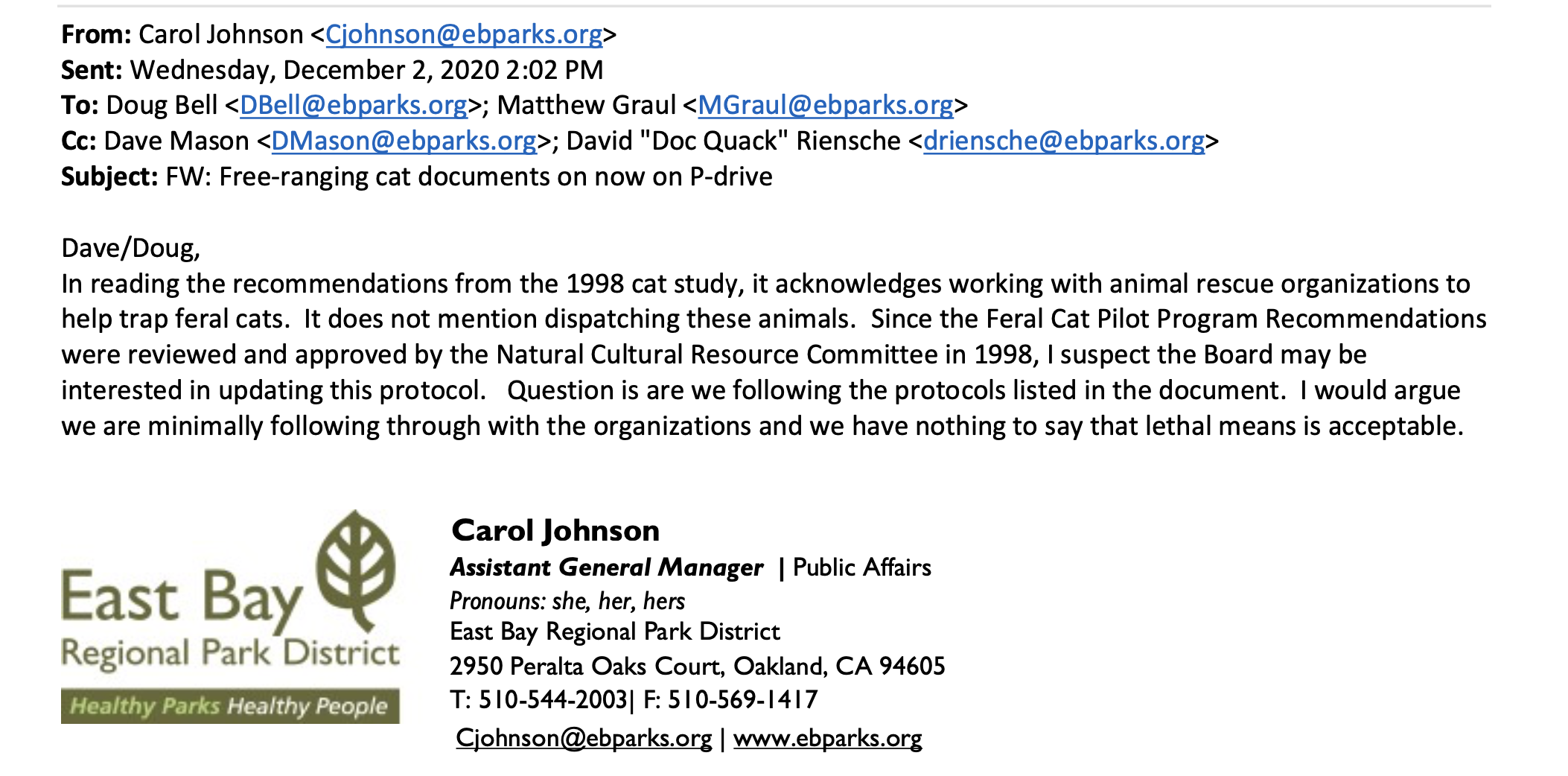
In those same internal emails, which were obtained from EBRPD via public records requests, staffers wondered if the district was following its own rules requiring it to reach out to local shelter networks and receive approval from federal authorities to kill cats. One EBRPD official, assistant general manager of public affairs Carol Johnson, noted the document EBRPD used as justification “does not mention dispatching these animals,” and requires the district to “work with animal rescue organizations to help trap feral cats.”
“[The] question is, are we following the protocols listed in the document?” Johnson asked her colleagues in a Dec. 2 email. “I would argue we are minimally following through with the organizations and we have nothing to say lethal means is acceptable.”
After telling local media that an old and little-known policy allowed the district to cull cats, EBRPD staffers could not locate a copy of the policy.
Internal correspondence among EBRPD staff, obtained via a public records request, show worried staffers searched in vain for a written policy on killing cats before using a Google search to find another agency’s policy.
EBRPD finally produced a copy of minutes from a 1998 meeting with notes attached saying the cat-culling policy had been approved by the board, but if a copy of the policy exists, the district has been unable to produce it.
In December Mason said cats were only shot as a last resort and “[L]ethal removal only happens when feral cats are in the act of hunting wildlife on District property,” but none of the documents say the cats Riensche shot were hunting. Indeed, it would require an extraordinary stroke of luck for the biologist to find 13 cats preying on endangered birds in just a few nights.
Despite public records requests, the EBRPD was unable to provide proof that Riensche had consulted anyone before shooting the cats. Records indicate no one was notified until after Riensche killed the animals.
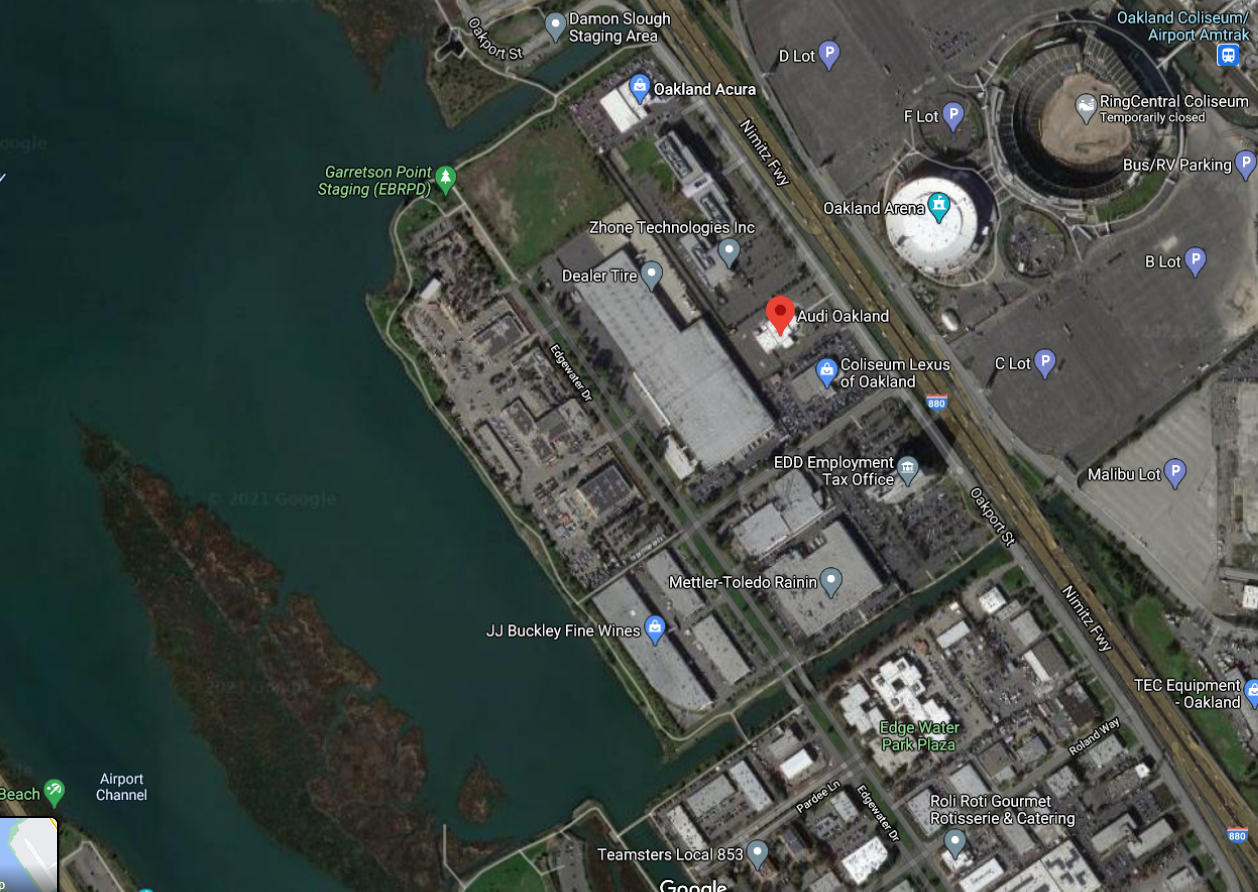
The stray cats lived between Audi Oakland and Coliseum Lexus of Oakland. Credit: Google Maps
In addition, the cat colony sat some distance from the protected marshland: An office park, electric car charging station, at least three parking lots and a substantial body of water are between the cat colony’s home and the marshland. That’s a distance considerably longer than most stray and feral cats range from their homes, and domestic cats are notoriously averse to water or getting themselves wet.
Records line up with cat shootings
While Riensche uses coded language by referring to the cats he shot as “party favors” in his email to colleagues, it was sent on Nov. 18, the day after EBRPD’s own records show he killed the last of the colony cats. Internal documents from the EBRPD, obtained through public records requests, as well as the district’s own public timeline of events, show the dates the cats were killed line up with Riensche’s email. In addition, in audio recordings of his radio contact, Riensche advises dispatchers only after he’s fired the killing shots.
“Yeah this is Dave Riensche in wildlife at MLK, I just dispatched an animal down here, so if you get a call, it was me,” Riensche tells a dispatcher in one of the calls on Nov. 13 at 6:24 a.m.
EBRPD’s records show the only animals killed on that day were cats.
(Click the embedded audio to hear Riensche call dispatch on Nov. 13, 2020.)
Finally, according to EBRPD’s records, Riensche received overtime for working on nights that correspond to the same dates EBRPD says the cats were shot. [EBRPD document: TIMECARDS (REDACTED)]
Riensche, who has been employed as a biologist with the district for decades, is a prominent birder whose work involves protecting birds and other endangered species from predators wild and domestic. He penned a newsletter, Bird News, in the early aughts and is on record saying there’s “a wealth of evidence” that stray and feral cats are the primary danger to bird populations.
Shooting cats as a ‘first resort’
Riensche earned $182,951 in salary and benefits in 2019, the most recent year for which salary data is available for public employees in California. Riensche earned a base salary of $90,239 and $56,050 in overtime, including for overnight hours spent shooting animals in EBRPD’s parks.
An Oakland woman who wrote to the EBRPD after the district came clean about the cat killings related an anecdote about Riensche from 2019.
The woman worked with a local rescue that received a call from a parks employee who wanted help trapping and relocating a female cat and her young kittens who were living on or near an EBRPD park. The rescue volunteers were working with the EBRPD employee, making plans for the cat and her babies to be vaccinated and spayed/neutered, and even had homes lined up for some of the kittens, the woman wrote in a Nov. 25 email.
After visitors to the park saw the mother carrying a dead rabbit back to her kittens, “Doc Quack [Riensche] then reportedly told employees he was going to shoot the cats,” the volunteer wrote.
The mother cat “disappeared” and her fate was unknown, but the rescue was able to work with the EBRPD employees to get the kittens trapped. However, Riensche wasn’t happy with that outcome, she wrote.
“I was told later by an employee, that they were reprimanded for saving the cats and going outside of the EB Parks, to get this help,” the woman wrote in her letter to EBRPD. “Apparently, they should have just been quiet and let Doc Quack shoot the cat family.”
The connection between birders and cat killing
Cat killing isn’t unusual among birders. In 2007 a Texas man named James M. Stevenson — founder of the Galveston Ornithological Society — admitted killing dozens of cats on private and public property after coming to believe the cats were killing piping plovers, shorebirds who commonly nested in the area.
In a 1999 posting on an Internet bulletin board for bird lovers, Stevenson nonchalantly described killing many feral cats during his first year living on Galveston Island. He rationalized his acts as a way to restore the natural order.
“I’m sorry if this offends — but I sighted in my .22 rifle, and killed about two dozen cats,” Stevenson wrote in his message, titled “killer kitties; kittie killers.”
“This man has dedicated his whole life to birds,” Stevenson’s attorney said in his defense. The case ended in a mistrial.
Nico Arcilla, then known as Nico Dauphiné, was well known as a birder and outspoken critic of cats. A group of people who cared for strays near Washington’s Meridian Hill Park contacted the Humane Society after noticing food they left out for the cats “would sometimes become covered by a white powdery substance overnight.”
After the Humane Society and Washington police tested the substance and verified it was poison, they set up a stakeout and had cameras trained on the food bowls. Footage, which prosecutors later exhibited on trial, was damning:
“Dauphiné [Arcilla] can be seen approaching the bowl, pulling something out of a small bag, reaching down toward the food twice, and then leaving the scene,” a sciencemag.org report reads. “The next morning, police found the food covered with the same white powder as before, which tested positive as poison.”
[Click here to see video of Arcilla poisoning the cat food.]
Arcilla wasn’t just a prominent birder and anti-cat campaigner — she is a co-author of several frequently-cited studies claiming cats kill billions of birds in the US each year. Those studies, which have been used to justify cat-culling policies around the world, are highly controversial, with critics blasting them for poor methodology, a lack of hard data, and arbitrary numbers plugged in to estimate both the national cat population and the felines’ impact on birds. For example, the authors estimate a national stray and feral cat population between 25 and 125 million, an estimate so vague that any extrapolations based on those numbers are virtually useless.
Riensche has repeatedly cited Arcilla’s work in public and private documents arguing that cats are primarily responsible for declines in bird populations.





 Pain In The Bud